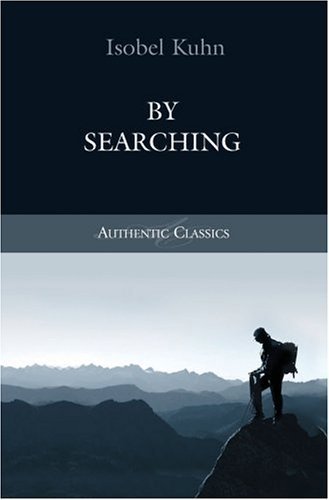
This is a short book about one girl's journey from her parent's faith to doubt and back to faith. Isobel loses her faith when she is faced by a skeptical professor in college who sneeringly asks if anyone in the class actually believes the silly myths in the Bible. The question leads her to eventually abandon her faith, much to the chagrin of her parents. She calls this time living in The Misty Flats. Her analysis of the Misty Flats (as her writing over all) is quite perceptive. She writes:
"It was a popular thing to be on The Misty Flats: you had plenty of company. And one was respected as being modern and intelligent to question the old faiths. Life drifted along so pleasantly—for a while."
For a while indeed. She discovers that The Misty Flats are not as fulfilling as it would first seem:
"Therefore The Misty Flats are attractive to foot, eye, and palate at the beginning. There is no hint that the pretty mist will gradually close in and bring darkness...And above all, there is never a hint that the end of The Flats is the visitation of the Lord and the judgment of sin. Yet all that is the real truth."
And so it is. Isobel eventually begins to feel the pull of God as he unrelentingly pursues her, despite her lack of interest in spiritual things. It takes awhile because she is a little stubborn, but eventually is drawn back to true faith and commitment to God. She writes of God:
"God is not a puppet. Man may not pull strings and expect Him to perform—not even doctrinally correct strings, such as Balaam tried to pull. God is not man’s servant, that a puny atheist may shout a challenge and He is bound to respond. Neither is God a genie, that if man is lucky enough to find the right combination of words, He will suddenly pop out and reveal Himself. God is our Creator, all powerful and dwelling in light unapproachable. He demands reverence. But He is also willing to be Father to such as come to Him by His ordained road, Jesus Christ, and as a Father He tenderly stoops to the immaturity of the babe in Christ."
Mrs. Kuhn has an understated analytical style of writing that reads quite contemporarily despite the fact that this book was written almost 70 years ago. She writes about an acquaintance who did not believe in spanking children and comments:
"Mrs. McMillan was a thinker, but, inbred with theosophy, had fallen in with the idea that it was wrong to spank a child. I have wondered if this was not the reason her children did more as they liked than as she liked."
Here is another example as she describes her initial attempts at being a third-grade teacher. She loves the "little cherubs," but discovers that she loves them too much:
"Needless to say, I had discipline problems! The little cherubs soon found out that their teacher was a softy and she was given daily samples of what unexpectedly naughty things a cherub can think up—even without ever losing his angelic smile!"
Mrs. Kuhn recounts her final surrender to Christ in part this way. Her host, Mrs. Whipple (at a Christian conference) senses that she is at a spiritual turning point. She sends Isobel off to wait for her but then delays coming for awhile. Mrs. Kuhn writes:
"I did not learn until many years later why she delayed in coming. But she ran for prayer help."
She finds her teenage daughter with two of her friends and tells them:
"“Isobel has come to a crisis in her life! Pray her through while I go upstairs and deal with her.” So down on their knees they went in prayer."
All three of these girls who prayed for her in that moment would end up in missionary service. Isobel herself finally surrenders fully to God and begins to pursue him in earnest. She ends up going to Moody Bible Institute for 2.5 years. Her story of how God provided for her there is quite riveting and filled with God very obviously providing for her again and again. It's at Moody that she meets the man who will eventually become her husband, John Kuhn. Both she and John had come to Moody swearing that they would not get involved with the opposite sex because they wanted to concentrate on their studies. Shortly after she arrives, she sees him washing dishes. She writes of that first glance:
"It was one of those shock-encounters when you find yourself already over the threshold and into the other fellow’s soul before there is time to knock for admission."
She actually avoids him for quite a long time, but God has his plan and his plan was to get the two together.
Another good example of her perceptive, direct analytical ability in writing is this description of God's "normal" work in our "normal" lives:
"Life does contain moments of adventure, but these times are interspersed with long periods of plain, unvarnished hard work. The real things of life are attained at these monotonous level periods, so to speak, more than they are at the high peaks of excitement."
Every Moody student had to do some kind of gospel work each semester and she and another girl are assigned to work at a Sunday school in a "liberal" church. The first time they meet the minister he chides them for believing so much in the Bible. They set to work in the Sunday school of this church and pretty soon the little children are coming to faith right under the nose of this minister! The pastor is remarkably honest about his experience with liberalism:
"“You know, girls, I used to believe like you do. In fact, you may be surprised to learn that I am a Bible school graduate myself. But after graduation I went into a seminary and there learned that no one nowadays believes in that old-fashioned stuff. I lost my ‘faith,’ as you call it, at seminary. But somehow our liberalism does not energize people like your teaching seems to, so when I found out how dead the work is here, I asked for a couple of Moody students to be sent us, to stir up interest in the neighborhood. You bring them in, and we’ll mold them into a good community!”
The two girls begin to pray for the minister and, remarkably enough, he eventually comes back to faith! Again the pastor is frank and honest:
"“I am calling on you girls to tell you that the Lord has answered your prayers for me,” he said. “I have come back to Him. It has been a bitter fight, as you doubtless have watched and seen. Pride refused to be crucified for a long time. But week by week it became more evident to me that the Word you girls preached was the power of God unto salvation. Lives were changed through your ministry; my honesty had to admit it. Nobody was changed through mine."
An amazing encounter.
There is much more here, answered prayer after answered prayer, God moving in and through her life in unexpected ways, sadness and death, successful ministry. One of my favorite parts of the book is the friendship she strikes up with a girl named Ruth, who had lost her faith just as she herself had at one time. I will leave the story to your own reading of the book.
She summarizes what she has learned about God in this way:
"Up to this point I have discovered that God is, and that He is mine by the mediatorship of Christ. I have discovered that He can and will teach me His way, or His plan for my life. I have found that He can overcome obstacles and that we do not need to arouse a great hullabaloo to get Him to do so. Hudson Taylor was right in his discovery: “Learn to move man, through God, by prayer alone.” By searching I have discovered that God has strange and sweet ways of manifesting Himself, at sundry times and in divers manners He is still speaking."
The book ends as she is on a steamer leaving Canada for China, where her future husband, John Kuhn awaits.
I can't communicate how much I loved this little book. Read it for yourself and find out.