

What do you think?

Apocalypse: A History of the End of Time
The ancient Egyptians would have known it as the sixth day of Pachon. The Mayans named it 4 Ahau 3 Kankin. To us it is 21 December, 2012. On this day, it is said, the world will come to an end. This is not the first time we've been told that our time is up. And - touch wood - it probably won't be the last. Religious and secular, past and present - Apocalypse covers each and every one of our prophesized featuring asteroids, Antichrists, solar flares, Singularities, Utopias, UFOs, Zoroastrians and Zapotecs, to mention but a small few. The result is a thorough history of one the most fascinating threads of our cultural spanning from the first warnings of our ancient ancestors, to the contemporary (yet equally glum) forecasts for our future.
229 pages, Paperback
First published April 1, 2012
About the author
John Michael Greer
188 books537 followersJohn Michael Greer is an author of over thirty books and the blogger behind The Archdruid Report. He served as Grand Archdruid of the Ancient Order of Druids in America. His work addresses a range of subjects, including climate change, peak oil, the future of industrial society, and the occult. He also writes science fiction and fantasy. He lives in Rhode Island with his wife.
Ratings & Reviews
Friends & Following
Create a free account to discover what your friends think of this book!
Community Reviews
Displaying 1 - 27 of 27 reviews

August 13, 2021
December 21st 2012 was a commonly known date for the end of the world. According to ancient Mayan prophecy, this was the day of the apocalypse, the end of days, the rising of the fires from hell, the last day of man, ......... well, yeah you get the point. BUT you're reading this now, in 2021 so obviously, it was wrong, but then some say it was a miscalculation and it is now to be 2045?
Remember the turn of the century? ATMs were going to spit money out haphazardly, cars would stop, computers would not be able to cope and shut down all of the Earth's essentials like water supplies and electricity grids and ......... we all woke up New Year's day 2000 and found it all was business as usual. Some said it was because officially the end of the millennium was 31/12/2000 ......... and so we all woke up New Year's day 2001 and guess what? Business as usual.
As long as man has put word on paper or passed knowledge word of mouth our planet has been doomed by the coming apocalypse. Be they crackpots, religious organizations, ancient civilizations, or the trusted ones, many have declared the time and date of the event and all have been wrong. The Mayans, The Jews, The Roman Empire, Nostrodamus, The Egyptians, Zarathrusta, and many others all read the prophecies. The second coming of Christ, Y2K, 21/12/2012, the return of Quetzalcoatl, Nostradamus' predictions, the uprising of the Antichrist, and the alignment of moons and planets were all supposed to end this world.
There would be fires, tsunamis, droughts, plagues, earthquakes, and volcanic eruptions bigger than any Hollywood Blockbuster. Invasions from aliens, massive rocks impacting the Earth, whichever way it was to go down we were toast - LITERALLY. Save me some peanut butter.
Of course, none of these predictions came to fruition but John Michael Greer's book takes a look at many of them from as far back as the Egyptians and Romans. When you get your head around the many names mentioned in the book it is fun, and at times, humorous read. Typically not for those who have no interest in History.
Ironically down through civilizations, we have made these predictions, quivered in fear of the upcoming doom, stood on mountain tops awaiting arrivals, performed mass suicides, or sat by an ATM at midnight hoping for a jackpot but we ignore the obvious. We are the creators of the apocalypse, forget something happening in thousands of years, we're not going to make it. We are killing the planet, we are killing ourselves, the difference is this apocalypse will happen over decades not overnight.
Remember the turn of the century? ATMs were going to spit money out haphazardly, cars would stop, computers would not be able to cope and shut down all of the Earth's essentials like water supplies and electricity grids and ......... we all woke up New Year's day 2000 and found it all was business as usual. Some said it was because officially the end of the millennium was 31/12/2000 ......... and so we all woke up New Year's day 2001 and guess what? Business as usual.
As long as man has put word on paper or passed knowledge word of mouth our planet has been doomed by the coming apocalypse. Be they crackpots, religious organizations, ancient civilizations, or the trusted ones, many have declared the time and date of the event and all have been wrong. The Mayans, The Jews, The Roman Empire, Nostrodamus, The Egyptians, Zarathrusta, and many others all read the prophecies. The second coming of Christ, Y2K, 21/12/2012, the return of Quetzalcoatl, Nostradamus' predictions, the uprising of the Antichrist, and the alignment of moons and planets were all supposed to end this world.
There would be fires, tsunamis, droughts, plagues, earthquakes, and volcanic eruptions bigger than any Hollywood Blockbuster. Invasions from aliens, massive rocks impacting the Earth, whichever way it was to go down we were toast - LITERALLY. Save me some peanut butter.
Of course, none of these predictions came to fruition but John Michael Greer's book takes a look at many of them from as far back as the Egyptians and Romans. When you get your head around the many names mentioned in the book it is fun, and at times, humorous read. Typically not for those who have no interest in History.
Ironically down through civilizations, we have made these predictions, quivered in fear of the upcoming doom, stood on mountain tops awaiting arrivals, performed mass suicides, or sat by an ATM at midnight hoping for a jackpot but we ignore the obvious. We are the creators of the apocalypse, forget something happening in thousands of years, we're not going to make it. We are killing the planet, we are killing ourselves, the difference is this apocalypse will happen over decades not overnight.

July 9, 2018
Apocalyptic thinking was a persistent background feature of my upbringing. Ideas about the rapture, the 1000 year reign of Jesus on Earth, the reclaiming of the Jewish homeland triggering the end of times, and dozens of others swirled around in the religious teachings I was subjected to in my parents church. I read "The Late Great Planet Earth" with breathless anticipation and sincere belief that all this shit was real. My favorite book of the bible was (and still is) The Book Of Revelation (followed by Ezekiel for similar reasons) due to the wild imagery and bizarre content that of course provides a perfect canvas on which anyone can lay any fucking interpretation they desire. My Father flirted with all kinds of apocalyptic nonsense briefly hording canned and dry goods (this didn't last very long at all), and buying into a scheme to hide gold away in a vault that would be protected from the liberal governmental forces that would try to confiscate all the money. People in the church believed in the mark of the beast, but of course they hotly debated what the actual manifestation was, ranging from credit cards, to enforced forehead tattoos, to social security numbers. Talk of the end of times wasn't constant, but it was always buzzing around in the background, ready to leap out, especially when someone went on a tear about the downfall of society or kids these days.
Therefore this book was a great lot of fun for me. I knew the history was deep but there were so many forms I had never heard before. It seems like people ought to know by now how to avoid falling into the trap of apocalyptic thinking, but human psychology is ever the same. I like how the author covered not only the religious versions, but also secular versions like Kurzweil's proselytizing of the technological singularity. Note that there is nothing wrong with speculating about the idea in the confines of science fiction, the problem lies in adopting it with religious fervor. I also liked how he revealed the ideas of that shit-spewer Terrence McKenna to be deeply apocalyptic in tone, making promises of a new world, one that of course fit all his desires and prejudices. The book is a breeze to read and not very long.
Therefore this book was a great lot of fun for me. I knew the history was deep but there were so many forms I had never heard before. It seems like people ought to know by now how to avoid falling into the trap of apocalyptic thinking, but human psychology is ever the same. I like how the author covered not only the religious versions, but also secular versions like Kurzweil's proselytizing of the technological singularity. Note that there is nothing wrong with speculating about the idea in the confines of science fiction, the problem lies in adopting it with religious fervor. I also liked how he revealed the ideas of that shit-spewer Terrence McKenna to be deeply apocalyptic in tone, making promises of a new world, one that of course fit all his desires and prejudices. The book is a breeze to read and not very long.

November 18, 2016
In just over 200 pages, Greer provides us with a more or less universal history of what he calls the Apocalypse meme. This was first published in 2012, no doubt to counter the then current and virulent version of the meme predicting the end of time and civilisation on Friday 21 December 2012, as anticipated by the ancient Mayans’ calendar. As we know, the end did not come as predicted.
Greer’s intention here is to tell the story of how this meme started, and how it has been used, adapted and reissued over and over again (always with the same “disappointing” outcome) throughout the centuries.
To the best of our knowledge, the meme’s first articulation stems from the teachings of Zoroaster, probably as early as the 12th-c BCE, and incorporated as an essential part of Zoroastrianism. (Remnants of the Zoroastrians are to found in the Parsees of today.) Zoroastrianism taught that there was a good god (Ahura Mazda) and an evil one (Angra Mainyu), and that the battles between these two would rage over great lengths of time until a final, apocalyptic battle would solve the matter in favour of Ahura Mazda. Thus the meme was born… Greer traces its history through time, and the various manifestations of the meme up to and including the present day; and suggests that versions of it will continue to manifest itself in our history into the future, and suggesting that each time it occurs, the same “disappointment” will result.
Greer is more interested in tracing specific events connected with the meme rather than trying to psychoanalyse or philosophise on the matter — possibly because the issue is fraught with the difficulties we associate with all attempts to deal with the problem of good and evil in our lives. For me, the core issues are two: the dissatisfaction with our lives on earth, and a conceptual error in determining “good” and “evil” as separate, independent and all powerful, antagonistic forces. Our dissatisfaction with our lives is a result of the perpetual warring between these two entities. The “hope” implied in the meme lies in the promise that, in the end, the “good” will win over completely, and then we will all be happy and satisfied with everything.
The “obvious” answer lies in the fact that “good” and “evil” are not absolute at all, but relative. Few of us want to accept that. We all “know” what is good, and what is evil, and we base our morality and our ethics by adopting the battle-lines set by the meme so that we insist on fighting for the good, and battling against evil. The irony, of course, is that this approach ensures that the power of the meme is intensified, not mitigated; and that in turn leads to fear, stress, perpetual war, and ultimately, even to despair. It will appear that the only way we might find perfect happiness is only when we are dead!
That last sentence needs to be contextualised as a further example of the meme, especially when it comes to religions which posit that yes, indeed, it is only when you are dead that you might find perfect happiness (provided you follow specific dictates of the particular religion involved… — otherwise, only perpetual horror and damnation await you!). This “spiritual” can also be attributed to Zoroastrianism — albeit a heretical version of it perpetrated by the Zoroastrian monk Mani, who taught that only “spirit” was absolutely good, and that all matter was, by definition, absolutely evil. This Manichaean interpretation, while “officially” condemned, has been absorbed by all religious groups, cults and sects, and can even be identified in secular, cultural, social, economic, ideological and political organisations, but manifested in myriad ways peculiar to each. They are all trapped within the same fallacious meme.
The above are but some of the thoughts that can be explored in dealing with this subject. They are not necessarily included in Greer’s work, but they can be extrapolated from it to a certain extent.
Greer’s book is a good, basic history which should be read by all. It is written in a very accessible, readable style, so it does not require much effort on the part of the reader. Its basic information should, by now, have been absorbed by everyone. Unfortunately, the reality is that, especially in a world where religion, superstition and so-called spiritual cult beliefs are apparently on the rise, people will still be primed to accept the next false prophet at face value, and so the meme will persist. (At the end of the book, Greer — in keeping with his avowed interests — argues that the Apocalypse meme has no place in an “authentic spirituality”. Personally, I think the problem here is in the word “spirituality” (authentic or not), as it carries too much cultural baggage to be of any real value any more.)
Hopefully, this book will assist in defusing the power and potential negative influences of the meme in all its manifestations, so that it can be safely ensconced in history and no longer emerge to fool and frighten us ever again.
Greer’s intention here is to tell the story of how this meme started, and how it has been used, adapted and reissued over and over again (always with the same “disappointing” outcome) throughout the centuries.
To the best of our knowledge, the meme’s first articulation stems from the teachings of Zoroaster, probably as early as the 12th-c BCE, and incorporated as an essential part of Zoroastrianism. (Remnants of the Zoroastrians are to found in the Parsees of today.) Zoroastrianism taught that there was a good god (Ahura Mazda) and an evil one (Angra Mainyu), and that the battles between these two would rage over great lengths of time until a final, apocalyptic battle would solve the matter in favour of Ahura Mazda. Thus the meme was born… Greer traces its history through time, and the various manifestations of the meme up to and including the present day; and suggests that versions of it will continue to manifest itself in our history into the future, and suggesting that each time it occurs, the same “disappointment” will result.
Greer is more interested in tracing specific events connected with the meme rather than trying to psychoanalyse or philosophise on the matter — possibly because the issue is fraught with the difficulties we associate with all attempts to deal with the problem of good and evil in our lives. For me, the core issues are two: the dissatisfaction with our lives on earth, and a conceptual error in determining “good” and “evil” as separate, independent and all powerful, antagonistic forces. Our dissatisfaction with our lives is a result of the perpetual warring between these two entities. The “hope” implied in the meme lies in the promise that, in the end, the “good” will win over completely, and then we will all be happy and satisfied with everything.
The “obvious” answer lies in the fact that “good” and “evil” are not absolute at all, but relative. Few of us want to accept that. We all “know” what is good, and what is evil, and we base our morality and our ethics by adopting the battle-lines set by the meme so that we insist on fighting for the good, and battling against evil. The irony, of course, is that this approach ensures that the power of the meme is intensified, not mitigated; and that in turn leads to fear, stress, perpetual war, and ultimately, even to despair. It will appear that the only way we might find perfect happiness is only when we are dead!
That last sentence needs to be contextualised as a further example of the meme, especially when it comes to religions which posit that yes, indeed, it is only when you are dead that you might find perfect happiness (provided you follow specific dictates of the particular religion involved… — otherwise, only perpetual horror and damnation await you!). This “spiritual” can also be attributed to Zoroastrianism — albeit a heretical version of it perpetrated by the Zoroastrian monk Mani, who taught that only “spirit” was absolutely good, and that all matter was, by definition, absolutely evil. This Manichaean interpretation, while “officially” condemned, has been absorbed by all religious groups, cults and sects, and can even be identified in secular, cultural, social, economic, ideological and political organisations, but manifested in myriad ways peculiar to each. They are all trapped within the same fallacious meme.
The above are but some of the thoughts that can be explored in dealing with this subject. They are not necessarily included in Greer’s work, but they can be extrapolated from it to a certain extent.
Greer’s book is a good, basic history which should be read by all. It is written in a very accessible, readable style, so it does not require much effort on the part of the reader. Its basic information should, by now, have been absorbed by everyone. Unfortunately, the reality is that, especially in a world where religion, superstition and so-called spiritual cult beliefs are apparently on the rise, people will still be primed to accept the next false prophet at face value, and so the meme will persist. (At the end of the book, Greer — in keeping with his avowed interests — argues that the Apocalypse meme has no place in an “authentic spirituality”. Personally, I think the problem here is in the word “spirituality” (authentic or not), as it carries too much cultural baggage to be of any real value any more.)
Hopefully, this book will assist in defusing the power and potential negative influences of the meme in all its manifestations, so that it can be safely ensconced in history and no longer emerge to fool and frighten us ever again.

May 18, 2017
An entertaining book that rounds up the ever-evolving but ever-persistent belief of the millennia in what the author dubs "the apocalypse meme": the idea that the world as we know it will shortly end.
Greer moves from ancient Zoroastrians and Jews to medieval Christians and Muslims to modern-day cults, identifying the varying beliefs about when and how doomsday will come. Much of this belief is religious, but he also touches on secular doomsday predictions, such as those made by Marxists and modern environmentalists. (The book came out in 2012 and is pegged to the weird belief in the Mayan doomsday, but is still highly readable well after.)
On occasions when Greer ventures beyond just codifying apocalyptic beliefs to describing broader socioeconomic conditions, the book sometimes falters into oversimplification. But these are rare enough and not the point of the book, which addresses its core subject in a fun, accessible style.
Though the author is rarely didactic, his broader point is unmistakable: when you compile hundreds of pages about all the times people incorrectly believed the world would shortly end, it's hard to resist skepticism about the very idea of an imminent apocalypse.
Greer moves from ancient Zoroastrians and Jews to medieval Christians and Muslims to modern-day cults, identifying the varying beliefs about when and how doomsday will come. Much of this belief is religious, but he also touches on secular doomsday predictions, such as those made by Marxists and modern environmentalists. (The book came out in 2012 and is pegged to the weird belief in the Mayan doomsday, but is still highly readable well after.)
On occasions when Greer ventures beyond just codifying apocalyptic beliefs to describing broader socioeconomic conditions, the book sometimes falters into oversimplification. But these are rare enough and not the point of the book, which addresses its core subject in a fun, accessible style.
Though the author is rarely didactic, his broader point is unmistakable: when you compile hundreds of pages about all the times people incorrectly believed the world would shortly end, it's hard to resist skepticism about the very idea of an imminent apocalypse.

January 4, 2015
A fascinating and engaging book that is just as much a targeted history of religious and social movements as a book specifically about "the apocalypse meme," which Greer pinpoints as starting 3000 years ago with Mithras and Zoroastrianism and persisting right up to the present--just in case you're wondering, the next one to look out for, now that the whole Mayan thing didn't pan out, should arrive by 2045, when Kurzweil's Singularity is due. I especially like that the author explores apocalyptic beliefs in a large context, one that occurs and reoccurs in both religious and secular belief systems throughout recorded history. This is one of those books that turns out to be just packed with all kinds of interesting stuff -- the origins of fundamentalism, Seventh-Day Adventists and the Harmonic Convergence, for example, or why Sunni and Shi'ite Muslims don't get along, or why the medieval Celts awaited the return of King Arthur.
Greer devotes several pages early on to the term "meme" (something I've often wondered about because I see it used practically everywhere lately.) The word was first termed in 1975 by evolutionary biologist Richard Dawkins; Greer defines meme as "a label for ideas that replicate in human society the way that genes replicate in a population of living things." I'm still wrapping my mind around this, wondering if the ancient alchemical Theory of Correspondences was correct after all.
Anyway, I love a writer who defines his terms, states his premise, and then just runs with it and has a good time in the process. An excellent book!
Greer devotes several pages early on to the term "meme" (something I've often wondered about because I see it used practically everywhere lately.) The word was first termed in 1975 by evolutionary biologist Richard Dawkins; Greer defines meme as "a label for ideas that replicate in human society the way that genes replicate in a population of living things." I'm still wrapping my mind around this, wondering if the ancient alchemical Theory of Correspondences was correct after all.
Anyway, I love a writer who defines his terms, states his premise, and then just runs with it and has a good time in the process. An excellent book!

March 3, 2013
This was a cracking short book explaining the almost ever present idea of an impending Apocalypse that has haunted mankind’s thoughts. Apparently it was all the fault of Zarathustra, the prophet of Zoroastrianism, who in a vision saw that there were not many Gods but one, who was in battle with a foe for truth since the dawn of time and that the victory was due soon in an Apocalypse, but that only true believers would get to enjoy eternal bliss and an end to suffering.
This seemed such a good idea that it has been with us ever since, constantly re-imagined for each new era. The author takes us through the development of this idea through various historical epochs, including the fall of Israel and the Jewish diaspora, its willing adoption by the Christians who turbo charged the idea with the Book of Revelation until the Reformation and the 30 Years War in Europe gave an idea glorious rebirth and new beginning a bad name. The idea then changed from religious to the secular (take a bow Communism) and carried on with great verve until the Americans bought it back to the religious again and the idea has become all pervading.
Everything is going to end soon so why bother, only the true will be saved, and then everything will be much better than before.
What makes this book so much fun is the erudition of the idea and the romp so through so many well-known and obscure but fascinating periods of history. The Taborites any one?
This seemed such a good idea that it has been with us ever since, constantly re-imagined for each new era. The author takes us through the development of this idea through various historical epochs, including the fall of Israel and the Jewish diaspora, its willing adoption by the Christians who turbo charged the idea with the Book of Revelation until the Reformation and the 30 Years War in Europe gave an idea glorious rebirth and new beginning a bad name. The idea then changed from religious to the secular (take a bow Communism) and carried on with great verve until the Americans bought it back to the religious again and the idea has become all pervading.
Everything is going to end soon so why bother, only the true will be saved, and then everything will be much better than before.
What makes this book so much fun is the erudition of the idea and the romp so through so many well-known and obscure but fascinating periods of history. The Taborites any one?

October 4, 2014
სამი ათას წელიწადზე მეტია, ადამიანები არწმუნებენ საკუთარ თავს, რომ მათი სამყარო გლობალური ტრანსფორმაციის ბეწვის ხიდზე ქანაობს, რომ მათი მტრები სადაცაა განადგურდებიან და სანუკვარი იმედები აღსრულდება, გრანდიოზული მოვლენით რომელიც თვით რეალობის ბუნებას შეცვლის. სამი ათას წელიწადზე მეტია ისინი სუნთქვა შეკრული ელოდებიან უდიდესი მოვლენის მანიფესტაციას. მას შემდეგ რაც ზოროასტრიზმის დამაარსებელმა ზარატუსტრამ შექმნა აპოკალიპტური ნარატივი, ეს მიმი ვირუსივით გავცელდა და მას შემდეგ კაცობრიობა პერმანენტულად ხდება სხვადასხვა ილუზიის, იმედის და შიშის მსხვერპლი. ჩნდება წინასწარმეტყველება, ნიშნები, მოლოდინი, მერე კი როცა დანიშნულ თარიღზე არც იესო ჩამოდის ციდან და არც დაპირებული სამოთხე, იმის მაგივარდ რომ ყველაფერი დავიწყებას მიეცეს. რამდენიმე წელიწადში ისევ თავიდან იწყება.საინტერესოა აპოკალიტური მიმის ისტორია და სახე ძველ რელიგიებში, ქრისტიანობაში და ახალი ეპოქის მისტიციზმის წიაღში. ასევე სეკულარულ და ფსევდომეცნიერულ ტყავში.
საინტერესო და კარგად დაწერილი წიგნია. გულდასაწყვეტია რომ ასე მოკლეა.
საინტერესო და კარგად დაწერილი წიგნია. გულდასაწყვეტია რომ ასე მოკლეა.

July 29, 2017
The concept is great, which is why I picked it up. I love the idea that people have, throughout all of history, fallen into the apocalypse meme. And while I know this book is a history, I guess I didn't expect it to be such a "history." Some people will love it for the names, dates, and places. I am not one of them. I struggled to get through most of it as I felt like I was sitting in on a(n admittedly more interesting than mine actually was) history class. And that's just not my type of book. That said, there were several parts, especially in chapters six and seven, that I was able to get into. I learnt plenty. I'm happy I picked it up and powered all the way through. (Kind of.) I don't feel like I learnt as much as I could have, and I definitely won't remember the majority of it.

June 19, 2013
A much more in-depth look at this phenomenon than I thought it would be, but still a very enjoyable read. It was really interesting to learn about the history behind the apocalypse, and how certain ideas keep being recycled over the centuries. However, the Y2K hysteria seemed to be slightly glossed over; I would have liked more depth here. An updated version including post-2012 and and other recent events would be very be fascinating to read!

September 5, 2012
A great analysis into the apocalypse meme and particularly great as it includes new age nonsense and secular utopian fantasies like marxism and international neoliberalism in its review of illogical movements bound for disappointment. The kind of book many more people should read.
November 20, 2016
As so often with books like these, the desire to write a fast-paced, entertaining and informal overview falls well short of the possibilities offered by the topic.
The structure is efficient, taking ur-myths through their development in Catholicism, Protestantism, a detour through America before ending up with secular, so-called New Age ones. The last chapter attempts to wrap it all up in a pseudo-psychological explanation.
All well and good, but the very concept of apocalypse in shaping societies, or policies, is not dealt with, nor are similar myths around the globe tackled (except for China, with a political rather than ideological approach). A link to Levi-Strauss, to Mircea Eliade, would have been helpful in trying to make sense of the phenomenon on a more conceptual, cultural-historical way.
As it is, this book is a breezy run through forms of apocalypse which, despite the annoying matey style, does offer some interesting tit-bits, but no more.
The structure is efficient, taking ur-myths through their development in Catholicism, Protestantism, a detour through America before ending up with secular, so-called New Age ones. The last chapter attempts to wrap it all up in a pseudo-psychological explanation.
All well and good, but the very concept of apocalypse in shaping societies, or policies, is not dealt with, nor are similar myths around the globe tackled (except for China, with a political rather than ideological approach). A link to Levi-Strauss, to Mircea Eliade, would have been helpful in trying to make sense of the phenomenon on a more conceptual, cultural-historical way.
As it is, this book is a breezy run through forms of apocalypse which, despite the annoying matey style, does offer some interesting tit-bits, but no more.

January 31, 2019
The only problem with this book is that Greer tries to shove too much info into too small of a book. That aside, it's a well written book that covers a lot of history to discuss the apocalypse meme and to explain why people keep falling for the idea that the end of the world is just around the corner. (Spoiler alert, it's not.)
Greer looks at religious and secular movements alike. And his writing is very engaging and although he does sometimes do a whole nudge, nudge, wink dismissal of some of the beliefs of the people he writes about, I think that it's a bit appropriate. He also discusses why he thinks that some people are so eager to see the end of the world happen without marginalizing those feelings.
The only reason why this book got 3 stars and not 4 is because it did drag in the middle section - again it's a case of too much info in too little space. It got a little overwhelming and it does help to have a general idea of the history of the Middle Ages onward to understand why some of these movements happened.
Greer looks at religious and secular movements alike. And his writing is very engaging and although he does sometimes do a whole nudge, nudge, wink dismissal of some of the beliefs of the people he writes about, I think that it's a bit appropriate. He also discusses why he thinks that some people are so eager to see the end of the world happen without marginalizing those feelings.
The only reason why this book got 3 stars and not 4 is because it did drag in the middle section - again it's a case of too much info in too little space. It got a little overwhelming and it does help to have a general idea of the history of the Middle Ages onward to understand why some of these movements happened.

December 24, 2020
A good read, however, the book covered more a history of religions than the subject of the title. I was hoping for a history of different cultural approaches to the Apocalypse. Mr Greer obviously has done his research and produced a very readable book.(With reservations)

January 5, 2026
Not what I was expecting, this felt a lot more like a (boring) history lesson where information is being thrown at you from all corners and naturally your brain isn’t able to comprehend all these dates & concepts & names. I had to power through to finish this

June 2, 2020
Full of good and well-sourced information, but lacking in the art of tacking it all together. The book remains entertaining and educating, all the same. Enjoyable.

June 6, 2020
A very detailed book about the apocalypse meme.

June 13, 2014
With a twinkle in his jolly old Archdruid eye, JMG set out to make an easy buck off the 2012 apocalypse by writing a book on how the 2012 apocalypse is hooey. This book presents a breezy history of the very idea of the apocalypse, of the notion that at some point (usually quite soon) the world and history would end, once and for all.
While I didn't seriously believe Terence McKenna's TimeWave Zero prediction about the end of time in 2012, I'd known about this obscure prophecy for decades before it became a pop cultural meme. Looking forward to 2012 provided me some comfort in the wake of the Y2K and millennial nonevents and the all-too-real events of 9/11/2001. I say comfort because I was raised in a home with a father who was exploring the apocalyptic fringes of Pentacostal Christianity, and so there has always been a part of me that expects the world to end right fucking now.
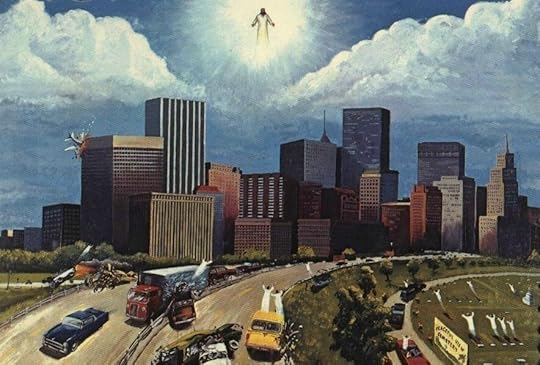
This image hung in my dad's workshop. It depicts the Rapture.
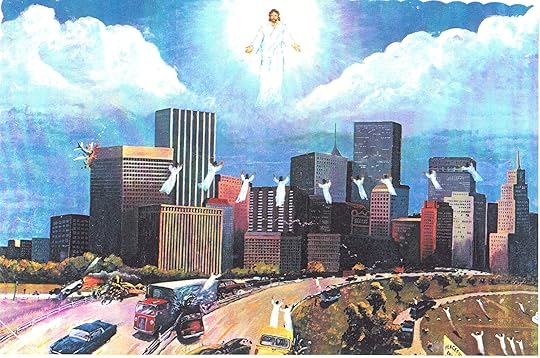
This is like the Episode 1 version of the previous picture, with a new and improved Jesus and 25% more resurrected Christians in glorified bodies.
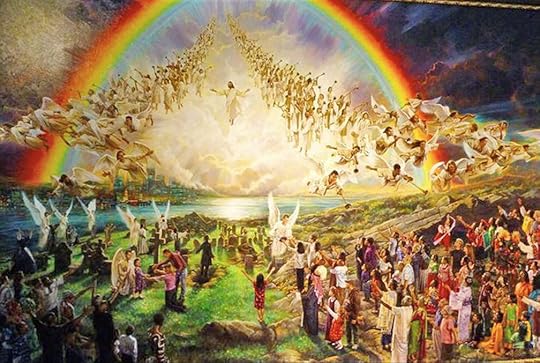
This one's kinda pretty, with a New Agey feel and a Tibetan color scheme.
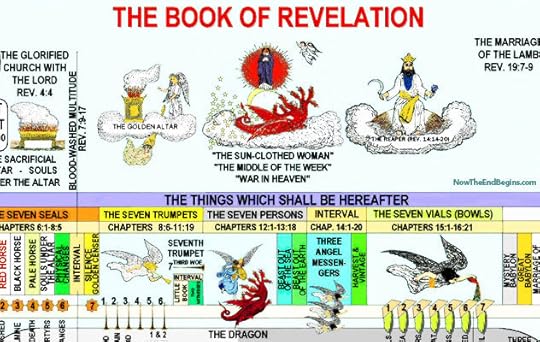
This is like the Periodic Table of Rapturology.

I still remember (though he doesn't) the time my dad explained to me that the world would end in 1992 because the dates in the Bible added up thusly. I became a stoner mystic in fall 1992. Coincidence?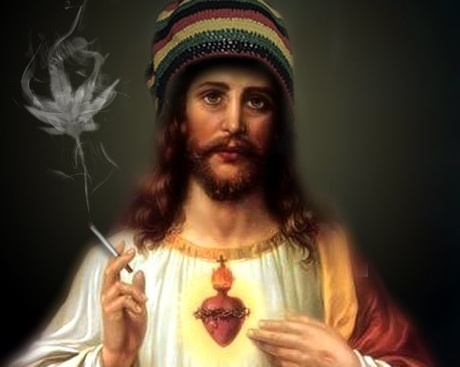
Jesus is like, "Dude, what took you so long?"
Waking up on December 22, 2012 was slightly weird. I had expected something after all, and nothing had happened. And yet something had happened. I had finally realized that I had responsibility for my own life, in a deep, fundamental way. That's what this book is actually all about. That and history.
Greer traces the apocalypse meme back to Zoroaster and a dysfunctional, as it turns out, reinterpretation of the cyclical procession of the equinoxes. The Jews picked it up during the Babylonian Captivity, Christianity was forged in the crucible of apocalyptic expectations, and Islam inherited the same family resemblance. Chinese Buddhists and Daoists picked it from up along the Silk Road, and later from Christian missionaries.
One of Greer's insights is that secular utopian thinking is a contemporary form of the apocalypse meme, of the notion that history can end and in fact has ended with us, here, now, in the perfect present moving into an ever more perfect future. It is a function of what Greer calls the myth of progress. And the meme, whether in religious or secular form, in apocalyptic or utopian drag, serves the same basic purpose, to assuage our own personal fears of change, of death, and of dying. And of taking responsibility to live in the face of those realities.
While I didn't seriously believe Terence McKenna's TimeWave Zero prediction about the end of time in 2012, I'd known about this obscure prophecy for decades before it became a pop cultural meme. Looking forward to 2012 provided me some comfort in the wake of the Y2K and millennial nonevents and the all-too-real events of 9/11/2001. I say comfort because I was raised in a home with a father who was exploring the apocalyptic fringes of Pentacostal Christianity, and so there has always been a part of me that expects the world to end right fucking now.
This image hung in my dad's workshop. It depicts the Rapture.
This is like the Episode 1 version of the previous picture, with a new and improved Jesus and 25% more resurrected Christians in glorified bodies.
This one's kinda pretty, with a New Agey feel and a Tibetan color scheme.
This is like the Periodic Table of Rapturology.
I still remember (though he doesn't) the time my dad explained to me that the world would end in 1992 because the dates in the Bible added up thusly. I became a stoner mystic in fall 1992. Coincidence?
Jesus is like, "Dude, what took you so long?"
Waking up on December 22, 2012 was slightly weird. I had expected something after all, and nothing had happened. And yet something had happened. I had finally realized that I had responsibility for my own life, in a deep, fundamental way. That's what this book is actually all about. That and history.
Greer traces the apocalypse meme back to Zoroaster and a dysfunctional, as it turns out, reinterpretation of the cyclical procession of the equinoxes. The Jews picked it up during the Babylonian Captivity, Christianity was forged in the crucible of apocalyptic expectations, and Islam inherited the same family resemblance. Chinese Buddhists and Daoists picked it from up along the Silk Road, and later from Christian missionaries.
One of Greer's insights is that secular utopian thinking is a contemporary form of the apocalypse meme, of the notion that history can end and in fact has ended with us, here, now, in the perfect present moving into an ever more perfect future. It is a function of what Greer calls the myth of progress. And the meme, whether in religious or secular form, in apocalyptic or utopian drag, serves the same basic purpose, to assuage our own personal fears of change, of death, and of dying. And of taking responsibility to live in the face of those realities.
It's the emotional payoffs of apocalyptic faith here and now... that explain the extraordinary persistence of the meme over more than three thousand years of history. (197)
The apocalypse meme... encourages people to believe in promises of a kind that will never be fulfilled. (200)
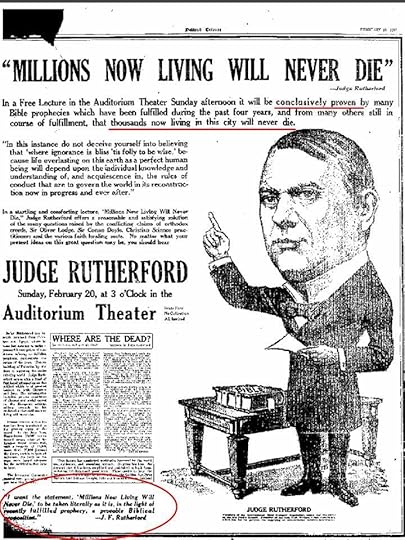
The apocalypse meme is not really about the end of the world, or more precisely, it's not about the kind of end that the world, or humanity, or contemporary industrial civilization, or each of our lives, will actually have. At the center of the apocalypse meme is the insistence that those endings aren't for us—that, as Joseph Rutherford insisted, millions now living will never die. (207)

July 19, 2014
This book is not what many might have thought it to be when they picked it up--all the better!!
Mr. Greer's "Apocalypse: A History of the End of Time" is an accessible history of the 'apocalypse meme'. The author defines this meme [cultural gene or "an element of a culture or system of behavior that may be considered to be passed from one individual to another by nongenetic means, especially imitation" -- Googled: define meme] as:
"the promise as life as we know it, with all its frustrations, limitations, and annoyances, will be replaced by something wholly other -- something that normally just happens to correspond to whatever the fondest fantasies of its believers happens to be." p. 199 or Location 1927
"The apocalypse meme...encourages people to believe in promises of a kind that will never be fulfilled." p. 200 or Location 1938
The book is not concerned with simply religious apocalyptic theories but secular ones as well: social, political, economic [see discussion of the Credit Crunch and Tulip Mania], environmental, mythological, alien, etc.
For the better part of the book, Mr. Greer is concerned with laying bare history as read through the Apocalyptic Meme from its originator Zarathustra [perhaps as early as 1,500 BCE/BC] until 2012. Apocalypse was published before December 2012 so it projects a fail there...which is what all apocalyptic memes, according to the author, do...fail.
It is a brilliant work that is highly accessible and well-written.
This book should be read by anyone obsessed with apocalyptic theories, both religious and secular, and who wishes to speak, articulately, about them...even those who are interested in cultural history would find much here to be worth their time.
One criticism -- there are no references in the text, but at the end of the book there is a Notes section where you will find these. I'm the sort that likes to look up references in the hope of finding something else to read and the book thwarted me in this respect.
5 out of 5 stars.
HIGHLY RECOMMENDED for all readers of history and those interested in apocalyptic theories and those interested in the pathology of the apocalyptic meme.
A MUST READ!!!
Mr. Greer's "Apocalypse: A History of the End of Time" is an accessible history of the 'apocalypse meme'. The author defines this meme [cultural gene or "an element of a culture or system of behavior that may be considered to be passed from one individual to another by nongenetic means, especially imitation" -- Googled: define meme] as:
"the promise as life as we know it, with all its frustrations, limitations, and annoyances, will be replaced by something wholly other -- something that normally just happens to correspond to whatever the fondest fantasies of its believers happens to be." p. 199 or Location 1927
"The apocalypse meme...encourages people to believe in promises of a kind that will never be fulfilled." p. 200 or Location 1938
The book is not concerned with simply religious apocalyptic theories but secular ones as well: social, political, economic [see discussion of the Credit Crunch and Tulip Mania], environmental, mythological, alien, etc.
For the better part of the book, Mr. Greer is concerned with laying bare history as read through the Apocalyptic Meme from its originator Zarathustra [perhaps as early as 1,500 BCE/BC] until 2012. Apocalypse was published before December 2012 so it projects a fail there...which is what all apocalyptic memes, according to the author, do...fail.
It is a brilliant work that is highly accessible and well-written.
This book should be read by anyone obsessed with apocalyptic theories, both religious and secular, and who wishes to speak, articulately, about them...even those who are interested in cultural history would find much here to be worth their time.
One criticism -- there are no references in the text, but at the end of the book there is a Notes section where you will find these. I'm the sort that likes to look up references in the hope of finding something else to read and the book thwarted me in this respect.
5 out of 5 stars.
HIGHLY RECOMMENDED for all readers of history and those interested in apocalyptic theories and those interested in the pathology of the apocalyptic meme.
A MUST READ!!!

July 18, 2015
The main thing I learnt from this book concerned an entirely different book: Umberto Eco's novel 'The Name of the Rose'. The 'assistant detective' to William of Baskerville, Adso of Melk, was based on a real medieval monk Adso of Melk. According to 'Apocalypse' Adso wrote a 'Biography of the Anti-Christ' which laid the basis of subsequent myth making about the End times. For me this shed light on why Eco made the Book of Revelation the basis for the labyrinth in his novel.
John Michael Greer's 'Apocalypse: a history of the End of Time' is a journalistic rather than a scholarly account of how humans have envisaged the end of the world. What it lacks in rigour it makes up for in readability. How much you like his analysis will depend on how much you like his treating the Apocalypse as a meme. The meme device allows Greer to trace lines though history that connect disparate thinkers. E.g. He credits Zoroastrianism with introducing the 'end time' idea to Judean, then Christian thought. The medieval scholar Joachim of Fiore developed a detailed idea of historical 'ages' or phases leading to the end of days. Joachim influenced GWF Hegel with his ideas of unfolding historical progress. Hegel influenced Karl Marx and his notion that Communism would be the culmination of human history. After the fall of Communism numerous neoliberal and neoconservative accounts of history took a Hegel/Marx influenced view that liberal capitalism was now the End of History. Greer sees this process as the passage of the Apocalypse meme from one thinker and time to another. I'd say that you should definitely read more on each of these subjects before accepting the meme as historical shorthand. As an introduction though, the book does the job.
John Michael Greer's 'Apocalypse: a history of the End of Time' is a journalistic rather than a scholarly account of how humans have envisaged the end of the world. What it lacks in rigour it makes up for in readability. How much you like his analysis will depend on how much you like his treating the Apocalypse as a meme. The meme device allows Greer to trace lines though history that connect disparate thinkers. E.g. He credits Zoroastrianism with introducing the 'end time' idea to Judean, then Christian thought. The medieval scholar Joachim of Fiore developed a detailed idea of historical 'ages' or phases leading to the end of days. Joachim influenced GWF Hegel with his ideas of unfolding historical progress. Hegel influenced Karl Marx and his notion that Communism would be the culmination of human history. After the fall of Communism numerous neoliberal and neoconservative accounts of history took a Hegel/Marx influenced view that liberal capitalism was now the End of History. Greer sees this process as the passage of the Apocalypse meme from one thinker and time to another. I'd say that you should definitely read more on each of these subjects before accepting the meme as historical shorthand. As an introduction though, the book does the job.

March 20, 2015
This book wasn't what I expected. I had thought it would have explored more of the Pagan and ancient apocalypse theories. The Christian/Catholic theories are all well known in basic forms to most Westerners and so focusing on that aspect was uninformative. The self centred focus on American culture was extremly short sighted but not unexpected from an American author. I'm quite sure many other counties have cults and apocalypse culture.
I also feel that the Singulaity was glazed over way too quickly and only one definition of the Singulaity was mentioned. The Singulaity is also thought of as the point at which computers/machines/robots are advancing faster than human beings. This definition is much more plausable than the one mentioned in the book.
I would also liked to have seen the author point out that a circular calander can't possibly come to an end. Geometricly a true circle has no beginning and no end. The Mayan calander is a circle and thus it works in circles/cycles and thus can't end.
It is also important to note that recently we are seeing change on a massive scale. World records for weather events and natural diarsters are being broken left right and centre. Australia is seeing an unprecidented terror threat which is only just being felt with IS, recently all Aussie cops must now wear bullet proof vests, carry weapons even at ANZAC Day (first time this has happened in at least 20 years), and are no longer allowed to work alone. This, to me, is an indication that serious large scale changes happen slowly and it is unrealistic to expect that a new cycle will mean sudden change.
I also feel that the Singulaity was glazed over way too quickly and only one definition of the Singulaity was mentioned. The Singulaity is also thought of as the point at which computers/machines/robots are advancing faster than human beings. This definition is much more plausable than the one mentioned in the book.
I would also liked to have seen the author point out that a circular calander can't possibly come to an end. Geometricly a true circle has no beginning and no end. The Mayan calander is a circle and thus it works in circles/cycles and thus can't end.
It is also important to note that recently we are seeing change on a massive scale. World records for weather events and natural diarsters are being broken left right and centre. Australia is seeing an unprecidented terror threat which is only just being felt with IS, recently all Aussie cops must now wear bullet proof vests, carry weapons even at ANZAC Day (first time this has happened in at least 20 years), and are no longer allowed to work alone. This, to me, is an indication that serious large scale changes happen slowly and it is unrealistic to expect that a new cycle will mean sudden change.

January 9, 2014
A surprisingly cheerful, wide-ranging survey of apocalyptic dreams, visions, predictions and cons, the book's main fault is it's length. At just over 200 pages, there just isn't room to go into much depth on any of the end of the world lunacies Greer writes about.
From the bonkers sci-fi predeterminism of Zoroastrianism (which Greer blames for kicking off this ever-ridiculous kind of thinking in the first place) all the way through to the supposed Mayan prophecy that was to have ended things in December 2012, a lot of people have believed a lot of stupid things about the end times.
Most of Greer's arguments are sound ones so it's strange to see him drag the French Philosophes and Francis Fukuyama into things but his accounts of the Millerites, the Yellow Turbans, Sabbatai Zevi and Joachim of Fiore are well done and very entertaining.
The book ends strongly with a great debunking of the 2012 Mayan nonsense and a convincing section that explains why apocalyptic cults and ideas are like tulips.
Overall, a great starting point, and one that's left me wanting to know much, much more about some of these whack jobs.
From the bonkers sci-fi predeterminism of Zoroastrianism (which Greer blames for kicking off this ever-ridiculous kind of thinking in the first place) all the way through to the supposed Mayan prophecy that was to have ended things in December 2012, a lot of people have believed a lot of stupid things about the end times.
Most of Greer's arguments are sound ones so it's strange to see him drag the French Philosophes and Francis Fukuyama into things but his accounts of the Millerites, the Yellow Turbans, Sabbatai Zevi and Joachim of Fiore are well done and very entertaining.
The book ends strongly with a great debunking of the 2012 Mayan nonsense and a convincing section that explains why apocalyptic cults and ideas are like tulips.
Overall, a great starting point, and one that's left me wanting to know much, much more about some of these whack jobs.

January 30, 2014
It's less about the apocalypse itself than the way the idea of it has been integrated into society. Really interesting read that is a lot more historical and a lot less new age-y than I expected it to be.
The author's voice is clearly evident sometimes, and it makes for a cheerful, sometimes amusing read, rather than one that tells of doom and gloom.
It would be interesting to see this updated post-2012, especially when some new apocalypse hysteria has the world in its grip.
The author's voice is clearly evident sometimes, and it makes for a cheerful, sometimes amusing read, rather than one that tells of doom and gloom.
It would be interesting to see this updated post-2012, especially when some new apocalypse hysteria has the world in its grip.

August 1, 2015
Fascinating and interesting book looking at how this 'Apocalypse Meme' has continued through out history and keeps repeating itself. It no longer needs a religious dimension but have jumped on the secular bandwagon, by any number of political ideas. Missed a trick by not looking at how it has crept into management ideas as Business Process Engineering. Very easy read, but highly entertaining.
November 5, 2012
A good starting point for the subject that outlines and cheerfully debunks the outlandish ideas regarding the end-of-the-world-as-we-know-it that have cropped up worryingly often during the last few thousand years.

November 6, 2014
A very interesting book on the "myth" of Apocalypse since Zarathustra up to Left Behind and the rapture. Provides a good perspective on the persistence of the Apocalypse on human mind and the re-elaboration of the idea in different times and civilizations.

January 3, 2015
An interesting overview of the apocalypse meme throughout human history. My only issue is that it conflates revolutionary utopian movements with apocalyptic movements and doesn't make enough convincing arguments to support this idea, as interesting as it is.

April 3, 2015
A well written book that goes a long way in explaining why so many of us seem so keen to see the end of time.
Displaying 1 - 27 of 27 reviews