

What do you think?

The Science of Good Cooking: Master 50 Simple Concepts to Enjoy a Lifetime of Success in the Kitchen
In this radical new approach to home cooking, we use science to explain what goes on in the kitchen. Unlike other food science books, we make a direct and practical connection between the science and the cooking. We divide the book into 50 core principles, support them through detailed yet friendly explanations, bring them alive with color illustrations and inventive experiments, and reinforce them through recipes that put the principle to work. At Cook's Illustrated, we've been asking why in the kitchen for over 20 years and often find our answers in science. We believe good science makes great food and that understanding basic science will make you a great cook.
486 pages, Hardcover
First published January 1, 2012
Ratings & Reviews
Friends & Following
Create a free account to discover what your friends think of this book!
Community Reviews
Displaying 1 - 30 of 134 reviews

January 21, 2014
A few years ago, I was flipping through an America's Test Kitchen magazine at my mother-in-law's house and saw a diagram showing ripening bananas and their relative sugar content. The riper the banana, the more sugar due to the starch breakdown -- that's one reason super-ripe bananas are better for desserts. I skimmed some of the recipes and they all had little lead-ins, explaining why they chose specific ingredients and techniques. They were like mini science papers about cooking! My background is research science, so I found this incredibly appealing.
At the time, I was decidedly a non-cook. I loved watching cooking shows, but my feelings about the act of cooking anything myself amounted to something like gleeful disdain. I had decided I was terrible at it and, thus, hated it in a proud sort of way. For a long time, I avoided it as much as possible to protect my home from fires and my loved ones from gastrointestinal distress. My husband did most of the cooking and once in a while I contributed by either cooking something from my mom's Cream of Comfort recipes or, better, ordering take-out.
But something about these Test Kitchen recipes... they were so detailed. They seemed doable. I did not have experience in the kitchen, but I was good at following instructions. I also loved that the recipes were optimized. I had occasionally attempted new recipes I found on the internet, but the results there were highly variable. With the Test Kitchen, the recipes had gone through taste testing by people that knew good food. For me, this seemed like a suitable replacement for the generations of optimizing that happen as great family recipes are passed down.
(I've had people argue with me over this last point, usually people that DO have a culinary starting point, like a grandmother's spaghetti sauce recipe. "Best" is subjective for sure when it comes to food. When I ask these people about their specific recipes, however, they say, "Oh, I add a little of this and a little of that -- it is a little different every time." Ok, if it's different every time, how do you know it's always "best"? The scientist in me wants some amount of reproducibility of results. Also, without intuition, "a little of this and that" doesn't really help me. My culinary starting point was something like, "Jarred spaghetti sauce tastes better than canned spaghetti sauce.")
After a few years of cooking their recipes, my pan is no longer to hot, my spices are properly bloomed, and I can even cook chicken breasts without drying them out. When I started this process, I routinely overcooked scrambled eggs. This weekend, I made the most luscious mini frittatas with mushrooms, potatoes, chives, and gruyere. Discovering the Test Kitchen's recipes was a life changer. Sometimes when I chat with other Test Kitchen aficionados, we jokingly refer to ourselves as disciples, but it is completely true. They rarely fail me.
I have almost all their show compendium cookbooks, plus Baking Illustrated, and miscellaneous others. This book is organized differently than the rest. Instead of presenting the recipes by meal or food category, they are organized by cooking concepts, such as controlling potato starches, balancing bread leaveners, and matching the right cooking techniques with various cuts of meat. Along with the experiments that convey the concepts, they include several recipes that demonstrate the concepts in action. It's pretty brilliant.
The book is also includes full page information sheets (like Butter 101) explaining how to properly shop for, store, and handle various ingredients. I also loved the numerous tables and insets describing tangential experiments they did. I've included my favorite here. Click to embiggen...

Hilarious. I love that they did this.
I'm not sure I'd recommend this as a first Test Kitchen cookbook (I'd probably recommend this one first, since it has a greater survey of recipe types), but it's a great complement to any cookbook collection. And, if you're a beginner like me, you may find the foundation of your new culinary intuition here. I still wouldn't call myself a great cook yet, but I'm getting there.
At the time, I was decidedly a non-cook. I loved watching cooking shows, but my feelings about the act of cooking anything myself amounted to something like gleeful disdain. I had decided I was terrible at it and, thus, hated it in a proud sort of way. For a long time, I avoided it as much as possible to protect my home from fires and my loved ones from gastrointestinal distress. My husband did most of the cooking and once in a while I contributed by either cooking something from my mom's Cream of Comfort recipes or, better, ordering take-out.
But something about these Test Kitchen recipes... they were so detailed. They seemed doable. I did not have experience in the kitchen, but I was good at following instructions. I also loved that the recipes were optimized. I had occasionally attempted new recipes I found on the internet, but the results there were highly variable. With the Test Kitchen, the recipes had gone through taste testing by people that knew good food. For me, this seemed like a suitable replacement for the generations of optimizing that happen as great family recipes are passed down.
(I've had people argue with me over this last point, usually people that DO have a culinary starting point, like a grandmother's spaghetti sauce recipe. "Best" is subjective for sure when it comes to food. When I ask these people about their specific recipes, however, they say, "Oh, I add a little of this and a little of that -- it is a little different every time." Ok, if it's different every time, how do you know it's always "best"? The scientist in me wants some amount of reproducibility of results. Also, without intuition, "a little of this and that" doesn't really help me. My culinary starting point was something like, "Jarred spaghetti sauce tastes better than canned spaghetti sauce.")
After a few years of cooking their recipes, my pan is no longer to hot, my spices are properly bloomed, and I can even cook chicken breasts without drying them out. When I started this process, I routinely overcooked scrambled eggs. This weekend, I made the most luscious mini frittatas with mushrooms, potatoes, chives, and gruyere. Discovering the Test Kitchen's recipes was a life changer. Sometimes when I chat with other Test Kitchen aficionados, we jokingly refer to ourselves as disciples, but it is completely true. They rarely fail me.
I have almost all their show compendium cookbooks, plus Baking Illustrated, and miscellaneous others. This book is organized differently than the rest. Instead of presenting the recipes by meal or food category, they are organized by cooking concepts, such as controlling potato starches, balancing bread leaveners, and matching the right cooking techniques with various cuts of meat. Along with the experiments that convey the concepts, they include several recipes that demonstrate the concepts in action. It's pretty brilliant.
The book is also includes full page information sheets (like Butter 101) explaining how to properly shop for, store, and handle various ingredients. I also loved the numerous tables and insets describing tangential experiments they did. I've included my favorite here. Click to embiggen...
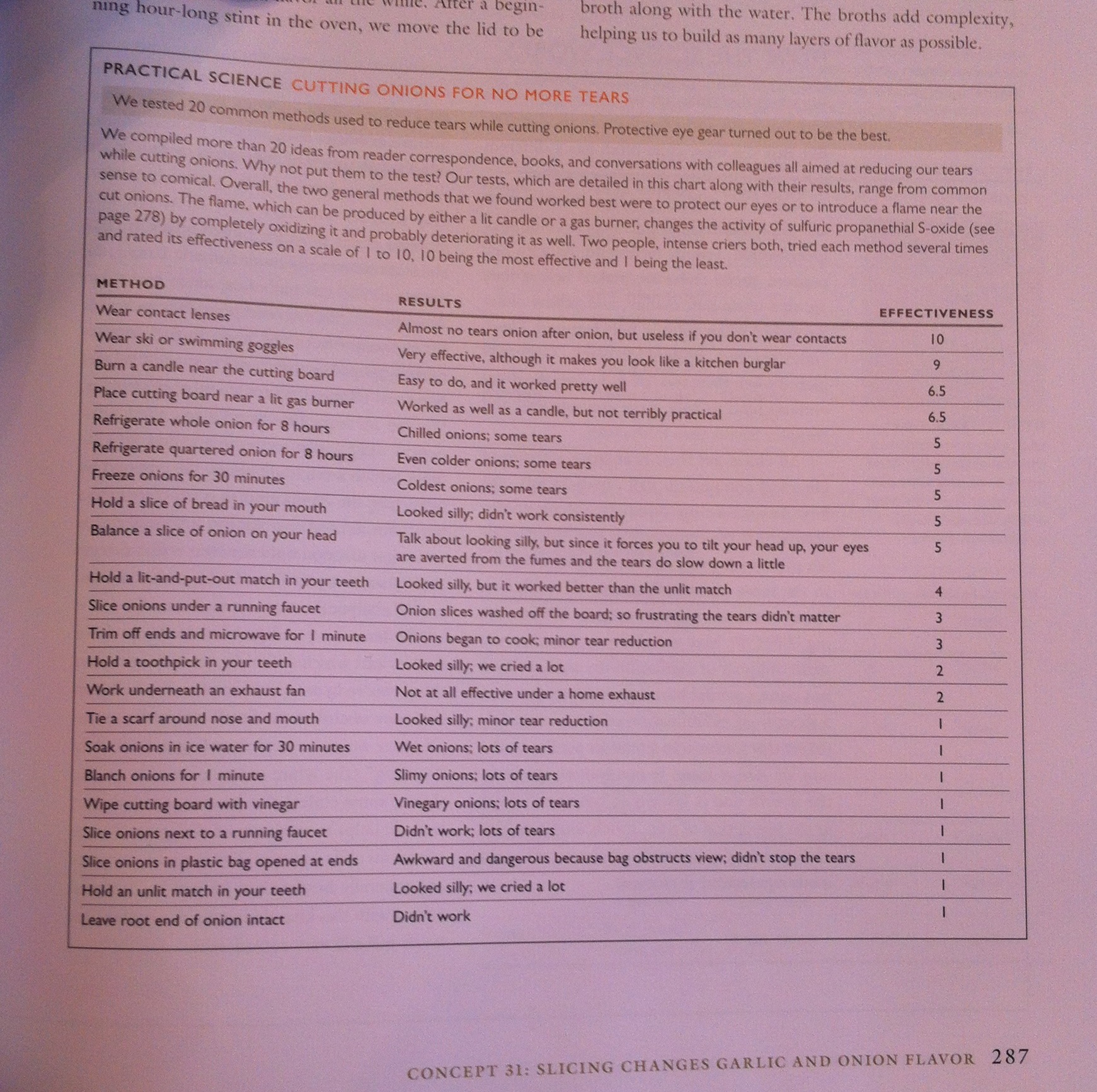
Hilarious. I love that they did this.
I'm not sure I'd recommend this as a first Test Kitchen cookbook (I'd probably recommend this one first, since it has a greater survey of recipe types), but it's a great complement to any cookbook collection. And, if you're a beginner like me, you may find the foundation of your new culinary intuition here. I still wouldn't call myself a great cook yet, but I'm getting there.

June 9, 2015
I feel weird writing a review for a cookbook, but SERIOUSLY. This book is a game-changer. I've enjoyed cooking and baking for years and can follow a recipe well enough, but when something didn't turn out I could never really troubleshoot what went wrong. This book will change that! I loved the layout - there are 50 concepts and they begin with explaining the science behind why this technique works versus others, etc. They explain the test kitchen experiments and give several insanely detailed recipes to try on your own. I love that they tell you not only what to do, but what not to do; what substitutions will work and which won't. There are tons of insets of "practical science" and ingredient 101's, along with pictures of accurate and inaccurate cooking. Their experiments were creative and sometimes hilarious (testing methods on how to keep from crying while chopping onions, trying 120 ways to crack hard-boiled eggs). I read through the entire book and am now going to go back through trying recipes for each concept. To say I'm excited about it would be an understatement. This will be gifted to anyone I know that has a marginal interest in improving their cooking and I know mine will be used often.

May 9, 2013
I do no know how to cook. I can bake because I can follow directions and set a timer, but cooking meat is terrifying for me. I don't know how many times that I have heard "You'll just know when it is done." If this cooking 6th sense inherited in some people? I definitely do not have it. Also, the color change technique doesn't work for me because slight variations of color make a big difference in how down something is. I just don't get it! The Science of Good Cooking (Cook's Illustrated Cookbooks) is a great book for people like me that just can't cook. This book gives extremely simple steps, the justification behind doing things each way, Do's and Do not's, and pictures. I think my favorite part is knowing the science behind several of the reactions that go with cooking. I guess this is just demystifying cooking for me. Anther great part is that instead of just telling you what to do, they are smart enough to know that we terrible cooks do things wrong. Because of this, we also get explicit DO NOT do this or that. This actually helps a lot because you can anticipate problems as you are cooking (or trying to cook).

February 12, 2013
I have been reading Cook's Illustrated since the first issue in 1993. Following 20 years of this wonderful magazine is like an educational journey. I've observed from afar as the staff has explored and learned and even invented successful kitchen techniques, then dug more deeply to understand the "why" behind their successes and failures, often revisiting old formulas in search of improvement.
A distinguishing and endearing signature of a Cook's Illustrated article is the unapologetic quest for shortcuts. The trick, often achieved through trial and error, is to distinguish the unnecessary steps or ingredients from those which are truly essential. You learn, for example, that substituting for buttermilk is no sin, but skipping the browning step in a braised meat dish is sacrilege.
Now, the staff at Cook's has compiled these lessons into a single volume that whittles down 20 years of experimentation into a neat set of 50 timeless principles for success in the kitchen, with detailed explanations that go beyond even those featured in the magazine.
There are recipes, but this should by no means be classified as a cookbook. It's a volume that anyone with even a modest interest in cooking can curl up with and devour. 5 Stars
A distinguishing and endearing signature of a Cook's Illustrated article is the unapologetic quest for shortcuts. The trick, often achieved through trial and error, is to distinguish the unnecessary steps or ingredients from those which are truly essential. You learn, for example, that substituting for buttermilk is no sin, but skipping the browning step in a braised meat dish is sacrilege.
Now, the staff at Cook's has compiled these lessons into a single volume that whittles down 20 years of experimentation into a neat set of 50 timeless principles for success in the kitchen, with detailed explanations that go beyond even those featured in the magazine.
There are recipes, but this should by no means be classified as a cookbook. It's a volume that anyone with even a modest interest in cooking can curl up with and devour. 5 Stars

January 12, 2013
I was tempted to give this three (or even two) stars because:
1. It's WAY too much information for the stated goal. These concepts are far too nitpicky to be able to "master" for cooking in the kitchen.
2. This seems to be presented as a book for beginner cooks but if I didn't already know how to cook, I would have been totally overwhelmed by it.
3. Most (probably all) of the recipes are just recycled from their magazine and other cookbooks so there wasn't much new for me because I've been an on and off CI subscriber for several years.
4. Many of the concepts felt a little repetitious, as if they were grasping for 50.
BUT...
Here's why I'm giving it four stars:
1. We used it last weekend for the crepes recipe and they were delicious.
2. I've been wanting to learn about when to salt beans and it told me. (Soak in a brine overnight.)
3. It has a great recommended equipment section in the back.
4. There are several recipes in there that I want to try.
5. Some of the concepts were good for me to review or solidify in my mind.
SO:
A. If you already know how to cook and want to fine-tune your skills, this is the book for you.
B. If you don't know how to cook but want something like this, a far better book for you is Ruhlman's Twenty: The Ideas and Techniques that Will Make You a Better Cook. This is a fabulous book that's simple, easy to understand, and will do exactly what the subtitle claims that it will - make you a better cook. (Everyone who cooks should read Twenty, actually.)
1. It's WAY too much information for the stated goal. These concepts are far too nitpicky to be able to "master" for cooking in the kitchen.
2. This seems to be presented as a book for beginner cooks but if I didn't already know how to cook, I would have been totally overwhelmed by it.
3. Most (probably all) of the recipes are just recycled from their magazine and other cookbooks so there wasn't much new for me because I've been an on and off CI subscriber for several years.
4. Many of the concepts felt a little repetitious, as if they were grasping for 50.
BUT...
Here's why I'm giving it four stars:
1. We used it last weekend for the crepes recipe and they were delicious.
2. I've been wanting to learn about when to salt beans and it told me. (Soak in a brine overnight.)
3. It has a great recommended equipment section in the back.
4. There are several recipes in there that I want to try.
5. Some of the concepts were good for me to review or solidify in my mind.
SO:
A. If you already know how to cook and want to fine-tune your skills, this is the book for you.
B. If you don't know how to cook but want something like this, a far better book for you is Ruhlman's Twenty: The Ideas and Techniques that Will Make You a Better Cook. This is a fabulous book that's simple, easy to understand, and will do exactly what the subtitle claims that it will - make you a better cook. (Everyone who cooks should read Twenty, actually.)

October 28, 2012
I am a connoisseur of good food, and good cookbooks. I am of the opinion, one can never have too many good cookbooks!
However, this one, this marvellous piece of cooking knowledge, I so wish I'd had those 30+ years ago when I first started out on my own! Do they still teach 'Home Ec' in high schools? [If so, this should be required curriculum!]
Not only is this book filled with fabulous recipes, but the science that makes the recipe work! Yes, you read that right.... the "science" behind the recipe that makes it a success. [I was in my 40's before that light bulb moment of realizing that cooking was science and chemistry, before my real love for it took off!]
Different areas of science are spelled out, followed by several recipes in which that particular area of science makes the recipe such a successful dish. And there is no shortage of recipes to try out! [400-plus!]
By 'Cook's Illustrated' so it's a trusted book to be sure! This would be a wonderful addition for every newlywed, as well as anyone just moving out on their own for the first time. And it's making a grand addition to this 'old-timer's' kitchen shelf as well!
I give this book FIVE STARS and a big THUMBS UP!
Highly recommended!
****DISCLOSURE: This book was provided by Amazon Vine in exchange for an independent and non-biased review.
However, this one, this marvellous piece of cooking knowledge, I so wish I'd had those 30+ years ago when I first started out on my own! Do they still teach 'Home Ec' in high schools? [If so, this should be required curriculum!]
Not only is this book filled with fabulous recipes, but the science that makes the recipe work! Yes, you read that right.... the "science" behind the recipe that makes it a success. [I was in my 40's before that light bulb moment of realizing that cooking was science and chemistry, before my real love for it took off!]
Different areas of science are spelled out, followed by several recipes in which that particular area of science makes the recipe such a successful dish. And there is no shortage of recipes to try out! [400-plus!]
By 'Cook's Illustrated' so it's a trusted book to be sure! This would be a wonderful addition for every newlywed, as well as anyone just moving out on their own for the first time. And it's making a grand addition to this 'old-timer's' kitchen shelf as well!
I give this book FIVE STARS and a big THUMBS UP!
Highly recommended!
****DISCLOSURE: This book was provided by Amazon Vine in exchange for an independent and non-biased review.

March 18, 2018
ok, but not the 5 star cookbook I expected.

January 12, 2016
From the starting of point of I think it's a wonderful book (I wish I had something like this 20 years ago when I started cooking), I'm going to point out a few things that I didn't enjoy as much about the book given that the other 5-star reviewers have heaped (much deserved) praise already.
Sometimes the book feels too self-assured. This perhaps partly comes out of doing such rigorous testing (great!) but it can also come across patriarchal and "listen to me for I am Vader and can kill you with just my cooking knowledge".
For instance in box entitled "Is the pan ready?", it says "The only way to know when the pan is ready is to make a test pancake about the size of a half-dollar, or about 1 tablespoon of batter". Well it's not the *only* way. You can do that a couple times whilst simultaneously taking the temperature of pan using a non-contact thermometer.
That way, you can come much closer to the desired result with even the first pancake.
I say this because the type of person to buy a book like this is less likely to be unable to afford a $20 thermometer and also is less likely to be a afraid to "geek out" and get one.
It seems minor to pick on the use of the word "only" but it's simply to illustrate the slightly lecturing tone that the book sometimes has.
And the other thing is more of out sadness that it's so US-centric. Maybe I should work on a British version, with metric measurements and British/European ingredients and preferences. And maybe one day I'll get a chance to cook Yukon Golds, Russets and red potatoes next to the common British varieties of King Edward, Maris Piper and Charlottes and compare them!
Sometimes the book feels too self-assured. This perhaps partly comes out of doing such rigorous testing (great!) but it can also come across patriarchal and "listen to me for I am Vader and can kill you with just my cooking knowledge".
For instance in box entitled "Is the pan ready?", it says "The only way to know when the pan is ready is to make a test pancake about the size of a half-dollar, or about 1 tablespoon of batter". Well it's not the *only* way. You can do that a couple times whilst simultaneously taking the temperature of pan using a non-contact thermometer.
That way, you can come much closer to the desired result with even the first pancake.
I say this because the type of person to buy a book like this is less likely to be unable to afford a $20 thermometer and also is less likely to be a afraid to "geek out" and get one.
It seems minor to pick on the use of the word "only" but it's simply to illustrate the slightly lecturing tone that the book sometimes has.
And the other thing is more of out sadness that it's so US-centric. Maybe I should work on a British version, with metric measurements and British/European ingredients and preferences. And maybe one day I'll get a chance to cook Yukon Golds, Russets and red potatoes next to the common British varieties of King Edward, Maris Piper and Charlottes and compare them!

February 4, 2013
At last! I have been looking for this cookbook for years.
Things I love about this book:
1. In-depth, scientific explanations at the beginning of each chapter/concept.
2. More specific explanations after each recipe, with the rationale behind each step.
3. Enough recipes for each concept to really help you master it.
4. The recipes themselves have been delicious. (The turkey I prepared the night before Thanksgiving and then left in the fridge, uncovered, had the most amazing, crispy skin. My brother, sister-in-law, and I descended upon that turkey, vulture-style, until not a flake of buttery delicious skin was left.)
I'm approaching this cookbook as a home-study cooking class, and it's been so much fun. I've been going concept by concept, trying most of the recipes. It's kind of slow going, just because the first several chapters involve cooking big chunks of meat, and you can't eat that way every night (more like once a week). I'm actually going to start jumping around in concept sequence to avoid gastronomic monotony.
I used to be the kind of person who read "rinse chicken and pat dry" in a recipe and skipped that messy, unnecessary step. I needed to know why I should wash and pat. Now that I know how much extra flavor that dry, easy-to-brown chicken will have, I take the time.
Things I love about this book:
1. In-depth, scientific explanations at the beginning of each chapter/concept.
2. More specific explanations after each recipe, with the rationale behind each step.
3. Enough recipes for each concept to really help you master it.
4. The recipes themselves have been delicious. (The turkey I prepared the night before Thanksgiving and then left in the fridge, uncovered, had the most amazing, crispy skin. My brother, sister-in-law, and I descended upon that turkey, vulture-style, until not a flake of buttery delicious skin was left.)
I'm approaching this cookbook as a home-study cooking class, and it's been so much fun. I've been going concept by concept, trying most of the recipes. It's kind of slow going, just because the first several chapters involve cooking big chunks of meat, and you can't eat that way every night (more like once a week). I'm actually going to start jumping around in concept sequence to avoid gastronomic monotony.
I used to be the kind of person who read "rinse chicken and pat dry" in a recipe and skipped that messy, unnecessary step. I needed to know why I should wash and pat. Now that I know how much extra flavor that dry, easy-to-brown chicken will have, I take the time.

February 11, 2013
For the most part I knew the science behind each concept what with being a loyal Good Eats fan. But it's always nice to see something from a different perspective. The science aspect is very accessible. The experiments are not too rigorous but do get the point across that they generally know what they are doing. The recipes are all great. Everyone I've made so far has been a real winner. (Except the meringue cookies but that's likely user error). Each recipe is followed by why it works and the science behind it. Something that I really like is after certain recipes, there are mini applications to tweak it like making a different sauce or a slightly different variation of the dish. This is great! Sometimes people get stuck in ruts making the same recipe over & over. Helps expand your own cooking repertoire.
I take umbrage with their philosophy of substituting as don't do it. That is decent advice for someone who doesn't know their way around the kitchen. But substituting can be fun, and scientific! Take note of how the food differed from what you changed (and remember to only change one variable at a time).
If you are a sciencey person and enjoy cooking then you'll get a lot of mileage out of this book.
I take umbrage with their philosophy of substituting as don't do it. That is decent advice for someone who doesn't know their way around the kitchen. But substituting can be fun, and scientific! Take note of how the food differed from what you changed (and remember to only change one variable at a time).
If you are a sciencey person and enjoy cooking then you'll get a lot of mileage out of this book.

December 29, 2013
My new favorite go-to source in the kitchen. Every recipe I've tried in here has been a success (granted, a very small sampling of what's available in the book). Does an excellent job of explaining the techniques so you can actually apply what you learned to other situations beyond the specific recipe.

March 17, 2022
Lots of great information in this not so little book. As a person of science, I always find it hard to blindly trust recipes. Like why do I need to punch my dough after a rise? That and other things that appeared a little arbitrary to me are answered here with a little bit of science and some experiments. While the experiments might not pass the scrutiny of a peer-review, they are still fairly convincing. The book is largely organized around 50 core cooking/baking concepts starting with the statement, theory behind it, experiments to test the theory and some recipes that use the concept.
The book can either be used as a cooking science reference or a science-backed recipe collection, with again "science" being used in a rough sense. I am not sure I will remember everything since I read it cover to cover but I took notes and at least will be reminded of the concepts when they appear in the recipes. Recommended for curious cooks/bakers!
The book can either be used as a cooking science reference or a science-backed recipe collection, with again "science" being used in a rough sense. I am not sure I will remember everything since I read it cover to cover but I took notes and at least will be reminded of the concepts when they appear in the recipes. Recommended for curious cooks/bakers!

February 2, 2021
The omnivore in me wants to give this 4+ stars, buy a reference copy, and make an appointment for myself to skim it every year for new tips until the kid is old enough to work through it like a science textbook when she's old enough to graduate from playdough pies.
The minimalist in me is annoyed this book's organization is not sympathetic to figuring out how to build menus which use what is already in your pantry, keep that pantry staples list manageably short, and make better educated substitutions as needed.
The whole foods plant based health nut in me is shaking my fist that only ~13 of 50 concepts address making fruit and veggies more compelling... and even within that, the applied recipes usually call for animal products... oh and be careful about the Sirens in the chocolate/baking concepts final section on your way to the index.
The harried parent in me is wondering why they didn't weigh in on pressure cookers, slow cookers, and what might or might not work as a meal prep or fire and forget weeknight meal option.
The minimalist in me is annoyed this book's organization is not sympathetic to figuring out how to build menus which use what is already in your pantry, keep that pantry staples list manageably short, and make better educated substitutions as needed.
The whole foods plant based health nut in me is shaking my fist that only ~13 of 50 concepts address making fruit and veggies more compelling... and even within that, the applied recipes usually call for animal products... oh and be careful about the Sirens in the chocolate/baking concepts final section on your way to the index.
The harried parent in me is wondering why they didn't weigh in on pressure cookers, slow cookers, and what might or might not work as a meal prep or fire and forget weeknight meal option.

September 21, 2014
Finally finished…and I'm a better chef for it.
I've always loved cooking, but there's always been a part of me asking why does a particular recipe work when I add the secret ingredient? What's the science behind it? What's the reason I add salt to my meat, or flour before cooking. Just how long should I let something sit in a stew? Why? Why? Why? Finally, I decided to find out. By looking online? Of course not…being the voracious reader that I am, I opted to get a book about the science of cooking. And this was the book for me.
The book is categorized by 50 concepts, anything ranging from the Malliard effect when browning your meats, what happens to the whites and yolk of eggs when they are heated, and just how much sugar to add to your fruity drink affects not only the taste, but the texture as well. Each concept is given its own introduction, a sample experiment of the concept in action, and a variety of recipes that fit into this concept's category. Each recipe is also given it's own, "Why this works" scientific explanation. For the budding scientist in the kitchen, this is right where it's at.
There's so much going on in the world that we can't see, and I find it fascinating to be able to find these out. Sure, the adept cook can figure out that the minutes are very important when working in the kitchen, but when asked why, only a handful of them would be able to promptly explain why their method works, and can be repeated. Remember, a good experiment is something that can be repeated with the same results. Cooking is no exception.
This book would make a wonderful conversation starter in your kitchen. Perhaps put it on one of those knife blocks that also serve as a cookbook book shelf, and you've got yourself a recipe for fun! I give this book a scrumptious 5 out of 5.
I've always loved cooking, but there's always been a part of me asking why does a particular recipe work when I add the secret ingredient? What's the science behind it? What's the reason I add salt to my meat, or flour before cooking. Just how long should I let something sit in a stew? Why? Why? Why? Finally, I decided to find out. By looking online? Of course not…being the voracious reader that I am, I opted to get a book about the science of cooking. And this was the book for me.
The book is categorized by 50 concepts, anything ranging from the Malliard effect when browning your meats, what happens to the whites and yolk of eggs when they are heated, and just how much sugar to add to your fruity drink affects not only the taste, but the texture as well. Each concept is given its own introduction, a sample experiment of the concept in action, and a variety of recipes that fit into this concept's category. Each recipe is also given it's own, "Why this works" scientific explanation. For the budding scientist in the kitchen, this is right where it's at.
There's so much going on in the world that we can't see, and I find it fascinating to be able to find these out. Sure, the adept cook can figure out that the minutes are very important when working in the kitchen, but when asked why, only a handful of them would be able to promptly explain why their method works, and can be repeated. Remember, a good experiment is something that can be repeated with the same results. Cooking is no exception.
This book would make a wonderful conversation starter in your kitchen. Perhaps put it on one of those knife blocks that also serve as a cookbook book shelf, and you've got yourself a recipe for fun! I give this book a scrumptious 5 out of 5.

October 25, 2012
Those who watch America's Test Kitchen on PBS are familiar with the brief scientific explanations that accompany each demonstration. This book amplifies those discussions.
Unlike most cookbooks, which are broken out by type of dish (eggs, appetizers, what-have-you), "The Science of Good Cooking" is broken out by scientific principle. The first part of the chapter explains the principle in detail (e.g., lamination, which some books refer to as larding, and why different types of butter affect lamination in varying ways). After the scientific discussion, there is a breakdown of a test kitchen experiment that explains how they arrived at certain conclusions for the following recipes. The recipes follow the experiment with detailed information on how to accomplish each step. The most interesting part of this unusual book was the "why this recipe works" section after each dish. Instead of just presuming instant success, as most books do, this one talks about why the scientific principle applies and how the various chemical and physical reactions work together.
As someone who has often said that baking is science but cooking might as well be voodoo, I was delighted to see a book that explained the science of the stovetop as well.
Unlike most cookbooks, which are broken out by type of dish (eggs, appetizers, what-have-you), "The Science of Good Cooking" is broken out by scientific principle. The first part of the chapter explains the principle in detail (e.g., lamination, which some books refer to as larding, and why different types of butter affect lamination in varying ways). After the scientific discussion, there is a breakdown of a test kitchen experiment that explains how they arrived at certain conclusions for the following recipes. The recipes follow the experiment with detailed information on how to accomplish each step. The most interesting part of this unusual book was the "why this recipe works" section after each dish. Instead of just presuming instant success, as most books do, this one talks about why the scientific principle applies and how the various chemical and physical reactions work together.
As someone who has often said that baking is science but cooking might as well be voodoo, I was delighted to see a book that explained the science of the stovetop as well.

May 30, 2017
This cookbook was given to us as a gift. I am a home cook and my girls and I love science. The lay out of this book is a lot like all of the Cooks Illustrated/America's Test Kitchen books. The recipes are easy to read, they don't all have pictures which I do prefer with cook books. The pictures it does include are mostly grey scale.
There are sections that explain the science behind food reactions, how food cooks, and why it's more efficient to cook certain items one way and not another way. There are also sections explaining WHY the methods under the recipes work. I think this is invaluable to cooks. Cooking for the most part is taking foods and applying a method to them. Once you learn methods creating and adapting recipes comes naturally.
I recommend this cook book to any level of cook.
There are sections that explain the science behind food reactions, how food cooks, and why it's more efficient to cook certain items one way and not another way. There are also sections explaining WHY the methods under the recipes work. I think this is invaluable to cooks. Cooking for the most part is taking foods and applying a method to them. Once you learn methods creating and adapting recipes comes naturally.
I recommend this cook book to any level of cook.

January 15, 2018
Actually, it probably isn't accurate to say I've read this, which suggests cover-to-cover, as it is primarily a reference book for the analytical cook who wants to discover the science behind the art of cooking a great meal. If you have subscribed to the Cook's Illustrated magazine or seen the shows on PBS, then you know this group loves to investigate -- and then explain -- how food cooks and why some techniques/foods/gadgets work better than others. I don't always agree with their 'science' but I always learn something. They always include lots of recipes but I find them excessively detailed and daunting. So I glean what I can from the cooking science that I'm willing to incorporate into my every day efforts in the kitchen and leave the rest for the foodies. I never fail to learn something new from CI and I think it has made me a better cook.

December 26, 2013
I have to make a lot of substitutions in recipes due to food allergies. This book is great because I can learn the functional purpose of each ingredient and that helps me determine what the best sub would be. Also, I appreciate knowing what steps are critical and why (including photos of what happens if a step is done incorrectly.

January 2, 2013
This book has so much useful information! As a scientist (biologist) I feel an almost irresistible urge to repeat all their experiment. My plan is to read/cook my way through all their 50 cooking concepts.

Read
December 11, 2013Featured on Science for the People show #232 on September 27, 2013, during an interview with author Guy Crosby. http://www.scienceforthepeople.ca/epi...

November 8, 2021
Great book on the basics and the scientific background of cooking! I learned a lot; partially also how little I know about why we cook food in a certain way… and I definitely am going to have a second and third look at that book to extract some more hints and start experimenting.
… and I should have probably read the German version.
… and I should have probably read the German version.

March 3, 2021
So pre-pandemic, cooking was never my forte, nor did I have the time to truly dive into honing my skills on it. I know I'm not the only one who has seen the cute pinterest recipe, been drawn to the photo, yet still having the result turn out bland. But WFH has totally changed the game. Scratch that. My recent re-watch of Julie & Julia has changed the game.

And kicking off 2021, my obsession with all things cooking has reached a boiling point.

I'm OBSESSED. I mean, obsessed enough to not only be cooking, but to sit down and read through cook books like I would a Harry Potter novel. And Cook's Illustrated is a great place to start. This is the Welcome to Hogwarts cooking equivalent. There's scientific details, reasoning why recipes work, and clear instructions - which are also liberating enough to make you feel like you truly could improvise and not be tied down to a recipe, because you're understanding the process of why and how things work. While it's not quite as novel-esque as say Salt, Fat, Acid, Heat: Mastering the Elements of Good Cooking or The Food Lab: Better Home Cooking Through Science, it's certainly, still worth grabbing a copy for your cookbook shelf.
Bon Appétit bitches!
P.S. Pinterest, it was you, not me.
And kicking off 2021, my obsession with all things cooking has reached a boiling point.
I'm OBSESSED. I mean, obsessed enough to not only be cooking, but to sit down and read through cook books like I would a Harry Potter novel. And Cook's Illustrated is a great place to start. This is the Welcome to Hogwarts cooking equivalent. There's scientific details, reasoning why recipes work, and clear instructions - which are also liberating enough to make you feel like you truly could improvise and not be tied down to a recipe, because you're understanding the process of why and how things work. While it's not quite as novel-esque as say Salt, Fat, Acid, Heat: Mastering the Elements of Good Cooking or The Food Lab: Better Home Cooking Through Science, it's certainly, still worth grabbing a copy for your cookbook shelf.
Bon Appétit bitches!
P.S. Pinterest, it was you, not me.

July 27, 2021
Excellent book. Very readable and extremely informative.

October 24, 2012
Must-Have Cookbook/Encyclopedia
Reading the title may make the buyer beware. Is this a cookbook or a science lecture? Cooks, relax! In addition to explaining why a recipe works, the book is chock full of delicious, easy-to-prepare recipes. As a former subscriber to Cook’s Magazine, and avid cook, I have made and can attest to the quality of many recipes in this book. The cover of this new cookbook says it all. Four hundred recipes are “Engineered for Perfection.” In addition to the tested and delicious recipes, the book is an education on what kinds of ingredients and cooking techniques will make your dish come out perfectly.
Fifty concepts are explored. Some intriguing examples are:
• Green Vegetables Like It Hot—Then Cold
• Slicing Changes Garlic and Onion Flavor
• Vodka Makes Pie Dough Easy
• Don’t Soak Beans—Brine ‘Em
• Resting Meat Maximizes Juices
Recipes for appetizers, dressings soups, stews, poultry, pasta dishes, rice, vegetables, meat, fish, eggs, breads, desserts are clearly laid out. Flexible ingredient substitutes may save you a trip to the store. A “Why this recipe works section” explains the nitty-gritty of the technique. Pictures show test kitchen results to demonstrate the effects of certain changes to the recipes. (For example, how you handle your butter affects what your biscuits look and taste like).
I tested one recipe on my husband, who hates to cook. He made the “Meatballs for 12” recipe. The meatballs were tender, delicious and easy. He said the directions were clearly presented, flexible as to ingredient substitution, and doable. He is a math guy so he really enjoyed the scientific explanations about why 93% beef didn’t work as well as 85% beef. (Juicier meatballs). Once you master the meatball recipe, a Swedish Meatball recipe with similar technique is presented for expanding your serving possibilities.
A chapter on cakes starts with the standard “Fluffy Yellow Layer Cake.” Then you can go wild with recipes for Chiffon cake, Lemon Bundt Cake, Best Shortbread, Cheese Cake and many frostings.
This book demystifies cooking. Written by pros, it is geared to even a beginning cook. Is it worth your $22? Definitely. Highly recommended.
P.S. - Try the “Best Beef Stew.” It is oh-to-die-for comfort food.
Book copy provided by the Amazon Vine Program.
Reading the title may make the buyer beware. Is this a cookbook or a science lecture? Cooks, relax! In addition to explaining why a recipe works, the book is chock full of delicious, easy-to-prepare recipes. As a former subscriber to Cook’s Magazine, and avid cook, I have made and can attest to the quality of many recipes in this book. The cover of this new cookbook says it all. Four hundred recipes are “Engineered for Perfection.” In addition to the tested and delicious recipes, the book is an education on what kinds of ingredients and cooking techniques will make your dish come out perfectly.
Fifty concepts are explored. Some intriguing examples are:
• Green Vegetables Like It Hot—Then Cold
• Slicing Changes Garlic and Onion Flavor
• Vodka Makes Pie Dough Easy
• Don’t Soak Beans—Brine ‘Em
• Resting Meat Maximizes Juices
Recipes for appetizers, dressings soups, stews, poultry, pasta dishes, rice, vegetables, meat, fish, eggs, breads, desserts are clearly laid out. Flexible ingredient substitutes may save you a trip to the store. A “Why this recipe works section” explains the nitty-gritty of the technique. Pictures show test kitchen results to demonstrate the effects of certain changes to the recipes. (For example, how you handle your butter affects what your biscuits look and taste like).
I tested one recipe on my husband, who hates to cook. He made the “Meatballs for 12” recipe. The meatballs were tender, delicious and easy. He said the directions were clearly presented, flexible as to ingredient substitution, and doable. He is a math guy so he really enjoyed the scientific explanations about why 93% beef didn’t work as well as 85% beef. (Juicier meatballs). Once you master the meatball recipe, a Swedish Meatball recipe with similar technique is presented for expanding your serving possibilities.
A chapter on cakes starts with the standard “Fluffy Yellow Layer Cake.” Then you can go wild with recipes for Chiffon cake, Lemon Bundt Cake, Best Shortbread, Cheese Cake and many frostings.
This book demystifies cooking. Written by pros, it is geared to even a beginning cook. Is it worth your $22? Definitely. Highly recommended.
P.S. - Try the “Best Beef Stew.” It is oh-to-die-for comfort food.
Book copy provided by the Amazon Vine Program.
January 23, 2015
THE REVOLUTIONARY BOOK THAT
BRINGS SCIENCE TO THE STOVE
Great cooks seem to operate on intuition. Watch one at work and you might think he or she must have a sixth sense that switches on in the kitchen. But great cooks aren t psychic. They simply understand the fundamental principles of cooking the unspoken rules that guide their every move in the kitchen. What s behind these principles? Science.
At America s Test Kitchen, we know something about that. The team at Cook s Illustrated has spent the past 20 years investigating every facet and every detail associated with home cooking through tens of thousands of kitchen tests. In The Science of Good Cooking, we distill the past two decades of this test kitchen work into 50 basic cooking concepts, ones that every home cook should know.
These concepts sound suspiciously simple: Gentle Heat Retains Moisture. Salty Marinades Work Best. Starch Helps Cheese Melt Nicely. Sugar Changes Sweetness and Texture. It turns out that these ideas are not only easy to understand but also easy to master. And don t worry there is no molecular gastronomy, liquid nitrogen, or fancy equipment involved. As always, our mission is squarely focused on great home cooking.
In addition to explaining how food science works (and why you should care), The Science of Good Cooking shows you the science. This book brings you into the test kitchen with 50 unique (and fun) experiments engineered to illustrate (and illuminate) the science at work. The experiments demonstrate why adding fat to your eggs will make the perfect tender omelet, why grinding your own meat will make the ultimate burger, and why you should have patience before carving your roast.
And because no concept is complete without recipes, The Science of Good Cooking includes more than 400 classic Cook s Illustrated recipes that take the science to the stove, putting the principles to work. The book offers a fresh perspective on everything from roasting a chicken to baking chocolate chip cookies. These are the fundamental recipes home cooks struggle to get right. And when these recipes are coupled with the simple science explaining how and why they work, the results are illuminating.
**

November 4, 2012
Cook's Illustrated takes a new approach to food and the art of cooking, examining not just the ingredients and the preparation methods for recipes, but exploring and highlighting why recipes work the way they do. The delicious results of this landmark twenty-year study are to be found in "Cook's Illustrated: The Science of Good Cooking". Thousands of tests resulted in 50 Simple Concepts to ensure success and enjoyment from the time spent in the kitchen. Whether you are a seasoned cook, a fanatic foodie, or somewhere in-between, you will find this marvel of a book to be compelling. The more you learn, the more you want to learn. The book offers 400 temptingly tasteful recipes, and at the end of each recipe, Cook's Illustrated explains "Why This Recipe Works". For example: "Onion Braised Beef Brisket" works because it is sealed up with its braising liquid in a foil packet. The steam generated in the sealed packet tenderizes the lean cut of meat and keeps it moist. After the meat has cooked, keep the packet sealed, allow the meat to cool, and then store it still sealed overnight in the refrigerator. The next day, the meat will be extremely tender, but still firm enough to slice without falling apart. "Grand Marnier Souffle with Grated Chocolate" works because the base for the souffle is stabilized with a paste made from flour and milk which is given added richness with butter and egg yolks. Whipping the egg whites with both granulated sugar and cream of tartar also enhances the stability of the souffle. "Stuffed Tomatoes with Parmesan, Garlic, and Basil" works because fresh tomatoes that are ripe, but still firm, are opened with a thin slice removed from the top, and then they are cored, seeded, salted and drained. Stuffed with a homemade bread crumb mixture that also includes olive oil, Parmesan cheese, garlic and fresh basil, they are baked for just 20 minutes until the top of the stuffing is golden-crisp. Cooking techniques, pans and utensils, food safety, ingredient substitutes, and conversions and equations are also examined. A fascinating find for foodies.
Review Copy Gratis Amazon Vine
Review Copy Gratis Amazon Vine

December 16, 2013
Currently waiting for my banana bread to finish baking, and the smell is driving me absolutely bonkers. I've pitted my favorite recipe against the recommendation in the book to see which I like better. My bread isn't that much different from the GC book. Instead of vanilla, I typically add a tsp. of pumpkin spice and in the past I've used salted butter (based on what the book said on salt in butter, def. going salt free from now on). Also, I hadn't thought to put banana slices directly on top of the bread dough before baking, brilliant! The biggest change is pre-microwaving ripe bananas coupled with straining and reducing the juices, I suspect this will make the greatest difference in flavor. My bread usually is fairly thick, based on the measurements in the book, I suspect that will remain the same.
I look forward to trying several of the suggestions. The format is extremely easy to follow without too many obscure ingredients. Love, love, love the science explanations.
Update: the moisture and texture of my bread vs. GC are about the same. For a rich, authentic banana experience, GC is the way to go. I like a bit of pumpkin spice in my bread. From now on, sliced bananas on top will be an absolute must.
For Thanksgiving, I'm giving the pie crust and pumpkin pie suggestions a go. My family tradition is to put gobs and gobs of molasses in the pie; the pumpkin ends up being a custard vehicle not the primary flavor. GC recommends mixing yams in with the pumpkin. If I miss the molasses, I'm hoping to pick up at least a few ideas making the pie filling smoother.
Last Update: didn't drain the yams as well as I should have and the first pie didn't set in the middle -will be using that one as ice cream topping. Got it right on the second go. The texture and flavor is pretty amazing! As a side note, my eldest child was horsing around at lunch and about a tbs. of peanut butter landed in the first batch milk mix. It flavored the pie just enough that I think I may have a new pumpkin pie favorite. For the crusts, I had GC on the first and a store bought roll out for the second. The GC crust is lovely, the roll out wasn't bad and saved me time.
I look forward to trying several of the suggestions. The format is extremely easy to follow without too many obscure ingredients. Love, love, love the science explanations.
Update: the moisture and texture of my bread vs. GC are about the same. For a rich, authentic banana experience, GC is the way to go. I like a bit of pumpkin spice in my bread. From now on, sliced bananas on top will be an absolute must.
For Thanksgiving, I'm giving the pie crust and pumpkin pie suggestions a go. My family tradition is to put gobs and gobs of molasses in the pie; the pumpkin ends up being a custard vehicle not the primary flavor. GC recommends mixing yams in with the pumpkin. If I miss the molasses, I'm hoping to pick up at least a few ideas making the pie filling smoother.
Last Update: didn't drain the yams as well as I should have and the first pie didn't set in the middle -will be using that one as ice cream topping. Got it right on the second go. The texture and flavor is pretty amazing! As a side note, my eldest child was horsing around at lunch and about a tbs. of peanut butter landed in the first batch milk mix. It flavored the pie just enough that I think I may have a new pumpkin pie favorite. For the crusts, I had GC on the first and a store bought roll out for the second. The GC crust is lovely, the roll out wasn't bad and saved me time.

December 28, 2012
I've had this book for a few years and have dipped into it off and on - in a quest this spring to clean up my currently-reading stack I brought it out and started reading, which got me inspired to get in the kitchen and cook!
I tend to think of myself as someone who follows recipes rather than improvising but as I discovered with a different Cook's Illustrated book, I definitely do some tweaking here and there with recipes. The great thing about this cookbook is that because it explains the different principles of cooking, you can follow the recipes and get a great result or branch out and try some ideas you've had and have success with those as well. Kind of nerdy/sciency but great for anyone who loves (or has to) cook. Very much recommended.
Favorite recipes (so far): I've just made a few so far and will add to this list, but these were all excellent:
Braised Boneless Beef Shortribs
Juicy Pub-style Burgers with Sauteed Onion and Smoked Cheddar (it is worth the extra step of grinding the meat yourself. Really!)
Brown Sugar Cookies (so, so good. Brown butter and dark brown sugar, what more do I need to say?)
I tend to think of myself as someone who follows recipes rather than improvising but as I discovered with a different Cook's Illustrated book, I definitely do some tweaking here and there with recipes. The great thing about this cookbook is that because it explains the different principles of cooking, you can follow the recipes and get a great result or branch out and try some ideas you've had and have success with those as well. Kind of nerdy/sciency but great for anyone who loves (or has to) cook. Very much recommended.
Favorite recipes (so far): I've just made a few so far and will add to this list, but these were all excellent:
Braised Boneless Beef Shortribs
Juicy Pub-style Burgers with Sauteed Onion and Smoked Cheddar (it is worth the extra step of grinding the meat yourself. Really!)
Brown Sugar Cookies (so, so good. Brown butter and dark brown sugar, what more do I need to say?)

February 27, 2018
Tips:
-Memorize: 1T=3t.; 4T=1/4 cup
-Meat (not poultry) should be removed from heat when it's 5 to 10 degrees below desired temperature due to carry-over effect
-You should balance 5 main tastes
- salt masks bitterness
- sugar masks spiciness
-If you've added too much salt, sugar, or spice, add the opposite:
- too salty, add acid or sweetener
- too sweet, add acid or seasonings
- too acidic, add fat or sweetener
- too bitter, add salt
- too spicy, add sugar or fat
-Adjust seasoning just before serving (to let it cool down first)
-To make things taste better:
- Season with an acid (lemon, vinegar to soups, stews, sauces)
- use coarse salt when seasoning meat
- season cold foods aggressively, because chilling dulls flavors
- add hearty herbs early in cooking process, delicate herbs at end
- add umami (soy sauce, worcestershire, anchovies--have high levels of glutamate)
- Focus on senses (taste, aroma, looks, texture)
Concepts:
1) Gentle heat prevents overcooking of large cuts of meat and delicate foods like eggs or shrimp because it minimizes moisture loss
2) High heat develops flavor
-Memorize: 1T=3t.; 4T=1/4 cup
-Meat (not poultry) should be removed from heat when it's 5 to 10 degrees below desired temperature due to carry-over effect
-You should balance 5 main tastes
- salt masks bitterness
- sugar masks spiciness
-If you've added too much salt, sugar, or spice, add the opposite:
- too salty, add acid or sweetener
- too sweet, add acid or seasonings
- too acidic, add fat or sweetener
- too bitter, add salt
- too spicy, add sugar or fat
-Adjust seasoning just before serving (to let it cool down first)
-To make things taste better:
- Season with an acid (lemon, vinegar to soups, stews, sauces)
- use coarse salt when seasoning meat
- season cold foods aggressively, because chilling dulls flavors
- add hearty herbs early in cooking process, delicate herbs at end
- add umami (soy sauce, worcestershire, anchovies--have high levels of glutamate)
- Focus on senses (taste, aroma, looks, texture)
Concepts:
1) Gentle heat prevents overcooking of large cuts of meat and delicate foods like eggs or shrimp because it minimizes moisture loss
2) High heat develops flavor

November 6, 2013
This might be the best cookbook I own. Not because it has great recipes but because of what it offers in the science behind the cooking.
If you aren't familiar with America's Test Kitchen then you may not be aware of what this cookbook has to offer. It is really 3 things: 1. They cook from a 'problem' stand-point meaning before the finish product is made they showcase exactly what and can go wrong depending on the ingredients being used 2. You get the actual scientific explanation behind why certain things go together or don't (ie: salt vs sweet, how to bake what at certain temperatures and under what conditions, ect). 3. Actual great recipes.
There is truly a science behind great cooking, and this cookbook will show you how without being boring or regimented. I recommend the hardcover over the digital as there are beautiful glossy photos and illustrations best seen in a physical book. I got this last year as a Christmas gift and have been slowly reading it all year. I am now ready to unleash some yummy creations over the upcoming holiday season.
If you aren't familiar with America's Test Kitchen then you may not be aware of what this cookbook has to offer. It is really 3 things: 1. They cook from a 'problem' stand-point meaning before the finish product is made they showcase exactly what and can go wrong depending on the ingredients being used 2. You get the actual scientific explanation behind why certain things go together or don't (ie: salt vs sweet, how to bake what at certain temperatures and under what conditions, ect). 3. Actual great recipes.
There is truly a science behind great cooking, and this cookbook will show you how without being boring or regimented. I recommend the hardcover over the digital as there are beautiful glossy photos and illustrations best seen in a physical book. I got this last year as a Christmas gift and have been slowly reading it all year. I am now ready to unleash some yummy creations over the upcoming holiday season.
Displaying 1 - 30 of 134 reviews