For more than six decades, James Castle (1899-1977) dedicated himself virtually full-time to the activity of making art, producing a vast and accomplished body of work, much of which he managed to preserve. Growing up in rural Idaho, Castle devised his own art materials and techniques, making ink for drawing by moistening soot from the family stove with his own saliva and using discarded paper and other materials. In the 1950s, through the efforts of family members, Castle's work came to the attention of the local art community, and it began to be exhibited in Idaho and the Pacific Northwest, often under the rubric of outsider or self-taught art. Not until the late 1990s, however, did it appear in mainstream art circuits. Castle's work poses numerous challenges for the art historian. He was born profoundly deaf and never adopted conventional means of communication and thus never commented on his art. His works are neither titled nor dated, and it is difficult to trace an evolution or establish a chronology. As a result, previous scholarship has tended to focus on Castle's biography or on specific aspects of his oeuvre. James Show and Store takes a different approach, looking at the entire scope of the artist's production--which included drawings, constructions made from found pieces of colored card and handmade books--and emphasizing the centrality of his display and storage methods to his practice. The essays in this volume also question the notion of Castle as an artist who worked in isolation from the world at large, examining his copying and reuse of images derived from printed media, including advertising and product packaging, and perhaps even television. Illustrated with more than 200 full-color reproductions, Show and Store examines drawings, handmade books, cardboard and paper constructions and collages. Born profoundly deaf, James Castle (1899-1977) never fully learned to read or write, instead developing his own unique sign system and visual vocabulary. He won some local acclaim during his lifetime (including 1963 and 1976 exhibitions at the Boise Gallery of Art) but only achieved international recognition after his death in 1977.
Lynne Cooke is the Senior Curator, Special Projects in Modern Art, at the National Gallery of Art, Washington DC. Prior to her present position, she was the deputy director and chief curator at the Museo Reina Sofia, Madrid, Spain, (2008 to 2012) and the curator at the Dia Art Foundation (1991 to 2008). Born in Geelong, Australia, Cooke received her B.A. from Melbourne University and an M.A. and Ph.D. in art history from the Courtauld Institute, University of London, and has taught and lectured regularly at the University College London, Syracuse University, Yale University, Columbia University, and the Center for Curatorial Studies at Bard College. She was a co-curator of the Venice Biennale in 1986, the Carnegie International in 1991, and was artistic director of the Biennale of Sydney in 1996.
From 1979 to 1989, Cooke was a Lecturer in the History of Art Department at University College London, and prior to her move to the United States and appointment as curator at the Dia Art Foundation in 1991, Dr. Cooke established herself during the mid-80s as a writer on contemporary artists of the period, including British sculptors Anish Kapoor and Bill Woodrow, and American artist Allan McCollum. During her years at Dia, she has worked to bring greater recognition to women artists who contributed to the minimalist period, organizing exhibitions and publishing writings on Jo Baer, Louise Bourgeois, Bridget Riley, and Agnes Martin, among others; and in addition to developing historical projects with artists of the established Dia collection, nearly all of whom are male and became prominent during the 1960s, she has organized significant exhibitions aimed at introducing European artists of the 1980s to the American public, such as Rosemarie Trockel, Katharina Fritsch, Juan Muñoz, and Thomas Schütte.
From the mid-1990s forward, Cooke has organized a number of exhibitions of younger American women artists, including Jessica Stockholder, Ann Hamilton, and Roni Horn, and worked on several projects with male artists all born outside of the United States. In addition to her work at the Dia Center for the Arts, she has curated exhibitions at the Arnolfini Gallery, Bristol; Whitechapel Art Gallery and Hayward Gallery, London; Third Eye Center, Glasgow; Institute of Contemporary Art, Boston; Tamayo Museum, Mexico; and elsewhere. In 2006, she was the recipient of the Award for Curatorial Excellence from the Center for Curatorial Studies at Bard College, and in 2007, she co-curated the exhibition "Richard Serra Sculpture: Forty Years," at the Museum of Modern Art in New York. She has written widely about contemporary art in exhibition catalogues and in Artforum, Artscribe, The Burlington Magazine, and Parkett, among other magazines.
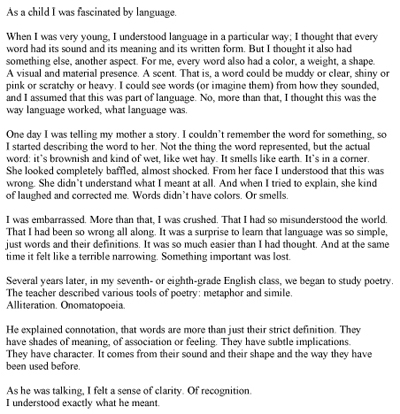
I enjoyed this book, but I especially enjoyed section IX of Zoe Leonard’s piece, which appears on pages 14 and 15. I’ve posted it as an image to preserve the line breaks:
I'm always interested in information about James Castle who used to live a couple blocks from my home now, and his home place is being made into a museum and stopping place for anyone who is interested. I'm eager to see what it will look like when it's open to the public.