

What do you think?

Hal & Roger Hunt Adventures #12
Cannibal Adventure
Hal and Roger Hunt explore a wild and dangerous island, Papua New Guinea. They tackle man-eating crocodiles, cannibals, and even a dragon. Their old enemy Kaggs wants revenge.
246 pages
First published January 1, 1973
About the author
Willard Price
150 books83 followersWillard DeMille Price was born in Peterborough, Ontario, and moved to the US when he was four. He got his MA and Litt.D from Columbia. He held a special interest for natural history, ethnology and exploration and made numerous expeditions for the American Museum of Natural History and the National Geographic Society. Price also went on to edit various magazines on travel and world affairs and spent six years working in Japan as foreign correspondent for New York and London newspapers. He travelled in seventy-seven countries before his death in 1983.
Ratings & Reviews
Friends & Following
Create a free account to discover what your friends think of this book!
Community Reviews
Displaying 1 - 17 of 17 reviews

September 2, 2011
I read most of Willard Prices adventure books as a child, but Cannibal Adventure was not one of these. I was very happy to find the book in 2003, but unfortunately I found it to be rather derogatory and insulting towards the people of PNG. I happened to be living in PNG at the time and found myself rather embarrassed to be reading it.
I know attitudes at the time of writing were rather different to those of today, but I still wish Willard Price had taken the time to understand the people he was writing about.
I know attitudes at the time of writing were rather different to those of today, but I still wish Willard Price had taken the time to understand the people he was writing about.

January 17, 2021
First one I ever got in 1993 😭
July 30, 2020
Having finished up near Australia, the Hunt brothers next move onto New Guinea in their hunt for exotic animals. Having seen the colonial and racist mindset of some of the writing in the books based in Africa, particularly “African Adventure”, I was a little worried that would return here, particularly as the book was titled “Cannibal Adventure”, which already seemed to have cast the local population with an unfair reputation.
It certainly seems that way when the brothers land on New Guinea and are approached by a local village, who they astound and befriend with their own brand of magic, which results in the village witch doctor being banished from the village and vowing revenge. This revenge takes the form of Merlin Kaggs, who has recently escaped from prison in Australia and lucks upon this with doctor when he lands on New Guinea himself. Whilst the Hunts are making themselves a vital part of the village by teaching them new ways of doing things, so the villagers help the Hunts catch some of their animals and make them welcome, with Kaggs in the background doing his best to make sure they don’t leave alive, with or without any animals.
This novel is a bit of a turn around from many of the others, as it’s largely character driven, in the way that the Hunts and Captain Ted assimilate into the local culture and learn the language, as well as introducing them to their way of doing things. Indeed, whereas many of the books previously drew from Price’s experience as a natural history journalist, this seems to have been written more from the point of view of an anthropologist, dealing more with culture than animals. Indeed, the animals that the Hunts have been sent to New Guinea to capture largely appear in the story as an afterthought, with a large number of animals being captured easily and in a short space of time, almost as if Price himself was bored with writing about this aspect of the story and needed to get it out of the way before going back to what interested him more.
This change of approach brings home a larger cast of characters than normal and it’s rare that any character should have a back story, which makes Kaggs’ actions in prison a strange thing to see on these pages. Whilst the villagers aren’t often included in detail, several of them are named and they have their own stories in places, as well as important parts of the story and none of them appear and vanish as needed for the story, as has happened so often with other books. Neither are they bunched together as a collective, which has also happened in other novels, which is an improvement on the way other cultures have been written in this series. Certainly in terms of characters, this is one of the best written books in the series so far, with Price seemingly finally got the hang of character building, 12 books in.
The problem with the tone of the novel is that it relies heavily on the advanced white man being far superior to the local savages. From the very first meeting where they defeat the witch doctor by overcoming his curse and amazing the locals with simple things like dentures, a mirror and a match, the whole attitude is that modern life is far better, despite the villagers having a happy existence. Indeed, when there is a battle with the other village, it is the Captain who is the victor and comes up with the tactical idea and there is some mocking of their way of life and a supposedly comedic moment where they go aboard the ship and have their first experience with glass. It’s not quite as overtly racist as in “African Adventure”, which was particularly uncomfortable to read, but it does speak of a modern privilege and a lack of acceptance of other cultures which doesn’t sit well in these modern times and the surprise Hal feels when he realises that the village chief is picking up English as easily as he is picking up the local language is highly insulting.
This is a shame, as the wider scope of the novel away from animals and more towards characters and anthropology made it one of the more interesting ones in the series. But the refusal to treat the villagers as equals in the narrative is highly disappointing and takes a huge amount of the shine off the novel. Price has written worse than this in terms of cultural ignorance, but he hasn’t written much better in terms of the characters and I find myself wanting to like this novel and wanting to hate it at the same time, which is a complicated way to feel.
It certainly seems that way when the brothers land on New Guinea and are approached by a local village, who they astound and befriend with their own brand of magic, which results in the village witch doctor being banished from the village and vowing revenge. This revenge takes the form of Merlin Kaggs, who has recently escaped from prison in Australia and lucks upon this with doctor when he lands on New Guinea himself. Whilst the Hunts are making themselves a vital part of the village by teaching them new ways of doing things, so the villagers help the Hunts catch some of their animals and make them welcome, with Kaggs in the background doing his best to make sure they don’t leave alive, with or without any animals.
This novel is a bit of a turn around from many of the others, as it’s largely character driven, in the way that the Hunts and Captain Ted assimilate into the local culture and learn the language, as well as introducing them to their way of doing things. Indeed, whereas many of the books previously drew from Price’s experience as a natural history journalist, this seems to have been written more from the point of view of an anthropologist, dealing more with culture than animals. Indeed, the animals that the Hunts have been sent to New Guinea to capture largely appear in the story as an afterthought, with a large number of animals being captured easily and in a short space of time, almost as if Price himself was bored with writing about this aspect of the story and needed to get it out of the way before going back to what interested him more.
This change of approach brings home a larger cast of characters than normal and it’s rare that any character should have a back story, which makes Kaggs’ actions in prison a strange thing to see on these pages. Whilst the villagers aren’t often included in detail, several of them are named and they have their own stories in places, as well as important parts of the story and none of them appear and vanish as needed for the story, as has happened so often with other books. Neither are they bunched together as a collective, which has also happened in other novels, which is an improvement on the way other cultures have been written in this series. Certainly in terms of characters, this is one of the best written books in the series so far, with Price seemingly finally got the hang of character building, 12 books in.
The problem with the tone of the novel is that it relies heavily on the advanced white man being far superior to the local savages. From the very first meeting where they defeat the witch doctor by overcoming his curse and amazing the locals with simple things like dentures, a mirror and a match, the whole attitude is that modern life is far better, despite the villagers having a happy existence. Indeed, when there is a battle with the other village, it is the Captain who is the victor and comes up with the tactical idea and there is some mocking of their way of life and a supposedly comedic moment where they go aboard the ship and have their first experience with glass. It’s not quite as overtly racist as in “African Adventure”, which was particularly uncomfortable to read, but it does speak of a modern privilege and a lack of acceptance of other cultures which doesn’t sit well in these modern times and the surprise Hal feels when he realises that the village chief is picking up English as easily as he is picking up the local language is highly insulting.
This is a shame, as the wider scope of the novel away from animals and more towards characters and anthropology made it one of the more interesting ones in the series. But the refusal to treat the villagers as equals in the narrative is highly disappointing and takes a huge amount of the shine off the novel. Price has written worse than this in terms of cultural ignorance, but he hasn’t written much better in terms of the characters and I find myself wanting to like this novel and wanting to hate it at the same time, which is a complicated way to feel.

November 28, 2014
I wish I could find the hardcover versions I used to love!

January 6, 2025
An explosive and eerie adventure set in the world's 'wildest' island.
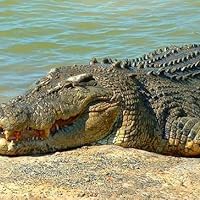
Hal and Roger along with Captain Ted Murphy embark on a thrilling quest to capture New Guinea's fascinating wildlife specimens. As the title suggests , the book is set in the village of a cannibalistic indigenous tribe with whom they become firm friends. As expected, they confront sinister antagonists along the way , a witch doctor and an unexpected but familiar foe , Merlin Kaggs. Tussles with a giant saltwater crocodile, Komodo dragon, Taipan were entertaining and Price as usual fills us up with information about all the animals captured.
The supporting characters in this book are well developed for a change. Commenably, Price depicts two such figures glowingly, Pavo , the village chief and Pug , a boy of Roger's age who befriends him. Both of them put their lives on the line several times to protect Hal and Roger. The cultural exchange is rich and positive between the boys and the islanders. Kaggs' stunning return makes the story sinister as he tricks his way out of an Australian Prison to seek revenge on the boys allying with the witch doctor to do so.
As always, Price has unfairly received criticism from readers of being condescending and racist. In this book , when Roger says the islanders have the disgusting practice of headhunting, Hal argues that for every hundred heads taken, civilized men take a million lives in war. When a tribal woman nurses Roger , her smile reminded him of his mother. Hal reminds Roger that they're safe in the village at night unlike New York and Chicago.
The islanders especially Pavo and Pug are anxious to learn new things from the Hunts and the villagers are open minded and excited after being introduced to modern goods. After all , the example of Kaggs proves that a so called civilised man is more vengeful than any savage or beast.
Cannibal Adventure is testament to the fact that Civilisational cooperation is possible if it's based on mutual respect.
As Hal said "Take your hat off for the Headhunters". The so called Savage can be Civilised and the the so called Civilised can be Savage.
Hal and Roger along with Captain Ted Murphy embark on a thrilling quest to capture New Guinea's fascinating wildlife specimens. As the title suggests , the book is set in the village of a cannibalistic indigenous tribe with whom they become firm friends. As expected, they confront sinister antagonists along the way , a witch doctor and an unexpected but familiar foe , Merlin Kaggs. Tussles with a giant saltwater crocodile, Komodo dragon, Taipan were entertaining and Price as usual fills us up with information about all the animals captured.
The supporting characters in this book are well developed for a change. Commenably, Price depicts two such figures glowingly, Pavo , the village chief and Pug , a boy of Roger's age who befriends him. Both of them put their lives on the line several times to protect Hal and Roger. The cultural exchange is rich and positive between the boys and the islanders. Kaggs' stunning return makes the story sinister as he tricks his way out of an Australian Prison to seek revenge on the boys allying with the witch doctor to do so.
As always, Price has unfairly received criticism from readers of being condescending and racist. In this book , when Roger says the islanders have the disgusting practice of headhunting, Hal argues that for every hundred heads taken, civilized men take a million lives in war. When a tribal woman nurses Roger , her smile reminded him of his mother. Hal reminds Roger that they're safe in the village at night unlike New York and Chicago.
The islanders especially Pavo and Pug are anxious to learn new things from the Hunts and the villagers are open minded and excited after being introduced to modern goods. After all , the example of Kaggs proves that a so called civilised man is more vengeful than any savage or beast.
Cannibal Adventure is testament to the fact that Civilisational cooperation is possible if it's based on mutual respect.
As Hal said "Take your hat off for the Headhunters". The so called Savage can be Civilised and the the so called Civilised can be Savage.

January 13, 2020
Willard Price’s Adventure series will always hold a special place in my heart, inspiring a lifelong love of reading and exotic animals and locations. Reading now, I can still see what attracted me to the series in the first place, but am unable to ignore the glaring faults. It’s overly simplistic fare, which is fine, but also full of scientific and geographic inaccuracies and dated ideals, particularly when it comes to that of indigenous populations. I was surprised by how bloodthirsty this book was... the body count is wild. Although Cannibal Adventure hasn’t exactly held up in these modern, more sophisticated times, I still have a burning desire to read through the entirety of the series again - for old time’s sake.
February 24, 2021
Good adventure, the 12th i have read in this 14 book series.
Hal and Roger find themselves in Papua New Guinea amongst head hunting tribes but while some of the language being used to describe the natives would be a bit old fashioned now they are far from savage, helping the boys many times.
The usual perils are there, wild beadts and witch doctors, but the boys greatest enemy Kaggs is surely safely in prison, isn't he...?
Hal and Roger find themselves in Papua New Guinea amongst head hunting tribes but while some of the language being used to describe the natives would be a bit old fashioned now they are far from savage, helping the boys many times.
The usual perils are there, wild beadts and witch doctors, but the boys greatest enemy Kaggs is surely safely in prison, isn't he...?

Read
January 17, 2022Good youth fiction as I noted but I wanted it for research on Indonesia which it provided as well as an action setting and some adventure which demands some attention as if one were a responsible adult but you never expect gory details in such a book anyway.

July 5, 2018
Action, adventure, survival, environment, conservation...
I loved these books when I was a kid. At the time, they seemed to border on sci-fi regarding the at-the-time-amazing technology the boys used.
Of course, looking back you can see how these stories are flawed, but I still think they are enjoyable. In fact, it would make for a really interesting middle school science project for children to read one of these books and then compare them with the knowledge of the world and technology we have today.
I loved these books when I was a kid. At the time, they seemed to border on sci-fi regarding the at-the-time-amazing technology the boys used.
Of course, looking back you can see how these stories are flawed, but I still think they are enjoyable. In fact, it would make for a really interesting middle school science project for children to read one of these books and then compare them with the knowledge of the world and technology we have today.
July 22, 2019
One of my favourites when I was younger, Cannibal Adventure is set on the wild island of New Guinea where cannibalism is still practiced amongst the natives. Because I knew least about this strange island with primeval wildlife and even stranger peoples, I never knew quite how much of the content was fabricated or straight up invented. Hal and Roger are tasked to capture specimens such as saltwater crocs, komodo dragons, taipans, flying foxes and birds of paradise, all of which are rare and worth a fortune. During their trip, they manage to befriend a village of savages, make an enemy of a witch doctor, and run into their old nemesis Kaggs, who has escaped from prison and is determined to do them in once and for all.
Like all the Willard Price books, this one is highly informative, introducing the reader to the stone age culture of the cannibals and the strangest menagerie yet encountered. Some may disagree, but it rarely feels like the facts are shoehorned in; except perhaps when Hal decides to give his brother a natural history lecture whilst running for their lives. There are a few inconsistency errors again, but not nearly as glaring as those in the previous book. My main complaint is an underwater scene towards the end which is recycled word for word from Underwater Adventure. It amounts to shameless self plagiarism.
Like all the Willard Price books, this one is highly informative, introducing the reader to the stone age culture of the cannibals and the strangest menagerie yet encountered. Some may disagree, but it rarely feels like the facts are shoehorned in; except perhaps when Hal decides to give his brother a natural history lecture whilst running for their lives. There are a few inconsistency errors again, but not nearly as glaring as those in the previous book. My main complaint is an underwater scene towards the end which is recycled word for word from Underwater Adventure. It amounts to shameless self plagiarism.

May 10, 2009
The last decent Adventure of the series focuses on capturing the fauna of Papua New Guinea. There are some effective action sequences, but Kaggs' return is rather disappointing - for such a clever villain, his attempts to wipe out the Hunts seem uncharacteristically weak.
July 22, 2010
These books were wonderful ways of escaping to exotic shores when I was growing up; a fantastic alternative to Enid Blyton!
October 21, 2010
Fast, great book that makes nerves pump.

November 1, 2010
Here is my review: http://www.learntodivetoday.co.za/blo...

wishlist
March 3, 2011Hal & Roger ke papua..:)

September 8, 2012
I loved for these books when I was about 11 and learned A LOT about animals and geography from them
January 31, 2017
too awesome
Displaying 1 - 17 of 17 reviews