

What do you think?

Inspector Chen Cao #3
When Red Is Black
Inspector Chen Cao of the Shanghai Police Bureau is taking a vacation, in part because he is annoyed at his boss, Party Secretary Li, but also because he has been made an offer he can’t refuse by Gu, a triad-connected businessman. For what seems to be a fortune—with no apparent strings attached— he is to translate a business proposal for the New World, a complex of shops and restaurants to be built in Central Shanghai, evoking nostalgia for the “glitter and glamour” of the 1930s.
It is up to Detective Yu, Chen’s partner, to take charge of a new case. Yin, a novelist, has been murdered in her room. At first it seems that only a neighbor could have committed the crime, but when one confesses, Yu cannot believe that he is really the killer. As Yu looks further into Yin’s life, ample motives begin to surface, even on the part of Internal Security. But it is only when Inspector Chen steps back into the investigation that the culprit is apprehended. And then Chen discovers how Gu has played him and how he, in turn, can play the new capitalist system.
It is up to Detective Yu, Chen’s partner, to take charge of a new case. Yin, a novelist, has been murdered in her room. At first it seems that only a neighbor could have committed the crime, but when one confesses, Yu cannot believe that he is really the killer. As Yu looks further into Yin’s life, ample motives begin to surface, even on the part of Internal Security. But it is only when Inspector Chen steps back into the investigation that the culprit is apprehended. And then Chen discovers how Gu has played him and how he, in turn, can play the new capitalist system.
310 pages, Paperback
First published January 1, 2004
About the author
Qiu Xiaolong
67 books503 followersQiu Xiaolong (裘小龙) was born in Shanghai, China. He is the author of the award-winning Inspector Chen series of mystery novels, Death of a Red Heroine (2000), A Loyal Character Dancer (2002), When Red Is Black (2004), A Case of Two Cities (2006), Red Mandarin Dress (2007), and The Mao Case (2009). He is also the author of two books of poetry translations, Treasury of Chinese Love Poems (2003) and Evoking T'ang (2007), and his own poetry collection, Lines Around China (2003). Qiu's books have sold over a million copies and have been published in twenty languages. He currently lives in St. Louis with his wife and daughter.
Ratings & Reviews
Friends & Following
Create a free account to discover what your friends think of this book!
Community Reviews
Displaying 1 - 30 of 275 reviews

September 26, 2020
I loved the previous entries in this series, however this one didn't quite engage me to the same level. The story seemed to plod just a bit. However, learning more about Chinese culture was truly interesting. Additionally, the food was as intriguing and mouthwatering as usual. Inspector Chen Cao is also a poet and it is a treat to listen to the narrator read the poetry that is included.
I also enjoyed learning about the network of people swapping forbidden literature, in an underground book club of sorts. New books obtained from "outside contacts" were prized and passed clandestinely from member to member. Each person had just one day to read the book before passing it to the next person.
Favorite lines:
"People here still seemed to be covered with the dust of the past, just like the Shikumen building itself. To be more exact, they were still living in the shadow of the Cultural Revolution. The government called on the people to look forward never turning their head back."
"She had long since accepted the truism that happiness comes only n contentment." I thought about this as I walked my dog while listening.
"The clouds eager to make
your dancing costume, the peony,
to imitate your beauty, the spring breeze
touching the rail, the petal glistening with dew........ "
by Tang dynasty poet Li Bai.
I also enjoyed learning about the network of people swapping forbidden literature, in an underground book club of sorts. New books obtained from "outside contacts" were prized and passed clandestinely from member to member. Each person had just one day to read the book before passing it to the next person.
Favorite lines:
"People here still seemed to be covered with the dust of the past, just like the Shikumen building itself. To be more exact, they were still living in the shadow of the Cultural Revolution. The government called on the people to look forward never turning their head back."
"She had long since accepted the truism that happiness comes only n contentment." I thought about this as I walked my dog while listening.
"The clouds eager to make
your dancing costume, the peony,
to imitate your beauty, the spring breeze
touching the rail, the petal glistening with dew........ "
by Tang dynasty poet Li Bai.

July 16, 2016
When Red is Black is the third in the Inspector Chen Cao series. I very much enjoyed this installment in the series. Qiu Xiaolong has created my favorite kind of international mystery series. I learn about the history, culture, literature, and politics of China, along with a well-plotted murder mystery. Like P.D. James' detective Adam Dalgliesh, Chen is a poet, and these books are actually filled with poetry, both classical Chinese poetry and Chen's (Qiu's) own poetry. I learned that Chinese novels often include poetry and Qiu Xiaolong's mysteries incorporate this feature. So how much do I like all of these elements? A lot. Qiu has become one of my favorite authors.
This book is has a strange twist: Inspector Chen is on "vacation" because he has been asked to translate a business plan for a known triad boss named Gu. Mr. Gu is also a real estate developer and he wants to create a large tourist-oriented complex in Shanghai that will attract visitors who are interested in Shanghinese history and culture. Gu needs the plan translated into English to present to foreign investors. Of course, why hire a police officer for this work? Even one with a minor reputation as a translator? All will be revealed. The complex will be designed in the shikumen style, which originated in the mid-19th century and continued into the 1930s. Ironically, these beautiful houses that were once inhabited by Shanghai elites, both European and Chinese, at the time the novel is set -- the early 1990s --are now occupied by maybe 10 or 12 families, up to 100 people. No longer the height of elegance and style, these once-fashionable houses are run down and chopped into little rooms. There's a severe housing shortage at this time in Shanghai, so every nook and cranny might become a living space. And a murder has occurred in a shikumen located on Treasure Garden Lane. The victim is a middle aged woman named Yin, an ex-Red Guard who fell out of favor when she wrote a novel denouncing the Cultural Revolution, called Death of a Chinese Professor. The novel told the fictionalized story of the death of Yin's lover, Yang, a much-older professor and translator. But she wrote that book many years ago. Who would want to kill her now? With Chen out on vacation, Inspector Yu, Chen's partner, has taken responsibility for the investigation. Yu and his wife Peiqin are important secondary characters and I was happy to see him take a more prominent role in this book. But Chen's research on the 1920s and 1930s, when Shanghai was touted as the Paris of the East, was also fascinating; although I thought Chen's project for Gu was a little contrived, it gave Qiu the opportunity to reveal more about the history of Shanghai and also gave Yu the opportunity to take center stage.
One reviewer who is vegan really doesn't like Qiu's frequent descriptions of Shanghainese food, but food is a major part of the culture. Haven't we all heard about the unusual things that people eat in China? It's something that American visitors always talk about. These books are like Anthony Bourdain goes to China. Nearly every meal features a new exotic dish. There's absolutely no way I would eat most of this food -- and I'm not even a vegetarian. But I understand its importance in Qiu's portrayal of life in Shanghai.
Finally, poetry. I flagged instances of beautiful poetry and passages about the importance of literature. This aspect greatly enhances my appreciation of Qiu's series. Inspector Chen is often reminded of a passage of poetry. Here's one I especially liked (p. 174):
The moon appears like a hook.
The lone parasol tree locks the clear autumn
in the deep courtyard.
What cannot be cut,
nor raveled,
is the sorrow of separation.
Nothing tastes like that to the heart...
True confession: One reason that I enjoy reading about Shanghai is that my library has a collection of photographs from the 1930s and 1940s taken in Shanghai's Jewish ghetto. It was a haven for refugees before and during World War II. I have a soft spot for the Shanghainese who welcomed these families when the rest of the world turned them away. If you want to see the photos, here's a link: digitalcollections.lmu.edu/cdm/landin....
This book is has a strange twist: Inspector Chen is on "vacation" because he has been asked to translate a business plan for a known triad boss named Gu. Mr. Gu is also a real estate developer and he wants to create a large tourist-oriented complex in Shanghai that will attract visitors who are interested in Shanghinese history and culture. Gu needs the plan translated into English to present to foreign investors. Of course, why hire a police officer for this work? Even one with a minor reputation as a translator? All will be revealed. The complex will be designed in the shikumen style, which originated in the mid-19th century and continued into the 1930s. Ironically, these beautiful houses that were once inhabited by Shanghai elites, both European and Chinese, at the time the novel is set -- the early 1990s --are now occupied by maybe 10 or 12 families, up to 100 people. No longer the height of elegance and style, these once-fashionable houses are run down and chopped into little rooms. There's a severe housing shortage at this time in Shanghai, so every nook and cranny might become a living space. And a murder has occurred in a shikumen located on Treasure Garden Lane. The victim is a middle aged woman named Yin, an ex-Red Guard who fell out of favor when she wrote a novel denouncing the Cultural Revolution, called Death of a Chinese Professor. The novel told the fictionalized story of the death of Yin's lover, Yang, a much-older professor and translator. But she wrote that book many years ago. Who would want to kill her now? With Chen out on vacation, Inspector Yu, Chen's partner, has taken responsibility for the investigation. Yu and his wife Peiqin are important secondary characters and I was happy to see him take a more prominent role in this book. But Chen's research on the 1920s and 1930s, when Shanghai was touted as the Paris of the East, was also fascinating; although I thought Chen's project for Gu was a little contrived, it gave Qiu the opportunity to reveal more about the history of Shanghai and also gave Yu the opportunity to take center stage.
One reviewer who is vegan really doesn't like Qiu's frequent descriptions of Shanghainese food, but food is a major part of the culture. Haven't we all heard about the unusual things that people eat in China? It's something that American visitors always talk about. These books are like Anthony Bourdain goes to China. Nearly every meal features a new exotic dish. There's absolutely no way I would eat most of this food -- and I'm not even a vegetarian. But I understand its importance in Qiu's portrayal of life in Shanghai.
Finally, poetry. I flagged instances of beautiful poetry and passages about the importance of literature. This aspect greatly enhances my appreciation of Qiu's series. Inspector Chen is often reminded of a passage of poetry. Here's one I especially liked (p. 174):
The moon appears like a hook.
The lone parasol tree locks the clear autumn
in the deep courtyard.
What cannot be cut,
nor raveled,
is the sorrow of separation.
Nothing tastes like that to the heart...
True confession: One reason that I enjoy reading about Shanghai is that my library has a collection of photographs from the 1930s and 1940s taken in Shanghai's Jewish ghetto. It was a haven for refugees before and during World War II. I have a soft spot for the Shanghainese who welcomed these families when the rest of the world turned them away. If you want to see the photos, here's a link: digitalcollections.lmu.edu/cdm/landin....

May 26, 2013
What a great book. I love Xiaolong because he gives me an insight into an alien world - all the more fascinating because it is a world that actually exists; China. A former Red Guard is found murdered. Known for a book she has written about the Cultural revolution, her death could be an embarrassment for the State - they can already see the headlines "Dissident Dies!". Inspector Chen has taken time off to carry out a very lucrative translation so Yu investigates.
This book is actually about the nastiness of the Cultural Revolution and the present-day pains of a China which has abandoned Maoism for a society based on the old, equally questionable values of a society based on contacts, nepotism and social unfairness.
The book is almost depressing as one reads about the living conditions of the ordinary Chinese, of the loss of status of men and women who once played their part in trying to create a better world and seen their hopes, dreams and sacrifices ripped apart. Somehow they struggle through the unfairness of the world they find themselves in.
Food plays an interesting side-role and gives us another dimension through which we can view this world.
Reading this book I kept thinking back to other books which tried to depict the unfairness of society and of the struggle of individuals to carve out some sort of future and my thoughts constantly returned to "Man's Estate" and how little has really been achieved by the Chinese in this century.
This book is actually about the nastiness of the Cultural Revolution and the present-day pains of a China which has abandoned Maoism for a society based on the old, equally questionable values of a society based on contacts, nepotism and social unfairness.
The book is almost depressing as one reads about the living conditions of the ordinary Chinese, of the loss of status of men and women who once played their part in trying to create a better world and seen their hopes, dreams and sacrifices ripped apart. Somehow they struggle through the unfairness of the world they find themselves in.
Food plays an interesting side-role and gives us another dimension through which we can view this world.
Reading this book I kept thinking back to other books which tried to depict the unfairness of society and of the struggle of individuals to carve out some sort of future and my thoughts constantly returned to "Man's Estate" and how little has really been achieved by the Chinese in this century.

June 1, 2011
I'll be honest: I wouldn't recommend this series to anyone looking for unputdownable mysteries. The mystery part of any of the three books I've read so far just isn't strong enough to make it compelling for me. But the characters and everything else are. Chen, Yu and Peiqin really come alive in these pages, and so while I may not read this to find out who is the killer but rather to find out what Yu, Peiqin and Chen do to find out in the end what matters is that it is a well-written and engaging series.
I may have to take a short break from reading this series, however, because it can be very depressing at times. Since Chen is in a very different position from Shan of Pattison's Tibet books, it's not quite so obviously bad - Chen is struggling to find his place and peace of mind as someone working within in the system, and the many injustices aren't discussed as openly as in Pattison's books. But what I found most striking and upsetting in this book was how flexible justice and truth can be. I know that that's how life is, even here, but when you are forced to think about it like that it can be somewhat unsettling.
And even though this may sound ridiculous to some, reading about the delicacies of Shanghaian cuisine really is a bit much for me at times. You know, being a vegan and all. (The same is true for all books where they're eating a lot, though. I never noticed that sort of thing before, but it can actually be sickening.)
I may have to take a short break from reading this series, however, because it can be very depressing at times. Since Chen is in a very different position from Shan of Pattison's Tibet books, it's not quite so obviously bad - Chen is struggling to find his place and peace of mind as someone working within in the system, and the many injustices aren't discussed as openly as in Pattison's books. But what I found most striking and upsetting in this book was how flexible justice and truth can be. I know that that's how life is, even here, but when you are forced to think about it like that it can be somewhat unsettling.
And even though this may sound ridiculous to some, reading about the delicacies of Shanghaian cuisine really is a bit much for me at times. You know, being a vegan and all. (The same is true for all books where they're eating a lot, though. I never noticed that sort of thing before, but it can actually be sickening.)

December 4, 2015


Description: Crime drama set in early 1990s Shanghai. When Chen agrees to do a translation job for a property developer he is given a laptop, a 'little secretary' to provide for his every need, and medical care for his mother. There are, it seems, no strings attached . . . and then the murder of a dissident writer is reported.
Director: David Hunter
The third dramatisation in the Inspector Chen series, following on from Death of a Red Heroine & A Loyal Character Dancer.
When the murder of a dissident writer is reported Sergeant Yu is forced to take charge of the investigation. The victim, a middle-aged teacher with a dissident past and a book notorious in the West, has been found dead in her tiny room in a converted multi-family house. It is only when Chen, on leave to complete a lucrative translation project gets involved, and the past excavated, that the murderer is eventually found.
Qiu Xiaolong was born in Shanghai, China. As well as writing the award-winning Inspector Chen series of mystery novels, he is also the author of two books of poetry translations, Treasury of Chinese Love Poems (2003) and Evoking T'ang (2007), and his own poetry collection, Lines Around China (2003). Qiu's books have sold over a million copies and have been published in twenty languages. He lives in St. Louis, USA with his wife and daughter.
3.5* Death of a Red Heroine (Inspector Chen Cao #1)
3* A Loyal Character Dancer (Inspector Chen Cao #2)
3* When Red Is Black (Inspector Chen Cao #3)

December 14, 2022
a well told detective story set in Shanghai

February 23, 2019
Das dritte Buch in der Serie um den Inspektor Chen Cao war leider eine ziemliche Enttäuschung.
Inspektor Chen und sein Mitarbeiter Yu sind sympathische Ermittler im Shanghai der ausgehenden 1990er, das den Kommunismus Maos endgültig hinter sich gelassen hat und von einem ungemilderten Kapitalismus beherrscht wird: Schwarz folgt auf Rot. Dieser Umbau wirkt sich auch auf Leben und Arbeit des Ermittlerduos aus.
Chen, Parteimitglied und Leiter einer Abteilung für brisante, politische Morde, erhält von einem neureichen Immobilienunternehmer mit Triadenverbindungen einen lukrativen Auftrag, während sein Kommissar Yu den Mord an einer Schriftstellerin aufklären soll, die in einem alten, völlig heruntergekommenen Wohnviertel Shanghais unter ärmlichen Bedingungen gelebt hat.
Allein diese Konstellation hätte das Rezept für einen spannenden Krimi sein können, wenn der Mordfall nicht so uninspiriert langweilig gewesen wäre. Vom Opfer erfährt man kaum etwas, die ermordete Frau erscheint selbst den Ermittlern unwichtig, die Verdächtigen unterscheiden sich nur im Namen voneinander, obwohl sich die Befragungen endlos hinziehen, die Auflösung hängt eher vom Zufall als der Leistung der Kriminalisten ab.
Da auch das Shanghai der 90er nicht durch Handlung oder Dialoge, sondern vor allem in unerträglich langatmigen, trockenen Vorträgen von Nebenfiguren präsentiert wurde, konnte ich keinen Stern für den eigentlich spannungsreichen historischen Hintergrund vergeben.
Inspektor Chen und sein Mitarbeiter Yu sind sympathische Ermittler im Shanghai der ausgehenden 1990er, das den Kommunismus Maos endgültig hinter sich gelassen hat und von einem ungemilderten Kapitalismus beherrscht wird: Schwarz folgt auf Rot. Dieser Umbau wirkt sich auch auf Leben und Arbeit des Ermittlerduos aus.
Chen, Parteimitglied und Leiter einer Abteilung für brisante, politische Morde, erhält von einem neureichen Immobilienunternehmer mit Triadenverbindungen einen lukrativen Auftrag, während sein Kommissar Yu den Mord an einer Schriftstellerin aufklären soll, die in einem alten, völlig heruntergekommenen Wohnviertel Shanghais unter ärmlichen Bedingungen gelebt hat.
Allein diese Konstellation hätte das Rezept für einen spannenden Krimi sein können, wenn der Mordfall nicht so uninspiriert langweilig gewesen wäre. Vom Opfer erfährt man kaum etwas, die ermordete Frau erscheint selbst den Ermittlern unwichtig, die Verdächtigen unterscheiden sich nur im Namen voneinander, obwohl sich die Befragungen endlos hinziehen, die Auflösung hängt eher vom Zufall als der Leistung der Kriminalisten ab.
Da auch das Shanghai der 90er nicht durch Handlung oder Dialoge, sondern vor allem in unerträglich langatmigen, trockenen Vorträgen von Nebenfiguren präsentiert wurde, konnte ich keinen Stern für den eigentlich spannungsreichen historischen Hintergrund vergeben.

September 30, 2017
Another really good book in this series by the dissident Chinese writer Xiaolong. I like the characters of Chen and Lu a lot and the descriptions of life in China in the 1990's seem very well done.

August 8, 2020
I am really enjoying this series as an audiobook.

March 5, 2026
Altro libro piacevole dell'isepttore Chen, che in questo terzo volume rimane comunque un po' sullo sfondo, impegnato in un lavoro di tradizione per Gao e in una lenta e combattuta scivolata nel reame oscuro dei favori in una società in rapido sviluppo e preda di cambiamenti della società come quella cinese degli anni dell'apertura all'occidente.
E così mentre Chen è troppo impegnato in questa sua attività collaterale (e a combattere sé stesso per la vicinanza forzata a Nuvola, ora sua temporanea segretaria personale) per indagare veramente o anche solo per fare il gourmet come suo solito, questi compiti ricadono su Yu.
Sarà lui a svolgere le indagini, che peraltro sono molto letterarie stavolta riguardando l'omicidio di una scrittrice dissidente nonché ex guardia rossa. Un personaggio scomodo, politico in più modi.
Peraltro Yu ha già perso l'appartamento assegnatogli alla fine del secondo libro, a causa dei giochi di potere tra agenzie e all'interno dello stesso partito, con Li che comincia a temere l'ascesa di Chen (di cui Tu è un uomo, per cui colpire lui si ripercuote sull'ispettore senza attaccarlo direttamente). E per risolvere questo caso guadagnando credito servirà anche l'aiuto della moglie, intelligente e acculturata, capace di vedere cose che nemmeno Chen ha notato.
Un altro bello spaccato di quella Cina in cambiamento, che riporta alla luce un altro periodo "dimenticato", con le scuole di partiti per ricollocare e togliere di mezzo persone ormai ingombranti e inutili alle aspirazioni del dittatore, dopo averle spremute fino all'ultimo.
E così mentre Chen è troppo impegnato in questa sua attività collaterale (e a combattere sé stesso per la vicinanza forzata a Nuvola, ora sua temporanea segretaria personale) per indagare veramente o anche solo per fare il gourmet come suo solito, questi compiti ricadono su Yu.
Sarà lui a svolgere le indagini, che peraltro sono molto letterarie stavolta riguardando l'omicidio di una scrittrice dissidente nonché ex guardia rossa. Un personaggio scomodo, politico in più modi.
Peraltro Yu ha già perso l'appartamento assegnatogli alla fine del secondo libro, a causa dei giochi di potere tra agenzie e all'interno dello stesso partito, con Li che comincia a temere l'ascesa di Chen (di cui Tu è un uomo, per cui colpire lui si ripercuote sull'ispettore senza attaccarlo direttamente). E per risolvere questo caso guadagnando credito servirà anche l'aiuto della moglie, intelligente e acculturata, capace di vedere cose che nemmeno Chen ha notato.
Un altro bello spaccato di quella Cina in cambiamento, che riporta alla luce un altro periodo "dimenticato", con le scuole di partiti per ricollocare e togliere di mezzo persone ormai ingombranti e inutili alle aspirazioni del dittatore, dopo averle spremute fino all'ultimo.

February 22, 2024
Un bel caso di omicidio che ha le sue radici nel mondo letterario della Cina della Rivoluzione Culturale. Un amore che non può essere coronato dal matrimonio a causa delle proibizioni nei confronti degli intellettuali; un libro autobiografico ritenuto sovversivo; il tentativo di scrivere un retelling del Dottor Zivago cinese. E il tutto con l'ispettore Chen impegnato in una traduzione dal cinese all'inglese molto remunerativa che ha ben poco di letterario (il progetto di ricostruire con le nuove tecnologie delle case in zone caratteristiche di Shangai, utilizzando lo stesso stile architettonico anni '30 delle case che si trovavano lì), per cui le indagini cadono quasi tutte sulle spalle di Yu, che ha dovuto appena inghiottire il boccone amaro di vedersi rifiutare il nuovo appartamento di due stanze che gli era stato assegnato, continuando a vivere con moglie e figlio in una stanza di 14 metri quadrati.
Purtroppo non sono riuscita ad apprezzare il romanzo quanto mi sarebbe piaciuto, ma è colpa mia: in questo periodo mi distraggo troppo facilmente. Per fortuna avevo letto qualche libro ambientato in Cina durante la Rivoluzione culturale, per cui sapevo all'incirca come venivano rieducati gli intellettuali.
Però... in un libro che parla di traduzioni e di sfumature di significato delle parole, mi sarei aspettata che il traduttore utilizzasse il trapassato prossimo! Ma ormai devo convincermi della sua morte, purtroppo, anche se non mi rassegnerò mai.
Purtroppo non sono riuscita ad apprezzare il romanzo quanto mi sarebbe piaciuto, ma è colpa mia: in questo periodo mi distraggo troppo facilmente. Per fortuna avevo letto qualche libro ambientato in Cina durante la Rivoluzione culturale, per cui sapevo all'incirca come venivano rieducati gli intellettuali.
Però... in un libro che parla di traduzioni e di sfumature di significato delle parole, mi sarei aspettata che il traduttore utilizzasse il trapassato prossimo! Ma ormai devo convincermi della sua morte, purtroppo, anche se non mi rassegnerò mai.

October 2, 2017
Plutôt 3,5. J'ai apprécié la peinture de la société citadine chinoise et notamment du problème du logement. L'enquête est assez classique et se lit bien.

April 7, 2010
First Sentence: Detective Yu Guangming of the Shanghai Police Bureau stood alone, still reeling of the blow.
Inspector Chen Cao is taking time off from his role with the police. He has been asked to translate a business proposal for a triad-related businessman. The proposal is for the construction of a new shopping/residential complex in Shanghai called the New World. Both the salary and the benefits are too good to resist, but Chen ultimately finds everything has strings. With Chen unavailable, Sgt. Yu must take charge of the newest investigation.
Yin was a college teacher and novelist living in a tiny room in a multi-family house. While she wasn't well liked, she kept to herself. With the house locked at night, was she murdered by a neighbor? If so, why did they ransack her room but not take her money?
Qiu Xiaolong (pronounced "chew shao-long") has become one of my favorite authors. He creates such a strong sense of place with wonderful descriptions, from the largest panorama to the smallest detail. The inclusion of both Chinese and western poetry is something I so appreciate and enjoy.
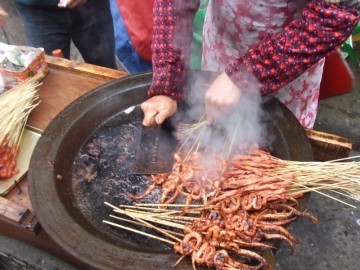
Food plays such a significant role in China. Its inclusion is so well done and, even if some of the particular dishes may not appeal to my western palate, I always end up hungry while reading. There is one particular scene when Chen goes to a restaurant with 1930s European style serving supposedly western food which was very interesting.
I learned so much about life during the Cultural Revolution; a period about which I know virtually nothing. It is interesting to read about the lasting impact on those who lived through it as well as the confusion of living in a rapidly changing China.
I very much enjoy Qui's characters. While I was glad Chen wasn't completely absent from the scene, it was nice to have Yu and his wife, Peiqin, move to the forefront. Not only did I learn more about them and their lives, but saw all the major characters grow and develop as the book progressed.
The story's plot is very effective. I find the difference in the style of questioning fascinating but the process of following the leads is the same in all cultures. My one criticism would be that the confession of the killer seemed abrupt, but that could be a cultural difference as well. I did think the ending was excellent.
I highly recommend "When Red is Black" although, as always, I suggest starting the series at the beginning.
WHEN RED IS BLACK (Pol Proc-Sgt Yu/Insp Chen Cao-Shanghai,
China-Cont/1990s) - VG
Xiaolong, Qiu - 3rd in series
Soho Press, C2004, US Hardcover - ISBN: 1569473692
Inspector Chen Cao is taking time off from his role with the police. He has been asked to translate a business proposal for a triad-related businessman. The proposal is for the construction of a new shopping/residential complex in Shanghai called the New World. Both the salary and the benefits are too good to resist, but Chen ultimately finds everything has strings. With Chen unavailable, Sgt. Yu must take charge of the newest investigation.
Yin was a college teacher and novelist living in a tiny room in a multi-family house. While she wasn't well liked, she kept to herself. With the house locked at night, was she murdered by a neighbor? If so, why did they ransack her room but not take her money?
Qiu Xiaolong (pronounced "chew shao-long") has become one of my favorite authors. He creates such a strong sense of place with wonderful descriptions, from the largest panorama to the smallest detail. The inclusion of both Chinese and western poetry is something I so appreciate and enjoy.
Food plays such a significant role in China. Its inclusion is so well done and, even if some of the particular dishes may not appeal to my western palate, I always end up hungry while reading. There is one particular scene when Chen goes to a restaurant with 1930s European style serving supposedly western food which was very interesting.
I learned so much about life during the Cultural Revolution; a period about which I know virtually nothing. It is interesting to read about the lasting impact on those who lived through it as well as the confusion of living in a rapidly changing China.
I very much enjoy Qui's characters. While I was glad Chen wasn't completely absent from the scene, it was nice to have Yu and his wife, Peiqin, move to the forefront. Not only did I learn more about them and their lives, but saw all the major characters grow and develop as the book progressed.
The story's plot is very effective. I find the difference in the style of questioning fascinating but the process of following the leads is the same in all cultures. My one criticism would be that the confession of the killer seemed abrupt, but that could be a cultural difference as well. I did think the ending was excellent.
I highly recommend "When Red is Black" although, as always, I suggest starting the series at the beginning.
WHEN RED IS BLACK (Pol Proc-Sgt Yu/Insp Chen Cao-Shanghai,
China-Cont/1990s) - VG
Xiaolong, Qiu - 3rd in series
Soho Press, C2004, US Hardcover - ISBN: 1569473692

March 20, 2022
As usual with the Inspector Chen series, the author is more interested in exploring the contradictory aspects of society in so-called Communist China than in pursuing the mystery. In this case, we're faced with the stark differences between the haves and the have-nots in modern Shanghai. A murder occurs in a so-called shikumen house - originally intended as a single family dwelling, now crammed with unrelated people who live in single rooms, or in the case of the murder victim, a cubbyhole under the stairs, cook in the courtyard, and try to survive as socialist safety net deteriorates.
Meanwhile, Chen is being paid a handsome sum by a tycoon linked to a variety of shady businesses to translate a marketing proposal into English, for a project that will transform a shikumen district into a trendy shopping and dining area.
Chen's moral confusion rings true, and I love the way remembered poems echo his emotions. A good man in a corrupt society faces hard choices.
Meanwhile, Chen is being paid a handsome sum by a tycoon linked to a variety of shady businesses to translate a marketing proposal into English, for a project that will transform a shikumen district into a trendy shopping and dining area.
Chen's moral confusion rings true, and I love the way remembered poems echo his emotions. A good man in a corrupt society faces hard choices.

August 7, 2017
A lot of this book revolves around the Cultural Revolution in China, Mao (before, during, after) and how this affected people and their place in the Communist Chinese hierarchy. The Black (capitalists) who were in favor, then criminalized, now back in favor under Deng, and the Red, who were in or out depending on their role before or after the Cultural Revolution, all of this plays an important part in solving the murder and how it's solved. (i.e. finding a politically correct solution) To be honest, I'm not up on all this Chinese history and I can't say I got into this book all that much but it turned out well at the end. Lots of food and poetry too! But once was enough for me with this book and I wouldn't want a second helping.
December 10, 2019
PROTAGONIST: Sergeant Yu
SETTING: Shanghai
SERIES: #3
RATING: 3.25
WHY: Inspector Chen is on vacation doing a lucrative English translation when a young women named Yin Lige who authored a banned book is found murdered. Thus the case is assigned to Chen’s colleague, Sergeant Yu, who is tested by a difficult investigation and the politics involved. Yin was involved with a famed author, Yang, and was the caretaker of some of his manuscripts. The sections dealing with the relationship of Yin the dissident and Yang the talented writer were quite cerebral and had me fighting the Snooze Monster. The pace was further slowed by many poetic allusions. When the book focused on the investigation and the personal and professional lives of Chen and Yu, it was quite enjoyable.
SETTING: Shanghai
SERIES: #3
RATING: 3.25
WHY: Inspector Chen is on vacation doing a lucrative English translation when a young women named Yin Lige who authored a banned book is found murdered. Thus the case is assigned to Chen’s colleague, Sergeant Yu, who is tested by a difficult investigation and the politics involved. Yin was involved with a famed author, Yang, and was the caretaker of some of his manuscripts. The sections dealing with the relationship of Yin the dissident and Yang the talented writer were quite cerebral and had me fighting the Snooze Monster. The pace was further slowed by many poetic allusions. When the book focused on the investigation and the personal and professional lives of Chen and Yu, it was quite enjoyable.

June 14, 2016
It is not mainly for the plot that I liked this book - the mystery is a bit ... thin - but because it is all centered on translation and translating! Even clues to solve the murder were taken from a translation in English of a Chinese book of fiction. Who wrote it MUST be, beside an author, also a translator - as one of his main character is. It is the first time I read in a work of fiction all I suffer in my work.
Should be read by those who organize the offices!!!!
Should be read by those who organize the offices!!!!

April 23, 2025
Book 3 in this fascinating series- opening up a world that was unknown .
The characters are getting stronger.
Historically interesting
A murdered writer / teacher in a communal house has Chen and Yu bewildered.
Like the previous books, proverbs and poetry aplenty .
Book 4 awaits soon
The characters are getting stronger.
Historically interesting
A murdered writer / teacher in a communal house has Chen and Yu bewildered.
Like the previous books, proverbs and poetry aplenty .
Book 4 awaits soon

July 4, 2023
I enjoy this series for the characters and for the glimpse of life in China. The investigation in this story was good and I would not have guessed who committed the crime.

October 21, 2012
Re-reading this series after five years - and after visiting Shanghai recently - I am struck by the many levels at which Qiu Xiaolong processes the huge revolutions in China in the twentieth century. In this book, his Inspector Chen grapples with the very tangible opportunities and temptations of being a favoured party cadre in the early 1990s - he is just red (and obedient) enough to be acceptable to the party, and he clearly finds value in both the partially-implemented egalitarian vision of socialism, and the new individualistic opportunities opening up under Deng Xiaoping's Four Modernisations. He sees so clearly how the flurry of new business leaves millions of Chinese behind while making a few super-rich, and he owns his own position in this massive socioeconomic upheaval.
Chen gratefully accepts the perks of getting well paid by a "Mr Big Bucks" for translating a business proposal into English, and having his mother's hospital costs paid by the party, and getting generous secretarial services to ease the whole process. Yet he turns down the obvious offer of sexual favours wrapped up with the assignment of a beautiful young woman as his "little secretary" - not without some doubts. And he ends the book with the intention to publish against the party's wishes a novel that exposes more of the damage done by the Cultural Revolution.
While Chen is grappling with these moral dilemmas and doing a bit of personal enrichment, his next-in-command Yu is investigating the murder of an activist. This story really brings to light just how harsh the Cultural Revolution was, and the many waves of political correctness that in turn destroyed those who had flourished under the previous wave. Millions of people were denounced and destroyed simply because a parent or even a much more distant relative was considered not politically correct.
As somebody who grew up with great admiration for socialist revolutions around the world, I now find wisdom in the words of another book I am currently reading: "Evil arises in the honoured belief that history can be tided up, brought to a sensible conclusion."
Chen gratefully accepts the perks of getting well paid by a "Mr Big Bucks" for translating a business proposal into English, and having his mother's hospital costs paid by the party, and getting generous secretarial services to ease the whole process. Yet he turns down the obvious offer of sexual favours wrapped up with the assignment of a beautiful young woman as his "little secretary" - not without some doubts. And he ends the book with the intention to publish against the party's wishes a novel that exposes more of the damage done by the Cultural Revolution.
While Chen is grappling with these moral dilemmas and doing a bit of personal enrichment, his next-in-command Yu is investigating the murder of an activist. This story really brings to light just how harsh the Cultural Revolution was, and the many waves of political correctness that in turn destroyed those who had flourished under the previous wave. Millions of people were denounced and destroyed simply because a parent or even a much more distant relative was considered not politically correct.
As somebody who grew up with great admiration for socialist revolutions around the world, I now find wisdom in the words of another book I am currently reading: "Evil arises in the honoured belief that history can be tided up, brought to a sensible conclusion."
April 9, 2010
Deciding to read this book was a bit of a radical departure from my normal reading habits. I had never before read a novel about modern day China and do not often read detective novels.
I found the insights into present day China fascinating. It must be a nightmare to keep up with the various political changes, all decreed from the top, over the last 50 years. I enjoyed reading the way that the characters in the novel negotiated this mine field. I also found the general view of acceptance of the political mix that is modern China to be convincing. Live and let live would be just about the only way of surviving in such a situation.
As for being a detective novel, I felt that the book failed. It was fairly slow moving. For example once the police decided that the murder suspect was from amongst the residents of the same building as the victim, the story seemed to mark time for nearly 100 pages. There were also various loose ends which either did not resolve themselves, which is OK, but one was often left wondering why they were introduced at all.
I also found most of the characters in the novel to be fairly wooden which is not an accurate representation of Chinese I know. They can be as excitable and fun as a group of Latins.
One of the two main characters, Inspector Chen, is meant to be a poet and poetry aficionado. I liked that touch. However I felt by the end it was laboured a bit so that it slowed down the novel without really adding much to the story.
In short, I would give this one a miss.
I found the insights into present day China fascinating. It must be a nightmare to keep up with the various political changes, all decreed from the top, over the last 50 years. I enjoyed reading the way that the characters in the novel negotiated this mine field. I also found the general view of acceptance of the political mix that is modern China to be convincing. Live and let live would be just about the only way of surviving in such a situation.
As for being a detective novel, I felt that the book failed. It was fairly slow moving. For example once the police decided that the murder suspect was from amongst the residents of the same building as the victim, the story seemed to mark time for nearly 100 pages. There were also various loose ends which either did not resolve themselves, which is OK, but one was often left wondering why they were introduced at all.
I also found most of the characters in the novel to be fairly wooden which is not an accurate representation of Chinese I know. They can be as excitable and fun as a group of Latins.
One of the two main characters, Inspector Chen, is meant to be a poet and poetry aficionado. I liked that touch. However I felt by the end it was laboured a bit so that it slowed down the novel without really adding much to the story.
In short, I would give this one a miss.

February 27, 2015
A less fantastical, more believable case for this installment which brings Detective Yu more to the fore. He is the one who takes charge of the case of a dissident writer who is found dead in her "cubicle" living space (apparently Shanghai doesn't run to garrets).She has been smothered and the room ransacked. Who dun it? Not the man who claims to be the murderer, that's for sure. Why does he insist he is? And how could the killer just vanish in a building full of witnesses?
Chen is on vacation, doing a translation for a Mr Big Bucks businessman. I used to be a translator myself, and I got nowhere near the money he is promised. Maybe I just never had the right contacts. But he can't keep away from this literary-based case.
The author demonstrates his mastery of both languages he works in, as well as his craftsmanship as a plotter. There is also a good bit of gentle humour, not least in the title itself, with its resonance of The Red and the Black, of political colours ("black" meaning "capitalist" and therefore evil in the old Maoist vocabulary), and of course the new China economy--in the red vs in the black.
The ending is less "adventure film" than the last installment. I like a good, solid, believable police procedural, which this is. An excellent read that held me from start to finish, developed the characters in a satisfying way, and left us with a bit of a cliff-hanger.
Please, sir, may I have some more?
Chen is on vacation, doing a translation for a Mr Big Bucks businessman. I used to be a translator myself, and I got nowhere near the money he is promised. Maybe I just never had the right contacts. But he can't keep away from this literary-based case.
The author demonstrates his mastery of both languages he works in, as well as his craftsmanship as a plotter. There is also a good bit of gentle humour, not least in the title itself, with its resonance of The Red and the Black, of political colours ("black" meaning "capitalist" and therefore evil in the old Maoist vocabulary), and of course the new China economy--in the red vs in the black.
The ending is less "adventure film" than the last installment. I like a good, solid, believable police procedural, which this is. An excellent read that held me from start to finish, developed the characters in a satisfying way, and left us with a bit of a cliff-hanger.
Please, sir, may I have some more?

December 12, 2015
From BBC radio 4 - Drama:
Inspector Chen: When Red is Black
by Qiu Xiaolong
dramatised by John Harvey
Crime drama set in early 1990s Shanghai. When Chen agrees to do a translation job for a property developer he is given a laptop, a 'little secretary' to provide for his every need, and medical care for his mother. There are, it seems, no strings attached . . . and then the murder of a dissident writer is reported.
Director: David Hunter
The third dramatisation in the Inspector Chen series, following on from Death of a Red Heroine & A Loyal Character Dancer.
When the murder of a dissident writer is reported Sergeant Yu is forced to take charge of the investigation. The victim, a middle-aged teacher with a dissident past and a book notorious in the West, has been found dead in her tiny room in a converted multi-family house. It is only when Chen, on leave to complete a lucrative translation project gets involved, and the past excavated, that the murderer is eventually found.
Qiu Xiaolong was born in Shanghai, China. As well as writing the award-winning Inspector Chen series of mystery novels, he is also the author of two books of poetry translations, Treasury of Chinese Love Poems (2003) and Evoking T'ang (2007), and his own poetry collection, Lines Around China (2003). Qiu's books have sold over a million copies and have been published in twenty languages. He lives in St. Louis, USA with his wife and daughter.
http://www.bbc.co.uk/programmes/b06s6n4m
Inspector Chen: When Red is Black
by Qiu Xiaolong
dramatised by John Harvey
Crime drama set in early 1990s Shanghai. When Chen agrees to do a translation job for a property developer he is given a laptop, a 'little secretary' to provide for his every need, and medical care for his mother. There are, it seems, no strings attached . . . and then the murder of a dissident writer is reported.
Director: David Hunter
The third dramatisation in the Inspector Chen series, following on from Death of a Red Heroine & A Loyal Character Dancer.
When the murder of a dissident writer is reported Sergeant Yu is forced to take charge of the investigation. The victim, a middle-aged teacher with a dissident past and a book notorious in the West, has been found dead in her tiny room in a converted multi-family house. It is only when Chen, on leave to complete a lucrative translation project gets involved, and the past excavated, that the murderer is eventually found.
Qiu Xiaolong was born in Shanghai, China. As well as writing the award-winning Inspector Chen series of mystery novels, he is also the author of two books of poetry translations, Treasury of Chinese Love Poems (2003) and Evoking T'ang (2007), and his own poetry collection, Lines Around China (2003). Qiu's books have sold over a million copies and have been published in twenty languages. He lives in St. Louis, USA with his wife and daughter.
http://www.bbc.co.uk/programmes/b06s6n4m

November 28, 2011
I fell in love with Shanghai when i visited four years ago. A week there was not enough time to indulge my senses. To find that Qiu Xialong had written a series of detective novels set in that city was something I had to read. Inspector Chen is a hard working middle grade detective in a city that is struggling to adapt. The politicals are not keen about the rate of change and the loss of respect of the Party hierarchy. The crooks are already spreading their nets ever wider and creaming off the profits. Chen has to tread the fine line between arresting criminals and upsetting his superiors. He is constantly observed by the commissars whose priorities may not be the same as his. In fact he is on holiday, translating a business proposal into English, and doesn't want to take the case on at all but pressure from his superiors leaves him with little option.
Throughout all of this there are Chinese aphorisms and fabulous recipes, the paranoia that is still present in Chinese society and the open palm. Qiu is as much a poet as he is a writer of detective fiction. The pace of the boooks is leisurely and the charfacterisations are almost more important than the crime.
Throughout all of this there are Chinese aphorisms and fabulous recipes, the paranoia that is still present in Chinese society and the open palm. Qiu is as much a poet as he is a writer of detective fiction. The pace of the boooks is leisurely and the charfacterisations are almost more important than the crime.

January 29, 2019
Although this is number 3 in the series, this is the second book by Qiu Xiaolong that I have read. The first was Death of a Red Heroine. Both were lent to me by my sister-in-law, who is also a mystery fan.
The author was born in Shanghai, and to me seems to reflect a Chinese mentality in his writing and his characters. While his plotting and characters are fine, I found reading about the Chinese way of thinking more interesting.
While the story takes place in contemporary Shanghai, the backstory is about the time of the Red Guards and the Cultural Revolution.
The description of the Shikumen houses were particularly fascinating, leading me to learn more about them. They are native to Shanghai, built in the 20s and 30s, with many living units off a central lane, entered into by a large gate or arch. And by now, probably all demolished for high rises. I hope a few get to stay alive.
The main detective is Inspector Chen, who seems to live alone and have no family, his associate is Detective Yu, who has a wife and son and lives in a very small apartment. Houses are almost a character in this tale.
The author was born in Shanghai, and to me seems to reflect a Chinese mentality in his writing and his characters. While his plotting and characters are fine, I found reading about the Chinese way of thinking more interesting.
While the story takes place in contemporary Shanghai, the backstory is about the time of the Red Guards and the Cultural Revolution.
The description of the Shikumen houses were particularly fascinating, leading me to learn more about them. They are native to Shanghai, built in the 20s and 30s, with many living units off a central lane, entered into by a large gate or arch. And by now, probably all demolished for high rises. I hope a few get to stay alive.
The main detective is Inspector Chen, who seems to live alone and have no family, his associate is Detective Yu, who has a wife and son and lives in a very small apartment. Houses are almost a character in this tale.
August 18, 2019
Crime is sad, isn't it? Whether on a national scale or a personal scale, how tragic is murder.
A political dissident, or someone who might possibly be seen as such, is murdered. Sergeant Yu is in charge of the investigation as his boss, Inspector Chen, is on vacation and working on a translation of a big important building proposal that involves overseas funding. Chen ends up with "a little secretary" as part of the perks of doing the translating. Yu is helped with his investigation by his intelligent and hard working wife.
Several things were bothersome to me as a reader; the little secretary and all the little perks like a heating unit for Chen's apartment, made me nervous. The turtle that was given as a gift to Yu and his wife also bothered me. Something creepy about these gifts, everything had a price and it was going to come due sooner or later. This is stated quite clearly in the line, "What will come, eventually comes". The book is full of gorgeous poetry, some of the most beautiful I've ever heard, and meaningful Confucianisms. I loved that about it. But it left me with a sense of dread and a weariness that I can't quite explain.
A political dissident, or someone who might possibly be seen as such, is murdered. Sergeant Yu is in charge of the investigation as his boss, Inspector Chen, is on vacation and working on a translation of a big important building proposal that involves overseas funding. Chen ends up with "a little secretary" as part of the perks of doing the translating. Yu is helped with his investigation by his intelligent and hard working wife.
Several things were bothersome to me as a reader; the little secretary and all the little perks like a heating unit for Chen's apartment, made me nervous. The turtle that was given as a gift to Yu and his wife also bothered me. Something creepy about these gifts, everything had a price and it was going to come due sooner or later. This is stated quite clearly in the line, "What will come, eventually comes". The book is full of gorgeous poetry, some of the most beautiful I've ever heard, and meaningful Confucianisms. I loved that about it. But it left me with a sense of dread and a weariness that I can't quite explain.

April 5, 2010
Like its predecessors the third Inspector Chen mystery provides an insightful look into modern China. The "red" of the title refers to the politically correct, the "black" to the supposed enemies of working class. Chen, who writes poetry and translates Western mysteries in addition to his police work, is taking vacation time to earn extra income translating a business proposal for an ambitious entrepreneur. So when the author of a banned book is found murdered in her Shanghai apartment, his subordinate Yu Guangming is the one who must pursue the leads, even as he questions the meaning of what he is doing. With the help of his wife, Yu discovers a long-ago romance between the victim and a poet/college professor. The account of the investigation provides an opportunity for the inclusion of a number of beautiful Chinese poems. However, the real plot of the book centers on how the past still affects the daily lives of Chinese people and how the reforms of contemporary China are creating growing gaps between rich and poor.

April 12, 2017
The backdrop of the cultural exploration of China from the revolution to the modern-day economic model proves to be more fascinating than the centrepiece mystery which initiates the reader into this world. With the evolution of Chinese society from the early days of a working-class centred society to the typical capitalist economy, the lingering traces of the past - such as the peasantry who thought they had committed themselves to a good cause - still bears upon the present despite the rapidity of invention and reconstruction. Steeped in accounts of the state bureaucracy, the ironies of state-run establishments vs private ones, dreams of success, and scenes of families in cramped flats struggling to make a living on one hand, and the burgeoning increasingly Westernised middle/upper class seeking new forms of excitement, the complex world in which detectives Yu and Chen reside in cannot be so straightforwardly assessed as flourishing or in decline, especially at the axes where profit and preservation, change and harm meet.

December 7, 2018
This is the third in the very enjoyable Inspector Chen series. My main enjoyment in the series is however more around the wonderfully descriptive picture of China in the 1990's; its culture, food, art and politics and in this book the picture of how the Maoist cultural revolution was viewed by later generation of communists.
The plot itself revolves around the murder of a former red guard from said cultural revolution who had published the story of her love affair with one of her prisoners a famous poet. The residents of the cramped property in which she lives are all suspects as Chen is on vacation and profitably translating a business proposal from English to Chinese leaving his colleague detective Yu to investigate.
i'll definitely read the next in the series although I'm not tempted ny the attraction of sparrow brains and tongues for dinner although I loved the foody references.
The plot itself revolves around the murder of a former red guard from said cultural revolution who had published the story of her love affair with one of her prisoners a famous poet. The residents of the cramped property in which she lives are all suspects as Chen is on vacation and profitably translating a business proposal from English to Chinese leaving his colleague detective Yu to investigate.
i'll definitely read the next in the series although I'm not tempted ny the attraction of sparrow brains and tongues for dinner although I loved the foody references.
October 25, 2021
I enjoyed this book. I do the alphabet challenge every year and I use this series as my X author. I find the politics of China and communism infinitely more interesting than the case itself. The case was very simple (but still enjoyable) but interesting enough to make for an interesting mystery. Some of the subplots that have nothing to do with the case were more interesting to me. I would love a little more character development. There is some but I still feel like I don't know these characters very well after 3 books. Some of the characters (even small supporting ones) are interesting to me and I wish I knew more about them. This is a very quick read (which makes sense as the case is simple compared to the two from the first two books) but that is not a criticism. I will continue with this series and still give it a qualified thumbs up.
Displaying 1 - 30 of 275 reviews