

What do you think?

Cleopatra's Heir
The might and power of Julius Caesar, the man who conquered the known world. The beauty of Cleopatra, the woman who conquered the conqueror. Together they could have forged an empire whose power had never been seen before. Tragically, it was not meant to be, but what of the son who was born of their passion?
Gillian Bradshaw gives us a possible answer in Cleopatra's Heir, a riveting historical novel drawn from meticulous research and a unique historical premise. The young son of Julius Caesar and the fabled Cleopatra, Caesarion was seen by some as the hope of the marriage between Rome and Egypt, by others as the folly of a commander's lust for a wanton foreign schemer. For the new Roman ruler, Octavius, Caesarion is the threat that could topple his dreams of a safe and peaceful Roman Empire.
The brutal truth is that Caesarion could not be allowed to live. But what if he somehow managed to survive the inevitable assassination and went underground to hide his identity? How would he find a way to live when he has always chosen and honor, even though his life has been shadowed by forces greater than anyone should have to cope with?
Caesarion will travel the lands that he thinks he knows so well only to discover that he knew his people not at all. And only after that discovery, when he loses all and is forced to confront his humanity, will Caesarion finally come to know friendship, honesty, and love.
Gillian Bradshaw gives us a possible answer in Cleopatra's Heir, a riveting historical novel drawn from meticulous research and a unique historical premise. The young son of Julius Caesar and the fabled Cleopatra, Caesarion was seen by some as the hope of the marriage between Rome and Egypt, by others as the folly of a commander's lust for a wanton foreign schemer. For the new Roman ruler, Octavius, Caesarion is the threat that could topple his dreams of a safe and peaceful Roman Empire.
The brutal truth is that Caesarion could not be allowed to live. But what if he somehow managed to survive the inevitable assassination and went underground to hide his identity? How would he find a way to live when he has always chosen and honor, even though his life has been shadowed by forces greater than anyone should have to cope with?
Caesarion will travel the lands that he thinks he knows so well only to discover that he knew his people not at all. And only after that discovery, when he loses all and is forced to confront his humanity, will Caesarion finally come to know friendship, honesty, and love.
448 pages, Paperback
First published January 1, 2002
About the author
Gillian Bradshaw
55 books340 followersBorn in Arlington, Virgina, Gillian Bradshaw grew up in Washington, Santiago, Chile and Michigan. She is a Classics graduate from Newnham College, Cambridge, and published her first novel, Hawk of May, just before her final term. A highly acclaimed historical novelist, Gillian Bradshaw has won the Hopwood Award for Fiction, among other prizes. She lives in Cambridge with her husband and their four children.
Ratings & Reviews
Friends & Following
Create a free account to discover what your friends think of this book!
Community Reviews
Displaying 1 - 30 of 66 reviews

December 17, 2016
So what if Caesar and Cleopatra’s son survived? That’s the big question posed in this novel. It’s not precisely an alternate history since the basic idea is that this was the secret history that nobody knows about, but it does make the events surrounding the Roman conquest take on a bit of a different flavor.
Don’t let that fool you into thinking this is going to be a dramatic political thriller. The entire premise is basically an excuse to give us a Captains Courageous storyline set in newly Roman Egypt. Caesarion’s a rich, spoilt little brat, endlessly going on about his destiny and greatness. Naturally, he’s recovered (from a funeral pyre rather than the sea) by a no nonsense merchant who then teaches him the value of hard work and compassion and leaving him with difficult decisions to make regarding his destiny.
None of this is meant to mock the book. Complete originality is an impossible ideal and one that’s overrated. Captains Courageous is a good novel, and one that can be adapted easily to many new circumstances. As a child I particularly enjoyed Charles Sheffield’s Billion Dollar Boy, which is the same thing in space. As it stands, the story is a good one and it builds its scenarios well. For example, the problems that ensue when Rome seizes administration of Egypt naturally provide (Caes)Arion with a great advantage over most of his peers. Remove his dynasty and the name Caesar and you have the Greek son of a Roman father who was given a thorough Latin education and is familiar with many of the leading Romans (without having met them, thankfully). Such a boy has the potential to soar above his peers, provided he doesn’t pull an Icarus and aim for the throne. All he has to do is keep his identity a secret. Neither of these ideas appeal to him initially.
Arion is an enjoyable character, for all his ego. His journey is enjoyable. In addition to coming to terms with being a forgotten and mostly unwanted figure, Arion has to figure out a new position for himself in this Roman-dominated world. I enjoyed both Arion’s internal journey, from prince to merchant lord, and his physical one, to Alexandria and a new life. In addition to his emotional hardships, Arion’s been given a physical one as well in the form of uncontrollable seizures that strike him sporadically (and actually saved his life). In short, he’s got a lot to overcome.
In addition to (and really more intriguing than) the high level intrigues are the day-to-day existence of Egyptian traders. Arion’s journey sees him traveling alongside an upstart Egyptian trying to cut his way into a Greek-dominated market. Arion, with his knowledge of high class Greek culture and Roman society, is ideally placed to assist them in getting their business off the ground. So we get to see a lot of what life was like during the administrative changeover, as the Greeks of Egypt came to terms with the fact that their independence was gone and nobody knew quite what the Romans would demand or expect. A perfect time for a new man to strike it rich, but also a dangerous and shifting one.
I really enjoyed this book and find myself going back and rereading it whenever I’m in the mood for a story that’s heartwarming and not overly challenging. It reads very easily and is pleasing at all points (except perhaps the contrived ending). It may not stand out among Bradshaw’s books for depth or complexity but it’s one of her easiest and most engaging reads. Try it.
Plot: 8 (mostly engaging at all points)
Characters: 9 (simplistic if enjoyable archetypes)
Accuracy: 9 (simplifies a complex situation but generally thorough)
Don’t let that fool you into thinking this is going to be a dramatic political thriller. The entire premise is basically an excuse to give us a Captains Courageous storyline set in newly Roman Egypt. Caesarion’s a rich, spoilt little brat, endlessly going on about his destiny and greatness. Naturally, he’s recovered (from a funeral pyre rather than the sea) by a no nonsense merchant who then teaches him the value of hard work and compassion and leaving him with difficult decisions to make regarding his destiny.
None of this is meant to mock the book. Complete originality is an impossible ideal and one that’s overrated. Captains Courageous is a good novel, and one that can be adapted easily to many new circumstances. As a child I particularly enjoyed Charles Sheffield’s Billion Dollar Boy, which is the same thing in space. As it stands, the story is a good one and it builds its scenarios well. For example, the problems that ensue when Rome seizes administration of Egypt naturally provide (Caes)Arion with a great advantage over most of his peers. Remove his dynasty and the name Caesar and you have the Greek son of a Roman father who was given a thorough Latin education and is familiar with many of the leading Romans (without having met them, thankfully). Such a boy has the potential to soar above his peers, provided he doesn’t pull an Icarus and aim for the throne. All he has to do is keep his identity a secret. Neither of these ideas appeal to him initially.
Arion is an enjoyable character, for all his ego. His journey is enjoyable. In addition to coming to terms with being a forgotten and mostly unwanted figure, Arion has to figure out a new position for himself in this Roman-dominated world. I enjoyed both Arion’s internal journey, from prince to merchant lord, and his physical one, to Alexandria and a new life. In addition to his emotional hardships, Arion’s been given a physical one as well in the form of uncontrollable seizures that strike him sporadically (and actually saved his life). In short, he’s got a lot to overcome.
In addition to (and really more intriguing than) the high level intrigues are the day-to-day existence of Egyptian traders. Arion’s journey sees him traveling alongside an upstart Egyptian trying to cut his way into a Greek-dominated market. Arion, with his knowledge of high class Greek culture and Roman society, is ideally placed to assist them in getting their business off the ground. So we get to see a lot of what life was like during the administrative changeover, as the Greeks of Egypt came to terms with the fact that their independence was gone and nobody knew quite what the Romans would demand or expect. A perfect time for a new man to strike it rich, but also a dangerous and shifting one.
I really enjoyed this book and find myself going back and rereading it whenever I’m in the mood for a story that’s heartwarming and not overly challenging. It reads very easily and is pleasing at all points (except perhaps the contrived ending). It may not stand out among Bradshaw’s books for depth or complexity but it’s one of her easiest and most engaging reads. Try it.
Plot: 8 (mostly engaging at all points)
Characters: 9 (simplistic if enjoyable archetypes)
Accuracy: 9 (simplifies a complex situation but generally thorough)

December 20, 2009
This book was bordering on a 1 or 2 star rating, but then I read the author's blurb at the back of the book. This blurb dropped that rating from maybe a 2 to definitely a 1 or lower. During the book I felt like Bradshaw was having her characters parrot her opinions about key players in history, such as Cleopatra, Marc Antony and Julius Caesar. The blurb in the back confirmed that this was in fact the case.
Bradshaw is so clearly biased against Cleopatra. I adore Cleopatra, but I do understand her flaws. But Bradshaw seems to think Cleopatra was one of the worst beings to walk on this earth. To quote Bradshaw, "Cleopatra was a nasty piece of work." Seriously? She even goes as far as to say that she made Caesarion an epileptic in order to make him a "sympathetic" character because he "wouldn't have been much better" than his mother. To top it off, Bradshaw seems to have actually perhaps liked Octavian (Augustus) as she talks of his reign as having "clemency and humanity". Meanwhile Cleopatra is the lowest of the low, including her son, and Antony was a drunkard. How can an author write decent historical fiction when she is so blinded by her own dislike towards the players?
While these opinions would not necessary make for a poor novel, the novel was poor anyway. The characters are not believable, they do not come alive. Adding to that is the fact that nearly nothing happens in more than half the novel. Caesarion spends it traveling with a merchant and his family and the book details everyday life. Could we have perhaps chosen a more interesting route Bradshaw?
Then there is the problem with characters summarizing events to each other in great detail. Events that we as readers were all privy to so these long-winded speeches to others in the book acts as random summaries of events that are absolutely unnecessary. Then a scene near the end is completely impractical, the merchant Ani speaks at length with Octavian about Caesarion's future life or death. Seriously? Octavian is having a one on one conversation with a nobody Egyptian peasant about one of the people who would be a great danger to his standing? I don't think so!
And as to be expected by Bradshaw, there is mention after mention about the terrible things Cleopatra did or did not do and how she was in love with a drunkard. This novel was a joke, I wish another author had written a "what if" story about Caesarion.
**Note** Bradshaw does not include her sources so it makes me wonder if she was using many materials which contained Roman propaganda from the time period. The Romans to say the least did not like Cleopatra and spread many terrible rumors about her.
Bradshaw is so clearly biased against Cleopatra. I adore Cleopatra, but I do understand her flaws. But Bradshaw seems to think Cleopatra was one of the worst beings to walk on this earth. To quote Bradshaw, "Cleopatra was a nasty piece of work." Seriously? She even goes as far as to say that she made Caesarion an epileptic in order to make him a "sympathetic" character because he "wouldn't have been much better" than his mother. To top it off, Bradshaw seems to have actually perhaps liked Octavian (Augustus) as she talks of his reign as having "clemency and humanity". Meanwhile Cleopatra is the lowest of the low, including her son, and Antony was a drunkard. How can an author write decent historical fiction when she is so blinded by her own dislike towards the players?
While these opinions would not necessary make for a poor novel, the novel was poor anyway. The characters are not believable, they do not come alive. Adding to that is the fact that nearly nothing happens in more than half the novel. Caesarion spends it traveling with a merchant and his family and the book details everyday life. Could we have perhaps chosen a more interesting route Bradshaw?
Then there is the problem with characters summarizing events to each other in great detail. Events that we as readers were all privy to so these long-winded speeches to others in the book acts as random summaries of events that are absolutely unnecessary. Then a scene near the end is completely impractical, the merchant Ani speaks at length with Octavian about Caesarion's future life or death. Seriously? Octavian is having a one on one conversation with a nobody Egyptian peasant about one of the people who would be a great danger to his standing? I don't think so!
And as to be expected by Bradshaw, there is mention after mention about the terrible things Cleopatra did or did not do and how she was in love with a drunkard. This novel was a joke, I wish another author had written a "what if" story about Caesarion.
**Note** Bradshaw does not include her sources so it makes me wonder if she was using many materials which contained Roman propaganda from the time period. The Romans to say the least did not like Cleopatra and spread many terrible rumors about her.

December 3, 2016
An interesting look at what might have been had Caesarion lived. He's a historical character it is hard not to have hope for a miracle for him - the only son of Caesar and Cleopatra. It did need some willing suspension of disbelief but Ms Bradshaw is such a good writer that that suspension was given oh, so willingly! The hardest part to swallow was Octavian being merciful. But we all have our good points....maybe even he did!

September 6, 2012
Multiple positive, 'like'able, informative reviews about this ... another of Bradshaw's enjoyable characters set in rich historical context. In library collection development, I would have placed copies in both the adult and young adult sections.
***
12/9/'19 -
In recent weeks the question "Which living author would you most like to converse with?" has been has frequently come to mind. It would be Bradshaw. Her focus on little known areas of history has substantial interest. Her characters particularly appeal.
As I age, my interest in literary and academic books wains. (It was never strong.) I'm most inclined to read historical fiction that would appeal to my high school self, books that I'd have purchased while working as a school librarian, the Rosemary Sutcliff genre.
In Heir's forward she answers the question "Why are you calling Cleopatra a Greek?"
"It's what she would have called herself. Pharaonic Egypt fell to the Persians in 525 B.C.; two centuries later the Persian Empire, including Egypt, was itself overwhelmed by the onslaught of Alexander the Great. In 323 one of Alexander's generals ... the dynasty he founded ... ruled Egypt for the next eight generations ...
"Ptolemy and his descendants unquestionably regarded themselves as Greek, and governed Egypt through a Greek-speaking administration initially drawn from a mixture of Alexander's soldiers and ambitious Greek immigrants. Egyptians, in their view, were peasants. ... Only one Lagid monarch even bothered to learn to speak Egyptian."
In this alternative history, Bradshaw has Cleopatra's son rescued by an Egyptian peasant named Ani who wants to become a business man with Caesarion as his partner.
page 97 - "Ani nodded fractionally. He'd been aware from the start that his birth was against him. Egyptians paid taxes from which Greeks were exempt, and were barred from position of power which Greeks could hold. They could not ordinarily use Greek courts of law, and were forbidden to intermarry with Greek citizens or to themselves become citizens of any Greek city. An Egyptian obviously had several disadvantages as a prospective business partner for a Greek."
page 128 - "He spoke, like his son, in Demotic. Caesarion wondered if they realized that he could overhear and understand. Greeks from the cities usually spoke no Demotic at all. The queen, however, had learned the language of her subjects--the first of her dynasty to do so--and she had insisted that her son learn it as well. ..."
page 215 - "The legionaries were all entirely convinced of his own innocence, which was a start. They had never before encountered a Greek who spoke fluent Latin: Greeks in general expected people to master their own tongue, and considered it demeaning to learn anyone else's. No young man who had departed so far from the usual Hellenic arrogance could possibly be an anti-Roman agitator."
Afterword - page 444 - " ... when I started researching for this book, but I came reluctantly to the conclusion that Cleopatra was a nasty piece of work. ... She was too ruthless, and showed far too much interest in conquering the world and not enough in looking after her own kingdom."
page 446 - "The Romans used the caravan routes heavily, improved them, and established mines in mountains nearby. They also repaired the irrigation systems along the Nile, which the later Lagids had neglected. For a brief time Egypt flourished as a Roman province. However, very little of the wealth which flowed out was reinvested at home, and the Augustan period was followed by a steady decline. Ultimately, the Roman rule was a disaster."
***
12/9/'19 -
In recent weeks the question "Which living author would you most like to converse with?" has been has frequently come to mind. It would be Bradshaw. Her focus on little known areas of history has substantial interest. Her characters particularly appeal.
As I age, my interest in literary and academic books wains. (It was never strong.) I'm most inclined to read historical fiction that would appeal to my high school self, books that I'd have purchased while working as a school librarian, the Rosemary Sutcliff genre.
In Heir's forward she answers the question "Why are you calling Cleopatra a Greek?"
"It's what she would have called herself. Pharaonic Egypt fell to the Persians in 525 B.C.; two centuries later the Persian Empire, including Egypt, was itself overwhelmed by the onslaught of Alexander the Great. In 323 one of Alexander's generals ... the dynasty he founded ... ruled Egypt for the next eight generations ...
"Ptolemy and his descendants unquestionably regarded themselves as Greek, and governed Egypt through a Greek-speaking administration initially drawn from a mixture of Alexander's soldiers and ambitious Greek immigrants. Egyptians, in their view, were peasants. ... Only one Lagid monarch even bothered to learn to speak Egyptian."
In this alternative history, Bradshaw has Cleopatra's son rescued by an Egyptian peasant named Ani who wants to become a business man with Caesarion as his partner.
page 97 - "Ani nodded fractionally. He'd been aware from the start that his birth was against him. Egyptians paid taxes from which Greeks were exempt, and were barred from position of power which Greeks could hold. They could not ordinarily use Greek courts of law, and were forbidden to intermarry with Greek citizens or to themselves become citizens of any Greek city. An Egyptian obviously had several disadvantages as a prospective business partner for a Greek."
page 128 - "He spoke, like his son, in Demotic. Caesarion wondered if they realized that he could overhear and understand. Greeks from the cities usually spoke no Demotic at all. The queen, however, had learned the language of her subjects--the first of her dynasty to do so--and she had insisted that her son learn it as well. ..."
page 215 - "The legionaries were all entirely convinced of his own innocence, which was a start. They had never before encountered a Greek who spoke fluent Latin: Greeks in general expected people to master their own tongue, and considered it demeaning to learn anyone else's. No young man who had departed so far from the usual Hellenic arrogance could possibly be an anti-Roman agitator."
Afterword - page 444 - " ... when I started researching for this book, but I came reluctantly to the conclusion that Cleopatra was a nasty piece of work. ... She was too ruthless, and showed far too much interest in conquering the world and not enough in looking after her own kingdom."
page 446 - "The Romans used the caravan routes heavily, improved them, and established mines in mountains nearby. They also repaired the irrigation systems along the Nile, which the later Lagids had neglected. For a brief time Egypt flourished as a Roman province. However, very little of the wealth which flowed out was reinvested at home, and the Augustan period was followed by a steady decline. Ultimately, the Roman rule was a disaster."

February 11, 2018
The premise of Gillian Bradshaw's novel is a simple but powerful one. Caesarion, Julius Caesar's illegitimate son with Cleopatra, was assassinated on the orders of Octavian after the defeat of Marc Antony and Cleopatra. In Bradshaw's story, however, he manages to escape the assassination attempt and struggles to create a new life for himself amid the ruins of his mother's kingdom. Reduced overnight from prince to hunted fugitive, he is forced to depend upon the kindness of people whom he would previously have despised.
What makes Bradshaw stand out as an author of fiction set in the ancient world is that rather than focusing on battles and the brutal mechanisms of conquest that so many other authors of this period are fixated upon, she writes about the relationships between individuals, the cultural pressures they face, the accommodations they are obliged to make with political, religious and economic realities, and their attempts to find a place for themselves within their society. As a result, despite living under very different circumstances from us, her characters are immediately recognisable. The reader is drawn into the narrative as he or she would be drawn into a novel set in the contemporary world.
Engaging, sympathetic and vividly imagined, Cleopatra's Heir is a hugely enjoyable read and undoubtedly one of her best novels.
What makes Bradshaw stand out as an author of fiction set in the ancient world is that rather than focusing on battles and the brutal mechanisms of conquest that so many other authors of this period are fixated upon, she writes about the relationships between individuals, the cultural pressures they face, the accommodations they are obliged to make with political, religious and economic realities, and their attempts to find a place for themselves within their society. As a result, despite living under very different circumstances from us, her characters are immediately recognisable. The reader is drawn into the narrative as he or she would be drawn into a novel set in the contemporary world.
Engaging, sympathetic and vividly imagined, Cleopatra's Heir is a hugely enjoyable read and undoubtedly one of her best novels.

January 22, 2018
Bradshaw always writes strong historical fiction that reminds me a little bit of Rosemary Sutcliff’s work, and Cleopatra’s Heir is no exception. She takes the little that is known about Cleopatra’s son, Caesarion, and plays with it — what if he survives? What if he really is Caesar’s son? And if he is, what if he’s also epileptic, as Julius Caesar was known to be? She writes about genuine medical treatments of epilepsy, and the way people generally saw it. Some of her characters are perhaps a little too good to be true in their understanding of it, and especially in how well they deal with Caesarion’s arrogance… but people like that do exist, and without that family, the story wouldn’t be nearly so satisfying.
It’s an interesting what-if, and it’s also an absorbing story. It explores what it might be like to be Cleopatra’s son, and what it might be like to survive the fall of your dynasty. And it explores what it might be like to go from being Caesar’s son to being nobody, to having to rely on your own wits and knowledge for once. Of course, for the story to be interesting, it’s no surprise that Caesarion has those skills and learns to use them, but it’s still a satisfying arc.
I’m not sure I’m convinced by the Octavian we see here. He was perfectly capable of being ruthless, and I don’t think he’d have let sentiment get in his way. Even if he pitied someone, my impression is that he wouldn’t have taken a risk on them being faithful to a promise made when killing them would be so much safer.
Still. That wouldn’t be as satisfying for an ending, and Bradshaw definitely knows how to balance faithfulness to history and historical personages, and an entertaining story.
Reviewed for The Bibliophibian.
It’s an interesting what-if, and it’s also an absorbing story. It explores what it might be like to be Cleopatra’s son, and what it might be like to survive the fall of your dynasty. And it explores what it might be like to go from being Caesar’s son to being nobody, to having to rely on your own wits and knowledge for once. Of course, for the story to be interesting, it’s no surprise that Caesarion has those skills and learns to use them, but it’s still a satisfying arc.
I’m not sure I’m convinced by the Octavian we see here. He was perfectly capable of being ruthless, and I don’t think he’d have let sentiment get in his way. Even if he pitied someone, my impression is that he wouldn’t have taken a risk on them being faithful to a promise made when killing them would be so much safer.
Still. That wouldn’t be as satisfying for an ending, and Bradshaw definitely knows how to balance faithfulness to history and historical personages, and an entertaining story.
Reviewed for The Bibliophibian.

April 10, 2011
This book is on my top-ten historical fiction books, what number it is exactly, I cannot say. I have never been able to pick out a Number One, but this one could be it. I have always loved Ancient Greece, Rome, and Egypt, and Cleopatra's Heir blends all three cultures beautifully. I have read it three times since I first discovered it.
Caesarion, son of Cleopatra and Julius Caeser, was supposed to die. History says that he was killed, betrayed, but what if he survived? What if, somehow, he escaped? Wounded, wracked by epileptic seizures, he stumbled away from his own funeral pyre, stumbling as far as he could before collapsing on the road. The merchant Ani, a pious Egyptian, came across this wounded boy in the desert and took him in, caring for his wounds with absolutely no idea what he was getting himself into.
Caesarion is a proud, arrogant, determined and utterly impractical person who is portrayed in a completely believable fashion. One would think that such a person would be no fun to be around, but I found myself hoping as the story went along that he would somehow survive and find a new life.
http://liedermadchen.blogspot.com/201...
Caesarion, son of Cleopatra and Julius Caeser, was supposed to die. History says that he was killed, betrayed, but what if he survived? What if, somehow, he escaped? Wounded, wracked by epileptic seizures, he stumbled away from his own funeral pyre, stumbling as far as he could before collapsing on the road. The merchant Ani, a pious Egyptian, came across this wounded boy in the desert and took him in, caring for his wounds with absolutely no idea what he was getting himself into.
Caesarion is a proud, arrogant, determined and utterly impractical person who is portrayed in a completely believable fashion. One would think that such a person would be no fun to be around, but I found myself hoping as the story went along that he would somehow survive and find a new life.
http://liedermadchen.blogspot.com/201...
February 18, 2018
Un libro entretenido, facil de leer, pero con poca precisión histórica. No pasa de ser una novelita para el verano, con pocos personajes un buen argumento y una narracion agil y entretenida. Pero sinceramente podriamos cambiar la epoca y poner el heredero de Rockefeller y la historia se podria mantener igual.
En general busco libros y novelas de corte historico porque me gusta sumergirme en otras epocas y aprender costumbres, vestimentas, modos, etc que no te enseñan en el colegio. Desde ese punto de vista este libro fue una decepción, pero me entretuvo bastante los dos o tres dias que me tomo leerlo.
En resumen un buen libto para llevar a la playa mientras tomas sol, no acapara tu cerebro y permite leerlo con distracciones.
En general busco libros y novelas de corte historico porque me gusta sumergirme en otras epocas y aprender costumbres, vestimentas, modos, etc que no te enseñan en el colegio. Desde ese punto de vista este libro fue una decepción, pero me entretuvo bastante los dos o tres dias que me tomo leerlo.
En resumen un buen libto para llevar a la playa mientras tomas sol, no acapara tu cerebro y permite leerlo con distracciones.

January 17, 2016
Interesting historical novel about Caesarion, with lots of adventure and twists. My favorite parts were actually the various lies he blends with truth to get out of the many scrapes he finds himself in. I prefer The Sand Reckoner, though.
not-interested
March 3, 2023High marks from GR friends & other readers. Priority To Buy/Thrift next time. Should be cheap.

October 22, 2011
Suppose Caesar and Cleopatra's son Caesarion had escaped Octavian. Bradshaw has given him an interesting personality, sheltered and sort of stuck-up but basically decent. She's also given him epilepsy, as an inheritance from his father, and perhaps a dead give-away to anyone looking for him. He was assumed to be dead because when Octavian's men overran his camp, he had an attack and appeared to be lifeless. He escaped the funeral pyre and was helped by Ani, the owner of a small caravan, who doesn't know who he really is. He becomes Ani's secretary and helps his business. Everything leads back to Alexandria and a confrontation with Octavian. Overall, it's a very interesting journey.

April 3, 2019
I love historical fiction and Cleopatra's Heir encompasses historical fiction with adventure and romance to make a perfect combo. I love imagine alternative stories and Bradshaw gave us the alternative story for what could have happened to Cesaerion, the son of Cleopatra and the alleged son of Julius Cesaer, if he wasn't actually killed when Octavian come into power in Egypt.
I know a lot of this was purely fiction, including the "sacred disease" that Cesaerion probably never had. But then again, the entire story of how he met Ani, fell in love with his daughter, and received secret clemency from Octavian was all fiction as well... or was it :)
That is what makes it more fun! Either way, I thoroughly enjoyed it for the story line as one should when reading fiction.
I know a lot of this was purely fiction, including the "sacred disease" that Cesaerion probably never had. But then again, the entire story of how he met Ani, fell in love with his daughter, and received secret clemency from Octavian was all fiction as well... or was it :)
That is what makes it more fun! Either way, I thoroughly enjoyed it for the story line as one should when reading fiction.
July 10, 2023
3,5 estrellas. Si Cesarión hubiera sobrevivido, dudo mucho que hubiera terminado como la novela narra, pero de igual manera ha estado entretenida.
August 4, 2021
I've enjoyed Gillian Bradshaw's historical fiction for many many years. This book has an interesting premise: if Cleopatra and Julius Caesar's son survived after Cleopatra's defeat and death, what might have happened to him? Would he have tried to take his throne back? Would he have been content to live like a normal person? How might he have done that?
The author explores this premise, exploring the possible mindset of Caesarion as a privileged (in the non-21st century meaning of the word) member of the royal family to someone with no family, no money, and in danger of his life. The book is charmingly written (as is all of the author's books) and informative about life in the Egyptian court. If there is any criticism, it is that there is a little too much teenage drama and angst from Caesarion. But perhaps that is more about my impatience with and intolerance of teenage angst than it is a criticism of the book. :)
The book also takes an interesting perspective on Octavian, Cleopatra, and Mark Anthony and makes them more human than legend has made them. I liked the angle.
In the end, as the Author's Note made clear, Caesarion was almost certainly killed by the Romans. But this book fascinates with the "what if" alternative. It's definitely a worthwhile read!
The author explores this premise, exploring the possible mindset of Caesarion as a privileged (in the non-21st century meaning of the word) member of the royal family to someone with no family, no money, and in danger of his life. The book is charmingly written (as is all of the author's books) and informative about life in the Egyptian court. If there is any criticism, it is that there is a little too much teenage drama and angst from Caesarion. But perhaps that is more about my impatience with and intolerance of teenage angst than it is a criticism of the book. :)
The book also takes an interesting perspective on Octavian, Cleopatra, and Mark Anthony and makes them more human than legend has made them. I liked the angle.
In the end, as the Author's Note made clear, Caesarion was almost certainly killed by the Romans. But this book fascinates with the "what if" alternative. It's definitely a worthwhile read!

September 17, 2008
I read this book for the second time recently, recollecting my joy in Gillian Bradshaw's style, and her choices of subject matter, but not the specifics of what I liked and disliked. In truth, were were about equal portions of each.
The premise of the book is that Caesarion, the (alleged) son of Cleopatra VII and Julius Caesar, survived the attempt on his life by Octavian/Agustus Caesar. I love alternate history, I love this era, and I love Caesarion, so the premise itself is really enough to endear the book to me. And, as is normal for her, Gillian Bradshaw, fills the book with lovely historical details that leave me comfortable and content in the world she creates - I did mention that I love this era, didn't I?
Additionally, Bradshaw has one tiny bit of characterization that I love, and had forgotten till I went to reread: she gives Caesarion epilepsy. This is quite genius of her, as it's a well known fact that Julius Caesar had epilepsy, and characterizing Caesarion as having it as well both takes a definitive stance on the (in my opinion, ridiculous) controversy over his parentage, and gives Bradshaw a starting place from which to build her character - a good thing when you have a historical figure about which so little is known.
However, despite all this, I still finished the book feeling vaguely dissatisfied. First of all, Cleopatra's Heir seemed to be written for a younger audience than most of Bradshaw's books, and she occasionally took some of the shortcuts common to inexperienced authors of young adult fiction, giving us only vaguely sketched characters and relationships, especially in the sense that many of the characters seemed to have only a vague hint of personality other than the way they interacted with Caesarion. And the plot/character arc of arrogant Caesarion learning to respect 'the common people' and acccept living as a normal person rather than a prince, while an interesting one, sometimes felt as though it was slipping into irritatingly cliched patterns.
The ending also felt incredibly anti-climactic to me, largely because Bradshaw's portrayal of Octavian just seemed...confusing. She seemed to be avoiding taking a deliberate stance on how she wanted to portray him, and so he merely ended up having far less personality than the amount neccesary to sustain a character that pivotal in the protaganist's life. I could deal with her unapologetically negative portrayal of Cleopatra VII, and with odd fact that, while Caesarion constantly thought and worried about his youngest brother Ptolemy Philadelphos, the twins Alexander Helios and Cleopatra Selene were mentioned, at most, half a dozen times and completely in passing. But the lack of any distinct portrayal of Octavian meant that the story lost a lot for me.
It's definitely still worth reading, though, if you have a particular liking for the era or are already fond of Gillian Bradshaw's writing. There's plenty that's good about this book, but there are a number of things about it that will irritate a good many readers.
The premise of the book is that Caesarion, the (alleged) son of Cleopatra VII and Julius Caesar, survived the attempt on his life by Octavian/Agustus Caesar. I love alternate history, I love this era, and I love Caesarion, so the premise itself is really enough to endear the book to me. And, as is normal for her, Gillian Bradshaw, fills the book with lovely historical details that leave me comfortable and content in the world she creates - I did mention that I love this era, didn't I?
Additionally, Bradshaw has one tiny bit of characterization that I love, and had forgotten till I went to reread: she gives Caesarion epilepsy. This is quite genius of her, as it's a well known fact that Julius Caesar had epilepsy, and characterizing Caesarion as having it as well both takes a definitive stance on the (in my opinion, ridiculous) controversy over his parentage, and gives Bradshaw a starting place from which to build her character - a good thing when you have a historical figure about which so little is known.
However, despite all this, I still finished the book feeling vaguely dissatisfied. First of all, Cleopatra's Heir seemed to be written for a younger audience than most of Bradshaw's books, and she occasionally took some of the shortcuts common to inexperienced authors of young adult fiction, giving us only vaguely sketched characters and relationships, especially in the sense that many of the characters seemed to have only a vague hint of personality other than the way they interacted with Caesarion. And the plot/character arc of arrogant Caesarion learning to respect 'the common people' and acccept living as a normal person rather than a prince, while an interesting one, sometimes felt as though it was slipping into irritatingly cliched patterns.
The ending also felt incredibly anti-climactic to me, largely because Bradshaw's portrayal of Octavian just seemed...confusing. She seemed to be avoiding taking a deliberate stance on how she wanted to portray him, and so he merely ended up having far less personality than the amount neccesary to sustain a character that pivotal in the protaganist's life. I could deal with her unapologetically negative portrayal of Cleopatra VII, and with odd fact that, while Caesarion constantly thought and worried about his youngest brother Ptolemy Philadelphos, the twins Alexander Helios and Cleopatra Selene were mentioned, at most, half a dozen times and completely in passing. But the lack of any distinct portrayal of Octavian meant that the story lost a lot for me.
It's definitely still worth reading, though, if you have a particular liking for the era or are already fond of Gillian Bradshaw's writing. There's plenty that's good about this book, but there are a number of things about it that will irritate a good many readers.

January 1, 2021
2.5 Stars
To anyone who likes to read a good historical fiction set about the time of the Roman Empire with a lot of adventure and a touching love story thrown in I can recommend Gillian Bradshaw – especially her early books. For a long time now I have listed her amongst my favorite authors. Some of her books I have re-read more than 10 times already. But “Cleopatra’s Heir” was never one of my favorite books of her. I read it when it first appeared in 2003 and found it … okay but I did not love it and never re-read it. Until now. I thought it was time to give this book a second chance.
It’s a fictive story about Cleopatra’s supposed son by Julius Gaius Caesar – Ptolemy Ceasar – called Ceasarion. When Egypt falls to the Roman Emperor Octavian, he wants to capture Cleopatra alive, but he wants Ceasarion dead, because a son of Julius Caesar could become dangerous to him. In this – entirely fictive – story Caesarion espaces– wounded and suffering from epilepsy he tries to make his way through the desert to next water place and is rescued by an Egyptian caravan driver named Ani. Fate is not done with Caesarion yet.
Gillian Bradshaw knows how to make history come alive. Even if her stories are fiction, the surrounding is well researched. But be aware that she does take an opinionated stance on historical figures. Her picture of Cleopatra couldn’t have been worse. In contrast she doesn’t seem to know what to do with Octavian. She writes in a simple, unassuming language that suits the story and setting very well.
Starting the story I immediately remembered what prevented me from loving this book as most other Bradshaw books. It’s Caesarion. This story starts with him being a king and totally spoilt and not very likeable. Sure he undergoes a big change within the story and I could eventually warm up to him but this takes a while and I didn’t enjoy being in the head of a spoilt, condescending, arrogant princeling for almost 200 pages. Granted the 3rd-narrator-pov changes from time to time but we get Ceasarions thoughts most of the time. It doesn’t help that the first half of the book (after the escape and rescue) not much is happening. It’s like a boring travel diary at times and I think it would have served the book to have been cut a bit shorter here at times.
While I must admit this book had its moments – well written, interesting historical background, some suspense, some romance – it is by far not Bradshaws best book.
To anyone who likes to read a good historical fiction set about the time of the Roman Empire with a lot of adventure and a touching love story thrown in I can recommend Gillian Bradshaw – especially her early books. For a long time now I have listed her amongst my favorite authors. Some of her books I have re-read more than 10 times already. But “Cleopatra’s Heir” was never one of my favorite books of her. I read it when it first appeared in 2003 and found it … okay but I did not love it and never re-read it. Until now. I thought it was time to give this book a second chance.
It’s a fictive story about Cleopatra’s supposed son by Julius Gaius Caesar – Ptolemy Ceasar – called Ceasarion. When Egypt falls to the Roman Emperor Octavian, he wants to capture Cleopatra alive, but he wants Ceasarion dead, because a son of Julius Caesar could become dangerous to him. In this – entirely fictive – story Caesarion espaces– wounded and suffering from epilepsy he tries to make his way through the desert to next water place and is rescued by an Egyptian caravan driver named Ani. Fate is not done with Caesarion yet.
Gillian Bradshaw knows how to make history come alive. Even if her stories are fiction, the surrounding is well researched. But be aware that she does take an opinionated stance on historical figures. Her picture of Cleopatra couldn’t have been worse. In contrast she doesn’t seem to know what to do with Octavian. She writes in a simple, unassuming language that suits the story and setting very well.
Starting the story I immediately remembered what prevented me from loving this book as most other Bradshaw books. It’s Caesarion. This story starts with him being a king and totally spoilt and not very likeable. Sure he undergoes a big change within the story and I could eventually warm up to him but this takes a while and I didn’t enjoy being in the head of a spoilt, condescending, arrogant princeling for almost 200 pages. Granted the 3rd-narrator-pov changes from time to time but we get Ceasarions thoughts most of the time. It doesn’t help that the first half of the book (after the escape and rescue) not much is happening. It’s like a boring travel diary at times and I think it would have served the book to have been cut a bit shorter here at times.
While I must admit this book had its moments – well written, interesting historical background, some suspense, some romance – it is by far not Bradshaws best book.

May 17, 2012
My teenage daughter had picked this up at the library as a casual read. I read the back of it and stole it from her :o) It was a great read, in my opinion. The story was well constructed and a nice blend of believable and escapist.
There is a moral lesson taught by the book but not beaten into the reader's head. The lesson is one of the value of humility versus weilding power over others.
I am reluctant to say much more about the book because I found it so enjoyable as a lighter read that I do not want to spoil it for others. Very little, if any, of the action and story-line were predictable. For me this was a nice change from modern American fiction I've stumbled across lately.
If you like historical fiction, if you are a fan of ancient Egypt and are interested in some of the nitty gritty of day-to-day life during that time, it's unlikely that this book with disappoint.
There is a moral lesson taught by the book but not beaten into the reader's head. The lesson is one of the value of humility versus weilding power over others.
I am reluctant to say much more about the book because I found it so enjoyable as a lighter read that I do not want to spoil it for others. Very little, if any, of the action and story-line were predictable. For me this was a nice change from modern American fiction I've stumbled across lately.
If you like historical fiction, if you are a fan of ancient Egypt and are interested in some of the nitty gritty of day-to-day life during that time, it's unlikely that this book with disappoint.

January 16, 2009
I LOVED this book! Bradshaw has a unique talent for bringing history alive and this book is no exception. Caesarion, the son of Cleopatra and Julius Caesar is a character that history has largely ignored despite his famous parents. In this novel, Bradshaw hypothesizes about Caesarion's life if he had survived the death edict of his cousin Caesar Octavius Augustus. What would he have been like had he had a "real" father figure? What if he had fallen in love, not for political gain but for real with someone who was oblivious of his identity? Cleopatra's HeirGillian Bradshaw

June 27, 2010
I think this was my third time through this book (Gillian Bradshaw is always good for a reread) and I enjoyed it more than previous times. The story is interesting as is the time period. However, the real excellence in this book is Bradshaw's creation of Ceasarion, son of Cleopatra. He has such a deep personality as he struggles to find his role in life following the death of his mother. I remembered being annoyed by his arrogance in previous readings. This time, though, I had a greater appreciation for the drastic life changes he makes and the strong character he becomes.
December 21, 2008
This book is so fantastic. Bradshaw imagines Cleopatra & Caesar's son, Caesarion, as an epileptic (as was Caesar). When her rule ends, he tries to escape Egypt with some of her assets, only to be hunted down by Roman soldiers. Such a fascinating time and set of characters. Learning history (she tells you which parts were fictionalized at the end, as in all of her books) has never been so fun. All of Bradshaw's historical books are beyond great.
October 3, 2010
A very good historical fiction book that is hard to put down once started. The author brings Egypt around 30 BC to bright life, with a great story tied in to Caesarian, who was purported to be Cleopatra’s son by Julius Caesar. The author takes liberties, as she must, imagining how Caesarian talked and felt; and what may have happened to him as another, better acknowledged son of Caesar ascended to power. But nothing seems forced or incredible, and the end result is an edifying and good read.

April 1, 2014
I love history, but I'm not a historian, and especially not ancient history - so all the facts in this book could be wrong. I could be reading anti-Cleopatra propaganda. Even so, when I wasn't using it to mentally hit Caesarion, I couldn't stop reading this book. Enthralling, mysterious, beautiful... I adored it.
October 7, 2017
I really enjoyed seeing the growth of the character Caesarion in this book. This is really not so much about the historical character Caesarion as about what it would be like for a person to have been in his exalted position and then have everything fall apart. A good what-if book.

November 8, 2018
This book is exceptionally well-researched, delving into alternative history. What COULD have happened to Caesarion, had he survived his murder by Octavian. For those with a hunger for late 1st Cent. BC subjects, this is a perfect fit.
March 28, 2014
This book was a huge disappointment for me.
August 26, 2014
I am pretty sure you cannot survive decapitation, which is how Caesarian was murdered.

Read
December 8, 2015R(rated by my system)

November 12, 2019
This tale of what might have happened if Caesarion survived is one of my favorite comfort reads.
August 8, 2024
I certainly will never get bored reading Bradshaw’s works although now I see quite a pattern in all her historical novels. Her main character’s personality seems slightly similar to other main characters from her previous works. Either contemplative, humble, or often inflicting punishment to their own body and emotion but always at the end of their journey, they prevail and become emotionally mature and usually obtain what they wish for.
Cleopatra’s Heir is about Caesarion. Allegedly the son that Cleopatra had with Julius Caesar. Though historically Caesarion was killed by the order of Octavian, in Bradshaw’s novel, Caesarion survived and was helped tremendously by a kind Egyptian merchant called Ani who clearly sees “Arion” as his own son. Caesarion hid his real identity throughout his journey back to Alexandria while suffering from incurable epilepsy, having seizures every time he was distressed.
Bradshaw brilliantly captured Caesarion’s emotional suffering and challenge of facing the “loss” of family, trust, and identity but in exchange for all those, Caesarion gained something much more valuable: understanding, acceptance, and love.
Unfortunately, Caesarion’s frequent flashback of Cleopatra felt a bit one-sided since it shows Cleopatra as an ambitious, cold, and calculated ruler who seems not to care one bit about her own children. And if that’s the case, why did Caesarion grieve when he found out that his mother had killed herself? If only Bradshaw could be neutral (since it’s clear that Bradshaw dislikes Cleopatra as she herself wrote at the end of the book) and fleshed out the relationship between Caesarion and Cleopatra wholly, all the misery that Caesarion felt might have made more sense. Nonetheless, this book is quite enjoyable to read.
Cleopatra’s Heir is about Caesarion. Allegedly the son that Cleopatra had with Julius Caesar. Though historically Caesarion was killed by the order of Octavian, in Bradshaw’s novel, Caesarion survived and was helped tremendously by a kind Egyptian merchant called Ani who clearly sees “Arion” as his own son. Caesarion hid his real identity throughout his journey back to Alexandria while suffering from incurable epilepsy, having seizures every time he was distressed.
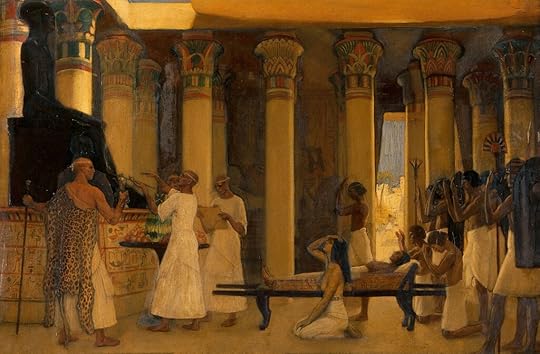
An invocation to I-em-hetep (Imhotep), the Egyptian deity of medicine by Ernest Board. In Cleopatra’s Heir, whenever Caesarion was having a seizure, he always had a flashback reminiscing all the treatments imposed upon his body by Cleopatra. I would like to imagine that Cleopatra must have tried to invoke the God of Medicine to help Caesarion heal from his disease.
Bradshaw brilliantly captured Caesarion’s emotional suffering and challenge of facing the “loss” of family, trust, and identity but in exchange for all those, Caesarion gained something much more valuable: understanding, acceptance, and love.
Unfortunately, Caesarion’s frequent flashback of Cleopatra felt a bit one-sided since it shows Cleopatra as an ambitious, cold, and calculated ruler who seems not to care one bit about her own children. And if that’s the case, why did Caesarion grieve when he found out that his mother had killed herself? If only Bradshaw could be neutral (since it’s clear that Bradshaw dislikes Cleopatra as she herself wrote at the end of the book) and fleshed out the relationship between Caesarion and Cleopatra wholly, all the misery that Caesarion felt might have made more sense. Nonetheless, this book is quite enjoyable to read.

October 24, 2022
“Where did you acquire a conscience?” asked Octavian. “It was bred out of your mother’s line long ago.” [p. 415]
I decided to read this whilst I was in Egyptian mode, following Cleopatra's Daughter: I was surprised to find that it also resonated strongly with A Confusion of Princes. Indeed, it has pretty much the same plot as the latter -- though a very different setting, and a different emotional landscape. (Both, it seems, owe a plot-debt to Kipling's Captains Courageous, which I haven't read.)
Caesarion, son of Cleopatra VII and Julius Caesar, wakes up on his own funeral pyre: he had a seizure when the camp was attacked by traitors, and has been left for dead. He eludes the half-hearted guards and makes his way to the caravan trail, where he's found and tended by an Egyptian trader named Ani. Caesarion, unaccustomed to dealing with the lower classes (he was a king!) tells Ani that his name is Arion, and proceeds to display all the arrogance, entitlement and prejudice with which he's been inculcated from birth. Ani is remarkably tolerant, and (very gradually) Arion becomes less arrogant. Once he's recovered from his wounds he's actually useful to Ani and Ani's family: literate, Latin-speaking, and well-informed, he can discuss poetry with a Roman general, write letters introducing Ani to trading partners, and entertain Ari's children with tales of Alexandria before the Roman conquest.
I didn't love this as much as Island of Ghosts (one of the most enjoyable historical novels I've read in years) but it was an engaging read. Though I disliked Caesarion in the initial chapters, I was drawn into his story as he began to adjust to his new, lowlier status, and the loss of all he'd known or anticipated. Though there is constant peril here, there's also humour and warmth. In Ani's family, Arion finds something he's been missing all his life. Perhaps that's what gives him the strength to face up to enemies, traitors and even his second cousin...
Bradshaw's Afterword explains her approach to the story: she 'came reluctantly to the conclusion that Cleopatra was a nasty piece of work, and that her son wouldn’t have been much better' (p. 444). Arion's epilepsy (the 'sacred disease' which Caesar also apparently suffered -- here an additional indication that Caesarion truly was Caesar's son) is depicted with sensitivity: be warned, though, that Arion's haunted by nightmarish visions of medical horrors, which he relives during his seizures.
Displaying 1 - 30 of 66 reviews