

What do you think?

Tom Paine: A Political Life
"More than any other public figure of the eighteenth century, Tom Paine strikes our times like a trumpet blast from a distant world." So begins John Keane's magnificent and award-winning (the Fraunces Tavern Book Award) biography of one of democracy's greatest champions. Among friends and enemies alike, Paine earned a reputation as a notorious pamphleteer, one of the greatest political figures of his day, and the author of three best-selling books, Common Sense, The Rights of Man, and The Age of Reason. Setting his compelling narrative against a vivid social backdrop of prerevolutionary America and the French Revolution, John Keane melds together the public and the shadowy private sides of Paine's life in a remarkable piece of scholarship. This is the definitive biography of a man whose life and work profoundly shaped the modern age. "Provide[s] an engaging perspective on England, America, and France in the tumultuous years of the late eighteenth century." -- Pauline Maier, The New York Times Book Review "It is hard to imagine this magnificent biography ever being superceded.... It is a stylish, splendidly erudite work." -- Terry Eagleton, The Guardian
576 pages, Paperback
First published April 20, 1995
About the author
John Keane
101 books35 followersJohn Keane is the professor of politics at the University of Sydney and the author of The Life and Death of Democracy.
Ratings & Reviews
Friends & Following
Create a free account to discover what your friends think of this book!
Community Reviews
Displaying 1 - 23 of 23 reviews

June 11, 2012
When it shall be said in any country in the world, "My poor are happy; neither ignorance nor distress is to be found among them; my jails are empty of prisoners, my streets of beggars; the aged are not in want, the taxes are not oppressive" – when these things can be said then may that country boast of its constitution and its government.
The Rights of Man Part Two
Today I found an old document on which my "best reads of 2012" were listed. The non-fiction entries were
The Spanish Civil War: A Very Short Introduction
Fun Home. (2012)
Understanding Power (2014)
Anarchism: A Very Short Introduction (2015)
To the Finland Station (2017)
Tom Paine
Basil Street Blues
The year following the book is when I got around to writing a review.
So three out of seven are still unreviewed. Today I'll make that two out of seven.
When I decided to review the book, here's where I found it.
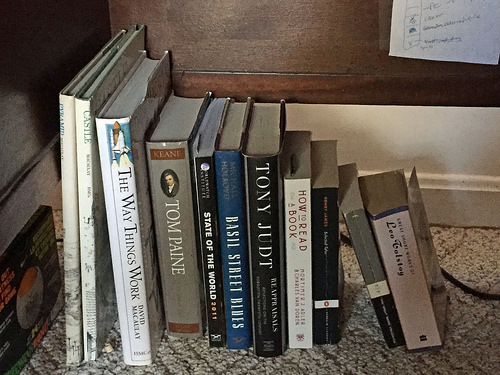
Five years it had been patiently waiting, gathering a bit of dust perhaps. Hearing everything that went on in that room over those years. Friends and family gathered for gettogethers – New Years, Easter, Thanksgiving – Christmas Eve, birthdays – grandkids running around, building towers of blocks, pushing little cars and trains on block-tracks – laughing, crying, pouting – TV sounds sometimes, almost always a baseball game, sometimes football when son or son-in-law in attendance. Enduring the vacuum cleaner being pushed towards it, usually just before those gettogethers. Sometimes, when grandson number one around, having piles of balloons pushed under the desk, blocking it's view of mostly feet but maybe sometimes a young person glimpsed on the floor, probably not very close, but offering a taste of human companionship. What were its thoughts, I wonder, when I finally pulled it out from among its companion books on that dour shelf, bringing it into a greater world, the world in which it had been read?
John Keene

The Australian-born author of this biography a "political theorist" on Wiki. He founded the Centre for the Study of Democracy in London in '89.
Keane is fairly well-known in the Czech Republic, owing to his 2000 authorized biography of Vaclav Havel, Vaclav Havel: A Political Tragedy. Another Havel connection is the 1989 edition of Havel's 1978 book The Power of the Powerless, which Keane edited.
Tom Paine
In his Prologue, A Citizen Extraordinary, Keane begins thus:
Keane divides the book into sections, corresponding to four different periods of Paine's life.
I. England, 1737 – 1774
In these first decades of his life, Tom Paine was twice married. The first marriage ended in 1760 when his wife died in childbirth – as did the child. Paine worked, during his 20s and 30s, mostly as an exciseman for the Crown, starting in 1762. In 1771 he married for the second time, a woman twelve years younger than he.
Throughout these years Paine had been attending lectures about the natural sciences, especially Newton's theories and discoveries, and had become acquainted with the religious ideas underlying the Deistic views of many of the men associated with the new sciences. Keane writes that, "Newtonianism met increasing hostility from the English governing class, which saw correctly the tensions between the spirit of modern scientific reason and existing institutions of government, property, and manner guided by power and tradition. The circles of Newtonians reacted by becoming breeding grounds for a new radical politics."
In 1772 Paine wrote a pamphlet which argued that excise officers should be granted higher wages. In the winter of 1772-73 he spent time in London distributing it to members of parliament. Nothing ever came of it; in fact, in 1774 he was dismissed from excise service a second time, for absence from his post without permission.
A tobacco shop which he had been running with his wife failed around this time, and in April '74 he sold his household possessions to pay his debts. Weeks later he signed separation papers from his wife, with whom local gossip had increasingly indicated a variety of problems, including non-consummation of the marriage. Keane terms Paine a "ruined citizen" at this time, but one who had talent and the ability at this time in his life to "turn in any direction" and start anew.
He was able to arrange an appointment in London with Ben Franklin, whose Causes of the American Discontents before 1768 had recently been reprinted in the London Chronicle. "The amicable Franklin was renowned for spirited conversation, and the meeting convinced Paine that he had the means to change his life."
Consequently, with a letter of introduction from Franklin, he sailed for Philadelphia in early October of 1774. Paine was 37 years old.
II. America, 1774 – 1787
Paine had become ill on the voyage, and was cared for by a medical friend of Franklin's. He immediately began writing, produced an essay for the January 1775 issue of The Pennsylvania Magazine, and became its editor the following month. The Revolution began in April of that year at Concord. Throughout the year Paine became friends with numerous advocates of the American cause in Philadelphia, and began the period of over a decade in which he rose to prominence as a political writer, taking the side of the American colonies against his own English Crown.
During these years he produced writings which made him a "star" in the colonies, writings that were read by thousands as the American Revolution began and moved through its perilous years. In January 1776 he published the pamphlet Common Sense, which called for the creation of an independent American republic. An expanded edition appeared in February. Common Sense, attributed to "an Englishman", was read throughout the colonies and sold tens of thousands of copies. After the Declaration of Independence on July 4, Paine joined a Pennsylvania militia. As winter approached he wrote the pamphlet The American Crisis, Number I, which appeared on December 19, 1776.
This series of pamphlets continued until The Last Crisis, Number XIII was published in April 1783. Paine signed these essays "COMMON SENSE" – and, even though he had not attached his name to the pamphlet of that title, it was soon widely known who the writer was. The aim of the series was both to rally American morale and to provide rational arguments, based on political facts, in support of the American cause.
Payne began Number I with this passage, the opening line of which has achieved lasting fame.
After the war, Paine continued writing, and began spending increasing amounts of time in working on a series of inventions, including an innovative design for a single-arch iron bridge using principles of stone vaulting. In 1785 he was elected to the American Philosophical Society, and awarded £500 (by the Pennsylvania Assembly) and $3000 (by Congress) for his services during the Revolution.
In early 1787 he exhibited his wrought-iron bridge model in Philadelphia, and attempted, without success, to secure funding for building such a bridge across the Schuykill River. Paine sailed for France in April of that year, with hopes of gaining endorsements for his bridge design. He carried letters of introduction from Franklin to leading French scientific and political figures. Paine was 50 years old, and was not to return to America for a decade and a half.
III. France and England, 1787 – 1802
The following fifteen years saw Paine physically and spiritually present at the eighteenth century's most profound event – the French Revolution.
This section of the review has been moved to my writing.
IV. America, 1802 – 1809
1802 Paine lands in Baltimore on Oct. 30. Federalist press widely attacks him as an infidel and a drunkard. Jefferson receives him at the executive mansion. Receives letter from Samuel Adams, who writes that he is "grieved' by Paine's "defense of infidelity".
1803 Writes and publishes a response to Adams defending his religious beliefs. Marguerite de Bonneville and her three sons arrive in Bordentown (her husband, under surveillance by the French police, is unable to leave France).
1804 Returns to New York in January. Marguerite, unhappy in Bordentown, comes to New York with her sons, and Paine assumes responsibility for their schooling. Writes frequently for The Prospect, mainly on religious subjects. Writes article in September denying right of Louisiana's inhabitants to continue importing slaves.
1805 Recommends to Jefferson that the U.S. mediate between France and the rebels in Haiti. Begins to drink heavily as health declines.
1806 Angered when New Rochelle election officials question his American citizenship and refuse to count his ballot. Moves from one domicile to another to in NYC.
1807 Writes article attacking Chief Justice John Marshall.
1808 Friends persuade him to sell house and land in Bordentown; in July begins boarding in house in Greenwich Village. Loses use of his legs. Last known published piece, an attack on the Federalists, appears August 25.
1809 Makes out will on January 18, leaving most of estate to Marguerite Bonneville and her sons. Requires constant care as his condition worsens. Society of Friends denies his request to be buried in a Quaker cemetery, claiming that Paine's followers might try to build a monument, which Quaker rules forbid. Moved to a nearby house rented by the Bonneville family in May. Refuses entreaties that he recant deism and accept Christianity. Dies on morning of June 8 at the age of 72. Buried on New Rochelle farm on June 9. In 1819 English journalist William Cobbett has Paine's remains exhumed and sent to England, intending to build a memorial to him; the plan fails and the remains are eventually lost.
At the time of his death, most American newspapers reprinted the obituary notice from the New York Evening Post that in turn quoted from The American Citizen, which read in part: "He had lived long, did some good, and much harm". Only six mourners came to his funeral, two of whom were black, most likely freedmen.
Many years later the writer and orator Robert G. Ingersoll wrote:
Thomas Paine had passed the legendary limit of life. One by one most of his old friends and acquaintances had deserted him. Maligned on every side, execrated, shunned and abhorred – his virtues denounced as vices – his services forgotten – his character blackened, he preserved the poise and balance of his soul. He was a victim of the people, but his convictions remained unshaken. He was still a soldier in the army of freedom, and still tried to enlighten and civilize those who were impatiently waiting for his death. Even those who loved their enemies hated him, their friend – the friend of the whole world – with all their hearts. On the 8th of June 1809, death came – Death, almost his only friend. At his funeral no pomp, no pageantry, no civic procession, no military display. In a carriage, a woman and her son who had lived on the bounty of the dead – on horseback, a Quaker, the humanity of whose heart dominated the creed of his head – and, following on foot, two negroes filled with gratitude – constituted the funeral cortege of Thomas Paine.
this is a wonderful biography of an inspiring thinker
. . . . . . . . . . . . . . . . . . . .
Previous review: A Boy's Will Robert Frost
Random review: A Midsummer Night's Dream
Next review: A Season in Hell
Previous library review: The Conquest of Bread
Next library review: Nations and Nationalism Since 1780
The Rights of Man Part Two
Today I found an old document on which my "best reads of 2012" were listed. The non-fiction entries were
The Spanish Civil War: A Very Short Introduction
Fun Home. (2012)
Understanding Power (2014)
Anarchism: A Very Short Introduction (2015)
To the Finland Station (2017)
Tom Paine
Basil Street Blues
The year following the book is when I got around to writing a review.
So three out of seven are still unreviewed. Today I'll make that two out of seven.
When I decided to review the book, here's where I found it.
Five years it had been patiently waiting, gathering a bit of dust perhaps. Hearing everything that went on in that room over those years. Friends and family gathered for gettogethers – New Years, Easter, Thanksgiving – Christmas Eve, birthdays – grandkids running around, building towers of blocks, pushing little cars and trains on block-tracks – laughing, crying, pouting – TV sounds sometimes, almost always a baseball game, sometimes football when son or son-in-law in attendance. Enduring the vacuum cleaner being pushed towards it, usually just before those gettogethers. Sometimes, when grandson number one around, having piles of balloons pushed under the desk, blocking it's view of mostly feet but maybe sometimes a young person glimpsed on the floor, probably not very close, but offering a taste of human companionship. What were its thoughts, I wonder, when I finally pulled it out from among its companion books on that dour shelf, bringing it into a greater world, the world in which it had been read?
John Keene
The Australian-born author of this biography a "political theorist" on Wiki. He founded the Centre for the Study of Democracy in London in '89.
Keane is fairly well-known in the Czech Republic, owing to his 2000 authorized biography of Vaclav Havel, Vaclav Havel: A Political Tragedy. Another Havel connection is the 1989 edition of Havel's 1978 book The Power of the Powerless, which Keane edited.
Tom Paine
In his Prologue, A Citizen Extraordinary, Keane begins thus:
If one purpose of biography is to lift individuals out of time and confer upon them a form of immortality, then the Englishman Tom Paine (1737-1809) is a natural ally of the art of preserving lives in words. More than any other public figure of the eighteenth century, Paine strikes our times like a trumpet blast from a distant world. His writings still spark disputes about matters of public importance, while his thoughts move public figures as different as Ronald Reagan and Bob Dylan, Salman Rushdie and Margaret Thatcher to quote him – as if to prove that the dead are sometimes more alive than the living.
Paine's uncanny familiarity is partly traceable to his own stupendous achievements. Despite humble beginnings, Paine's every step later generated intense public excitement. Paine reckoned that life was either a daring adventure or nothing, and for that conviction many loathed him. The dominant classes, pickled in port and privilege, certainly thought him rough and ungracious, an upstart in their world of landed wealth and courtly power. But among enemies and friends alike, Paine earned a reputation as a citizen extraordinary – as the greatest political figure of his generation.
Keane divides the book into sections, corresponding to four different periods of Paine's life.
I. England, 1737 – 1774
In these first decades of his life, Tom Paine was twice married. The first marriage ended in 1760 when his wife died in childbirth – as did the child. Paine worked, during his 20s and 30s, mostly as an exciseman for the Crown, starting in 1762. In 1771 he married for the second time, a woman twelve years younger than he.
Throughout these years Paine had been attending lectures about the natural sciences, especially Newton's theories and discoveries, and had become acquainted with the religious ideas underlying the Deistic views of many of the men associated with the new sciences. Keane writes that, "Newtonianism met increasing hostility from the English governing class, which saw correctly the tensions between the spirit of modern scientific reason and existing institutions of government, property, and manner guided by power and tradition. The circles of Newtonians reacted by becoming breeding grounds for a new radical politics."
In 1772 Paine wrote a pamphlet which argued that excise officers should be granted higher wages. In the winter of 1772-73 he spent time in London distributing it to members of parliament. Nothing ever came of it; in fact, in 1774 he was dismissed from excise service a second time, for absence from his post without permission.
A tobacco shop which he had been running with his wife failed around this time, and in April '74 he sold his household possessions to pay his debts. Weeks later he signed separation papers from his wife, with whom local gossip had increasingly indicated a variety of problems, including non-consummation of the marriage. Keane terms Paine a "ruined citizen" at this time, but one who had talent and the ability at this time in his life to "turn in any direction" and start anew.
He was able to arrange an appointment in London with Ben Franklin, whose Causes of the American Discontents before 1768 had recently been reprinted in the London Chronicle. "The amicable Franklin was renowned for spirited conversation, and the meeting convinced Paine that he had the means to change his life."
Consequently, with a letter of introduction from Franklin, he sailed for Philadelphia in early October of 1774. Paine was 37 years old.
II. America, 1774 – 1787
Paine had become ill on the voyage, and was cared for by a medical friend of Franklin's. He immediately began writing, produced an essay for the January 1775 issue of The Pennsylvania Magazine, and became its editor the following month. The Revolution began in April of that year at Concord. Throughout the year Paine became friends with numerous advocates of the American cause in Philadelphia, and began the period of over a decade in which he rose to prominence as a political writer, taking the side of the American colonies against his own English Crown.
During these years he produced writings which made him a "star" in the colonies, writings that were read by thousands as the American Revolution began and moved through its perilous years. In January 1776 he published the pamphlet Common Sense, which called for the creation of an independent American republic. An expanded edition appeared in February. Common Sense, attributed to "an Englishman", was read throughout the colonies and sold tens of thousands of copies. After the Declaration of Independence on July 4, Paine joined a Pennsylvania militia. As winter approached he wrote the pamphlet The American Crisis, Number I, which appeared on December 19, 1776.
This series of pamphlets continued until The Last Crisis, Number XIII was published in April 1783. Paine signed these essays "COMMON SENSE" – and, even though he had not attached his name to the pamphlet of that title, it was soon widely known who the writer was. The aim of the series was both to rally American morale and to provide rational arguments, based on political facts, in support of the American cause.
Payne began Number I with this passage, the opening line of which has achieved lasting fame.
These are the times that try men's souls: The summer soldier and the sunshine patriot will, in this crisis, shrink from the service of his country; but he that stands it NOW, deserves the thanks of man and woman. Tyranny, like hell, is not easily conquered; yet we have this consolation with us, that the harder the conflict, the more glorious the triumph. What we obtain too cheap, we esteem too lightly: - 'Tis dearness only that gives every thing its value. Heaven knows how to set a proper price upon its goods; and it would be strange indeed, if so celestial an article as FREEDOM should not be highly rated. Britain, with an army to enforce her tyranny, has declared, that she has a right (not only to TAX) but "to BIND us in ALL CASES WHATSOEVER," and if being bound in that manner is not slavery, then is there not such a thing as slavery upon earth. Even the expression is impious, for so unlimited a power can belong only to GOD.
After the war, Paine continued writing, and began spending increasing amounts of time in working on a series of inventions, including an innovative design for a single-arch iron bridge using principles of stone vaulting. In 1785 he was elected to the American Philosophical Society, and awarded £500 (by the Pennsylvania Assembly) and $3000 (by Congress) for his services during the Revolution.
In early 1787 he exhibited his wrought-iron bridge model in Philadelphia, and attempted, without success, to secure funding for building such a bridge across the Schuykill River. Paine sailed for France in April of that year, with hopes of gaining endorsements for his bridge design. He carried letters of introduction from Franklin to leading French scientific and political figures. Paine was 50 years old, and was not to return to America for a decade and a half.
III. France and England, 1787 – 1802
The following fifteen years saw Paine physically and spiritually present at the eighteenth century's most profound event – the French Revolution.
This section of the review has been moved to my writing.
IV. America, 1802 – 1809
1802 Paine lands in Baltimore on Oct. 30. Federalist press widely attacks him as an infidel and a drunkard. Jefferson receives him at the executive mansion. Receives letter from Samuel Adams, who writes that he is "grieved' by Paine's "defense of infidelity".
1803 Writes and publishes a response to Adams defending his religious beliefs. Marguerite de Bonneville and her three sons arrive in Bordentown (her husband, under surveillance by the French police, is unable to leave France).
1804 Returns to New York in January. Marguerite, unhappy in Bordentown, comes to New York with her sons, and Paine assumes responsibility for their schooling. Writes frequently for The Prospect, mainly on religious subjects. Writes article in September denying right of Louisiana's inhabitants to continue importing slaves.
1805 Recommends to Jefferson that the U.S. mediate between France and the rebels in Haiti. Begins to drink heavily as health declines.
1806 Angered when New Rochelle election officials question his American citizenship and refuse to count his ballot. Moves from one domicile to another to in NYC.
1807 Writes article attacking Chief Justice John Marshall.
1808 Friends persuade him to sell house and land in Bordentown; in July begins boarding in house in Greenwich Village. Loses use of his legs. Last known published piece, an attack on the Federalists, appears August 25.
1809 Makes out will on January 18, leaving most of estate to Marguerite Bonneville and her sons. Requires constant care as his condition worsens. Society of Friends denies his request to be buried in a Quaker cemetery, claiming that Paine's followers might try to build a monument, which Quaker rules forbid. Moved to a nearby house rented by the Bonneville family in May. Refuses entreaties that he recant deism and accept Christianity. Dies on morning of June 8 at the age of 72. Buried on New Rochelle farm on June 9. In 1819 English journalist William Cobbett has Paine's remains exhumed and sent to England, intending to build a memorial to him; the plan fails and the remains are eventually lost.
At the time of his death, most American newspapers reprinted the obituary notice from the New York Evening Post that in turn quoted from The American Citizen, which read in part: "He had lived long, did some good, and much harm". Only six mourners came to his funeral, two of whom were black, most likely freedmen.
Many years later the writer and orator Robert G. Ingersoll wrote:
Thomas Paine had passed the legendary limit of life. One by one most of his old friends and acquaintances had deserted him. Maligned on every side, execrated, shunned and abhorred – his virtues denounced as vices – his services forgotten – his character blackened, he preserved the poise and balance of his soul. He was a victim of the people, but his convictions remained unshaken. He was still a soldier in the army of freedom, and still tried to enlighten and civilize those who were impatiently waiting for his death. Even those who loved their enemies hated him, their friend – the friend of the whole world – with all their hearts. On the 8th of June 1809, death came – Death, almost his only friend. At his funeral no pomp, no pageantry, no civic procession, no military display. In a carriage, a woman and her son who had lived on the bounty of the dead – on horseback, a Quaker, the humanity of whose heart dominated the creed of his head – and, following on foot, two negroes filled with gratitude – constituted the funeral cortege of Thomas Paine.
this is a wonderful biography of an inspiring thinker
. . . . . . . . . . . . . . . . . . . .
Previous review: A Boy's Will Robert Frost
Random review: A Midsummer Night's Dream
Next review: A Season in Hell
Previous library review: The Conquest of Bread
Next library review: Nations and Nationalism Since 1780

September 17, 2011
Be warned: this biography is terrifying -- in which a defender of "people power", a principled antagonist of wealthy elites, is ultimately rejected and destroyed by mobs of religious Frenchmen and later Americans, many of whom had once considered him a hero. The final pages here remain one of the most harrowing accounts of helplessness and emptiness I've ever encountered -- you may shed real tears to witness this quill-wielding giant dead-broke, shitting himself, weeping, despised by all Americans, no former friends giving a toss about his fate. Yet Paine remained principled to the end, as his last words bear out.
I'm always amused when a biographer sets out to create a "balanced portrait" of someone who's been subjected to either hagiographies or hatchet-jobs (mostly the latter) over the years. But Tom Paine -- the despised "drunken atheist" by the time he died -- that's gotta be a tough job for a biographer. Keane both acknowledges and buries the earlier works with his own contextual perspective, and he's first to thoroughly research Paine's "unknown" years in England. For example the exact spacial relationship between his childhood home in Thetford and its busy and notorious gallows (just look right as you exit the Paine house) probably informed Paine's entire worldview, but Keane was the first to dig it up. Similarly, when it comes to Paine's drinking -- a frequent trope used to dismiss him -- Keane points out that there was no evidence he ever drank heavily until his pitiful final days. In other words, his soused ending was deployed to unfairly color his entire life. As for his sexcapades -- another character-assassination tactic -- Keane points out that, since Paine's first wife died in childbirth (along with the infant), he spent his life fearing what his penis could do to a woman. There's no evidence that he frequented prostitutes or took male lovers -- he just shut his sex-drive down.
And finally, the atheism -- it's clear throughout his writings that Paine believed in a God, very devoutly in fact, but he rejected religion as an institution. In other words, he was a Deist -- much like most other Founding Fathers. And here's where Keane's bio gets really crazy -- we lefty dudes love to point out how Jefferson and Hamilton and Adams and Washington and Madison were deists, and thus the unique "space" for religious freedom offered by America as opposed to, well, everywhere. But look at what happened to Paine when he returned to America in 1803 -- attacked and reviled by mobs of Christians, because this shit was just beginning. The original "Tea Party" was not the Boston Tea Party, but the goddamn flinging-turds-at-Tom-Paine "second great awakening" (I propose it be named the "Second Nap"). Horrible. And things went quickly downhill thereafter for America's greatest writer, who still kept writing until his limbs failed him... read it yourself. A wonderful, memorable biography of a man who really should be rehabilitated as a hero of our Revolution.
I'm always amused when a biographer sets out to create a "balanced portrait" of someone who's been subjected to either hagiographies or hatchet-jobs (mostly the latter) over the years. But Tom Paine -- the despised "drunken atheist" by the time he died -- that's gotta be a tough job for a biographer. Keane both acknowledges and buries the earlier works with his own contextual perspective, and he's first to thoroughly research Paine's "unknown" years in England. For example the exact spacial relationship between his childhood home in Thetford and its busy and notorious gallows (just look right as you exit the Paine house) probably informed Paine's entire worldview, but Keane was the first to dig it up. Similarly, when it comes to Paine's drinking -- a frequent trope used to dismiss him -- Keane points out that there was no evidence he ever drank heavily until his pitiful final days. In other words, his soused ending was deployed to unfairly color his entire life. As for his sexcapades -- another character-assassination tactic -- Keane points out that, since Paine's first wife died in childbirth (along with the infant), he spent his life fearing what his penis could do to a woman. There's no evidence that he frequented prostitutes or took male lovers -- he just shut his sex-drive down.
And finally, the atheism -- it's clear throughout his writings that Paine believed in a God, very devoutly in fact, but he rejected religion as an institution. In other words, he was a Deist -- much like most other Founding Fathers. And here's where Keane's bio gets really crazy -- we lefty dudes love to point out how Jefferson and Hamilton and Adams and Washington and Madison were deists, and thus the unique "space" for religious freedom offered by America as opposed to, well, everywhere. But look at what happened to Paine when he returned to America in 1803 -- attacked and reviled by mobs of Christians, because this shit was just beginning. The original "Tea Party" was not the Boston Tea Party, but the goddamn flinging-turds-at-Tom-Paine "second great awakening" (I propose it be named the "Second Nap"). Horrible. And things went quickly downhill thereafter for America's greatest writer, who still kept writing until his limbs failed him... read it yourself. A wonderful, memorable biography of a man who really should be rehabilitated as a hero of our Revolution.

June 8, 2009
My only criticism is: for as thick as this book is, I would have liked to hear more about Paine's relationship with all of the great historical figures he knew, since that is one of the things that makes Paine so interesting. Also Keane has a tendency to interject his own views into the narrative and sometimes it becomes hard to discern where Paine's views end and Keane's began.
Otherwise it was a first rate biography. Keane is a great writer and the book reads more like exciting fiction than the usually dry history.
Otherwise it was a first rate biography. Keane is a great writer and the book reads more like exciting fiction than the usually dry history.

July 25, 2013
Possibly the single book that has had the most profound impact on my understanding of history and politics. Tom Paine is a vital link between the radicals of the civil war and the liberal left of today. He embodied and lived the ideals of the enlightenment. His instincts are deeply humane, his perception sharp and uncluttered, his ability to turn plain prose into a hymn to liberty unparalleled.
John Keane does Paine every justice with that rarest of things, a political biography that demands that each new page be turned as soon as its predecessor is read. Paine's life was a ripping yarn of an adventure, but his thinking, which though occasionally the victim of his own optimistic view of human nature and his naivity, has made him as important as any other political philosopher in the English language.
John Keane does Paine every justice with that rarest of things, a political biography that demands that each new page be turned as soon as its predecessor is read. Paine's life was a ripping yarn of an adventure, but his thinking, which though occasionally the victim of his own optimistic view of human nature and his naivity, has made him as important as any other political philosopher in the English language.

September 6, 2013
This biography of the great political writer and philosopher during the American revolutionary era is an erudite and definitive masterpiece. Although highly detailed, and at times feeling needlessly so, it remains readable and enjoyable throughout its 536 pages.
The biography focuses more on Paine's political life than on his day to day mundane affairs. The book is divided roughly into 4 sections: Paine's early years in England; his years in America during the American Revolution; his years back in England and in France during the French Revolution, including the Reign of Terror; and his final years spent in America.
What makes this biography fascinating, in more ways than one, is that it is as much about Paine's political life as it is about the surrounding history itself. There is something about the American Revolution, French Revolution, British monarchical regime during George III years, and post-Constitutional America. Thus, Paine's political life is placed into a broader historical and contemporary political context - which makes this splendid book a hybrid between a biography and history.
Finally, the author doesn't attempt to psychoanalyze Paine's character, or in any way interfere into the reader's own opinion of him. He simply retells Paine's life story, as part of the historical context, and allows the reader to formulate his/her own opinions as he/she may.
The biography focuses more on Paine's political life than on his day to day mundane affairs. The book is divided roughly into 4 sections: Paine's early years in England; his years in America during the American Revolution; his years back in England and in France during the French Revolution, including the Reign of Terror; and his final years spent in America.
What makes this biography fascinating, in more ways than one, is that it is as much about Paine's political life as it is about the surrounding history itself. There is something about the American Revolution, French Revolution, British monarchical regime during George III years, and post-Constitutional America. Thus, Paine's political life is placed into a broader historical and contemporary political context - which makes this splendid book a hybrid between a biography and history.
Finally, the author doesn't attempt to psychoanalyze Paine's character, or in any way interfere into the reader's own opinion of him. He simply retells Paine's life story, as part of the historical context, and allows the reader to formulate his/her own opinions as he/she may.

January 2, 2016
The biography was well researched and well written. The author's appreciation and admiration for Paine (which at times was excessive) didn't detract from an overall insightful and illuminating read. I was reminded how little I knew of a person so important to the cause of American independence and equally important as a political philosopher. While the author, at times, gave Paine too much credit for some of the concepts he championed - almost suggesting Paine as the originator rather than the proponent - it was clear that he (Paine) was an articulate and forceful advocate for Liberty. Paine's disdain for colonization, empire building, monarchy, restricting the vote, and slavery made him unique in his time and timeless in his stances. Paine's arrogance was often mentioned and it was easy to imagine him as insufferable. However, it was not until his writing of The Age of Reason in which he pilloried organized religion that the public and many friends abandoned him and left him to be marginalized by history.
Here was a man who was part of the two most important revolutions in modern history; a man who held regularly corresponded with Washington, Madison, Adams and Jefferson; who discussed an invasion of England with Napoleon and is today often forgotten.
Christopher Hitchens wrote on and admired Thomas Paine. They were much alike as intelligent voices speaking truth to power.
I very much recommend this to anyone who appreciates biography.
Here was a man who was part of the two most important revolutions in modern history; a man who held regularly corresponded with Washington, Madison, Adams and Jefferson; who discussed an invasion of England with Napoleon and is today often forgotten.
Christopher Hitchens wrote on and admired Thomas Paine. They were much alike as intelligent voices speaking truth to power.
I very much recommend this to anyone who appreciates biography.
July 20, 2012
This work by John Keane is a biographical window to historical understanding. Upon reading, one is staggered at Paine's influence and his involvement with so many events, especially because today he is often not included within the standard set of American founders, but rather is an adjunct. However, Paine led people to reevaluate the status of the individual in the world, in the process calling into question, with sharp rhetoric, long-established ruling and social institutions. The only analogue that comes to mind is Luther.
Thomas Paine's life ought to be studied because he was courageous and greatly influential, and studying his life also leads to further illumination of two landmark political revolutions. This book succeeds greatly along these lines. I highly recommend it.
Thomas Paine's life ought to be studied because he was courageous and greatly influential, and studying his life also leads to further illumination of two landmark political revolutions. This book succeeds greatly along these lines. I highly recommend it.

December 17, 2008
An exhaustive biography of a Founding Father forgotten and ill-used, rich in specific political detail, so as to bring us to a more intimate understanding of the American revolution and its aftermath as well as to see Mr. Thomas Paine, author of Common Sense, Rights of Man, and The Age of Reason, as a contemporary with much to teach us in 2008.

February 25, 2016
Though somewhat hagiographical, it confirms much of what critical biographers had written about the rogue. Bends over backwards trying to explain a number of his questionable actions.

February 22, 2019
Keane's biography weaves Paine's political philosophy and activism in context with the major cultural, religious, and scientific developments of his time. In this respect, his work is an political and intellectual history of the transatlantic world as seen through the prism of Paine's revolutionary writings and actions. Inasmuch as he offers insight into Paine's character, oftentimes it is the character of Paine's political detractors that comes more sharply into focus. Paine was a party to the principles that he identified closely with American independence: “it was neither the place nor the people but the Cause itself that irresistibly engaged me in its support” (200). Paine battled three primary enemies of “the Cause” during his lifetime: American Tories, French Jacobins, and the Federalist Party in early US national politics. Paine regarded the American Tories as the foremost culprits in the Revolutionary War due to the misinformation and encouragements they provided to British occupiers. Ironically quoting James I, he once said of American Tories, “A rich man makes a bonny traitor” (189). At the conclusion of the British-American conflict, Paine emigrated to France to aid in the establishment of the French Republic as a member of the National Convention. He opposed the beheading of the former monarch, Louis XVI, leading the effort for clemency that lost by one vote (367). As Robespierre and the Jacobins ascended to power, he was identified as an “enemy of the people” and jailed during the Reign of Terror, nearly losing his life to the guillotine. After a decade-plus of political turmoil in France, Paine left in disappointment: “Had this [French] Revolution been conducted consistently with its principles, there was once a good prospect of extending liberty through the greatest part of Europe; but I now relinquish that hope” (373). On his return to the United States in the early 1800s, he encountered a new threat to the Cause: the Federalist Party. Paine's infamous screed against the character of George Washington perhaps is the earliest sign that he saw in the Federalist Party, despite its protestations against French Jacobinism, the emergence of similar abuses of state power in the United States. Washington's administration remained silent, while Paine languished in a French prison, offering “a sort of consent to” to Jacobin atrocities. John Adams' administration passed the Alien and Sedition Acts that suppressed freedom of the American press. Against the Federalist Party members who plotted to undermine the American representative system of government, Keane notes that Paine “insisted that their principles were both antifederalist and despotic and that their practice proved the truth of the maxim: 'Those who abuse liberty when they possess it would abuse power could they obtain it'” (469). The American Tories, French Jacobins, and Federalist Party all succumbed to the power of Paine's inquiring quill: “To be deceived, or to remain deceived, can be the interest of no man who seeks the public good; and it is the deceiver only, or one interested in the deception, that can wish to preclude inquiry” (484). His loyalty to the Cause of democracy against monarchy in general—not only its British variant—remains a testament to the principles of the American Revolution. Keane presents an insightful, engaging, and balanced narrative of Thomas Paine, delivering his most timely and relevant material in the final chapter about Paine's return to America and death.
August 5, 2024
A MASTERFUL BIOGRAPHY OF THE AMERICAN REVOLUTIONARY
Thomas Paine (1737-1809) was of course the critically important American revolutionary (author of historically important works such as 'Common Sense' and 'The American Crisis'), who also wrote such works as 'The Rights of Man' and 'The Age Of Reason.' John Keane is a professor of Politics at the University of Westminster, who has written other books such as 'The Life and Death of Democracy,' 'The Media and Democracy,' etc.
Keane wrote in the Prologue to this 1995 book, "The contextual approach to biography adopted for this purpose involves immersing readers in the detailed circumstances of a distant era, in order that they can better understand that world as it was experienced by Paine and his friends and enemies... Paine's revolutionary analysis of the grim side of the Revolution... is highlighted. His understanding of Native Americans is treated with a fresh eye... Finally, Paine's activities in England are here for the first time given their due weight." (Pg. xviii-xix)
He observes, "The story that Paine preached in Sandwich [England] as a Methodist is more probable, since his links with Methodism actually predated his arrival in the town... [John] Wesley's journal also records that when Paine was living in Dover... Paine's employer took him along to the Methodist chapel... where Paine, age twenty-one, confessed himself a believer and later preached sermons to the congregations. (Pg. 46)
He notes, "Throughout his life, Paine had difficulty handling money and balancing accounts. Reckless generosity usually got the better of him and sooner or later caused aggravation to donor and receiver alike." (Pg. 132) He wrote a letter for publication which compared the colonies' subjugation to Britain with slavery: 'Forget not the hapless African.'" (Pg. 134) Upon later meeting a group of Native Americans, Keane states, "he seemed magnetized by what he saw as the natural beauty, prudence, and intelligence of the Native Americans. He considered them fine human beings, unspoiled by modern civilization and the crooked ways of British despotism." (Pg. 148)
Paine "readily agreed to bear the risks of publishing the manuscript ['Common Sense'] and began immediately with his journeyman to set the type and print the pamphlet page by page." (Pg. 107)He wrote 'The American Crisis.' 'In a rage when our affairs were at their lowest ebb and things in the most gloomy state.' His quill spat venom at King George III... He lunged as well as the king's American Tory sympathizers... The tract reiterated Paine's view that violence must always be strictly controlled." (Pg. 143)
He admits that "There is no evidence that he had a hand in drafting the Declaration of Independence. In fact, he wrote little or nothing during the lull in congressional business..."" (Pg. 135) He also points out, "Considering his earlier American warnings, Paine was unusually slow to see the unintended dark side of the French Revolution." (Pg. 312) While still in prison in France, a fellow prisoner recounted, "he always expressed his firm belief in the principles of [The Age of Reason], and begged I would tell the world such were his dying opinions. He often said that if he lived he should prosecute further that work, and print it." (Pg. 409)
This is probably the best and most comprehensive biography of Paine currently available, and will be of immense use to anyone wanting to know more about this America patriot.
Thomas Paine (1737-1809) was of course the critically important American revolutionary (author of historically important works such as 'Common Sense' and 'The American Crisis'), who also wrote such works as 'The Rights of Man' and 'The Age Of Reason.' John Keane is a professor of Politics at the University of Westminster, who has written other books such as 'The Life and Death of Democracy,' 'The Media and Democracy,' etc.
Keane wrote in the Prologue to this 1995 book, "The contextual approach to biography adopted for this purpose involves immersing readers in the detailed circumstances of a distant era, in order that they can better understand that world as it was experienced by Paine and his friends and enemies... Paine's revolutionary analysis of the grim side of the Revolution... is highlighted. His understanding of Native Americans is treated with a fresh eye... Finally, Paine's activities in England are here for the first time given their due weight." (Pg. xviii-xix)
He observes, "The story that Paine preached in Sandwich [England] as a Methodist is more probable, since his links with Methodism actually predated his arrival in the town... [John] Wesley's journal also records that when Paine was living in Dover... Paine's employer took him along to the Methodist chapel... where Paine, age twenty-one, confessed himself a believer and later preached sermons to the congregations. (Pg. 46)
He notes, "Throughout his life, Paine had difficulty handling money and balancing accounts. Reckless generosity usually got the better of him and sooner or later caused aggravation to donor and receiver alike." (Pg. 132) He wrote a letter for publication which compared the colonies' subjugation to Britain with slavery: 'Forget not the hapless African.'" (Pg. 134) Upon later meeting a group of Native Americans, Keane states, "he seemed magnetized by what he saw as the natural beauty, prudence, and intelligence of the Native Americans. He considered them fine human beings, unspoiled by modern civilization and the crooked ways of British despotism." (Pg. 148)
Paine "readily agreed to bear the risks of publishing the manuscript ['Common Sense'] and began immediately with his journeyman to set the type and print the pamphlet page by page." (Pg. 107)He wrote 'The American Crisis.' 'In a rage when our affairs were at their lowest ebb and things in the most gloomy state.' His quill spat venom at King George III... He lunged as well as the king's American Tory sympathizers... The tract reiterated Paine's view that violence must always be strictly controlled." (Pg. 143)
He admits that "There is no evidence that he had a hand in drafting the Declaration of Independence. In fact, he wrote little or nothing during the lull in congressional business..."" (Pg. 135) He also points out, "Considering his earlier American warnings, Paine was unusually slow to see the unintended dark side of the French Revolution." (Pg. 312) While still in prison in France, a fellow prisoner recounted, "he always expressed his firm belief in the principles of [The Age of Reason], and begged I would tell the world such were his dying opinions. He often said that if he lived he should prosecute further that work, and print it." (Pg. 409)
This is probably the best and most comprehensive biography of Paine currently available, and will be of immense use to anyone wanting to know more about this America patriot.
March 6, 2020
Tom Paine is a freedom hero. Despite a lack of formal education, he was an agitator for freedom in three different countries: United States (before they were the United States), United Kingdom, and France. In each country he wrote a seminal exhortation to action: Common Sense, The Rights of Man, and The Age of Reason. His war on tyranny by states and religion is still relevant today.
Keane reveals the price Paine paid for his agitation. In France he was imprisoned and daily feared the guillotine. In Britain and the U.S. he was demonized, taunted, and deserted for his Deism and opposition to the dominant churches. He was a divisive figure: arguments over Paine was the last straw that caused the lengthy estrangement between Thomas Jefferson and John Adams. Paine is neglected by history today, considering his primacy in the worldwide fight for freedom.
Keane reveals the price Paine paid for his agitation. In France he was imprisoned and daily feared the guillotine. In Britain and the U.S. he was demonized, taunted, and deserted for his Deism and opposition to the dominant churches. He was a divisive figure: arguments over Paine was the last straw that caused the lengthy estrangement between Thomas Jefferson and John Adams. Paine is neglected by history today, considering his primacy in the worldwide fight for freedom.
May 20, 2022
Probably the most thorough biography on Tom Paine. The writing is tedious and a bit boring. Still, I learned a lot about Paine. There are a few places in which the author interprets some of the events of Paine's life, so watch for opinions. The author is most likely right based on the amount of research done. There are also a few commentaries about some of Paine's positions and views. Paine wrote some of America's most important political commentary, including Common Sense, during and after the American Revolution. But Paine had a knack for stirring up controversy with his writings. He offended people he viewed as friends, turning them into enemies eventually. His writings on religion further alienated him from his readers. Despite that, he was a witness to both the American Revolution and the French Revolution.

July 27, 2020
You must be a history lover
to plow through this tome. The author admits that, though well researched, it still maybe incomplete. There are definitely portions of the book where artistic license is taken concerning the thoughts and words of Thomas Paine
Bottom line, it is an interesting read about the period in Great Britain just before the American Revolution through 1809. The details about the founding fathers and their relations with the author of Common Sense and The Rights of Man are fascinating. Many of the authors points seem to be directed at the 21st century reader.
to plow through this tome. The author admits that, though well researched, it still maybe incomplete. There are definitely portions of the book where artistic license is taken concerning the thoughts and words of Thomas Paine
Bottom line, it is an interesting read about the period in Great Britain just before the American Revolution through 1809. The details about the founding fathers and their relations with the author of Common Sense and The Rights of Man are fascinating. Many of the authors points seem to be directed at the 21st century reader.

September 10, 2017
This was an extremely thoroughly-researched biography of this great figure. Paine comes to life vividly in these pages. His years growing up in England, in America during its revolution, in the terror of the French Revolution, and finally, his elderly years back in America are all very well covered.

Read
July 5, 2020One of my Freethought heroes!

March 30, 2025
One of my favorite books ever, perfect biography and study

March 2, 2017
Good book; plan to read again, should time allow.
October 26, 2015
Long detailed life of an important political thinker who lived through extraordinary times. Thomas Paine was born in England but repudiated the government of George III to play an important role as a political polemicist in both the American and French Revolutions. At times fascinating and at times turgid I didn't warm to the massively conceited Paine but the author did a good job of describing Paine's life and times.
March 15, 2013
A well-written, unbiased popular history of this revolutionist who opposed organized religion. The author does an excellent job of placing Paine's writings in their historical context. Not a hagiography. Paine is presented with his human flaws intact, including his stunning arrogance. Full review of this and other titles at greatnonfictionbooks.blogspot.com

April 19, 2015
Second reading of this excellent biography, Paine was a significant thinker with an effective political voice who developed many ideologies underpinning modern civil society. Where is this thought and voice for our time?

Read
September 23, 2010Tom Paine: A Political Life (Grove Great Lives) by John Keane (2003)

September 25, 2015
the stuff on the french revolution was cool but everything else was pretty boring.
Displaying 1 - 23 of 23 reviews