The Big Bend, the Big Country, the Big Empty. The High Plains, the Permian and the Panhandle. Cowboys, Cowtown and the curl of a killer tornado. A place where “you can stretch your eyeballs.” Where the Hale-Bopp comet, “hardly visible above some smoggy, light-polluted cities, looked like it could drop into the Pecos River at any moment.” West Texas, home to the state’s biggest legends, is chronicled by two authors who have spent most of their careers crisscrossing it. Mike Cochran and John Lumpkin, Associated Press journalists, bring their experiences to the pages of this handsome volume, accompanied by fifty photographs of the West Texas landscape, its people and its history. Converse with West Texas characters like Stanley Marsh 3, conman Billy Sol Estes, and Big Spring’s merry messiah, Marj Carpenter. Meet Gordon Wood, Friday night football’s winningest coach, and Groner Pitts, Brownwood’s liveliest undertaker. Remember ranching icon Watt Matthews, the founders of Santa Rita No. 1, and Lubbock’s C. W. Stubblefield, magnet to blues and country music stars. Honor Hallie Stillwell, Frenchy McCormick, and even modern art’s Georgia O’Keeffe, who put their stamp on Texas’s most fascinating region. A West Texan once said, “They show no pictures of my province or even neighboring provinces. They leave a big hole in Texas.” No more is that the case, thanks to Mike Cochran and John Lumpkin.
Don't know why I'm reviewing this (or any other book) , but I do know why I read it. This time a week from now we will be hiking in the Davis Mountains in West Texas.
The three authors of the book are all journalists. Mike Cochran is an Associated Press correspondent who has covered West Texas for decades. John Lumpkin is the bureau chief for Associated Press in Texas. Ron Heflin is the Associated Press photo editor for Texas.
The book is something of a coffee table book, since it's packed with photos. But there's a lot of text, so it's meant as a read, not just a look. What there is to read is uneven. Many of the 23 numbered but unnamed chapters seem like compendiums of story summaries that once appeared in newspapers of West Texas. There's quite a bit of breathless narrative, along the lines of huge tornadoes which have occurred, famous/infamous/renegade people who've come from the area (Billy Sol Estes, Buddy Holly, Joe Don Loony), places where actors stayed as the movie Giant was made in West Texas, the favorite indigenous writer Larry McMurtry (born in Archer City, a few miles south of Wichita Falls), etc etc.
let's back up …
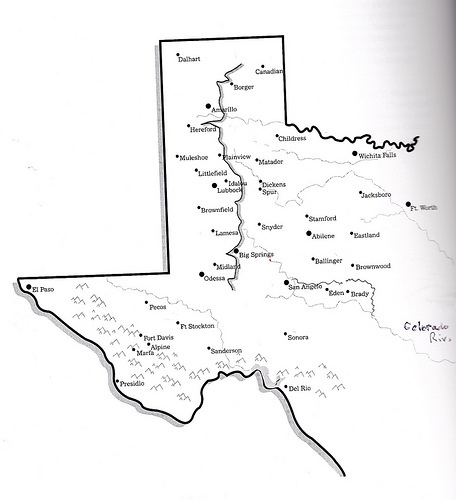
What and where is West Texas? Obviously in the western part of Texas, but it's not any sort of official area, it doesn't contain a specific set of counties, it's no sort of politically defined area. The authors early on state what they are taking West Texas to be. You may need a map here. Actually they provide one.
Draw a line from Ft. Worth, to strike the Red River (to the north) just east of Wichita Falls; follow the Red River to the panhandle, then up, over, down, and west to El Paso; follow the Rio Grande south east from there, to its meeting with the Pecos River, above Del Rio; then, take the line northeast back to Ft. Worth. The whole area you've enclosed deserves to be called West Texas, say the authors.
Now this is a big area, perhaps the size of Arizona. A little smaller than the state of New York together with all six states of New England. Ft. Worth is about 600 miles east of El Paso.
In this area is a lot of oil; a lot of cattle; and in places, a lot of nothing. The "Big Bend" area where we will be is that area south and east of El Paso, over to the Rio Grande south of Sanderson. The Big Bend contains an area that has been called the Big Empty.
Aside from those large cities at the east (Fort Worth) and west (El Paso) edges, the other "large" cities you see on the map range from Lubbock (about 250,000), through Amarillo, Midland, Abilene, Odessa, and Wichita Falls, down to San Angelo (100,000). All the rest are 50,000 or less. The eight "towns" in the Big Bend, bounded by Pecos at the northwest, Presidio south of there on the Rio Grande, and Sonora over to the east average about 4,000. The smallest is Sanderson (800).
Those large "edge" cities - Fort Worth about 870,000 (15th largest in the U.S.), El Paso ~680,000 (22nd largest).
so …
The book is mainly of interest to those from West Texas. As a non-fiction book about the area it leaves a lot to be desired – understandable I suppose from being a journalistic view, rather than an academic one.
But I admit, I had no trouble reading through it. The authors subscribe mostly to a light-hearted voice, not overbearing, and I enjoyed picking it up in the evening and spending 15-20 minutes reading a chapter or two.
If anyone notices this review, perhaps I'll add a couple pictures when we're back.
As has been said by some in the reviews of this book. It is average at best; unless you are from this amazing country. But, if you are; it is wonderfully written. I know most of these stories, lived through a lot of them. It is a one of a kind place to grow up. The people are unequalled; strong, motivated, and secure in themselves. God bless west Texas.