I blame the TARDIS.
I was exposed to the time-travelling blue telephone box, and its quirky, scarf-adorned occupant at an early age, and this exposure left me with a taste for causality violation, for the bending of the unbreakable constraints of physics in time travel stories that bring modern people into contact with both the pre-modern and their far-future descendants.
As a result, Palimpsest - a time travel story written by the very skilled Charles Stross - immediately appealed to me.
Stross, whose book Singularity Sky is a favourite of mine, has written a compelling, fascinating time travel story - no mean feat in a subgenre that has been flogged to death, dragged around the city behind a chariot and then flogged again just to be sure there's no life left in it.
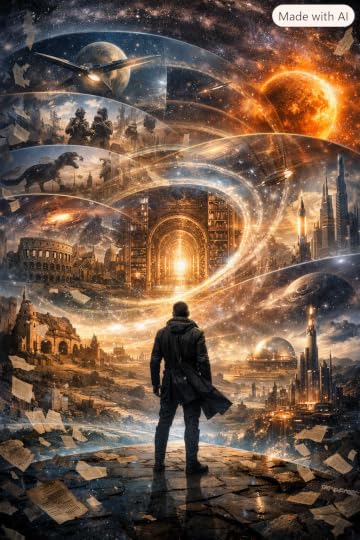
Stross finds a spark in this tired old beast however, and he drives it hard, keeping up a breakneck pace of great ideas and intriguing twists. There's a hell of a lot packed into this novella, which encompasses billions of years of history- from Earth's beginning to the entropic death of the universe.
Pierce is a recruit into an organisation known as Stasis. The near-immortal agents of Stasis have access to time gate technology, and they use their access to all of time and space to stop the human race destroying itself.
And humanity has an unfortunate tendency to do just that. Whether it's via war, natural disaster, ecological collapse or general stupidity human civilisations tend inevitably towards self extinction, flaming out before becoming truly stable.
Stasis accept this inevitability, and rather than attempting to stop it they simply take groups of primitive humans, shift them millions of years through time, and dump them onto the now empty Earth to breed and restart a new human civilisation.
This process, which they call reseeding, has been carried out many thousands of times, and across the billions of years of the life of our sun (and beyond) there exist countless human civilisations, some of whom are directed towards scientific and technical research to assist Stasis in their endeavours. Every bit of data, every page written, every theory published in these societies is recorded and stored in an archive that exists billions and billions of years from now near the cold, black death of the universe - a record of every human there ever was, and every human achievement.
Pierce's role in this is to carry out these reseedings, to manipulate events to suit Stasis, and direct the energies of civilisations away from activities his bosses deem useless - such as interstellar travel.
His first assignment, to prove his commitment to Stasis, is to murder his own grandfather, cutting himself adrift in time with no family, no relatives, with only Stasis and it's agents as his anchoring points. His own grandad's will not be the only blood on his hands
But someone seems to want to kill Pierce, and they're willing to use the worst that time travel tech offers, to the point of changing entire timelines into unhistory- potential realities and events that once existed, but through casual manipulation are now only memories in the minds of the Stasis agents that witnessed them. Pierce, whose near-death has drawn the scrutiny of his seniors in Stasis, needs to find out who is chasing him and why.
Stross tells a great story, up there with some of the best in the genre, and as I read it each morning I found myself wishing my train stop was further away, just so I could gulp down a few more pages before I disembarked. This is a rollicking novella, full of interesting ideas and mind-bending time travel and it's well worth your time.
I must confess to being perhaps a little biased as I love a time travel story, but what Science Fiction fan doesn't have a soft spot for taking jaunts through history and the future? If SF allows a writer (and a reader) to enjoy a palette which encompasses our entire universe (and others) then time travel expands that palette into every universe that was or ever will be - nothing is out of bounds, no place, no person, no event. In the hands of a writer like Stross this freedom can be a heady drug indeed.
Four stars.