Jump to ratings and reviews
Rate this book

Мисима: Биография

Rate this book
At forty-five, Yukio Mishima was the outstanding Japanese writer of his generation, celebrated both at home and abroad for The Sailor Who Fell from Grace with the Sea. In 1970 he startled the world by stepping out onto a balcony in Tokyo before an assembly of troops and plunging a sword into his abdomen; a disciple then beheaded him, completing the ritual of hara-kiri. John Nathan's riveting biography traces the life of this tortured, nearly superhuman personality. Mishima survived a grotesque childhood, and subsequently his sadomasochistic impulses became manifest-as did an increasing obsession with death as the supreme beauty. Nathan, who knew Mishima professionally and personally, interviewed family, colleagues, and friends to unmask the various-often seemingly contradictory-personae of the genius who felt called by "a glittering destiny no ordinary man would be permitted."

Unknown Binding

First published January 1, 1974

46 people are currently reading
1180 people want to read

About the author

John Nathan

64 books17 followers

Ratings & Reviews

What do you think?
Rate this book

Friends & Following

Create a free account to discover what your friends think of this book!

Community Reviews

5 stars
173 (28%)
4 stars
290 (48%)
3 stars
124 (20%)
2 stars
16 (2%)
1 star
1 (<1%)
Displaying 1 - 30 of 74 reviews
Profile Image for Sean O'Hara.
Author 23 books101 followers
June 11, 2012
Imagine: In 1970 Norman Mailer, fed up with hippies and the wimpification of America, leads his personal militia into a National Guard outpost in Washington DC, takes the commandant hostage and then exhorts the troops to rise up with him, overthrow the government and restore the Confederacy.

Crazy, right?

And yet that's pretty much what happened in Japan when Yukio Mishima, a renowned author who was seen as a sure bet for the Nobel Prize in Literature, attempted to incite a revolution within the JSDF. When he failed, he and his close companion, Masakatsu Morita, committed seppuku together.

As authors' lives go, you gotta give him 10/10 for style. Beats boring ol' Tennyson any day.

Nathan's biography does a good job with the facts, but is unfortunately light with interpretation and analysis, both of Mishima's life and his work. He glosses over many of Mishima's works -- major works -- spending only a couple sentences on The Temple of the Golden Pavilion, and barely touching on Mishima's final set of works, The Sea of Fertility Tetralogy. When he does examine Mishima's writing, it's always because he feels it gives some insight into Mishima's final act. But the analysis is always the same prosaic observation, that some character is an author-insert, and whatever that person says should be viewed as reflective of Mishima's philosophy, even when Mishima wrote the work in question a decade before arriving at that philosophy.

Reading the book, one can't help but notice that Mishima evolved over time. When he received a draft notice in WWII, he escaped service due to illness -- almost certainly psychosomatic if he wasn't outright faking -- yet after the war he came to repudiate Japan's new pacifism and wanted a return to the nation of warriors. While this seems like a change of his character over the years, Nathan portrays it as though Mishima held the same views all along, and his reaction to the draft was a sign of hypocrisy.

To exacerbate this problem, Nathan can't take Mishima's politics seriously. He's very much a creature of '60s left-radicalism, and he treats Mishima's increasingly right-wing views as inherently silly. While they certainly were that the biographer should strive to understand his subject's mind. How did Mishima get to this place? Nathan argues backward, taking Mishima's death as the starting point and taking for any minor utterance that prefigures it as evidence that he was on that path from the beginning. Only events in Mishima's earliest childhood are allowed to shape him -- once he hits ten, Nathan treats him as a fully-formed person with his end already predestined.

Nathan also fails to deal adequately with Mishima's bisexuality. Although acknowledging that Japanese attitudes towards man-love differ from the West, Nathan's tone is very much of his time, and despite his obvious liberal views, he can't help but refer to Mishima's sexuality as "deviant." Oddly, he spends much of the first half of the book dealing with Mishima's discovery of his bisexuality while researching Confessions of a Mask, but he never documents a liaison between Mishima and another guy -- the closest he comes is speculating on the relationship with Morita. There is no doubt that Mishima was into the ol' shonen ai, but if this biography was all you had to go on, you'd think it was a scurrilous rumor. In fact, the only sexual relationship in the book is between Mishima and his wife, with whom he fathered two children; nevertheless Nathan continually refers to Mishima as a homosexual instead of bi.

(Speaking of children, Nathan spends almost no time on Mishima as a father -- there are hardly any mentions of his daughter, mostly in terms of people Mishima met through her school, and fewer still of his son.)

For the longest time, Nathan's book has been the definitive Mishima bio in English, (Scott-Stokes' The Life and Death of Yukio Mishima being the only other contender), but I'm relieved to see that Stonebridge is bringing out Naoki Inose's Persona, which I hope will offer better analysis of his life, work and place in Japanese society.
Profile Image for Nicole~.
198 reviews297 followers
December 17, 2015
4.5 stars

The Last Samurai

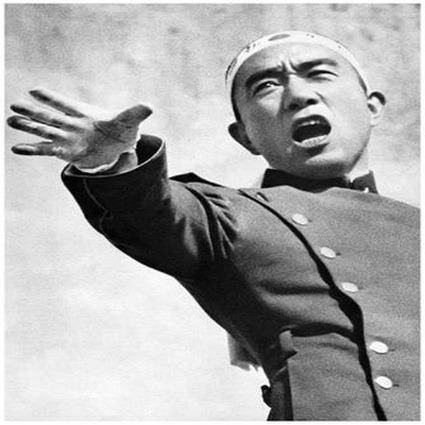
Two months short of his 46th birthday, on November 25, 1970, Yukio Mishima with a handful of followers and dressed in full uniform, entered the compound of the Japan Self-Defense Force,
gagged and tied up the commander of the JSDF, demanding the assembly of the entire Eastern division ( a gathering of 800 soldiers) to listen to his planned speech: "an appeal to repudiate the post war democracy that robbed Japan of its identity; to restore Japan to her true form, and in the restoration, die."
 photo image_zps0e376414.jpg
When his speech went unheard, muffled by the noise of his audience's jeers, Mishima engaged his final bloody concept, seppuku. His "second" then completed the ritual by beheading him with a long sword. The sequence of events played out dramatically and undeniably like something out of a violent motion picture.

Biographer John Nathan knew Mishima professionally and personally, having translated The Sailor Who Fell From Grace With The Sea. His analysis of Mishima's private life and novels led him to believe that his suicide was primarily about his erotic lifelong fascination with death. Mishima wanted passionately to die all his life, and consciously chose "patriotism" as a means to his fantasized, painful "heroic" end.

Mishima was born on January 14, 1925, and birth-named Kimitake Hiraoka (Yukio Mishima would become his pen name). At only 50 days old, his paternal grandmother Natsu Nagai took him away from his mother, Shizue, and moved him into her dark room downstairs of the family home. Natsu was noble born, a highly unstable woman who suffered fits of hysteria as a child. She held Kimitake "prisoner" until he was 12 years old, jealously and fiercely guarding him. She kept rigid control over his upbringing until 1937, when she became too ill to take care of him, paving the way for him finally to live in his parents' household. Nathan insightfully suggests that she possibly hoped to ingrain in her first grandchild the values she believed were the birthright of the noble Nagai.

Natsu exposed Kimitake to Kabuki theatre, and might have contributed in this way to his creative development: taking him to his first play, Chushingura--the Tale of the 47 Ronin --a celebration of feudal allegiance, said to be the most exciting of the great Kabuki classics. Nathan also alludes to her afflicting this impressionable young boy with constant mournful lamentations of a "lost distant past, an elegant past, a past beauty," fueling a romantic longing for "purity and beauty and a fierce impossible desire to be other than himself."

A loner and rarely seen without a book, Kimitake spent time writing poetry and fantasy stories as young as 12 years old, reading works by Oscar Wilde, Rilke, and Tanizaki. His adolescent writing sensibilities were influenced by the Japan Romantics, evolved with an aesthetic formula in which "Beauty, Ecstasy and Death are equivalent." Later, his ideology became ultranationalistic, exalting traditional convictions "worthy of dying for."

Nathan submits Kimitake's latent homosexuality was unintentionally the result of the hostile domestic environment he grew up in, however, this notion that a person's sexual preference is a product of living in a dysfunctional environment did not sit well with me - that's a whole 'nother debate! As young as 16, he showed anxiety and disgust at what he sensed was an "unwholesomeness," apologizing for his masquerade of normalcy. This is later reflected in the novel that catapulted him to stardom- Confessions of a Mask.

In Februrary 1945, Mishima welcomed the draft into the army, but when Japan surrendered on August 15, and the Emperor called for his subjects to lay down their arms, Mishima, Nathan assumes, might have convulsed with the "existential horror" of being cheated and deprived of that morbid destiny, gleaning from his postwar essays and novels: "The war ended. All I was thinking about, as I listened to the Imperial Rescript announcing the surrender, was the Golden temple. The bond between the temple and myself had been severed. I thought now I shall return to a state in which I exist on one side and beauty on the other. A state which will never improve so long as the world endures."

Mishima found it difficult adapting to postwar reality in the atmosphere of labeling, blacklisting and enforced isolation of "literary war criminals." It was the older, established writers who were being sought and many routes were closed to getting his manuscripts sponsored. His first novel, Thieves, was violently lyrical and in spite of a glowing preface by his new mentor, Yasunari Kawabata, the novel was ignored. Even with some guidance and editing, his stories went unnoticed and "no one who mattered was impressed."
 photo image_zpsb0c7b859.jpg
The autobiographical novel Confessions of a Mask, was a book he felt he must write in order to survive. It was a therapeutic effort, a process of self-discovery for Mishima, who finally validated within himself a suppressed homosexuality, and who was incapable of feeling alive or of showing passion, except in sadomasochistic fantasies which stank of blood and death. "This book is the last testament I want to leave behind in the domain of death where I have resided until now."

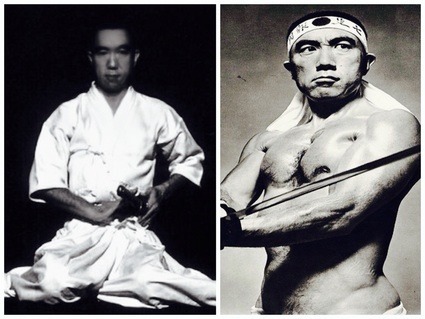
His decision to join the Army Self Defense Force (ASDF) in 1967 was partly for patriotic concern, and partly to feed his need for glory - of the hero, not the writer. In his mind, he had taken his first step in becoming a warrior, a samurai- a persona he obsessed over.
 photo image_zps4392df11.jpg
"The samurai's profession is the business of death. No matter how peaceful the age in which he lives, death is the basis of all his action. The moment he fears and avoids death he is no longer a samurai."

Rumors of a nomination for the Nobel prize ( for the third time) buzzed around Mishima in 1968. However, the prize went to his old mentor, Yasunari Kawabata. Many close to Mishima suspected this disappointment about the Nobel prize had a significant impact on his decision to end his life.

Mishima was a man who felt less real in this world than in the realm of his poetry and novels; a deeply tortured man who yearned for his eroticized, violently lyrical literary work to be acknowledged; but his brutal, unheard last words were the veritable final blow. Clearly, he was more suited to the bygone feudal days of Japan-- an accomplished swordsman loyal to the empire, who grabbed at the romantic hero's painful death he had longed for all his life. Nathan thoroughly probed Mishima's psyche through his novels; his conclusions into this tragic life lead him to hope finally that "he found what he expected to find inside and beyond the pain."

Shizue, his mother, summed it up best at his memorial, "Be happy for him.. This was the first time in his life Kimitake did something he always wanted to do."
Profile Image for Smiley .
776 reviews18 followers
September 18, 2018
When I was an undergraduate in 1970, as far as I could vaguely recall, one day I read in some newspapers and watched on television concerning Yukio Mishima, a remarkable, celebrated Japanese writer for his plays and novels at home and abroad, whose unthinkable novel-like action with his troops ended with the ritual of hara-kiri became shocking news to the world when he was 45. I didn't follow it in detail because I had never read or heard of him till, a decade or two ago, I didn't know why I started reading his novels and novellas, probably, from reading his Omi in an old, brownish Modern Japanese Literature: From 1868 to Present Day (Tuttle 1972) compiled and edited by Donald Keene. I guessed I also read him as one of those notable Japanese writers whose translated works I could find and read, I don't know Japanese so I found his translated works in English arguably enjoyable and worth spending my time. For instance, I read his The Sound of Waves (Vintage 1994), The Temple of the Golden Pavilion (Everyman's Library 1994), Five Modern No Plays (Vintage 2009), The Sailor Who Fell from Grace with the Sea (Tuttle 2001), The Sea of Fertility (Penguin 1986), etc. Along my reading exploration, I have since had my admiration and respects to him for his outstanding literary contribution.

Reading this eight-chapter book with its fonts large enough to read enjoyably would help us better understand his life because Professor John Nathan's biography
traces the life of this tortured, nearly superhuman personality. Mishima survived a grotesque childhood, and subsequently his sadomasochistic impulses became manifest - as did an increasing obsession with death as the supreme beauty. Nathan, who knew Mishima professionally and personally, interviewed family, colleagues, and friends to unmask the various - often seemingly contradictory - personae of the genius who felt called by "a glittering destiny no ordinary man would be permitted." (back cover)

Therefore, Mishima's readers interested in this indispensable biography and his works should take the information above into account since, I think, we can find reading it more rewarding for its in-depth narrative, well-written dialogs, detailed footnotes, etc. in which we would probably find them hard to find in our everyday reading. Moreover, I've since been fascinated beyond delight for the twenty-eight, black-and-white illustrations on its frontispiece and between pages 140 and 141 due to their rarity and originality, for instance, Mishima with his mother, Shizue, in 1925, age (sic) seven months, In 1929, age (sic) four, Mishima with his grandmother, Natsu, 1930, etc. One of those illustrations that delights me most (I read somewhere on this honor bestowed on him but I've never seen it before) reads Mishima with diploma and silver watch received from the emperor on Graduation Day 1944.

In brief, reading this biography is arguably informative for us; however, I couldn't help wondering why and reached something final at that. One of the reasons is that, from what I read somewhere on one's mind as an iceburg, literally/comparatively speaking, the known part is about one-eighth whereas the unknown one is about seven-eighths. In other words, what's in one's mind is so unimaginably mysterious and deep that it's impossible to know everything on one's mind; it's one of the demanding tasks professionally assigned to psychologists and psychiatrists. Therefore, we should be content with what we are informed and grateful to his works with awe and admiration.
Profile Image for George Ilsley.
Author 12 books315 followers
March 25, 2022
Clear and concise. Nathan tackles his complex subject, the multi-faceted Japanese writer Yukio Mishima, without placing himself too much into the picture. Re-read this as part of my recent Mishima extravaganza.

Mishima was a wealth of contradictions — both traditional and modern, and astonishingly prolific. One element of his obsession, the intersection of homo-eroticism and fascism, is alarmingly contemporary.
Profile Image for Olethros.
2,724 reviews534 followers
February 20, 2014
-“Cuando uno hace un estudio de un hombre considerable, tiene que atreverse a ver y mirar todas las cosas y, por lo menos, a indicar todo lo que se ha visto” (Sainte-Beuve).-


Género. Biografía.

Lo que nos cuenta. Relato de la vida del escritor japonés Kimitake Hiraoka, más conocido como Yukio Mishima, desde su nacimiento en el seno de una familia que posiblemente le marcó en muchos aspectos hasta los sucesos del 25 de noviembre de 1970, con un repaso simultáneo a su obra y la relación de ésta con la propia existencia del fascinante autor.

¿Quiere saber más de este libro, sin spoilers? Visite:

http://librosdeolethros.blogspot.com/...
Profile Image for David.
638 reviews130 followers
July 9, 2011
Good analysis of the man and the work, with lots of information on how Mishima lived his life (what he liked for dinner, his clothes, etc). Sometimes biographers who knew their subjects can be a bit annoying about it (I remember Iris Murdoch's biographer identifying his own dog in one of the photographs ...), but Nathan is only ever interesting. The one thing I would have liked is more information on the subsequent trial (or otherwise) of the survivors. Otherwise, pretty perfect. Great photographs.
Profile Image for Patrick McCoy.
1,083 reviews93 followers
September 23, 2011
I’ve been interested in reading John Nathan’s biography of Yukio Mishima, Mishima, for two reasons: 1) The man is interesting in his sum total of contradictions 2) It was the source material for Paul Schrader’s film. Mishima: A Life in Four Chapters, which I have been writing an essay about. Although Schrader has borrowed and developed many of the themes from the novel as well as reproducing some of the photos that accompany it-it was some of the details in the book that really captured my attention.

For example, I found it interesting that Nathan used “expansion into China” to describe Japanese imperialism early in the book. The book was first published in 1974, so I wonder if Nathan was shying away from controversy or was he sympathetic to writing about Japan in a positive light? Later, Nathan reports that Mishima’s mother’s parents had a packed a “bridal dagger” in her dowry chest-which symbolizes that she must kill herself rather than return home if he married fails-this strikes me as unsympathetic and barbaric especially since the daughter has no choice in the arranged marriage. I also found Mishima’s horrifically stunted childhood abhorrent as his grandmother smothered him and his father was completely against his desire to become a writer and actively sought to force him into a career path as a bureaucrat. This included limited play (only inside), play only with girls, he had to massage and give his grandmother her medicine, and he was basically in an in-house abduction from his parents until he was 12. Mishima’s life in general was analogous to Japanese postwar development-he gradually built his success as Japan, itself developed economically into a power. There are a couple of other interesting details. One where Mishima travels to Brazil and he finds wealthy Brazilian Nisei farmers arguing in 1951 about whether or not Japan won the war! Mishima sides with those who suggest victory! It was curious that Nathan describes Mishima as dressing “Roman drugstore cowboy” in 1974. All in all, it is an interesting biography that steers clear of literary analysis unless it reflects the many contradictions of Mishima, and focuses on the life that had been lived. It is a fascinating read.
Profile Image for Lars.
10 reviews
Read
May 19, 2024
After finishing this biography, I am experiening a feeling I can only describe as grief, so this is more of a late obituary than a full review of the book.

Maybe Mishima's brother was right when he said that he "always wanted to exist but never could." After I have learned more about Mishima's life by reading Nathan's biography, I can no longer see his suicide as the inevitable ending of his life - I keep wondering: Maybe there could have been possibilites for him to find a way to exist?

I have to admit that, back when I had only a vague understanding of his life, I somewhat admired Mishima for his suicide. I thought of his seppuku as a radical expression of his irrepressible will, his absolute lack of compromise in dealing with himself and the world, and I thought of the whole final act surrounding his coup attempt as his last, big performance - not a coup d'état, but a coup de théâtre, as stated in the synposis of Andrew Rankin's book on Mishima.
But, after reading the description of this final episode in Nathan's book, I have to come to the conclusion that, if this was a final performance, it was a farce. It is not even the fact that the coup attempt failed that makes it farcical. Nathan makes a convincing case that Mishima was from the beginning not really interested in overthrowing the government, but in finding a way to die. What makes it a farce are the details of the procedure: For example, that the gathered soldiers did not even really listen to Mishima's speech, which he had to cut short. Mishima's seppuku itself could have come out of a satirical short story highlighting the absurdity of such an act: Mishima wanted to write the Japanese character for "sword" with his own blood, but the pain after cutting himself open was too overwhelming. How can one now read the quote from RUNAWAY HORSES without shaking one's head: "Perfect purity is possible if you turn your life into a line of poetry written with a splash of blood"? In the end, not even a single character was possible. And even after that, as a final humiliation, his inexperienced comrades needed three strokes to decapitate him.

I don't want to be misunderstood: I am not saying that, had his suicide gone to plan, Mishima's final act would have been a success. Instead, I want to make clear that the grotesque details of his final moments belie his conceptualization of what death means. His concept of death was, as he would have said himself, a romantic one. He saw death as the only truly erotic moment possible. In spite of his views, death is something wholly profane and dirty, not connected to any higher truth, to ecstasy or fulfillment.
If we accept that his final act was a coup de théâtre, it is a failed one. It is the ending, but not the culmination of his life. In the end, he did not fully become himself - rather, he went over the edge.

His brother said Mishima "always wanted to exist but never could". Nathan as well sees Mishima's life as him donning a series of masks. Possibly, Mishima saw himself like that as well, not only as a young man when writing CONFESSIONS OF A MASK, but over the course of his whole life. The later novel KYOKO'S HOUSE is described by Nathan as the confrontation of four different masks, four different ways to exist. Even later, Mishima put on the uniform cap of his paramilitary group, the Shield Society. It was simply the last mask he donned.
If one was inclined to describe Mishima's fluid identity in a more favorable way than a masquerade, one could say: He was always a person that didn't simply exist, but actively crafted, sculpted his life and himself. It is this process of change and of becoming that is the essence of Mishima's life and work, much more so than his end. One wishes he could have found a way to live with the contradictions that were part of his very nature. As a child, Mishima read Rainer Maria Rilke. Maybe he could have found solace in something Rilke wrote in his LETTERS TO A YOUNG POET: "I would ask you, dear sir, to be patient with everything that is unresolved within your heart and to try to love the questions themselves."
Profile Image for brian.
109 reviews4 followers
June 30, 2020
this was pretty good. but, honestly, just watch the schaeder movie.
1 review4 followers
April 15, 2008
Yukio Mishima was certainly one of the most prolific Japanese writers of the twentieth century, if not one of the greatest. Between 1945 and his death in 1970, Mishima wrote forty novels and twenty collections of short stories, as well as a vast number of book reviews, literary articles, screenplays and traditional Japanese plays.

But with Mishima, the drama of his life mirrors the drama of his works. His fascination with the samurai lifestyle, a fascination that lead to his ritualistic suicide at the Japanese Self-Defense Headquarters in Tokyo in 1970, formed the basis of one of the most fascinating literary lives ever lived. Unlike many literary suicides, which result from a sense of despair or artistic depression, the death of Mishima can be viewed as the culmination of a life long dream, a dream in which the central obsession was death.

John Nathan’s biography of Japan’s greatest author is unique in that it's based on the personal recollections of those that knew Mishima best. Nathan, himself a friend of Mishima’s, returned to Japan following the author’s suicide to conduct a series of personal interviews with Mishima's family, friends, and colleagues. Armed with a first hand accounts of the life of Mishima, Nathan then sets out to weave these stories into one cohesive biography.

And for the most part, he succeeds. Even if you're not a fan of literature or Japanese culture, Nathan’s objective account of Mishima’s life is one of the better written literary biographies I’ve read. Nathan avoids the primary pitfall that traps many such biographers - a fascination with the subject that borders on hero-worship, and one that clouds and eventually taints any sense of objectivity. Instead, Nathan presents an engaging, thoughtful look at Mishima’s life, and his record is well worth the time spent reading it.
Profile Image for Louise.
1,846 reviews384 followers
May 9, 2013
While Mishima's suicide took those who knew him by surprise (or so it is said), who could not read "Confessions of a Mask" "Thieves" or "Patriotism" without noting the author's fascination with suicide? In this book John Nathan reviews his life and work and in doing so shows how clearly Mishima's writings show his intent.

Nathan takes the reader through Mishima's oppressed childhood, his life during and following the war, his marriage and eventually the workouts, the gravitation to the right wing and his personal army of young men. As you read this book, you draw the conclusion that Mishima's life was his own work of art, building to his ultimate suicide. His political ideas are so disjointed they appear to be his attempt to find a rationale for his final act, which he had decided upon long ago.

Nathan had been on the cold end of Mishima's practice of freezing out those who crossed his lines, deserved or not. In Nathan's case this was translating a novel (which eventually won a Nobel Prize) for another Japanese author at the time he had a verbal commitment to translate a novel of Mishima's. Nathan left Japan for the US without an attempt to reconcile. After Mishima's death, Nathan returned to Japan for a contract to write this biography. Mishima's friends and family did not freeze him out, quite the contrary, they cooperated.

I held back a star because I don't think Nathan put all his resources into this. While having known his subject, he doesn't use this insight much, relying instead on Mishima's writings and interviews with others. Also, while he explained some of the changing dynamics of Japanese society I don't think he fully used his nearly unique capacity to interpret in Japan for western audiences.
Profile Image for Josh 蔡.
46 reviews
August 11, 2025
This is the first full biography I've read in my life, and a fitting one-- Mishima as a person, his singular universe, and perverse logic has haunted me since I knew him. I share a similar interest in death of a different kind.
John Nathan's preface mentioned his two years of close contact with Mishima, and the dysfunction and eccentricities of his family he noticed interacting with them when he began collecting material for the book. Apart from one or two anecdotes in the footnotes or else briefly mentioned, only the day Mishima cut contact with Nathan (because he chose to translate Kenzaburo Oe over him) was described, and his family dynamics were limited mostly to the early years. Given the 1970s, discussions of his homosexuality was, while appropriately compartmentalized as only a part of the picture instead of "what truly made him do what he did", it was still seen in an outdated psychoanalytical light that matched the times.

Mishima is humanized because of the ridiculousness of his character in the backdrop of daily life, of course. But this book for me, was less a close watching of Mishima the man and more Mishima and his thought. It's like catching, releasing, and then closely following a translucent fish that was Mishima's obsessions, ideas, theories, and their development in ups and downs from childhood to death through his life and his work-- large quotations of works unavailable even today in english are given here to supplement following the stream of consciousness of Mishima. At the same time, it still feeds you stories, details, and enough ups and downs of his life that you give you the satisfaction of a biography, and details from them that give evidences to the different developments and stages of his life long obsessions. The desire to exist is one I share, a desire and problem so large Mishima's entire life is only one route within it, one excellently charted.

Mishima, as detached from society as he was, despite being in it as the ultimate elitist and insider, still projected a parallel fantasy unto it; and the shadows this real society capture what Japanese society was like in the 50s, 60s better than any photograph, essay, or film I've seen to date.

I wish I could have read more on the aftermath of his death, or be given a closer look into the creative processes with his last and my favorite works-- the sea of fertility-- but the end of his life was mostly lingered around the subject and contradictions of his political essays, and the forming of the Tatenokai. I understood that being written under the shadows of his death in 1974, these topics took more priority for those at the time thinking of Mishima, but a synthesis of this built up to unreality for Mishima and how it intersected with the last 4 books of his was something I wish I can learn about.
9/10, first time in ages I burned through a book in this pace, basically read in 2 days.
Profile Image for Matthew.
81 reviews8 followers
July 8, 2018
I wished John Nathan would have wrote more about the creation of The Temple of the Golden Pavilion as much as he described Kyoko's House or Confessions of a Mask.

There were a couple instances were the author drew opinions which seemed out-of-place for a biography about another person. However, his thesis, being that Mishima was acting out a life-long aesthetic death wish was convincing and fascinating.

I've read Confessions of a Mask, The Temple of the Golden Pavilion, and The Sailor Who Fell from Grace With the Sea and now I am further convinced I want to read more of Mishima's works.

This biography definitely focused on his non-literary artistic work as well which was revealing of the extent of an artist in every since of the word Mishima was.

Learning that Oscar Wilde and Joris-Karl Huysmans were early influences to Mishima was an exciting discovery. Mishima also read Rainer Maria Rilke and Villiers de L'Isle Adams too.
Profile Image for Joseph Pozo.
33 reviews1 follower
July 10, 2022
The man who always wanted to exist but never could. Nathan excels in the same aspects that Shrader later would in his film, obscuring the divide between fantasy and reality, an amalgamation that would lead and haunt Mishima’s life. Nathan’s intimacy with Mishima’s work is the most powerful aspect of the biography, positing his works not as a mirror that reflected mishima but a portent; Mishima’s works seems to predict his shifting values. A translator or an author is necessary to detail Mishima’s life, I wouldn’t want Mishima’s life to be written by anyone else.
Profile Image for Arek Szewczyk.
28 reviews
June 19, 2025
Mój pierwszy kontakt z literaturą Mishimy miał miejsce sporo przed 30-ką (czasy studenckie). Zafascynowany kulturą japońską sięgałem po wszystko, co miało gejszę lub samuraja na okładce. Tak trafiłem na "Zimny płomień", zbiór krótkich opowiadań tego autora. Nie pamiętam już swoich dokładnych przemyśleń po lekturze, ale na pewno nie ujęło mnie to, co przeczytałem. I tu zero zaskoczenia, bo to nie jest literatura japońska typu, który mnie wtedy interesował (czyt. popkulturowa), a także na lekturę której byłbym intelektualnie gotowy. Teraz, po przekroczeniu 4 dekady życia, powracam do Mishimy, myślę, że lepiej przygotowany zarówno życiowo jak i merytorycznie, stąd zacząłem od biografii by mieć kontekst. I trochę mi ta biografia popsuła wizję tego człowieka jaką miałem w głowie. Nie wiem czy byłbym zainteresowany jego literaturą wiedząc to, co wiem teraz. Raczej na pewno w realnym życiu z kimś takim jak Mishima nie mógłbym się przyjaźnić lub choćby kolegować. Niemniej, poza rozbiciem fałszywego obrazu jaki miałem, dowiedziałem się też sporo o jego literaturze i nadal jestem wystarczająco zaintrygowany. Tyle, że już mniej człowiekiem, który za nią stoi, a bardziej tym, co po sobie literacko pozostawił. Zobaczymy co ta przygoda przyniesie. Mam głębokie przekonanie, że wyjdę z niej bogatszy. W drogę!
Profile Image for Lauren.
1 review
January 25, 2023
Shortly after I began reading Yukio Mishima's novels I formed a morbid curiosity about the author after discovering his cause-of-death. If you're looking for a tried and true, straightforward and informative biography about Mishima, from a man who actually knew him for a time, I highly recommended this one. Some of Nathan's language and attitude is a bit dated, and there are parts that I wish he elaborated on more, but this biography satisfied my fascination. Mishima's life was exceptionally suitable material for an interesting biography, and I thoroughly enjoyed reading it. I hope to read another Yukio Mishima biography in the future, one that will fill in the gaps of what Nathan missed out on, if the passage of time hasn't too deeply hidden anything that was yet to be unearthed about the writer. Until then, I can vouch for this one.
157 reviews18 followers
September 6, 2016
For a man who wrote novels that were practically autobiographies, Mishima is inscrutable. This was probably somewhat intentional, based on Mishima's own words and diary entries. He seemed to enjoy being different things to different people, then upending the assumptions they made. I suppose its a truism that artistic geniuses are "complicated" people, but there is something fascinating about Mishima's life and creativity that I can't quite put my finger on. Every time I think I've found it, it slips away again when reading him or about him.

Kimitake Hiraoka (his real name) was obsessed with death, and I don't think even he knew why. Nathan provides some theories, ranging from his bizarre, sheltered childhood and abusive father, to his struggle accepting his homosexuality (or perhaps bisexuality). I suspect the answer is something more nuanced that involves these reasons and more. Something that draws me to Mishima is his indication that what he felt about death is really something all of us feel, but are too afraid to admit. Much of his life was spent coming to terms with this himself, and the tension this created made him who he was.

Mishima was a strange mix of emotions and interests. He was drawn to what he knew were socially unacceptable sexual interests, but he disliked the typical "lifestyle" of the cultural rebel. He didn't drink much and his personal life was austere, yet he was known for wearing flamboyant outfits like aloha shirts (half open) and gold medallions. He didn't like to party most of the time, but on some occasions he would suddenly lose all inhibition. He was single-minded and focused on his writing, and devoted his life to that more than anything else. In many ways he rejected typically Japanese cultural and social mores, and yet he ended his life in a right-wing coup that wanted to restore Meiji-era powers to the Emperor.

What to make of this? Nathan makes the interesting point that while most people seek a faith when they are about to die, Mishima wanted a faith in order to die. It may not have mattered what that faith was, as long as it served a purpose--that purpose being to validate his existence. Like all obsessions, one with death often stems from its opposite--how to feel truly alive. Mishima was not so much obsessed with death as he was with feeling alive, and paradoxically this led to his death. His other obsession, writing, may have been nothing more than a way to work these feelings out. In the end that may be why any writer writes in the first place. If there is anything he is to be praised or respected for, it is this.
Profile Image for David Haws.
870 reviews16 followers
November 15, 2011
If Japan’s renunciation of war was something forced on the Japanese people by an occupying army, then it was dishonorable (and the dishonor is ours). If it was an epiphany, recognized and promoted by the Japanese people, then it was probably the most important political act of the 20th Century. I tend toward the latter, and feel that Japan neo-nationalists (which would include Mishima) are the people who just didn’t get it. When you turn a man into a weapon, you turn him into a thing. It might be a beautiful (exquisite) thing, but it’s still a thing; and the man-as-moral-agent has been diminished.

Spinoza tells us that when we “discover” useful things, we imagine that they were left for us by an invisible god. We then try to ingratiate ourselves to the invisible god so that he’ll leave more useful things lying around for us. How much more fervently would we want to ingratiate ourselves if the god who leaves us useful things were visible and could be more meaningfully supplicated? In keeping with the coherence theory of truth, Hirohito was a god because the Japanese people believed he was a god; he focused the will of the Japanese for useful things.

At the Tule Lake segregation center, there were groups (e.g., the Hoshi-dan) trying to demonstrate that they were more “Japanese” than other groups (in and out of the camp). The samurai of the Shinpūren Rebellion (神風連の乱), the renegade officers of the February 1936 coup (帝都不祥事件), Mishima, the Shield Society (楯の会); with the actions of other Japanese nationalists are understandable in light of the Emperor’s divinity. Otherwise, they all seem a dysfunctional waste of good men’s lives and talents.

Nathan’s biography, in some ways, is like the slow-motion picture of a train wreck. I’ve only read one of Mishima’s novels, but it might be that Mishima-the-character is his most interesting creative ideation.
Profile Image for Javonne.
20 reviews
March 23, 2019
An intimate look at at Yukio Mishima through the eyes of his first English language translator. Nathan delves into the early life, daily life and psyche of one of Japan's star authors. Nathan was fired from working on translations of Mishima after refusing to translate one of his works (after initially agreeing to do it) citing it's difficulty to translate for him. Mishima's letting go of Nathan was gentle, yet final and it's obvious it wounded Nathan deeply, his assessments of Mishima's eccentricities becoming down right vitriolic at times.

Also, Nathan leans heavily on Mishima's sexuality as a "reason" for a lot of Mishima's proclivities as a writer and entire aspects of his existence. Despite Mishima's wife's subtle hint that Nathan not allude to Mishima's sexuality in a derisive, tabloid like way, he nonetheless sees Mishima's sexuality as the ultimate causality, alluding to it the way you would at a table full of gossiping teenagers - referring to Mishima's homosexuality rather conservatively as "deviant" at one point as well as 'perverse" Again, Mishima hurt Nathan with his customary chilliness and disregard after Nathan's refusal and Nathan all but lashes out at him in this biography in any way he can.

That said, this book is well written and exposes details about Mishima's entire life, from his stoic life as a child living in his grandmother's rooms to his eventual creation of the Tatenokai and his suicide. It is not a conclusive, unbiased biography about Mishima - in particular towards the end it is condescending regarding Mishima's politics and views on the essential Japanese-ness that makes up so much of his aesthetic - but does offer some insight into the mind of one of the most brilliant and unapologetic Japanese authors.
Profile Image for Wojciech Szot.
Author 16 books1,418 followers
October 24, 2022
Gdy biograf pisze o dziele swojego bohatera “to chore” i uważa, że matka z babką sprawiły, że wyrósł na “homoseksualistę”, warto zastanowić się nad tym, czy na pewno chcemy dotrwać do końca lektury. Ja dotrwałem, bo jestem wyznawcą Mishimy, ale wy nie musicie.

O wyjątkowości książki Johna Nathana decyduje fakt, że jako jeden z nielicznych zachodnich twórców miał on dostęp zarówno do samego Mishimy i jego rodziny, a szczególnie matki autora “Wyznań maski” (tłum. Beata Kubiak Ho-Chi). Nathan był tłumaczem japońskiego pisarza, choć - jak sam pisze - rozzłościł go w 1965 roku odmawiając przekładu jego nowej książki “i nie chciał mieć ze mną więcej nic wspólnego”. I właśnie osobiste, niezbyt mocno skrywane, afekty sprawiają, że ta biografia momentami jest bardziej irytująca, niż ciekawa i choć oczywiście dla miłośników Mishimy jest lekturą obowiązkową, tak dla osób, które nie rozkochały się w nim - niekonieczną.

Matka jest ważna. I babka. Ale zacznijmy od matki. Shizue“była bez dwóch zdań najważniejszą kobietą w jego życiu”. Ale w świecie pełnym głęboko osadzonych w kulturze konserwatywnych wartości, Shizue z Nathanem nie mogła rozmawiać. Gdy Nathan pojawiał się u rodziców Mishimy (który naprawdę nazywał się Kimitake Hiraoka), matka pisarza siedziała “w sąsiednim pokoju, słuchając mojej rozmowy z mężem i od czasu do czasu poprawiają go przez przesuwne drzwi z papieru”. Niekiedy wtrącała się z uwagami, których znaczenie było dla biografa niebagatelne, bo kto nie zastrzyże uszami, gdy nagle słyszy: - Proszę pana, czy pan widzi, jakim sadystą jest mój mąż? Finalnie Shizue z biografem zaczęła spotykać się potajemnie w “małym sklepie z kimonami” [polski słownik chce mi poprawić to słowo na “kominki”, okres grzewczy nadchodzi!]

Czy na pewno matka była najważniejsza? Nathan przypomina o roli, jaką w wychowaniu przyszłego pisarza i kandydata do literackiego Nobla, grała babka, Natsu, która “domagała się pełnej kontroli nad życiem wnuka i ją otrzymała”. Natsu, teściowa Shizuke, “w piętnastym dniu życia Kimitakego wzięło go od matki i przeniosła, z kołyską i resztą rzeczy, do swojej przyciemnionej izolatki”. I tak spędzili razem dwanaście lat, niemal do śmierci babki. Gdy Natsu wychodziła z domu oglądać przedstawienia teatru kabuki, w domu panowało święto. “Shizue wiedziała, że jej syn był wychowywany w sposób nienaturalny, ale nie mogła nic na to poradzić. Była tylko synową, nawet nie tyle gościem, ile obecnym w domu rodziców swojego męża, o statusie niewiele wyższym niż służący”, otwarcie pisze Nathan.

Wszystko to byłoby bardzo ciekawe, gdyby autor nie pisał tego na początku lat 70. przesiąknięty freudyzmami i hollywoodzkim wyobrażeniem o tym, jak powinno się tworzyć biografie wielkich, do tego tragicznie zmarłych, ludzi. Surowa babka, a potem nadopiekuńcza matka i ojciec zakazujący synowi tworzenia literatury zdaniem Nathana w oczywisty sposób sprawiły, że Mishima został gejem. No, nie używa oczywiście Nathan słowa “gej”, a trochę już męczącego mnie “homoeksualista”, ale na jedno wychodzi. Chłopak bawił się lalkami, kochał poezje i był potwornym narcyzem, więc oczywiście wyrosło z niego to, co wyrosło. Delikatnie mówiąc irytujące są te pomysły Nathana czytane pięćdziesiąt lat po premierze pierwszego wydania “Mishimy. Życie”.

Ale to nie koniec przygód biografa z innością swojego bohatera. Pisze bowiem Nathan o opowiadaniu, które Mishima napisał w wieku szesnastu lat, dwa lata po śmierci babki. Silnie autobiograficzna, choć też mocno fantastyczna historia napisana jest - jak na młodzieńca - całkiem wciągająco i przedstawia scenę spotkania w domu duchów, reprezentujących “choroby”. Bohater opowiadania dotyka jednego z duchów palcem, który później cały dzień próbuje zmyć. Scena ewidentnie szekspirowska, przypomnijmy sobie Lady Makbet. [“Lakier hybrydowy Lady Makbet to intrygujące połączenie czerwieni i ciemnego fioletu ze szlachetnym shimmerem, od którego trudno się uwolnić].

Ale co na to nasz biograf? No cóż… pozwólcie, że zacytuję:

“To dobitnie mówi samo za siebie. To jest chore, tak jak chory był w wieku szesnastu lat sam autor”.

Wcale się nie dziwię, że Mishima nie chciał gadać z Nathanem. Jeśli japoński pisarz nawiedza go w snach, to obstawiam, że śnią się Nathanowi koszmary. Choć może nie po to Mishima się zabijał, by zajmować się tak doczesnymi sprawami, jak uprzykrzanie życia swojemu biografowi. Sporo uwagi poświęca też Nathan przyjaciołom Mishimy, których pisarz porzucał bez słowa wyjaśnienia. Trudno tu nie dostrzec kiepsko ukrytego afektu, który rządzi tym opisem.

Choć "Mishima. Życie" jest niezwykle cennym opisem życia genialnego pisarza, jednej z największych gwiazd japońskiej literatury, to niestety przesiąknięte jest nadmiernym psychologizowanie, interpretacjami dzieł Mishimy, w których wybrzmiewają starożytne już dziś sposoby myślenia o homoerotyczności i opresji. Wizja Nathana jest bardzo romantyczna, niejako odpowiadająca kreacji, do której Mishima próbował wszystkich przekonać, a której finalnym momentem było teatralnie popełnione samobójstwo. Czy do tego gestu doprowadziło go pragnienie śmierci, które towarzyszy jego tekstom? Chęć zapisania się w historii na zawsze? A może wybujała forma nacjonalizmu i przywiązania do tradycji, będąca efektem wyparcia własnej seksualności? Nigdy się tego nie dowiemy, Nathan ma swoje tezy, które przemyca w biografii, ale jestem wobec nich podejrzliwy.

Na marginesie dodam, że bardzo ciekawa w życiu Mishimy jest rola ojca, który przeciwstawia się pomysłom młodego pisarza i jego wizji “bycia sobą”. Bardzo przypomina w tym samym ojca Tomasza Manna, który również nie wyobrażał sobie, że syn zostanie pisarzem, zwłaszcza że w rodzinie już jeden pisarz był (Heinrich, starszy brat autora “Czarodziejskiej góry”) i wystarczyło tego dobrego. Byłoby to dość atrakcyjnym przyjrzeć się losom Mishimy próbując je - ryzykując nawet europocentryzm - porównać z innymi twórcami, którym starzy postanowili ukrócić marzenia o pisarskiej sławie.

Wątpliwości mam sporo, lektura momentami była zwyczajnie przykra i rozczarowująca, w innych momentach fascynująca, zwłaszcza że sporo tu nietłumaczonych dotąd tekstów samego Mishimy, a te zawsze czyta się z fascynacją. Bardzo podoba mi się za to okładka tej książki, autorstwa Ewy Majewskiej, gdzie lakierem wydobyte słowo “Mishima” widoczne jest tylko, gdy książkę weźmiemy do ręki. Poręczny, a przy tym kojarzący się z modlitewnikiem format również mnie satysfakcjonują. Bo Mishima ma wyznawców i ja odrobinę się do nich zaliczam. Ale co do tego dzieła to wątpliwości mam zbyt dużo, by jakoś gorąco polecać.
Profile Image for GD.
1,121 reviews23 followers
June 24, 2015
Yukio Mishima, a dude who makes Lord Byron and Hubert Selby Jr look like puppies running through a field of daffodils, has been the subject of a lot of biographies, which is really something considering he was a writer wrote in Japanese and has only a fraction of his books translated into English. But this one was my favorite. John Nathan was the translator for The Sailor Who Fell From Grace With the Sea, and knew Mishima personally (like Scott-Stokes), but also had a falling out with him over something minor, like a ton of other people did, and had a lot of unflattering things to say about him, too. This was kind of a relief, as all the other biographies focus on his superhuman willpower, productivity, literary skill, and put a lot of his fallacies off on madness. All biographies of Mishima kind of have to follow the same trajectory almost by default, especially when the writer had a life like his that turned out exactly like a novel, and this was no different in that respect. But it focused on the writings less and the life more than other biographies. Anyway, I'm a huge fan, so it's hard for me to not really get into Mishima related stuff.
Profile Image for Julio The Fox.
1,716 reviews118 followers
January 10, 2022
"I agree with you about everything and will join you if only you call the Emperor by his right title."---Yukio Mishima, addressing leftists students at Tokyo University. Mishima---the pure warrior, magnificent anachronism and one of the greatest writes (in any language, any nation) since the Second World War. He hated his own puniness and thus became a body-builder. He was a homosexual who married for love. He loathed post-war Japan's comfy-chair capitalism and aimed to restore her martial past, starting with his own band of weekend warriors. Mishima was the crime passionel embodied, even before his own spectacular and carefully stage death; a strange cross of Che Guevara and samurai.
Profile Image for Betsy Ashton.
Author 15 books194 followers
November 12, 2012
The best biography of a tortured mind and soul. I have my first edition, as well as all of Mishima's works. Mostly in English, but a few aren't.

Nathan manages to balance the author's brilliance as a writer with his megalomania of wanting to bring back the samurai culture and spirit. Well worth reading to understand both sides of this talented writer.
Profile Image for Skitalac.
8 reviews
February 16, 2021
Three stars because of the author's personal antagonism towards Mishima and his work occassionally showing. There's quite a few immature jabs in here that it would have been better without. Otherwise a job well done, interviews with people from every area of Mishima's life, including an official sanction to write this biography from Mishima's wife, Yoko.
48 reviews
January 15, 2025
4.75/5

I picked up this biography so randomly at a bookstore where it was on clearance. I usually never read biographies because I'm just not really into that, but it was only $5 and I liked Mishima so I figured I'd give it ago. I owe John Nathan my first born child for this book.

John Nathan is absolutely stupendous. Fun fact: he is the master translator behind Mishima, Oe, Soseki, and most 20th century Japanese fiction into English. The man is a beast, not only because of his incredible grasp of the Japanese literary world but also because of his own talent as a writer in his own right. All of these translations wouldn't be even a tenth as good if John Nathan wasn't behind them.

This biography is one of my favorite things I have ever read. Aside from John Nathan's really incredible understanding of Mishima's psyche (due to his close personal relationship w Mishima as his confidante and translator), he paints such a beautiful and poignant narrative for Mishima's life and treats his story with such care and sympathy, which isn't easy given that Mishima was so insane. This is a phenomenal biography of Mishima if you want to know more about the most polarizing figure in modern Japanese literature, but also just an incredible work of writing in its own right. This biography truly moved me - but not because of a cringey obsession with Mishima's fascism. Mishima's life is a bizarre mix of the fantastical pursuit for greatness and the everyman's struggle with painful inadequacy. I have thought about this biography once every week ever since I read it (which is 1.5 years ago since the writing of this review)
Profile Image for Matthew Linton.
99 reviews33 followers
January 5, 2021
A disappointing biography of a fascinating literary figure. Yukio Mishima was one of the most transgressive writers of the post-World War II period fusing sex and violence into a scathing critique of modern passivity and ardorlessness.

Unfortunately, Nathan's biography drains the vitality out of Mishima's life and work. This is a classic "pump the breaks" biography whereby a biographer tries to minimize their subject's revolutionary contributions instead emphasizing the continuity between their work and the work of their peers and forebears. Nathan, rightly, wants to avoid making Mishima out to be a martyr for Japanese reactionaries. He presents Mishima's ritual suicide as less a revolutionary act in support of the emperor and traditional Japanese values than the inevitable end for an individual obsessed with the aesthetics of death.

While Nathan's argument is compelling, his biography fails to capture what made Mishima such a compelling figure. Little is made of his personal charisma. Even less on the reception of his work and how it resonated with audiences in Japan and abroad. Instead, you get a weak and cowardly man who is obsessed with honorable death even as he lives the dandyish lifestyle of an acclaimed writer. Nathan's biography ultimately fails to answer the "so what?" question: why does this writer matter?

Nathan's biography is a sober, argumentatively sound examination of a debauched, passionate artist. It's sin is in making Mishima what he never was: boring.
Displaying 1 - 30 of 74 reviews

Can't find what you're looking for?

Get help and learn more about the design.