Jump to ratings and reviews
Rate this book

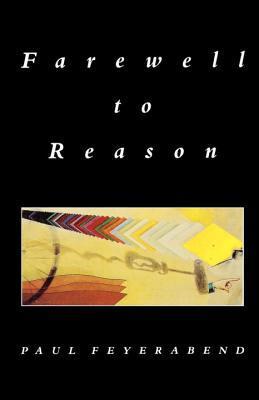
Farewell to Reason

Rate this book
Farewell to Reason  offers a vigorous challenge to the scientific rationalism that underlies Western ideals of “progress” and “development,” whose damaging social and ecological consequences are now widely recognized. 

For all their variety in theme and occasion, the essays in this book share a consistent philosophical purpose. Whether discussing Greek art and thought, vindicating the church’s battle with Galileo, exploring the development of quantum physics or exposing the dogmatism of Karl Popper, Feyerabend defends a relativist and historicist notion of the sciences. The appeal to reason, he insists, is empty, and must be replaced by a notion of science that subordinates it to the needs of citizens and communities.

Provocative, polemical and rigorously argued, Farewell to Reason  will infuriate Feyerabend’s critics and delight his many admirers.

336 pages, Paperback

First published January 1, 1987

17 people are currently reading
1119 people want to read

About the author

Paul Karl Feyerabend

93 books284 followers
Paul Karl Feyerabend was an Austrian-born philosopher of science best known for his work as a professor of philosophy at the University of California, Berkeley, where he worked for three decades (1958–1989).

His life was a peripatetic one, as he lived at various times in England, the United States, New Zealand, Italy, Germany, and finally Switzerland. His major works include Against Method (published in 1975), Science in a Free Society (published in 1978) and Farewell to Reason (a collection of papers published in 1987). Feyerabend became famous for his purportedly anarchistic view of science and his rejection of the existence of universal methodological rules. He is an influential figure in the philosophy of science, and also in the sociology of scientific knowledge.

Ratings & Reviews

What do you think?
Rate this book

Friends & Following

Create a free account to discover what your friends think of this book!

Community Reviews

5 stars
68 (32%)
4 stars
91 (43%)
3 stars
31 (14%)
2 stars
15 (7%)
1 star
2 (<1%)
Displaying 1 - 18 of 18 reviews
Profile Image for Kevin K.
159 reviews37 followers
January 20, 2013

This is a hard book for me to rate. On the one hand, when I first read parts of Farewell to Reason in the late '90s, I was electrified by it. It opened my mind to a whole new way of looking at the world (Feyerabend's relativism) which I have subscribed to ever since. On the other hand, the book is deeply flawed, and probably 70% of it isn't worth reading. One example: the final essay consists of responses to criticisms of Feyerabend in an obscure German publication. Unfortunately, the reader of FTR has no idea what the original critics actually said. So it's a little like coming into a conversation halfway through, where you don't have most of the background. Much of the book suffers from this type of thoughtlessness toward the reader, and large sections on the philosophy of science are both very dated and incomprehensible.

Nevertheless, the first and last essays of FTR rate five stars in my opinion. Among today's armies of moral crusaders, it's hard to find a genuine defender of relativism, and Feyerabend is one of the best. What is relativism? It's the idea that there is no moral truth, and that "objectivity," "rationality" and "progress" are phony constructs used primarily by Western people to undermine and destroy the diverse cultures and ways of life which existed in the pre-rational era (or remain pre-rational today). Feyerabend's program (perhaps it would be better to call it an "anti-program") is to allow total pluralism and self-determination where all sorts of societies and belief systems are allowed to flourish – without being browbeaten by intellectual elites, and forced into "rational" straight-jackets like free trade, growth economics, secular humanism, liberalism, Marxism etc.

Feyerabend doesn't hesitate to take on the hard cases either. At one point in FTR he defends the Catholic inquisition as being rational within its own terms, and its arguments as impossible to refute based on any "objective" arguments. And he's right! A less dramatic, but similar case would be the controversy in recent years over teaching evolution in public schools. Feyerabend's point of view is that what matters is not the "truth," but quality of life, and the right of human beings to live in ways they find meaningful and satisfying. That is, there is nothing wrong with a community of people deciding, through democratic principles, that they want to live a Biblically structured life, and teach their children Creationism. Of course, this is where the modern inquisition, and the Popes of Objectivity, step in and assert their right to force their "objective" views onto other people's children. And in today's America that seems perfectly normal. But translate this behavior to a society more fashionable than evangelical Christians like, say, Indios living in the Amazon. Do we really need to force their children into schools to learn evolution and other irrelevant garbage that, essentially, is just another missionary White man's religion to be rammed down their throats like Christianity? As Feyerabend eloquently puts it, "The pygmies, for example, or the Mindoro of the Philippines, do not want equal rights – they just want to be left alone."

Stephen J. Gould often said that there is no progress in evolution, and that no species is superior to any other. Species are simply adapted in various degrees to their environment. Feyerabend deploys similar arguments in the field of human culture. Essentially, his point is that no culture is superior to any other, and thus there is no reason for one culture to impose its views or ways of life on another. Yes, we could send the Indio children to school, and teach them evolution – instead of the silly, primitive, religious beliefs which dog their parents – along with all the other trappings of our modern "objective" civilization. But why? Their society is already superbly adapted to their environment, and meets their spiritual needs. Whereas our supposedly advanced society is destroying our environment, and not meeting our spiritual needs!

Farewell to Reason has some brilliant, life-changing material in it (well, at least it had a big impact on my life and thinking), and is well worth reading – just don't be hesitant to skim over the chaff.
Profile Image for Simon Mcleish.
Author 2 books141 followers
July 20, 2012
Originally published on my blog here in May 2000.

Farewell to Reason is a collection of essays on the subject of relativism. Though they were rewritten for inclusion in this volume, their independent origin still shows in a certain repetitiveness and in disparity of content - some are far more concentrated on a single theme than others (for example, some are criticisms of particular writers).

The essays pick on the same kinds of targets as Feyerabend's book Against Method, and attack the idea that science is a unified whole, with a single overriding method. Karl Popper is singled out for criticism, but much of what is said would apply to anyone who contrasts "scientific thinking" with other modes of thought (this is usually done do dismiss religious ideas).

Most of the criticisms that can be made of Against Method are also appropriate here. The rhetorical style of Feyerabend's argument, his use of Galileo as a paradigm of scientific method, and the use of counter examples from areas not always regarded as scientific such as economics are faults common to both. The essay form adds new problems, and some parts do not fit into the whole terribly well (notably the discussion of Aristotle's philosophy of mathematics, though it is interesting in itself). Neither Popper nor Feyerabend seem terribly convincing to me; while it is obvious that not all scientific thought is uniform, most practising scientists have quite similar ideas about what they are trying to do. These differ in details (such as the precise relationship between theory, experiment and whatever may count as underlying reality), but then philosophy does not interest many and certainly there are few who would let it affect their work.

The most interesting new point is part of the essay on Galileo and the church, in which Feyerabend parallels the attitude of Catholic cardinals then and the scientific establishment today. As the money and administrative side of scientific research grow every larger, it is more and more difficult to be a (successful, rather than starving) iconoclast. For science to have a religious orthodoxy of this kind is a bad thing, and we need people like Feyerabend to continually attack its genesis.
Profile Image for Uğur Erdem Seyfi.
31 reviews9 followers
February 20, 2020
Kitabın ilk bölümü görecilik hakkında ve bu bölüm kitabın yaklaşık çeyreğini oluşturuyor. Bu bölümün daha öncesinde benim gibi görecilik leyhinde bir şeyler okumamış ve özellikle görecilik karşıtı argümanları görmüş birisi için oldukça ufuk açıcı olabileceğini düşünüyorum. Bu bölümde Feyerabend hem göreciliğe getirilen belirli eleştirilere yanıt veriyor hem de kendi göreci görüşünü savunuyor.

Feyerabend amcamızın en göze çarpan taraflarından birisi farklı geleneklere ve bu gelenekler arasındaki farklılıklara verdiği önem. Ona göre bilim de geleneklerden yalnızca birisi ve bilimi ve "akılcı" ilkeleri esas alan bir toplumu başka ilkeleri esas alan bir topluma üstün kılacak "nesnel" bir kıyaslama ölçütü yok. Feyerabend görüşlerini desteklemek maksadıyla kitap boyunca bir sürü tarihsel örneğe başvuruyor ve bu örnekleri verirken dönemin şartlarını göz önünde bulundurarak o zamanlar savunulan görüşlerin kendi içerisinde nasıl da tutarlı olduğunu, bilimsel ilerlemenin bizim sandığımız kadar basit bir şekilde ilerlemediğini göstermeye çalışıyor.

Kitapta vurgulanan ve ilgimi çeken diğer şeylerden birisi ise kitabın sürekli bir şekilde "teori" ve "uygulama" arasında karşılaştırmalar yapması ve teoriyi uygulamaya ya da pratiğe göre daha asil, yüce bir uğraş olarak gören tayfanın tezatlıklarını (Feyerabend'in ifadesiyle "ikiyüzlülüklerini") ortaya çıkarması. Feyerabend ile tanışmamın, daha doğrusu bu kitabı okumanın bana kattığı en önemli şeylerden birisinin belirli bir teoriye olan imandan kaynaklanan kibirden arınmam olduğunu söyleyebilirim.

Kitapla ilgili sorunlardan birisi kitabın belirli kısımlarında kendinizi ne olduğunu dahi anlamadığınız tartışmaların içerisinde bulabilmeniz -ki bilim felsefesi ve bilim tarihi hakkında çok okuma yapmadıysanız muhtemelen hissedeceksinizdir-. Ancak yine de kitabın farklı bir persfektif sağlamak açısından oldukça faydalı olacağını düşünüyorum.

Kitabı okurken tekrardan okuyabileceğimi düşündüğüm, en çok hoşuma giden bölümleri işaretledim, o bölümler şöyle:

1. Görecilik Üzerine Notlar
2. Akıl, Ksenofanes ve Homeros'un Tanrıları
3. Bilgi ve Teorilerin Rolü
...
9. Galile ve Doğruluğun Tiranlığı
10. Putnam'ın Kıyaslanamazlık Üzeirne Düşünceleri
11. Kültürel Çoğul(cu)luk mu Yoksa Yeni Yavuz Birörneklik mi?
12D. BİLİM: BİRÇOK GELENEKTEN BİRİ
12E. AKIL VE PRATİK
12F. ÖZGÜR BİR TOPLUMUN ÖĞELERİ
12G. İYİ VE KÖTÜ
12H. AKLA VEDA
Profile Image for Àlex.
55 reviews2 followers
March 14, 2021
De moment només he llegit l'assaig "central", que dóna títol al llibre, un autèntic nyap. Quina mandra, quina teoria més pesada. El relativisme portat fins a l'absurd, a unes posicions indefensables. Li poso 2 perquè si que és cert que hi ha claredat i la prosa llisca.
Profile Image for Saif.
17 reviews6 followers
April 11, 2022
A breath of fresh air.
Profile Image for Conrado.
53 reviews2 followers
February 25, 2024
Like Nietzsche and Kierkegaard before him, Feyerabend tries to remind us that any appeal to objectivity is nothing more than an inclination and a reflection of our own cultural background and personal idiosyncasies -- to try to treat our dreams as actual universal rules and demands of humanity is not only to act in bad faith (in Sartre's sense of the term) and dishonestly (in Nietzsche's sense) but also a recipe for disaster when it comes to social problems, as Feyerabend argues that foreign cultures have no obvious need to know which problems are the most important and how they should deal with them -- it's up to the people themselves to know how to resolve them and it's been that way ever since until our own cultural imperialism tried to force the Western worldview (with its own conceptions of knowledge, science, objectivity, right and wrong) on them.

Feyerabend as I read him is not a relativist -- he's a skeptic, and one can even say of the pyrrhonian stripe as he tries as much as possible to avoid clinging to his views as universal truths and instead using them only as tools to disarm our own dogmatic convictions. This is the main point of some of the essays, notably "Notes on relativism" and "Farewell to reason", in which he tries to disarm our conviction in the authority of science and reason through historical considerations with the aim of inducing some form of embarassment in his opponents and not the aim of establishing the objective truth of these considerations. In other essays such as "Putnam on incommensurability", he doesn't feel the need to argue for incommensurability as philosophers of science generally fear -- it's enough to point out that such fear is motivated by unjustified philosophical assumptions about communication and translation, that such a craving for universal mediums of language are an illusion coming from the urge to philosophize. In that way he's very close to the therapeutic (anti-)philosophy of Sextus Empiricus, Montaigne, Kierkegaard, Nietzsche and Wittgenstein. There's even a hint of Stirnerism in Feyerabend when he says, towards the end of the final essay, that he "must never permit these inventions and convictions to get the upper hand and to turn me into their obedient servant", that he "might even 'take a stand'", but not because of any "moral conscience, or any other nonsense of that kind".

Because of this, Farewell to reason (and, really, I think all of his work from Against method onwards) is not to be read as book that's "right" or "wrong" -- it's a book that's meant to make an impact on you, and change your general orientation; it ultimately doesn't care about objective (perspective-independent) truth as Feyerabend is skeptical of that from the get-go and he's willing to use all his rhetoric to fulfull his practical purposes. Its purpose is humanitarian as Feyerabend thinks that scientific and philosophical dogmatism are in tension with democractic forms of society in which communities are free to flourish without unjustified external interference (see the first three essays). Naturally he does not have a program for this society, as he thinks its their responsability and no one else's to figure themselves out. It might lead to some forms of society we might not like, but that might fulfill their existential and practical demands perfectly. It might also lead to segregation, but it might be the start of new flourishing plural communities as well. There's no prediction, only dreams and hopes for a more humane future.

This is a very broad picture of the book and it does not do complete justice to it. It was a wonderful read and I highly recommend it. I wish I had read him sooner.
Profile Image for Muaz Jalil.
355 reviews9 followers
March 25, 2023
The last few chapters are interesting. He makes the same mistake about Popper as did others, I.e., Popper did not suggest falsification like a litmus test similar to verification (see Bryan Magee's Confession). Overall his criticism is identical to post-colonial critics against the cognitive privilege of the west. But like them, I feel he is throwing the baby with the birth water. Talks about location education and problems of spreading western education via schools in Asia/Africa, displacing local knowledge. He talks about how science should be subservient to democracy. His attitude explains why we have so many anti-vaxers, climate change deniers, flat earthers, and control of stem cell research, among others. Some interesting discussion about the history of science.
Profile Image for Mercurio Cadena.
65 reviews18 followers
October 23, 2017
Feyerabend es un requisito en el mundo de la epistemología. Paul nos persuade no sólo de la imposibilidad de un sistema de conocimiento "objetivo" que difumine al resto en una batalla de legitimidad, sino que nos muestra la mezquindad detrás de semejante proyecto.
Profile Image for Daniel.
25 reviews1 follower
July 6, 2018
Paul Karl Feyerabend ensues to be the sort of out of the ordinary irreverent philosopher, which is plenty of contradictions and triggers his readers’ awkwardness, although this present work would rather be classified as a short-tempered and tense juxtaposition of small essays which, in its best, could had a better impact, if its author wouldn’t deplete his munitions of straw man representations of science, philosophy and arts. I assume that the very point it makes and, at least, his work, would be of great value would be much more satisfying, if the author would never classify his colleges and readers as academic scroungers; its own work is itself contradictory, since he knocks out everyone who may sustain a different point, and doesn’t itself admit criticism, because he is not, as we says, a reasonable writer – instead, it befalls rational and logical comprehension of world, giving up on his fallacious attempts to detreat upon – and not from – others what we actually does, just because he isn’t reasonable – this point transforms his own position in a critique to the very intervention and intercultural dialogue, founded in the sign of variety – a multiplicity which, I admit, till the present moment, not only is not guaranteed, owing to the fact it hasn’t been accomplished in western and specially European history, but also in nowadays. Even so, this standpoint, being unable to account for debate and consisting in a coarctation of human action and consideration of his acts, would create a meta-historical writer, which tries to keep itself beyond bias – a foregone conclusion he implicitly tries to deny he upholds, indorsing this outlook in his criticisms to Popper and other authors (which I would better appreciate, if there wasn’t so many ad hominins! Indeed, this could never be achieved, since all we born in a cultural-biased world vision; in fact, he is trying to make his point, without considering others and obliterating the very culture path he eventually was trying to stand up for. As a result, we can’t affirm his ideas for we advise readers that doing anything – even denying his argumentation – from reflection upon his words would be impervious! But since we are citizens and our pollical institutions couldn’t stand as democratic, as long we can’t adopt our characteristically societal disparity from other ethnicities – the democratic world we envisaged in Greek culture and, as relativistic may agree, wouldn’t be superior to any other nor inferior, and, as a result, it consists in an idiosyncrasy that shall never be eliminated (the obliteration of memories would cause an aberration – the dilapidation and annihilation of our patrimonial fountainheads as humans, the mistreatment to the right for memory, because we must foment diversity and recognize it from our culture, and not as an stranger talking as a prophet, like some stylistic twists in Feyerabend’s book. Consequently, the problem is – and Feyerabend adopts a pattern with we couldn’t refuse it is the stain of his very own culture, since it considers problems –, therefore, how to foment diversity in world culture backdrop, without a reliance in homogeneous and inhuman methodology (and that is one of the greatest lessons we could learn about the view Paul Feyerabend gives us, although we denies: that is, in the treatment of our very own culture and social organization, we must seek for a methodology which allows diversity and respect to human diversity: and it only could be done if we take the time we need to reflect and try to surpass the intolerable standardization and velocity of our society: instead, we must not neglect science as something, which was to do which our western culture and it is important was well as other cultural traditions, but instead think how the democratization of education could be less dogmatic and more critical; in fact, Paul Feyerabend cannot forget our history and that his knowledge came from a tradition would had been lost, if it didn’t pass to us; so if we don’t give or foresee to provide education for our children, democratically – reserving it just for a minority as Feyerabend suggests in is argumentative path – in fact, we thinks education couldn’t extend his limits to the citizens that born as members of a western tradition (I agree that we can't destroy autochthonous structures, a point which I totally agree with), considering intellectuals and educated people as a minority –, it would eventually create more permeable citizens (that is, people which born in western culture) without tools to think for themselves and – throwing light to this truism – to consider Feyerabend words and its very point – however, the author disrepairs his culture and rather thinks that we must assume that other cultures are superior to our owns (they, in fact, have the same value) and that we must take some practices from them, instead of recognizing that this very solution was the one likewise we criticized (we denies we should share our cultural practises with others, because it would be a imperialist view; I agree we should be aware to the imperialism western tries to adopt, but I don't agree that we should forget our culture; I think that balance is required); so, our schools could be improved, but we should consider that reading, learning, intellectual work, which Paul Feyerabend had done, are taken from the very nature of our culture and we shall never try to forget this. So, nonetheless, my balance is that the indignation with honest efforts and intellectuals – they aren’t all of the same stipend, since, as all workers, they could be considered a contribuition to our society in general as a rich culture, as the others and, therefore, we shall never forget nothing and, specially, never try to foreshadow our history as a dynamical practice. So, at least, his very disrespectful remarks to all universities are, at best, very disgraceful, due to the fact that the contemporary world would need to conciliate his views, not within a rational system closed upon itself, but rather with critical thought.
35 reviews
January 9, 2025
Both this and SFS are substantially worse than *Against Reason*, an opinion generally shared even among his most ardent supporters, of which I am not one. *Farewell to Reason* is rated slightly higher than SFS in my opinion because the only argument made in these two that I remember sympathy for is that we shouldn't force "Western" traditions on the whole of the Earth, and that includes taking a hard look at when science is appropriate (that's a watered down version to be more palatable, but notably Popper appears to disagree with even this). *Farewell* also contains the most infuriating paragraph I've ever read, which is impressive.
10.6k reviews35 followers
October 9, 2024
A BROAD COLLECTION OF FEYERABEND'S ESSAYS

Paul Karl Feyerabend (1924-1994) was an Austrian-born philosopher of science who taught philosophy at UC Berkeley; he also wrote books such as 'Against Method', 'The Tyranny of Science,' 'Killing Time: The Autobiography of Paul Feyerabend,' 'Science in a Free Society,' etc.

He wrote in the Introduction to this 1987 book, "The essays collected in this volume deal with cultural diversity and cultural change. They try to show that diversity is beneficial while uniformity reduces our joys and our (intellectual, emotional, material) resources... I shall criticize two ideas that have often been used to make Western expansion intellectually respectable---the idea of Reason and the idea of Objectivity."

He suggests, "For every statement, theory, point of view believed (to be true) with good reason there exist arguments showing a conflicting alternative to be at least as good, or even better." (Pg. 76) In a later essay, he illustrates, "there exists no `objective' scientific study of the comparative effectiveness of Western and indigenous procedures in many fields. Even medicine can only offer isolated reports of successes, and equally isolated reports of the failures of non-Western medical practices: but the overall picture is far from clear." (Pg. 87)

He pointedly argues, "`It seems to me quite obvious,' says a critic, `that we know more about the world than people did in the days of Parmenides and Aristotle.' ... but who is the `we' the critic is talking about? Is he talking about himself? Then the statement is quite obviously false---there is no doubt that Aristotle, on many subjects, knew more than he does... There are lots of things unknown to `us' Western intellectuals but known to other people... It may be true that the sum total of the facts that now lie buried in scientific journals, textbooks, letters and hard discs by far exceeds the sum total of the knowledge that comes from other traditions. But what counts is not number but usefulness and accessibility. How much of this knowledge is useful, and to whom?... we find lots of problems, but no obvious answers. It is therefore necessary to go beyond empty slogans and to start THINKING." (Pg. 160-161)

In an essay of Galileo, he explains, "As far as I am concerned the best way of describing a historical conflict is to introduce the INDIVIDUALS that created it, to describe their temperament, their interests, their hopes and ambitions, the information at their disposal, their social background, the individuals and institutions they felt loyal to and that supported them in turn, and many similar things." (Pg. 247-248)

He responds to a letter, "you say that there is `cultural chaos' without a unifying bond... That sounds nicely abstract and philosophical but I wonder how closely you have considered the matter. Have you compared the clientèle of soap opera, or of Reverend Falwell, or of the Super Bowl with the clientele of modern art, or of the rationalism/irrationalism issue in philosophy? Do you have the numbers?... I don't think you have... even the simplest calculation shows that you cannot possibly be right:

"[T]here are now 10,000 philosophers teaching in the U.S. and in Canada. Most of them are obedient servants of the status quo, but let us assume that 25% are creators of disorder... let us again assume that 25% [of their students] become committed followers of their chaos-creating teachers. That would make 40,000. Do you know how many millions are watching [the TV show] Dallas? How many watched the Super Bowl?...compare the amount of money that is being used to uphold chaos with the amount of money that supports monotony... [I] contest your thesis of the pervasiveness of chaos." (Pg. 275-276)

In the title essay, he says, "My main thesis on this point is: the events and results that constitute the sciences have no common structure; there are no elements that occur in every scientific investigation but are missing elsewhere..."(Pg. 281) He adds later, "the best education consists in immunizing people against systematic attempts at education... even the most stupid and inhumane point of view has merit and deserves a good defence." (Pg. 316)

This broad collection of essays makes an excellent introduction to Feyerabend's work, and makes for stimulating and thought-provoking reading.

Profile Image for Rita.
125 reviews144 followers
November 19, 2023
This is an academic book, and yet somehow it had me tearing up by the end.

Feyerabend is at the top of his game here, weaving intricate historical and philosophical analysis with poignant quips about the state of modern academia and society. While his specialty will always be in the philosophy of physics, he takes a step away here and delves into questions relating to medical authority and fascism — some of the most controversial discussions from Against Method which he had not elaborated on well until this book. As someone recently said to me, Feyerabend never did himself any favours by focusing so much on physical theories when it doesn't make a difference to most people whether you're using Aristotelian physics or quantum mechanics. In contrast, the kinds of medical treatments we are able to access, the kind of freedoms we are afforded in educational institutions are more universal concerns. In Farewell to Reason, Feyerabend finally gets the chance to do these issues more justice, and I think the product is a beautiful piece of philosophy.

I think it is also important to acknowledge the biographical developments that led to this change in Feyerabend's philosophy. He often refers to the immense influence of his last wife, Grazia Borrini, in shaping his thought. In fact, the last paragraph of the book is dedicated to her, and to other thinkers he respects and who have influenced him:
So, I finally gave up my self-cynicism and decided to write one last, but good book, for Grazia, because I know her and because I write best when I have a smiling face before me (remember, I wrote AM with Imre Lakatos in mind), and through her, for all the people who despite hunger, oppression, wars try to survive and to achieve a little bit of dignity and happiness. Of course, to write such a book I shall have to cut the remaining strings that still tie me to the abstract approach or, to revert to my usual irresponsible way of talking, I shall have to say FAREWELL TO REASON.
As a fellow romantic and a philosopher who wants my work to mean something to the people I care about in this world, this ending will stay with me for a long time.
382 reviews12 followers
Read
April 30, 2020
Tomarse al pie de la letra a Feyerabend puede ser peligroso, pero como cura de humildad y toma de conciencia de hasta qué punto la labor científica y todo lo que la rodea son frágiles y contingentes resulta más que pertinente. Hay partes realmente brillantes y ricas en propuestas que ayudan más a la ciencia de lo que aparentemente la critican, aunque también abundan los fragmentos defensivos ante las muchas críticas que le hicieron en vida al bueno de Paul, que fluctúan entre las explicaciones lúcidas y las imprecaciones belicosas y con menos interés.

En definitiva, hay muchas cosas valiosas en Adiós a la razón, expresadas con mucha precisión y claridad, y presumo que en toda la obra de Feyerabend, pero, fiel su propio pensamiento, más vale leerlo y aprender de él que seguirlo ciegamente.
Profile Image for hcdr.
6 reviews
April 25, 2024
muchas veces tiene razón, pero lo leo con rabia. sobre todo la política. a veces es como leerse a un villano resentido de película
24 reviews
August 7, 2025
Feyerabend’in bilim eleştirisi haklı noktalara temas ediyor: Bilim tarihinin çizgisel olmadığı, Popper ve benzeri pozitivistlerin metodolojilerinin tutarsızlıklar barındırdığı, “nesnellik” ve “akılcılık” gibi kavramların mutlaklaştırılmaması gerektiği… Bunlar yerinde ve güçlü gözlemler. Fakat bu eleştirilerin çözüm önerileriyle desteklenmemesi, kitabı bir tür “romantik bilim karşıtlığı” çizgisine yaklaştırıyor.

Örneğin Feyerabend’in “bilim de diğer bilgi türleri kadar görecelidir” savı, bir özgürlük çağrısı gibi görünse de, pratik düzlemde bir kafa karışıklığı yaratıyor. Çünkü eğer bilimle mitoloji, astroloji ya da geleneksel bilgiler tamamen aynı epistemik statüye sahipse, bu kez neye göre karar vereceğiz? Feyerabend burada çoğulluğu savunurken, seçim yapma kapasitemizi zayıflatıyor.

Ayrıca kitabın dili, yer yer karizmatik bir anarşizmin etkisine kapılıyor. Bu, akademik disiplinlerde devrim isteyen biri için cazip olabilir; ancak bilginin sistematik üretimi için belirli çerçevelere hâlâ ihtiyaç duyduğumuzu inkâr etmek, naif bir iyimserlik sayılabilir. “Kültürel çeşitliliği savunmak” başka, “bütün yöntemleri eşitlemek” başka şeydir.
Profile Image for Rui Coelho.
256 reviews
July 31, 2016
More political, but also less bright, than Against the Method.
Displaying 1 - 18 of 18 reviews

Can't find what you're looking for?

Get help and learn more about the design.