Jump to ratings and reviews
Rate this book

L'uomo dal vestito grigio

Rate this book
Siamo negli anni Cinquanta: Tom e Betsy Rath, una giovane coppia del Connecticut, tre bambini, una casa e un reddito sicuro, hanno molti motivi per essere felici. E tuttavia non lo sono. Libro simbolo di un'intera generazione, "L'uomo dal vestito grigio" è stato uno dei primi romanzi a descrivere il disorientamento dell'uomo medio" americano negli anni successivi alla Seconda guerra mondiale di fronte al nascere della società dei consumi. Uscito per la prima volta nel 1955 ottenne subito uno straordinario successo. L'anno dopo il libro divenne un film di cassetta, con Gregory Peck protagonista.

344 pages, Paperback

First published January 1, 1955

172 people are currently reading
5225 people want to read

About the author

Sloan Wilson

34 books29 followers
Sloan Wilson (May 8, 1920 – May 25, 2003) was an American writer.
Born in Norwalk, Connecticut, Wilson graduated from Harvard University in 1942. He served in World War II as an officer of the United States Coast Guard, commanding a naval trawler for the Greenland Patrol and an army supply ship in the Pacific Ocean.
After the war, Wilson worked as a reporter for Time-Life. His first book, Voyage to Somewhere, was published in 1947 and was based on his wartime experiences. He also published stories in The New Yorker and worked as a professor at the State University of New York's University of Buffalo.
Wilson published 15 books, including the bestsellers The Man in the Gray Flannel Suit (1955) and A Summer Place (1958), both of which were adapted into feature movies. A later novel, A Sense of Values, in which protagonist Nathan Bond is a disenchanted cartoonist involved with adultery and alcoholism, was not well received. In Georgie Winthrop, a 45-year-old college vice president begins a relationship with the 17-year-old daughter of his childhood love. The novel The Ice Brothers is loosely based on Wilson's experiences in Greenland while serving with the US Coast Guard. The memoir What Shall We Wear to This Party? recalls his experiences in the Coast Guard during World War II and the changes to his life after the bestseller Gray Flannel was published.

Wilson was an advocate for integrating, funding and improving public schools. He became Assistant Director of the National Citizens Commission for Public Schools as well as Assistant Director of the 1955-56 White House Conference on Education.

Source: Wikipedia

Ratings & Reviews

What do you think?
Rate this book

Friends & Following

Create a free account to discover what your friends think of this book!

Community Reviews

5 stars
928 (24%)
4 stars
1,687 (45%)
3 stars
926 (24%)
2 stars
173 (4%)
1 star
32 (<1%)
Displaying 1 - 30 of 427 reviews
Profile Image for Orsodimondo.
2,458 reviews2,431 followers
November 24, 2025
FLANELLA GRIGIA


Gregory Peck è l’uomo dal vestito grigio (di flanella).

Ho letto questo libro, che non era neppure lontanamente nella mia lista dei desideri, perché ero fresco di Franzen e mi è stata consigliata (da Noodles, che ringrazio) la sua introduzione, dell’ottimo Jonathan F. intendo, proprio a questo libro.
Buona prefazione – letta tre volte – a questo bel romanzo degli anni Cinquanta (pubblicato nel 1955 con buon successo – il film è stato realizzato in tempo record, dopo un solo anno, e purtroppo si vede).
E ha ragione Franzen, più di una volta.


Betsy/Jennifer Jones e Tom/Gregory Peck.

Ha ragione a dire che la prima parte è quella migliore: infatti, la seconda si slabbra con le vicende e i ritratti troppo lunghi di personaggi non protagonisti. Mentre la prima era rimasta sapientemente addosso ai due protagonisti, Tom e Betsy, marito e moglie, con un lungo capitolo, il più lungo del libro, dedicato al periodo di guerra di Tom, paracadutato su un’isoletta giapponese, ma subito prima a Roma dove aveva goduto di una lunga insperata licenza, durante la quale ha incontrato Maria e vissuto con lei una storia lunga solo qualche settimana, pagine nelle quali Wilson raggiunge il suo meglio, pagine davvero molto belle (aggiungerei anche quelle dedicate alla nonna e alla villa, ai ricordi infantili di Tom).


Scritto e diretto da Nunnally Johnson (1956).

Ha ragione Franzen a dire che qui si leggono gli anni Cinquanta, la preparazione del decennio successivo, e ha ragione a non citare pietre miliari quali Revolutionary Road o The Swimmer di Cheever: non tanto per la diversa qualità, ma piuttosto perché per quanto periodo e ambientazione possano somigliarsi, quelli vanno in una direzione diversa da questo.
Ha ragione Franzen quando sostiene che se si crede nell’amore e nella lealtà e nella verità e nella giustizia si finisce per leggere con le lacrime agli occhi, come è successo a lui, come è successo a me.
Sarà un po’ anticonvenzionale, suppongo, ma a noi sembra semplice giustizia… Per me è una questione di coscienza e non intendo tentare di giustificarmi con nessuno, si legge alla penultima pagina, e i consueti dolori di stomaco dell’ottimo giudice Bernstein improvvisamente e miracolosamente si placano perché lui è qualcuno che apprezza ciò che voi definite “semplice giustizia”.


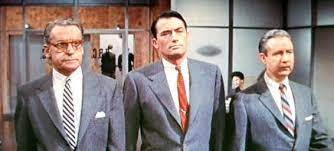
A dx Fredric March che interpreta il magnate Ralph Hopkins, datore di lavoro di Tom Rath.

Rath, il cognome di Tom, suona molto simile a ‘wrath’ che è la collera (divina). Eppure, Tom è pieno di pensieri, e dubbi, ma non sembra proprio mai davvero arrabbiato, mai in collera. Direi piuttosto che sa essere sensibile, e dolce, e giusto, nonostante il suo vestito di flanella grigia, espressione che è diventata un po’ sinonimo del travet.
E se è vero, come dice Ralph Hopkins, il magnate che ha assunto Tom, che Questo mondo è stato costruito dagli uomini come me! Per assolvere realemnte un compito, occorre viverlo, anima e corpo! Voi che dedicate soltanto metà di voi stessi al lavoro, vivete a nostre spese!
È anche vero che Tom al lavoro è pronto a dedicare più di metà di se stesso, ma non il cento per cento, non tutto se stesso: perché comprende che nella vita ci sono anche altri valori, e altri piaceri. In questo, il romanzo è alquanto controcorrente: l’american dream poggia su personalità infaticabili, che non conoscono riposo.
Ma anche se il libro è intitolato all’uomo il vero eroe è l’eroina, sua moglie Betsy, indimenticabile nel suo essere migliore di qualsiasi aspettativa.


A sin Henry Daniell/Ogden, a dx Arthut O’Connell/Walker che nel primo colloquio di assunzione di Tom è sdraiato dietro la scrivania.

PS
Wilson adotta una formula per esprimere i tanti “mumble mumble” di Tom e Betsy, i loro borbottii interiori, ruminii e rimuginamenti: li trasforma in una sorta di dialogo interiore, più che monologo, che diventa facilmente didascalico (mi ha ricordato la pletora di domande che si pone Giovanna in La vita bugiarda degli adulti, la parte più fiacca dell’ultimo romanzo di Elena Ferrante).
PPSS
Il film è molto lungo, due ore e mezza: avrebbe giovato una maggiore focalizzazione. Ma soprattutto è girato con una messa in scena che una volta si sarebbe definita televisiva, intendendo semplice, schematica, piatta (ora, invece, alcune delle cose migliori si vedono proprio in televisione, il cinema ha in buona parte smesso di stupire). Di tutte le interpretazioni ho trovato eccellere quella di Fredric March nei panni del magnate Ralph Hopkins e quella di Maria Pavan nel ruolo di Maria. L’ambientazione romana è, a essere gentili, risibile.


The Man in the Gray Flannel Suit.
Profile Image for Richard Derus.
4,185 reviews2,266 followers
March 29, 2025
Book Circle Reads 158

Rating: 4* of five

The Publisher Says: Here is the story of Tom and Betsy Rath, a young couple with everthing going for them: three healthy children, a nice home, a steady income. They have every reason to be happy, but for some reason they are not. Like so many young men of the day, Tom finds himself caught up in the corporate rat race - what he encounters there propels him on a voyage of self-discovery that will turn his world inside out.

At once a searing indictment of corporate culture, a story of a young man confronting his past and future with honesty, and a testament to the enduring power of family, The Man in the Gray Flannel Suit is a deeply rewarding novel about the importance of taking responsibility for one's own life.

My Review: 1955. That is, if you're math-challenged, 58 years ago, and the year that Simon & Schuster published this book. So Wilson was writing it in, it's safe to say, 1953 (60 years ago). And this is what Wilson said:

Money, I need money, {Tom} thought. If they don't build a new public shcool, I should be able to afford a private school. I should get everything but money out of my head and really do a job for Hopkins. I ought to be at work now....
Money, Tom thought. The housing project could make money, but it depends on re-zoning, and Bernstein says we shouldn't ask for that until they vote on a new school.
A new school, he thought---so much depends on that! ... I should work for a new school, and I should work harder for Hopkins, and I should be making plans for our housing project. Where did I ever get the idea that life is supposed to be anything but work? A man's work should be his pleasure---I shouldn't expect anything more.


Tom Rath has just been to see the overcrowded public school his daughters have to attend because, unlike his own father, he can't afford to put them in a private school. He muses on these thoughts while waiting for a late commuter train into the city, where he will take on a lowly personal assistant's position and, in the process, displace a number of female employees from their physical space.

Sixty years since Wilson was penning these words, and not that much has changed. Now, of course, it could easily be a mom having these platform reveries, because we've been sold the bill of goods that nannies and au pairs are plenty good enough to raise the kids we've had but don't feel like raising even if it means NOT having a home theater, six DVR-equipped TVs, and each kid with an unshared Xbox. If mom's better at business, dad, YOU stay home and raise those people you engendered. Read to them, make them a snack after carpool, help with their homework. Hiring out parenthood sorta makes it pointless, doesn't it?

Ahem.

Me and my rants.

Wilson's book analyzes the sources of Tom's inner discontent as disconnection and materialism. I agree. The alarm bell sounded by this, and by the 1956 movie, went unheeded despite the fact that both were hugely popular and successful in their own spheres. (The movie was as good as the book, for once.)

At every turn, MONEY the getting and spending of, obsesses and defines Tom. His wealthy grandmother is being cared for by a greedy granny-nanny, and the hijinks appertaining thereto are most instructive for today's audience. Tom's boss, the venal and piggish Hopkins, plays out before Tom's increasingly revolted gaze his own probable future of alienated kid (extra probable because his three are TV obsessed brats), estranged wife, and grasping mistress(es). Then things get complicated when a wartime indiscretion with an Italian lass provides a surprise to Tom's unsuspecting wife.

Wilson wrote of his own time. Change the props, update the clothes, and make it about Betsy the wife, and nothing much has changed.

I'm sad about that. So much needless hurt caused in this world from sheer, wasteful greed for MORE when there's more than enough right in front of these hungry-souled people.
Profile Image for Sara.
6 reviews4 followers
March 16, 2008
LOVED this. I'm a sucker for anything 1950s, and this was a great look at the depressing conformity of that era.

My dad recommended this book to me after I raved about the AMC show "Mad Men." It's pretty clear that the show's writers took the plot almost directly from this book. Both deal with the same dynamic: War-hero husbands quietly dealing with the mental fall-out of WW2, housewives stifled by a life of cleaning and baking, and what happens when no one is allowed to talk about how they're really feeling.

One thing I thought was really interesting: The man character, Tom Rath, is trying to get ahead in his career. His big break comes when he's asked to write a speech for the head of a broadcasting network, who is trying to build a foundation for mental health. Tom drafts several bland versions of the speech, all while having traumatic flashbacks to his time as a paratrouper. Somehow, it never occurs to him that HE is the example his speech needs. No one in the book ever makes the connection that the mental health foundation could be used to treat the thousands of men coming back from war with major issues. Instead, it all has to be bottled up and ignored — dressed up in a gray flannel suit.
Profile Image for carl  theaker.
937 reviews53 followers
January 24, 2025
One hopefully reads a lot of good books over a lifetime and that every so often on page one you say Dang! That’s writing!

‘The Man in the Gray Flannel Suit’ became a definition of the daily middle class struggle of the 1950s and the title itself iconic for the era, though ‘the Gray Flannel’ suit was the uniform for the businessman, the phrase was also adapted with a negative connotation for conformity.

Written in the early 1950s, its insights are used throughout the next …well many years, in other books and media. I found the middle class family with 3 little ones, wanting to reform their lives — Let’s not watch TV, it’s bad for the kids, and we’re not going to just eat hot dogs and hamburgers !

Has that not been said by parents many jillion times since then??? Considering TV did have a hot start but still only a few million TVs at the time in the US.

Protoganist Dad, Tom, is a paratrooper veteran of WW2. It’s often on his mind and of his friends. Interesting that no one ever refers to it as WW2, or to the current Korean War by name. It’s always - the ‘war’ or the ‘war before this one’ and there’s a worry about the inevitable war to come.

Fans of the TV show Madmen, about 60s advertising in NYC, may notice a variety of items were taken from this book.

‘Finding oneself’ became a theme pursued by the Beats of the '50s and later the '60s hippies and really youth(of all ages) in general. Though the ‘Gray flannel suit’ has been viewed as something drab, this family is doing just that - trying to find themselves, be better people, and make a better world.
Profile Image for Algernon.
1,839 reviews1,163 followers
March 30, 2025
“There seems to be something hanging over us, something that makes it hard to be happy.”

A suit without a face. He could be anyone, a cog in the machine, one of the colourless multitudes who descend every weekday at Central Station in New York and move, zombie-like and indistinguishable from one another, to their high-rise offices where they will perform obscure and pointless jobs, until the clock reminds them to pick up their briefcases and move back, zombie-like and indistinguishable, to the commuter trains that will take them to their identical houses and their identical families in some half-developed suburban community.

Tom Rath has returned from World War II carrying a heavy baggage. On paper, he has everything he could wish for in life: a pretty and loving wife, three healthy children and a decent job. Yet he is unhappy, borderline manic depressive, prone to fits of anger and sleepless nights filled with anxiety about the future.

I am a good man, he thought, and I have never done anything of which I am truly ashamed. Curiously, he seemed to be mimicking himself. “I am a good man,” he seemed to be saying in a high, effeminate, prissy voice, “and I have never done anything of which I am truly ashamed.” A gust of ghostly and derisive laughter seemed to ring out in reply.

Tom’s condition didn’t even have a name in 1955, when the novel was published, but Sloan Wilson does such a masterful job here with his portrait of the individual caught by the corporate rat race that the man from the title becomes a byword for discontent in both cultural and psychological circles, a snapshot of the 1950s for generations of readers.
I looked up PTSD online, and came back with : Symptoms may include disturbing thoughts, feelings, or dreams related to the events, mental or physical distress to trauma-related cues, attempts to avoid trauma-related cues, alterations in the way a person thinks and feels, and an increase in the fight-or-flight response

In this context, Tom Rath comes to us a veritable poster boy of trauma induced depression, checking all the boxes in the diagnostic cues above. Feelings of alienation, sadness, anger, anxiety dominate his everyday thoughts while the joys of family and material success appear to move farther and farther away. Time and time again, Tom returns to the past, in particular to memories of Maria, the girl he seduced and abandoned in Rome during the war.

There were really four completely unrelated worlds in which he lived, Tom reflected as he drove the old Ford back to Westport. There was the crazy, ghost-ridden world of his grandmother and his dead parents. There was the isolated, best-not-remembered world in which he had been a paratrooper. There was the matter-of-fact, opaque-glass-brick-partitioned world of places like the United Broadcast Company and the Schanenhauser Foundation. And there was the entirely separate world populated by Betsy and Janey and Barbara and Pete, the only one of the four worlds worth a damn. There must be some way in which the four worlds were related, he thought, but it was easier to think of them as entirely divorced from one another.

In an effort to meet the social aspirations of his wife Betsy and the needs to pay for his children’s education, Tom gives up his safe job as a public relations agent at a charitable foundation and applies for a much more demanding position at a big corporation.

The biggest parties of all were moving-out parties, given by those who finally were able to buy a bigger house. Of course there were a few men in the area who had given up hope of rising in the world, and a few who had moved from worse surroundings and considered Greentree Avenue a desirable end of the road, but they and their families suffered a kind of social ostracism. On Greentree Avenue, contenment was an object of contempt.

Betsy, who knows nothing of the horrible experiences Tom had to go through in his war years, is completely invested in the American Dream of happiness through material prosperity, the quintessential image of the 1950s in America. But she too feels the pressure and the disillusionment of conforming to the social norms of her class.

What’s the matter? the psychiatrist would say, and I would reply, I don’t know – nothing seems to be much fun any more. All of a sudden the music stopped, and it didn’t start again. Is that strange, or does it happen to everyone about the time when youth starts to go?

The trouble hadn’t been only that he didn’t believe in the dream any more, it was that he didn’t even find it interesting or sad in its improbability. Like an old man, he had been preoccupied with the past, not the future. He had changed, and she had not.

That had been the trouble with him and Betsy: what with his brooding about the past and worrying about the future, there never had been any present at all.

Based only on the subject matter, this novel would be too depressing to make for an easy read, but Sloan Wilson is such an elegant and insightful writer that I often found myself re-reading a particular passage or dialogue in order to enjoy the way it is constructed and to ponder on the subtlety of the argument.
Of course, as others noted, there are autobiographical elements here. In an afterword written for a 1980s reissue of the novel, Sloan mentions both his war service and his job as a public relations man at the University of Buffalo. Later in the novel, there is also a spirited debate for public school funding. Sloan Wilson was a keen advocate for integrating, funding and improving public schools and Tom and Betsy’s interventions in a town hall meeting should feel very familiar in 2025, when the whole education system is under attack.
The most important take from that afterword is the claim that critics and readers might have misunderstood the point of the novel on its first publication:

Underneath the bland exterior which the business world demanded of him, Tom Rath was of course a very angry young man. When I named him “Rath” I thought I might be criticized for making this too obvious in a rather corny way, but Tom’s manners in the book were so good that very few readers picked that up. Men in gray flannel suits hide their emotions all too well, but younger readers are seeing through the disguise.

I was tempted myself to draw some parallels with the literary scene in London in the 1950s, where young writers like Osborne and Amis and Sillitoe were making quite a splash with their ‘kitchen-sink’ dramas, but I feel the comparison would be forced and misleading. Sloan Wilson is indeed angry at society and at the corruption of the American Dream, but his focus is on the upper middle classes and his style is closer to the classics of XIX century, like Sinclair Lewis or Theodore Dreiser.
Wilson is also a romantic, maybe not so obvious here as in A Summer Place , but quite transparent in Tom’s recollections of his doomed love affair in Rome and in the uplifting conclusion of Tom Rath’s story, something I consider a cop out and a let down after the strong case study of PTSD built so patiently over the previous pages.

>>><<<>>><<<

How smoothly one becomes, not a cheat, exactly, not really a liar, just a man who’ll say anything for pay.

Tom Rath’s experiences in his new job at the United Broadcast Company resonate as strongly to my modern eyes as his depression and his school funding crusade.
Tom is assigned to work directly under Ralph Hopkins, a captain of industry and ‘job-creator’ who is running his fiefdom like a medieval tyrant, spreading terror in the ranks. A high achiever and a workaholic, Hopkins expects everyone to jump when he says so, to be available at all hours of day and night, to follow instructions to the letter but also to demonstrate initiative and creativity. He is quick to praise but even quicker to punish insubordination or poor results.
Wilson’s portrait of the top man in a corporation is subtle and ambiguous. Tom feels admiration for the work ethics of his boss and for the results Hopkins gets, thinking he deserves to rule. The author also spends some portion of his novel fleshing out Hopkins’ personality with some insights into his childhood and current family issues with a bored wife and a rebellious teenage daughter:
“This world was built by men like me!”

But Tom also feels the pressure and the insecurity of knowing that his future is in the hands of one person, a person who can change over night and who could put Tom out on the street at a moment’s notice.

Playing with a guy like that is like petting a tiger – any time he wants to turn on you, he can. I don’t want to be in a position like that.

The crux of the novel comes when Tom must tell his boss what he thinks about a speech he has been working on for months. Should he tell Hopkins the truth that it is garbage and risk his anger and his job, or should he become another ‘yes-man’ like his overseer Bill Ogden?
This conundrum is another good argument for the relevance of the story today, when so many corporate goons become self-appointed and tyrannical leaders of society.

“It’s not an insane world. At least, our part of it doesn’t have to be.”
“Of course not.”
“We don’t have to work and worry all the time. It’s been our own fault that we have. What’s been the matter with us?”


The easy solution is to put oneself out of the rat race, to search for some sort of work-life balance that doesn’t depend entirely on material purchases and fake social points. As I said, I like the conclusion, but it feels out of tune with the bleakness of the rest of the story.
Most of all, I appreciate the way Sloan Wilson writes, understated yet so self-assured and so sharp, so beautiful and heartbreaking in some places:

There’s something wrong, he thought. There must be something drastically wrong when a man starts wishing time away. Time was given us like jewels to spend, and it’s the ultimate sacrilege to wish it away.
“Don’t wish time away.”


I know I saw the movie on TV when I was a little child, but I don’t remember much of it except that it was much too sad and too boring for my tastes, which went the Errol Flynn and Sandokan way at the times. I have become a fan of Gregory Peck later in life, so I will try to find a copy and re-watch it while the novel is still fresh in my mind.

I really don’t know what I was looking for when I got back from the war, but it seemed as though all I could see was a lot of bright young men in gray flannel suits rushing around New York in a frantic parade to nowhere. They seemed to me to be pursuing neither ideals nor happiness – they were pursuing a routine. For a long while I thought I was on the side lines watching the parade, and it was quite a shock to glance down and see that I too was wearing a gray flannel suit.
Profile Image for Faith.
2,229 reviews677 followers
March 30, 2020
Man in the 1950s struggles to find a work/life balance and learns to accept the aftermath of his war experiences. The book was more timely than I expected. The title has become a symbol of conformity. I really have no idea how that happened since the book isn’t about that at all.
Profile Image for Zuberino.
429 reviews81 followers
February 13, 2016


One of the iconic American novels of the 1950s, thanks to its penetrating portrait of postwar disaffection in the New England suburbs. The novel is really one of two halves, with the first half far and away the better one. Tom Rath, 33-year-old former paratrooper turned reluctant corporate drone, is blindly stumbling through all manner of life crises, both internal and external, yet there is no one with the time or the empathy to listen, really listen to his cri de coeur. Exceptionally strong in its depiction of middle-class WASP discontent, it is no wonder that the book gave rise to one of the representative personas of the time; as the writer himself notes, the name of Tom Rath is now well forgotten, yet the Man in the Gray Flannel Suit lives on. If, for example, you are a fan of Don Draper's tangled existence in Mad Men, make no mistake because right here is the original model. This ground was later well trod by the likes of Cheever and Yates and Updike, accomplished chroniclers all of Yankee suburbia, but Wilson was among the very first and quite as good as any of the rest.

On top of that, there are the flashbacks to the war which, in laying out the currently conflicted character of Tom, play such an essential role in the story. Wilson gives us a blistering (and surely autobiographical) account of American GIs island-hopping in the Pacific, plunging into grisly hand-to-hand combat with the suicidally desperate Japanese. This is vivid, thrilling stuff that Mailer or James Jones would have been proud of. And the love affair in Rome with Maria, which has such reverberations through Tom's later life - that too is outlined with the greatest delicacy and restraint. Clearly, the author's own war experiences made him, soaking right into the marrow of his novel; although I've read that Wilson wrote the book for his wife, it nonetheless reads like some kind of personal exorcism.

After the fireworks of the first half, where Tom comes across as one messed-up former GI having no end of trouble trying to settle into civilian life, even after the best part of a decade - after all that we get a thoroughly disappointing second half which, if not exactly phony, is certainly too pat, with all kinds of distractions and sideplots that have little direct bearing on the travails of Tom. In direct contrast to the intensity and fierce focus of the first half - where Tom was the sole proprietor of the novel - the author spreads himself out in the second half and spreads himself far too thin in the process. There is way too much exegesis and background into the characters of Betsy, Hopkins and even the judge Bernstein, for crying out loud! There are make-believe problems and facile solutions all wrapped up with ribbons, contrived with all the guile and believability of a Hollywood happy ending. Basically at some point in the second half, I had trouble believing that this was the same book I was reading. Regardless of what Wilson says about his novel in the epilogue, the conclusion seems unavoidable that he had a crisis of conviction, resulting in the evident weakness of execution.

And yet, quite surprisingly, he manages to make the narrative soar again towards the end, so fully imagined is Rath, so much does the reader feel for him and with him, a destination that Betsy arrives at rather belatedly -- but for the Rath couple, as the saying goes, it is certainly a case of better late than never.

Four stars then, in spite of its multiple narrative failings; it's not at all difficult to see why this book touched such a chord during a decade that is now best known for its conformity and mindless consumerism. Tom Rath remains an anguished voice of protest against the vaunted American dream.
Profile Image for Paul Cornelius.
1,043 reviews42 followers
November 17, 2022
Sloan Wilson's novel has provided a misunderstood iconic image from the 1950s. Often mistaken as a symbol for conformity and the rise of the organization man, Wilson's protagonist, Tom Rath, is actually the opposite. He has replaced one uniform, that of an army paratrooper, with another, the gray flannel suit of corporate America. Both are items from wars. The paratrooper fought in World War II against both the Germans and Japanese--and Tom's life itself was in danger. But Tom the executive assistant to the head of a giant broadcasting company is also fighting a war, one where he wants enough money for his family but does not want to surrender his soul to a career that will take him from that family.

That is the essence of the novel. Tom is rebelling. So is his wife, Betsy. Neither of them are conformists and could not be further from the cliched imagery of the 1950s and the world of The Adventures of Ozzie and Harriett or Leave It to Beaver. Tom and Betsy are self aware. And the fact is that there were a lot of people who were self aware during that decade. The cliche of a society living within the conformity of rigid social expectations and morality was just that, a cliche. Things, in fact, were changing. Wilson goes at some length to expose these changes through the presence in Tom's memory of Maria, an Italian bar girl he had lived with for some months in 1944 and with whom he had an illegitimate son. At book's end, Tom reveals the situation to Betsy, who, after being devastated, finally agrees with Tom about supporting the child.

Thus are the conventions of puritanical morals struck down. Next up is the image of the career man. Tom is simply unwilling to follow in the footsteps of his boss and sacrifice his family life for a job. He realizes the need for money but not the need to barely see his wife and children, leaving them to become strangers while he spends his time in the office. Instead, he is satisfied working for a charitable trust. His boss recognizes his value and fosters him in the endeavor. In fact, his boss, Ralph Hopkins, is the mirror image of Tom. He is the outward picture of success, worth $5 million. But he is estranged from his wife, never lives at home, his son has died in the war, and his reckless daughter is on the path to ruin due to the lack of adequate parental guidance. Hopkins is the true failure, not Tom.

This novel was a constant point of cultural reference in the 1950s. It became so pervasive that it soon was parodied by comedians and other entertainers. The one I most remember is Stan Freberg's take on the Man in the Gray Flannel Suit as a werewolf. But the book has gradually disappeared from public consciousness, despite a small revival or two every thirty years or so. Today, on the cusp of the third decade of the twenty-first century, it is all but forgotten. For despite all its anger and rebellion, The Man in the Gray Flannel Suit also depicted an America where the path to success was not only possible but likely--even if you didn't always conform. That isn't the case today. That America is gone. And Wilson's novel is like a relic from a time capsule.
3 reviews
May 15, 2007
They drank a lot of cocktails in the 1950's.
Profile Image for David.
Author 1 book72 followers
February 18, 2025
One of the most enjoyable books I've read. Sloan Wilson entered my pantheon of great American writers upon reading Gray Flannel Suit. Later I found that he actually was a writing professor at Rollins College in Florida. He was a veteran of WWII and a lifelong sailor. He writes in clear precise prose with empathy for his characters--even the ones you don't like. Down-to-earth realism sensitively told is the hallmark of his novels.
Profile Image for Lahierbaroja.
675 reviews200 followers
February 29, 2016
El éxito de esta novela quizá sea el personaje de Rath, con el que todos nos podemos identificar en un momento u otro. Todos buscamos la felicidad, todos tratamos de hacer las cosas lo mejor posible aunque no siempre salgan como esperamos.

"Sólo los masoquistas pueden vivir sin retocar sus recuerdos."

He sentido angustia, en el matiz actual relacionado con el éxito, esto es, que todos necesitamos dinero, bienes, trabajo y familia para alcanzar el punto óptimo de felicidad que se valora hoy en día. Que cualquier tropezón que nos impida llegar a ello, de uno u otro modo siempre es un fracaso.

https://lahierbaroja.wordpress.com/20...
Profile Image for Cecily Black.
2,415 reviews21 followers
January 27, 2018
I didn't think I was going to like this book to be honest, but I was pleasantly surprised by how sucked into the story I was. I really liked the vibe and the insight into the 1950s!
It is really crazy to draw the comparisons between then and now, I don't think the majority of today's world could handle what happened in the everyday back then.
Great Read!!
Profile Image for carlageek.
310 reviews33 followers
June 30, 2017
It's difficult not to compare this book with Richard Yates' Revolutionary Road, published just a few years later. Both books take on the anxieties of suburban Connecticut in the early-mid 1950s. Both protagonists are traumatized war veterans now adjusting to life as a cog in a white-collar machine, to the subsuming of their identities and ambitions into generic head-of-household responsibility.

But the books are also very different from one another. The Man in the Gray Flannel Suit is solidly middlebrow in construction and tone. It is not written with the lush craft that Yates brings to bear in Revolutionary Road. But despite its sentimental strains and too-pat resolution of some of its plot threads, it is in many ways it is a more sensitive and thoughtful story than Yates's. Yates careens from sardonic critique to tragedy, and his unsympathetic, self-absorbed protagonist Frank Wheeler encourages the reader to detachment rather than identification. Wilson's book, in contrast, is sentimental and gentle. His protagonist, Tom Rath, is an externally mild everyman whose whole consciousness at times seems focused on suppressing his inner turmoil for the benefit of the people around him. The anger hinted at by Rath's name rarely comes to the surface. Like many men of his generation, Rath carries memories of absolutely brutal wartime experiences - the flashbacks to these are among the book's most affecting passages - and also like many men, he makes persistent efforts to forget them. But their influence drives Rath's obsessive pursuit of stability and security for his family.

Most fascinating about The Man in the Gray Flannel Suit is this: Wilson seems to attribute the postwar urge to conformity to a kind of collective PTSD, the desperate need of the men who went through unspeakable horrors in the war to forget them and impose some kind of normalcy on their lives - suburban order as a pendulum-swing reaction to wartime chaos.
Profile Image for Núria.
530 reviews677 followers
April 29, 2010
Ambientada en la década de los cincuenta, cuando no se hablaba de las frustraciones sino que se ahogaban en martinis, “El hombre del traje gris” de Sloan Wilson se centra en Tom Rath, un hombre que lleva una vida idéntica a la de miles de hombres de aquella época. Tom Rath vive en Connecticut pero cada mañana coge el tren para ir a trabajar a Nueva York. Tom tiene una mujer preciosa que le espera en casa y tres adorables hijos pequeños, pero esto no parece suficiente; en la pared del comedor hay un desconchado en forma de interrogante y las malas hierbas pueblan el jardín. Tom, pero especialmente su mujer (que por algo se pasa el día en casa) odian el vecindario en el que viven, sólo porque sus vecinos son personas como ellos, gente que desea marcharse de este barrio para ir a uno mejor.

“El hombre del traje gris” hace una radiografía de la vida en los suburbios durante los años 50 del mismo modo que la hizo John Cheever, pero Sloan Wilson no es tan amargo y pesimista, y en lugar de poner émfasis en las insatisfacciones y la frustración, prefiere centrarse en los esfuerzos que hace el protagonista para conseguir un equilibrio que le permita ser moderadamente feliz. No es que a Tom le guste el dinero, pero sí le gusta lo que se puede hacer con él, por ejemplo pagar en el futuro la universidad a sus tres hijos. Pero Tom tampoco se quiere matar trabajando para su familia, sábados, domingos y vacaciones incluidas, y luego no poder estar nunca con ellos. Tom lucha, como tantos otros, para poder equilibrar vida laboral y vida privada. Pero estos no son los dos únicos mundos que intenta armonizar Tom, también intenta reconciliar pasado y presente, y su traumática experiencia como paracaidista en la segunda guerra mundial con su reintroducción en la vida civil.

Se ha acusado muchas veces esta novela de “conformista”, como si este adjetivo tuviera una connotación peyorativa por naturaleza. Tom Wrath a veces es pesimista, casi siempre consciente de sus limitaciones y en ocasiones duda de sus capacidades, pero nunca es un ser pasivo. ¿Qué tiene de malo intentar ser feliz con lo que uno tiene al alcance? Demasiadas veces parece que la literatura debe contar sólo grandes historias de amor, hechos heroicos, vidas rebeldes o cualquier cosa que se salga de la norma, cuando igual de épica puede ser la lucha de un hombre de traje gris que intenta conservar su individualidad en una sociedad que se empeña en anularla, como también lo pueden ser los esfuerzos de un hombre corriente para conservar cierta honestidad y sinceridad (para con los otros pero también consigo mismo) en un entorno hostil. El protagonista desea encontrar lo que los clásicos llamaban “aurea mediocritas”, un término medio que le permita ser feliz, porque sino ¿qué otra opción tiene? ¿Hacerse beatnik y vagabundear por toda Norteamérica? Éste no sería precisamente el estilo de Tom Wrath.

El final de “El hombre del traje gris” puede parecer un final feliz al estilo de las películas de Frank Capra, pero como muchas de las películas de Frank Capra si uno se pone a analizar este supuesto final feliz no puede evitar empezar a ver fisuras. Por ejemplo, al final de “¡Qué bello es vivir!” George Bailey descubre que todo el pueblo se ha volcado para ayudarlo porque lo aprecian y, sí, esto está bien, pero no es lo que quería George Bailey en un principio; él quería viajar, descubrir el mundo y sobre todo no quedarse atrapado en Bedford Falls. De modo parecido, puede dar la sensación que Tom Wrath ha conseguido todo lo que quería, pero no se puede evitar pensar que esto no es suficiente y que, si lo ha conseguido, ha sido más que nada por un golpe de suerte y que, como en las numerosas ocasiones anteriores en las que todo parecía ir viento en popa, las cosas se volverán a torcer en el momento menos pensado. “El hombre del traje gris” es una obra en la que, por más que nunca se miren de frente, los sinsabores de la vida siempre están ahí escondidos, a punto de salir a la superficie en forma de jarrón estampado contra la pared. La novela se termina, pero uno tiene la sensación que la lucha por conseguir el equilibrio de Tom Wrath no se acabará jamás; las dificultades y las pequeñas frustraciones durarán toda la vida. Se podría decir que la lectura de John Cheever deja un sabor amargo, mientras que la de Sloan Wilson deja una sensación agridulce.
Profile Image for JacquiWine.
676 reviews174 followers
April 11, 2019
First published in 1955, The Man in the Gray Flannel Suit was the debut novel by the American writer and reporter Sloan Wilson. The novel performed very well on its release and was promptly adapted for the screen with Gregory Peck as the central character, Tom Rath. Even though the book may have fallen out of fashion since then, its title – The Man in the Gray Suit – remains symbolic of certain kind of middle-class conformity in 1950s America, namely the need for a man to submit to the rat race in pursuit of the American Dream. Fans of the series Mad Men and the work of Richard Yates will find much to appreciate in Gray Flannel – and yet Wilson’s protagonist is more humane than Don Draper, more likeable and fairer in his dealings with others.

To read my review, please visit:

https://jacquiwine.wordpress.com/2019...
Profile Image for Tom Stamper.
658 reviews38 followers
August 18, 2021
With so much being written about the "Greatest Generation" the story generally ends sometime around V-J day. Sloan Wilson's insightful novel gives readers an opportunity to see how a World War II veteran might handle the rat race in 1950s New York City.

Tom and Betsey Rath are married with three kids trying to keep up with the Joneses in their Connecticut suburb while Tom climbs the corporate ladder in Manhattan. The day to day conflicts are pretty interesting, but about halfway through the novel, Tom sees someone that brings his war past into the present.

The title of the book has come to mean the bland working man of the 1950s, but our hero Tom Rath is not bland. He has enough inner conflicts to field an Olympic team. Tom isn't some sycophant trying to get ahead, but a guy who killed and watched his friends get killed in the war. I wasn't expecting the depth of character.

The novel is written in clear direct language that makes it easy to follow the story and the real complexities of life. Stylistically, the omnipotent narrator is usually in the head of our hero Tom, but he occasionally jumps around to other minds for variation. Just as you've made up your mind about a simple character the narrator jumps into their skin and they too become a flesh and blood person.

The modern day criticism is that the novel has a happy ending, especially since happy endings are frowned upon in post-modern literature. But the important part of the book is not the resolution but the journey and Wilson gets the journey just right. I'm glad I gave the book a chance.
Profile Image for Jeanette (Ms. Feisty).
2,179 reviews2,186 followers
April 12, 2011
I didn't care for this one. It addresses middle-class dissatisfactions similar to those explored in Revolutionary Road, but Sloan Wilson's treatment is dry and pedestrian. Perhaps it just takes a tortured soul like Dick Yates to approach these issues in a dramatically memorable way. Skip this one and go for the depth. Read Yates instead.
Profile Image for Arwen56.
1,218 reviews336 followers
February 27, 2016
America anni ’50. Tom Rath e la moglie Betsy sono inquieti e, benché non se lo confessino, si sta lentamente facendo largo in loro la sensazione di non essere soddisfatti né l’uno dell’altro, né della vita che conducono.

In lui, affiorano i ricordi della guerra, non finita da molto, e di un passato che comincia a riconsiderare, perché lo ha troppo frettolosamente accantonato. In lei, fioriscono progetti su progetti, per tentare di uscire da un’atmosfera che sta diventando soffocante e che la fa sentire “ingessata”. Infine, riusciranno a parlarsi e a trovare una via d’uscita.

Bella la prima parte, dove si sviluppa la presa di coscienza di una sorta di “separazione” psicologica tra i due coniugi, ma troppo frettoloso il finale, quando i nodi sono ormai venuti al pettine, che avrebbe meritato un maggior approfondimento e non la rapida e troppo ottimistica chiusa, che tarpa un po’ le ali a una narrazione che avrebbe potuto offrire assai di più.
Profile Image for Xenja.
695 reviews98 followers
January 22, 2022
Non mi meraviglio che questo romanzo abbia avuto, negli anni Cinquanta, tanto successo. Ci presenta un personaggio simpatico, un uomo in gamba che si interroga, si preoccupa, si tormenta; che non ha le idee chiare e stenta a prendere decisioni. Ci sentiamo, leggendo, in sintonia con lui. La vita è difficile e complicata, forse addirittura assurda (Tom è un reduce di guerra, ha visto e commesso atrocità). Ma poi, verso la fine, il romanzo svolta decisamente per rassicurarci: i dubbi dell'uomo con il vestito grigio non hanno motivo di essere, basta essere coraggiosi e sinceri e tutto andrà bene, benissimo anzi. Proprio quello che vuole sentirsi dire la gente. Quanto alla guerra, basta non pensarci più e guardare avanti anziché indietro. Tutto va bene nel mondo, basta crederci. "Gli ho dato un lieto fine perché Tom, dopo averne passate tante, se lo meritava" ha scritto Wilson. Victor Hugo e Tolstoj avrebbero ridacchiato nella tomba, sentendolo.
Datato. Ipocrita. Sdolcinato.
Profile Image for Judy.
3,374 reviews30 followers
June 12, 2022
This is a classic which was originally published in 1955. I originally downloaded it because it was a book club selection. But it was interesting to me because I was born that year. I feel like my childhood was a great period of time to grow up. But from the point of view of the protagonist and his wife, life was pretty difficult. A good part of the story was pretty angst filled. It was interesting to see how World War II was still affecting people's relationships. I've never seen the movie based on this book, but I wonder how they adapted this story which included a lot of internal monologues.
Profile Image for Rafeeq O..
Author 11 books10 followers
June 26, 2021
Whenever I watch The Man in the Gray Flannel Suit with Gregory Peck, I say, "Boy, it'd be nice to read the original novel by Sloan Wilson sometime, wouldn't it?"...and when I at last came across an old 1956 printing in the local library basement sale, this vintage paperback shouldered its way immediately to the top of my reading list. I was not disappointed. It is an enjoyable and moving five-star work.

The basics of the novel--a combat veteran haunted by memories of the men he killed, and by the brief, desperate love he found in Italy, tries to turn his mousy career and his dispirited marriage around by joining the "rat race"--are familiar to anyone who has seen the film, so there is little need to cover them here. The novel, of course, is more finely grained in its telling detail than any film, and such detail is lifelike and good, and ultimately moving.

On the one hand, Wilson's narrative voice can be urbane and gently wry. After spending most of the first page describing a question-mark-shaped crack in the wall of the couple's dingy house, for example, the text reports with calm irony that this suspicious shape "d[oes] not seem symbolic to Tom and Betty, nor even amusing"--and in case we still don't get it, another nudge points out that everyone else cannot help staring at the thing. Sentences of the offhand "It was fashionable that summer to be cynical about one's employers..." variety are a similar joy.

Coupled with such minor authorial games, however, is a rich investigation of the mind of ex-paratrooper and now vaguely wary husband Tom Rath. During the Second World War, in close combat, Rath killed seventeen men--a fact "he simply hadn't thought about for quite a few years" rather than "a thing he had deliberately tried to forget." Mm hmm. And yet, as he thinks of those years, "His mind [goes] blank. Suddenly the word 'Maria' flashe[s] into it"...and yet, at least this early on, all we will get is that single word, and then the narrative tacks intriguingly away.

Wilson will give more in due time, of course. He will show us Rath's bleak fatalism of December '44, when after two years of fighting in Europe his unit is to be sent to the Pacific, and he knows--knows--that his luck will run out, and in another jump, or two at the most, he will be dead. The future he will never see, the cold beer he will never drink, the rare steaks he will never eat, the lovely wife waiting at home, to whom he will never make love again-- They do not seem real, while only the vulnerable and passionate Maria makes life at all palatable. And of course, just before shipping out to the Pacific Theater, he learns that there may be a child...

The friend killed by Rath's grenade, the unacknowledged longing for Maria and his abandoned child, his own absent father shell-shocked in the First World War and then likely suicided in the '20s, the ancient grandmother with her tales of family glory, the faithful wife who wants to see him happy and successful-- The introspective Tom Rath is pushed and pulled by impetuses he struggles to understand. And if he is to start living again, truly living, he will have to face the truth, as he has been avoiding for so long.

Is the ending a little too pat? Perhaps. Certainly Betty Rath, after a revelation that could indeed finish many a marriage, ends up being an astoundingly good sport about it. Would Tom be as forgiving, one might wonder, if Betty, as convinced as he had been of his imminent death, had found comfort as he did in Rome? Maybe at this stage of the novel he might. Wilson does not quite raise the question, however--unfortunate, as even a few lines would be worthwhile.

Nevertheless, the conclusion may indeed be believable. Betty Rath, after all, begins to realize that she has never had a clue about even a tenth of what the man sleeping beside her all these years has suffered, and her sympathy is touching, as are her husband's final simple and heartfelt, almost awestruck professions of love. Tom Rath in the end has nothing to hide, and for the first time in years he feels not cynical and bitter but happy, within himself and within his marriage. After delving so believably into the mind of a privileged college boy turned killer, then turned corporate drone, and finally turned balanced human being, Sloan Wilson brings The Man in the Gray Flannel Suit to a conclusion that is life-affirming and even heartwarming.
Profile Image for Samantha Glasser.
1,769 reviews68 followers
February 18, 2021
This is the story of a man who feels itchy working toward the status quo and learns that honesty will not ruin his life the way he was made to believe it would. Tom Rath is a WWII veteran who sinks into a suburban lifestyle with his wife and three children. She wants a bigger house and a ritzier lifestyle, but his mundane job doesn't afford them many luxuries. He applies for a better job, afraid of the potential time requirements but encouraged by the prospect of more money.

“They ought to begin wars with a course in basic training and end them with a course in basic forgetting.” Memories of the war are a vital part of the story. Rath has never properly processed his service or discussed it with anyone else.

I remember reading about this book in history class as an example of an important commentary on the time period post-war. It holds up; the content is still relatable and the writing is very good.
Profile Image for Ains.
58 reviews2 followers
January 23, 2025
3.5 stars. Honestly better than I expected. Some trigger warnings: brief mention of suicide, detailed war scenes, and infidelity. Kind of cute (?) taste of the uncertain, problematic era of the ‘50s.

Minor/predictable spoilers ahead!!!


Tom as a character downgrades the book for me. He grew and developed, but was still kind of boring. And dude be ashamed of cheating on your wife and getting another girl pregnant!

Betsy, on the other hand, is kind of awesome. I admire her taking charge of the household and being a little spontaneous, although I, too, would be annoyed if you sold our house without talking with me. Also she is probably so sick of her life that she actually enjoys hearing her husband’s “job struggles” and weighing in.

It was interesting to see the side characters’ perspectives, but I found Ralph’s to feel like adding in loose ends (kind of).

The ending was nice enough, although I still think Betsy deserves better. (Apologies for calling her delusional in my paper for class, I did what I had to!!)
128 reviews
July 9, 2018
Hollywood does not often improve on a book when it makes a movie, but The Man in the Gray Flannel Suit is one of the very few exceptions. It was Sloan Wilson's second published novel, but it reads like a cross between a first novel and a senior project, despite containing a fuller backstory for the lead character than is in the movie, as well as extra action in the novel's present time that got left on the cutting floor.

Tom, the lead character, finds himself in a quandary: at the age of 33, with a wife, three kids, and increasing worries about making ends meet, he has increasing trouble coming to terms with his experiences in World War II and fitting into post-war suburban Connecticut while running the rat race every day to and from New York City -- something far too many men endured but no one talked about back in the 1950s, when the book was published. This should make for at least as compelling a novel as the film truly is, but that happy ending doesn't exist here.

What is good about the book is how the author communicates the prison-like atmosphere of early 1950s New York and suburbia for main characters and secondary characters alike. Tom's new boss wants to give a speech about the need for improved mental health treatments in the USA, and hires Tom to write that speech. The new boss is insanely high-powered and driven; Tom strives to emulate him, at a cost to his own home life...yet neither man stops to consider his own mental health. Their wives become more and more estranged from them as the novel continues, each for their own reasons. Both women are trapped in their own lives, unable to connect with their husbands.

All of which should make for an excellent read. The problem is that the author had not yet learned how to do characterization believably. When the final confrontation comes between Tom and his wife Betsy, Betsy needs to get angrier than she gets -- her reaction is a young man's fantasy of how softly a woman would act when upset. She is quite unhappy but does not show the fury that any seriously wronged wife would unleash on her husband. When Tom's boss's wife calls him away from work in the middle of the day, she is worried about the future of their teenage daughter, but she can only complain to him that she wants the daughter to go to college. Understandable this concern may be, but the reader wishes for the mother to have some deeper insight into her daughter than simply, "...she's at some party out on Long Island. That's what I want to talk to you about, Ralph. She's at parties all the time." And the boss is particularly problematical: his very short backstory comes across as superficial, with no real, genuine understanding of how he became the workaholic he is.

In the end, what the reader really wants is nothing more than to run off to the nearest beatnik coffee house and chill to some jazz while thumbing through Jack Kerouac or Allen Ginsberg. And to find another novel about the same era by someone who understands characterization.
Profile Image for Arthur Pierce.
320 reviews11 followers
January 17, 2021
This book did not go where I expected it to, and I was somewhat distraught when it developed into something like a nightmare at times. But I was continually anxious to find out what was going to happen to the hero next, the "hero" who was not very heroic at the start, but who gradually developed into a thoroughly admirable character.
Profile Image for Marisolera.
894 reviews199 followers
Read
February 17, 2017
Para mí, "El hombre del traje gris" siempre ha sido parte de una canción de Sabina ("Quién me ha robado el mes de abril"). De pronto me encuentro con que es un libro, un libro de hace tiempo, y lo leo y es actual, actual.

Cuenta la historia de Tom. el hombre del traje gris, que está casado con Betsy. Tienen tres hijos y viven en un chalecito típico americano en un barrio normal. Llevan una vida normal, sin pretensiones (aunque beben muchísimo, a mi juicio: todas las noches acuestan a los niños y se echan al coleto algún combinado), sin problemas, sin estrecheces pero sin lujos. Tom fue paracaidista en la primera guerra mundial y eso ha marcado su vida. Betsy tiene una energía que para mí las quisiera yo, además de ser una optimista irredenta, en claro contraste a la insulsez y falta de expectativas de Tom.

Tom consigue un nuevo trabajo, mejor remunerado, que hace que Betsy pueda permitirse en soñar con una vida mejor. Además, muere la abuela de Tom y heredan una enorme finca en un lugar privilegiado con una casona gigantesca- ¿Qué más se puede pedir? Pues nada. En realidad, pasar, lo que se dice pasar, no pasa gran cosa. Con el cambio de trabajo, Tom se reencuentra con una parte de su vida anterior, la que transcurrió en Italia en plena guerra, y eso le inquieta; como también le inquieta el cambio de trabajo, las posibilidades de triunfar en él, los problemas que le puede acarrear el viejo criado de su abuela. Y, en un arrebato "místico", llevado por los consejos de su mujer, decide ser sincero con su jefe, con su mujer, con su vida, dándole un nuevo aire a todo lo que le rodea.

Sorprendida me he quedado con un detalle que para un norteamericano puede resultar una nonada, pero que aquí suena "extraterrestre": en el pueblo al que van a vivir hacen un referéndum para decidir si crean nuevas escuelas. Previamente, se organiza una reunión en el ayuntamiento para que cada uno pueda exponer los pros y los contras de crearlas. ¿Alguien se imagina algo así aquí?
Profile Image for Splendini.
29 reviews6 followers
August 28, 2017
"Da quando è terminata la guerra, è sempre stato come se tentassi di capire qualcosa che mi sfuggiva. Non mi è mai riuscito di vedere ben chiaro dentro di me, ma continuo a provare le stesse sensazioni di quando stavo per lanciarmi con il paracadute e sapevo che molti di noi ci avrebbero lasciato la pelle."

Tom Rath, eroe di guerra e dalla guerra segnato ben più di quanto immagini egli stesso, identifica il pessimismo con la saggezza.
Al contrario di sua moglie per cui andrà sempre tutto bene, lui vede svolte sinistre e minacciose in ogni cambiamento, mentre cerca di cancellare il passato e le ferite della guerra che non sa neanche di portarsi addosso.
Tom Rath e sua moglie Betsy sono due personaggi completi, ricchi di sfumature, che a dispetto delle apparenze e della vita che conducono, completamente standardizzata entro i canoni americani degli anni '50, hanno profondità e lucidità e sanno osservarsi dal di fuori.

Un romanzo che ho divorato. Una lunga riflessione sulle difficoltà di affrontare il presente e il tempo, di scegliere la vita che si vuole, con una peculiare sensibilità nello scandagliare l'animo dei suoi protagonisti.

A qualcuno non piacerà il finale un po' lacrimoso, ma io l'ho trovato credibile e commovente in un modo garbato.
E quando il pessimismo si trasforma in ottimismo, grazie alla forza di confrontarsi con il passato, il non detto e le ferite, attraverso la sincerità e la voglia di fare almeno una cosa per bene, come va fatta, il processo avviene naturalmente, con una dolcezza quasi sommessa.
E mi è piaciuta molto l'ultima conversazione tra Tom e il giudice Bernstein, personaggio anche questo molto riuscito.

Una gran bella storia che parla di tante cose e che, scritta nel 1955, è stata sicuramente di ispirazione per romanzi come Revolutionary Road e tanti altri.
44 reviews
January 4, 2015
As I worked my way through The Man in the Gray Flannel Suit, I tried to remember how and why it came to be recommended to me. This was especially true in the beginning of the book, as it took a while for the plot to get moving—relatively speaking. No one will ever mistake this book for a page-turner. More than once I thought to myself, “Why am I reading this?” It’s a legitimate question for any book, but especially for a book that you only read for fifteen minutes at a go and yet still find yourself picking up again the next day.

As described in the publisher’s summary, the story follows a married couple’s pursuit of the prototypical American Dream. And to be quite frank, they’re not exactly doing a great job of it. But, I guess that’s why I stuck with it. It wasn’t hard for me to identify with the characters, even though their struggles were depicted in 1950’s America. Sure, some details of the book were quite dated. But, the overarching themes of financial insecurity, corporate ethics and personal fulfillment still rang true, sometimes almost painfully so.

Would I recommend this book to a friend? I guess it depends on the friend. Not exactly a ringing endorsement, I know… but there is an audience for this book out there. I have to wonder if they’ll stick with the book long enough to realize it.
Profile Image for Redshirt Knitting.
67 reviews2 followers
August 28, 2012
This book was recommended to me as being "something every Mad Men fan should read." It has similar themes, but was ineptly written.

About 2/3rds of the book's bulk is comprised of characters either A) talking to each other, or B) thinking out loud. You start to appreciate the old writing class cliche about "show me, don't tell me."

If you want some 50s angst, check out Sylvia Plath's "The Bell Jar." It touches many of the same issues, and is about a million times better than this book in every respect.
Displaying 1 - 30 of 427 reviews

Can't find what you're looking for?

Get help and learn more about the design.