J. M. Adovasio has spent the last thirty years at the center of one of our most fiery scientific Who were the first humans in the Americas, and how and when did they get there? At its heart, The First Americans is the story of the revolution in thinking that Adovasio and his fellow archaeologists have brought about, and the firestorm it has ignited. As he writes, “The work of lifetimes has been put at risk, reputations have been damaged, an astounding amount of silliness and even profound stupidity has been taken as serious thought, and always lurking in the background of all the argumentation and gnashing of tenets has been the question of whether the field of archaeology can ever be pursued as a science.”
James M. Adovasio (1944- ) is an American archaeologist and one of the foremost experts in perishable artifacts (such as basketry and textiles). He was formerly the Provost, Dean of the Zurn School of Natural Sciences and Mathematics, and Director of the Mercyhurst Archaeological Institute at Mercyhurst University in Erie, Pennsylvania. Adovasio is best known for his work at Meadowcroft Rockshelter in Pennsylvania and for his subsequent role in the "Clovis First" debate. He has published nearly 400 books, monographs, articles, and papers in his field.
I am by no means an archaeologist, amateur or otherwise. My wife can attest that I cringe at the prospect of touching anything covered in dirt and grime (and yet I tend to be the one most often found pulling weeds out of our flower bed), so I can only imagine how squeamish and uncomfortable I'd be on an archaeological dig.
I do, however, "dig" the idea of archaeology and find it fascinating. (See what I did there? "Dig" it? Get it? See, what I did was a play on the word "dig", which is… oh, never mind...)
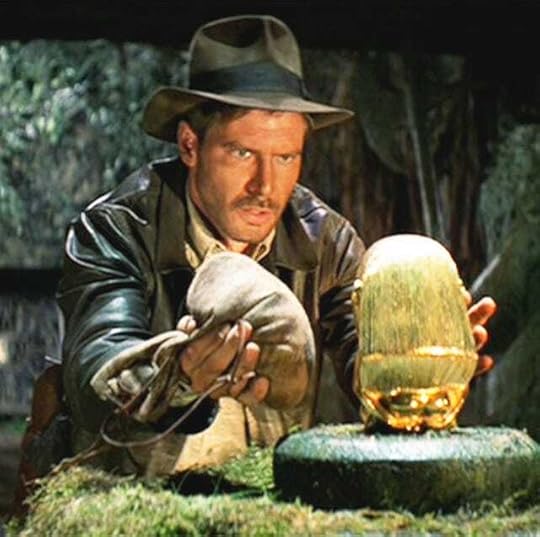
Harrison Ford as the famous fictional archaeologist Henry "Indiana" Jones, Jr.
Part of my fascination with archaeology is the fault of George Lucas and Steven Spielberg for making those wonderful Indiana Jones movies. Did you know that there was a real-life archaeologist who was the basis for Indy? In truth, there was probably several, but one of the contemporary models is an archaeologist and founder and director of the Mercyhurst Archaeological Institute in Erie, PA. He is still a professor at Mercyhurst College, and he still actively does fieldwork. He also manages to find time to write books.
Real-life archaeologist Jim Adavasio
J.M. Adavasio's "The First Americans" may be esoteric reading material for some, but it is fascinating nonetheless. Part history of the science of archaeology, part overview of the ancestry of humans on the American continents, the book also manages to be an entertaining and often funny reportage of the ongoing controversy within American archaeology, of which Adavasio puts himself dead-center: Clovis Man.
As Adavasio himself admits, most people neither know nor care about the controversy. He himself didn't care, until his work on the Meadowcroft Rockshelter in Pennsylvania involuntarily thrust him into the middle of the controversy. So, who or what is Clovis man?
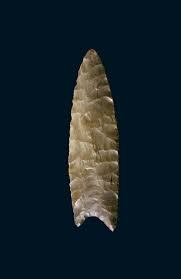
The Clovis spear
To explain in a nutshell requires an explanation of the Clovis spear, a finely chiseled spear point unique to America. They were created by men living between 11,250 and 10,550 years ago. Until recently, the archaeological party line has been that, due to lack of any evidence, Clovis Man was the first to set foot on this continent, spread out, and become the many (800+) Native American tribes that populated this country before European man ever set foot here.
There has, however, within just the past 30 years or so, a growing amount of evidence that suggests Clovis Man wasn't the first. And, hoo boy! them's fightin' words to the pro-Clovis Firsters!
With a pretty straight face (and a tongue occasionally firmly placed in cheek), Adavasio recounts the recent debates, brouhahas, and near-fisticuffs (I shit you not) that have erupted among the American archaeological community.
It seems now that only a mere handful of (albeit still somewhat powerful) minds in the field still hold on to the belief that no humans preceded Clovis, while more and more archaeologists are coming around to Adavasio et al's thinking.
A surprisingly entertaining and informative book, "The First Americans" is one of those books that should be on the shelves of everyone who has always wanted to know about a pretty interesting controversy in a field that very few people actually give a crap about.
A clear and lucid account of how the Clovis First model was overturned, with reference to the author’s own work at Meadowcroft as well as the work of others. Geared towards a general audience – the early chapters are taken up with explaining how the Clovis First model came about and how archaeology works, whilst the later chapters have a little bit of a tell-all feel into professional (or less than professional, as the case may be) spats between archaeologists. But well laid out, obviously well researched, and a very accessible read.
This book was published in 2002. I tend to avoid reading popular science books that are too old, particularly if they comment on fast-moving fields like ancient archaeology. For what it's worth, the book was assigned in an intro archaeology class I took in 2017 so its content is still 'valid' in some sense.
But the date of publication fundamentally does not matter too much because this book is not actually about the contemporary archaeological insights about who the first Americans were and how they colonized the continents during the early phases of human expansion across the globe. The book is actually a history-of-science account of the field of archaeology that is focused on prehistoric North American archaeology leading up to the resolution of the Clovis First controversy. The author, J.M. Adovasio, was the head archaeologist of the Meadowcroft site, the first conclusive pre-Clovis site discovered in North America, and is thus extremely well-placed to comment on the nature of the discourse and controversy within the field of archaeology.
Once the book has finished describing the history of archaeology up to Meadowcroft, the book shifts predominantly into a memoir form where Adovsasio describes his career leading up to Meadowcroft and the nature of the controversy after he revealed his findings. It is an excellent first-hand account of the "social" side of science, which I think is often neglected in popular science writing. Scientists can indeed get quite vicious and close-minded when their pet theories are attacked, and Adovasio unflinchingly portrays the realities of the more shameful parts of scientific discourse.
Of course, Adovasio himself is extremely biased in his retelling, as he often reminds the reader. But this attitude is so obviously ingrained into his account that the reader never forgets this bias, which I think is refreshing in its own way. Because of this, Adovasio is able to write in an informal and entertaining prose that stays engaging throughout the duration of the book.
Important reading for anyone who is curious about the nature of scientific discourse, especially so as it applies to archaeology. Not very useful for learning about the state of the art when it comes to who the first americans actually were and how they arrived there.
In 1974, archaeologist J.M. Adovasio found two hearths at the Meadowcroft Rockshelter excavation that dated to 13,000 B.C. The only problem was that until Adovasio found those dates, no one though there were humans in the New World, much less living at the edge of a glacier in Pennsylvania, thousands of miles away from the landbridge to Asia. Thus began an academic controversy about the origins of New World colonization that is still raging. The First Americans is an excellent book on what might be my favorite arcane academic topic!
The first half of the book - a introduction to what is known about New World colonization and what the prevailing theories have been - is excellent and easily five stars. It's well written and factual, but also manages to be engaging and humorous. It's some of the best popular science writing I've read, and I read a lot of popular science.
The second half, where Adovasio goes into the controversy surrounding his dig at Meadowcroft and his friend Tom Dillehay's dig at Monte Verde, sours a bit for me. Adovasio is both understandable biased towards his own dig and theories and bitter about the reactions of his colleagues when he published his findings (findings which, at the time, were something that few archaeologist have ever considered possible and completely against the canon of New World archaeology), but in my opinion, he spends to much time lambasting his opponents and calling their credentials and intelligence into questions, especially since by the time Adovasio wrote The First Americans, he had been vindicated and the results of his excavation (more or less) accepted without reservation. He also tends to over-simplify theories that contradict his own while at the same time accusing his detractors of doing the same thing. This isn't to say that the second half of the book is bad, just that it needs to be read with an eye towards the bias.
I seldmon ever write a review of a book unless it is really good or really bad. Unfortunately, this book is of the latter sort. What started as what one might call popular (layman) archaeology, became less about the actual history or the peopling of the Americas and more about chest beating over how the Clovis First camp persecuted and obstinately refused to acknowledge the author as the undisputed authority on the subject in general and about meticulous technical archaeology in particular based on his work at Meadowcroft. The book devolves into personal attacks, stories or how the author has been professionally attacked, stories of drinking and discussing theories at bars, and finishing with a political manifesto about misogyny. This fell so short of what I had hoped would be interesting and digestible archaeology and completely missed the mark of what seemed so promising in the beginning. I actually agree entirely with the much older and multiphase migrations into the Americas and that the Clovis people were not the first nor the only migration wave. But, the author fails to make this case because it is largely about being right, rambling on and on about how much more precise he was at Meadowcroft, about attacking the opposing views personally and professionally and less about the actual subject or providing actual history.
Adovasio begins the book with his discovery of a charcoal fire pit and artifacts in a rock shelter known as Meadowcroft Rockshelter that dated back almost four thousand years earlier than the previously earliest known people in America called the Clovis. He knew this was going to prove controversial because there was a strong established belief in the Archeological community that the earliest people were the Clovis. He then went into an explanation of the entrenched beliefs of the experts about the Clovis as earliest led by the leading Archeologist of the time a man named Hrdlicka. The book then went through a history of Archeology in America and some of the findings. He talked about some of the early civilizations and explained that there were many that were more advanced than in Europe. He explained that when the Europeans came to the Americas the diseases they brought with them wiped out almost ninety percent of the native population. He talked about radiocarbon dating and its advances over the years. He then began talking about some other discoveries in the Americas of finds that dated back even earlier than Meadowcroft including Monte Verde in Chile that found remnants of structures that dated to over 12,000 years ago. This find indicated a much more advanced people living in a village than the hunter gatherers that were thought to only exist. The last part of the book was about the politics involved in archeology and the controversy over many of the discoveries that arise, including the Kennewick Man. The book then concluded with the various ways the earliest people could have come to America.
A very dry and dusty subject (haha) made palatable, even enjoyable by the author’s gregarious, sometimes admittedly conceited retelling of events. While the history of the first humans in North America is interesting, the main character here is the history of discovering this history. It’s fascinating to read about how far back into the historical record our knowledge has reached in a relatively short amount of time, and the metamorphosis each new development has caused. I had the pleasure of hearing Adovasio lecture at Meadowcroft and I envy his students having history brought to life with his flare.
The first bit was intriguing, when he mentioned Clovis Woman as a missing piece. But then she appears in the index never again, and, skimming, is only briefly mentioned in the last chapter. Mostly the book is about people and the history of archaeology, focus on the author's ego. I want more science. Then again, it is quite old, relatively speaking. Maybe I'll find something more up-to-date and more about the actual First Americans.
Btw, there were plenty of pictures - of artifacts and sites. I'd like more diagrams and charts to illustrate the differences between the different current theories and that sort of helpful data.
The first sections of this book, which provided an interesting history of American archeology as well as an archaeological history of America, were by far the better portions. The later sections are clearly more personal for the author, and he often seems bitter and intent on airing grievances of a personal nature.
Rounding up from 3.5 stars. Adovasio (with Jake Page) is a witty, entertaining writer, and the subject matter -- how and when did the first humans reach the Americas, who were they, and where did they come from? -- is profoundly interesting, but Adovasio gets in his own way for large stretches in the back third of the book when he descends into inside-baseball gossip and turf-war sniping about academic archaeology and the bitter and personal battles between various camps, especially between those holding to the Clovis bar (i.e., no humans in the Americas prior to ~12,000 B.C.) and those (like Adovasio with his Meadowcroft excavation) pointing to evidence that humans arrived earlier.
The score settling and name calling (Adovasio repeatedly calls the more intense of the Clovis-bar adherents "extremists" as if this were a sectarian war between Protestants and Catholics or Sunnis and Shiites) will be of little interest or profit to most readers, but what makes the book worthwhile is the broad and compelling overview of the state of the field (as of 2002), and the general familiarity that the reader gains with terms like "pre-Clovis," "last glacial maximum," and the competing and (in Adovasio's view) most persuasive theories of how humans arrived in the Americas.
Despite the occasional detours into academic pettiness, Adovasio does manage to convey, powerfully at times, the wonder and mystery at the heart of this research: we know so little about how humans actually got to the Americas, and the more recent research suggests that there were waves of pre-historic migration to the Americas, at various times, from various places, and that humans from various different migrations may have overlapped, run into each other, interbred, etc. Some of the most fascinating parts of the book are the overviews of the linguistic research, which suggests that ~14,000 years was not nearly enough time for the ~900 separate languages that existed in the Americas at the time of Columbus's arrival to have developed. Moreover, the linguistic research suggests that large branches of these languages had separate roots: again suggesting various migrations of different groups, at different times.
A worthwhile and entertaining general introductory read on the subject of the peopling of the Americas.
I'd might prefer a 3.5 star but judging by how fast I read it, certainly deserves more than 3. The type font was quite small so there was a lot of information packed into just under 300 pages. Most of it almost totally new to me, guess archaeology has never been a big interest. But this was a spirited account of an epic and often ugly debate (up until about 2001) that has been waged within the archaeology world for decades before that. As to the question of who really were the first 'Americans', the debate all seems to come down to Clovis First vs Pre-Clovis. The author (s), mainly J.M. Adovasio who is the scientist, comes down resoundingly on the side of the Pre-Clovis theory. The owes mostly to his long and difficult work at Meadowcroft Rockshelter in far SW PA. There, back in the mid-1970s artifacts were excavated by his team, extensively radiocarbon tested and found to date as far back as 16,500 BP. This is well before the roughly 11,500 BP cache found at Clovis, NM (and elsewhere) that was the prevailing theory as to the earliest Americans. From there the battle rages through, other digs, scientific journals, conferences, popular media, even on-site visits. I must say he presents a very strong case for the Pre-Clovis theory, which has been backed up even more in the 20 years since the book was written. Interesting to learn that several important sites supporting Pre-Clovis are in VA including Saltville, Cactus Hill in Sussex County and a large complex in Warren County called Thunderbird. The book is thoroughly documented and goes into some detail on many aspects of the science including paleobotany, ethnology, climatology, linguistics, DNA testing and more. This is not a light read but it is kept moving as much by the fireworks surrounding the debate as by the technical aspects. There are some really unsavory characters in the field still trying to debunk advances and any deviation from the original theory. Nobody is censored like Covid dissenters today but probably because so few people are invested in the debate (and no Big Pharma making billions!).
I chose this book because I am fascinated with pre-history and one subject I want to know more about is who came to America and when. I was disappointed in the fact that this dealt more with the controversy revolving around such subjects as who built the dirt mounds and why and also when Clovis man falls in the realm of arrivals. These things were voraciously debated during the 70s and 80s, and the author was in the midst of the debates himself as a very well-respected archaeologist in those years. I did find the book fascinating at times, but also had stretches of boredom when the subjects being dealt with seemed more appropriate for a scholar of archaeology history not the history of the first Americans. Some of the subjects covered were very interesting, like when language studies came into the mix or the tragic covering up of Kennewick site by the army corps of engineers. But for the most part, what I had hoped to read about was evidence of different human groups that explored our new world, not the finds in various digs. It is a good book, written by a stunningly intelligent scientist, but it is now pretty dated because of the advancements in science since the end of the 80s. I would still recommend the book to anyone interested in archaeology but it did not follow the line I had hoped it would.
This is an utterly fascinating book by University of Pittsburg archaeologist James Adovasio, most famous for excavating the Meadowcroft Rockshelter site in Pennsylvania in the 70s. He tackles the ongoing question of just who the first peoples in the Americas were, in which his Meadowcroft site plays a large role. The book was published in 2002, so much scientific discovery has happened since, though not being a part of that scholarly industry I don’t know much about what that would be; even my mom, with her Masters Degree in Anthropology/Archaeology, just doesn’t follow developments all that much anymore. Suffice it to say, as Adovasio makes readily clear in the book, the long-standing and stubborn “Clovis First” theory has been proven incorrect, that many peoples and cultures existed on this continent long before the so-called Clovis culture did. Further technologies and sciences that dawned in the 80s and 90s have only solidified that overhaul: computer climate modeling, computer linguistic modeling, human genome mapping, mtDNA genetics, ground penetrating radar, and even advances in gender studies. In a nutshell, the peopling of the Americas most likely occurred in multiple waves via multiple different genetic stocks, most of them coming over via Beringia (“the Bering Strait”) during the last large Ice Age, but also possibly via water coastal routes.
Anthropology and archaeology have always been filled with charlatans, opportunists, mystics and religious wackos. Along the way, significant contributions to the understanding of human origins and development (dare I say 'evolution') have emerged. This volume explores some academic and practical theories about the arrival and survival of humans in the Americas. Issues of dating evidence and the procedures used in obtaining the evidence are discussed, illuminating various academic feuds over the evidence and the analysis results. Adovasio scoots through the Kennewick Man controversy rather blithely, I thought, though he correctly slams the US government for too hastily destroying the discovery site. With rising sea levels due to global warming, habitation sites already covered by sea water are unlikely to be well explored any time soon. Those probable sites could hold significant evidence for earlier human habitation, suggested by some evidence from a few non-coastal sites.
Apparent jealousy increases in pettiness through the following orders of magnitude: sibling children, rival teenage girls, and archaeologists. That’s the sense of things you’ll get from this.
Thus, the author illustrates just how shrill and unreasoning “scientific” objection to even the most careful and precise archaeological work will be if it tends to upset “settled science.” He had the misfortune to painstakingly and meticulously uncover human habitation dating back to 16,000 years ago at the Meadowcroft Rockshelter in western Pennsylvania – pre-dating Clovis culture, then the “settled” first Americans, by 3,000 years.
He explains in detail how “Clovis first” became sanctified, how his work progressed, and how baseless the objections to it by the leading lights of the archaeology world were, and are. And it’s funny too.
I'm an archaeologist and I found this painful to get through. I knew this book would cover some of the "drama" behind the archaeology but I'd hoped to have more of the story of the first americans than the archaeologists of the first americans. Instead this was the archaeological version of a tell-all memoir. It was well-written but at least 150 pages too long.
Adovasio's love toward Native American history is plainly on display in this book. This is a part of history that was, at least in my schooling, glossed over if not entirely ignored, so it's wonderful to be able to dive into an area of history that I have not been exposed to. Adovasio has an intimate writing style that does not sacrifice information for writing style. Highly recommend.
Good read on the populating of America and the diversity encountered but the first inhabitants. Long but worth reading. Lots of information on various other topics which I found quite interesting. Expecting book to be solely focused on first inhabitants but it veered into other topics such climate change, linguistics, genetics Etc.
This book is an excellent description of the archeological research that has been and is being conducted to learn how and who first settled the Americas. It is a fantastic education for everyone interested in the topic.
Long intro, but worth it to understand the depth of info to follow. Quite enjoyable, as its also the history of the study of Archaeology in Europe, and then, America.
A very informative book. Complete with easy to understand information and terms most wouldn't comprehend. Recommended for anyone interested in first person colonization.
This book was really good. I found it at a museum and it really piqued my interest because I took a lot of classes in college that discussed this material, with differing conclusions. I have the most interest in linguistics, how languages spread and changed as people evolved and moved around the world (and still do), which this book touched on a little. The author is an archaeologist who is known for impeccable excavation techniques and also huge knowledge on the role of women in earlier societies (and how most of their crafts/contributions have decomposed over time, leading us to ignore their role). The author definitely had his opinions and most of the time you knew what they were, but I liked that his main opinion was to investigate things without preconceived ideas about what you will find or prove.
When Dave and I went to Meadowcroft Rock Shelter on 6-3-2011, we purchased this book by the archaeologist/author who worked on this site. The radiocarbon dates for the human artifacts found at this site were about 13,000 years old which were 1,500 years before the earliest accepted date for people to be in the Americas! Later the author found remains from 16,000 years ago. So this is the story of the exciting and controversial research done there since 1973. The site is awesome to visit too!
J.M. Adovasio & Jake Page's "The First Americans: In Pursuit of Archaeology's Greatest Mystery" is the story of the quest for the origins of the original inhabitants of the American continent. This well researched book covers everything from the early history of man through Clovis & the Meadowcroft rock shelter as well. Each chapter is written in a way that keeps we the reader invested in the research & the discussion of the dates & just how the early Americans populated the continent. Included in the book are illustrations that add to this very interesting read.
Moves at a fair clip once the groundwork is established. Sharp, acerbic, doesn't pull punches and near-literally calls 'bullshit' at least once in the course of the text, this is the kind of guy you want to sit down, have beer with, and just discuss everything. Chock with information based on information based on information, made me glad to have sound paleo-anthro knowledge established, but wouldn't be obscure to those who don't. Honest writing that's self-serving in the best and most relatable of ways.
If you are in the least bit interested in North American archaeology, this is the book to start with. Written in a fantastic conversation style, but also packed with factual information. Adovasio has been working on the Meadowcroft site, highly controversial, for decades. Placing the first Americans in an area they were not believed to live in yet at 13,000 years ago, it is rife with controversy regarding his methods and ideas. A great read.
If you have even a mild interest in archeology, you will be glad you read this book. It's an interesting and enjoyably read that sheds light not only on the first evidence of humans in South America (Thousands of years earlier than many in the field will acknowledge) but on the stubbornness of human nature in the face of overwhelming contrary evidence. The thrilling rivalry between archaeologists is not hidden in this book, which elevates it above most scholarly works, in my mind.