For Davita Chandal, growing up in the New York of the 1930s and '40s is an experience of joy and sadness. Her loving parents, both fervent radicals, fill her with the fiercely bright hope of a new and better world. But as the deprivations of war and depression take a ruthless toll, Davita unexpectedly turns to the Jewish faith that her mother had long ago abandoned, finding there both a solace for her questioning inner pain and a test of her budding spirit of independence.
Herman Harold Potok, or Chaim Tzvi, was born in Buffalo, New York, to Polish immigrants. He received an Orthodox Jewish education. After reading Evelyn Waugh's novel Brideshead Revisited as a teenager, he decided to become a writer. He started writing fiction at the age of 16. At age 17 he made his first submission to the magazine The Atlantic Monthly. Although it wasn't published, he received a note from the editor complimenting his work.
In 1949, at the age of 20, his stories were published in the literary magazine of Yeshiva University, which he also helped edit. In 1950, Potok graduated summa cum laude with a BA in English Literature.
After four years of study at the Jewish Theological Seminary of America he was ordained as a Conservative rabbi. He was appointed director of Leaders Training Fellowship, a youth organization affiliated with Conservative Judaism.
After receiving a master's degree in English literature, Potok enlisted with the U.S. Army as a chaplain. He served in South Korea from 1955 to 1957. He described his time in S. Korea as a transformative experience. Brought up to believe that the Jewish people were central to history and God's plans, he experienced a region where there were almost no Jews and no anti-Semitism, yet whose religious believers prayed with the same fervor that he saw in Orthodox synagogues at home.
Upon his return, he joined the faculty of the University of Judaism in Los Angeles and became the director of a Conservative Jewish summer camp affiliated with the Conservative movement, Camp Ramah. A year later he began his graduate studies at the University of Pennsylvania and was appointed scholar-in-residence at Temple Har Zion in Philadelphia.
In 1963, he spent a year in Israel, where he wrote his doctoral dissertation on Solomon Maimon and began to write a novel.
In 1964 Potok moved to Brooklyn. He became the managing editor of the magazine Conservative Judaism and joined the faculty of the Teachers’ Institute of the Jewish Theological Seminary. The following year, he was appointed editor-in-chief of the Jewish Publication Society in Philadelphia and later, chairman of the publication committee. Potok received a doctorate in philosophy from the University of Pennsylvania.
In 1970, Potok relocated to Jerusalem with his family. He returned to Philadelphia in 1977. After the publication of Old Men at Midnight, he was diagnosed with brain cancer. He died at his home in Merion, Pennsylvania on July 23, 2002, aged 73.
Good fiction adapts to circumstances as it ages. What was immediately on the mind of the author and the details of his experiences are important beyond the times in which or about which they were written. I suppose this is of working definition of what’s meant by a ‘classic.’ In this sense at least I think Davita’s Harp qualifies as just that, a classic.
Potok’s book was written in 1985 but its setting is the late 1930’s. This is an era of severe political division and aggression in the United States. Communism and Fascism combat each other in local neighbourhoods as well as in international politics and military action. Unionising and union-busting, often violent, are commonplace. The horror of the Spanish Civil War is being pursued enthusiastically, and brutally, by both sides. Stalin starves the Ukrainians while Hitler de-personalises the German Jews.
The immediate context inhabited by Potok’s protagonist, a young American girl with a Christian father and Jewish mother, is casually anti-Semitic at all levels of society, from the playground to the boardroom. Easter European Jews are not only the most recent immigrants, they are also the most visible representatives of Marxist ideology and the chosen enemy of German fascists, for whom there is substantial American sympathy. So Jews are the natural object of moral panic.
But since she knows nothing about Judaism, she is also scorned by the Jewish community who simply don’t comprehend her status. As in a story told to her by a family friend who is also a writer, she is a grey horse living alone between a herd of black horses and a herd of white horses. No matter which herd she decides to join she will be an outcaste. On the face of it, this is a rather banal metaphor. But Potok has something in mind which makes the girl a universal figure, a representative of the entire world. Thus creating art.
Quite apart from the global ideologies and the emotional prejudices within her family and community, two fundamental principles are clearly at issue throughout the book: justice and freedom. To oversimplify, but not by much, the Torah is the symbol of ultimate divine justice. Although she is not religious, this priority is reflected in the mother’s Socialism. For the father’s family, the King James Bible is the epitome of freedom both in its creation and its continued importance in the rugged culture of rural Northern New England. Each group is alien to the other, involving very different experiences and interpretations of the same text.
The young protagonist doesn’t know it, but she is caught in the crossfire between the two interpretations of existential reality. Her mixed religious background is part of the metaphor for this situation, as is the Communist/Fascist antipathy (and the visible misogyny everywhere). How justice and freedom are prioritised and interpreted determines which side of the political and religious divide one ends up on. The dialectic is not inherent in either concept; but historically they have emerged as contradictory, forcing a cultural choice upon the girl.
It is here that the writerly friend of the girl’s mother emerges to suggest something crucial. While reporting on his experiences in the Spanish War, he writes: “Here things happen daily for which there are no words.” His experience of the crimes and inhumanity of both sides is not merely indescribable. It is descriptions of the conflict in terms of ideologies, religions, and opposing causes, that is to say, words, that are the origins of the conflict itself. The opposition among these ideologies, religious beliefs and causes is as tenuous, artificial and as historically conditioned as the dialectic of freedom and justice. The writer abandons politics completely in an attempt to escape.
And there the real paradox beings to appear: Words giveth and Words taketh away. Only death or mental collapse is the end of words, both often caused by the words. The mythical Yiddish witch, Baba Yaga, will do to represent words to the young girl. The witch torments her dreams. But the words of the Kaddish, the Jewish prayer for the dead, provide her only comfort when her father is killed at Guernica. Her mother too ultimately finds hope in words, strangely through the ministrations of her Christian evangelical sister-in-law. Both use words but not in accepted ways.
People don’t like your stories, especially political stories, if you don’t come down for either justice or freedom as the most important thing in life. Refusing to choose means you’re likely to remain the grey horse isolated between the white and black herds. Abandoning words is not a sensible option. Finding some other words to deal with a profoundly tragic and complicated reality is the real challenge. In this light, Potok’s story, although the best part of half a century old, retains its relevance.
This is a moving, haunting, and occasionally ambiguous novel that is ultimately about the value of sacred discontent. At first it may seem as if the message is that religion is an opiate of the people, soothing them and comforting them and preventing them from confronting the naked evil of the world, but that is not the thrust of the novel. The characters in Potok's story reminded me that if religion is a crutch, it is far from the only one. Potok made me recall Herman Wouk's assertion that "speaking of crutches--Freud can be a crutch, Marx can be a crutch, rationalism can be a crutch, and atheism can be two canes and a pair of iron braces. We none of us have all the answers, nor are we likely to have. But in the country of the halt, the man who is surest he has no limp may be the worst-crippled."
Potok shows the reader that we are living "in the country of the halt," and that if we don't realize we are limping and allow ourselves a crutch, we will remain permanently broken. But he also shows us that being religious should not mean being complacent, and that our discontent with the world is a sign that we were made for something more. And here I am reminded of what Richard John Nuehaus wrote in his meditation Death on a Friday Afternoon, and this I think sums up the message I felt was subtly and emotionally painted for me by Potok's book:
"For paradise we long. For perfection we were made. We don't know what it would look like or feel like, but we must settle for nothing less. This longing is the source of the hunger and dissatisfaction that mark our lives; it drives our ambition…This longing makes our loves and friendships possible, and so very unsatisfactory. The hunger is for nothing less than paradise, nothing less than perfect communion with the Absolute—with the Good, the True, the Beautiful—communion with the perfectly One in whom all the fragments of our scattered existence come together at last and forever. We must not stifle this longing. It is a holy dissatisfaction. Such dissatisfaction is not a sickness to be healed, but the seed of a promise to be fulfilled…The only death to fear is the death of settling for something less."
The end fell a little flat for me (was that partially the point?). And there were times when the narrator simply was not believable as an eight to ten year old girl. There were some slight sterotypes in his portrayls of devout Christians and orthodox Jews, but Potok did clearly try to find some balance there. Nearly five stars, but not quite.
Una ragazza speciale Uno dei romanzi più belli della letteratura americana moderna. Celebre libro scritto da C. Potok, autore ebreo di profonda cultura ed umana sensibilità. Egli, a differenza di molti suoi colleghi statunitensi, non è uno 'sradicato', né è preso nel vortice del materialismo consumista o travolta dalla caduta di valori. Ha alle spalle, invece, una tradizione millenaria trasferita, dall'Europa dei ghetti e dei progrom, nel Nuovo Continente, ove rivive in nuove comunità ricostruite. In lui troviamo sì un acuto osservatore della realtà, ma senza nichilismo e la disperante freddezza che paiono omologare conformisticamente molti intellettuali e scrittori americani della sua generazione.
Davita è una delle poche protagoniste della produzione letteraria di Potok, che ci ha lasciato indimenticabili ritratti maschili di figli e di padri. "L'arpa di Davita" può essere definito un 'romanzo di formazione' , ambientato nella New York degli anni '30-40. Racconta la crescita di una bambina poi ragazza da un'infanzia, vissuta in una famiglia comunista dilaniata dalla Guerra di Spagna e scossa in modo travolgente dal Patto tedesco- sovietico, a un'adolescenza in un clima familiare e culturale profondamente mutato, fino alle soglie di una giovinezza in cui sarà lei stessa a decidere per il proprio futuro.
Un romanzo che parte un po' in sordina e procede in modo progressivamente coinvolgente. Sono pagine dense di stimoli, palpitanti di vita nella ricerca di autenticità. Come tutte le opere di Potok, anche questo libro, oltre ad offrire una scrittura bellissima e grande piacevolezza di lettura, dà quella sensazione quasi 'terapeutica' che aiuta molti lettori, per così dire, a riconciliarsi con se stessi e con la vita.
It's sad to me that everyone reads THE CHOSEN in school, and not this amazing gem of a book. I barely remember THE CHOSEN, but I could rhapsodize for hours about DAVITA'S HARP. The characters are wonderful and real, and Davita's search for truth, for knowledge, and for family is heartbreaking and lovely. The daughter of two left-wing activists, Davita's sudden fascination with the Hasidic world her mother abandoned is baffling to her parents and their friends. But to a child whose life contains too many paradoxes and too many tragedies, the comfort of the rituals and faith of the Jewish religion have an obvious appeal. It's, quite simply, a shining jewel of a book, and it makes me want to both hold Davita close to my heart to comfort her, and to have a deep philosophical conversation with her.
Apr 9, 1240pm ~~ Davita's Harp is the last reread in my Chaim Potok project. The next four titles will be new to me. But since my last reading of this book was over thirty years ago (just like the others) I could not remember many details before I began to read.
Of course I remembered that this is the only book Potok wrote from the female perspective. Ilana Davita Chandal is the main character here, and the telling of her story follows the pattern Potok used in previous books. We meet our main character as a child, see the world through her eyes, follow her as she grows older and begins to comprehend the puzzling world of the adults around her.
Davita's mother is Jewish; she came to America from Poland between the World Wars. She is also a Communist, very active for the Party. She does not practice her religion, she believes in nothing except the ideas she works to put into place.
Davita's father is also non-religious (and not Jewish); he came from a wealthy American family and was being groomed to take a place in the lumber business that had made them rich. But an experience in Washington state turned him against both the family and capitalism as a political system. He became a journalist and his only contact with the family is his sister Sarah, a deeply religious nurse who never gave up on her brother.
I was disturbed at the way Davita was raised. She never completely understood everything her parents were involved in, but she heard the meetings, she heard any bad news, she was not allowed to be sheltered from events that she was too young to understand. She never really was allowed to be a carefree child.
There was a friend who came to stay with the family, a friend from Davita's mother's past: Jakob Daw, a writer and activist who traveled with Davita's father to meetings all over the country. He became Uncle Jakob to Davita and helped her cope with life, even though she was often confused by the stories he told her.
This is another book set between the two World Wars, but here the war in Spain is the main driving horror that affects Davita and her family. This book actually helped me understand better the reasons that Spain in the 30's became such a hell. Potok had mentioned Picasso's painting Guernica in his book My Name Is Asher Lev. In Davita's Harp he shows us how the town of Guernica became a symbol of inhumanity that caused Picasso picked up his brush to do the same.
I was delighted at a cameo appearance in the later chapters of this book by Reuven Malter and his father, characters from Potok's books The Chosen and In The Beginning. I thought that was a clever way to show the discrimination Davita suffered through at her school merely because she was female.
As always, Potok touched on topics that are meant to open the reader's eyes. By sharing the lives of his characters, we see not only their lives, but the author's own doubts and beliefs about the justice that is or is not part of life. Do we also see ways to find answers to our questions? That is for each reader to decide for themselves.
When we meet Ilana Davita she is around 8 years old, in the late 1930s. She lives in New York City with her writer-activist parents in a non-religious household. The subject for which her parents have nearly radical zeal is, we learn through Davita's listening in to conversations and nightly meetings, communism. Her parent's decisions and activism, their friends and political struggles lie at the heart of Davita's young life - they move frequently and her nights are spent in a strange dream of "Spain" and "Fascism."
Before I read this book I had no sense that the second World War played such a vital role within the context of the story, and the communist movement within America at the start of the war is a perspective I have never read about before. Davita's entire life is shaped by involvement of people she loves within the War - either first-hand or through political leanings that taint the reputation and limits one's freedom.
What I particularly loved about this book is Potok's firm grasp of a young child's voice - their understandings and misunderstandings. The entire tale is told from Davita's point of view and we often share her frustration as she understands that very important things are happening and all she can do is wait to be told or try to figure it out for herself.
The characters in this story are deep and vivid. I loved Davita's depth-less thirst for knowledge - about the meanings of words, about the war, and, eventually of Judaism and the Torah. Her decision to become religious on her own, despite her mother's disapproval, felt very real and was a thread throughout the book that I found particularly engaging. The other characters - her parents, the friends of her parents - and even Davita's own friends, never felt false or caricatured. Each person was flawed and yet full of different strengths that Davita used to help find her own way through the trauma of war and of growing up in a tumultuous time.
Davita's Harp is amazing, it has an almost mystical quality about it. The harp itself, which hangs on a door and is an omen of both good and bad - but mostly is a tinkling constant throughout her childhood, becomes a haven within the story-world that Davita retreats to when life becomes more than her imagination can handle. Because her world is sometimes incredibly harsh and confusing, her search for truth and good occasionally becomes a struggle against those she loves and respects the most.
This is a story of the uselessness of war, the truth that can be found between the lines of stories and the pages of books, the beauty and reality of Judaism and the reconciliation of a girl with the world that she was born into. A triumph.
From the lean phalanx of worthwhile authors, Chaim Potok retains his membership.
A bildungsroman of a young girl during the nineteen thirties and forties in Brooklyn.
A daring attempt to present all shades of a world during a time in history, narrated by a child.
The range of topics is extensive: respect for females in an antiquated faction of religion, control and power, World Wars, philosophy, loss, friendship, relationships, family and conatus.
My eyes were wet throughout.
Not unlike the few worthwhile authors available, this author reaches for the stars again and often comes close to touching them.
The architecture of the core themes of this book was so well constructed. I guess I don't think about the authors of books very often as I'm reading them. I typically think only about the stories and the characters. But the contents of this book were so beautifully written and so masterfully unfolded that I found myself thinking often about Potok's incredible skill in writing it. I loved the three birds. I of course loved the harp. I loved Davita's trueness to herself, her searching and her courage and undeviating authenticity, as well as her social misfitting and her many hours spent comfortably in solitude. I won't talk about my feelings of her vision at the end of her dad, Sarah, and Jakob Daw, giving her graduation speech other than to say that I loved it and have relied on it. A lot of books are about yearning. A lot of books are about growing up and about losing and finding and discovering and building identity and finding one's place and realizing important things after such a long time of feeling like you don't understand anything at all. This book is about those things too, but its quality is so exceptionally unique and extensive. I really loved this book.
This book I read within days after I finished Asher Lev. Chaim Potok has become somewhat of an obsession in our house hold ever since James Moes got me to read Asher Lev. Davita's Harp had me even more hooked than Asher Lev did. At first I was wondering if the stories were going to entwine because of the setting and time, because of the age of the characters and both Davita's and Asher's similarly unique ways of thinking and speaking. Obviously Potok has found a brilliant way to portray the thoughts and feelings of young people, and especially, young girls. I personally gravitate towards darker things: colors, books, film , and general dark topics. So when Davita's Harp began to take on these darker qualities, I became enthralled. The seasons were noted very often, and the moods of the characters often suited the temperature and weather outside very well. A big tension point was the relationship with Davita's mother, and her 'Uncle' Jakob Daw. I loved Jakob Daws' stories, but found his character unnerving, and didn't enjoy his presence when he was with the Chandal family. I especially felt anxiety over Jakob when Potok would hint that Jakob and Channah, Davita's mother, were having an affair. Despair and darkness came in the bitter winter months, while happiness and hope often came in summer. Hints of sexual exploration intrigued me to wonder how Potok was looked upon as a Rabbi in the Jewish communities.
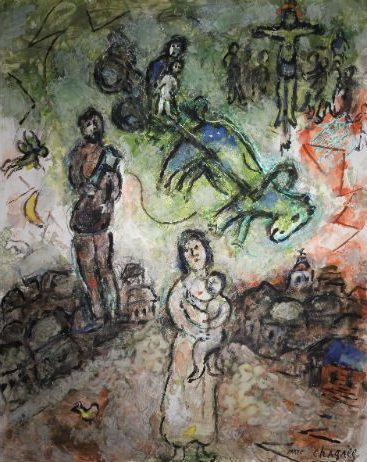
(Marc Chagall, Il carretto sulla città, 1981, Collezione Privata)
Un romanzo scoperto per caso, ma che mi ha permesso di leggere pagine toccanti e fiabesche nello stesso tempo. Ambientato durante il periodo della guerra civile spagnola, vi viene rappresentato, attraverso gli occhi semplici di una bambina, un mondo drammatico di guerre e persecuzioni, di odio e violenza: Davita riesce a sopportare la realtà quotidiana grazie alla fantasia e all'immaginazione, così da trasformare il racconto in un succedersi melodioso di suoni e di immagini. Ciò che rimane dunque, a lettura conclusa, è una sensazione di dolcezza e di forza insieme. E, mentre si percepiscono le note dell'arpa eolia come accompagnamento in sottofondo, sembra di essere immersi in una delle fantastiche rappresentazioni di Marc Chagall: mondi colorati e onirici, con i personaggi che si sollevano sopra città e colline, pervasi da una nostalgia diffusa... Intensa anche la descrizione del dipinto Guernica di Picasso, attraverso la quale Davita rivive la morte del padre.
As I write this review the REM song Losing My Religion is on the tv, which is apt as that's one of the themes of this complicated, melancholic novel. Ilana Davita is growing up in New York in the 1930s and the 1940s. Both parents, Hannah and Michael, are ardent communists. Communism has replaced the religions of their childhood - The Eastern European Hasidism of Ilana's mother, and the New England Episcopalian life of her father. Both parents are haunted by cruel childhood events, which they believe a communist revolution would stop from happening again.
However the Spanish Civil War and WWII wreak havoc with Ilana's family and their beliefs. Time and time again, the characters are forced to lo "lose their religion" - to examine their politics, their religion, their love for a flawed family member.
This is a slow, thoughtful book. One of Potok's talents is creating very real characters, with an equal measure of flaws and strengths. Hannah is a particularly neglectful parent by today's standards - she leaves barely 10 year old Ilana alone in their apartment at night to attend political meetings and rallies, and seems blind to her daughter's difficulties at school and inability to fit in. And yet Hannah's idealism and ferventness is understandable as the book reveals her early years.
This is the only one of Potok's books with a female protagonist. Through Ilana the reader sees the difficulties women face in fundamentalist religions, in this case orthodox judaism, but also the strength of community and warmth of belonging. While this is a coming of age story, it's not intended for teenagers, many of whom would find the slow pace and introspection boring - let alone have no knowledge of one of the most pivotal times in history. I've re-read this many times, starting with it's first publication when I was barely twenty to now in my forties, with my own children. Each time I take away something different, which is testament to the many layers within this story.
I think I rated the other Chaim Potok books 5 stars, but this one did not engage me quite so much. It was different from the others in that the protagonist was female and only around 9 years old. It developed into a coming of age story. Davita's first person narrative was a little choppy; I assume the author created simplistic sentences and dialog in keeping with her age. She often relayed adult conversation and then remarked "I didn't understand."
But the themes Potok explores are anything but simplistic. He delved into the subject of watershed moments that change a person forever such as war injuries, or witnessing horrible injustice, experiencing displacement or betrayal. Some individuals emerge from these scarring incidents with something the author calls "sacred discontent," which catapults them forward to fervently write or paint or become a political activist or channel their angst in some way to redeem the pain and better the world.
As always, Potok writes about the culture he knows best: Judaism. It is my observation that his stories portray tension between Jewish sects or between Jew vs. Christian, or in this case practicing vs. nonpracticing Jews. He then proceeds to create a breakthrough of understanding between the factions that is enormously heartwarming and affirms your hope in mankind.
Another earmark of Potok's writing is his use of symbolism. In this book it is a door harp and though it is a lovely symbol, it could have been treated more subtly. It seemed to be trotted out a bit too often and and the notes it struck were too ethereal for my liking.
Although I have criticized these points, there is still much to love in this book: well drawn characters, beautiful portrayals of faith, a happy ending that left me with a warm satisfaction.
💞One of my favorites of Chaim Potok and one of his bravest for here we have Christians helping Jews and Jews helping Christians during the Spanish Civil War. That is only part of the story but so beautiful to take in during the horrors of combat. It is Davita’s father who is in Spain and under fire when he risks his life to rescue a nun.
Of course there is so much more to the young girl Davita’s story. A brilliantly written novel. We see everything through Davita’s eyes as she grows from childhood into womanhood.
The title refers to a door harp that makes its music every time people come and go at Davita’s home.
My rating is based on my enjoyment of this novel when I read it, but it was such a very different stage in life for me, I don't know how I'd like it now. It's the story of Davita, the daughter of a left-wing and literary Jewish mother and a left-wing activist father. There's also an uncle of sorts in there, a prototype of Chaim Potok - a Yiddish writer. Besdies Davita, he was my favorite character, speaking in beautiful but undecipherable parables. In spite of her left wing background, Davita becomes enamored of traditional Judaism and becomes a baalas teshuva of sorts. I say "of sorts" because Chaim Potok is notoriously inaccurate in his portrayal of Orthodox and Hasidic Jews.
Speaking as an ex-lefty who did teshuva, I loved this book once upon a time. It certainly didn't turn me off. But everyone reading Chaim Potok should be forewarned, he's no expert on the real inner life of Hasidic Jews.
Though the quantity of your contribution to ‘Davita’s Harp’ is about as small as you are, you – and your creator the fantastic Jakob Dew - taught me and Ilana Davita a memorable lesson. That you should not close your eyes, no matter how worrisome the world is. This lesson is still so valuable to me today, because I always try to look away whenever something bad happens.
Thank you, black bird, for being such a brave bird in your quest to find the good music, instead of the sounds of destruction and war. Your bravery made this book an unforgettable journey for me. I hope you have found peace in Davita’s lovely door harp.
May you never close your eyes,
A deeply touched reader
PS If you happen to know any black birds in my neighbourhood, please tell them that my door harp is still vacant.
What a beautifully written story. Normally I wouldn’t have time for girls coming of age tales written by men but this has a sensitivity that makes it bearable. It takes place in a community and a time that is fraught with conflict. All beliefs are challenged and ultimately proven flawed. Who can argue with that?
Chaim Potok’s books are so engulfing: they suck me into a world that is both familiar and foreign; a world that appears both enchanting and soul-crushing. Davita’s Harp, though different than many of Potok’s other novels, nonetheless shares these features. One major difference is that the protagonist is a young girl: Ilana Davita. The second is the way the story is told. It is much more like a memoir. It starts with some of Ilana’s earliest memories as her world starts to take shape. It has a collage quality to it without a lot of continuity. As she grows the story becomes more robust and continuous, though never losing that memoir feel.
One of the reasons I love reading Potok is that he captures my own ambivalence about American Judaism (of the more religious variety). He, and his characters, are pulled to it, but at the same time he shows it’s darker, uglier side. The push/pull of the secular and religious is the dramatic tension in Potok’s novels. Davita’s Harp adds several other layers to this push/pull with conflicts of gender, politics, and family.
This is a much sadder novel than Potok’s other works that I’ve read. There is repeated tragedy, injustice, and death. And lots of pain and inner torment. The memories of past traumatic events haunt the characters and change them. A major theme of the books is that the characters are all driven to embrace some kind of ideology to help make sense of and give purpose to the world. For Ilana’s parents this was communism and Marxism; for others it was religion: Orthodox Judaism or the Catholicism of her Aunt. Ilana, struggling to make her own sense of things, turns to each of these as well. Mostly, though, she is looking for a home, a community. Part of the sadness, the tragedy of the book is that for most of the characters, and for some more than others, the individual gets let down, hurt, even rejected by their chosen ideological community. This is somewhat, though possibly unintentionally, mirrored by the grand conflicts in the background of the book between fascism and communism as they ate their own and the rest of Europe in the Spanish Civil War and World War Two.
The Jakob Daw character and his stories are intriguing. They add a somewhat mystical element to the novel. I’m not sure – much like Ilana – what they mean, but they provide a texture to the novel. And they are important for Ilana’s growth and development as she comes of age.
From very young, Ilana has to deal with heartbreak and loss. She is not always successful at it but she does seem to find a home in the synagogue and yeshiva. They too, though, end up causing her great pain. One of the best and chilling sequences in the book is her response to the injustice she experiences. I believe, though, that she eventually finds an outlet for her pain and finds peace through her writing and storytelling – as suggested by the hopeful ending.
Un libro di una bellezza incredibile, raccontato in prima persona da Ilana Davita, una ragazzina di otto anni, che parla di politica, di famiglia, di solitudine, del cosa vuol dire crescere, del cosa vuol dire essere una ragazza, in un'America della fine degli anni trenta. Il tutto con il sottofondo musicale di un'arpa eolica. I pensieri sono semplici e lineari come solo i bambini sono capaci di fare. Ma Ilana, è una bambina speciale è intelligente, è arguta, è curiosa, con una sensibilità fuori dal comune, ma è anche sola. Una bambina ebrea da parte di madre, il padre è cristiano ma entrambi non sono credenti, che impara a crescersi da sola, forse anche normale per i tempi un po' meno per i nostri. I genitori Anna e Micheal sono molto impegnati politicamente con il partito di sinistra a New York e instaurano un rapporto con la figlia non come adulto e bambino ma quasi come da pari a pari. E questo è anche un vantaggio, perchè è una bambina che cresce indipendente e legge, e tanto, anche quello che normalmente leggerebbe un grande. Potok ci mostra il periodo storico con gli occhi di una bambina: l'ascesa del fascismo, la guerra civile in Spagna, la tragedia di Guernica, la delusione della sinistra, le paure e in alcuni casi l'ignoranza degli ebrei. E bello vedere anche come questo scrittore, nonostante sia rabbino, sembra capire la disegualianza che c'è tra uomini e donne nella sua religione e attraverso Ilana le mette in evidenza. Ma oltre a Davita e i genitori, il libro è pieno di bellissime persone come Jackob Daw e Zia Sarah, ma anche il Signor Dinn, David, i signori Helfman e la figlia Ruthie. ... e dopo tutto quello che ho scritto, ho l'impressione di non essere riuscita in pieno a descrivere la bellezza di questo libro ...
Chaim Potok’s coming of age novels about Jewish young people are so insightful, intriguing and at times terrifying. Davita’s Harp takes this to a new level as he explores pre-WWII life in NYC and a brilliant young girl as she observes her parent’s efforts to fight fascism through communism. While I usually balk at a man writing from the perspective of a woman, Potok does accomplish this well. He holds so closely to the limited viewpoint of a child as she tries to understand what is happening to the world. At times, I felt I needed to do my own research about 1930s world events (namely the Spanish Civil War) to truly understand what was happening in Davita’s life. (But I didn’t make the effort and just lived in the same confusion as Davita). The events in her life are tragic, inspiring and even mystical. I enjoyed the Jewish aspects as Davita explores the religion of her ancestors.
The first half of the book is a bit monotonous and repetitive, but again, demonstrates the life of a child simply observing her world. The mystical and dream-like aspects of the story are confusing, but powerful as well. As the it reaches the half-way point and beyond, the story picks up steam and pushes the reader to the end.
While this is a book about a child, I caution that this is not a book for children. The themes are heavy and deep and overall inappropriate for young eyes.
This book is written in an interesting way. It's from the viewpoint of an 8 -11ish year old. So the sentence structure is simpler than Potok's other books. However, this is a very smart girl with parents who don't protect her from the horrors going on in the world, so she does have thoughts you wouldn't normally attribute to such a young girl. I thought it was a really good book, but I still kind of wish I hadn't read it. Reading how the Orthodox Jewish community in NYC during the 30s treat this extremely smart girl and let her know in ways large and small that she doesn't count because she's a girl was very difficult for me. It's easy, if you live within the Reform/Conservative Jewish world, to forget that so much misogynistic and heavy handed patriarchal attitudes are really fully part of Judaism. Kind of made me feel bad to be a Jewish woman. I guess I'm glad we've managed to change those attitudes for the majority of Jews, but still so many woman are getting squashed within the confines of Orthodoxy.
I really enjoy reading books written by Chaim Potok. They are not necessarily easy or entertaining, but I love his thought processess, his development of characters that I can associate with, and I am most impressed with the vast amount of knowledge he shares with his readers. From this book I discovered many subtle things about myself and about things that I am interested in at this point in my life. One poignant lesson I learned was that there are many truths out there that seem threatening to my belief system, and they may or may not be, but to really find hidden truths I have to be open minded and willing to see things from a different point of view. Another thing I learned while reading this book is that I need to be sure of my "source" of truth. If I have complete faith in my "source", which for me is my Heavenly Father, then He will help me find the truths that I need to complete the mission He has given me.
As slow and seemingly uneventful as Davita's Harp may seem at first, it has such a great pay off just in seeing Ilana Davita etch a place for herself and her own thoughts while surrounded by people with such extreme opinions and beliefs. I really appreciated the novel's depiction of girlhood as self-discovery and -assertion. The most powerful parts of the narrative are when Ilana breaks the mold of what's expected of her (like when she says Kaddish for the first time, or when she steps out of the boat). Especially goosebump-inducing is when she sees herself from the outside and the narrative changes to third person. Overall, a really surprising and delightful read for sure.
This entire review has been hidden because of spoilers.
Beautiful written story about a girl growing up in America in the 1930’s and being confronted with prejudice, war in Europe and the absurd fact that girls and boys, women and men are treated differently. Paints an exceptionally good picture of the time she lives in.
Potok's use of recurrent images borders on overt symbolism, and yet retains an internal coherence beyond that of religious iconography or surrealist leaps by having his narrators tell you exactly what the images mean. This is probably what makes Davita's Harp a childrens' book, even thought it explicitly and graphically addresses child abuse, rape, mutilation, murder, and warfare. A 'story within a story' conceit allows the close, first-person narrator to recall images that her storyteller friend had introduced, and to subsequently adopt that adroit identification with non-sentient creatures in later crises. While I tend to distrust such happy endings as this one - Potok's pace shifts from near-languid observation of nervous breakdown to a self-consciously mute record of marriage and conversion - the range of strategies and stances that his characters employ make this book a continual favorite.
We read narration mainly through the eyes of Ilana Davita, the precocious daughter of Communist parents in 1930s Brooklyn. Her characteristic narrative stance is that of one who has recently experienced the events, and yet still can't recall the over-arching context of the earliest ones (only isolated details, incidents, and gestures); part of the building drama comes in watching this character reconstruct her memories through the evidence that she later gained, where what-must-have-happened lies between the lines of what's actually remembered. The storyteller character (Jakob, an early lover of Davita's mother) comes for extended visits to the family, where he tells Davita stories of horses and birds with a melancholy, secretive personality mirroring his own. Much of the joy in this book emerges in watching the Davita character question these stories and eventually make her own meaning out of them. Potok's deliberate pace, where the thoughts and consequences of one step can occupy two pages, also allows for us to guess the hidden implications that Davita may not explicitly divine - especially as he returns to these questions at various points in the story; the differing juxtapositions of these divinations - where what-Davita-guesses meets up with different parts of what-we-guess - can make repeated readings of this book a rewarding exercises.
Repeat readings can make Potok's machinations more clear - and, while at times the layers of suggestion and emphasis offer a pleasure that the narrator herself shares (often while thinking of Jakob's stories or reading his letters), at some points the intent of Potok's elisions become less clear. Like Jacob wrestling with the angel, we readers are at times unaware of what's at stake in a scene. When Davita's mother remarries, the narrator and a secondary character "look at each other shyly, not sure what to say." I'd like to think that Potok does this on purpose - steps back from the story to allow us to step in - especially since, at another point in that chapter, Davita and that same character communicate their happiness in a small series of glances, smiles, and gestures. This is such a shift from the previous pattern of foreshadow-action-exposition, though, that I'm left a little confused.
Such shifts may very well be deliberate, intended to allow us to exercise the skills that Davita has displayed. It may mark, in this instance, an example of the character's maturation. Also, it may be evidence of Potok's own awareness of his project's range of concerns and interests; regarding an earlier novel's marriage, in fact, his narrator concluded that "In some instances, it is best to either say very much about a subject, or to say very little at all." Still, the suddenness of the shift in Davita's degree of attention towards her mother (which was previously nuanced, complicated, and subtle) here seems to become merely a touchstone for the mother character's further conversion to orthodox judaism. This is where I as a reader reach the boundary of my own comprehension.
Wow. I read The Chosen and The Promise beforehand, which were works of art, which were works of art. They helped me become acquainted with Potok's writing style, a completely different "voice" than what I'm used to reading usually. However, all these couldn't prepare me for what I read in DH.
The story goes through mostly similar arcs and ideas that The Chosen/Promise have: a Jewish-immigrant child in New York is caught in the crossfires of a parent (parents, in DH's case) dedicated to a particularly historic cause. The child grows up with many different idealogies battling to be understood and known, while they explore their Jewish identity and what it means in an ever-changing time, both at home and abroad. The child has their quirks and personality traits (Ilana Davita is very intelligent, clever, outspoken, and loves to learn the meanings of words and ideas), which set them apart in their day-to-day lives.
It's a hard book to get into at first; I approached this novel in this way, noting similarities and differences between Ilana Davita's and Reuven's upbringings. The hellishness young (the novel begins with her being around 7-8 years old) Ilana Davita endures in her family life, especially her home constantly changing, was a rough transition from Reuven's relatively more situated home life. We, as readers, are left in the dark much of the time and do not know the details of Ilana Davita's parents until the story unravels. Potok wonderfully portrays a very young girl's mind--her naive misunderstandings of the world around her, her inability to comprehend (until she grows up more toward the end, when she is beginning to make her own decisions) high concepts is a major feat for a grown man to portray! Not only that, but Potok mystically and beautifully portrays her transition from a non-religious life to bringing her broken family back to their Jewish roots.
And when that happens, I realized that the story was not only about Ilana Davita. It was about her parents, particularly, her mom.
Ilana Davita's simplistic, accidentally dark "voice" helps the reader understand the trials her parents have endured in their lives. AFter her father dies, Ilana Davita and her mother (Potok's interpretation of female characters in this novel is absolutely riveting!) must eke out a very lonely living. In that situation, after being completely dependent on her family (emotionally, mentally, physically, etc.) Ilana Davita has to become independent around ten years old. In this time, the reader can most easily see her mother's struggles: her fight for a party she once worshipped, and the former way of life now crumbling around her.
A beautiful, strange, hard, yet gloriously rewarding read!
This entire review has been hidden because of spoilers.
Sometimes the story was a little long winded, but still beautiful written story about a girl growing up in America in the 1930’s and being confronted with prejudice.
An interesting, thought provoking, intelligent, well written, engaging historical fiction novel about Davita Chantal growing up in New York, USA in the 1930s. Her parents are politically active communists. Davita’s father, Michael, is a journalist and travels to Spain to report on the Spanish civil war. Davita’s mother, Channah, is a non practicing Jew who attends communist meetings. Both of Davita’s parents had bad experiences during World War One. When Russia signed an agreement with Hitler’s fascist government, Davita’s parents became very disillusioned as they disagreed strongly with any political agreement with fascists.
As the story progresses, Davita becomes interested in the Jewish faith and studies the Hebrew language.
There are a number of interesting, well developed characters in this novel. The three main females in this book are all strong, independent characters. Davita’s aunt Sarah, is a Christian missionary, a nurse, who travels to Europe to help the wounded in the Spanish civil war. The Chantal’s give respectful shelter to an old friend, Jacob Daw, a writer of political allegories. David Dinn, a very clever Jewish boy living next door to the Chantal’s, introduces Davita to Jewish religious observance.
The author describes the issues confronting politically aware individuals with the political upheavals that occurred during the 1930s. For example, Jacob Daw, initially a communist writer, found himself changing his political views, however, during those times, the American government’s stance on people with communist views was to some extent, understandably inflexible. So Jacob Daw, a Jew, was unable to gain a visa to remain in the USA.
The late Chaim Potok was a treasure. His exquisitely written prose should be read, must be read, by generations to come. As a Jewish scholar, his books deal with the intricacies of the ultra-Orthodox Jewish sect. He informs, and then he puts it into modern perspective, analyzing and showing us what aspects can be discarded and updated. But all the while, he and his characters remain devout Jews. His 1985 novel Davita’s Harp takes on the topic of feminism and how it relates to the Orthodox Jews. Ilana Davita Chandal is a young girl being raised by her parents in the 1930s. Both parents are ardent supporters of Communism. The father has been raised by radically devout Christians; the mother was raised a devout Jew but lost her faith when her family was devastated by a pogrom. Ilana Davita thus begins her journey with no religion. But she begins to pick up parts of both Christianity and Judaism as she learns and grows, and eventually, she begins to attend synagogue and a yeshiva, a Jewish school. But as a girl, her road is a bumpy one in this ancient religion. This doesn’t deter her, for she decides and acts upon the idea that her religion should serve her and all women as much as it serves men. Potok, whose protagonists are usually boys or men, was wise to explore this idea in this sometimes wrenching novel. It is enlightening, too, to meet an old friend in the narrative. Reuven Malter, one of the two boys who form a friendship in Potok’s The Chosen, appears here as a student in Davita’s yeshiva, and we learn a bit more about the him, in the account that takes place earlier than The Chosen. Potok most always used the motif of glasses in his novels. He wants the reader to understand that we must open our eyes and see the world in order to change the world, and thus his metaphor is eyeglasses and the clarity they bring. In Davita’s Harp, Davita’s Uncle Jakob tells her to always wear her glasses, and he cautions, “It is wrong to face this world with eyes closed, no matter how deep the weariness….Keep your eyes open, wide open, Ilana Davita.” This is the essence of Chaim Potok. Although he was a Jewish scholar and thus his novels reflect his world, I believe he sends a message about religion—all religions—to the world. Potok wants us to see our particular faiths for what they are and work to change the world and them by truly examining everything.
As always, I love Potok's writing. Everything is described in a way that plays in front of your eyes like a movie. So much is said between the lines, so much is felt between the events that play out. Potok clearly uses alot of symbolism in this book (the bird, the harp etc.) but it never feels contrived since these symbols are real in Ilana Davita's imagination. They are a vessel for her to experience her thoughts and feelings about events she has no control over. I tell you, he has a way with words this man..
In de the beginning of the book I had a hard time connecting to Ilana (maybe because she is so young) making the story feel distant. You read about a horrible time in history without feeling you are part of it. This is also kind of the beauty of the book, as Ilana Davita IS actually only a spectator to all the events that happen. I think the disconnect is supposed to be there. Aside from that the characters do feel very real and make you care about them. Potok understands the human psyche and shows everybody with all their faults but also their redeeming quality's. There are no villains or heroes in this book, just humans. The villains in the story are mostly the different political systems and bureaucracy.
It's very interesting to be inside the jewish world in that period in time in New York. Communism, judaism and christianity all get a fair showing in this book. You see the good and the bad, and there is little judgement. There is however a clear criticism in the story on the way jews excluded outsiders and the sexism in the community, which must have been hard to read about for jews in Chaim Potok's community. All I know is that I was glad that Ilana chose to go her own way, picking up the good parts of the different worlds she was exposed to.