Jump to ratings and reviews
Rate this book

Black Water #2

Black Water 2: More Tales of the Fantastic

Rate this book
Short stories by authors including Julian Barnes, Gabriel Garcia Marquez, F. Scott Fitzgerald and Isabelle Allende deal with prophetic dreams, strange creatures, and bizarre occurences

941 pages, Paperback

First published December 12, 1990

Loading...
Loading...

About the author

Alberto Manguel

265 books1,850 followers
Alberto Manguel (born 1948 in Buenos Aires) is an Argentine-born writer, translator, and editor. He is the author of numerous non-fiction books such as The Dictionary of Imaginary Places (co-written with Gianni Guadalupi in 1980) and A History of Reading (1996) The Library at Night (2007) and Homer's Iliad and Odyssey: A Biography (2008), and novels such as News From a Foreign Country Came (1991).

Manguel believes in the central importance of the book in societies of the written word where, in recent times, the intellectual act has lost most of its prestige. Libraries (the reservoirs of collective memory) should be our essential symbol, not banks. Humans can be defined as reading animals, come into the world to decipher it and themselves.

Ratings & Reviews

What do you think?
Rate this book

Friends & Following

Create a free account to discover what your friends think of this book!

Community Reviews

5 stars
65 (56%)
4 stars
40 (34%)
3 stars
8 (6%)
2 stars
1 (<1%)
1 star
1 (<1%)
Displaying 1 - 9 of 9 reviews
Profile Image for Fionnuala.
923 reviews
Read
October 16, 2026
While I was slowly reading this 1983 anthology of sixty-five short stories, I frequently thought about the huge task the editor had given himself, all the long hours he must have spent sifting though hundreds of stories before fixing on the ones that he felt he couldn't leave out. A long and lonely task.
And to think this is the second volume of Alberto Manguel's huge project involving collecting examples of the 'Fantastic' in literature. In total he compiled one hundred and thirty stories by different authors from across the world and from several centuries, and the ones he couldn't find English translations for, he translated himself—at least from Spanish and French.
I posted an update for each story in this volume as I read it, and included a quote that captured something of the atmosphere. I'm glad I did as the list now serves as a great memory aid to each individual story.

But what was Manguel's idea of 'fantastic' literature?

In the Foreword to the first volume, which I read before this one, Manguel recalls realizing as a boy that reading is a solitary and lonely place but at the same time, "there nothing can touch us because, like Alice through the looking-glass, we ourselves create the country through which we walk, giving it a geography in our mind...When literature is discovered, a revelation occurs: the joyful, exultant knowledge that anything can happen. Of the many forms of literature, fantastic literature in particular explores that blissful knowledge. It makes use of our everyday world as a façade through which the undefinable appears, hinting at the half-forgotten dreams of our imagination. Unlike tales of fantasy (those chronicles of mundane life in mythical surroundings such as Narnia or Middle Earth), fantastic literature deals with what can be best described as the impossible seeping into the possible, what Wallace Steven's calls 'black water seeping into reality'. Fantastic literature never really explains everything. Like the ghost train at the fair, it takes us through the darkness of the real world, from terror to laughable terror, diving into walls that swing away at the last minute, racing under eerie nothings that touch us with cobweb fingers, suddenly slowing down and lengthening that last encounter (with what? with what?), using our expectancy of horror more effectively than horror itself...Conrad said that he did not write fantastic tales because writing them would be denying that life itself is fantastic. But that is not so. On the contrary, a truly good fantastic story will echo that which escapes explanation in life itself; it will prove, in fact, that life is fantastic. It will point to that which lies beyond our dreams and fears and delights; it will deal with the invisible, with the unspoken; it will not shrink from the uncanny, the absurd, the impossible; in short, it has the courage of total freedom."

Interestingly, Manguel includes a story by Conrad in both volumes, and the one in this volume is absolutely fantastic in every sense of the word. Here's what I posted about it in the updates when I read it:
'The Brute' begins as follows: "Dodging in from the rain-swept street, I exchanged a smile and a glance with Miss Blank in the bar of the Three Crows."
The story ends in a similar way: "On going out I exchanged a glance and a smile (strictly proper) with the respectable Miss Blank, barmaid of the Three Crows."
What happens in between is as mysteriously hilarious as those two sentences. I loved it!

Since it's a Conrad story, you won't be surprised to hear that it's about the sea, and that the 'Brute' is a ship. But it's a ship with a reputation, and whether the knowledge of its reputation causes the people travelling on it to have strange experiences or whether the ship itself causes the experiences, Conrad doesn't bother to explain—which backs up what Manguel says Conrad thought: that life itself is 'fantastic'. I recommend Conrad's story if you ever come across it.

In the meantime, if you're curious about the other sixty-four stories in this volume, you can see their authors and titles in the updates. Reading through those updates now, I've thrilled at the wonder of them and wondered at what thrilled me.

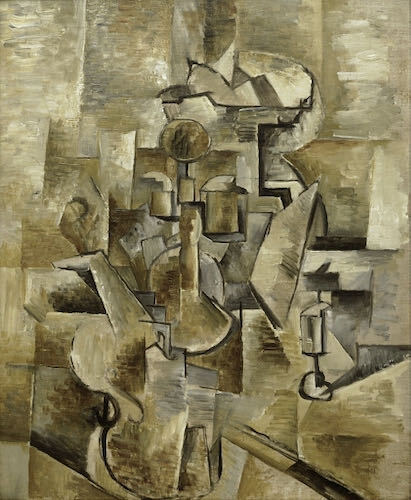
Take this one by May Sinclair: "Then suddenly the room began to come apart before her eyes, to split into shafts of floor and furniture and ceiling that shifted and were thrown by their commotion into different planes. They leaned slanting at every possible angle; they crossed and overlaid each other with a transparent mingling of dislocated perspectives like reflections fallen on an interior seen behind glass".
That one makes me think now of a cubist painting, maybe a Braque:


And here's one that reminds me of a Kandinsky painting:
"The moon was a thin rind curled low in the sky. The spire was squint on the church, and all the houses were leaning backwards. The lighted windows were at all angles, like red postage stamps. Smoke went sideways, a dim, black flag in the night.." That's from Dorothy Haines.


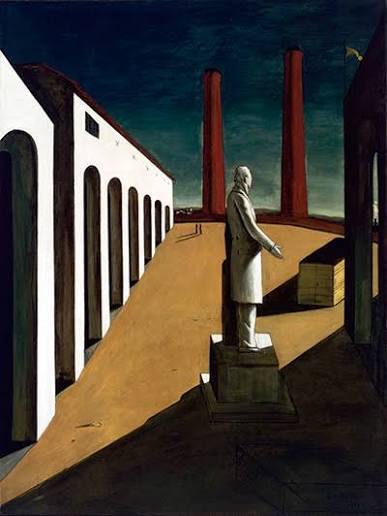
And the following quote from E.B.White plus the one after from Elizabeth Bowen, as well as one from VS Naipaul, reminded me of several strange Giorgio Di Chirico paintings:
"The wall, which was glass but turned out on being approached not to be a wall, it was something else, it was an opening or doorway—and the doorway through which he saw himself approaching turned out to be something else, it was a wall. And what he had eaten not having agreed with him"

"Full moonlight drenched the city and searched it; there was not a niche left to stand in...The soaring new flats and the crouching old shops and houses looked equally brittle under the moon, which blazed in windows that looked its way. The futility of the black-out became laughable." E Bowen

"My story was to be set in classical times, in the Mediterranean. My narrator would write plainly, without an attempt at period style or historical explanation. He would arrive—for a reason I had yet to work out—at that classical port with the walls and gateways like cutouts. He would walk past that muffled figure on the quayside. He would move from that silence to a doorway.." 'The Enigma of Arrival', V. S. Naipaul"


I found something strange and a little 'fantastic' too about the dedications Manguel wrote in both Blackwater volumes.
He dedicated Volume 2 as follows:
'To my mother, for an imaginary life.'
And the dedication to Volume 1 reads equally enigmatically:
'To Johnny and Mikey and Lili, for all I wish we could have shared, far away and long ago.'
There might be 'fantastic' stories to be chiseled out of both those dedications...
Profile Image for Cecily.
1,386 reviews5,670 followers
Read
February 22, 2025
Short Story Club, round 3: I read and revied one story a week, along with The Short Story Club, starting spring 2025 and pausing/stopping after story 27 in November 2025.
You can join the group here.

About the collection

Black Water was published in 1983. See my review of those stories here.

Black Water 2 was published in 1990. The format is much the same as the first book. A wide range of authors, including plenty of ones I've never heard of, and tantalising titles. Each story is prefaced with a few paragraphs about the author. As with volume 1, rather than take the easy and obvious route of publishing them alphabetically by author or chronologically, there's a delicate daisy chain of themes.

I'm in awe at Manguel's achievement in compiling two such large, high-quality, and varied collections. This has a simple dedication:
"To my mother,
For an imaginary life.
"

I take it as a tribute to his mother for nurturing his imagination via literature, but also as a nod to alternative layers of reality, as explored by many of the stories, and also films like The Truman Show, Being John Malkovich, Synedoche, New York, and now Severance.

On the meaning of ‘fantastic’, from the foreword

Unlike the literature of fantasy, in which the world itself — Narnia or Middle Earth — is unreal, fantastic literature finds its bearings in our own landscapes, our cities, our living-rooms, our beds, where suddenly something happens which demands not so much our belief as our lack of disbelief.

Once I defined fantastic literature as 'the impossible seeping into the possible' and found an echo of that definition in a line by Wallace Stevens: 'black water breaking into reality'. It is on this sodden reality that fantastic literature flourishes. The ghost, the wrinkle in time, the mingling of dream and vigil flow into this liquid realm, a realm readers recognize as home, a place where they feel oddly familiar. It is there that readers are at their most vulnerable and there that the fantastic becomes most effective.


Stories and reviews

1. The Child who Believed, Grace Amundson, 4*. Review HERE.
2. It's a Good Life, Jerome Bixby, 4*. Review HERE.
3. The Door, EB White, 4*. Review HERE.
4. Mysterious Kôr, Elizabeth Bowen, 4*. Review HERE.
5. Nights at Serampore, Mercea Eliade, 4*. Review HERE.
6. The Dead Fiddler, Isaac Bashevis Singer, 2*. Review HERE.
7. The Phoenix, Sylvia Townsend Warner, 2*. Review HERE.
8. The Spider, Hanns Heinz Ewers, 4*. Review HERE.
9. The Changeling, Dorothy K Haynes, 4*. Review HERE.
10. The July Ghost, AS Byatt, 4*. Review HERE.
11. Poor Girl, Elizabeth Taylor, 4*. Review HERE.
12. Where Their Fire Is Not Quenched, May Sinclair, 4*. Review HERE.
13. The Complete Gentleman, Amos Tutuola, 3*. Review HERE.
14. The Professor and the Siren, Giuseppe Tomasi di Lampedusa, 2*. Review HERE.
15. The Sausage ("Die Wurst"), Friedrich Durrenmatt, 3*. Review HERE.
16. A Woman Seldom Found, William Sansom, 4*. Review HERE.
17. Mummy to the Rescue, Angus Wilson, 2*. Review HERE.
18. Aghwee the Sky Monster, Kenzaburō Ōe, 3*. Review HERE.
19. Bishop Berkeley or Mariana of the Universe, Liliana Heker, 4*. Review HERE.
20. The Saint, Antonia White, 3*. Review HERE.
21. The Ghost of Firozsha Baag, Rohinton Mistry, 4*. Review HERE.
22. The Miracle of Ash Wednesday, Yevgeny Zamyatin, 4*. Review HERE.
23. Heartburn, Hortense Calisher, 3*. Review HERE.
24. The Accident, Ann Bridge, 3*. Review HERE.
25. The Old Woman, Joyce Marshall, 4*. Review HERE.
26. A Short Trip Home, F Scott Fitzgerald, 3*. Review HERE.
27. The Brute, Joseph Conrad, 2*. Review HERE.

Pause/stop?

Story 27 is almost half-way. At this point, the group put this volume aside as too few of the stories were available online, and switched to members picking a story to share each week.

I will probably dip in and out of some of the remaining stories, but may not review them all.

Short Story Club

Short Story Club, round 1: we read Gioia's The Art of the Short Story, which I reviewed HERE.

Short Story Club, round 12: we read Manguel's Black Water: The Anthology of Fantastic Literature, which I reviewed HERE.
Profile Image for Falkor.
21 reviews
August 1, 2007
The sequel to Manguel’s collection Black Water: An Anthology of Fantastic Literature, this book maintains the level of excellence of the previous one. The stories in this volume, taken from a wide array of impressive authors, are disturbing, funny, grotesque, terrifying, thought-provoking, erotic, and just plain weird—everything a full blooded fantasy fan could want. Includes stories by E.B. White, F. Scott Fitzgerald, Arthur C. Clarke, Isabel Allende, Margaret Atwood, Isaac Bashevis Singer, A.S. Byatt, Julian Barnes, Herman Melville, Gabriel Garcia Marquez, Luigi Pirandello, V.S. Naipaul and George Bernard Shaw, among many others.
238 reviews47 followers
August 17, 2026
Exceptional anthology of stories of the fantastic. I think it's no accident that Manguel has subtitled this and the previous anthology as "Tales of the Fantastic" and not "Tales of Fantasy," since the stories here often rely on the characters' belief that something is fantastic. There's nothing here of Dunsany-ian or Tolkien-like fantasy, but more of fantastic elements intruding into everyday life ("The Visiting Star"; "The Jewbird"; "The July Ghost"; "The Finder") or descriptions of reality that appear fantastical ("The Door"; "Private -Keep Out!"; "How it Happened").

As with any anthology, some stories were more to my taste than others, but Manguel has read widely and so his selection is wide-ranging. I thought I had a fairly broad view of what constituted the fantastic in fiction, but Manguel's is far broader than mine -- much as I admire the story, Herman Melville's "Bartleby," I'm not sure it's exactly fantastic -- but that's what also makes this anthology appealing: It pushes at your definitions and makes you reconsider how you view literature.
Profile Image for Shawn.
995 reviews233 followers
May 11, 2012
PLACEHOLDER REVIEW (for this EXCELLENT but ENORMOUS collection I hope to re-read someday)

"A Short Trip Home" by F. Scott Fitzgerald - A wealthy young man, attending Yale but home in St. Paul MN for the holidays, moves among his circle of "bright, young things" at parties and cotillions and the like. But he begins to worry about a female friend of his, whom he secretly loves, who is keeping time with a sneering, criminal type - and so he involves himself in her affairs, discovering that her train trip to Chicago involves an assignation with this criminal fellow, and eventually, on another train trip back, finds himself in a direct contest of wills with the sinister individual...

Oddly enough, in the supernatural/fantasy genre it is not often you read a story by Fitzgerald ("Benjamin Button" being the other of which I am aware) and, oddly enough, in the horror genre, you do not read many stories so directly involving "unspoken moral corruption". We are never actually told just what the sinister Joe Varland intends of Ellen, but it is not doubt something more than what you normally might expect from these scenarios, as Varland himself is... compromised in his worldly existence (trying not to spoiler) and Ellen seems not only in his thrall, but herself struggling to make arguments for him, so we don't know just how much control he has. The final confrontation scene is quiet, low-key and powerful. There are some notable class conflict details as well (I appreciated that Fitzgerald was aware enough of this to actually have our main character momentarily reflect on how lucky he was to be well off). A different kind of thing, to be sure, but charmingly effective.
Profile Image for Jake Cooper.
498 reviews22 followers
December 9, 2018
Another 900+ pages of fantastical shorts, with a similar batting average. Between the two volumes (72+65 = 137 stories), my top 3 are:
- Certain Distant Suns, by Joanne Greenberg (1979)
- A Woman Seldom Found, by William Sansom (1956)
- Aghwee the Sky Monster, by Kenzaburo Oe (1964)
Profile Image for Hester.
773 reviews
August 25, 2026
An altogether excellent experience . Read with members of the Good Reads Short Story Club at the sedate but manageable pace of one story a week .

Manguel is an excellent editor , managing to choose stories that link in some way to their neighbours but always with the hint or flavour of something fantastic , weird or inexplicable .

Apart from one tale from the distant Chinese past all are from the nineteenth and twentieth century with a bias towards tg3 latter . Like is predecessor it's an eclectic mix of known and once known writers with a few whose obscurity never transformed into internet traceable success .

I have found names new to me that I have further persued and revised my opinion of others that I might have crossed the road to avoid .

Finishing it this week I feel a little bereft but also a little in awe that I did it . Thank you Manguel .
Profile Image for Alexander Winzfield.
105 reviews
May 29, 2020
A sequel to one of the best anthologies of fantastic literature that just might be better than the first. This volume introduced me to some of my very favourite short stories: "The Troll" by T.H. White; "The Professor and the Mermaid" by Giuseppe Tomasi di Lampedusa; "The Dead Fish" by Boris Vian; "The Complete Gentleman" by Amos Tutuola. The volume also does a decent job of breaking out of the sphere of North American and European literature, with a number of stories from Asia, Africa, the Indian subcontinent and South America. Highly recommended.
Displaying 1 - 9 of 9 reviews