

What do you think?

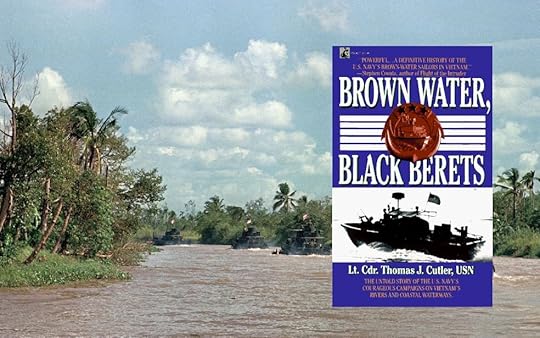
Brown Water, Black Berets: Coastal and Riverine Warfare in Vietnam
The men of the U.S. Navy's brown-water force played a vital but often overlooked role in the Vietnam War. Known for their black berets and limitless courage, they maneuvered their aging, makeshift craft along shallow coastal waters and twisting inland waterways to search out the enemy. In this moving tribute to their contributions and sacrifices, Tom Cutler records their dramatic story as only a participant could. His own Vietnam experience enables him to add a striking human dimension to the account. The terror of firefights along the jungle-lined rivers, the rigors of camp life, and the sudden perils of guerrilla warfare are conveyed with authenticity. At the same time, the author's training as a historian allows him to objectively describe the scope of the navy's operations and evaluate their effectiveness.
Winner of the Navy League's Alfred Thayer Mahan Award for Literary Achievement in 1988 when the book was first published, Cutler is credited with having written the definitive history of the brown-water sailors, an effort that has helped readers better understand the nature of U.S. involvement in the war.
Winner of the Navy League's Alfred Thayer Mahan Award for Literary Achievement in 1988 when the book was first published, Cutler is credited with having written the definitive history of the brown-water sailors, an effort that has helped readers better understand the nature of U.S. involvement in the war.
448 pages, Paperback
First published June 1, 1988
Ratings & Reviews
Friends & Following
Create a free account to discover what your friends think of this book!
Community Reviews
Displaying 1 - 10 of 10 reviews

March 5, 2009
This book reads like a novel, but it isn't: it's the history of men in a war doing a little known and less understood duty in the rivers of southern Viet Nam. Say what you like about war, and I am not a great fan, these men demonstrate bravery and courage that I could only imagine.
I was encouraged to read this book by a relative who knew someone from the book. Naturally I read that part first. However the rest of the book was just as fascinating and thrilling as the first part I read and I began to get a feeling for what the US faced in Viet Nam. After a while, you can feel the oppressive heat, the never ending pelting rain and the life that you can't seem to escape. How these people persevered as long as they did, I have no idea.
This is an exciting book which I wouldn't have otherwise read, but am now glad I did. One thing I learned is that the Viet Cong were using Cambodia as a logistics staging area and that when these river patrols really started having an effect on supplies coming in for the VC, it really started to hurt them.
This book is filled wit details which will send you running to a map of SE Asia, but after a while you get the idea of the terrain. It’s also filled with stories of tragedy and success and it’s fun to read. Ultimately for a forgotten part of the war in Viet Nam’s rivers, this is a great book.
I was encouraged to read this book by a relative who knew someone from the book. Naturally I read that part first. However the rest of the book was just as fascinating and thrilling as the first part I read and I began to get a feeling for what the US faced in Viet Nam. After a while, you can feel the oppressive heat, the never ending pelting rain and the life that you can't seem to escape. How these people persevered as long as they did, I have no idea.
This is an exciting book which I wouldn't have otherwise read, but am now glad I did. One thing I learned is that the Viet Cong were using Cambodia as a logistics staging area and that when these river patrols really started having an effect on supplies coming in for the VC, it really started to hurt them.
This book is filled wit details which will send you running to a map of SE Asia, but after a while you get the idea of the terrain. It’s also filled with stories of tragedy and success and it’s fun to read. Ultimately for a forgotten part of the war in Viet Nam’s rivers, this is a great book.

June 6, 2023
Changing tacks from one side of the Atlantic Ocean to the other, James Dearden and Adrian Lyne tried their hand of turning the former's short-film DIVERSION into something bigger, succeeding seven years later when FATAL ATTRACTION was released to huge critical and commercial success. Quite controversial in 1987, the movie focuses on fidelity and obsession, and aside from an amateurish but traumatizing attempted Lapin a la creme dish, one of the big takeaways was the female star's line "I won't be ignored." Just because the US Navy and in particular NSW pushed its way to the forefront of the Armed Forced and became the quasi poster child for the Military after the Navy SEALs took credit for permanently taking UBL off the board in 2011, that doesn't mean it's always been that way. For decades toiling in the shadows as the quiet professionals, BROWN WATER, BLACK BERETS is a primarily and unashamedly positive retelling of the often forgotten involvement of the Naval forces in the Vietnam war. Though Uncle Sam's Misguided Children and the Army usually carve up the attention cake, as they often do, 38,000 Sailors at peak strength and close to 2 million US NAVY and Coast Guard personnel serving in the Vietnam War shall no longer be ignored.
Before taking over from the French after Dien Bien Phu in '54, Americans began to trickle into Saigon in 1950 with the aim to front military materiel to those fighting the insidious crawl of communism in Indochina. Vietnam, a country going from Japanese to French to American domination, sits at the bottom of the world's eleventh longest river that spans from Tibet to Vietnam, referred to by Westerners as the Mekong, despite it going through a host of countries along its 2,600 mile journey and carrying many different names. Ending its journey in a massive delta with more than 5 million inhabitants and the majority of the nation's rice being farmed there, both the South Vietnamese and the Viet Cong were pent up to control the "rice bowl of Vietnam" as the war ground on. This contest for control of the delta is the meat of BROWN WATER, BLACK BERETS, detailing that U.S. riverine efforts were tasked to engage enemy forces to disrupt their supply lines, interdict suspicious water craft, and recon the environs. Although nary dragged into the spotlight, riverine warfare was not a rookie effort for the US Navy; there was precedent in "Brown-water warfare', albeit activated and shelved when needed during conflicts ranging from the Revolution, the Mexican, Seminole, and Civil War as well as pre-WWII Yangtze River patrols. As per BROWN WATER, BLACK BERETS, passed-on tactical knowledge found no application on the Nam's rivers, forcing Sailors to set precedent through their fights and patrols, preventing seaborne infiltrations, and successfully driving the Communists onto the brutal Ho Chi Minh trail, seriously denting Uncle Ho from supplying his force in the South.
Living in a world of tropical discomfort, monsoon weather conditions, and an unseen enemy who was never very far away, US naval personnel only had to fear the Viet Cong, immersion foot, and venomous snakes during their time in the Mekong Delta. BROWN WATER, BLACK BERETS details how they carried out their missions in the face of controversy and in a milieu of doubt and domestic strife, and became intimately familiar with boredom, fear, fatigue, and sometimes death. While dodging the insidious enemy that is monotony, one of the certainties of war alongside the piratical habit of taking souvenirs, Sailors dealt with the resulting complacency in hopes to evade the inevitable casualties, testing their mettle and means of amphibious river warfare. Thus, the nature of the littoral beast allowed military leadership to see and leverage the value of a river assault force. However, 8,700 miles west, the sailors and soldiers' missions and actions failed to impress their fellow Americans and their myopic eye for a long time, and were relegated to the obscurity of collective sacrifice as carved into black granite in DC since 1982.
Though often misappropriated by their naval brethren as their domain, the SEAL teams and the River rats enjoyed a symbiotic partnership in the Mekong Delta, that swampy south of a distant land that most sailors had nary heard of, trying to help a people that could never be fully trusted and more often than not had to be classified both as potential friend and a deadly foe. Life was dilemma and this book nails it. From junks, cutters, trawlers, PBRs, to destroyers, and spouting off with more ship acronyms, tonnage, Hull draft, displacement and armament descriptions than a vintage Clancy novel, BROWN WATER BLACK BERETS has an authentic Nam feel and easily takes the reader back to the 60s, deep into the attitudes, happenings, and mindset during the Vietnam War. Despite the sometimes dragging narrative and penchant for listing mission specs, BROWN WATER, BLACK BERETS is a fascinating look at a different but equally crucial component of US Military strategy during the Vietnam War. Allow yourself to be taken for a ride with the River Rats of brown-water warfare, one of the stop-gaps holding up those dominoes in Indochina more than sixty years ago. BROWN WATER, BLACK BERETS is not just a book, it's an adventure.
September 26, 2017
A great factual book that reads likes a novel and covers a not as well known aspect of the war

March 20, 2022
Wht a good read. I only wish there were more also about the people as well, and what caused us to lose the war.
March 11, 2025
Very good book about the Mobile Riverine Force in Vietnam. It even included the area North of Danang, where I was. A very good read!

June 9, 2015
An enjoyable book on an aspect of Vietnam that I had the least knowledge. The Riverine war has certainly interested me after cutting my teeth in the '60s with both "PT-109" and "McHale's Navy." This book even had an officer who led "MacLeod's Navy." The nature of Vietnam was certainly conducive to this type of operation and who better to perform that task than the US Navy? However, as happens again and again in history, we utilize a tactic that proves successful and when we move onto the next strategic issue we find we lost that ability both in equipment and training and have to start over again.
Again, like our footprint in Vietnam, the US Navy presence in that country was light, this despite the knowledge (or again, perhaps lost historical knowledge) that the French had helped maintain the Vietnamese Navy in patrolling the rivers. The U.S. Military Assistance Advisory Group (MAAG) in 1961 had 53 advisors in 1961, by 1965 there were 235. Three task forces existed: Sea Force, River Force, and the Junk Force. It was an interesting time to be in country and with the Navy. This is where things really begin.
Cutler's book explores the five main tactical operations of the Brown Water Navy and then the final Vietnamization of that operation as the United States left. I'm a geek on operational names and these give you a sense of what was going on, and alone for me drew me towards reading this book. Operation Market Time, Operation Game Warden, The Mobile Riverine Force, Task Force Clearwater, and Sea Lords. All of these had varying levels of success and I do believe that they were successful, but they also resulted in high casualties for Navy personnel despite that success. Many of these patrol boats were fiberglass, they were not designed neither for this type of offensive tactics and were highly sought after targets on the river by the Viet Cong. Noisy meant trying different things to create surprise. To float into the jungle overhang of a riverbank and wait for the enemy to come to you. To drop troops off and create ambushes that you could support or help withdraw same troops if they get in trouble.
Lots of heroism, but yet stories of seaman who weren't always certain what their mission was, much less who the enemy was. One sailor on a .50 cal machine gun almost fired upon a group of Vietnamese provincial soldiers because they were wearing black pajamas. He had thought only the VC wore this, no one had warned him otherwise.
I know it's a reach to see some parallels between Vietnam and Afghanistan/Iraq, but as far as cultural differences I do believe that the United States encounters these and often had blinders on by far too many of the public, political apparatus, the foreign policy departments, foreign service representatives and that doesn't even touch upon the soldier or even NGO rep in the field. Without good guide work, good cultural understanding and know what people "need" at the basic level our good intentions of spreading democracy or aiding in reducing famine, terror, and genocide are doomed to fail. We simply cannot fix everything and war certainly isn't a dam against dominoes falling. Never has been, never will be.
Good book that I hope to revisit and read with a detailed map of Vietnam, perhaps in tandem with a superior land history of the war.
Again, like our footprint in Vietnam, the US Navy presence in that country was light, this despite the knowledge (or again, perhaps lost historical knowledge) that the French had helped maintain the Vietnamese Navy in patrolling the rivers. The U.S. Military Assistance Advisory Group (MAAG) in 1961 had 53 advisors in 1961, by 1965 there were 235. Three task forces existed: Sea Force, River Force, and the Junk Force. It was an interesting time to be in country and with the Navy. This is where things really begin.
Cutler's book explores the five main tactical operations of the Brown Water Navy and then the final Vietnamization of that operation as the United States left. I'm a geek on operational names and these give you a sense of what was going on, and alone for me drew me towards reading this book. Operation Market Time, Operation Game Warden, The Mobile Riverine Force, Task Force Clearwater, and Sea Lords. All of these had varying levels of success and I do believe that they were successful, but they also resulted in high casualties for Navy personnel despite that success. Many of these patrol boats were fiberglass, they were not designed neither for this type of offensive tactics and were highly sought after targets on the river by the Viet Cong. Noisy meant trying different things to create surprise. To float into the jungle overhang of a riverbank and wait for the enemy to come to you. To drop troops off and create ambushes that you could support or help withdraw same troops if they get in trouble.
Lots of heroism, but yet stories of seaman who weren't always certain what their mission was, much less who the enemy was. One sailor on a .50 cal machine gun almost fired upon a group of Vietnamese provincial soldiers because they were wearing black pajamas. He had thought only the VC wore this, no one had warned him otherwise.
I know it's a reach to see some parallels between Vietnam and Afghanistan/Iraq, but as far as cultural differences I do believe that the United States encounters these and often had blinders on by far too many of the public, political apparatus, the foreign policy departments, foreign service representatives and that doesn't even touch upon the soldier or even NGO rep in the field. Without good guide work, good cultural understanding and know what people "need" at the basic level our good intentions of spreading democracy or aiding in reducing famine, terror, and genocide are doomed to fail. We simply cannot fix everything and war certainly isn't a dam against dominoes falling. Never has been, never will be.
Good book that I hope to revisit and read with a detailed map of Vietnam, perhaps in tandem with a superior land history of the war.

May 23, 2024
A good overview of Naval operations such as Operation Mark Time (1965 - 1973) and Operation Game Warden (December 18th, 1965 - March 1973), also includes the early period of American Involvement in the First Indochina war with the MAAG.
It's probably a good book on the Naval operational aspect of the Vietnam War.
Overall, it was a good read and a good addition to any library of the Vietnam War
It's probably a good book on the Naval operational aspect of the Vietnam War.
Overall, it was a good read and a good addition to any library of the Vietnam War

February 25, 2009
A interesting, short, readable, history of "brown water" U.S. Naval operations in the Vietnam War. I found the book tended to jump between first-person narratives, but also gained some insight into the neglected but important role of naval operations in Vietnam. I also realized how so many other books I've read on the Vietnam War, tend to gloss-over the navy's contributions in this regard. A book I found beneficial to my knowledge of the Vietnam War, but hardly highly essential.

January 13, 2008
Jumps from subject to subject, or rather boat to boat with irritating frequency, neglecting any real human aspect of the riverine forces.

October 1, 2016
Read this as research for Blood Wake.
Displaying 1 - 10 of 10 reviews