Stephen Hinshaw grew up in Columbus, Ohio and attended Harvard and UCLA. A professor of psychology (UC Berkeley) and Psychiatry (UC San Francisco), he is an international presence in clinical psychology/mental health, with over 320 articles/chapters and 12 books. He received a Distinguished Teaching Award in 2001; his Teaching Company (‘Great Lecture’) series, “Origins of the Human Mind,” appeared in 2010. He has been recognized by the Distinguished Scientist Award from the Society for a Science of Clinical Psychology (2015), the James McKeen Cattell Award from the Association for Psychological Science (2016) for a lifetime of outstanding contributions to applied psychological research, and the Distinguished Scientific Contributions to Child Development Award (2017) from the Society for Research in Child Development. He lives in Berkeley, California, with his wife, Kelly Campbell; they have three sons. His newest book, "Another Kind of Madness," chronicles his father's recurring mental illness and the doctor-enforced silence surrounding it, plus the huge need to combat stigma.
I'd give it 4.5 stars, because I'm a tough grader.
But, if you read one book about ADHD, this should be the one. It's a concise (168 pages) review of the state of ADHD diagnoses and treatment through the ages and around the world. It debunks many of the myths and prejudices with hard data. It does not give easy answers because that's the way science works. Data can absolutely refute theories, but can't prove them. But, a preponderance of data does point to a consensus.
Oh, did I mention the data? Next time someone says something stupid to my face, I'll just hand them the book and point to the data.
BTW, the co-authors are professors at my alma mater. Go, Bears.
This is an interesting summary of the medicine and social science of ADHD, and debunks much of the "article du jour" reporting of the media. The bottom line message is that ADHD is real (although proper diagnosis is required), drugs are effective, and changes in our society are causing ADHD to be more of a problem. It's short (168 pages before the footnotes) with reasonably short chapters - it would be perfect for ADHDers if wasn't also a bit dull.
An excellent academic treatise on the challenges...social, physical, emotional and financial that revolve around an ADD/ADHD diagnosis. Very well researched and presented. Whether you are a professional or a layperson, I can highly recommend this book as a means to a greater understanding surrounding this vastly misunderstood disorder.
this is one of the best, most comprehensive books on ADHD I've ever read. I love that is just informational and not trying to convince the reader that ADHD is not real or that it is curable. this book places all the facts in front of the reader and allows the reader to decide what he or she thinks. there are over 14 pages of references in the back of this book. to me that is always a good sign that the book is well researched. it also brings to light some great information and some great food for thought in the world of ADHD. highly recommended!!!!
Well researched analysis to justify the hyperbolic title. The increasing rate in which mood altering drugs are being prescribed could certainly be described as an explosion. Rampant misdiagnosis in combination with billions spent on direct to consumer ads promising a cure for every ailment has fueled this epidemic. The authors go to lengths to stress how multifaceted this issue is as a combination of genetics, environment, parental influence, teacher's role, doctor incentives, exposure to pesticides, physical activity, and diet. .
Although the book is five years old and recent data and trends render some parts of it slightly out of date, the basic premises and extensive research supporting the presentation of ADHD as a real condition that impacts millions remains valid and extensively substantiated. The authors convey a clear understanding of the condition, and the impact it can have on health, relationships, education and careers. They strongly emphasize the need for careful diagnosis, and make a strong case that under diagnosis of the condition still remains a problem.
This was fascinating. It looked at the very real reality for people with ADHD, the stigma attached to the diagnosis, the possibility of simultaneous over and under diagnosis and why, it's triggers, and more. It was amazing to learn.
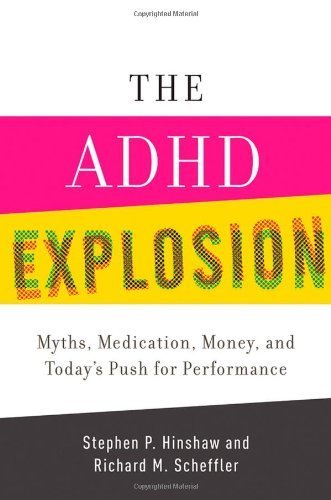
The ADHD Explosion is an eye-opening and occasionally frightening look at how and why we diagnose children with ADHD. Stephen Hinshaw and Richard Scheffle have presented a thoughtful, detailed, and well researched examination of what ADHD is, how it is currently diagnosed and treated, and, most importantly, how it should be diagnosed and treated.
Unlike some of the alarmist publications we often see on the topic, the authors make it clear that ADHD is a very real condition and that correct diagnosis and treatment is essential for the well-being of the patient. They focus their concerns not just on ADHD itself, but the push for expediency instead of accuracy in the diagnosis and treatment. Too often, children that would respond better to therapy over medication are pushed into prescriptions because that is what the insurance covers or because it is easier to manage for the parents. They discuss the issue of both over-diagnosis with some demographics (almost a third of boys age nine and older in the Southern United States are diagnosed with ADHD) and the overlooked under-diagnosis of other demographics.
The authors do not just focus on children, however. They look at the issue of adult ADHD and its impact. There is also wide-ranging discussion about the real effect of ADHD on the economy, both from a treatment standpoint and worker productivity. It is a wide-ranging look at the condition and its impact on society as a whole.
This book should be required reading for any parent with a child that has been given an ADHD diagnosis, as it provides a wealth of ammunition and information for parents who want to make sure they are making the right decisions, not just the most convenient, for their child's treatment.
Reviewer Note: I was given a comp copy of this book for review.
It's a compact, quick read but full of hard data. I think a previous reviewer described it as a book with no quick or easy answers, which I greatly appreciate bc it can be difficult to wade through various propaganda - whether for or against the adhd diagnosis. I just wanted some objective insight, and this book offers exactly that.
This book does an excellent job of explaining the history and current events surrounding ADHD. It is meticulously researched and clearly lays out facts vs myths with documentation to support its claims.
From this book, I learned a lot about the historical and recent trends in diagnosing and treating ADHD. The authors also outlined the benefits of early diagnosis and treatment for those affected.