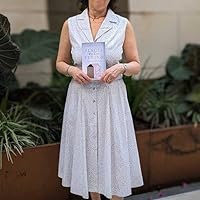
I was a little wary of this at first: contentious subject matter published by an indie press (though perhaps in this case, the contentious subject matter here was a reason why traditional publishing wouldn’t touch it.) In fact, I’ve read a few novels out of Black Rose Writing, and this one might be my favorite. :0
In this story geared for teens, Eglash follows three girls from different “tribes” of Jerusalem: Tamar the Israeli secular Jew, Nour the Palestinian Muslim, and Rivki the Haredi Jew (who technically has Israeli citizenship—in fact all three of these girls have Israeli citizenship—though, like Nour, she’s not entirely aligned with mainstream culture.)
The prose is a bit pedestrian; it might be Eglash’s journalism background coming through, especially with most chapters being very short, almost like a daily report. More developmentally, Rivki’s story isn’t quite as “parallel” to Tamar’s and Nouri’s. Both Tamar and Nouri are contending with narratives that essentially paint the other directly as the bad guy, and they both have family or friends whose extremist views lead to violence. I had more trouble connecting with Rivki’s interiority for the reasons why she was grappling with the norms of her own community. However, it’s also true that like it or not, she lives in Jerusalem and thereby has direct physical and mental proximity to the conflict, especially when it boils over into terror attacks. All three girls’ lives intersect twice on the Jerusalem light rail, where they must react to two such attacks—first indirectly, where the train is stopped due to an ambush on the streets, and then directly, when confronting an assailant in the train car.
Another reason Eglash’s journey is a little different than that of many indie authors: she was a writer for the Washington Post, and likely had fewer roadblocks in accessing media to promote her story. In interviews and op-eds, she described her jadedness towards how her profession handles the conflict, and wanting to reach out to young people who are often on “the front lines.” And yes, THE HUNGER GAMES came into her inspiration for writing the book, especially given the ages of many of the soldiers and militants. (I'd argue the comparison would've been more apt if her book also probed why extremist leaders want to perpetuate conflict.) Eglash's own biases lead her to “the Israeli side” of experiencing terror attacks in Jerusalem, though Nour’s reality was similarly fleshed out on the page.
The intended audience is also a bit of an oxymoron. As Rabbi Marc Katz extols in his Jewish Book Council review, the book isn’t “preachy” he also sees it as “instructive” where young people might come out of the conflict with the nachas (my word, but it feels appropriate!) to work together towards peace.
There’s an argument to be made that given this story takes place within Israel’s Green Line—granted, Jerusalem’s semi-divided status is a little murkier than that of, say, Tel Aviv—circumvents the larger conflict of the occupation of the West Bank and now, though this book came out early in 2023, the aftermath of October 7, the war and humanitarian crisis in Gaza. But then again the lives of these teen girls are still valid, and are arguably the easiest jumping-off place for change.
I’m writing this review a bit after finishing the book, and I can’t say I’ve been ruminating deeply on the characters this whole time. But while reading, I definitely appreciated bursts of insight into the day-to-day realities and relationships for Tamar, Nour and ultimately Rivki.