Jump to ratings and reviews
Rate this book

Selected Poems and Fragments

Rate this book
Friedrich Hölderlin (1770-1843) is now recognized as one of Europe’s supreme poets. He first found his true voice in the epigrams and odes he wrote when transfigured by his love for the wife of a rich banker. He later embarked on an extraordinarily ambitious sequence of hymns exploring cosmology and history, from mythological times to the discovery of America and his own era. The ’Canticles of Night’, by contrast, include enigmatic fragments in an unprecedented style, which anticipates the Symbolists and Surrealists. Together the works collected here show Hölderlin’s use of Classical and Christian imagery and his exploration of cosmology and history in an attempt to find meaning in an uncertain world.

352 pages, Paperback

First published January 1, 1843

114 people are currently reading
4478 people want to read

About the author

Friedrich Hölderlin

499 books394 followers
Johann Christian Friedrich Hölderlin was a major German lyric poet, commonly associated with the artistic movement known as Romanticism. Hölderlin was also an important thinker in the development of German Idealism, particularly his early association with and philosophical influence on his seminary roommates and fellow Swabians Georg Wilhelm Friedrich Hegel and Friedrich Wilhelm Joseph Schelling.

Ratings & Reviews

What do you think?
Rate this book

Friends & Following

Create a free account to discover what your friends think of this book!

Community Reviews

5 stars
475 (53%)
4 stars
272 (30%)
3 stars
111 (12%)
2 stars
26 (2%)
1 star
9 (1%)
Displaying 1 - 30 of 45 reviews
Profile Image for Andrew.
2,258 reviews931 followers
Read
April 21, 2022
I'd heard about Holderlin for years, ever since seriously engaging with German philosophy, and read mere bits and scraps. It was time. I'd been holder'ing it in too long (sorry).

And what I got from it? An absolute headlong deep dive into German romanticism in its purest form, like to the point where I felt I should be reading this on a granite outcrop over the Rhine as the wind buffeted my face, to the point where I started involuntarily humming the overture to Tristan and Isolde in my spare hours. He looks backward in time, mostly, to Greece, and never to Rome. He also looks forward, and his dreamy thoughts would be turned – in grand German tradition – into highly systematic but also highly metaphysical and unworkable cobwebs of axiom and subject and object, and would prove a fertile inspiration for a certain fussy and mustachioed philosopher who donned a brown uniform and tried to hide his Jewish mistress and then cover his tracks vis-a-vis said brown uniform afterwards, who would, in turn, set the stage for a few of the things that would later be called “postmodern.” And the poems themselves are pretty fuckin' gorgeous.
Profile Image for Nathan.
194 reviews53 followers
March 22, 2019
So I have been really immersed in German Idealism, and lately German Romanticism (Jena School) in order to get a better understanding of 19-20th century radical revisions of the human and their world. Hölderlin is crucial here. A romantic poet, friends with Schelling and Hegel, mentored by Schiller. Along with Novalis and Schlegel, he is part of the triumvirate of German Romanticism. I have been reading these thinkers in relation to the preceding and contemporaneous Idealism, and also the succeeding Frankfurt School.

Regarding Hölderlin’s work itself, what can I say? I cried after reading his final poems (not tears, but a proper cry). They were deep. The biography in the penguin book is great. Shines light into a very obscure and underrated thinker. He was a master of poetry and, even in the peak of mental illness, when he was no longer regularly writing, he could suddenly smash out a brilliant piece of prose.

Reading him in relation to his intellectual/historical context is really important to appreciate the richness and depth of his work.
Profile Image for Y.
84 reviews110 followers
April 15, 2019
A collection of poems that give readers peace and gentle delight, as if returning to the drunken yet quiet days of the ancient Greek gods.
Profile Image for Hon Lady Selene.
579 reviews85 followers
April 19, 2021
It was hard to get through these, especially in German, especially since Friedrich was a friend of Hegel. Some poems are pretentious, some quite touching, but all quite lyrical, classical, idealistic and romantic.

When I was a boy

When I was a boy
a god often rescued me
from the shouts and the rods of men
and I played among trees and flowers
secure in their kindness,
And heaven's soft breezes
played with me too.

And as you delight
the hearts of plants
When they extend
Their tender arms towards you,

so you delighted the heart in me
father Helios! and like Endymion
I was your favourite,
Holy Luna!

O all you faithful
Friendly gods!
If only you knew
how my soul has loved you!

Even though when I called to you then
it was not yet with names, and you
never named me as people do,
as though they knew one another.

But I knew you better
Than I've ever known mankind,
I understood the silence of the Aether,
but never the words of men.

I was raised by the melody
Of the murmuring grove
and I learned to love
among flowers.

I grew up in the arms of the gods.
Profile Image for Sajid.
457 reviews110 followers
June 9, 2022
Deep in the Alps, the night is shining bright. And the cloud, joyfully forming, covers over the gaping vale.
Turbulent, laughing mountain air, this way and that; suddenly, down through the pine trees shines and dwindles a ray.
 Joyful, shivering chaos slowly hurries to battle.
Young in form, but strong, it revels in loving strife.
Brewing, wavering under the rocks in timeless barriers, morning rises in Bacchic frenzy, deep inside.

Hölderlin's poems are the musical air brimming with the coldness of upcoming nostalgia. Fresh air. Mystical songs which underlines the blazing loneliness of a silent man. Almost every poem Hölderlin wrote had similar undertones–sometimes praying to God,or gods,or Demigods,sometimes about the fatherland, the nature,the beauty, love,loneliness. Reading Hölderlin's poems feels like i am ballooning upward with my spirit... As if i am never again going to touch my feet to the ground.
Profile Image for Dionysius the Areopagite.
383 reviews164 followers
February 1, 2017
How could it have taken me so long to get to Holderlin? O heavens, what a treasure in the February darkness of eastern wintry contemplation! Joy to the grim world via Goethe, Talmudic cap, a Thoreau of the soul; O lyrical beatitude!
Profile Image for Peter Crofts.
235 reviews29 followers
August 22, 2013
I'm not reviewing this particular edition of Hamburger's translations of Holderlin but the Penguin edition which strangely doesn't seem to be on the Goodreads list. The Penguin is probably only about half the size of this particular edition. On that note let me give my thoughts on this poet and translator. Is it best to read an introduction to a poet or writer and then following the work itself? In regards to this poet (Gerard De Nerval is another) I would say no, the reason being once you read of the man's life you're going to take a highly coloured impression into the verse itself. Whatever Holderlin wrestled with is very much in the verse. That being said his Odes and Hymns are absolutely magnificent. I found myself, when it was possible, reaching for this volume right after breakfast, sometimes before. The volume is broken down into the type of poetry and I found, upon finishing a section, that rather than move on I would begin the finished section all over again. I just did not want to finish the book. Holderlin does fit within the general contours of romanticism but there is a finely chiseled lucidness to his poetry that, at least for me, sets him apart. His verse varies from the very brief to the almost epic. Rene Char adored him which should give you some idea of the vitality that dances behind the words. Highly recommended, possibly to be read and contrasted with Leopardi, ideally the recent FSG edition.
Profile Image for Sean Wilson.
200 reviews
April 13, 2020
Hölderlin's poetry is one of the greatest gifts to humanity. His hexameters and odes provide comfort in this uncertain world we live in. The book contains both the original German text and its English translation. I sometimes envy my wife for being fluent in German but the English text flows very well.
Profile Image for E. G..
1,175 reviews797 followers
January 9, 2015
Foreword
Preface
Introduction
Biographical Note


Odes and Epigrams (1797-1799)

Epigrams (1797)
--Good Advice
--Descriptive Poetry
--To Diotima
--Diotima ('Bliss of the heavenly Muse...')
--Bonaparte
--Empedocles
--To the Fates
--Diotima ('You suffer and keep silent and, strange to them...')
--To Her Genius
--Plea for Forgiveness
--Then and Now
--The Course of Life ('High my spirit aspired...')
--Brevity
--Human Applause
--Home ('Content the boatman turns...')
--Good Faith
--Her Recovery ('Nature, she who's your friend...')
--The Unpardonable
--To the Young Poets
--To the Germans ('Do not laugh...')
--The Sanctimonious Poets
--Sunset
--To Our Great Poets
--Socrates and Alcibiades

Epigrams (1799)
--Sophocles
--The Angry Poet
--The Root of All Evil

The Later Odes (1798-1803)

--Man
--Hyperion's Song of Fate
--In my boyhood days...
--The Spirit of the Age
--Evening Fantasy
--In the Morning
--The River Main
--My Possessions
--To Princess Augusta of Homburg
--Go down, then, lovely sun...
--To the Germans ('Never laugh at...')
--Rousseau
--Heidelberg (Alcaic version)
--The Neckar
--Home ('Content the boatman turns...')
--Love
--The Course of Life ('More you also desired...')
--Her Recovery ('Nature, look, your most loved...')
--The Farewell (second version)
--Diotima ('You suffer and keep silent, unknown...')
--Return to the Homeland
--The Ancestral Portrait
--The Departed
--Exhortation (second version)
--Nature and Art or Saturn and Jupiter
--Sung beneath the Alps
--The Poet's Vocation
--Voice of the People (second version)
--The Blind Singer
--Chiron
--Tears
--To Hope
--Vulcan
--The Poet's Courage (first version)
--Timidness
--The Fettered River
--Ganymede

Hexameters and Elegies (1800-1801)

--The Archipelago
--Menon's Lament for Diotima
--The Traveller
--Stuttgart
--Bread and Wine
--Homecoming

The Hymns (1799-1803)

--The Ages of Life
--Half of Life
--The Nook at Hardt
--As on a holiday...
--At the Source of the Danube
--The Journey
--Germania
--The Rhine
--Celebration of Peace
--The Only One (first version)
--The Only One (second version)
--Patmos
--Patmos (fragments of the later version)
--Remembrance
--The Ister
--Mnemosyne (third version)

Fragments of Other Hymns (1800-1805)

--German Song
--Home ('And no one knows...')
--For when the grape-vine's sap...
--On fallow foliage...
--What is the life of men...
--What is God?...
--To the Virgin Mary
--The Titans
--At one time I questioned the Muse...
--But when the heavenly...
--The Eagle
--You firmly built alps...
--Whatever is Nearest (third version)
--Colombo
--When there's a flaming...
--For from the abyss...
--Narcissi...
--In Socrates' Time
--Greece (third version)

Last Poems (1807-1843)

--If from the distance...
--On the Birth of a Child
--The world's agreeable things...
--To Zimmer ('The lines of life...')
--Conviction
--The Merry Life
--The Walk
--Spring ('New day descends...')
--Summer ('When then the blooms...')
--Summer ('Still you can see...')
--Autumn ('Nature's bright gleam...')
--Winter ('When past, unseen...')
--Spring ('When springtime from the depth...')

Index of German first lines
Index of English first lines
Index of German titles
Index of English titles
Profile Image for Algirdas.
307 reviews135 followers
April 14, 2014
Hölderlinas Hölderlinu, asmeniškai man ši knyga - dar vienas susitikimas su Gintaru Beresnevičiumi, dar vienas langas į jo pasaulį. Labai geras straipsnis knygos pabaigoje. Nežinau ar gerai padariau pirmiausiai jį perskaitęs, nes Hölderliną skaičiau jau jo įtakoje.
Profile Image for —.
80 reviews82 followers
June 6, 2020
I may have just found a new favorite poet!

I thoroughly recommend looking through at least some of his poems online or getting a pdf. And picking up his collected poems is a good idea too. Don't buy this book from Penguin though.
Profile Image for Caspar "moved to storygraph" Bryant.
874 reviews56 followers
Read
June 22, 2023
I was doing my best to read this parallel text in my delightfully rusty german so I award myself points for trying , I'm not the strictest

beautiful & in a completely dire translation by hamburger which somehow makes a dynamic, exciting 19th-century poet sound like he's William morris writing in the 15th. Also maybe I'm missing something but it looks like ? somebody ? forgot to give us the original text on page 326 & there are parallel verses in English, but not the same english - possibly the literal trans.?

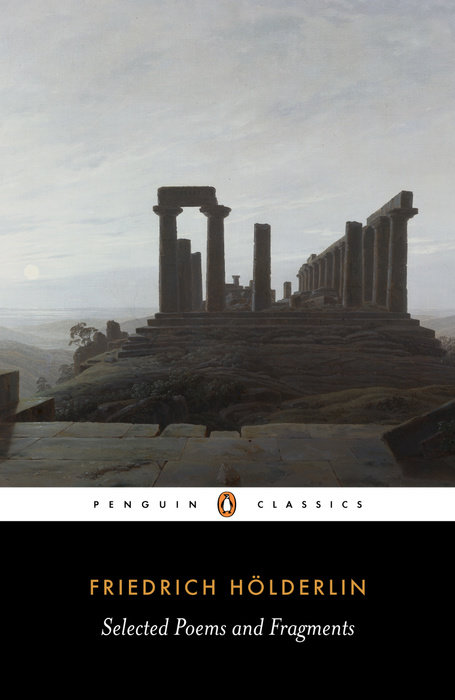
I really enjoyed this though & the caspar on the cover, he's one of those to live WIth
Profile Image for Tom Romer.
16 reviews2 followers
April 19, 2020
POET OF MODERNITY

Friedrich Hölderlin has something of a mythical status among thoughtful ('intellectual') circles as a poet who, in his yearning for the old days of Ancient Greece and the gods of old, introduced these themes in his poems, as well as, in the epigrams that start the book, apt commentary on his time which still applies today.

In short, he was a poet who, to poetise modernity, went back in time to the roots of our civilization, two and a half thousand years ago, and as such has a relevance and urgency for those of us today who feel that a quiet, underground spiritual rejuvenation needs to be brought to our spiritless times.

Friends with German idealist philosophers Schelling and Hegel, he influenced the young Nietzsche and, in the 20th century, has been interpreted by giant thinkers Walter Benjamin and Martin Heidegger, the latter seeing in Hölderlin a new Homer for Europe and the main anchor point for his philosophy.

It is of course historically material that Hölderlin was regarded as 'schizophrenic' in his lifetime, but that says more about the dogmatic and conformist culture of his time, still prevalent today, than it does Hölderlin's mind which was able, for example, to provide a seminal translation of Sophocles.

As a modern day classics student and amateur thinker, very drawn to the Hellenistic, Latin and Teutonic traditions, Hölderlin is a point of reference for me as he truly is at the crossroads of these powerful currents which have so much to offer us in our day and age.

This Penguin edition is very handsome and includes the German texts as well as Michael Hamburger's much-lauded English translations.

It contains selections from Hölderlin's entire creative life, be it the odes, the elegies, the hymns and so forth.

I recommend this book, and Hölderlin generally, to all who have a penchant for Ancient Greece, Latin poetry, and German literature, or The Humanities with a capital 'H'.
Profile Image for Mike.
1,430 reviews55 followers
July 11, 2014
One of my favorite Romantic poets. While in Austria over the summer of '07, I made a special trip to Tübingen just to visit Hölderlin Tower (and the infamous "Goethe Puked Here" tavern sign). These poems brought me back to my time in Bavaria and the Black Forest; in fact, it almost feels like these poems demand to be read in those locations for the full experience. In terms of this collection, I felt that the translations were a little rigid at times, but I still enjoyed having all the best works in one volume, especially a sampling of Hölderlin's later work in the midst of his mental collapse. I also hadn't read many of the hexameters or elegies before, so those were worth the read alone.
Profile Image for David Hinton.
Author 2 books3 followers
February 25, 2016
If you haven't read Holderlin yet but love poetry, please be sure to check him out. This is an excellent collection of his poems with very good translations. And, with a Caspar David Friedrich painting on the cover, it is a good addition to your collection of German Romanticism.
Profile Image for Karl Hallbjörnsson.
669 reviews72 followers
June 13, 2017
Man, I love this guy! His writing just vibrates so well with my mind. This edition is wonderful: the cover is beautiful, the poems are both in German and English and there's a lot of material to read and re-read. Highly recommended.
Profile Image for Aidan Jude.
78 reviews3 followers
May 31, 2025
I don’t read much 19th century romantic poetry anymore, but this was good.


For if the gods need of one thing,

It is of heroes and human beings

---

I was reared by the euphony

Of the rustling copse

And learned to love

Amid the flowers.

I grew up in the arms of Gods.

---

for *once* I

Lived like the gods,

and no more is needed

---

Latest News: Apollo’s become the god of journalists, press men, And his blue-eyed boy he who reports all the facts.
Profile Image for Billie Pritchett.
1,202 reviews121 followers
Read
October 18, 2025
What's best about this Penguin edition is that it contains dual German and English translations so that for those poems that move you most in English you can sound out in German to get a deeper sense of the poem's music.
42 reviews1 follower
April 27, 2021
(counting as read only because this is a compilation of sorts from which I've sampled the majority of the contained work)

This compilation can be dry due to the sheer volume of similar material, but when taken a little bit at a time, it is a salve for a dry soul. His poetics are absolutely top shelf more often than not, and his trademark blend of the Classical and (in his time) Modern is truly, incredibly beautiful. Not much else to say aside from how essential Hölderlin is to any Average Poetry Enjoyer's oeuvre.

I read this mostly before bed aloud with my wife, and filled in the gaps between poems read aloud elsewhere.
Profile Image for Alexander.
77 reviews18 followers
May 12, 2021
dead pantheist. greek poet born in a 18th century lutheran family. lover of nature and german idealism. contemporary of hegel and schiller, but much less fortunate. hölderlin’s tale is a tragic song, but one that perhaps is best reflected on in his own words:

“On a fine day – they should consider – almost every mode of song makes itself heard; and Nature, whence it originates, also receives it again.”

this melody has resonated in history, after all, and been received.
Profile Image for Tonia.
87 reviews
September 29, 2011
Amazing, amazing poet and thinker. This is a great edition, but I would also recommend comparing with the Sieburth version as the translations are slightly different, but comparing the two really captures the language/meaning on one hand and the other gives you more the feel of the poetic elements.
Profile Image for Jenni.
171 reviews51 followers
August 1, 2007
If you like Holderlin, this book has 787 pages of poems and fragments. Originals are on the opposite page.
Profile Image for S P.
650 reviews119 followers
November 28, 2025
from Introduction
xxiii "'A lyrical poem', he wrote 'is the continuous metaphor of a feeling.' A tragic poem, on the other hand, 'is the metaphor of an intellectual point of view'; and this intellectual point of view 'can be no other than the awareness of being at one with all that lives.'
xxxvii 'Zimmer's comment on Hölderlin's 'madness' is as good as any: 'It's the too much he had in him that cracked his mind.'"

from In my boyhood days...
In my boyhood days
Often a god would save me
From the shouts and the rod of men;
Safe and good then I played
With the orchard flowers
And the breezes of heaven
Played with me.

And as you make glad
The hearts of the plants
When toward you they stretch
Their delicate arms,
[...]
I was reared by the euphony
Of the rustling copse
And learned to love
Amid the flowers

I grew up in the arms of the gods (27-9)

from Bread and Wine
And in vain we conceal our hearts deep within us, in vain we,
Master and novice alike, still keep our courage in check.
For who now would stop us, who would forbid us rejoicing?
Day-long, night-long we’re urged on by a fire that’s divine.
Urged to be gone. Let us go, then! Off to see open spaces,
Where we may seek what is ours, distant, remote though it be!
One thing is sure even now: at noon or just before midnight,
Whether it’s early or late, always a measure exists,
Common to all, though his own to each one is also allotted,
Each of us makes for the place, reaches the place that he can.
Well, then, may jubilant madness laugh at those who deride it,
When in hallowed Night poets are seized by its power;
Off to the Isthmus, then! To land where wide open the sea roars
Near Parnassus and snow glistens on Delphian rocks;
Off to Olympian regions, up to the heights of Cithaeron,
Up to the pine-trees there, up to the grapes, from which rush
Thebe down there and Ismenos, loud in the country of Cadmus:
Thence has come and back there points the god who’s to come. (153)

The Nook at Hardt
Down slopes the forest
And, bud-like, inward
Hang the leaves, for which
Down below a ground blossoms forth,
Quite able to speak for itself.
For there Ulrich
Once walked; and often, over the footprint,
A great destiny ponders,
Made ready, on the residual site. (173)

from The Rhine
The voice it was of the noblest of rivers
Of freeborn Rhine,
And different were his hopes when up there from his brothers
Ticino and Rhodanus
He parted and longed to roam, and impatiently
His regal soul drove him on towards Asia. (199)
[...]
And that is why his word is a jubilant roar,
Nor is he fond, like other children,
Of weeping in swaddling bands;
For where the banks at first
Slink to his side, the crooked,
And greedily entwining him,
Desire to educate
And carefully tend the feckless
Within their teeth, he laughs,
Tears up the serpents and rushes
Off with his prey, and if in haste
A greater one does not tame him,
But lets him grow, like lightning he
Must rend the earth and like things enchanted
The forests join his flight and, collapsing, the mountains. (201)

Home
And no one knows

But meanwhile let me walk
And pick wild berries
To quench my love for you
Upon your paths, O Earth

Here where
and thorns of roses
And sweet lime-trees give out their fragrance
Beside the beeches, at noon, when in the yellowish cornfield
There is a whisper of growth, by the straight stalk,
And the ear inclines its neck to one side
Like autumn, but now beneath
The oaks’ high vault, where I ponder
And question heavenward, the stroke of the bell,
Familiar to me,
Rings out from afar, with a golden ring, at the hour when
The bird’s awake once more. Then all is well. (267)

Where there's a flaming...
Where there's a flaming above the vineyard
And black as coal
The vineyard looks, around the
Autumn season, because
More fierily breathe the pipes of life
In the grapevine's shadows. But
Lovely it is to unfold
The soul and our brief life (313)

from Greece
But above, all reflection, lives Aether. But silver
On pure days
Is light. As a sign of love
Violet-blue the earth.
A great beginning can come
Even to humble things.
Everyday but marvellous, for the sake of men,
God has put on a garment.
[...]
Unmeasured paces, though,
He limits, but like blossoms golden then
The faculties, affinities of the soul consort
So that more willingly
Beauty dwells on earth and one or the other spirit
More communally joins in human affairs. (319)
Profile Image for Ben.
427 reviews45 followers
January 5, 2018
GOOD ADVICE
You've a head and a heart? Reveal only one of them, I say;
If you reveal both at once, doubly they'll damn you, for both.

THE ROOT OF ALL EVIL
Being at one is godlike and good, but human, too human, the mania
Which insists there is only the One, one country, one truth and one
way.

from VOICE OF THE PEOPLE - Second Version
The voice of God I called you and thought you once
In holy youth; and still I do not recant!
No less indifferent to our wisdom
Likewise the rivers rush on, but who does

Not love them? Always too my own heart is moved
When far away I hear those foreknowing ones,
The fleeting, by a route not mine but
Surer than mine, and more swift, roar seaward,

For once they travel down their allotted paths
With open eyes, self-oblivious, too ready to
Comply with what the gods have wished them
Only too gladly will mortal beings

Speed back into the All by the shortest way;
So rivers plunge -- not movement, but rest they seek --
Drawn on, pulled down against their will from
Boulder to boulder -- abandoned, helmless --

By that mysterious yearning towards the chasm;
Chaotic deeps attract, and whole peoples too
May come to long for death....
Profile Image for Juanjo.
128 reviews8 followers
January 16, 2023
Hölderlin was very much inspired by the Greek poets, but his following of that tradition is not just mere imitation. Rather than simply mimicking the past, the ancient myths are brought into the present where its contrast sometimes clashes and other times it's brought to harmony. It's certainly timeless in showing us how distant these things have become to us but are still deeply embedded everywhere if you look. Portrayals of the night or of nature, with lingering traces of magical presences that we have forgotten... Though nostalgia is present, it's not the main message; it's more of an attempt at reconciling the old and the new, mixing those old conceptions with those found in christianity and elsewhere. Instead of digging up old concepts, he takes these past ideas and makes them born again in a new context that is no longer removed from us but is in fact quite familiar. Not resurrected, because they never left to begin with. In the earthly he finds the intangible, and it's inscribed in these pieces which rather than state it, evoke a feeling which points to it. Sometimes it's very imposing and enigmatic, but it never detracts of the impact it has.
Profile Image for Joseph M..
144 reviews9 followers
August 3, 2019
Holy shit-- this is beautiful. Even I didn't comprehend most of it. Nonetheless I'm definitely going to read this over again because it contains the most beautiful and spiritually deep poems I've ever read in my life. I can see why this inspired Nietzsche, and I see a lot of similarities in their thought.

Favorite poems:
In my boyhood days... (p. 27)
Bread and Wine (p. 151)
The Rhine (p. 197)
To Zimmer (p. 329)
Conviction (p. 329)
Home (p. 13)
The Merry Life (p. 329)
Profile Image for mxxnreader.
12 reviews
March 21, 2024
I guess it is no secret for any Hölderlin lover that this man builds an unbreakable bridge between rational observations and lighter feelings exposures.
This man describes the most senseless elements while still looking like the sanest poet.
Truth bleeds from his pen, yet insanity bleeds from his mind.
Displaying 1 - 30 of 45 reviews

Can't find what you're looking for?

Get help and learn more about the design.