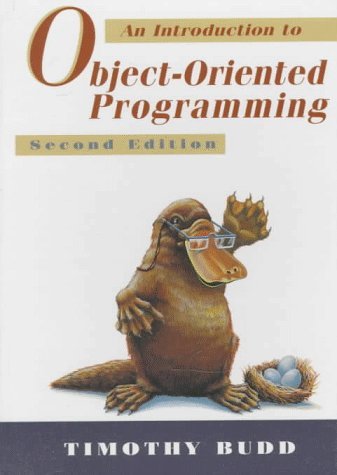
Discover the basic concepts of object-oriented programming and the elements of object-oriented design. Timothy Budd teaches objects, class methods, inheritance (including multiple inheritance), polymorphism and principles in a language-independent manner, with examples from five different C++, Delphi, Java, Objective-C, and Smalltalk.
As a geeky kid back in the late 70's I learned to program BASIC in the Italian Cuisine style - real spaggetti code. Man, I loved GOTO's. A whole maze of twisty little passages - or is that little twisting passsages? Moving on to university I learned Pascal, and procedural programing. I didn't continue programming after university, so that was as far as I got.
Jumping forward 20 years, I decided to take up programming again as a hobby. Things had rather moved on, to say the least. And whereas in many ways programming is easier today than it was back then, I struggled with the whole 'Object Oriented' concept. With this book I finally got it.
Budd starts from an assumption of having some understanding of programming, but starts from scratch with the whole OO concept. He covers basic OO terminology, and builds up from there. I find his style readable and friendly without being patronising (I'm looking at you, Heads First!), or skimping on technical details. It's well balanced in terms of information density, and the exercises helped me to retain the ideas and terminology. It also covers the 'why' as well as the 'how', which I needed, and seems to be glossed over in a number of other books. The order Budd covers the main points is also well thought out, laying down the foundations before covering more sdvanced ideas like inheritance and polymorhism.
The book is not language specific, which was really helpful - having code examples in multiple languages helped me to isolate the concept from the mechanics of implementation, while still demonstrating the code implementation.
Oh, and just in case you are wondering, there is a good reason he has a Duck-Billed Platypus on the cover. By the time I understand why, I was half way to my goal of understaining Object-Oriented Programming.
My overall impression is that this book was very boring. It's an okay overview of object-oriented features I supposed but the presentation annoyed me throughout the book. The way object-orientation was presented reminded me too much of the way I always saw it presented before learning about alternative computational models: as the modern model, contrasted almost exclusively with so called "traditional" programming languages (meaning procedural programming). Other alternative models such as the functional one are briefly mentioned in a few places, but never in a way that suggests that they offer alternative, at least equally flexible models to the object-oriented one. Object-orientation is again and again presented as the way to offer dynamic behavior. Keep in mind that this critique comes from someone who actually likes object-orientation very much, but hates to see it presented in such a simplistic fashion. Not only does the forced connection between dynamic, flexible programming styles and object-orientation diminish the alternative models, it also obstructs a proper description of what is unique to the object-oriented model: that precise way in which object-orientation enables dynamic behavior.
In any case, the mechanisms involved are described to some extent here, but always in a fashion that is a bit too shallow for my tastes. Maybe this is mainly the natural opinion of someone who has read a fair amount of more theoretically oriented literature on the subject of programming language theory and type systems recently and so, frowns upon the almost completely non-technical descriptions found in this book. Maybe the book is an okay introduction to object-oriented concepts for an audience that already has some familiarity with one or more object-oriented languages (or at the very least, one or more programming languages of some sort), but I found it to be boring and uninspiring and to be frank, not that well written. It does deserve three stars anyway I think, since my overall impression of it was something along the lines of: "this is alright I suppose".