Jump to ratings and reviews
Rate this book

How the Brain Got Language: The Mirror System Hypothesis

Rate this book
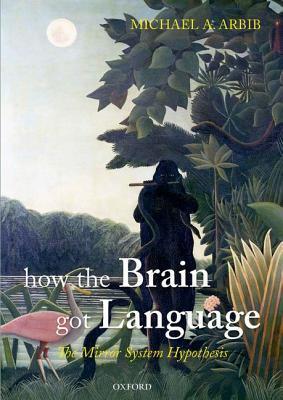
Unlike any other species, humans can learn and use language. This book explains how the brain evolved to make language possible, through what Michael Arbib calls the Mirror System Hypothesis. Because of mirror neurons, monkeys, chimps, and humans can learn by imitation, but only "complex imitation," which humans exhibit, is powerful enough to support the breakthrough to language. This theory provides a path from the openness of manual gesture, which we share with nonhuman primates, through the complex imitation of manual skills, pantomime, protosign (communication based on conventionalized manual gestures), and finally to protospeech. The theory explains why we humans are as capable of learning sign languages as we are of learning to speak. This fascinating book shows how cultural evolution took over from biological evolution for the transition from protolanguage to fully fledged languages. The author explains how the brain mechanisms that made the original emergence of languages
possible, perhaps 100,000 years ago, are still operative today in the way children acquire language, in the way that new sign languages have emerged in recent decades, and in the historical processes of language change on a time scale from decades to centuries. Though the subject is complex, this book is highly readable, providing all the necessary background in primatology, neuroscience, and linguistics to make the book accessible to a general audience.

432 pages, Hardcover

First published March 14, 2012

7 people are currently reading
101 people want to read

About the author

Michael A. Arbib

51 books16 followers
Michael A. Arbib is the Fletcher Jones Professor of Computer Science, as well as a Professor of Biological Sciences, Biomedical Engineering, Electrical Engineering, Neuroscience and Psychology at the University of Southern California.

Ratings & Reviews

What do you think?
Rate this book

Friends & Following

Create a free account to discover what your friends think of this book!

Community Reviews

5 stars
1 (8%)
4 stars
8 (66%)
3 stars
3 (25%)
2 stars
0 (0%)
1 star
0 (0%)
Displaying 1 - 4 of 4 reviews
Profile Image for Cell.
451 reviews31 followers
abandoned
February 27, 2022
我原本是想了解為什麼幼兒學語言的速度特別快
而在本書後面有涵蓋到這主題
只是我在大量的神經科學及語言學的詞彙中溺死了

這本書後續有出二版
這感覺不像是會暢銷的書啊
13 reviews1 follower
March 22, 2019
The origin of language will always be one of the most complicated questions related to the rise of human-specific consciousness. lots of accumulating data pools in a way that makes the phonological view of language a matter of a critical debate. Sign language gives new dimensions to the story undermining the status of stand-alone phonological explanation to the way humans developed their ways of communication.
It was a turning point in the history of biology when bipedalism dominated throughout the sapiens. The fact that the upper limbs are now free to do things not related to walking and running brought to them a whole new battery of choices. This should always be taken into consideration when the function of the upper limbs in general and the hands in specific are described with the hand grasp playing a key role in imitation and then communication.
Mirror neurons discovery was about having neurons being activated while doing the task or while seeing others executing the same task. Great enthusiasm followed and exaggeration in measuring the mirror neurons function and consequences resonated among neuroscientists to the limits that created a rebound myth busters in order to refine the way we should make use of that discovery.
However, Michael Arbib was quite aware of that and thus dissected his theory in a very organized and stepwise crescendo. To get his mission done, he creates a bunch of definitions (i.e: simple imitation, complex imitation, protolanguage…etc) to set his own stage as a true and competent rival of the widely recognized and adopted Chomskyan theory about our innate universal grammar. Success of Arbib’s theory if it ever happened in the future should owe his neuroscientific background a lot. Moreover, computational neuroscience was a robust lever arm that held his view very close to the clinical findings and observations. It is hard to continue accepting a mutant gene that was responsible for the linguistic explosion of humans without spotting it. And it is hard to continue talking about the grammar that is universal without defining what it really is. Arbib keeps an eye on semantics and its intimate relations with what is called constructionism in the way he describes the emergence of syntax paying attention to the contextual meaning of words with all the difference among languages in context dependance (Japanese as an example).
Several new brain facts and findings should be answered when we are on the verge of creating a satisfying theory about the origin of human language. F5 region in the macaque brain is so homologous to Broca’s area but F5 has nothing to do with phonation and it is the seat of a major part of the mirroring system inside the brain. You can’t help thinking about the resemblance between imitation and mirroring in general, and if communication is about sharing experience that once lived by the self or by thyselves then imitation would be a good starting point. Imitation is a plan of action that rebuilds the seen movement inside the body of the observer and language could have launched over based of that mutual exchange of body plans.
All the data extracted from neuroimagings in the deaf population who capitalize on sign language in their communication utterly shows that they use the same brain areas talking people use to fulfill the neuronal assemblies needed to make language. Moreover, sign languages proved to be competent at all levels of linguistic communication and they have their own syntax that is independent from the phonological and written counterparts. The historical narratives about Nicaraguan Sign Language (NSL) and Al-Sayyid Bedouin Sign Language (ABSL) are so rich and they provide us with a new conception of the matter of what language is really for humans.
Language is now all symbols extracting its legitimacy from the shared and common understanding of its elements , and the syntactic bounds between them that widen the semantic potentials of expression. It may all have arisen from the limited verse of imitation to the open-ended world of pantomime heading toward symbolization. Orofacial replacement was the final station in which language best fitted in accordance with the neuroeconomy principles. And when the respiratory tree took hold of the main step in language production, auditory brain areas started to be the main gait of acquiring language negating its original copy of pantomimic symbolization. However, when hearing is impaired language has no other way but to make that copy resurface again as a plan B.
Obviously, the main theme of the line of thoughts of Arbib’s way of thinking is really attracting and it sounds satisfying of the one of the greatest question about human mind yet to be answered.
Profile Image for Mission.
97 reviews5 followers
February 6, 2022

傳說中屬於「教授內戰」等級的科普書:你以為是寫給一般人看的,但看著看著你會開始懷疑自己跟「普通人」的智力差距。這本的主要是抗衡「普世語法」的存在,以及反駁「普世語法是生物性的,寫在遺傳資訊裡」,但不反對「目前只有人類擁有語言先備」的大腦。總之,就是一堆不熟悉的詞彙堆積出來的 ... 一樣是假說等級的論調。但!我必須說,即便艱困的閱讀著,這本書照樣帶給我許多啟發,我也比較能接受「語言的出現是由於生物、社會演化的結果、而不是目的」的想法

讀墨:http://moo.im/a/gCFGJQ

Profile Image for Kevin.
186 reviews16 followers
August 20, 2022
The view from a computer into the mind, with a critical side-view of Chomsky. Is syntax primal or primary? Arbib raises semantic to the level of syntax, making a case the meaningful is as essential as the structure that creates memories, syntax. Maybe meaning has hijacked the human mind, but that doesn't mean it requires parity with the great process of syntax. We know what meaning is, but syntax is a subtler tool, it has evolved, where meaning appears to have merely transitioned.
Displaying 1 - 4 of 4 reviews

Can't find what you're looking for?

Get help and learn more about the design.