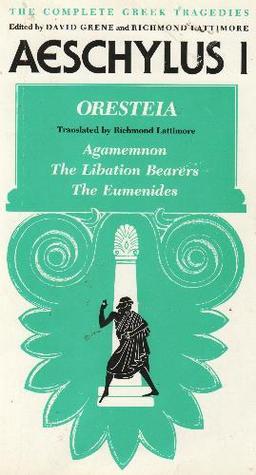
Hands down, easily one of my favorite books. It has everything one could ever want in a book.
Motif? Check. The webs and nets show how all the characters in the play are in a seemingly endless cycle of bloodshed, fury, entrapment, and deception. The fire is both a symbol of triumph and of destruction with the fall of Troy, but also violence returns (the fire arriving before the victor Agamemnon does to the house).
Gore and bloodshed? Check. The code of justice (prior to the establishment of the Athenian court) followed by the main characters and the Furies in the play is one of revenge, as the only way to cleanse an act of violence is through punishing the perpetrator with another act of violence, creating an endless cycle of bloodshed. According to our professor, such direct retribution was considered a moral obligation at the time. Whoever kills a family member, as the descendant, one must kill the murderer. Following this logic makes one wonder about the justification behind murders. IS Clydemnestra killing Agamemnon justified? Was Orestes justified? There is also historical mythology tied, related to the House of Atreus when the family's tragic cycle of violence began with Tantalus' sins and continued through generations. The characters acknowledge this themselves, "I tell you, the living are being killed by dead ones." How genius. On the surface, this sentence hints at Orestes' fake identity, claiming himself to be "dead" and killing Aegisthus as the "dead". However, one can also argue the "dead ones" point to the violence unleashed by the House of Atreus, despite the generations prior being dead, the violence still haunts the living like a curse.
Law and reflection on the wider world? Check. As someone interested in the legal field, the book shows how law is at its root about accountability. Justice in the play is redefined to end the blood cycle of revenge only after Athena rules that Orestes is innocent, where the Furies' purpose transforms from revenge to fairly governing the Athenians as the graceful (complete reversal of the definition of justice from revenge seen through the parallel from “bloodshed for bloodshed” to “grace for grace”). We see the transition from an old, chaotic system, to a legal, systematic framework, and really watch the emergence of justice in Ancient Greece unravel before us. Symbolic representation, but still incredibly well done.
Interaction with the crowd? Check. The play and all its drama simultaneously occur to both the audience and the characters. Instead of seeing the murder occur, the audience sees the palace doors open with Clytemnestra / Orestes over the bodies much like the rest of the kingdom would see it. Reminds me of Hedda Gabler with her pistol.
An actually nuanced discussion on gender (that was likely really ahead of his time)? Check. We see this at both the individual level and the societal level. For example, throughout the play, gender roles and attributes are explored through Clytemnestra’s character, especially at the beginning of Agamemnon. The elders acknowledge Clytemnestra’s power as a woman but remain skeptical of her words. Her defiance of patriarchal norms directly challenges the male-dominated order that defines Greek society: she kills her husband, defying one gender norm, supposedly out of a motherly instinct for revenge for her daughter, but also sends Orestes away from the kingdom, choosing power and lover over her son. On a more societal level, we see, from the court case, the shift from a female-first order to a male-first order, as Athena, a motherless goddess gains the upper hand from the Furies (daughters of the Night). While the Furies represent the priority placed on matriarchal lineage, Apollo and Athena represent the patriarchal view; which views Orestes as the son of Agamemnon before being the son of Clytemnestra, that views mothers as the vessel carrying the heritage of the men, not of “kindred blood.”
It is just a genius piece of work.