

What do you think?

Hans Huckebein, der Unglücksrabe / Fipps der Affe / Plisch und Plum
207 pages, Paperback
First published January 1, 1882
About the author
Wilhelm Busch
986 books47 followersHeinrich Christian Wilhelm Busch was an influential German caricaturist, painter, and poet who is famed for his satirical picture stories with rhymed texts.
After initially studying mechanical engineering and then art in Düsseldorf, Antwerp, and Munich, he turned to drawing caricatures. One of his first picture stories, Max and Moritz (published in 1865), was an immediate success and has achieved the status of a popular classic and perennial bestseller.
After initially studying mechanical engineering and then art in Düsseldorf, Antwerp, and Munich, he turned to drawing caricatures. One of his first picture stories, Max and Moritz (published in 1865), was an immediate success and has achieved the status of a popular classic and perennial bestseller.
Ratings & Reviews
Friends & Following
Create a free account to discover what your friends think of this book!
Community Reviews
Displaying 1 - 1 of 1 review

January 6, 2017
I read these three stories by Wilhelm Busch from the Kindle edition of his Collected Works (available for almost nothing on Amazon). The common theme is “bad behaving” animals.
__________
Hans Huckebein, the unlucky raven (1867/68) is the story of a young raven who got caught by Fritz. The boy carries the raven home to his aunt where the mischievous bird causes all kinds of havoc and even injures aunt and nephew and in the end .

Und dieser Fritz, wie alle Knaben,
Will einen Raben gerne haben.
[ And Fritz, like every other boy,
Would like a raven for a toy. ]
The story includes 48 drawings by the author like the one above each accompanied by two lines of rhymed text. As usual with Busch we find some onomatopoeia, for example Schnapp, Patsch, Perdums (I never heard the last one before). Like in modern comic strips the fur does fly here. Even blood splashes at some time, but only a little in the form of black dots like here from the aunt’s nose:
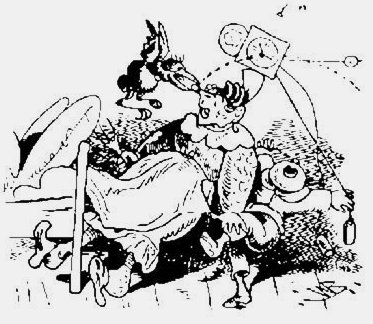
Denn – schnupp! – der Tante Nase faßt er;
Und nochmals triumphiert das Laster!
[ For – whack! – Aunt Lotte's nose he nails,
And wickedness once more prevails. ]
I quite liked this one. The drawings of the raven are incredible, especially the last ten or so.
[ translations by Gabriele Kahn, taken from here ]
__________
The second story, Fipps, the monkey (1879), is the longest of the three and includes 152 drawings and longer texts than in Huckebein. There’s a little foreword, like a concert overture, in which Fipps’s fate is already outlined:
Fipps – so wollen wir [das Kind] nennen. –
Aber wie er sich betrug,
Wenn wir ihn genauer kennen,
Ach, das ist betrübt genug.
Selten zeigt er sich beständig,
Einmal hilft er aus der Not;
Anfangs ist er recht lebendig,
Und am Schlusse ist er tot.
[ We would like to call the child Fipps. –
But how he behaved,
If we know him more closely,
Oh, that is sad enough.
Rarely does he show himself abiding,
Once he helps out of need;
At first he is quite alive,
And in the end he is dead.
I couldn’t find an English version, so I translated this myself – without rhymes, sorry. ]
After he escaped a capture by a black man in Africa who wanted to eat him, Fipps got tricked by a sea man who captures him and takes him to the city of Bremen. There the man sells the animal to a barber, and the first misdeed by Fipps is giving a farmer a special treatment in the barber shop during which one of the farmer’s ears comes in close contact with scissors and some hot curling irons – and again the blood comes gushing:

After some more encounters with several other people who all have to suffer from the monkey’s ideas of having a good time, Fipps finally is accepted into a family. But his escapades don’t end here, of course, especially if you consider the fact that there are also a dog and a cat who don’t like the new family member very much. But Fipps also has to suffer, and he is not always on the laughing side of the pranks. And, like the foreword says, Fipps dies in the end. It’s sort of sad actually.
Although I also liked this story there is one thing that made me wonder. In the first chapter the “black man from Africa” is depicted in text and picture in a way one can think Busch was a racist. Or maybe that is too harsh a word. In any case, prejudices are served here which I would not expect from an enlightened poet.
__________
The final story, Plish and Plum (1882), introduces two puppies who nearly got drowned by their evil owner in a pond. Luckily two brothers witnessed the incident and are able to rescue the dogs and bring them home.
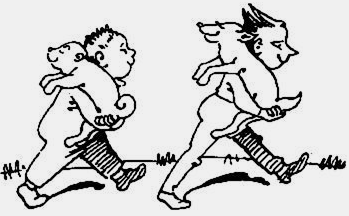
Und so tragen Paul und Peter
Ihre beiden kleinen Köter
Eilig, doch mit aller Schonung,
Hin zur elterlichen Wohnung.
[ Paul and Peter then with pleasure,
Tenderly took each his treasure,
And, with speed and joy past telling,
Steered for the parental dwelling. ]
There the puppies do what all puppies do when not being brought up right. They cause havoc.
It’s not as bad as in the previous stories (no blood is spilled this time), but nevertheless it’s bad:
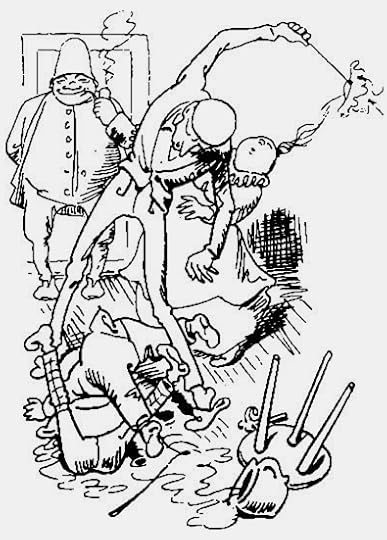
As you can see the whole family got involved here. The man in the background with the pipe is the original dog owner, the evil Mr. Schlich [Mr. Sly], who always watches from afar and makes a recurring comment like this:
»Ist fatal!« – bemerkte Schlich –
»Hehe! aber nicht für mich!«
[ “This is bad!” says Sly, “he! he!
Very bad, but not for me!” ]
As you can think this kind of comment won’t go unpunished. At the end of the story
This is also a very nice story except for chapter 5. In this chapter the two doggies fret a man and ruin parts of his clothing. Later the man threatens to sue the father if he does not pay for the damage. The man is introduced like this:
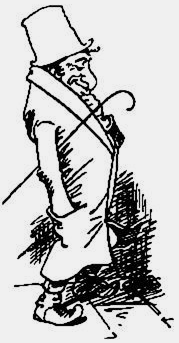
Kurz die Hose, lang der Rock,
Krumm die Nase und der Stock,
Augen schwarz und Seele grau,
Hut nach hinten, Miene schlau –
So ist Schmulchen Schievelbeiner.
(Schöner ist doch unsereiner!)
[ Breeches short and long surtout,
Crooked nose and cane to suit,
Gray of soul and black of eye,
Hat slouched back, expression sly—
Such is old Sol Shuffleshins;
How complacently he grins! ]
So the man is obviously a Jew, fulfilling the stereotypes of Jews at the late 19th century. According to Busch-biographer Joseph Kraus these words could have come just as well from an anti-Semite hate sheet and I tend to agree. I see no reason why Bush uses such an elaborate description of a man at this point in the story. It certainly sticks out. This doesn’t make Bush a Nazi of course. I think it’s hard to really judge people saying/writing things like these when you have the knowledge of the atrocities that will happen 50 years later. A bitter taste remains nonetheless.
[ translations by Charles T. Brooks, taken from here ]

This work is licensed under a Creative Commons Attribution-NonCommercial-ShareAlike 3.0 Unported License.
__________
Hans Huckebein, the unlucky raven (1867/68) is the story of a young raven who got caught by Fritz. The boy carries the raven home to his aunt where the mischievous bird causes all kinds of havoc and even injures aunt and nephew and in the end .

Und dieser Fritz, wie alle Knaben,
Will einen Raben gerne haben.
[ And Fritz, like every other boy,
Would like a raven for a toy. ]
The story includes 48 drawings by the author like the one above each accompanied by two lines of rhymed text. As usual with Busch we find some onomatopoeia, for example Schnapp, Patsch, Perdums (I never heard the last one before). Like in modern comic strips the fur does fly here. Even blood splashes at some time, but only a little in the form of black dots like here from the aunt’s nose:

Denn – schnupp! – der Tante Nase faßt er;
Und nochmals triumphiert das Laster!
[ For – whack! – Aunt Lotte's nose he nails,
And wickedness once more prevails. ]
I quite liked this one. The drawings of the raven are incredible, especially the last ten or so.
[ translations by Gabriele Kahn, taken from here ]
__________
The second story, Fipps, the monkey (1879), is the longest of the three and includes 152 drawings and longer texts than in Huckebein. There’s a little foreword, like a concert overture, in which Fipps’s fate is already outlined:
Fipps – so wollen wir [das Kind] nennen. –
Aber wie er sich betrug,
Wenn wir ihn genauer kennen,
Ach, das ist betrübt genug.
Selten zeigt er sich beständig,
Einmal hilft er aus der Not;
Anfangs ist er recht lebendig,
Und am Schlusse ist er tot.
[ We would like to call the child Fipps. –
But how he behaved,
If we know him more closely,
Oh, that is sad enough.
Rarely does he show himself abiding,
Once he helps out of need;
At first he is quite alive,
And in the end he is dead.
I couldn’t find an English version, so I translated this myself – without rhymes, sorry. ]
After he escaped a capture by a black man in Africa who wanted to eat him, Fipps got tricked by a sea man who captures him and takes him to the city of Bremen. There the man sells the animal to a barber, and the first misdeed by Fipps is giving a farmer a special treatment in the barber shop during which one of the farmer’s ears comes in close contact with scissors and some hot curling irons – and again the blood comes gushing:

After some more encounters with several other people who all have to suffer from the monkey’s ideas of having a good time, Fipps finally is accepted into a family. But his escapades don’t end here, of course, especially if you consider the fact that there are also a dog and a cat who don’t like the new family member very much. But Fipps also has to suffer, and he is not always on the laughing side of the pranks. And, like the foreword says, Fipps dies in the end. It’s sort of sad actually.
Although I also liked this story there is one thing that made me wonder. In the first chapter the “black man from Africa” is depicted in text and picture in a way one can think Busch was a racist. Or maybe that is too harsh a word. In any case, prejudices are served here which I would not expect from an enlightened poet.
__________
The final story, Plish and Plum (1882), introduces two puppies who nearly got drowned by their evil owner in a pond. Luckily two brothers witnessed the incident and are able to rescue the dogs and bring them home.

Und so tragen Paul und Peter
Ihre beiden kleinen Köter
Eilig, doch mit aller Schonung,
Hin zur elterlichen Wohnung.
[ Paul and Peter then with pleasure,
Tenderly took each his treasure,
And, with speed and joy past telling,
Steered for the parental dwelling. ]
There the puppies do what all puppies do when not being brought up right. They cause havoc.
It’s not as bad as in the previous stories (no blood is spilled this time), but nevertheless it’s bad:

As you can see the whole family got involved here. The man in the background with the pipe is the original dog owner, the evil Mr. Schlich [Mr. Sly], who always watches from afar and makes a recurring comment like this:
»Ist fatal!« – bemerkte Schlich –
»Hehe! aber nicht für mich!«
[ “This is bad!” says Sly, “he! he!
Very bad, but not for me!” ]
As you can think this kind of comment won’t go unpunished. At the end of the story
This is also a very nice story except for chapter 5. In this chapter the two doggies fret a man and ruin parts of his clothing. Later the man threatens to sue the father if he does not pay for the damage. The man is introduced like this:

Kurz die Hose, lang der Rock,
Krumm die Nase und der Stock,
Augen schwarz und Seele grau,
Hut nach hinten, Miene schlau –
So ist Schmulchen Schievelbeiner.
(Schöner ist doch unsereiner!)
[ Breeches short and long surtout,
Crooked nose and cane to suit,
Gray of soul and black of eye,
Hat slouched back, expression sly—
Such is old Sol Shuffleshins;
How complacently he grins! ]
So the man is obviously a Jew, fulfilling the stereotypes of Jews at the late 19th century. According to Busch-biographer Joseph Kraus these words could have come just as well from an anti-Semite hate sheet and I tend to agree. I see no reason why Bush uses such an elaborate description of a man at this point in the story. It certainly sticks out. This doesn’t make Bush a Nazi of course. I think it’s hard to really judge people saying/writing things like these when you have the knowledge of the atrocities that will happen 50 years later. A bitter taste remains nonetheless.
[ translations by Charles T. Brooks, taken from here ]
This work is licensed under a Creative Commons Attribution-NonCommercial-ShareAlike 3.0 Unported License.
Displaying 1 - 1 of 1 review