

What do you think?

Easter Egg Artists
Orson Abbott is a rabbit. His parents decorate Easter eggs. When the Abbotts go on vacation, they have lots of adventures. Orson likes decorating, but not as much as he likes to play. When a family wants their house decorated, Orson gets to do the high parts.
A pilot wants his plane to have designs, and Orson gets a free ride
When the townspeople ask the Abbotts to paint the town bridge, Orson decides he wants to do the whole thing by himself? It takes a lot of hard work, but Orson loves it and never gets tired.
A pilot wants his plane to have designs, and Orson gets a free ride
When the townspeople ask the Abbotts to paint the town bridge, Orson decides he wants to do the whole thing by himself? It takes a lot of hard work, but Orson loves it and never gets tired.
Unknown Binding
First published March 1, 1976
About the author
Adrienne Adams
72 books22 followersAdrienne Adams (February 10, 1906 - December 3, 2002) was a children's book illustrator. She won two Caldecott Honors (in 1960 and 1962) and in 1973 she was awarded the Rutgers Award for overall contributions to children’s literature. In 1977, she won a University of Southern Mississippi Medallion.
She was born in Fort Smith, Arkansas and grew up in Oklahoma She obtained a BA at Stephens College (who awarded her the Alumnae Achievement Award in 1964) then attended the University of Missouri and moved to New York in 1929 to study at the American School of Design and until 1949 she was a free-lance designer of displays, murals, textiles, greeting cards etc. She married children's book writer John Anderson in 1935 and in 1942 illustrated one of his books Bag of Smoke to begin her career as an illustrator becoming full-time in 1952. In total she illustrated more than 30 books, from contemporary authors such as Rumer Godden, Irwin Shapiro and Aileen Fisher to the fairy tales of Hans Christian Andersen and the Brothers Grimm.
She was born in Fort Smith, Arkansas and grew up in Oklahoma She obtained a BA at Stephens College (who awarded her the Alumnae Achievement Award in 1964) then attended the University of Missouri and moved to New York in 1929 to study at the American School of Design and until 1949 she was a free-lance designer of displays, murals, textiles, greeting cards etc. She married children's book writer John Anderson in 1935 and in 1942 illustrated one of his books Bag of Smoke to begin her career as an illustrator becoming full-time in 1952. In total she illustrated more than 30 books, from contemporary authors such as Rumer Godden, Irwin Shapiro and Aileen Fisher to the fairy tales of Hans Christian Andersen and the Brothers Grimm.
Ratings & Reviews
Friends & Following
Create a free account to discover what your friends think of this book!
Community Reviews
Displaying 1 - 30 of 58 reviews

February 9, 2020
4.5 stars. What gorgeous illustrations! This book is so beautiful to look through and has a wonderful storyline. A rabbit family with a love of decorating, paint just about everything you can think of with wonderful designs. Their busy time of year is Easter when their family business decorates and hides eggs. This is a perfect Easter read. I did wonder why these characters were rabbits and not hares which are the traditional deliverers of eggs but this is a wonderful book nonetheless.
Read on open library.
Read on open library.

April 9, 2010
Lovely, nostalgic illustrations and a fun story about a family of bunnies working together to paint Easter eggs (among other things) and a young bunny discovering his artistic talents and interests. I love the "family vibe" of this story and how much faith mother and father bunny have in their son and his ability to choose the right path for himself. A wonderful choice for Easter!

September 14, 2010
Wonderful illustrations! Charming story about a family of artists, who paint Easter eggs, their car, and a bunch of other things, some on commission, and they happen to be bunnies who live in a community of bunnies. What makes the story special is the development of young Orson, from a typical youngster with a short attention span to a passionate artist who becomes the star of his little family, and a child who finds his passion, which happens to be the family business of beautiful and creative painting.

October 24, 2018
The marvelously talented Adrienne Adams - an artist whose Halloween fare, from
A Woggle of Witches
to
A Halloween Happening
, is deliciously creepy - here turns her attention to the holiday of Easter, and the result is a picture-book that is sweetly adorable, without being at all cutesy or overdone. The story of the Abbotts - Father Abbott, Mother Abbott, and Orson Abbott - and the process whereby young Orson becomes passionately involved in his parents' calling as Easter Egg artists, was simply delightful, from the opening page - "There are Abbotts and there are Abbotts. These Abbotts are rabbits. The rabbit Abbotts make the designs on Easter eggs." - onward.
Not only was the narrative of The Easter Egg Artists involving, and likely to keep young readers entertained - children will be tickled at this story of a youngster who surpasses even his parents (and this despite their worries about him!) - but the gorgeous pastel artwork was just breathtaking. I've raved about Adams' work before, but I don't think I had hitherto fully appreciated the softer side of her work. This is just a charming book, in every respect, and one that I highly recommend to anyone looking for lighthearted (as opposed to religious) Easter stories, or who is a fan of the artist.
Not only was the narrative of The Easter Egg Artists involving, and likely to keep young readers entertained - children will be tickled at this story of a youngster who surpasses even his parents (and this despite their worries about him!) - but the gorgeous pastel artwork was just breathtaking. I've raved about Adams' work before, but I don't think I had hitherto fully appreciated the softer side of her work. This is just a charming book, in every respect, and one that I highly recommend to anyone looking for lighthearted (as opposed to religious) Easter stories, or who is a fan of the artist.

March 27, 2016
Aaaa! Too marvelous for words! These bunnies decorate EVERYTHING!
Just look at their car!
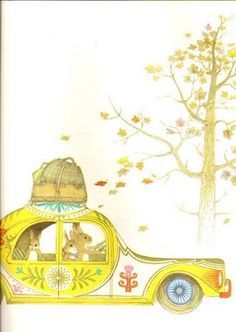
Aaaa!
I love this book!
Just look at their car!
Aaaa!
I love this book!

February 24, 2018
Here's an inspirational read to get out right before your family paints Easter eggs! Your eggs are bound to be more creative after this story.
Ages: 4 - 8
#easter #eastereggs
**Like my reviews? I also have hundreds of detailed reports that I offer too. These reports give a complete break-down of everything in the book, so you'll know just how clean it is or isn't. I also have Clean Guides (downloadable PDFs) which enable you to clean up your book before reading it! Visit my website: The Book Radar.
Ages: 4 - 8
#easter #eastereggs
**Like my reviews? I also have hundreds of detailed reports that I offer too. These reports give a complete break-down of everything in the book, so you'll know just how clean it is or isn't. I also have Clean Guides (downloadable PDFs) which enable you to clean up your book before reading it! Visit my website: The Book Radar.

April 9, 2017
This book is about Orson Abbott, who is a rabbit, and how he learns from his parents to paint beautiful Easter eggs. It was a longer book than Mom usually reads to me, but I loved seeing all of the things Orson painted and was pretty into it from start to finish.

February 7, 2019
When I was a young child, I had an Easter picture book that had an illustration that I loved. The illustration showed bunnies in an Easter egg factory, with eggs on conveyor belts (I think). I don’t know the title or the author, or what happened to it, but I’ve been searching for that book since I was a teen. It’s not The Country Bunny, though I had that one. It’s not The Golden Egg Book, though I remember that one, too. I thought this may have been it. It has beautiful illustrations, was published in the right timeframe, it’s an Easter book about bunnies painting eggs. But, alas, this is not the book I’m looking for.
Still, it’s a lovely book with a vaguely hippy-inspired plot, about a family of bunny artists who travel at random during the winter, looking for a warm place to camp and picking up odd jobs as they go until Easter approaches and it’s time to paint eggs, their one steady job a year. Maybe hippy isn’t the right word. But the bunny world is civilized, with houses and bridges and planes and cars to paint. Yet our bunny family is pretty free-spirited, traveling with no plan or destination. It just felt 1970s in spirit.
The bunny parents are hoping their son will join the family business, but he lacks focus. Oddly, despite being bunnies, they only have the one child. Everything works out, of course. The strength of this book is really in the charming and softly colorful illustrations.
Adams did write and illustrate another Easter book. Maybe that’s the one I’m searching for....
Still, it’s a lovely book with a vaguely hippy-inspired plot, about a family of bunny artists who travel at random during the winter, looking for a warm place to camp and picking up odd jobs as they go until Easter approaches and it’s time to paint eggs, their one steady job a year. Maybe hippy isn’t the right word. But the bunny world is civilized, with houses and bridges and planes and cars to paint. Yet our bunny family is pretty free-spirited, traveling with no plan or destination. It just felt 1970s in spirit.
The bunny parents are hoping their son will join the family business, but he lacks focus. Oddly, despite being bunnies, they only have the one child. Everything works out, of course. The strength of this book is really in the charming and softly colorful illustrations.
Adams did write and illustrate another Easter book. Maybe that’s the one I’m searching for....

March 25, 2013
This is a book from my childhood, so of course it's extra special. It's the story of a family of rabbits who have the fun job of painting Easter eggs. This year, their son will help them, but he doesn't show much interest in the task. But when they go on vacation and begin to get offers to paint other things (like a house, a plane, a bridge) he really gets into it! When they get home to start the task of painting the Easter eggs, they wonder if their son will be up for the challenge. Turns out he has a surprise in store for them.
The story is wonderful and the watercolor illustrations, so detailed and charming, make this a very special holiday story.
The story is wonderful and the watercolor illustrations, so detailed and charming, make this a very special holiday story.

March 25, 2016
Who knew that a family of rabbits - the Abbotts - were Easter egg artists? And that they had a lovely studio in which to work? Surprisingly, this couple had only one son, Orson, a pre-adolescent. The parents wonder if he'll ever settle down and learn to paint. Here we have a coming-of-age tale of a budding artist.
One double-page spread shows the three Abbotts, each carrying a flashlight, out at night hiding the eggs. That's unique.
One double-page spread shows the three Abbotts, each carrying a flashlight, out at night hiding the eggs. That's unique.
April 27, 2025
If there is one kids’ picture book that defined much of my childhood, it’s The Paintbrush Bunny (an alternate title for The Easter Egg Artists). Rereading it as an adult was amazing, as I realized how ingrained Adrienne Adams’ detailed, whimsical illustrations are into my memory. It’s a simple story without much conflict or symbolic themes, but that simplicity is what makes this book so very special.
Energetic and easily distracted young Orson Abbott is born into a family of Easter-egg-painting rabbits, but his parents worry that Orson will be unable to concentrate on his work enough to help them in the busy Easter season. The Abbotts take their annual trip south to avoid the cold winter, and Orson immediately shows an interest in tackling larger projects like the family car and trailer. Throughout the trip, Orson becomes more and more ambitious, creating intricate paintings on the family’s cottage, a local aviator’s plane, and even a town bridge, but upon returning home to the tedious task of Easter egg production, Orson discovers yet another special interest – painting comic Easter eggs for the local rabbits to enjoy.
Adrienne Adams’ illustrations are the real star of The Paintbrush Bunny — her sketches are of the loveliest pencil-and-watercolor quality, with exceptional detail and gorgeous pastel palettes. Every scene is a window into a tender, whimsical sort of Easter-themed world. The Abbott family is sketched with great simplicity and expressiveness, while the Hobbit-like designs painted by Orson throughout the book are incredibly intricate and colorful. I love the designs Adams creates for the Easter eggs (especially Orson’s comic ones!), as well as the plethora of art styles she incorporates to represent each rabbit. The world would certainly be a prettier place if people decorated their houses, cars, trailers, planes, bridges, flagpoles, etc. the way Orson decorates his.
The Paintbrush Bunny is a rare Easter-themed book, sort of in the vein of the Rankin-Bass television specials like Here Comes Peter Cottontail and The Easter Bunny Is Comin’ to Town. Adams’ worldbuilding is pretty unique, with a blend of realism (the Abbott family is migratory based on the seasonal weather) and magical realism (the Abbott family is a literal group of “Easter bunnies” who paint eggs and ship them out for the holiday). It’s unclear what exactly the extent of the worldbuilding is — the world seems to be populated entirely by anthropomorphic rabbits, who have managed to invent electricity, learn to fly planes, and institute a complex postal system — but Adams’ style is distinctly reminiscent of 1930s America, based on some of her technology designs. I know no one is asking these questions but me, but it’s fun for me to analyze.
The Paintbrush Bunny is also unique in that it does not teach an explicitly moral lesson. Orson Abbott, our protagonist, is an adorable little character whose main flaw is that he is still a child and therefore struggles to focus on his work when he would rather be playing. Orson is not portrayed as a bad kid just because he’s easily distracted; he simply takes on more responsibility as he gets more inspiration and encouragement. He finds his niche in tackling enormous projects that play directly into his skill set — climbing, jumping, flying, and being creative in how he uses color and humor. What I found especially insightful about Orson’s journey into professionalism is that he begins taking an interest in his work when others take an interest in his work. It’s a great lesson for adults as well as children: that people often just need a little recognition and appreciation for their work to get them inspired again. Adams emphasizes the excitement that comes with discovering your passion in life, as well as using your imagination and creativity in a way that inspires others.
The Paintbrush Bunny is a lovely tribute to the magic and beauty of springtime and Easter, but it’s especially wonderful for me because it’s brimming over with childhood nostalgia. It can even be educational — I learned the word “aerobatics” from this book! With the combination of stunning artwork and simple storytelling, Adams’ talent is on full display, especially as her own skill as an artist complements the subject matter.
Energetic and easily distracted young Orson Abbott is born into a family of Easter-egg-painting rabbits, but his parents worry that Orson will be unable to concentrate on his work enough to help them in the busy Easter season. The Abbotts take their annual trip south to avoid the cold winter, and Orson immediately shows an interest in tackling larger projects like the family car and trailer. Throughout the trip, Orson becomes more and more ambitious, creating intricate paintings on the family’s cottage, a local aviator’s plane, and even a town bridge, but upon returning home to the tedious task of Easter egg production, Orson discovers yet another special interest – painting comic Easter eggs for the local rabbits to enjoy.
Adrienne Adams’ illustrations are the real star of The Paintbrush Bunny — her sketches are of the loveliest pencil-and-watercolor quality, with exceptional detail and gorgeous pastel palettes. Every scene is a window into a tender, whimsical sort of Easter-themed world. The Abbott family is sketched with great simplicity and expressiveness, while the Hobbit-like designs painted by Orson throughout the book are incredibly intricate and colorful. I love the designs Adams creates for the Easter eggs (especially Orson’s comic ones!), as well as the plethora of art styles she incorporates to represent each rabbit. The world would certainly be a prettier place if people decorated their houses, cars, trailers, planes, bridges, flagpoles, etc. the way Orson decorates his.
The Paintbrush Bunny is a rare Easter-themed book, sort of in the vein of the Rankin-Bass television specials like Here Comes Peter Cottontail and The Easter Bunny Is Comin’ to Town. Adams’ worldbuilding is pretty unique, with a blend of realism (the Abbott family is migratory based on the seasonal weather) and magical realism (the Abbott family is a literal group of “Easter bunnies” who paint eggs and ship them out for the holiday). It’s unclear what exactly the extent of the worldbuilding is — the world seems to be populated entirely by anthropomorphic rabbits, who have managed to invent electricity, learn to fly planes, and institute a complex postal system — but Adams’ style is distinctly reminiscent of 1930s America, based on some of her technology designs. I know no one is asking these questions but me, but it’s fun for me to analyze.
The Paintbrush Bunny is also unique in that it does not teach an explicitly moral lesson. Orson Abbott, our protagonist, is an adorable little character whose main flaw is that he is still a child and therefore struggles to focus on his work when he would rather be playing. Orson is not portrayed as a bad kid just because he’s easily distracted; he simply takes on more responsibility as he gets more inspiration and encouragement. He finds his niche in tackling enormous projects that play directly into his skill set — climbing, jumping, flying, and being creative in how he uses color and humor. What I found especially insightful about Orson’s journey into professionalism is that he begins taking an interest in his work when others take an interest in his work. It’s a great lesson for adults as well as children: that people often just need a little recognition and appreciation for their work to get them inspired again. Adams emphasizes the excitement that comes with discovering your passion in life, as well as using your imagination and creativity in a way that inspires others.
The Paintbrush Bunny is a lovely tribute to the magic and beauty of springtime and Easter, but it’s especially wonderful for me because it’s brimming over with childhood nostalgia. It can even be educational — I learned the word “aerobatics” from this book! With the combination of stunning artwork and simple storytelling, Adams’ talent is on full display, especially as her own skill as an artist complements the subject matter.
May 2, 2022
This is by far the nicest Easter book for young children I have yet seen. The art work is exquisite and the rabbit family charmingly happy. The story is simple; we see the rabbits painting their car, a biplane (top and bottom, please—I do acrobatics), a house, and lots and lots of Easter eggs.
I originally picked it, because the rabbits are artists. In other stories, parents (if they have a visible occupation at all) are office workers or tradesmen. They’re never painters, or musicians, or poets. This book rights the balance and teaches young rabbits, I mean children, that work isn’t just some boring thing that takes grown-ups away from their family: it has a value and provides income. Young Orson Rabbit’s comic Easter eggs sell like hot cakes!
I originally picked it, because the rabbits are artists. In other stories, parents (if they have a visible occupation at all) are office workers or tradesmen. They’re never painters, or musicians, or poets. This book rights the balance and teaches young rabbits, I mean children, that work isn’t just some boring thing that takes grown-ups away from their family: it has a value and provides income. Young Orson Rabbit’s comic Easter eggs sell like hot cakes!
January 2, 2018
This is a lovely, nostalgic, immersive book with stunning pastel illustrations. I most love that it's the story of a young rabbit growing up, and the love and trust his parents place in their child's journey to adulthood. It's about family, growing up, and the creative spirit. The illustrations wonderful and evocative. We picked this one up in the thrift store but it's become a favorite.

May 30, 2018
This is one from my early childhood that I recently sought out again. It’s an Easter story but only in the rabbits-and-painted-eggs sense. It’s quite wordy, but an enjoyable story, and the illustrations are to die for. Makes me wonder if this is why I paint the way I do... I know I was very very young when my mom found this book for me at the library!

April 7, 2023
The Abbots are rabbits who have a well established family business of painting designs on Easter Eggs. Orson, the son in the family wanted to be an artist also, but his father didn't think Oscar had the attention span to focus on the work before him. During a family vacation, Oscar surprised both his mother and father with his skills of artistry.

December 15, 2017
In my top 3 for favorite Christmas books to reach each year.

April 2, 2018
This is a fun book to tell young children around Easter time to show them a fun reason why people dye/paint Easter eggs.
Six +1Traits: Sentence Fluency
DRA Level: 36
Lexile: 650L
Six +1Traits: Sentence Fluency
DRA Level: 36
Lexile: 650L

April 5, 2019
I enjoyed the story and the illustrations are gorgeous!!
April 6, 2019
The Abbott's are Easter egg artists. But they paint EVERYTHING!
The Easter Egg Artists is a fun holiday book with colorful yet soft illustrations.
The Easter Egg Artists is a fun holiday book with colorful yet soft illustrations.

April 25, 2019
Simply lovely illustrations!!

April 6, 2020
Reading it for pleasure, I get to devour the illustrations, pastel and sweet. Loved the cute bunny story about the artists.

March 29, 2021
Delightful and artful book.

April 11, 2022
My son loved this book, but I felt the story missed the mark.

April 23, 2023
The illustrations are lovely. This is a nice story with the moral of letting your children grow into their work ethic. It's a sweet holiday adventure.
March 6, 2025
A darling story about a rabbit family, the Abbott’s, father, mother, and son. They travel for the winter and do a lot of painting along the way.

December 21, 2025
Orson was just the sweetest and most innovative little rabbit dude.

April 29, 2014
This story of anthropomorphic rabbits doesn't totally make sense but the pictures are quite cute. I found that little things bothered me somewhat, such as them visibly not wearing seat belts as the go on a trip, even though the dad says "Fasten your seat belt" to his son. Also, him nonchalantly painting from the house's roof without any protection, or hopping on top of the well in the dark, etc ... but I don't know why I should be getting upset about that, they're rabbits after all.

April 3, 2009
This is a nice story about a family of bunnies who paint easter eggs in season and travel south at other times, painting portraits on the beach or houses, planes, bridges, etc. Their son wants to join in, but is he mature enough? The illustrations are fun and colorful and the story is a sweet one about growing up.
January 15, 2013
The illustrations were nice. The plot was so so. It seems like the little rabbit, Orson, is going to go off and do his own thing, but he becomes an artist like his parents, except he paints many things besides (but including) Easter eggs. Probably should weed this book from the library once I have a few more Easter books.

January 16, 2016
A mother and father bunny are in charge of painting Easter eggs. They worry that their son will not be able to do the hard work of the job. So before the Easter egg rush, they go off together on a trip. Along the way, their son proves his mettle and shows himself to be a promising Easter egg artist.
Lovely illustrations.
Lovely illustrations.
Displaying 1 - 30 of 58 reviews