

What do you think?
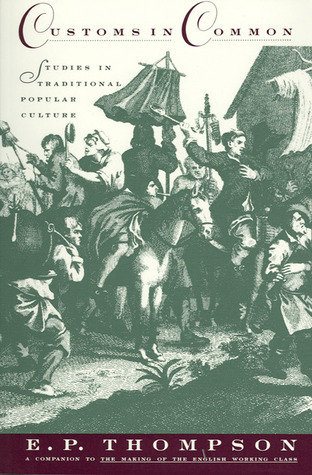
Customs in Common: Studies in Traditional Popular Culture
The “meticulously researched, elegantly argued and deeply humane” sequel to the landmark volume of social history, The Making of the English Working Class ( The New York Times Book Review ).
This remarkable study investigates the gradual disappearance of a range of cultural customs against the backdrop of the great upheavals of the eighteenth century. As villagers were subjected to a legal system increasingly hostile to custom, they tried both to resist and to preserve tradition, becoming, as E. P. Thompson explains, “rebellious, but rebellious in defense of custom.” Although some historians have written of riotous peasants of England and Wales as if they were mainly a problem for magistrates and governments, for Thompson it is the rulers, landowners, and governments who were a problem for the people, whose exuberant culture preceded the formation of working-class institutions and consciousness.
Essential reading for all those intrigued by English history, Customs in Common has a special relevance today, as traditional economies are being replaced by market economies throughout the world. The rich scholarship and depth of insight in Thompson’s work offer many clues to understanding contemporary changes around the globe.
“[This] long-awaited collection . . . is a signal contribution . . . [from] the person most responsible for inspiring the revival of American labor history during the past thirty years.” ― The Nation
“This book signals the return to historical writing of one of the most eloquent, powerful and independent voices of our time. At his best he is capable of a passionate, sardonic eloquence which is unequalled.” ― The Observer
This remarkable study investigates the gradual disappearance of a range of cultural customs against the backdrop of the great upheavals of the eighteenth century. As villagers were subjected to a legal system increasingly hostile to custom, they tried both to resist and to preserve tradition, becoming, as E. P. Thompson explains, “rebellious, but rebellious in defense of custom.” Although some historians have written of riotous peasants of England and Wales as if they were mainly a problem for magistrates and governments, for Thompson it is the rulers, landowners, and governments who were a problem for the people, whose exuberant culture preceded the formation of working-class institutions and consciousness.
Essential reading for all those intrigued by English history, Customs in Common has a special relevance today, as traditional economies are being replaced by market economies throughout the world. The rich scholarship and depth of insight in Thompson’s work offer many clues to understanding contemporary changes around the globe.
“[This] long-awaited collection . . . is a signal contribution . . . [from] the person most responsible for inspiring the revival of American labor history during the past thirty years.” ― The Nation
“This book signals the return to historical writing of one of the most eloquent, powerful and independent voices of our time. At his best he is capable of a passionate, sardonic eloquence which is unequalled.” ― The Observer
560 pages, Paperback
First published January 1, 1980
About the author
E.P. Thompson
84 books237 followersEdward Palmer Thompson was an English historian, writer, marxist and peace campaigner. He is probably best known today for his historical work on the radical movements in the late 18th and early 19th centuries, in particular The Making of the English Working Class (1963). He also published influential biographies of William Morris (1955) and (posthumously) William Blake (1993) and was a prolific journalist and essayist. He also published the novel The Sykaos Papers and a collection of poetry.
Thompson was one of the principal intellectuals of the Communist Party in Great Britain. Although he left the party in 1956 over the Soviet invasion of Hungary, he nevertheless remained a "historian in the Marxist tradition," calling for a rebellion against Stalinism as a prerequisite for the restoration of communists' "confidence in our own revolutionary perspectives". Thompson played a key role in the first New Left in Britain in the late 1950s. He was a vociferous left-wing socialist critic of the Labour governments of 1964–70 and 1974–79, and during the 1980s, he was the leading intellectual light of the movement against nuclear weapons in Europe.
Thompson was one of the principal intellectuals of the Communist Party in Great Britain. Although he left the party in 1956 over the Soviet invasion of Hungary, he nevertheless remained a "historian in the Marxist tradition," calling for a rebellion against Stalinism as a prerequisite for the restoration of communists' "confidence in our own revolutionary perspectives". Thompson played a key role in the first New Left in Britain in the late 1950s. He was a vociferous left-wing socialist critic of the Labour governments of 1964–70 and 1974–79, and during the 1980s, he was the leading intellectual light of the movement against nuclear weapons in Europe.
Ratings & Reviews
Friends & Following
Create a free account to discover what your friends think of this book!
Community Reviews
Displaying 1 - 16 of 16 reviews

May 1, 2024
adam smith slander alllllllll day long

November 18, 2013
The question of the commons is one of the most important political and social projects for us right now. Leftists romanticize them and capitalists call them a tragedy.
This book shows the way they functioned to give average people dignity and security -- within limits. Read this book so that when you talk about the commons you don't say something stupid.
This book shows the way they functioned to give average people dignity and security -- within limits. Read this book so that when you talk about the commons you don't say something stupid.
Read
October 28, 2024Seeing history at the moment of transition to a society organised around the reproduction of capital throws industrial society into sharper relief.
Intellectually its easy to abstractly understand that life according to Adam Smith is a historically contingent mode of organising society, but when placed in direct contrast to previous forms of society (directly interpersonal patrician/plebeian structure with reciprocal rights and obligations) I found it genuinely difficult to comprehend. You don’t realise how deep political economy has burrowed into your brain until you try to recognise the concrete differences in ways of living.
In all the essays Thompson seems to be implicitly playing with the concept of hegemony to understand traditions, repertoires of collective action, reciprocal rights/obligations, ‘the rules of the game’. I think this does work but possibly at the expense of a more historically specific understanding of the concept. So is hegemony transhistorical? Is the concept useful before a separate sphere of ‘civil society’ really embeds itself? Seems to raise lots of theoretical questions while also providing satisfying answers to historical ones.
The time and work discipline essay is still an all time classic.
Intellectually its easy to abstractly understand that life according to Adam Smith is a historically contingent mode of organising society, but when placed in direct contrast to previous forms of society (directly interpersonal patrician/plebeian structure with reciprocal rights and obligations) I found it genuinely difficult to comprehend. You don’t realise how deep political economy has burrowed into your brain until you try to recognise the concrete differences in ways of living.
In all the essays Thompson seems to be implicitly playing with the concept of hegemony to understand traditions, repertoires of collective action, reciprocal rights/obligations, ‘the rules of the game’. I think this does work but possibly at the expense of a more historically specific understanding of the concept. So is hegemony transhistorical? Is the concept useful before a separate sphere of ‘civil society’ really embeds itself? Seems to raise lots of theoretical questions while also providing satisfying answers to historical ones.
The time and work discipline essay is still an all time classic.

November 20, 2021
EP Thompson's works are a huge favorite of mine. His historical research, methodology and writing style continues to inspire even today. In Customs in Common, Thompson studies the complexities of relations between the plebian and patrician groups in late 18th century Britain, and within this cultural domain, he explores the political complexities of subsistence moral economy of the peasants in a pre-industrial society. In addition, he also has written on plebian rituals and rites in the forms of rough music and wife sales, and offers an insightful look on these pubic spectacles which despite their ambiguous mythic origins, offered a symbolic vocabulary through which customs and norms were both challenged and reinforced. Of course, the most classic essay is probably the one that studies how time and clock keeping became tyrannical means through which the 'undisciplined' pre-industrial workers were slowly transformed into factory wage workers suitable for the demands of the newly rising industrial capitalist system in the nineteenth century. I think my only grievance with the book is Thompson's obsession with discrediting female scholars of gender history, as being too obsessed with seeing only patriarchy and oppression of women in their historical studies. Though I am myself not familiar with the works of feminist scholars that he consulted, I doubt they would have resorted to such monolithic assumptions. The relevance of gender history and any other subaltern history has been to make visible presence of those of whom early history considered unworthy, and to acknowledge their significance in formation of current social categories and relations of race, gender and caste. So for Thompson to take offence of criticism by feminist scholars over his wife sale essay seems a little petty. In fact, I would venture that some of his arguments regarding the patriarchal content of rough music and wife sale are not at all novel and can be easily gleaned with sufficient data. Nevertheless, he is one of true greats of history for me. His work has inspired me to work harder on my sources and think more critically but with some heart and purpose. And his work on the English working class in the 18th and 19th century remains a seminal work. A must read for any aspiring historian.
This entire review has been hidden because of spoilers.

December 28, 2008
E.P. Thompson, a scholar-activist, may be one of the most underestimated figures of the twentieth century. He certainly played a far greater role in ending the Cold War than anyone in Washington, while at the same working as a historian to bring to light the “common” people of his own national past. If part of your heritage is from England, you owe yourself a look at his work, especially if you think of your ancestors as particularly rational, orderly, and unsuperstitious.
May 9, 2026
A great book for the reasons noted in the introduction and in other reviews. It is a compilation of long essays on various topics, not a unified book, but they are key topics and one can gain a clear understanding of the late 18th century forced shift from a custom-based society in which ordinary people had at least some say, to a market-based society.
One can also gain a clear understanding of how to do and how to write history. No one else has had Thompson's mastery of the archives and therefore of the particular and of the
human, as well as his ability to synthesize, to draw theoretical models from the particular and the general, and also to write clearly and well.
The field of history has recently (like other academic disciplines) become mere vehicles of individual scholars' aggrandizement or playgrounds of theory. This book shows it needn't be so.
One can also gain a clear understanding of how to do and how to write history. No one else has had Thompson's mastery of the archives and therefore of the particular and of the
human, as well as his ability to synthesize, to draw theoretical models from the particular and the general, and also to write clearly and well.
The field of history has recently (like other academic disciplines) become mere vehicles of individual scholars' aggrandizement or playgrounds of theory. This book shows it needn't be so.

February 23, 2020
从经济、历史、道德、民俗等角度观察讨论十八、十九世纪平民习惯(customs)的几篇论文(翻译得略干涩了点),关于乡绅(gentry)与贫穷劳动者(the labouring poor)之间的关系(家长制、父权和“文化霸权)、这一时期认知文化在对时间的理解上经历的变化(从“按传统,星期一或星期二手织机会与缓缓的‘时间很充裕,时间很充裕’的赞美诗为伴,星期四和星期五的赞美诗是‘还有一天,还有一天’”到关注对雇工耕作时间的有效利用),和“买卖妻子”(“曾有助于激发道德说教雄辩术的训练)几篇相对最好读(约等于外行人觉得更有趣)。

December 2, 2020
Much more clearly structured and mature than the piece to which it was intended as companion.
February 9, 2023
Unbelievably interesting. Very readable.

April 9, 2008
E.P. Thompson is a joy to read; he writes so well and is always able to stick something witty in with what he's trying to explain. This book is a compliation of many of his essays, including "Patricians and the Plebs," "The Moral Economy of the English Crowd in the Eighteenth Century," and "The Sale of Wives!"

July 7, 2011
Interesting look at the commons and customs of the people who lived on the commons and were slowly pushed off them. really obscure at times--things i've never heard of--but also very interesting. I feel that the writing was academic and dry at times, but still thought provoking with copious research. Wanna know more about the commons? I recommend.

December 11, 2010
Invaluable book for understanding both the plebeian culture surrounding the Enclosure and the process of writing historiography.

January 22, 2015
It's amazing how history reads when you actually think of people as people.

September 12, 2016
Love this book

November 17, 2016
The cruelty of traditional working class culture sensitively portrayed and analysed by the great historian.

April 24, 2020
My favourite book by one of my favourite historians. Filled with gems.
Displaying 1 - 16 of 16 reviews