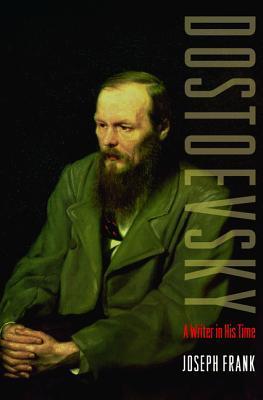
For as long as I can remember, I’ve regarded reading as a powerful gift. As an aspiring author myself, I will always stand in awe of the remarkable impact that books can make on those who read them. I can wholeheartedly say that Joseph Frank’s “Dostoyevsky: A Writer in His Time” is one of those works I will never forget. If you follow me on Goodreads, or Facebook, or Tumblr, or if you know me personally, you’ve probably heard this before: Dostoyevsky is my favorite author, and one of a very few influences who I can say without doubt has changed my life. Thus, reading Frank’s account of Dostoyevsky’s life and works was extremely enticing to me, especially as the biography comes with such esteemed acclamations.
I honestly don’t even know where to start in my humble attempt to recapture some of the impact Frank’s work produced on me. This is, to date, the longest book I have ever read (a hefty tome of 959 pages in paperback) and it’s been my companion since last January. It has seen me through the triumphs and tribulations of my first year of college. It has witnessed my frantic consultation of its pages for help in citing facts about Dostoyevsky for my emotional final paper on “The Brothers Karamazov” (for which I have also written a Goodreads review, if you would like to share in my gushing over that novel!). It has seen me defend, time and again, my reasons for choosing Dostoyevsky as a favorite author, and my agreement with him, despite what some call naivety, that people, after all things, are inherently good. (In his short story, “The Dream of a Ridiculous Man”, Dostoyevsky asserts, “I will not and cannot believe that evil is the normal condition among men. And yet they all laugh at this faith of mine. But how can I help believing it?”) And Frank’s biography has played its part in my choice to major in Russian Language and Literature. It may sound silly, but I really do think that “companion” is the best word to describe the relationship that I now have with this massive volume, which I have toted with me through ups and downs and changes now for more than half a year.
Frank’s “Dostoyevsky” is a condensation of his famous five- volume set detailing the Russian author’s life. Nonetheless, this “short” version cannot be found wanting in its meticulous—and arguably unrivaled—depiction of Dostoyevsky and all that he stood for. Though this work is, of course, non-fiction, it often reads like a novel, and I found myself thoroughly engrossed in its pages. Frank opens with Dostoyevsky’s childhood, and it is endearing to read of the little boy who protected his schoolmates from bullies, a touching detail that I think has quite a bit to say about Dostoyevsky’s character and who he would become.
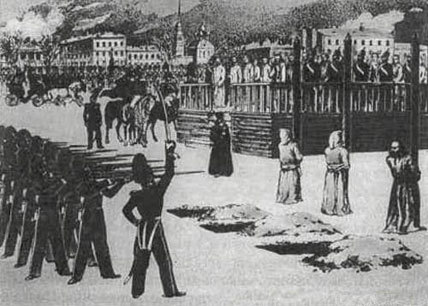
Indeed, while the aforementioned detail may seem trivial out of context, it becomes truly profound when one begins to understand the later events of Dostoyevsky’s life. In the 1840s, the young Dostoyevsky was accused of political subversion—for supporting the freedom of the press—and he was sentenced to four years in a Siberian prison. However, this “lighter” sentence came only after Dostoyevsky and his fellow prisoners were subjected to a “mock execution”; they stood before a firing squad, and were only “saved” at the last moment. Frank unflinchingly illustrates the harrowing experience, and one must respect Dostoyevsky, if for no other reason than fortitude in surviving this horror with his sanity intact. The next four years, during the great novelist’s time in prison, can only be adequately fathomed by reading Dostoyevsky’s haunting semi-autobiographical novel, “The House of the Dead”. Many have speculated about Dostoyevsky’s years in Siberia, including Leonid Tsypkin, in his novel “Summer in Baden-Baden” (which I have also reviewed). Tsypkin believed that Dostoyevsky was flogged while in prison, and while we may never know for certain whether this is true, the awful possibility is entirely plausible. What we can say for sure constitutes one of my principal reasons for caring so deeply about Dostoyevsky: it was only through his suffering in Siberia that he began to regard his fellow prisoners as human beings who had erred but could be redeemed. (Let it be noted that, while Dostoyevsky was a political prisoner, many of the convicts he lived with had committed violent crimes, and some had murdered multiple people). Dostoyevsky’s ordeal in prison arguably became the trial by which he could become an author truly capable of seeing the souls in all people. Frank marvelously sums up Dostoyevsky’s convictions: “Dostoyevsky believed that since man… was capable of remorse and repentance, the hope of his redemption should never be abandoned” (357).
As can well be expected, memories of his prison years would haunt Dostoyevsky for the rest of his life, and I applaud Frank for not overlooking this issue. Many people are quick to label Dostoyevsky as rude or arrogant because of his occasional losses of temper over seemingly-trivial issues. Such a judgment, in my opinion, disregards and belittles the traumatic experiences Dostoyevsky endured. While his cruel words were clearly in the wrong, they were likely the manifestations of deep psychological scars which never healed, and which, in the 19th century, were also never fully understood. One of the most unforgettable scenes from Frank’s biography, related through the words of E.P. Letkova-Sultanova’s memoir, comes to mind:
“Dostoyevsky’s words came tumbling out in a stream of spasmodic sentences. He evoked the freezing coldness of the morning [of the mock execution], and the horror that overcame [the prisoners] as they heard the death sentence being pronounced. ‘It could not be that I, amidst all the other thousands who were alive—in something like five to six minutes would no longer exist!’… Polonsky (the host of the gathering Letkova-Sultanova describes) approached [Dostoyevsky] to break the tension and said consolingly, ‘Well, all this is past and gone,’ inviting him to drink tea with their hostess. ‘Is it really gone?’ Dostoyevsky whispered” (780).
Throughout this masterful work, I admired Frank’s ability to powerfully address various controversial issues from which others would shy away. He does this in describing Dostoyevsky’s own prejudices (most often against Jewish people), assessing them in their 19th century context, when such views were commonplace, without excusing them. Frank also, in describing Dostoyevsky’s epilepsy (from which he suffered seizures about once a month), touches on cultural stigmas which continue to surround the disease even today. Offended by the portrayal of radicals in Dostoyevsky’s novel “Demons”, many protested that the writer’s characters were too psychologically damaged to be taken seriously. And, Frank adds, many were inclined to view Dostoyevsky in the same manner because he suffered from epilepsy. Dostoyevsky’s contemporary Ivan Turgenev is known to have held this opinion as well. Frank skillfully weaves this context into his analysis of Dostoyevsky, and his words carry connotations about the instinctive human fear of that which we do not understand. This thought echoes Dostoyevsky’s own beliefs in his short story, “A Gentle Creature”, in which the inability to understand one another leads his characters to disaster. Certainly a sobering thought in today’s war-ravaged, isolation-based world as well.
Of course, I couldn’t finish this review without discussing Anna Snitkina, Dostoyevsky’s second wife (after the death of his first, Marya Isaeva, in 1864 from Tuberculosis). Anna is one of my favorite historical ladies, and often doesn’t receive the respect she deserves. In fact, my one point of contention with Frank arises over this very issue. He, like many others, describes Anna as submissive to her husband’s will. On the contrary, she was a fascinating and complex person. First of all, Anna attended a women’s college (Yay, women’s colleges! Can you tell I go to a women’s college?), which was remarkable in her time because higher education for women was still relatively unheard of. She met Dostoyevsky through his hiring her as a stenographer to help him finish the manuscript for “The Gambler”. Having an independent means of earning money was also revolutionary for a woman in 19th century Russia.
The two eventually fell in love and were married, living abroad for several years afterward. Though Anna was perhaps naïve at first, unwittingly enabling her husband’s gambling addiction by lending him money and unfailingly forgiving him for losing it, she quickly matured into a powerful woman in her own right. It was Anna who negotiated (behind her husband’s back at first) with creditors who sought to put Dostoyevsky in debtors’ prison and exposed their corruption. It was Anna who went out alone into a dangerous city (also without Dostoyevsky’s permission) to rescue a lost suitcase which contained an extremely important manuscript of her husband’s. And, overall, it is quite valid to assert that it was Anna who is responsible for making Dostoyevsky the great writer the world knows today, as she eventually took over the family’s finances and organized their own publishing business. One has only to read her remarkable “Reminiscences” to appreciate how smart, capable, and compassionate a soul Anna Dostoyevskaya was.
The Dostoyevskys’ marriage, while having undergone many strains in the beginning (Dostoyevsky’s gambling addiction and resulting debt, as well as the horrific tragedy of losing their first daughter, Sonya), grew into a relationship of deep love and mutual respect. It should be known that Fyodor put aside his own crippling grief to take care of Anna when she was shattered after the loss of Sonya. He battled some of his greatest demons for her, eventually giving up gambling after their second daughter, Lyubov, was born. Frank portrays Anna and Fyodor’s love with exceptional skill (and several very entertaining excerpts from their rather “suggestive” letters to each other!). It seems no test could break their devotion, and that no force could destroy their unfailing optimism. In the heartbreaking end, Anna holds her husband’s hand as he dies, and he still manages to console her, beseeching her not to worry. Anna is later said to have exclaimed, “Oh, whom have I lost!” (926) and the reader cannot help but feel the power of the additional words, uttered by Dostoyevsky’s lifelong friend, Appollon Maikov: “whom has Russia lost?” (926).
In the final pages of this monumental work, Frank astutely notes that, in the end, Dostoyevsky achieved his ideal of bringing Russia together. Indeed, the unprecedented crowds attending his funeral transcended the divides of class, gender, religion and politics to pay tribute to the man Russians call prophet. I can say for certain that Frank’s remarkable account of Dostoyevsky’s life will remain with me for years to come, as it has helped me gain a greater understanding of the author whose works have shaped the person I have become. I first encountered Dostoyevsky’s novels during a very dark time in my life, from which I had begun to doubt I would ever heal. But Dostoyevsky, through his immortal words and his own life’s example, taught me that the power of compassion and love outweighs the power of negativity. It was he, after all, who said that “compassion is the chief law of human existence”, and, conversely, that “Hell… is the suffering of being unable to love”. We can all learn from Dostoyevsky’s example; once a falsely-imprisoned convict who thought his life would never amount to anything, Dostoyevsky became perhaps the greatest writer to live. As Frank writes, “There is never a moment in Dostoyevsky’s life when we can catch him giving up entirely” (445). And because of him, I didn’t give up. Critics throughout history have remarked that Dostoyevsky’s words have changed the world, but for me, it will always be enough that they changed my life.