

What do you think?
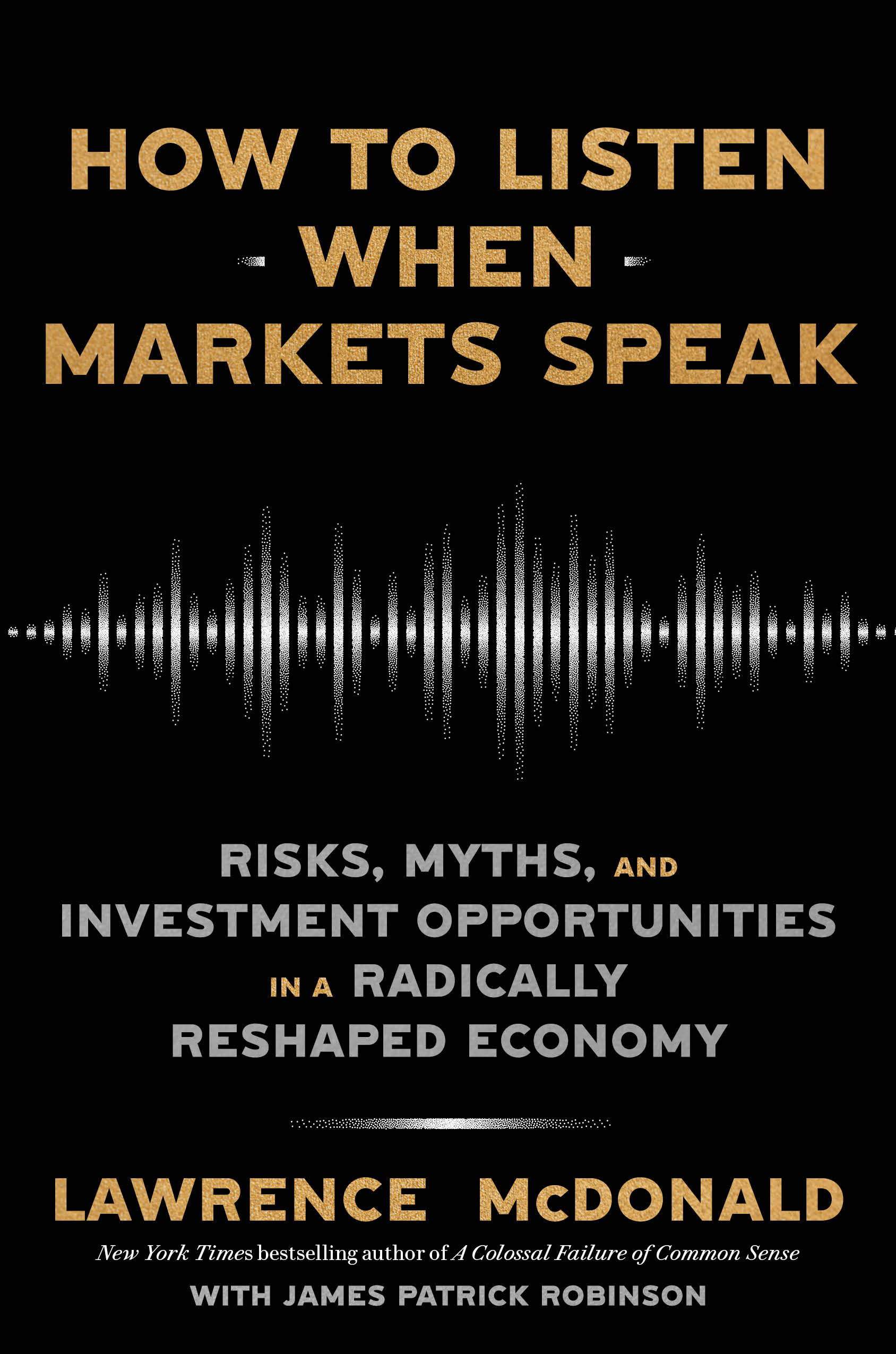
How to Listen When Markets Speak: Risks, Myths, and Investment Opportunities in a Radically Reshaped Economy
A New York Times bestselling author and leading expert on market risk argues that seismic shifts in the global economy will trigger a multi-trillion-dollar migration of wealth, tracing the fateful decisions that created this crisis—and outlines new rules of investing for the forward-thinking.
From Wall Street to the White House, the fantasy of an eventual “return to normal” is still alive and well. But an unprecedented era of easy money—nurtured by disastrous policy decisions and artificial disinflationary forces—is coming to a screeching halt. We’re about to witness a new era defined by sustained inflation, a series of sovereign and corporate debt crises, and a historic multitrillion-dollar migration of wealth.
Few are prepared.
Lawrence G. McDonald, founder of the economic research platform The Bear Traps Report, got a real-world education in market risk when, as a Lehman Brothers VP, he watched the firm ignore flashing warning signs before its collapse. His analysis formed the basis of his explosive exposé A Colossal Failure of Common Sense and ultimately led him to identify twenty-one indicators for gauging the health of an economy and detecting early signals of opportunity and danger.
In How to Listen When Markets Speak, McDonald not only traces the fateful events that led to our current crisis but also unveils his unique predictive models, outlining counterintuitive investing strategies for the years ahead. Readers will learn
• how the growing demand for oil, coal, precious metals, and rare minerals; underinvestment in urgently needed energy infrastructure; and cozy Russia–Saudi Arabia relations will trigger the next bull market for commodities
• why America will likely weaken its position as holder of the world’s premier reserve currency, and how that should affect your portfolio
• why hard assets and value stocks will outperform growth stocks, U.S. Treasuries, and overcrowded passive investment strategies
Rather than merely doomsaying, McDonald equips readers to resist reactionary narratives, stay a beat ahead of the crowds, and preserve their wealth in turbulent times.
When markets speak, it pays to listen.
From Wall Street to the White House, the fantasy of an eventual “return to normal” is still alive and well. But an unprecedented era of easy money—nurtured by disastrous policy decisions and artificial disinflationary forces—is coming to a screeching halt. We’re about to witness a new era defined by sustained inflation, a series of sovereign and corporate debt crises, and a historic multitrillion-dollar migration of wealth.
Few are prepared.
Lawrence G. McDonald, founder of the economic research platform The Bear Traps Report, got a real-world education in market risk when, as a Lehman Brothers VP, he watched the firm ignore flashing warning signs before its collapse. His analysis formed the basis of his explosive exposé A Colossal Failure of Common Sense and ultimately led him to identify twenty-one indicators for gauging the health of an economy and detecting early signals of opportunity and danger.
In How to Listen When Markets Speak, McDonald not only traces the fateful events that led to our current crisis but also unveils his unique predictive models, outlining counterintuitive investing strategies for the years ahead. Readers will learn
• how the growing demand for oil, coal, precious metals, and rare minerals; underinvestment in urgently needed energy infrastructure; and cozy Russia–Saudi Arabia relations will trigger the next bull market for commodities
• why America will likely weaken its position as holder of the world’s premier reserve currency, and how that should affect your portfolio
• why hard assets and value stocks will outperform growth stocks, U.S. Treasuries, and overcrowded passive investment strategies
Rather than merely doomsaying, McDonald equips readers to resist reactionary narratives, stay a beat ahead of the crowds, and preserve their wealth in turbulent times.
When markets speak, it pays to listen.
272 pages, Hardcover
Published March 26, 2024
Ratings & Reviews
Friends & Following
Create a free account to discover what your friends think of this book!
Community Reviews
Displaying 1 - 30 of 59 reviews

July 19, 2024
1. Focus on Hard Assets:
• Investment in Commodities: Prioritize investments in commodities like oil, coal, precious metals, and rare minerals such as lithium and cobalt. These assets are expected to outperform growth stocks and passive investment strategies due to increased global demand and underinvestment in energy infrastructure .
2. Prepare for Sustained Inflation:
• Hedge Against Inflation: With inflation likely to stay around 3-5% for the next decade, investors should seek inflation-protected securities and assets that typically perform well in inflationary environments, such as real estate and commodities .
3. Adjust to Geopolitical Shifts:
• Diversify Geographically: As the U.S. potentially weakens its position as the global superpower and the primary reserve currency holder, diversify investments globally to mitigate risks associated with U.S.-centric economic downturns .
• Monitor Global Energy Policies: Pay attention to the geopolitical dynamics between major energy producers like Russia and Saudi Arabia, which can significantly impact energy prices and availability .
4. Counterintuitive Investment Strategies:
• Embrace Value Stocks: Shift focus from overvalued growth stocks to undervalued value stocks, which are expected to provide better returns in the changing economic landscape .
• Scrutinize Passive Investments: Be cautious with passive investment vehicles as they can fuel market bubbles and may not offer sufficient protection in volatile markets .
5. Stay Ahead of Market Trends:
• Leverage Predictive Models: Use McDonald’s predictive models and indicators to identify early signals of economic shifts and investment opportunities. Staying informed and proactive can help investors make timely decisions to preserve and grow their wealth .
6. Risk Management:
• Protect Against Debt Crises: Prepare for potential sovereign and corporate debt crises by avoiding over-leveraged companies and countries with high debt levels. Focus on investments with strong balance sheets and solid fundamentals
• Investment in Commodities: Prioritize investments in commodities like oil, coal, precious metals, and rare minerals such as lithium and cobalt. These assets are expected to outperform growth stocks and passive investment strategies due to increased global demand and underinvestment in energy infrastructure .
2. Prepare for Sustained Inflation:
• Hedge Against Inflation: With inflation likely to stay around 3-5% for the next decade, investors should seek inflation-protected securities and assets that typically perform well in inflationary environments, such as real estate and commodities .
3. Adjust to Geopolitical Shifts:
• Diversify Geographically: As the U.S. potentially weakens its position as the global superpower and the primary reserve currency holder, diversify investments globally to mitigate risks associated with U.S.-centric economic downturns .
• Monitor Global Energy Policies: Pay attention to the geopolitical dynamics between major energy producers like Russia and Saudi Arabia, which can significantly impact energy prices and availability .
4. Counterintuitive Investment Strategies:
• Embrace Value Stocks: Shift focus from overvalued growth stocks to undervalued value stocks, which are expected to provide better returns in the changing economic landscape .
• Scrutinize Passive Investments: Be cautious with passive investment vehicles as they can fuel market bubbles and may not offer sufficient protection in volatile markets .
5. Stay Ahead of Market Trends:
• Leverage Predictive Models: Use McDonald’s predictive models and indicators to identify early signals of economic shifts and investment opportunities. Staying informed and proactive can help investors make timely decisions to preserve and grow their wealth .
6. Risk Management:
• Protect Against Debt Crises: Prepare for potential sovereign and corporate debt crises by avoiding over-leveraged companies and countries with high debt levels. Focus on investments with strong balance sheets and solid fundamentals

March 30, 2024
7/10
I loved A Colossal Failure, so I was excited for this one.
This book gets pretty technical and was a bit hard to follow along in a lot of places. I understood Colossal Failure a lot better, but that may be because I was already pretty familiar with the 08 crisis.
I'll definitely give it another listen or read at some point to try to understand it better.
The last chapter or two were the best in the book where they talk about investment strategies for the future. It will be interesting to see how well this advice ages.
I appreciate that Larry McDonald always seems very straightforward and honest every time I've seen or read him - I just can't always keep up.
One disappointing thing is that the audiobook isn't read by McDonald.
Edit: yay, I'm the first review for this book!
I loved A Colossal Failure, so I was excited for this one.
This book gets pretty technical and was a bit hard to follow along in a lot of places. I understood Colossal Failure a lot better, but that may be because I was already pretty familiar with the 08 crisis.
I'll definitely give it another listen or read at some point to try to understand it better.
The last chapter or two were the best in the book where they talk about investment strategies for the future. It will be interesting to see how well this advice ages.
I appreciate that Larry McDonald always seems very straightforward and honest every time I've seen or read him - I just can't always keep up.
One disappointing thing is that the audiobook isn't read by McDonald.
Edit: yay, I'm the first review for this book!

January 19, 2026
Cold War economics & cold hard assets 🍻

June 28, 2024
First, I would encourage you to read the other reviews here before investing in this one. I did a modest search to find 'economic/financial' reviews of this work looking for 'dispassionate' fact check. Didn't find, but it wasn't an extremely serious search either. So, 23 years at Merrill on the retail side. We had good technical research, lots of experience in the office and I listened to 'contrarians' a lot. So, we missed LTCM, the Dotcom bubble and the Great Recession. Retired 2016. There's a lot of good background here which is important not just in regard to investment portfolios, but also regarding the lack of intelligence/direction by our political/corporate elite - energy self sustainability, upgrading and safeguarding our electrical grid, rebuilding American manufacturing capability, water, etc. I would have preferred less name dropping or at least skipped the 'posh' settings paragraphs. And, the 'sell' of the 'Bear Trap Report.' Also, while there is a brief reference to the shift from Glass-Steagall to Graham-Rudman, it fails to really define how detrimental that change (approved and sustained by both parties) has been in the destruction of the American middle class - both blue and white collar. Nor did he mention the changes in General Accounting Principles which make many quarterly reports laughable. But, at least he's talking some of the real issues we face.
March 12, 2026
Could not even finish this book. How can I trust someone with financial advise that indirectly refuses to admit that climate change is a real and pressing issue. The wild fires in California? Not due to climate change but rather due to renewable energies. You’re wondering how? Could not for the life of me explain how he reaches that conclusion. After reading that passage I decided to not continue (page 110/226). Maybe it gets better but after reaching nearly the half way mark, I have seen enough and want my time and money back. There are way better books for finance out there and none of them sound as self centered and selfish as this author.
April 8, 2024
His basic thesis is that the disinflationary environment that we have been in since the 80’s is over. High levels of U.S. debt have resulted in an environment where the fed can no longer stimulate the economy without the risk of inflation. We are now in an inflationary environment exasperated by a shift to a multi-polar world. This will result of a shift out of growth into value and commodities.
It’s an interesting thesis, and one that I plan to spend more time thinking about. Definitely worth the read.
It’s an interesting thesis, and one that I plan to spend more time thinking about. Definitely worth the read.

November 3, 2025
Gets technical at times. Enjoyed the interviews. Did feel a bit fear monger-y at times.

June 20, 2025
- 多极世界不稳定,自给自足才能保证战略安全。
- 通胀通缩是主脉搏。通缩长周期已结束,通胀长周期开启。
- 人口增长,能源需求必然增长。硬资产、贵金属、核能在未来将有大发展。
- 通胀通缩是主脉搏。通缩长周期已结束,通胀长周期开启。
- 人口增长,能源需求必然增长。硬资产、贵金属、核能在未来将有大发展。
This entire review has been hidden because of spoilers.
April 9, 2025
This is a book of two halves: one part an economic history of the past 4 decades or so and one part suggestions for how to position your investments for the coming decade (as of publication in 2024, roughly).
The historical part reads nicely, but the suggestions feel very sketchy - basically: go long energy-related commodities. They're specific enough that you can check out how many of them have performed since publication, and the answer is: not well.
To be fair, we're only a couple of years into the timeframe the authors had in mind, so they could yet be proved right. But commodities, really? Even if underlying trends like the green energy shift are correctly identified, getting the price changes right when they're so dependent on supply as well as demand is a big ask.
Personally I'd steer clear of all the recommendations except maybe the broadest commodity ETFs as a small part of a very diversified portfolio - but hey, nobody is giving me a book contract.
Oh, almost forgot: the interspersed mini interviews with investing personalities are pretty much all sycophantic, full of unnecessary details (e.g. the full name of an assistant who booked a meeting - wtf?) and cheesily presented.
I guess it's worth mentioning that I read this during the 3 days or so that Donald Trump crashed global markets and the dollar by imposing huge tariffs on damn near every country on the basis of a totally irrelevant formula. Which made the talk of US debt and international dependence on the dollar super interesting, but also meant that damn near every investment in the world was down about 15% year-to-date. Commodities included!
The historical part reads nicely, but the suggestions feel very sketchy - basically: go long energy-related commodities. They're specific enough that you can check out how many of them have performed since publication, and the answer is: not well.
To be fair, we're only a couple of years into the timeframe the authors had in mind, so they could yet be proved right. But commodities, really? Even if underlying trends like the green energy shift are correctly identified, getting the price changes right when they're so dependent on supply as well as demand is a big ask.
Personally I'd steer clear of all the recommendations except maybe the broadest commodity ETFs as a small part of a very diversified portfolio - but hey, nobody is giving me a book contract.
Oh, almost forgot: the interspersed mini interviews with investing personalities are pretty much all sycophantic, full of unnecessary details (e.g. the full name of an assistant who booked a meeting - wtf?) and cheesily presented.
I guess it's worth mentioning that I read this during the 3 days or so that Donald Trump crashed global markets and the dollar by imposing huge tariffs on damn near every country on the basis of a totally irrelevant formula. Which made the talk of US debt and international dependence on the dollar super interesting, but also meant that damn near every investment in the world was down about 15% year-to-date. Commodities included!

June 21, 2024
A Concise Insight into Market Dynamics
This book reminded me of an abbreviated version of Ray Dalio’s “The Changing World Order” meets the “Market Wizards” series. Lawrence G. McDonald does an excellent job of distilling complex economic and investment concepts into a more digestible format. The book is particularly insightful for those looking to understand market risks and opportunities in an evolving economy. While it may not dive as deeply as some of the more comprehensive works in the field, it provides a solid foundation and is a valuable read for both novice and seasoned investors looking to prepare for the next bubble.
This book reminded me of an abbreviated version of Ray Dalio’s “The Changing World Order” meets the “Market Wizards” series. Lawrence G. McDonald does an excellent job of distilling complex economic and investment concepts into a more digestible format. The book is particularly insightful for those looking to understand market risks and opportunities in an evolving economy. While it may not dive as deeply as some of the more comprehensive works in the field, it provides a solid foundation and is a valuable read for both novice and seasoned investors looking to prepare for the next bubble.

August 16, 2024
The author states that in the coming years we are going to witness prolongued periods of inflation and traditional portfolio schemes may not perform as last decades. Commodity prices should rise as global demand for raw materials rises, especially coming from high-growth developed countries like India. Bullish on cooper and lithium.

October 13, 2025
Bottom line: Good "contrarian" view on macro conditions and the implications for different asset classes. But, not that great as a book. I suspect it would've been better suited as a podcast or video.
Main takeaway: instead of the classic 60/40 stock bond portfolio, go for 10% cash / 40% stocks / 30% bonds / 20% commodities.
~~~
I like reading about contrarian ideas, so this book caught my interest.
If I were to pick one takeaway, it'd be that McDonald thinks the old “60/40” portfolio no longer fits today’s world of rising inflation and massive US government debt. Instead, he suggests a mix of 10% cash / 40% stocks / 30% bonds / 20% commodities for the next decade. His believes the time has come to move away from tech and growth stocks and pay attention to real assets again.
I thought McDonald makes a solid case for commodities: gold, silver, copper, cobalt, uranium... Basically real assets needed for energy, infrastructure, and store of value. His argument builds toward a bold prediction:
I find the arguments convincing. And to be fair, many of the commodities and specific investments he highlighted at the time have done well in the past year. That said, the writing is rough! The book often feels like a mix of bold proclamations and scattered thoughts with little structure or evidence. The ideas aren't bad. It's actually quite insightful. But it took real effort to piece it together. It reads more like someone thinking out loud than a carefully reasoned argument. I imagine McDonald would have gotten his points across better in a live interview like in a Bloomberg/CNBC segment than in a book.
Main takeaway: instead of the classic 60/40 stock bond portfolio, go for 10% cash / 40% stocks / 30% bonds / 20% commodities.
~~~
I like reading about contrarian ideas, so this book caught my interest.
If I were to pick one takeaway, it'd be that McDonald thinks the old “60/40” portfolio no longer fits today’s world of rising inflation and massive US government debt. Instead, he suggests a mix of 10% cash / 40% stocks / 30% bonds / 20% commodities for the next decade. His believes the time has come to move away from tech and growth stocks and pay attention to real assets again.
I thought McDonald makes a solid case for commodities: gold, silver, copper, cobalt, uranium... Basically real assets needed for energy, infrastructure, and store of value. His argument builds toward a bold prediction:
“Precious metals, coal miners, uranium, copper, rare earths, oil and gas—once the great laggards of the stock market—will be among the most heavily populated sectors in the coming years, and big tech will fall into the shadows.”He believed (when the book was published in Q1'2024) that we’re about to see one of the biggest shifts of capital in market history. I liked some of the examples of how China seems to have played the long game in contrast and is now in a good position, e.g. buying control of copper and cobalt mines in Africa from US companies.
I find the arguments convincing. And to be fair, many of the commodities and specific investments he highlighted at the time have done well in the past year. That said, the writing is rough! The book often feels like a mix of bold proclamations and scattered thoughts with little structure or evidence. The ideas aren't bad. It's actually quite insightful. But it took real effort to piece it together. It reads more like someone thinking out loud than a carefully reasoned argument. I imagine McDonald would have gotten his points across better in a live interview like in a Bloomberg/CNBC segment than in a book.

May 19, 2026
There is a particular kind of intellectual vanity that afflicts the credentialed classes when it comes to markets. They mistake complexity for insight, model output for wisdom, and the rearview mirror for a windshield. Larry McDonald has written, with considerable elegance and more considerable nerve, a book that dismantles this conceit page by page.
How to Listen When Markets Speak is not a book about investing in the conventional sense. It is a book about orientation. About where we are in the long arc of a structural regime change that most portfolio managers are still, bafflingly, treating as a temporary anomaly. The forty-year bond bull is over. The dollar's unchallenged supremacy is fraying at the edges. Commodities, long dismissed as the province of unsophisticated money, are reasserting their old geological authority. McDonald does not merely assert these things. He demonstrates them, with the kind of cross-asset fluency that only comes from having actually felt a crisis in the body. From having, as he did at Lehman, watched the cathedral collapse from the inside.
I keep this book close. It sits, physically and conceptually, at the center of how I think about positioning in the world we now inhabit rather than the world the consensus still imagines. When I am tempted by the comfortable orthodoxy, when the Fed dot plot seduces, when the soft-landing narrative flatters, I return to McDonald's framework like a navigator returning to dead reckoning. The signal is here. The noise is everywhere else.
What distinguishes it from the crowded shelf of macro doom literature is the absence of hysteria. There is a difference between a bear and a catastrophist, and McDonald knows it. His tone is urgent without being unhinged, contrarian without being reflexively so. He is, in the best sense, a man who has learned to read discomfort as information. That is a rarer skill than any Bloomberg terminal can teach.
If you have persuaded yourself that the post-2009 regime was the natural order rather than a historically unprecedented experiment, this book will disturb you. It should. The world has been radically reshaped. The question is whether you are listening.
How to Listen When Markets Speak is not a book about investing in the conventional sense. It is a book about orientation. About where we are in the long arc of a structural regime change that most portfolio managers are still, bafflingly, treating as a temporary anomaly. The forty-year bond bull is over. The dollar's unchallenged supremacy is fraying at the edges. Commodities, long dismissed as the province of unsophisticated money, are reasserting their old geological authority. McDonald does not merely assert these things. He demonstrates them, with the kind of cross-asset fluency that only comes from having actually felt a crisis in the body. From having, as he did at Lehman, watched the cathedral collapse from the inside.
I keep this book close. It sits, physically and conceptually, at the center of how I think about positioning in the world we now inhabit rather than the world the consensus still imagines. When I am tempted by the comfortable orthodoxy, when the Fed dot plot seduces, when the soft-landing narrative flatters, I return to McDonald's framework like a navigator returning to dead reckoning. The signal is here. The noise is everywhere else.
What distinguishes it from the crowded shelf of macro doom literature is the absence of hysteria. There is a difference between a bear and a catastrophist, and McDonald knows it. His tone is urgent without being unhinged, contrarian without being reflexively so. He is, in the best sense, a man who has learned to read discomfort as information. That is a rarer skill than any Bloomberg terminal can teach.
If you have persuaded yourself that the post-2009 regime was the natural order rather than a historically unprecedented experiment, this book will disturb you. It should. The world has been radically reshaped. The question is whether you are listening.
August 16, 2026
This was overall a good book and changed the way I view markets. It can get really technical at times with a lot of financial jargon, but I took away some great key points. This book really puts into perspective why the world views the United States of America as it is. The rise and current fall of the USD and how and why countries are actively trying to shift away from the use of the dollar in trade. I enjoyed more of the first half of the book when it talks more about history.
I learned about the importance of the collapse of the USSR, shifting the world into a unipolar world instead of a multipolar one. The 1985 Plaza Accord, growing budget deficits, suppression of inflation through quantitative easing, and how the Fed continuously bails out the markets, leading to trillions of dollars in debt. I was also able to connect the dots on why the United States and China dislike each other so much despite them being some of each other's most critical trading partners.
The book then shifts into a more modern take on current issues. How mathematically it is impossible to reach our net carbon zero goals by 2050 due not only to our severely underpowered power grid, but also the lack of demand for the materials needed to build clean, sustainable energy. Materials such as aluminum, copper, lithium, cobalt, nickel, and manganese are essential to build an EV, but the demand is not sufficient for the whole car market to only sell EV's by the target date.
The markets currently are more focused on high-growth stocks like tech and finance. Investors are completely ignoring the hard asset sector, thus leading to undervaluation. Lawrence G. McDonald used the analogy of desert sands to explain how capital shifts from sector to sector. He believes that once the run of growth and tech stocks is over, investors will shift into hard assets like precious group metals and other rare earth metals.
I learned about the importance of the collapse of the USSR, shifting the world into a unipolar world instead of a multipolar one. The 1985 Plaza Accord, growing budget deficits, suppression of inflation through quantitative easing, and how the Fed continuously bails out the markets, leading to trillions of dollars in debt. I was also able to connect the dots on why the United States and China dislike each other so much despite them being some of each other's most critical trading partners.
The book then shifts into a more modern take on current issues. How mathematically it is impossible to reach our net carbon zero goals by 2050 due not only to our severely underpowered power grid, but also the lack of demand for the materials needed to build clean, sustainable energy. Materials such as aluminum, copper, lithium, cobalt, nickel, and manganese are essential to build an EV, but the demand is not sufficient for the whole car market to only sell EV's by the target date.
The markets currently are more focused on high-growth stocks like tech and finance. Investors are completely ignoring the hard asset sector, thus leading to undervaluation. Lawrence G. McDonald used the analogy of desert sands to explain how capital shifts from sector to sector. He believes that once the run of growth and tech stocks is over, investors will shift into hard assets like precious group metals and other rare earth metals.
This entire review has been hidden because of spoilers.

January 4, 2026
In How to Listen When Markets Speak, Lawrence McDonald presents a macro driven framework for understanding markets and positioning portfolios for the years ahead. McDonald’s central message is that investors should focus on interpreting market signals across credit & rates (his favorite), currencies, equities and volatility rather than relying on popular narratives and short-term noise.
Lawrence touches upon multiple themes in the book. He is bullish on commodities especially metals and mining arguing that ambitious global goals around carbon neutrality, EV vehicles, power for AI driven developments and renewable energy will require enormous amounts of physical resources such as copper, lithium, rare earths, etc. In his view, years of investor preference for technology and growth stocks have left industrial stocks undervalued. So, metals and mining stocks are well positioned to benefit from infrastructure spending.
On US dollar, he believes that consistent fiscal mismanagement, a shift toward a more multipolar world and the frequent use of financial sanctions by US governments have gradually undermined the privilege US dollar has enjoyed traditionally. As a result, McDonald expects a slow rotation away from US government debt toward real assets such as gold and silver. While he does not predict a sudden collapse of the dollar, he is skeptical of its long-term dominance, noting that the U.S. share of global GDP has declined from roughly 40% at its peak to about one-quarter today. Likewise, McDonald is highly critical of post-GFC Fed policies particularly QE which he argues suppressed volatility artificially and created moral hazard through the “central bank put.”
Lawrence touches upon multiple themes in the book. He is bullish on commodities especially metals and mining arguing that ambitious global goals around carbon neutrality, EV vehicles, power for AI driven developments and renewable energy will require enormous amounts of physical resources such as copper, lithium, rare earths, etc. In his view, years of investor preference for technology and growth stocks have left industrial stocks undervalued. So, metals and mining stocks are well positioned to benefit from infrastructure spending.
On US dollar, he believes that consistent fiscal mismanagement, a shift toward a more multipolar world and the frequent use of financial sanctions by US governments have gradually undermined the privilege US dollar has enjoyed traditionally. As a result, McDonald expects a slow rotation away from US government debt toward real assets such as gold and silver. While he does not predict a sudden collapse of the dollar, he is skeptical of its long-term dominance, noting that the U.S. share of global GDP has declined from roughly 40% at its peak to about one-quarter today. Likewise, McDonald is highly critical of post-GFC Fed policies particularly QE which he argues suppressed volatility artificially and created moral hazard through the “central bank put.”
May 25, 2024
Save your time and money. This author's only skill might quite possibly just be name-dropping - he loves regaling you with tales of his conversations with Charlie Munger, Nassim Taleb etc. and somehow transforming their actual insights into pure drivel. (quite an amazing feat to be honest).
It's particularly galling when you read some of what he writes and wonder whether someone actually checked the book - here's a passage for example, describing Jane Street:
" There is a culture of great secrecy in this downtown Manhattan ivory tower, which is complete with a brand-new gym, ... But it's not really a culture. It's a cult."
The man probably read some news article about Jane Street in the Financial Times e.g. this, saw 'a cultish dedication to ... OCaml', and thought to himself - aha! that's a cult! Maybe he ought to look at firms like Bridgewater Associates before bandying about the term so casually?
"Jane Street may be little known outside its community — and even there mostly famous for its
cultish dedication to a recondite programming language called OCaml. But the company has become one of the world’s largest market-makers, trading more than $17tn worth of securities in 2020.
"
https://www.ft.com/content/81811f27-4...
Whatever insights the man might have is just buried underneath layers of self-aggrandizement - he loves talking about his time as a meat salesman and his time at Lehman Brothers. And maybe I'm nitpicking by only choosing the bad parts - but hey, that's what he's doing too! Check out the other reviews for positive comments. After all, even a broken clock is right twice a day :0
It's particularly galling when you read some of what he writes and wonder whether someone actually checked the book - here's a passage for example, describing Jane Street:
" There is a culture of great secrecy in this downtown Manhattan ivory tower, which is complete with a brand-new gym, ... But it's not really a culture. It's a cult."
The man probably read some news article about Jane Street in the Financial Times e.g. this, saw 'a cultish dedication to ... OCaml', and thought to himself - aha! that's a cult! Maybe he ought to look at firms like Bridgewater Associates before bandying about the term so casually?
"Jane Street may be little known outside its community — and even there mostly famous for its
cultish dedication to a recondite programming language called OCaml. But the company has become one of the world’s largest market-makers, trading more than $17tn worth of securities in 2020.
"
https://www.ft.com/content/81811f27-4...
Whatever insights the man might have is just buried underneath layers of self-aggrandizement - he loves talking about his time as a meat salesman and his time at Lehman Brothers. And maybe I'm nitpicking by only choosing the bad parts - but hey, that's what he's doing too! Check out the other reviews for positive comments. After all, even a broken clock is right twice a day :0

April 19, 2025
The global financial markets are going through a new turbulent phase that has caught many by surprise. A sharp jump in volatility, an unprecedented rise in uncertainty and a drop in investors’ confidence are some of the consequences of a seismic shift in the global system especially geo-political, economic, technological and defence. That’s the reason why I picked up Lawrence McDonald’s book titled How to Listen When Markets Speak on day 1 of my gardening leave. Lawrence McDonald is founder of the economic research platform The Bear Traps Report, a leading market risk and as Lehman Brothers VP, he watched the firm ignore flashing warning signs before its collapse. His book “A Colossal Failure of Common Sense” was an insider’s account of Lehman Brothers’ collapse in September 2008. He has developed a 21 indicators dashboard for gauging the health of an economy and detecting early signals of opportunity and danger. In the book How to Listen When Markets Speak, Lawrence states that ongoing shifts in the global economy will have a deep impact on global financial markets and he has laid out a framework for investing for the forward-thinking. However, the book is not a guide to risk management and devotes more time to history of recent financial markets follies.
Some of the key themes of the book include (i) end of the post-Cold war disinflation period and a new cycle of inflation driven by de-globalization and de-carbonization, (ii) shift in global geo-political and economic balance leading to a declining role of the US in global economy, trade and politics, and hence erosion of US dollar as a reserve currency and higher cost of treasury borrowing, (iii) shift from financial assets to real assets both for store-of-value and inflation-hedging purposes, (iv) risks of modern day trends such as preference for growth stocks over value, passive investing and rise of Crypto, (v) challenges of a large scale green transition and how it will impact commodity prices such as Oil, Copper, Lithium, Uranium and other rare earth metals, and (vi) an asset allocation framework for the coming decades that calls for higher allocation to cold hard assets such as Gold and metals over paper, diversification out of dollar assets and inflation protection. He highlights the reckless role of governments, central banks, and regulators have played since the 1990s in the form of huge fiscal and monetary stimulus, by keeping interest rates close to zero or even negative, raising public debt to astronomic levels and relaxed regulations, that sowed the seeds of multiple crises and financial bubbles.
According to Larwrence (he is not a doom monger) hard times are fast approaching and traditional portfolios that gained prominence post the GFC and shone Post Covid will be swept away. Investors who deployed their capital into hard assets and value stocks will survive “the most epic migration of capital in the history of financial markets.”
While it is a well-written and informative book with some very sound investment recommendations backed by analyses, I believe the author focused more on history and trends, and didn’t elaborate in detail about his risk management dashboard. I found his interviews of some leading investors such as David Einhorn, David Tepper and Charlie Munger very insightful. His praise for bond traders in sniffing shifting economic trends and detecting upcoming storms is definitely spot-on 😊. This is an informative book for those who are involved in global markets as investors, fund managers, traders, risk managers and regulators. People who started their careers or investment journey post the Global Financial Crisis in 2008 will surely benefit from the book.
Some of the key themes of the book include (i) end of the post-Cold war disinflation period and a new cycle of inflation driven by de-globalization and de-carbonization, (ii) shift in global geo-political and economic balance leading to a declining role of the US in global economy, trade and politics, and hence erosion of US dollar as a reserve currency and higher cost of treasury borrowing, (iii) shift from financial assets to real assets both for store-of-value and inflation-hedging purposes, (iv) risks of modern day trends such as preference for growth stocks over value, passive investing and rise of Crypto, (v) challenges of a large scale green transition and how it will impact commodity prices such as Oil, Copper, Lithium, Uranium and other rare earth metals, and (vi) an asset allocation framework for the coming decades that calls for higher allocation to cold hard assets such as Gold and metals over paper, diversification out of dollar assets and inflation protection. He highlights the reckless role of governments, central banks, and regulators have played since the 1990s in the form of huge fiscal and monetary stimulus, by keeping interest rates close to zero or even negative, raising public debt to astronomic levels and relaxed regulations, that sowed the seeds of multiple crises and financial bubbles.
According to Larwrence (he is not a doom monger) hard times are fast approaching and traditional portfolios that gained prominence post the GFC and shone Post Covid will be swept away. Investors who deployed their capital into hard assets and value stocks will survive “the most epic migration of capital in the history of financial markets.”
While it is a well-written and informative book with some very sound investment recommendations backed by analyses, I believe the author focused more on history and trends, and didn’t elaborate in detail about his risk management dashboard. I found his interviews of some leading investors such as David Einhorn, David Tepper and Charlie Munger very insightful. His praise for bond traders in sniffing shifting economic trends and detecting upcoming storms is definitely spot-on 😊. This is an informative book for those who are involved in global markets as investors, fund managers, traders, risk managers and regulators. People who started their careers or investment journey post the Global Financial Crisis in 2008 will surely benefit from the book.

January 12, 2026
Some reviewers have made two points and I must say they are not wrong. The first is that the book appears to be fear-mongering. Unfortunately, this is because we live in scary times and McDonald gives it to you straight. Secondly, some people find the book to be technically challenging. They are again not wrong. McDonald talks to you as if you already have the necessary background information and just need help getting to the right synthesis. He supplies that information in his book, but not everyone can follow right on.
Now for the good parts. From the analysis to the synthesis, he is spot on. It takes a certain kind of courage to proclaim what he does in the book, but I am so grateful he did. It’s truly like sitting at an inside discussion where all the strategy is drawn up for the battle ahead. He has tried his best to make the subject matter engaging and animated (by working with J.R. Robinson) and though one could wonder what literary pretences have to do in a book about finance and investing, I enjoyed it. I appreciate McDonald because he doesn’t spare the details. I paid €16.95 for this book, and I feel the ROI I’ll receive on it is far beyond that value. He tells you exactly what he thinks, why he thinks it and what he would tell you to do if he was your advisor. I can’t dream of a better scenario. I’ve been looking for this book for a long time, and am beyond grateful it found me.
This is a strong: BUY.
You’ll have to google/chatgpt some things, but study is the entry price to understanding.
Now for the good parts. From the analysis to the synthesis, he is spot on. It takes a certain kind of courage to proclaim what he does in the book, but I am so grateful he did. It’s truly like sitting at an inside discussion where all the strategy is drawn up for the battle ahead. He has tried his best to make the subject matter engaging and animated (by working with J.R. Robinson) and though one could wonder what literary pretences have to do in a book about finance and investing, I enjoyed it. I appreciate McDonald because he doesn’t spare the details. I paid €16.95 for this book, and I feel the ROI I’ll receive on it is far beyond that value. He tells you exactly what he thinks, why he thinks it and what he would tell you to do if he was your advisor. I can’t dream of a better scenario. I’ve been looking for this book for a long time, and am beyond grateful it found me.
This is a strong: BUY.
You’ll have to google/chatgpt some things, but study is the entry price to understanding.
May 5, 2024
I am a subscriber to The Bear Traps Report, Larry McDonald’s daily publication of Bloomberg chats and observations from hundreds of institutional investors and family offices, many of whom are true investment All-Stars, not mere average ballplayers “talking their book.” How to Listen When Markets Speak really summarizes Larry’s investment foresight and analysis in a readable, yet thorough and persuasive way. He gives you, the investor, a continuum of how government policy and economic events have led us to today. He warns about current asset bubbles. He reaches back to meaningful interviews he’s had with investment giants, such as David Tepper and David Einhorn, and with former Secretary of State and Secretary of the Treasury Jim Baker, for the lessons that guide the future. The book is only 225 pages. You’ve got it in you.
I am not providing investment advice. I don’t know your circumstances. The above should be considered information only, as you formulate your own investment program with your investment advisor.
I am not providing investment advice. I don’t know your circumstances. The above should be considered information only, as you formulate your own investment program with your investment advisor.
December 18, 2025
“At some point, the coming commodity boom will see a counter-reaction—reigniting inflation in what could be described as the “afterburner stage.” When most investors finally migrate out of financial assets into hard assets and adjust to a world of sustained higher prices, the Fed will step in. The central bankers will mandate an increase in bank reserves and force our largest financial institutions to hold more U.S. Treasuries. In this world, the Fed ought to raise interest rates, perhaps even above long-term inflation expectations, to seek their natural level, but their hands will be tied. Interest on the U.S. national debt will crowd out nearly all discretionary spending in that world. As Tytler warned us more than 150 years ago, there is no political will for that outcome.
The only release valve will be the U.S. dollar. Bond yields could spiral out of control. The Fed will be forced into yield-curve control, which will crash the strong dollar. In turn, this will cause a capital flight from the United States, like a great flock migrating south for the winter”.
The only release valve will be the U.S. dollar. Bond yields could spiral out of control. The Fed will be forced into yield-curve control, which will crash the strong dollar. In turn, this will cause a capital flight from the United States, like a great flock migrating south for the winter”.
This entire review has been hidden because of spoilers.

June 5, 2024
Great book. Interesting blend of international politics, history and economics. This book may be irrelevant in 3-4 years so I recommend reading now. Bottom line from an investment stand point is to invest in hard assets and value - think previous metals and companies that have hard assets - growth stocks days are over. Also interesting that the US Government has a vested interest in inflation - the government is trying to inflate their way out of this unsustainable debt. Inflation is the norm. The future economy is going to demand tremendous amounts of copper, aluminum, uranium, silver, etc..... and while governments keep making bad decisions your currency will be worth less. The problem is particularly concerning for the dollar since large countries are diversifying away from dollar reserves and more international transaction are utilizing US Dollar alternatives.
September 10, 2024
Informative, theoretical, seemingly creditable and reasonable, this is textbook-level coverage of pertinent financial topics. When I purchased this book it was a best seller.
I am neither a scholar nor a prophet but rather I try to distill truths where they exist and act or don't act as needed. There is truth in the simple principle that when there is money on the table there are always going to be winners and losers. There are also probably going to always be suckers and cheaters.
I found the following sentence to be one of the most important takeaways - a dichotomy that speaks to both taking actionable advise or not taking it - though I don't believe it was Mr. McDonald's intent that this sentence be interpreted so broadly. He wrote: "When the buy-in to the prevailing investment narrative is that loud, run, don't walk, the other way."
Indeed, caveat emptor.
I am neither a scholar nor a prophet but rather I try to distill truths where they exist and act or don't act as needed. There is truth in the simple principle that when there is money on the table there are always going to be winners and losers. There are also probably going to always be suckers and cheaters.
I found the following sentence to be one of the most important takeaways - a dichotomy that speaks to both taking actionable advise or not taking it - though I don't believe it was Mr. McDonald's intent that this sentence be interpreted so broadly. He wrote: "When the buy-in to the prevailing investment narrative is that loud, run, don't walk, the other way."
Indeed, caveat emptor.

September 4, 2024
This book was very interesting because it's amazing how recent it feels. I feel like it has been written for today, although it must have taken some time to fill the . Maybe it's because it's echoing my own thoughts and maybe it's the doom porn in it that I can't resist, but I can't help to agree that the reasoning in it is making complete sense. Ukraine wars and Russian sanctions, China rising creating the need for de-dolarisation, weakening the dolar, making the FED's job impossible and the search for a safe heaven.
Even if you're not into doom porn, I think you will benefit from having some terms and financial history explained, getting a rundown of how market ecosystem works.
Even if you're not into doom porn, I think you will benefit from having some terms and financial history explained, getting a rundown of how market ecosystem works.

April 27, 2024
A Must Read for Investors
Although a tad euphoric or hyperbolic at times, McDonald paints a compelling picture of the changing investment landscape. We are witnessing a shift back into hard assets as the West grapples with the new geopolitical realities and the shortages of key resources. Like McDonald, I expect the next decade to be more turbulent than the past several decades since the end of the Cold War.
For those that are nimble and agile, there will be many great opportunities.
Although a tad euphoric or hyperbolic at times, McDonald paints a compelling picture of the changing investment landscape. We are witnessing a shift back into hard assets as the West grapples with the new geopolitical realities and the shortages of key resources. Like McDonald, I expect the next decade to be more turbulent than the past several decades since the end of the Cold War.
For those that are nimble and agile, there will be many great opportunities.

March 31, 2025
One of the most well detailed, researched and put together books about future outlook of the markets i have ever come across. Lawarance and james have taken their time to compile this data into a book that not just convinces you but makes you think real hard about how we are progressing towards hard assets and how the global economy is shaping towards it. It gives clear cut directions to the readers with real reasoning and keeps the readers gripped with interviews from highly successful investors around the world. Truly one of a kind book.
August 18, 2025
After the first hour or so of reading I was skeptical on whether it would be worth continuing but I kept with it and it got better.
I appreciated the comparisons and humor and did learn a thing or two. I do feel like the recommendations are a bit rooted in the 2023 era and while many still apply in 2025 things have changed a smidge.
I’m also not convinced gold will be one of the best investments in the future as it’s not a productive asset, merely a store of wealth. The inflationary recommendation will be tested over time which I agree with to a degree.
I appreciated the comparisons and humor and did learn a thing or two. I do feel like the recommendations are a bit rooted in the 2023 era and while many still apply in 2025 things have changed a smidge.
I’m also not convinced gold will be one of the best investments in the future as it’s not a productive asset, merely a store of wealth. The inflationary recommendation will be tested over time which I agree with to a degree.

May 3, 2026
The book started pretty well, but I just couldn't finish it after the first 80 pages. I skimmed some of the rest of the book and it didn't appear to get better. The author spends a large portion of the book telling you about conversations he has had with various people:
"Larry... I'm not just talking about a couple of extra funds piling into these strategies..."
"Larry, markets speak to us through important divergences"
"When you get right to it, Larry, an energy shortage in the West means a cold shower"
Conversations would be better in a podcast format instead of a book, in my opinion.
"Larry... I'm not just talking about a couple of extra funds piling into these strategies..."
"Larry, markets speak to us through important divergences"
"When you get right to it, Larry, an energy shortage in the West means a cold shower"
Conversations would be better in a podcast format instead of a book, in my opinion.

April 7, 2024
Here is slightly longer description what is inside
https://books.google.lu/books/about/H...
The comment of the well known "Doom" Prophet on it : "As soon as I finished How to Listen When Markets Speak, I took a long, hard look at my portfolio. Any investor with skin in the game needs to buy this book."
— Niall Ferguson, Stanford historian and author of The Ascent of Money and Doom
https://books.google.lu/books/about/H...
The comment of the well known "Doom" Prophet on it : "As soon as I finished How to Listen When Markets Speak, I took a long, hard look at my portfolio. Any investor with skin in the game needs to buy this book."
— Niall Ferguson, Stanford historian and author of The Ascent of Money and Doom
January 3, 2025
A limited book recommending investing in commodities and gold while warning of inflation and dollar weakness. Much less insightful and less interesting than it should have been.
This book could have (and probably should have) been reduced to a four-page brokerage report, but a... [see the rest on my book review site.]
This book could have (and probably should have) been reduced to a four-page brokerage report, but a... [see the rest on my book review site.]

May 3, 2025
Great book on investing. Has made me reconsider my currently portfolio and outlook for the next decade. Agree with the author hard assets and value stocks (particularly in commoditites) will perform very well in the next 10 years or so. Disagree tech will fall to the wayside to make room for this growth however. Innovation comes from this sector and younger investors are obsessed with the pipe dreams these companies purport.
Displaying 1 - 30 of 59 reviews