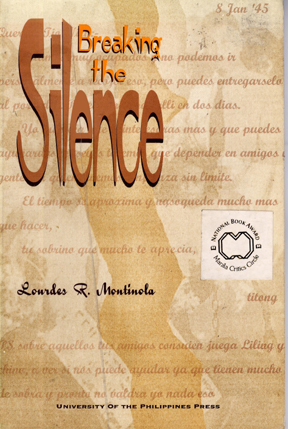
Breaking the Silence is a story reluctantly told by the author, a survivor of Japanese atrocities during the liberation of Manila. It was first partially recounted to Nick Joaquin who had been commissioned by the author's family and the Far Eastern University to write a biography of Dr. Nicanor Reyes, university founder and first president. Nick Joaquin's book was launched on February 11, 1995, by coincidence almost exactly 50 years after Dr. Reyes and his family had perished. A memorial to the non-combatant victims of the battle for the liberation of Manila was inaugurated in the Plazuela de Sta. Isabel in Intramuros on February 18. The author and other survivors belonging to Memorare-Manila raised funds for the monument. They were asked to surmount the pain and anguish of reliving their experiences, and to tell the story of the innocent civilians who had died in the battle. This is Lourdes R. Montinola's sharing of her story.
I don't think writing about one's harrowing experiences during the war and witnessing too many deaths can ever be fluid in narrating them, but the author managed to ease them out albeit in increments. On another note, there were repetitive snippets but this becomes understandable as the author's intention is to reinforce the fragments of memories. Still, the moments wherein "the mind continues, but the pen stops" sometimes say significant things, and it is the absences, the ones in between that speak so much in times of silence.
As mentioned by others, there are repetitive snippets that others might find tedious. However, I think it's the perfect narration for such a story. It feels intimate and slowly uncovers the nightmare that the author repressed for several decades. Moreover, it helps us understand why such important stories haven't been shared enough despite their significance in our history. While finally exposing the brutality of Japanese soldiers in graphic detail, I cannot help but ask why? How come the Japanese soldiers had the heart to commit such atrocities?
"How does one recall the end of the world, or the textures of pain?"
I'm not an English major nor have any high knowledge regarding literature but as an ordinary woman, I sometimes feel that the writing style is not really that impressive. BUT, if one would treat the book like one treats a friend then you'd find the treasure behind the lines. Sometimes, I feel that there are instances which the story is somehow repetitive but I placate myself that if I listen to a friend's story then there are possibilities for recurrent tales. It's like I barged into a memory which is not supposed to be released. The pain of loss, the horrors of war, the miracles to survive, the tranquility of moving on and the breaking of silence...
PS the GR cover page for this book is not the same as mine...
What you read is what you get. Although not that beautifully written compared to other stories of war experiences, you can feel the sincerity and realness of the author -- like she's just inches away from you, sharing her story over a cup of tea. You could feel her struggle in letting go of the words carefully put together to reveal what happened to her. To think that she wrote this to help ease her nightmare of the what happened in the war was enough for me to continue on reading.