Jump to ratings and reviews
Rate this book

The Autobiography of Alice B. Toklas

Rate this book
Stein's most famous work; one of the richest and most irreverent biographies ever written.


From the Trade Paperback edition.

342 pages, Hardcover

First published January 1, 1933

1104 people are currently reading
21340 people want to read

About the author

Gertrude Stein

407 books1,184 followers
Gertrude Stein was an American writer who spent most of her life in France, and who became a catalyst in the development of modern art and literature. Her life was marked by two primary relationships, the first with her brother Leo Stein, from 1874-1914, and the second with Alice B. Toklas, from 1907 until Stein's death in 1946. Stein shared her salon at 27 rue de Fleurus, Paris, first with Leo and then with Alice. Throughout her lifetime, Stein cultivated significant tertiary relationships with well-known members of the avant garde artistic and literary world of her time.

Ratings & Reviews

What do you think?
Rate this book

Friends & Following

Create a free account to discover what your friends think of this book!

Community Reviews

5 stars
3,113 (23%)
4 stars
4,237 (31%)
3 stars
3,639 (27%)
2 stars
1,593 (11%)
1 star
833 (6%)
Displaying 1 - 30 of 1,128 reviews
Profile Image for Lisa.
1,108 reviews3,290 followers
February 28, 2019
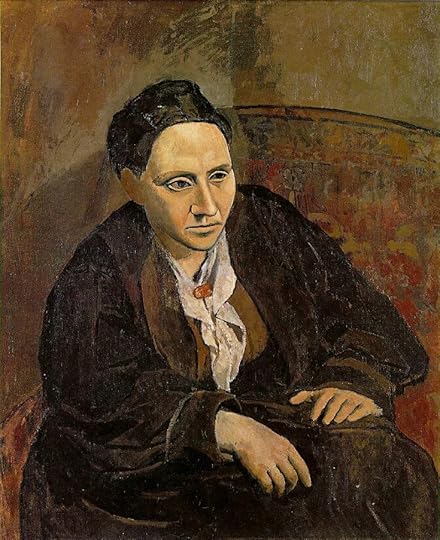
"After a while I murmured to Picasso that I liked his portrait of Gertrude Stein. Yes, he said, everybody says that she does not look like it but that does not make any difference, she will, he said."

Well, I can't really say if Gertrude Stein ever looked like Picasso's portrait of her in real life, but in my imagination, there is no other way to see her, exception made for Man Ray's photograph of her in front of the painting which is a brilliant double portrait of the grand lady through two artist lenses:


Whoever is in love with the painters and writers who frequented Paris during the first decades of the 20th century must read Gertrude Stein's brilliant account of the era. A woman of exceptional self-confidence, she conquered a world of machismo and made her own creativity the starting point for a whole generation. Matisse, Hemingway, Picasso, Apollinaire ... The guest list in her novel is exquisite. But it never forgets to pay the most enduring tribute to the hostess of the show - Gertrude Stein herself, as seen through the eyes of her lifelong companion, Alice B. Toklas. It is both a novel and an autobiography, and the careful selection and presentation of specific facts and events turn it into a quasi-fictional construction in the spirit of Goethe's autobiography, appropriately called Dichtung und Wahrheit - or "fiction and truth".

Gertrude Stein, being a woman, had to face far more severe criticism for believing in her own genius and her right to earn money than any of her male artist friends. Her irony, wit and intelligence speak for themselves, though, and she remains one of the defining voices of her era. The juxtaposition of literary discussions between the masters of the time with seemingly unimportant everyday worries and details is a perfect combination: an overview of a historical phase and an intimate portrait of a woman at the same time.

Recommended for Paris lovers and bibliophiles alike - a rare treat!
Profile Image for Orsodimondo.
2,457 reviews2,430 followers
October 30, 2025
ALICE’S RESTAURANT


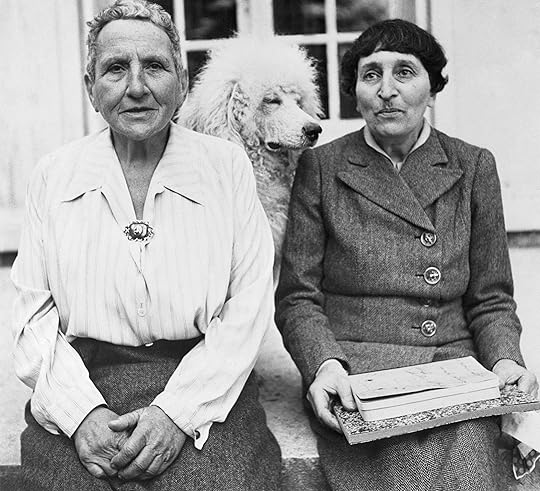
Gertrude Stein a sin e Alice Toklas a dx.

Gertrude Stein si traveste da Alice B. Toklas, la sua compagna di vita (e confidente, amante, cuoca, segretaria, musa, editrice e critica), per scrivere quella che soprattutto è l’autobiografia della stessa Stein che gioca a fare la Toklas ma è davvero interessata alla Stein (se stessa). Senza modestia né falsa modestia. E infatti, per evitare qualsiasi dubbio, quella ritratta in copertina è Gertrude, non Alice.
E ciò nonostante compone un romanzo divertente e brillante e interessante e a tratti scoppiettante.
E il cuore si allarga pensando a queste due donne, amanti e conviventi pubblicamente nonostante in quel periodo l’omosessualità non fosse affatto digerita dalla maggioranza. In quella Parigi, che la Stein riesce a far rilucere come se fosse il centro del mondo (e probabilmente lo era, almeno di quello occidentale). E al centro della città, lu centru de lu munnu (Foligno docet), la casa di Gertrude e Alice in rue de Fleurus 27, dove sono passati tutti gli artisti e creativi dell’epoca, a conoscere e farsi conoscere, ammirare o criticare i quadri esposti nell’atelier, cenare o prendere il tè. Tutti maestri nell’arte di socializzare: forse il maggior talento di entrambe, Alice e Gertrude, nonostante di talenti ne avessero ciascuna più di uno.


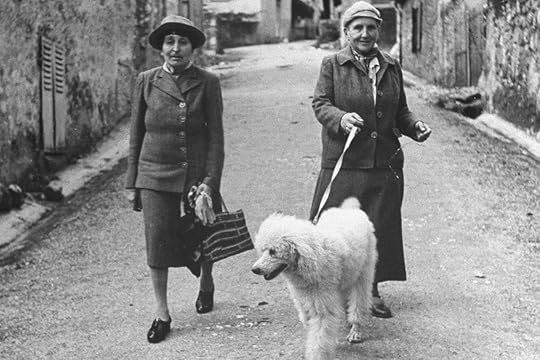
Alice e Gertrude che tiene al guinzaglio Basket.

A quel tempo stava progettando la stesura di quel suo lungo libro, The Making of Americans, era intenta a lottare con le sue frasi, quelle lunghe frasi che dovevano essere articolate esattamente a quella maniera. Frasi e non solo parole ma frasi e sempre frasi furono per Gertrude Stein la durevole passione della sua vita.

Gertrude Stein diceva che le virgole erano superflue, che il significato doveva essere intrinseco e non reso evidente per mezzo di virgole e che altrimenti le virgole si riducevano soltanto a una segnalazione di pausa necessaria a prendere fiato, ma che bisognava sapere da sé quando ci si voleva fermare per prendere fiato.

Inoltre le piaceva anche impostare in modo autonomo una frase come una sorta di diapason e un metronomo e poi scrivere secondo quel ritmo e quella tonalità.


Il salotto del sabato sera, nell’atelier dove erano esposti i quadri ricevuti in dono e acquistati, insieme al fratello Leo – grande collezionista a sua volta - o in proprio, dove la migliore scena mondiale, pittori, scrittori, musicisti, scultori, geni e artisti in genere, fotografi, critici, editori, traduttori, stampatori e gli amici degli amici, facevano salotto, e amicizia, qualcuna più duratura dell’altra, come quella tra Gertrude e Pablo (Picasso). Facevano arte, sviluppavano teorie, lanciavano movimenti, segnavano la storia culturale dell’Occidente.
Il tutto durante i primi tre decenni del Novecento, ché il libro fu pubblicato nel 1933: ma la Stein rimase a Parigi fino alla morte, nel 1946, avvenuta all’Ospedale Americano di Neuilly-su-Seine (dove sono stato ricoverato anch’io che sono ancora qui a raccontarlo).

Oh al diavolo, fece allora lei, stammi bene a sentire io sono piuttosto nota per avere l’abitudine di sparlare di chiunque e di qualunque cosa, ne ho dette su varie persone, ne ho dette a varie persone, ne ho dette quando e come mi piaceva, ma siccome generalmente dico quello che penso, il minimo che tu o chiunque altro può fare è accontentarsi di quello che dico di persona.


Ricordi e aneddoti a iosa, presentati con prosa libera, scorrevole, moderna, niente corsivi o virgolettati, senza punti interrogativi, con poche virgole, quasi sempre dove meno si aspettano, prosa che qualcuno ha paragonato alla destrutturazione del cubismo, e a me – che non sono un fan del cubismo - sembra molto colloquiale, pressoché “parlata”, oltremodo fresca nonostante sia trascorso quasi un secolo.
E si chiarisce la celebre frase della Stein che in tanti citiamo e ripetiamo a casaccio e lei riportava nella sua carta da lettere: una rosa è una rosa una rosa è una rosa una rosa è una rosa una rosa è una rosa. Quattro volte, non tre come succede di leggere o sentire di solito.


Picasso: Il ritratto di Gertrude Stein, conservato al Metropolitan Museum di New York.
Profile Image for Diane.
1,117 reviews3,198 followers
August 17, 2013
Pablo Picasso! Henri Matisse! Ernest Hemingway! F. Scott Fitzgerald! Sherwood Anderson! T. S. Eliot! Djuna Barnes! Ezra Pound! Georges Braque! Ford Madox Ford! Jean Cocteau!

All of these artists and writers were bumping into each other in Paris in the 1920s, often at Gertrude Stein's apartment, the famous salon at 27 rue de Fleurus. (And if you're wondering who the hell Alice B. Toklas is, she was Stein's longtime partner and lover, and calling it an autobiography but yet it was written by Stein was Stein's idea of a joke.)

I'll be honest and say I was keen to read this book because I had hoped for some delicious gossip about these famous people, and while there were some good stories, Stein's writing was more difficult to read than I expected. This was my first Stein book, and I would describe her style as a conversational stream of consciousness that frequently turns into babble.

Here is a good example of her style: "This was the year 1907. Gertrude Stein was just seeing through the press Three Lives which she was having privately printed, and she was deep in The Making of Americans, her thousand page book. Picasso had just finished his portrait of her which nobody at that time liked except the painter and the painted and which is now so famous, and he had just begun his strange complicated picture of three women, Matisse had just finished his Bonheur de Vivre, his first big composition which gave him the name of fauve or a zoo. It was the moment Max Jacob has since called the heroic age of cubism. I remember not long ago hearing Picasso and Gertrude Stein talking about various things that had happened at the time, one of them said but all that could not have happened in that one year, oh said the other, my dear you forget we were young then and we did a great deal in a year. There are a great many things to tell of what was happening then and what had happened before, which led up to then, but now I must describe what I saw when I came."

I did not change anything about that quote -- you get a sense of Stein's run-on sentences and her laissez-faire punctuation. Often when I was reading this book I felt as if I was listening to a confused storyteller, someone who just kept talking and talking and rambling and trying to convey a message, but that they themselves had forgotten what the message was.

There were some nice quotes and turns of phrase, such as: "[Stein] was born in Allegheny, Pennsylvania, of a very respectable middle class family. She always says that she is very grateful not to have been born of an intellectual family, she has a horror of what she calls intellectual people." But I had to slog through quite a few pages before I found a quote worth marking.

So, why would someone read this book? Maybe you would be brought to it, as I was, by the Woody Allen movie "Midnight in Paris," which had scenes that were inspired by this memoir. Or maybe you want to hear more about Picasso and Matisse and Hemingway, which were my favorite parts of the book. Maybe you want to read about Paris during World War I, and how empty of men the world had seemed then.

For me, I'm still fascinated by the Lost Generation and will read more Hemingway and Fitzgerald (because I didn't fully appreciate them when I was younger), but I may have had my fill of Stein for now.
Profile Image for Sean Barrs .
1,121 reviews47.9k followers
October 17, 2018
This book captures the heart of 20th century Paris, and chronicles the city before and after the first world war.

Stein ran an artistic hub from her house and around her formed an important circle of writers, artists and thinkers. She met Picasso, Hemingway and Fitzgerald. She spoke to Ezra Pound and exchanged letters with T.S Eliot. She supported artists in Paris and bought their paintings when they were first starting out. All in all, she was a purveyor and supporter of the arts.

She was also a lesbian, living with Alice Toklas who spoke to the wives of the important men Stein met. So this was written by Stein under the guise of her friend and lover. Stein expresses friendship very strongly. Her friends clearly meant a lot too her, and she influenced them as much as they influenced her. She had a constant exchange of ideas with people.

description
-Gertrude Stein, by Pablo Picasso (1906)

Other than that, it's a bit dull

Stein advocates for the beauty of writing, for creating artistic sentences and prose; yet, for all that, she has little to know skill at doing so. Her sentences are endless pieces of ordinariness. There’s no skill involved in them. At one point she mentions one as being particularly good, but there is nothing to it. It’s no more skilful than I’m writing here. I’m not sure what she is reading in her own work, but I certainly cannot see it. Read a page of Woolf then a page of Stein and you will see precisely what I mean. There’s nothing in her words except endless repetition about her own books. It’s like she was taking very opportunity to sell me one of them, irrelevant for sure to the motives behind an autobiography.

I’ve also read Paris, France and had a similar reaction to the dull nature of the writing. It’s a bit better, only because it’s in the first person, but it has none of the skill the writer professes it contains. I don’t think I will ever try one of her other books. There’s no passion in her words. As I said, the value of this book is with the image it creates of a modern France. And if you’re interested in 20th century Europe it’s certainly something you should read along with Hemingway's A Movable Feast.

I found myself skimming sections, so I was quite glad to finally finish it. It's a curiosity, though a bit of a trudge.
Profile Image for Madeline.
837 reviews47.9k followers
December 16, 2015
During my Modern Poetry class in college, we read some of Tender Buttons (prompting me to write a scathing review of it, which was promptly trolled) and my professor explained Gertrude Stein thus: "Gertrude Stein believed that there was only one great poet of the twentieth century, and it was her. She might admit that Shakespeare was talented as well, but only on a good day."

Having now read The Autobiography of Alice B. Toklas, I fully support this assessment of Miss Stein. Not that I dislike her - in fact, I find Gertrude Stein to be a fascinating person and I like everything I've heard about her. I just. Cannot stand. Her writing.

Based on the description, this book should be amazing: Stein, writing as her companion Alice Toklas, describes how they came to live in Paris, World War One, and the various artists and writers who visited their famous salon at 27 Rue de Fleurus. Hemingway is here, as is Picasso, TS Eliot, Max Jacob, Henri Matisse, George Braques, and countless others. A story about all of these people living and working and making art together in Paris in the early 20th century should be incredible, right? Wrong.

The main problem is that Alice B. Toklas isn't a very good narrator. Rather than dishing out the dirt on these famous men and women (as Hemingway did in A Moveable Feast), she chooses instead to just rattle off the names of people who visited her and Gertrude Stein, sprinkled with little anecdotes that are either boring despite themselves (according to this book, World War One really wasn't so bad at all, and Toklas spends the most time telling us how hard it was to go on vacation during the war because she had trouble with her passport), or are just plain boring. ("Glenway left behind him a silk cigarette case with his initials, we kept it until he came back again and then gave it to him.") Hemingway's snippy gossip may not have been true, but at least it was entertaining.

Also there's the fact that Toklas always remains on the fringe of this great group. Stein is right in the middle of it, helping Hemingway with his writing and discussing punctuation with TS Eliot, but Toklas freely admits that she isn't an artist, and always keeps herself apart: "The genuises came and talked to Gertrude Stein and the wives sat with me. How they unroll, an endless vista through the years. I began with Fernande and then there was Madame Matisse and Marcelle Braque and Josette Gris and Eve Picasso and Bridget Gibb and Marjory Gibb and Hadley and Pauline Hemingway and Mrs. Sherwood Anderson and Mrs. Bravig Imbs and the Mrs. Ford Maddox Ford and endless others, genuises, near geniuses, and might be geniuses, all having wives, and I have sat and talked with them all all the wives and later on, well later on too, I have sat and talked with all."

For God's sake. It's like if Diane Keaton's character from The Godfather wrote a book about her experiences with the mob. She was there for some of it, and she saw everybody who was important, but then the door slams shut in her face at the end and we realize that she doesn't really know anything at all, and won't ever know.
Profile Image for Meike.
Author 1 book4,942 followers
October 18, 2021
The most humble autofiction ever published (not! :-)): Gertrude Stein writes her own autobiography and, until the last paragraph, tricks the reader into thinking the narrator is her lesbian lover Alice B. Toklas writing about the "genius" Gertrude Stein and her achievements - because this is certainly NOT the autobiography of Toklas herself, mind you. The whole "as if"-mode is revealed in the last sentence, but as this is the foundation of the reputation this book holds in the literary world, it's certainly not a spoiler; rather, it makes the text much funnier imagining Stein (who is also named as the author on the cover, thus contradicting the stated genre "autobiography") putting together this assemblage of vignettes celebrating her own capabilities and intellect - after all, this was first published in 1933, so not exactly a time when Jewish women generally wrote about themselves through the eyes of their lesbian lovers.

The book itself is a little hard to get through if you're not all too interested in gossip about, you know, Matisse, Picasso, Satie, Hemingway, and the other people hanging out at Stein's Parisian salon (this is basically the same criticism I had of Hemingway's A Moveable Feast, which is less a celebration of Paris and more a conglomarate of gossip about famous artists and intellectuals). Still, the book stands for innovation in the field of autofiction and as a daring statement about Stein's life. Canonic stuff.
Profile Image for Michelle.
139 reviews46 followers
May 12, 2009
Hold your forefinger and thumb approximately an inch apart. That was how much I knew about Gertrude Stein prior to reading The Autobiography of Alice B. Toklas. I’m certainly no expert now, not even close, but I can safely say that I am completely enamored of both Stein and her life partner, Toklas.

No, it’s not because of the near-constant stream of visiting artists and other members of Parisian society to their home at rue de Fleurus in the early 1900s, though that was impressive. They were very friendly with Pablo Picasso, Henri Matisse, and Guillaume Apollinaire. They saw Isadora Duncan dance. They knew Sherwood Anderson, Jean Cocteau, and Ernest Hemingway, which was one of the most humorous relationships in the whole book. They made the acquaintance of T.S. Eliot (he and Stein quarreled over split infinitives -- isn't that great?), Henry James, F. Scott Fitzgerald, and late in the book, Paul Bowles. And those are just most of the people I have heard of.

No, it’s not because they volunteered for the American Fund for the French Wounded during World War I, though that was noble. They distributed clothing and other goods to soldiers and people that were wounded or displaced by the war.

I mostly loved the camaraderie between these two charming women. I loved the idea that Stein wrote the book in the style of an autobiography by Toklas because she became tired of waiting for Toklas to write the book herself. She imitated Toklas’s voice with an almost childlike glee, and I could feel the love on the page.
Profile Image for Jesse.
501 reviews
January 14, 2010
I don't dispute the book's importance, by Stein's style drives me bonkers. I'd much rather read ABOUT her than actually read her. That said, I'm glad she existed-- I'm also glad I'm not forced to read this all the time.
Profile Image for El.
1,355 reviews491 followers
April 23, 2015
This is timely. There's an article about Gertrude Stein today in the Huffington Post. Others thought she was an asshole (as I describe below) as well. Except I don't think they appreciated the genius part I recognized after reading this book...

Here's what I know about Gertrude Stein: She was an asshole.

I say that in a joking way. I actually learned more about her from this book than I learned about Alice B. Toklas (whoever she was) because this "autobiography" was written by Stein, supposedly from Toklas's perspective and should, for all intents and purposes, be about Toklas. Except it's all about Stein, as though Toklas wrote it about her? You with me so far?

If you are, you'll agree Stein was sort of an asshole. But also a genius because who thinks to do all this. It seems overly complicated, right? Just write an autobiography about yourself if you want to write about yourself; it would actually look less arrogant that way. The way she did it was to pretend like it's all about Alice, but that Alice only wrote it about Stein, even though Stein's name is listed as the author... I mean, really. Thinking about this all too much is enough to cause a brain aneurysm.

So what did I learn about Alice?:
*She did not like hot weather. Or walking. Gertrude Stein, apparently, loved walking and hot weather. Freak.
*St. Anthony of Padua was Alice's favorite saint. Gertrude Stein preferred some other guy, some St. Francis of Assissi because animals.
*Alice was forgetful. This seems like an especial jab at Alice. Remember, this is Stein writing as though from Alice's perspective, right, so the comment about being forgetful is really Stein calling Alice forgetful.
*Alice would go to bed early. Stein was a night owl.

Annnd that's about it. In 252 pages, that is all the reader really discovers about Alice B. Toklas. I don't even know what her middle name was. (I lied; her middle name was Babette, but I found that out from looking on Wikipedia. While there is some Alice-related information in the very first chapter, her middle name was not one of the things listed. And people who first pick up the book will inevitably read that first chapter as though it's Stein talking about Stein, because she's the damn author of the book, so it's all very misleading and disorienting at first.)

On the other hand, we know so much about Stein, as if there's not enough information about her life out there in the world. What I did learn is that she lived in Pittsburgh for way less amount of time than I ever thought she did. People here love to say "Gertrude Stein lived in Pittsburgh!" Sorry, yinzers, she moved away when she was 6 months old and, according to this book, has never stepped foot on Pittsburgh soil again. That is a bummer, I agree. For about a year or more, I lived a block away from the house where she was born. You can see it here: House.

Having just re-read Ernest Hemingway's A Moveable Feast recently, it was definitely cool to read Stein's account of the same time and place. They wrote about a lot of the same people, including each other, and it's interesting to see how their views matched or differed. Stein was much more interested in the visual artists of the period than I think Hemingway was (or at least she wrote about it more than he did, being such good friends with some guy called Picasso and others), but still covered a lot of similar territory. In some ways, her description of the early 1900s is more vivid to me reading the account now than Hemingway's was, but I think he was even more interested in exposing gossip than she was (which is hard to believe because she put up a good fight).

I'm intrigued that while she talked about the war years in Paris, there's still little emotion behind it, or any real sense how the war caused any significant disturbance in her life. I got the impression that she (or Toklas, or both, or whatever, I give up) wanted to do something good for the cause, but it was mentioned only briefly, and then the topic shifted away from that, returning to more good ol' days with more buddies.

I have never been more interested in reading more by Stein. She-Toklas referred to Stein's writing quite a bit, and one day hopefully soon I will tackle The Making of Americans which, I understand, has no real punctuation? Or something like two commas in the entire book? See. Asshole. But, again, also genius. I want to be more pissed at Stein, but I have to admire the way she really seems to be poking fun at the reader.

Well played, Stein, well played.

Seriously, though, don't read this book if you actually want to know anything about Toklas. You won't find it here, I promise you that.
Profile Image for Paul.
1,472 reviews2,167 followers
July 4, 2014
3.75 stars rounded up.
I struggle with Gertrude Stein, as I struggled with this novel. I don’t think this work is typical of Stein as she wrote it very quickly with the idea of being commercial as she needed money; not a problem in itself, but it meant she was also ambivalent about it. It is a novel written as though Stein’s partner Alice Toklas is writing an account of Stein’s life in Paris before and after the First World War. It is also an account of those many famous and not so famous writers and artists who passed through their home: Picasso, Matisse, Cezanne, Braque, Hemingway, Fitzgerald, the Sitwells, Appollinaire, Eliot and many others.
My issues with Stein relate to her support for Franco in the 1930s. She was also a vocal supporter of Petain, even when he was deporting Jews to Auschwitz. There is a certain political naivety and possibly, being a Jew in Nazi occupied France, some self preservation. There is a point in the novel where Paul Robeson visits Paris. Suffice it to say he received a much warmer welcome from the coalminers of the Welsh Valleys. However Stein was a pioneer in terms of writing about same sex relationships; writing some very early coming out short stories. Stein was also one of the first to use the term gay in her writing. I haven’t read enough Stein to make a judgement about her work and feel I need to read much more. She was an early experimenter with stream of consciousness. Modern critics have tended focus on Stein’s limited breadth; she was politically quite right wing and that is a limiting factor for me. And yet this novel does draw you in.
The writing is interesting and managed to offend a fair few of those mentioned (including Hemingway). Jeanette Winterson has argued that this is a development of the type of writing Woolf did in Orlando. This is really an experimental novel. It isn’t clear whether Stein writing as Toklas is expressing the views of Stein or Toklas, or both. Reading it is slightly confusing and you have to think on your feet at times: sometimes it feels as though you are watching Stein as described by Toklas until you remember Stein is writing as Toklas, observing herself. It is also very formally written; Stein is always referred to as Gertrude Stein, never as Gertrude. There is no analysis; it is really a description of domestic manners; dinner parties, buying paintings, moving around France, meeting people etc.
I enjoyed the novel. In itself it isn’t ground breaking and I still feel I need a more rounded appreciation of Stein; and I still have some uncertainty about Stein herself. So it’s a bit of a work in progress and I think I will try to look out a decent biography and put The Making of Americans on my tbr list, as well as her short stories.
Profile Image for Barry Pierce.
598 reviews8,926 followers
October 28, 2014
I feel that if I had the chance to meet one person from the 20th Century it would be Gertrude Stein. She was friends with anyone who was anyone in the artistic and literary circles of early 20th century Paris. The sheer amount of name-dropping in this book is immense; Picasso, Braque, Man Ray, Hemingway, Fitzgerald, Joyce, Pound, Beach, et al. Although don't go into this book expecting something along the lines of Hemingway's A Moveable Feast, this majorly focuses on the artists of Paris, not the writers. Since I'm doing my BA in English Literature and History of Art this book was just fabulous to me. This is a very niche book, but if you fit into that niche then this is essential reading.
Profile Image for Cheryl.
524 reviews844 followers
May 17, 2014
"And now I will tell you how two Americans happened to be in the heart of an art movement of which the outside world at that time knew nothing."

I'm ashamed that I haven't delved into Stein's work until now, but quite honestly, at 900+ pages, The Making of Americans seemed daunting. Yet when I saw Stein's character in the movie Midnight in Paris, and I read Hemingway's A Moveable Feast, I knew it was time to read the work of one of the few women writers of her time and place. So I started with her autobiography.

The title of this memoir,The Autobiography of Alice B. Toklas, is satire. For years Stein had been asked to write a memoir and she refused. Perhaps this is how she could bring herself to write one: write it as if it were coming from her life partner of over twenty-five years.
Sure, she said, as Pablo once remarked, when you make a thing, it is so complicated making it that it is bound to be ugly, but those that do it after you they don't have to worry about making it and they can make it pretty, and so everybody can like it when the others make it.

She was an important figure within American literature--especially once you consider how many writers she mentored and introduced to Parisian society (i.e.: Hemingway) and how many manuscripts she read and edited. She told Fitzgerald (even though he didn't believe in himself at the time) that The Great Gatsby would be read "when many of his well known contemporaries are forgotten." She wrote numerous novels and plays. She also painted and was a vital figure and host within the artistic world.

She has a way with sentences in this memoir. Short; concise. I've heard that The Making of Americans has longer sentences but I really liked the stylistic choice here: conversational tone and no dialogue quotations. And it really does sound as if someone is telling you a story (at least in the first part).

The first section was my favorite and was an easy four stars for me. I also loved reading about Stein's close relationship with Pablo Picasso. They were best friends and through her you're able to view his lifestyle. Towards the end though, there were too many characters to keep up with and too many mini story lines. You may however, like the inclusion of many writers and artists like: Ezra Pound, Ernest Hemingway, Sherwood Anderson, Sylvia Beach, Roger Fry, Matisse, Cezanne, Picasso, and more.
She says it is a good thing to have no sense of how it is done in the things that amuse you. You should have one absorbing occupation and as for the other things in life for full enjoyment you should only contemplate results.
Profile Image for Dagio_maya .
1,107 reviews350 followers
November 5, 2021
” I geni venivano e parlavano con Gertrude Stein
e le mogli si sedevano con me a chiacchierare.”


Oh perbacco!
Qualcosa non quadra!
Un'autobiografia dove chi scrive non coincide con chi è oggetto di scrittura.
La scrittrice americana Gertrude Stein, d’altro canto, era un’originale mattacchiona.

Questo libro è la fusione di sguardi tra quelli della scrittrice e quelli della compagna di una vita: Alice B, Toklas.
Oppure -come qualche maligno sostiene- è la testimonianza di un rapporto dove la Stein dominava completamente.
Ed è probabile anche questo..

«Sono nata a San Francisco, in California» comincia a raccontare di sé Alice B. Toklas dando qualche cenno della sua vita prima dell’arrivo Parigi nel 1907.
Si tratta, tuttavia, di presentazioni sì doverose ma quasi superflue.
Tutto accadrà nella capitale francese ed, in particolare, al 27 di rue de Fleurus.

description

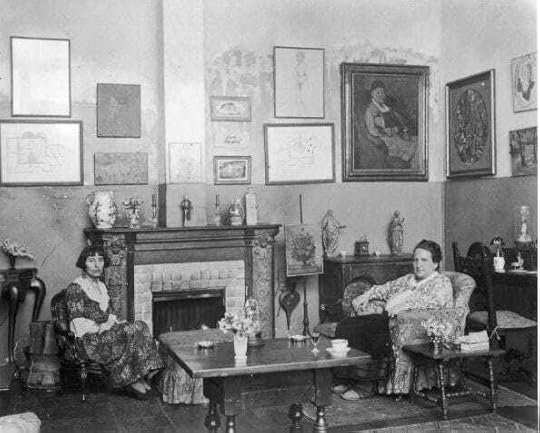
” La casa di Rue de Fleurus 27 consisteva a quel tempo come adesso in una casetta di due piani al di là di un androne con quattro piccole stanze, una cucina e un bagno, affiancata a un atelier molto ampio.”

Qui Gertrude ed il fratello Leo custodiscono la loro ricca collezione di dipinti e che, ben presto, ogni sabato sera diventa fulcro di un vivace salotto.

La scrittura è colloquiale in tutti i sensi: la scelta del linguaggio ma anche una forma un po’ dispersiva tipica di un interlocutore che vuole raccontarci tutto nei minimi particolari salvo per perdersi in continuazione.

” E ora vi dirò di come due americane finirono per trovarsi nel cuore di un movimento artistico di cui il mondo esterno in quel momento non sapeva nulla.”

L’elenco di artisti – di ogni genere- che transitò in rue de Fleurus è molto lungo ma sicuramente possiamo fissarne i due perni:
Henri Matisse e Pablo Picasso che proprio in quelle stanze costruirono il loro rapporto di amici-nemici.

description
La femme au chapeau fu esposto, per la prima volta, nel 1905 al Salon d’Automne.

I fratelli Stein lo acquistarono dando così inizio ad una lunga amicizia con Matisse mentre cominciava a diffondersi un movimento di avanguardie: les fauves.

Non molto tempo dopo scoprono i dipinti di due giovani spagnoli:
il più talentuoso tra i due si chiamava Pablo Picasso.

Passano i giorni, che diventano mesi e poi anni.
Dal 27 di rue de Fleurus entrano ed escono uomini e donne la cui leggenda è ancora in fase di costruzione.
Bizzarri e scandalosi pionieri di nuove forme di un’arte che vuole scrollarsi di dosso il XX° secolo.

Matisse sconvolge con ”Le bonheur de vivre” attraverso il quale crea la nuova scuola coloristica.
Picasso mette mano agli spazi da cui nascerà il cubismo.
Stein intesse le lodi di se stessa usando la voce della sua amante e nasce lo scrittore ventriloquo.

description

” Spesso i giovani quando hanno appreso tutto quello che possono imparare la accusano di un orgoglio smodato.
Lei dice sì naturale.
Si rende conto di essere unica nella letteratura inglese della sua epoca. Lo ha sempre saputo e adesso lo ammette anche.”
(Sic!)

Insomma, interessante lettura per il contesto storico ed artistico tutto il resto è autocelebrazione gratuita.
Profile Image for Joselito Honestly and Brilliantly.
755 reviews430 followers
March 19, 2011
I had seen them during my mother's 75th birthday celebrations last January 2011. Both old women, lifetime companions. C. is the more "manly" of the two, short haircut, never wears a skirt. B. is my distant relative, very feminine in her deportment, said to have been the former girlfriend of another relative of mine (now deceased, God bless his soul). They brought with them to the party their three-year-old adopted girl, begot out-of-wedlock by a prostitute in our hometown, father unknown. Years before, they had another adopted girl who died of leukemia before she was a teen.

They are my Gertrude Stein (GS) and Alice B. Toklas (ABT). GS and ABT, however, never adopted a child. What they had was a succession of dogs. The last was a white poodle named Basket who outlived GS for many years, went blind and deaf, and died of old age. ABT never got another dog after that.

Gertrude Stein is Gertrude Stein is Gertrude Stein (a play with her "rose is a rose is a rose is a rose"). Alice B. Toklas, however, was not dumb bimbo (though she was pretty). She was GS's able collaborator and critic. Well into her 80's she was reading ponderous titles and heavyweight authors and even translating books. She only stopped when her eyes started to fail her (in one of her letters--see my other review today--she said she couldn't read Durrell (Lawrence?) anymore because of her eyes). In this other book I will review today she dismissed Francoise Sagan's "Bonjour Tristesse" as an "abomination" (I noted this with amusement as I gave this book 2 stars although I missed using this perfect word, "abomination').

Here at goodreads we are all very fond of discussing authors. Hemingway this, Steinbeck that. In "The Autobiography of Alice B. Toklas" there are also a lot of artists, poets and writers mentioned. The difference is that GS and ABT did not just read them or see their work. They hobnobbed with them in flesh and blood, several of them were even their close friends(or at least they were first name basis with them): Picasso, Matisse, Juan Gris, Thorton Wilder, Hemingway, Fitzgerald, Capote, Faulkner, Jean Cocteau, Dos Passos, T.S. Eliot, Steinbeck, H.G. Wells, Ezra Pound, William James, to name a few. These long dead authors/artists will come alive before your eyes (the best, I suppose, to me at least, is the part where GS and ABT met Hemingway, then working for a newspaper, and before he wrote his great novels, GS giving him some pointed advice).

This is, however, more than gossips. This was written out of love. Gay love, but love still. GS telling ABT I love you, I know you, I know your story of you, your story of me, and your story of us. But you wouldn't write these stories. Let me then write them for you. This is, then, The Autobiography of Alice B. Toklas written by her great love, Gertrude Stein.

With this book, they had become one.
Profile Image for Teresa.
1,492 reviews
October 19, 2017
Não costumo ler biografias, mas tinha alguma curiosidade nesta. Por saber que Gertrude Stein conviveu com pintores e escritores famosos, pensava que ia ficar a saber pormenores interessantes das suas vidas. Mas, tirando uma coscuvilhice ou outra (que o irmão de Stein disse ser tudo mentiras), não passa de descrições rotineiras do género: Matisse veio jantar e Apollinaire embebedou-se; Picasso está a pintar e Stein está a escrever; fomos ao café com Braque e ao ballet com Gris...
Provavelmente estou a dizer uma barbaridade, mas é assim tipo revista de sociedade (A Caras, por exemplo) para intelectuais.

Mas isto é só a minha opinião. Esta obra terá muito valor porque:
1) me foi recomendada por uma pessoa muito dada às letras;
2) foi um sucesso editorial aquando da sua publicação;
3) este ano foi publicada, com traduções diferentes, por duas editoras portuguesas.
Profile Image for Nick.
159 reviews22 followers
April 5, 2016
Self-obsessed snoozefest of a memoir detailing to excruciation the dining habits and interior designs of post-War Paris Bohemia. That Stein can make figures like Picasso boring when disfigured by her ugly syntactic compulsions is a perverse sort of accomplishment, I suppose. Genius my ass.
Profile Image for Cosimo.
443 reviews
August 11, 2023
760 volte Gertrude Stein

Nessuna emozione mi ha destato la lettura di questo classico di un'autrice naturalmente fondamentale per la cultura del Novecento; ella è stata infatti un personaggio di rilevanza essenziale per lo sviluppo artistico del modernismo. Il valore letterario del lavoro è invece da ricondurre in prevalenza al ruolo di documento e testimonianza, certo importante per l'aspetto storico e teorico, ma non appagante sul piano narrativo e poetico, poiché mette in gioco ben poco di considerevole e creativo.

Il testo a me è risultato privo di immaginazione, di sentimento, di movimento interiore. Non c'è ombra di passione nella relazione con Alice Babette Toklas, niente di significativo emerge sulle avanguardie artistiche, tutto è descrizione e ovunque abbonda il name dropping.

Ho trovato questo libro monotono e noioso, costituito di razionalismo e celebrazione. Queste pagine sono generose in buona creanza e rispettabilità, in finto ardore e domestica contentezza.

Elegante, radicale, è la prosa di Gertrude Stein, e insieme sentenziosa, incapace di essere tragica quanto lo è stato il tempo nel quale lei è nata e vissuta.

La letteratura di Gertrude Stein – fermandosi qui e nell'attesa di conciliarsi con la lettura di Tre Esistenze e The Making of Americans - non fa che risuonare nel rumore dei salotti, comunicare il piacere della tessitura sociale, investire nella ripetizione discorsiva. L'autrice aspira infatti alla inappellabile definizione di una mitologia personale, e si appaga solo nell'ottuso e tacito riconoscimento che solo può venire dalle altre e dagli altri; trovando in esso il miracoloso medicamento di ogni correlativa alterazione viscerale. Tra queste, prima tra tutte, il disprezzo.
Profile Image for K.D. Absolutely.
1,820 reviews
June 26, 2011
What makes this book memorable for me is this interesting idea: a pseudo-autobiography. Gertrude Stein wrote this book from the perspective of her lover, Alice B. Toklas. It is like an autobiography yet Stein put herself in Toklas' shoes. I am still to read Stein's first novel, Three Lives and her long The Making of the Americans both of which were mentioned a lot of time in this book but I have an inkling that Stein's writing style or voice here is different from what she used in those two books. Her intention was to mimic the speaking style of Toklas: crisp and very conversational.

A couple of months back, i.e., prior to reading this book, I saw an old cookbook written by Toklas herself. In the book's intro, she said that one of her fondest dreams was to write her own book. I thought of buying it but when I leafed through the pages, I saw that it had nothing except French food recipes with exotic ingredients that obviously will not be available in a third-world country like the Philippines. So, I did not buy it and now I am regretting it big time. I forewent the chance of having a memento from a fascinating literary non-fiction character. The better half of a self-proclaimed genius: Getrude Stein.

Based on this book, it is too early for me to say that Stein is really a genius. The idea of her writing and describing herself as one using Toklas just sounds presumptuous to me. However, as I said it is early for me to say since I am still to read her other works. However in her rented house in Paris before, during and after WWI, she and Toklas hobnobbed with world-renowned artists: painters and writers. These includes the likes of Pablo Picasso (who Stein said to be the other genius), Ernest Hemingway, Sherwood Anderson, T. S. Eliot and many, many others (I will not mention them because I don't know them yet). From reading Henry Miller's Tropic of Cancer, I am just wondering how come Stein and Toklas did not meet him and his lover, Anais Nin. They could have a foursome date and that would be interesting the drunkard Miller mentioning Stein in his book and genius Stein doing the same to Miller.

Aside from being a 1001 book, this is also one of the Top 10 Best Gay & Lesbian Novels in one of the legit surveys I found in the web. However, it has no sex lesbian scenes and if you don't pay close attention to the narration, it might even escape you that Stein and Toklas were lesbian and lovers. My point is that a gay or lesbian novel can be great even if there are no sex scenes. This just reminds me of Augusten Burrough's Running with Scissors that is written nicely like a autobiography but he included disgusting in-your-face homosexual acts that are so distasteful I almost threw the book against the wall.

I will surely read Stein's other works and see for myself if she is really a genius.

And hey, GR says that this is my 500th read book! Another reason why this book is memorable for me!
Profile Image for Liz.
598 reviews632 followers
February 6, 2017
The ego of Gertrude Stein was too hard to swallow, particularly combined with the absolutely atrocious writing. This woman seriously compared herself to Shakespeare at some point. Shakespeare and this...No, just no.
Horrible horrible horrible.
Worse than Hemingway and Kafka.
Profile Image for Kim.
426 reviews540 followers
December 29, 2012

This is a must-read for anyone interested in artists and writers in Paris in the early part of the 20th century, because every writer and artist of any note who was in Paris at that time encountered Gertrude Stein at some point. Picasso, Braque, Matisse and Magritte, Apollinaire, Gide, Pound and Hemingway: all of them and many others attended Stein's celebrated Saturday evening salon.

Stein wrote this work in the conversational style of Toklas, who was her life partner. Ostensibly Toklas' autobiography, it is in reality Stein's memoir written as if Stein were Toklas. Whether the voice which emerges is authentically that of Toklas I don't know, but the conversational style is very convincing and comes complete with non sequiturs and digressions. It's an interesting device, but it doesn't make the book - a relatively short one - easy to read. At least, I didn't find it so. If Stein accurately reproduced the rhythm and content of Toklas' conversation, then Toklas was probably best taken in small doses.

Writing about herself as if her partner were the one doing the writing allowed Stein to blow her own trumpet more than would have been seemly in a straight memoir. There was nothing shy and retiring about Stein and her high opinion of herself never faltered. Here's what she wrote - in Toklas' voice - at the end of the first chapter:
I may say that only three times in my life have I met a genius and each time a bell within me rang and I was not mistaken, and I may say in each case it was before there was any general recognition of the quality of genius in them. The three geniuses of whom I wish to speak are Gertrude Stein, Pablo Picasso and Alfred Whitehead*. I have met many important people, I have met several great people but I have only known three first class geniuses and in each case on sight within me something rang. In no one of the three cases have I been mistaken.

I initially suspected that the not infrequent references in the text to Stein's genius were meant ironically, but I was rapidly persuaded that Stein was serious. She was convinced that her writing had great merit and could not understand why her literary genius went so long unrecoginsed.

One of the reasons I wanted to read this book was for Stein's impressions of Ernest Hemingway, who held Stein up to ridicule in A Moveable Feast. They had initially been good friends, but fell out when Hemingway disparaged Sherwood Anderson, whom Stein considered had been a great influence on Hemingway's writing. Reading what Stein had to say about Hemingway in this book - almost all of it extremely unflattering - made me realise that Hemingway's portrait of Stein in A Moveable Feast was effectively his revenge.

This is unlikely to be enjoyed by anyone not interested in the writers and artists with whom Stein was acquainted and in that particular period in the history of Paris. Stein, of course, would have wanted the book read for the pleasure of reading the work of a literary genius. Sadly, I think I would prefer to read more about Stein than more of her writing. As it is, this is worth in the region of 3-1/2 stars.

*Not being of a mathematical or scientific bent, I'd never heard of Whitehead before. This is what Wikipedia says about him.
Profile Image for John Anthony.
941 reviews165 followers
October 12, 2021
My first introduction to Stein. This records her life c 1906-1926, supposedly through the eyes of her companion and lover, Alice B. Toklas. In fact, it is Gertrude Stein (G.S.) writing about G.S. Both women are American born but throughout much of the book we find them living in Paris. Here they hold court to the artists, writers and musicians of the day. It reads like a shopping list of the ‘art world’ with the same level of flatness one would expect from a shopping list.

The war years are particularly interesting with both of them doing their bit for the war effort: ferrying injured soldiers to hospital.

Whilst the book should be a fascinating glimpse of artistic life during an important period of history, the writing lacks zest and I found my attention wandering from time to time as one luvvie entered Stein’s presence and another departed....

G S’s singular attitude towards punctuation, taken together with all the Kindle gremlins which either dropped letters, added them, or misplaced words, made this a more bizarre read than even Gertrude Stein might have intended!
Profile Image for B..
165 reviews79 followers
April 1, 2018
One may be tempted to give this four stars because of the constant digressions, but then one reflects that it is just Stein brilliantly imitating Toklas' conversational style of speech. Tired of waiting for Toklas to write her memoirs, Stein amusingly wrote Toklas' autobiography for her. Whether you want to know more about Picasso, Matisse, Stein or any of the number of famous artists that strolled through 27 rue de Fleurus to see all of the famous paintings, then you must read this book. It is insightful, engaging and witty, but it is also an incredible accomplishment of style. I wish I had met you Stein, rest assured, I will be reading a lot more of your work in the near future.

There's a lot of love in this text, both for Stein herself and for her companion. But the one thing I felt lacking was that Stein never informs us of the true nature of her relationship with Toklas. A highly enjoyable read nonetheless.
Profile Image for George Ilsley.
Author 12 books314 followers
June 27, 2022
This book is wonderfully written. It is ironic that it was not Gertrude Stein's favorite, but it is the book that made her much more well known. To this day, I will pick it up and dip into it, anywhere. Bliss. Absolute bliss.

It is an exploration of voice, a demonstration of voice, and for that reason alone can be studied. The sentences flow effortlessly, carrying the reader along.

Stein demonstrates ironic distance, self-mockery and great humour— all while polishing an often fabricated memoir. One can almost hear those genius bells ringing!
Profile Image for Sunny Lu.
983 reviews6,402 followers
September 28, 2023
lesbian art and literature (g0d)mothers, problematic proto-butch/femme, history's modernism
Profile Image for Xandra.
297 reviews275 followers
April 6, 2020
Gertrude Stein is really on to something here. I think she might have found a solution to a fairly widespread problem in the literary world. Writers tortured by their sense of superiority, all too aware of their genius, overwhelmed by their unbridled desire to show off, having to resort to pompous prose as an outlet for their narcissism. Well, Gertrude Stein came with an ingenious idea. Why use such a cheap subterfuge when she can have other people flat out call her a genius?

So she writes The Autobiography of Alice B. Toklas, which of course is not really the autobiography of Toklas - she is only an observer -, but a biography of Gertrude Stein as seen through her life partner’s eyes. It's awfully self-indulgent and ridiculous and not as obnoxious as you'd fear. Gertrude Stein is always referred to by her full name so it's firmly established that you are reading about a person of importance whose name should inspire reverence. How much her work shaped the course of literature I can't say, but she is very sure of her talent and, considering all the criticism she faced, her self-confidence is quite admirable.

The fascination for this book also comes from the impressive group of friends and acquaintances that frequented her Paris salon: Picasso, Matisse, Appollinaire, Braque, Satie, Hemingway and many others. The multitude of people and anecdotes can make the reading tiring, but there's an undeniable charm that will keep you turning the pages.

You end up not knowing much more about Alice Toklas than when you started, as I'm sure wasn't the intention. It was good advertising though. If Gertrude Stein wanted to trick me into reading more of her work, I think she might have just succeeded.

3.5
August 24, 2020

[La foto è un quadro d’autore e non certo una istantanea: Picasso sicuramente ne ha curato il set avendo in mente una rivisitazione della “Donna con l’ombrello” di Monet. Bellissima lei. Lui, Pablo, gioca con il suo complesso d’Edipo].

Direte: ma che c’entra questa foto? Ma è lui il personaggio principale di questa biografia di Gertrude camuffata da autobiografia (una roba di natura antropofagica dell’anima della povera Alice, il versante debole della coppia Stein/Toklas).
Autobiografia piacevolissima perché è un gioiello di scrittura ma autoecelebrante: un io ipertrofico così… quanto è antipatica la Stein, quanto è supponente e quanto presuntuosa. E quanto è scialba, l'’ombra della dea, la Tolkas senza che per questo ti stimoli l’empatia: se l’era cercata, voluta e ci sguazzava. E forse godeva quando lei la tradiva: il vero amore è sacrificio di sé, o no? Non l’ha Gertrude portata a Venezia per suggellare il loro amore? Ohibò, una genuflessione ci sta.
" width="150" height="250" alt"/>

Solitamente, se la lettura è stata “acchiappina”, giro per il web per saperne di più. E qualche pettegolezzo, ci può pure stare. Trovo, così, la biografia dell’Eccelso (Pablito), scritta dalla bellissima compagna dal dente avvelenato verso l’ex, i cui difetti, tanto tollerati dalla sua Musa Gertrude (della serie è puerile ma geniale) furono invece per lei un tormento.
Siamo nella primavera del ’45 e Picasso porta la nuova, l’ennesima, bellissima compagna dalle sue vecchie amiche:
“Picasso bussò alla porta. Dopo una breve attesa, la porta venne socchiusa, quasi di malavoglia, come quella dello studio di rue des Grands-Augustins. Attraverso lo spiraglio scorsi un volto magro e bruno dalle palpebre pesanti, dal lungo naso ricurvo, la bocca sottolineata da una peluria scura e folta. Quando questa apparizione riconobbe Pablo, la porta si aprì un poco di più e mi trovai davanti a una vecchietta con un enorme cappello. Era Alice B. Toklas. Ci fece entrare nel vestibolo e salutò Pablo con una profonda voce da baritono.
L’impressione che il gioco delle luci e ombre facesse comparire, nelle foto, sul labbruzzo della Toklas un paio di baffetti all’Adolfo era dunque realtà, bianco su nero!

E comincio a provare una certa simpatia per questa donna compressa e incompresa e sfruttata, una tappezzeria sbiadita, ma non al punto da non metterci il suo zampino quando attendeva al compito di addetta alla ricopiatura degli spartiti della divina. Pena no. Non se la merita. Ha avuto più di me.
Ci fece entrare nel vestibolo e salutò Pablo con una profonda voce da baritono. Quando egli mi presentò, essa brontolò un «buongiorno, signorina», con l’accento di un comico che imiti un turista americano che parla francese. Ci togliemmo il cappotto appendendolo in un piccolo vano, passammo in un ambiente più grande pieno di quadri, molti dei quali appartenevano al periodo cubista e per la maggior parte erano di Picasso e di Juan Gris, e sbucammo in un salotto inondato di sole… Alice Toklas si sedette sul mio divano, ma il più discosto possibile. L’enorme cappello … mi distraeva. In grigio antracite e nero, il largo cappello ornato di una sottile guarnizione grigia, sembrava si fosse vestita per un funerale. La sua voce era bassa e rauca come quella di un uomo e si poteva sentir l’aria fischiare fra i suoi denti.

Ed ecco che entrare in scena lei: l’immagine è paro paro a quella che ti sei fatta quando leggevi il testo originale. Cosa aveva generato quell'impressione? L’autoironia di Gertrude o la mite ironia della mogliettina timida, che si era fatta largo tra le righe? Sta di fatto che le due immagini, quella di Alice della biografia e quella dataci dalla bellona coincidono:
Là, in una poltrona, di fronte alla porta, sotto il suo ritratto dipinto da Picasso nel 1906, sedeva Gertrude Stein, larga, solida, imponente, la zazzera grigia tagliata cortissima. Indossava una gonna marrone che scendeva quasi fino alle caviglie, una brutta camicetta beige e aveva i piedi nudi dentro pesanti sandali di cuoio. Un lampo nei suoi occhi indicava che si aspettava di divertirsi moltissimo.


Mi disse che era la madre spirituale di tutti: Sherwood Anderson, Hemingway, Scott Fitzgerald. Insistette in modo particolare sull’influsso che aveva esercitato su Dos Passos e su Erskine Caldwell. Voleva farmi capire l’importanza del suo ascendente, perfino su quelli che non si erano mai seduti ai suoi piedi, come Faulkner e Steinbeck, ad esempio. Affermò che senza di lei la letteratura moderna americana non sarebbe stata quella che è ora”.
Avevano fatto a gara per ritrarla: troppe le amicizie di lei con i grandi galleristi per ignorarla. Da dire però che se godevano della sua ammirazione era capace di grandi affetti. Ma più invecchiava meno talentuosi erano i pittori del suo giro.

="100" height="300" alt="description"/>


Niente di nuovo in questa biografia dal dente avvelenato, come ho detto. Tutta roba che ho potuto leggere nell’autobiografia autografa della coppia e, soprattutto, senza la nuance da giornaletto scandalistico : fatte le debite scremature dell’invidia e antipatie per la Stein, la sua vita ti fa venire l’acquolina in bocca. Quanto vorresti essere vissuta prostrata ai suoi piedi e magari essere la scialba Alice pur di respirare quell’aria fatta di luci e colori e forme, unica e irripetibile, almeno fino a questi bui tempi che ci è capitato di vivere.

In ultimo ma non ultimo: non poteva mancare il mio giudizio morale su questa donna, morale alla maniera di H.Arendt e non quella di piccolo cabotaggio delle comari di F. De Andrè.
Navigando sul web – volendo è utilissimo – scopri le sue simpatie naziste e la lunga e speciale amicizia per Bernard Faÿ, amico del generale Pétain … Con Gertrude Stein condivideva le stesse idee. Anche su Hitler. Al riguardo, Gertrude Stein non aveva reticenze, «Dovrebbero dargli il Nobel per la pace» dichiarava … ha rimosso dalla Germania tutti gli elementi di contrasto. [...] Cacciando gli ebrei (lei stessa di origini ebree, eh), i democratici e la sinistra, ha espulso dal paese tutto ciò che crea un qualche disturbo (conduce to activity). E ciò vuol dire pace».
Una sera … si misero a parlare di Hitler, descrivendolo come un grande uomo, da paragonarsi, forse, con Napoleone. Sulla persecuzione degli ebrei, cosa ben nota in Francia ,la Stein la liquida come “Pubblicità”. Che cosa poi volesse dire per lei questa parola, non è dato capire.
A voi…
Profile Image for Anima.
431 reviews80 followers
November 2, 2019
“It was only a very short time after this that Picasso began the portrait of Gertrude Stein, now so widely known, but just how that came about is a little vague in everybody’s mind. I have heard Picasso and Gertrude Stein talk about it often and they neither of them can remember. They can remember the first time that Picasso dined at the rue de Fleurus and they can remember the first time Gertrude Stein posed for her portrait at rue Ravignan but in between there is a blank. How it came about they do not know. Picasso had never had anybody pose for him since he was sixteen years old, he was then twenty-four and Gertrude Stein had never thought of having her portrait painted, and they do not either of them know how it came about. Anyway it did and she posed to him for this portrait ninety times”

“Gertrude Stein never corrects any detail of anybody’s writing, she sticks strictly to general principles, the way of seeing what the writer chooses to see, and the relation between that vision and the way it gets down. When the vision is not complete the words are flat, it is very simple, there can be no mistake about it, so she insists. It was at this time that Hemingway began the short things that afterwards were printed in a volume called In Our Time.”
Profile Image for moneypenny.
13 reviews2 followers
October 30, 2015
Awful! This book is like be stuck next to someone's boring wife during the longest dinner party ever. Sure, she name drops like nobody's business but what she has to say is dull and inane. "We met so and so. He was charming and Gertrude Stein liked him very much. He preferred English Daises above all other flowers."

I would have loved an editor with some guts working on this too. The same things are mentioned over and over but the thinking isn't linear so you end up saying "wait, didn't that person die 20 pages ago?"

This book could have been half the length or maybe just one of those "People Magazine 10 Things You Don't Know About Me"
1. Please use my complete name when talking about me. It's not Gertrude or Gertie or Ms. Stein. It's Gertrude Stein.
2. I like to take long walks in the heat.
3. I'm a night owl. Alice goes to bed early.
4. It's very hard to get good help after a war.
And so on.
Profile Image for Simona.
974 reviews228 followers
February 5, 2018
Metti insieme Alice Toklas, Gertrude Stein e la traduzione per Einaudi di Cesare Pavese e otterrai una miscela esplosiva.
"Autobiografia di mia madre" di Alice Toklas è una opera straordinaria che ci racconta due donne dalla cultura raffinata: Gertrude Stein e Alice Toklas. Le due donne, negli anni pre e post guerra, sono circondate dal meglio della letteratura e dell'arte del periodo. Sono anni ricchi di bellezza, di incredibili scrittori e pittori. Sono gli anni delle conoscenze e delle amicizie con Picasso, Braque, Juan Gris sino ad Ernest Hemingway:

"Ricordo benissimo l'impressione che riportai di Hemingway quel primo pomeriggio. Era un giovane straordinariamente ben fatto, e aveva ventitre anni".

Parigi e Rue du Fleurus 27 sono il salotto letterario ad accogliere i grandi del 900 con cui si intavolano discussioni, risate e battibecchi. Un salotto letterario intriso di arte, cultura e splendore con figure che hanno cambiato il loro secolo regalando, a chi ha il piacere di leggere queste pagine, momenti unici di cui noi siamo testimoni.
Profile Image for Steven Fisher.
51 reviews54 followers
April 18, 2021
With preconceived notions that I would be given a insight into this Svengali.
Looking back now, I can see that the author has challenged it's readers to listen and observe the subtilties of her observations and being nothing more than a just a witness

This same technic being used by Hemingway. Not what he says, but rather what he has not.

Stein's contribution and mentorship has been vastly downplayed . Her legacy went on to incubate the many artist with the courage to reach out and forge art that has never been seen..
Displaying 1 - 30 of 1,128 reviews

Can't find what you're looking for?

Get help and learn more about the design.