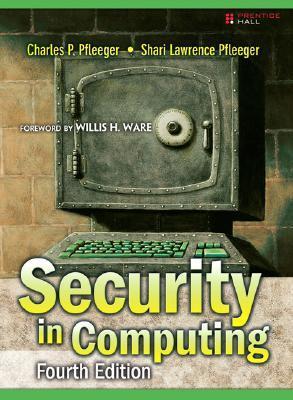
The New State-of-the-Art in Information Now Covers the Economics of Cyber Security and the Intersection of Privacy and Information Security For years, IT and security professionals and students have turned to Security in Computing as the definitive guide to information about computer security attacks and countermeasures. In their new fourth edition, Charles P. Pfleeger and Shari Lawrence Pfleeger have thoroughly updated their classic guide to reflect today's newest technologies, standards, and trends. The authors first introduce the core concepts and vocabulary of computer security, including attacks and controls. Next, the authors systematically identify and assess threats now facing programs, operating systems, database systems, and networks. For each threat, they offer best-practice responses. Security in Computing, Fourth Edition, goes beyond technology, covering crucial management issues faced in protecting infrastructure and information. This edition contains an all-new chapter on the economics of cybersecurity, explaining ways to make a business case for security investments. Another new chapter addresses privacy--from data mining and identity theft, to RFID and e-voting. New coverage also includes Programming mistakes that compromise man-in-the-middle, timing, and privilege escalation attacks Web application threats and vulnerabilities Networks of compromised bots, botnets, and drones Rootkits--including the notorious Sony XCP Wi-Fi network security challenges, standards, and techniques New malicious code attacks, including false interfaces and keystroke loggers Improving code software engineering, testing, and liability approaches Biometric capabilities and limitations Using the Advanced Encryption System (AES) more effectively Balancing dissemination with piracy control in music and other digital content Countering new cryptanalytic attacks against RSA, DES, and SHA Responding to the emergence of organized attacker groups pursuing profit
This book covers security at Many different levels (tries to be comprehensive)... although this is a constantly changing topic of study, every time new tactics are used by some hacker/virus/trojan...etc.
Topic included are: the "Meaning of Computer Security", Attacks & methods of defense, cryptology, software(code) security, Viruses, root-hacks, Operating system security, Trusted-systems, File protections, Database security, SQL injection, Multi-Level approaches, Networks, firewalls, Vlans, Session hijacking, flaws in net protocols, Web site vulnerabilities, Alarms, monitoring, countermeasures, Administration, Risk Analysis, Physical building security, Data privacy, computer ethics, Email monitoring or interception, spoofing, phishing, computer crime, code of ethics, SOA Architecture, and more...
This is certainly not a "light read" or something you complete in a week; but for somebody who runs computers professionally, there is a lot of info here -so you know several problem issues to avoid when designing new computer systems.
I would also recommend knowing the ISO-27001 and ISO-27009 standards, and similar security standards from OWASP (Open.Web.Application.Security.Project), plus Oasis-open.org guides.
Look, I don't read much poetry-adjacent stuff, and Security in Computing still got under my skin. Pfleeger, Shari Lawrence writes short, sparse chapters that feel like voice memos from someone trying to be honest, and the one about the last day in a childhood home made me put the book down and just stare at the wall. It's not for everybody, and a few pieces feel unfinished. For readers who like quiet, reflective writing. Skip it if you want a traditional story.
Look, Security in Computing is the kind of smart that doesn't need to announce itself. Shari Lawrence Pfleeger lets the ideas show up in small stories and quiet asides, and they stick longer that way. A couple of chapters drift. Great for readers who like subtle, skip if you want a loud thesis.
Reading Security in Computing 4th (forth) edition Text Only feels like getting a secret handbook from Charles P. Pfleeger on how to preserve your autonomy while living inside a hyper-managed culture.
This book has some great high level information on computer security and is heavy loaded with the computer security's industry lingo. However, it does not cover details on hacking techniques and the content is quite verbose - not very succinct. Additionally, this is not the latest edition of that book.