

What do you think?

Bad Girls: Sirens, Jezebels, Murderesses, Thieves and Other Female Villains
From Jezebel to Catherine the Great, from Cleopatra to Mae West, from Mata Hari to Bonnie Parker, strong women have been a problem for historians, storytellers, and readers. Strong females smack of the unfeminine. They have been called wicked, wanton, and willful. Sometimes that is a just designation, but just as often it is not. "Well-behaved women seldom make history," is the frequently quoted statement by historian and feminist Laurel Thatcher Ulrich. But what makes these misbehaving women "bad"? Are we idolizing the wicked or salvaging the strong?
In BAD GIRLS, readers meet twenty-six of history’s most notorious women, each with a rotten reputation. But authors Jane Yolen and Heidi Stemple remind us that there are two sides to every story. Was Delilah a harlot or hero? Was Catherine the Great a great ruler, or just plain ruthless? At the end of each chapter, Yolen and Stemple appear as themselves in comic panels as they debate each girl’s badness—Heidi as the prosecution, Jane for context.
This unique and sassy examination of famed, female historical figures will engage readers with its unusual presentation of the subject matter. Heidi and Jane’s strong arguments for the innocence and guilt of each bad girl promotes the practice of critical thinking as well as the idea that history is subjective. Rebecca Guay’s detailed illustrations provide a rich, stylized portrait of each woman, while the inclusion of comic panels will resonate with fans of graphic novels.
In BAD GIRLS, readers meet twenty-six of history’s most notorious women, each with a rotten reputation. But authors Jane Yolen and Heidi Stemple remind us that there are two sides to every story. Was Delilah a harlot or hero? Was Catherine the Great a great ruler, or just plain ruthless? At the end of each chapter, Yolen and Stemple appear as themselves in comic panels as they debate each girl’s badness—Heidi as the prosecution, Jane for context.
This unique and sassy examination of famed, female historical figures will engage readers with its unusual presentation of the subject matter. Heidi and Jane’s strong arguments for the innocence and guilt of each bad girl promotes the practice of critical thinking as well as the idea that history is subjective. Rebecca Guay’s detailed illustrations provide a rich, stylized portrait of each woman, while the inclusion of comic panels will resonate with fans of graphic novels.
172 pages, Hardcover
First published January 1, 2013
About the author
Jane Yolen
921 books3,288 followersJane Yolen was a novelist, poet, fantasist, journalist, songwriter, storyteller, folklorist, and children’s book author who wrote more than three hundred books. Her accolades include the Caldecott Medal, two Nebula Awards, the World Fantasy Award, three Mythopoeic Awards, the Kerlan Award, two Christopher Awards, and six honorary doctorate degrees from colleges and universities in Massachusetts and New Hampshire. Born and raised in New York City, the mother of three and the grandmother of six, Yolen lived in Massachusetts and St. Andrews, Scotland.
Ratings & Reviews
Friends & Following
Create a free account to discover what your friends think of this book!
Community Reviews
Displaying 1 - 30 of 329 reviews

May 5, 2015
Society has long looked at tough, smart, ambitious women and written them off as bad. But whether it's a criminal act or a moral lapse, wrongdoing needs to be viewed within the context it occured. Then again, bathing in blood, poisoning pesky husbands, and axe-murdering your parents doesn't usually win a girl any fans!

You would think with my reading tastes I would have been all over this book. It's written in short chapters that just gloss over the woman in history's story though and at the end I have no idea why the authors thought it would be cute to place little dialogues of them discussing the woman from the chapter. It was just plain stupid. I don't even think most kids are going to like that part. Then you have a graphic image post but again. Just stupid.
These strong, some misunderstood, some really whacko women made up our history. I would love a book that actually did them justice.
Some that were included but not done to their full glory were:
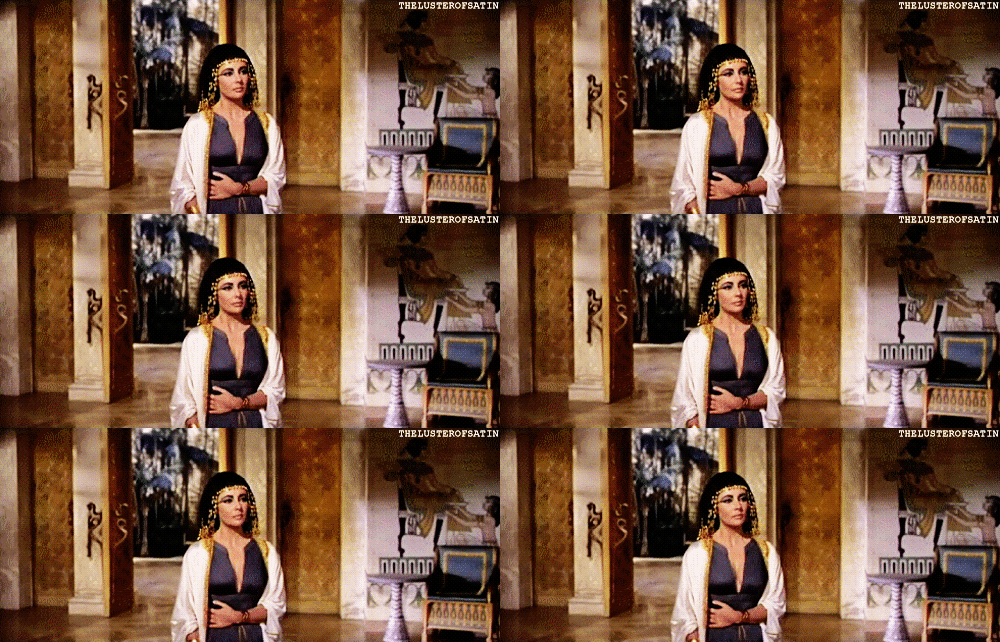
Cleopatra
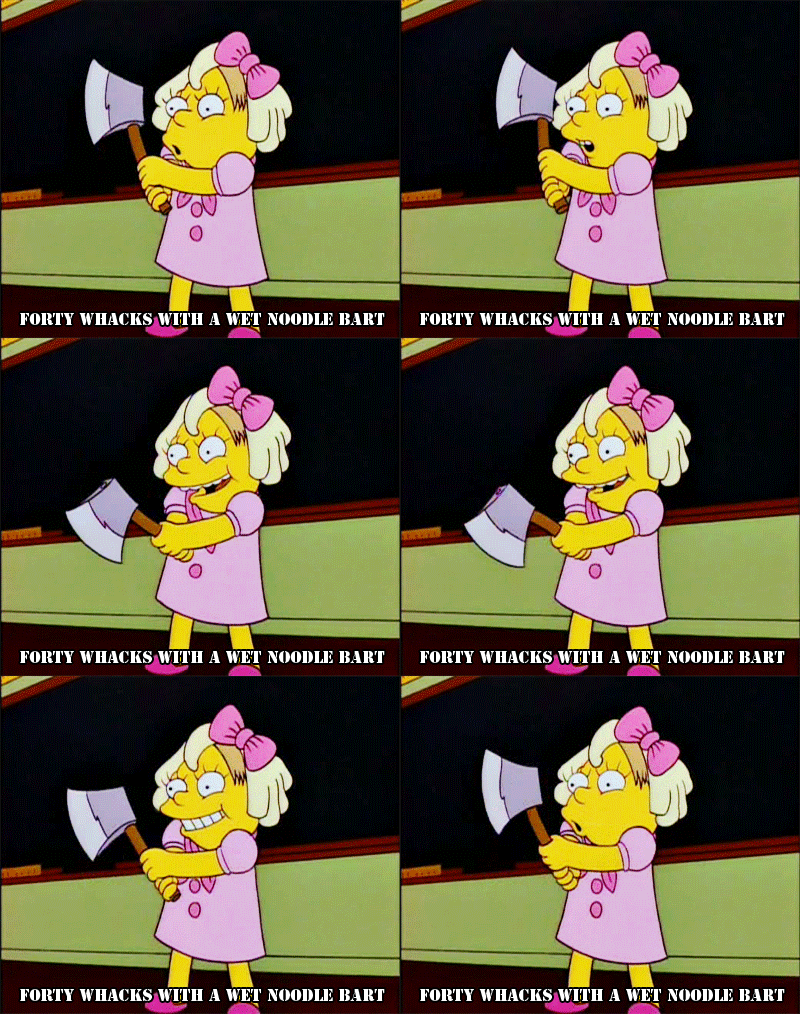
Lizzie Borden
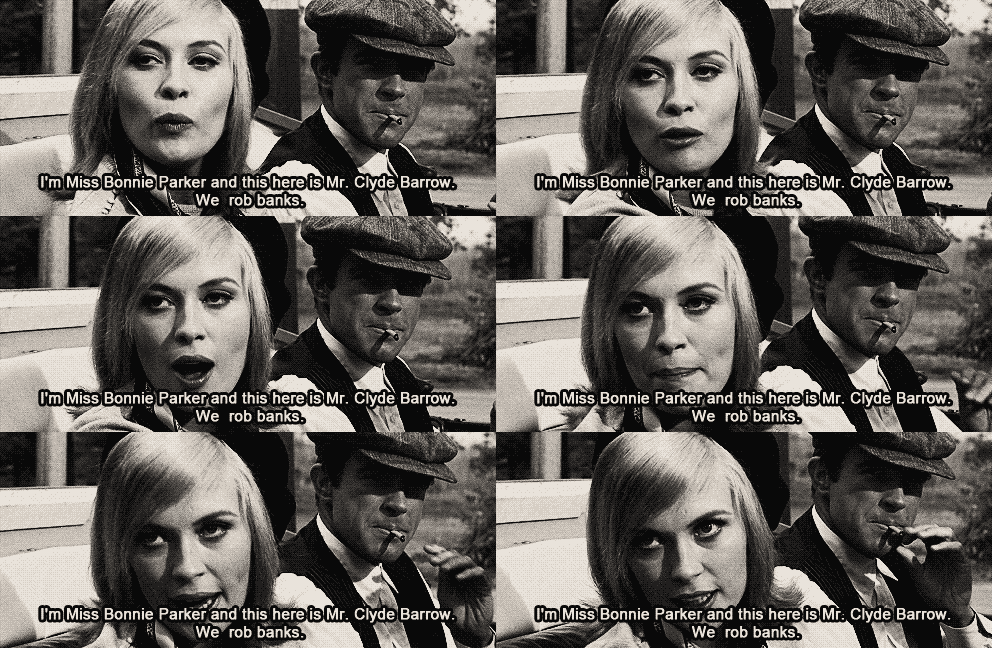
Bonnie Parker
I'm kinda meh about the book but it did make me want to learn more about most of these women.
You would think with my reading tastes I would have been all over this book. It's written in short chapters that just gloss over the woman in history's story though and at the end I have no idea why the authors thought it would be cute to place little dialogues of them discussing the woman from the chapter. It was just plain stupid. I don't even think most kids are going to like that part. Then you have a graphic image post but again. Just stupid.
These strong, some misunderstood, some really whacko women made up our history. I would love a book that actually did them justice.
Some that were included but not done to their full glory were:
Cleopatra
Lizzie Borden
Bonnie Parker
I'm kinda meh about the book but it did make me want to learn more about most of these women.

December 5, 2013
This is one of those nonfiction books that has a lot of very short chapters, all related to central theme. Here, it's history's "bad girls". Each woman gets a brief (5-10 page) overview of their personal history, written in a conversational, accessible way. It's a pretty decent selection. There are women that most readers would have heard something about (Cleopatra, Lizzie Borden), women that may have crossed the radars of some (Calamity Jane, Mary Read), and women that will almost certainly be new to most readers (Moll Cutpurse, Pearl Hart). Anyone who's seen the musical Chicago will be fascinated by the chapter on Beulah Annan and Belva Gaertner, the ladies who inspired Velma and Roxie.
An interesting departure from most books like this are the comic pages that accompany each bio. This is where the two authors debate the relative "badness" of each featured lady. Most books would have been satisfied to simply present the biography and move on. I'm not a big fan of the frivolous presentation (shoe shopping? ok) but the idea is a great one. It gives deeper context to who these women were and why they may have made the choices they did.
It's light, and fast, and definitely aimed at younger readers. It won't be satisfying for a lot of readers who would prefer more substance and less bios overall. But I think this could be a big hit with the target audience, and I appreciate the bibliography at the end.
An interesting departure from most books like this are the comic pages that accompany each bio. This is where the two authors debate the relative "badness" of each featured lady. Most books would have been satisfied to simply present the biography and move on. I'm not a big fan of the frivolous presentation (shoe shopping? ok) but the idea is a great one. It gives deeper context to who these women were and why they may have made the choices they did.
It's light, and fast, and definitely aimed at younger readers. It won't be satisfying for a lot of readers who would prefer more substance and less bios overall. But I think this could be a big hit with the target audience, and I appreciate the bibliography at the end.

June 18, 2013
I thought the comics at the end of each chapter were contrived and self-indulgent of the writers. I like the idea of exploring both the research process and the context of the women's lives, but I did not like the way the authors presented it. The "bad girls" were fascinating, and I liked the illustrations of them. Also, they cited Wikipedia as a source plenty if times. While I imagine they verified the info they found on that site, I don't trust the facts now.

June 22, 2017
I've read better history books, and the little side comics in between each chapter that featured the author and her daughter discussing the previous "bad girl" were dumb. I get that they were trying to promote discussion and that these "bad girls" may really not have been all that bad, but I just didn't like them. The only thing I liked about this book was the artwork.

May 10, 2013
This is the strangest book. I took it home expecting it to read much like "How They Croaked" by Georgia Bragg..and it is similar- 2-3 page retellings of why each of these women throughout history was seen as such a bad girl..from Cleopatra to Bonnie and Clyde's Bonnie, etc.
The tales are great and fun to read..but then between each woman's condensed life story there's a page of graphic novel style interactions between Jane Yolen and her daughter..one page they're going shoe shopping and talking about whether Delilah was framed..its the oddest thing ever and it doesn't work for me at all. I couldn't care less what this cartoon version of jane yolen and her daughter think about each of these women.
I'd definitely recommend this to a teen or even tween girl that's up for a bit of carnage- but I'd advise her to feel ok skipping those lame parts in between. I did..and then I went back and read them and wished I hadn't.
JESSE
The tales are great and fun to read..but then between each woman's condensed life story there's a page of graphic novel style interactions between Jane Yolen and her daughter..one page they're going shoe shopping and talking about whether Delilah was framed..its the oddest thing ever and it doesn't work for me at all. I couldn't care less what this cartoon version of jane yolen and her daughter think about each of these women.
I'd definitely recommend this to a teen or even tween girl that's up for a bit of carnage- but I'd advise her to feel ok skipping those lame parts in between. I did..and then I went back and read them and wished I hadn't.
JESSE

April 20, 2018
I loved this so much!!! Honestly I'm kind of shocked by all the low reviews on here for this one. Tthis was exactly what I needed because I've read a lot of these books that feature more 'good' or 'inspiring' women, but it's nice to see some definite bad girls as well. The book does go out of its way to say that some of these women might not necessarily have been as bad as they are remembered now in popular culture, but some of them are definitely inexcusable. I mean Typhoid Mary was probably really just a woman who was sick and didn't trust doctors, but Elizabeth Bathory had over 300 people killed to bathe in their blood and I don't know how you could put a positive spin on that.
Anyway, I thought this was really fun and it included a lot of women that you will probably not see in any other similar collections. Also I LOVED that it went [more or less] in chronological order! It always bugs me that these collections skip around so much but this one started out in Bibles times and ended up in the 20th century and it seems like a little thing but my organized brain loves it so much. I suppose if I had one criticism it would be that it was mostly focused on Western women after the first few entries, but overall it was still a really great read.
Anyway, I thought this was really fun and it included a lot of women that you will probably not see in any other similar collections. Also I LOVED that it went [more or less] in chronological order! It always bugs me that these collections skip around so much but this one started out in Bibles times and ended up in the 20th century and it seems like a little thing but my organized brain loves it so much. I suppose if I had one criticism it would be that it was mostly focused on Western women after the first few entries, but overall it was still a really great read.

April 9, 2013
I started reading this book thinking it might be interesting to take on school visits to booktalk, but was disappointed right away. I only read the first few chapters. They were extremely short and not very informative, and when I got to the death of Cleopatra, I was surprised that the authors relied on the much-theorized death by asp. I have read other books about Cleopatra which delved into other possibilities for her death. For example:
From the website http://penelope.uchicago.edu:
Although Cleopatra poisoned herself, no-one quite knew how. Plutarch relates that there were two slight pricks on her arm and that poison might have been hidden in a hollow comb (knestis), a word used rarely enough to suggest that he may have adhered to an earlier account (LXXXVI.2-3). Dio comments upon the marks as well, which may have been caused by a poisonous pin used to fasten her hair (LI.14.1). Or they may have been from the bite of an asp, which must have been hidden in a basket of flowers (or figs) or a water jar, although no snake ever was found.
At any rate, given those factors, I did not finish the book because I was not sure how historically accurate it was going to be, and I felt like the depictions of these women were really really abbreviated so you had no sense of who they were or why they did the things they did. Disappointing.
Publication Date: February 1, 2013
Meet twenty-six of history's most notorious women. Each bad girl has a rotten reputation, but there are two sides to every tale. Decide whether Tituba was really a conspiring witch or just a humble housemaid. Analyze the evidence stacked for and against Lizzie Borden. And what made the brazen Cleopatra so dishonorable . . . or honorable? Each chapter ends with comic panels featuring caricatures of the authors discussing the women, with Heidi arguing as the prosecution and Jane arguing for context.
From the website http://penelope.uchicago.edu:
Although Cleopatra poisoned herself, no-one quite knew how. Plutarch relates that there were two slight pricks on her arm and that poison might have been hidden in a hollow comb (knestis), a word used rarely enough to suggest that he may have adhered to an earlier account (LXXXVI.2-3). Dio comments upon the marks as well, which may have been caused by a poisonous pin used to fasten her hair (LI.14.1). Or they may have been from the bite of an asp, which must have been hidden in a basket of flowers (or figs) or a water jar, although no snake ever was found.
At any rate, given those factors, I did not finish the book because I was not sure how historically accurate it was going to be, and I felt like the depictions of these women were really really abbreviated so you had no sense of who they were or why they did the things they did. Disappointing.
Publication Date: February 1, 2013
Meet twenty-six of history's most notorious women. Each bad girl has a rotten reputation, but there are two sides to every tale. Decide whether Tituba was really a conspiring witch or just a humble housemaid. Analyze the evidence stacked for and against Lizzie Borden. And what made the brazen Cleopatra so dishonorable . . . or honorable? Each chapter ends with comic panels featuring caricatures of the authors discussing the women, with Heidi arguing as the prosecution and Jane arguing for context.

April 15, 2013
This would be great for an introduction to any one of the 26 infamous women in these pages, but my biggest complaint is simply that it left me wanting So. Much. More. Each chapter on a woman is alternated with a short graphic page with author commentary in which Jane Yolen and her daughter Heidi Stemple debate the relative goodness/badness of their subjects and hint at tantalizing research journeys. I wanted more on the women, and I wanted more author commentary. I thought both pieces of this book were tantalizing, but ultimately unfulfilling.
These are bad girls. Book discusses murder, adultery, and other crime.
These are bad girls. Book discusses murder, adultery, and other crime.

February 14, 2016
This is a horrible book that portrays women in a bad light. Not only is it badly written the authors go out of their way to make these women seem bad for the stupidest reason which in many cases is historically incorrect. This was another book I picked to read with my daughter thinking it will be nice to introduce her to females from history. According to the author Jezebel was bad because she was spoiled, was different, and made bad choices. Elisabeth Bathory murdered people because she was vain and bored and to make her worse she practiced witchcraft and magic not any magic but black magic. This book is a joke and I regret getting it!

August 25, 2017
This book was quick and fun. The tone was entertaining, though I question the 9 and up age level I saw for it on Amazon. I wanted more from each chapter. However, I did like the graphic pages at the end where the authors debate whether these women were "bad" and brought up points about the historical and cultural contexts.

August 11, 2018
Seemed like an interesting premise, but I quickly realized that trying to fit people into the label of 'bad' or 'good' just doesn't appeal to me.
September 18, 2023
The snippets about each "Bad Girl" were interesting. A little short. The commentary after each snippet was just really bad...
June 8, 2022
I love this book and now I know that when Taylor Swift mentions “Bonnie and Clyde” in getaway car they really were a couple in a getaway car!!!

April 16, 2013
Hailee Christman
Yolen, J., & Stemple, H. (2013). Bad girls: Sirens, jezebels, murderesses, thieves and other female villains. Watertown, MA: Charlesbridge.
Biography
Selection process: Booklist, starred review, February, 2013. Retrieved from Booklistonline.com
In Bad Girls, mother and daughter team Yolen and Stemple collect a biography of some of history’s most notorious female villains. Starting the collection in Biblical times with Delilah in 110 BCE and Salome in 17 CE among them and continuing through history with some of the most well-known “bad girls”. Did Lizzie Borden really murder her family with an ax? Did Elizabeth Bathory bathe in the blood of the girls that she killed? Each chapter is ended with a comic strip of the authors in their research process debating whether or not the “bad girls” were really bad. They present questions to ponder, but ultimately allow the reader to form their own opinions on the subject’s guilt or innocence. Illustrator Guay’s full page portraits prefacing each chapter are beautifully done and the thick, glossy paper is welcome. While the subject matter is highly appealing and will draw readers in, the brief biographies of these twenty-six ladies will leave readers with more curiosity than knowledge of the subject. Some of the women mentioned in the book are not as well but the chapters range from only a page and a half to three or four, making a quick read with not much substance. Those interested in the content will want to do further research on the villains that interest them for more extensive biographies, especially since the back matter contains only a conclusion and a bibliography.
Recommended for reluctant readers.
Yolen, J., & Stemple, H. (2013). Bad girls: Sirens, jezebels, murderesses, thieves and other female villains. Watertown, MA: Charlesbridge.
Biography
Selection process: Booklist, starred review, February, 2013. Retrieved from Booklistonline.com
In Bad Girls, mother and daughter team Yolen and Stemple collect a biography of some of history’s most notorious female villains. Starting the collection in Biblical times with Delilah in 110 BCE and Salome in 17 CE among them and continuing through history with some of the most well-known “bad girls”. Did Lizzie Borden really murder her family with an ax? Did Elizabeth Bathory bathe in the blood of the girls that she killed? Each chapter is ended with a comic strip of the authors in their research process debating whether or not the “bad girls” were really bad. They present questions to ponder, but ultimately allow the reader to form their own opinions on the subject’s guilt or innocence. Illustrator Guay’s full page portraits prefacing each chapter are beautifully done and the thick, glossy paper is welcome. While the subject matter is highly appealing and will draw readers in, the brief biographies of these twenty-six ladies will leave readers with more curiosity than knowledge of the subject. Some of the women mentioned in the book are not as well but the chapters range from only a page and a half to three or four, making a quick read with not much substance. Those interested in the content will want to do further research on the villains that interest them for more extensive biographies, especially since the back matter contains only a conclusion and a bibliography.
Recommended for reluctant readers.

July 22, 2013
I've been intrigued by this book ever since I laid eyes on it's gorgeous cover. Who doesn't want to be seen reading a book with this bad girl on the cover? I felt instantly cool, just by association. Prolific and popular Jane Yolen teams up with her daughter to enlighten and inform a new generation of readers about the escapades and lives of some of history's most notorious bad girls, from Cleopatra to Bonnie (of Clyde fame). I like the range of characters they explore and the two or three pages of lively writing that accompany these femme fatales: enough to inform readers and to whet appetites for more, should you choose. Interspersed between chapters is an interesting twist: a dialogue between Jane and her daughter, in graphic novel format, discussing the merits of each of the bad girls, always going back to context. They are also portrayed as hard-at-work researchers, whether at a musical, restaurant, or shoe-store (all for the sake of research, right?) Were these women victims of circumstances or knowing vixens of evil? Are they misunderstood or simply misanthropic? While some reviews found these little narrative vignettes self-indulgent or frivolous, I didn't mind them at all. I'm not sure how younger readers will find them: they may simply gloss over them, but given the tantalizing pull of a graphic novel template, I doubt they will. This book may cause a stir, as well, given the glamorizing treatment these murderesses and thieves receive, but Yolen certainly does not gloss over the untimely and often gruesome ends most of these women endured.
May 17, 2013
This book wasn't what I expected! First of all, it's a nice book, aesthetically. It's got shiny pages and pretty pictures (Rebecca Guay's art, as always, is stunning). Every section is about a separate 'bad girl' from history, and after the two or three page sections there's a one page comic of the authors (mother and daughter!) discussing whether they think the girl is 'bad' or 'good'. It's cute. The book has big print and is targeted probably towards a middle school audience. My major problem with the book is that the focus is so heavy on western women. Every single person is white except Cleopatra and Tituba. I mean, they're awesome ladies! I like this book! But it would have gotten four or five stars if they included some great Asian, African, Latin American, Native American, etc etc women in it as well.

March 14, 2014
The summaries of each "bad girl" in the book were awesomely written, and Guay's portraits of each were exquisite. I was less thrilled about the didactic and corny comics of the authors discussing the women's relative guilt. I think the ideas they presented were great, I just didn't understand the need to put it in graphic format. We're they afraid that young readers would be put off if those thoughts were in essay form? Great summation of those ideas at the end - in a thoughtful essay at that. Also, awesome bibliography, but then, Yolen is a professional! Can't wait to read more about the women they introduced. Maybe they'll write Bad Girls II but skip the cheesy comics.

September 4, 2014
I think maybe I wanted a little more from this... but then I studied women's history in college and this is a book for tweens, so maybe that's unreasonable. I think it's a great little intro to some famous (and not-so-famous) women of history, as well as to the concept that there are multiple perspectives on historical figures. And that people, especially women, maybe have been operating within a limited framework when they made their options.
I also liked the comic versions of Jane Yolen and her daughter/co-author talking about each "bad girl" and making their own judgement. It feels cute and behind-the-scenes-y, and shows healthy disagreements.
I also liked the comic versions of Jane Yolen and her daughter/co-author talking about each "bad girl" and making their own judgement. It feels cute and behind-the-scenes-y, and shows healthy disagreements.

January 26, 2016
I would have given this a 3.5, because the summation of the Bad Girls was well done and the illustrations were lovely. But the authors - a mother daughter team - inserted a comic panel of themselves "discussing" the relative badness of each girl after every story, and not only were the panels jarring and lacking, they failed at what I believe the goal was - to get readers thinking about relativity. Halfway through the book I started skipping those panels and I found the experience much more pleasant (and actually MORE thought-provoking!)
August 30, 2017
2/5 stars
Overall I thought that with the limited amount of pages given that they managed to get a lot of information out. I thought that the small graphic/comic page at the end of each story was very irrelevant and sometimes silly, it would've been a lot better if they left that part out. The story was interesting and it was something I've never read before, though sometimes boring it was still an okay read
Overall I thought that with the limited amount of pages given that they managed to get a lot of information out. I thought that the small graphic/comic page at the end of each story was very irrelevant and sometimes silly, it would've been a lot better if they left that part out. The story was interesting and it was something I've never read before, though sometimes boring it was still an okay read
October 13, 2018
Quick easy read meant for young adults. The most basic outlines on the stories of "bad" women through history. Stumbled across this on my ebooks looking for something else. It made for a good subway read since each story is so short.

January 24, 2013
Fun book for tweens, but very introductory. Still, gave me some ideas for historical figures I'd like to do further reading on!
January 21, 2016
Ok. I learned a few things. It made me want to read more about some of these women. But it was pretty lame. The cartoons at the end of each chapter were awful and unnecessary.

February 21, 2021
✨ "When I'm good, I'm very good. But when I'm bad, I'm better."
A fascinating read about some of history's most prominent femme fatales, from iconic figures such as Cleopetra, Elisabeth Bathory, Anne Boelyn, Lizzy Borden and Bonnie Parker to lesser-known ones like Salome, Moll Cutpurse and Virginia Hill.
I would have enjoyed longer chapters and more content about each woman and their extraordinary lives. Didn't care much for the authors' commentary in between each chapter, though I understand it's to provide balance and both sides of the story e.g. are the women 100% villains or just victims of circumstance?
✨ "Because even the baddest of bad girls... may have a good side."

January 24, 2013
My new neighbor just asked me if there was any non-fiction out there that wasn't boring. Her daughter's avoiding a summer reading assignment on ancient civilizations. When I suggested a book about history's baddest girls, she cringed. Which lit her daughter's eyes up even more.
This is non-fiction that does exactly what it should be doing. It piques kid's interest. More so, it piques girl's interests. Right from the start, Jane Yolen and Heidi Stemple present a lens for their reader to evaluate bad girl's story. We're they victims of circumstance? Were they affected by the time in which they lived? Or, were they just bad? Each woman chronicled is accompanied by a gorgeous image from Rebecca Guay, While Heidi and Jane give a wikipedic overview of each character's background, they're writing does so with attitude. Each piece of the tale clearly ties back to what the author's intended. They present as many facts as possible, they present as much historical context as possible (while keeping succinct), and at the end of each summary a mother/daughter debate is presented in graphic form.
We talk so much about the boys and reading "epidemic" but equally as important, the amount of girls averse to non-fiction. Granted, my sample size is relatively small but I've always struggled to get non-fiction to catch on with my 5th grade girls. There's only a few titles that stick out in terms of circulation without prompting. This is one of those titles. Captivating its reader's interest, I have no doubt that the girls who find this gem will want to investigate the characters even further.
This is non-fiction that does exactly what it should be doing. It piques kid's interest. More so, it piques girl's interests. Right from the start, Jane Yolen and Heidi Stemple present a lens for their reader to evaluate bad girl's story. We're they victims of circumstance? Were they affected by the time in which they lived? Or, were they just bad? Each woman chronicled is accompanied by a gorgeous image from Rebecca Guay, While Heidi and Jane give a wikipedic overview of each character's background, they're writing does so with attitude. Each piece of the tale clearly ties back to what the author's intended. They present as many facts as possible, they present as much historical context as possible (while keeping succinct), and at the end of each summary a mother/daughter debate is presented in graphic form.
We talk so much about the boys and reading "epidemic" but equally as important, the amount of girls averse to non-fiction. Granted, my sample size is relatively small but I've always struggled to get non-fiction to catch on with my 5th grade girls. There's only a few titles that stick out in terms of circulation without prompting. This is one of those titles. Captivating its reader's interest, I have no doubt that the girls who find this gem will want to investigate the characters even further.

March 2, 2016
The full title of this book is Bad Girls: Sirens, Jezebels, Murderesses, and Other Female Villains, and it's a collection of short biographies of, well, female villains of history.
It's fairly standard as far as biographees go. Jezebel, Mata Hari, Catherine the Great, Cleopatra, Delilah, etc (though there were a few surprises; I wasn't expecting Virginia Hill or Tituba). The biographies are five to ten pages long, nice bite-sized pieces for a middle-grade reader, and the illustrations (by Rebecca Guay) are cute and well done. If the book were just those little biographies, I'd probably give it to a kid, but I wouldn't expect them to read it more than once.
What makes this book special, though, is the page-long graphic novel-esque dialogue between the two authors at the end of each biography. Yolen and Stemple are mother and daughter, and each segment is a conversation between them on the subject of the woman we've just read about. They debate whether each woman is a villain or a heroine, whether her actions were understandable in the context of the time or not, or even, in some cases, whether or not she was guilty. It's a sort of historiography for children; it teaches them to think about history, to think about the assumptions they're making, and to question the stories they're being told. I think that's a valuable lesson at any age, and conveyed particularly well here.
This would be a good addition to any library's children's collection, and it's definitely worth a read for middle-school kids.
It's fairly standard as far as biographees go. Jezebel, Mata Hari, Catherine the Great, Cleopatra, Delilah, etc (though there were a few surprises; I wasn't expecting Virginia Hill or Tituba). The biographies are five to ten pages long, nice bite-sized pieces for a middle-grade reader, and the illustrations (by Rebecca Guay) are cute and well done. If the book were just those little biographies, I'd probably give it to a kid, but I wouldn't expect them to read it more than once.
What makes this book special, though, is the page-long graphic novel-esque dialogue between the two authors at the end of each biography. Yolen and Stemple are mother and daughter, and each segment is a conversation between them on the subject of the woman we've just read about. They debate whether each woman is a villain or a heroine, whether her actions were understandable in the context of the time or not, or even, in some cases, whether or not she was guilty. It's a sort of historiography for children; it teaches them to think about history, to think about the assumptions they're making, and to question the stories they're being told. I think that's a valuable lesson at any age, and conveyed particularly well here.
This would be a good addition to any library's children's collection, and it's definitely worth a read for middle-school kids.

June 10, 2013
Bad Girls, by Jane Yolen and Heidi E. Stemple, illustrated by Rebecca Guay
Charlesbridge, 2013
164 pages
Nonfiction
Recommended for grades 6+
I was reading this the other day when my friend poked the cover and said: "Jane Yolen, as in Owl Moon?" It goes without saying (though I'm saying it anyway), Jane Yolen can't be pigeonholed. In this interesting creation Yolen and her daughter team up to explore some 26 Bad Girls from around the world. 2011's How They Croaked: The Awful Ends of the Awfully Famous by Georgia Bragg and Kevin O'Malley shares a similar format with Bad Girls. Both books have short nonfiction (with pizazz) chapters on particular historical figures. Both books share the not so glamorous sides of those public figures, and both books are incredibly fun to read!
Each chapter is dedicated to one or two bad girls, and what follows is a short comic depicting mother Yolen and daughter Yolen debating the accused bad girl of her guilt or innocence, though it's never as clear as one or the other.
My only qualm about rating this book so highly is that I don't think it truly delves deeply into any one of the bad girls' lives. I knew a lot more about some of these women than others, and because of that some chapters interested and informed me, while others made me want to say, wait a minute, there's more to this story!
Charlesbridge, 2013
164 pages
Nonfiction
Recommended for grades 6+
I was reading this the other day when my friend poked the cover and said: "Jane Yolen, as in Owl Moon?" It goes without saying (though I'm saying it anyway), Jane Yolen can't be pigeonholed. In this interesting creation Yolen and her daughter team up to explore some 26 Bad Girls from around the world. 2011's How They Croaked: The Awful Ends of the Awfully Famous by Georgia Bragg and Kevin O'Malley shares a similar format with Bad Girls. Both books have short nonfiction (with pizazz) chapters on particular historical figures. Both books share the not so glamorous sides of those public figures, and both books are incredibly fun to read!
Each chapter is dedicated to one or two bad girls, and what follows is a short comic depicting mother Yolen and daughter Yolen debating the accused bad girl of her guilt or innocence, though it's never as clear as one or the other.
My only qualm about rating this book so highly is that I don't think it truly delves deeply into any one of the bad girls' lives. I knew a lot more about some of these women than others, and because of that some chapters interested and informed me, while others made me want to say, wait a minute, there's more to this story!

February 19, 2021
DNF at page 37, after reading 5 chapters. I just... could NOT with this book, which is historically inaccurate in a way that feeds into misconceptions about controversial women rather than deconstructing them (eg the Anne Boleyn chapter is a load of bullshit about how she actively pursued the King and everyone hated her - read the Hayley Nolan book or check out her Tik Tok for why that’s so so wrong).
The comic asides between the authors are massively self-indulgent, trite, prejudiced and judgey as FUCK Example: one of the authors (Heidi) insists that Salome probably being eleven or twelve doesn’t stop her being complicit in the murder of John the Baptist, even after she was just made to strip for everyone by her step-father????? The author Heidi goes on to quip she believes it because it’s ‘what the bible told her’, which I assume is meant to be a tongue-in-cheek indication that that’s bullshit, but... it does NOT work. It’s just not well-developed enough for that level of discourse, especially when it is a pervasive problem in society that some people WOULD judge an older-looking pre-teen as ‘knowing what she’s doing.’
Really disappointed with this book, which has such a promising premise and which was a gift (... from several years ago lol, I’m working through my backlog).
The comic asides between the authors are massively self-indulgent, trite, prejudiced and judgey as FUCK Example: one of the authors (Heidi) insists that Salome probably being eleven or twelve doesn’t stop her being complicit in the murder of John the Baptist, even after she was just made to strip for everyone by her step-father????? The author Heidi goes on to quip she believes it because it’s ‘what the bible told her’, which I assume is meant to be a tongue-in-cheek indication that that’s bullshit, but... it does NOT work. It’s just not well-developed enough for that level of discourse, especially when it is a pervasive problem in society that some people WOULD judge an older-looking pre-teen as ‘knowing what she’s doing.’
Really disappointed with this book, which has such a promising premise and which was a gift (... from several years ago lol, I’m working through my backlog).

February 12, 2016
Features the "usual suspects" (Cleopatra, Queen Mary I of England, Catherine the Great, and Elizabeth Bathory) with a few new ones who are relative unknowns unless you have a passing interest in the late 19th century American or 1940s-1950s mafia history. Geared towards a young adult audience, the chapters are relatively short and poses the moral question at the end of whether or not we should consider these women villianous based on their circumstance. Hard to tell in some cases in the way the information is presented. Personally I have no issues if the main sources come from Wikipedia as it indicates how little scholarship have been devoted towards some of these women. I do have any issue however in how this is list is pre-dominantly Euro-centric and American-centric. Inclusion of other figures from other cultures and society would have made the list much more interesting. However, if the book gets you interested in reading more about these women, then it has done it's job. Although I wonder if young females were the actual audience for this book as I suspect that the writers were trying to write a book that would attract a much wider audience that are more accustomed to pop culture-like media entries as opposed to more scholarly analysis.

April 4, 2015
This was a fun and interesting book about rebellious women of history and legend. The cast of characters is a motley crew of women who have make their presence known by breaking many rules and perhaps not a small number of bones. I think Yolen and Stemple do a great job of introducing readers to some important and wacky (and terrifying) historical figures, and to the processes of researching, writing and collaboration.
My main issue with the book was the comics that came after each chapter. Sometimes the shtick in these sections got heavy-handed -- I found them to be very repetitive and a bit condescending toward their intended audience. I think perhaps the authors were trying a little too hard to keep to their chosen recipe of humor and reflection and it felt over-produced and hemmed in. I doubt their YA audience would have minded more authentic, in-depth reflections. I did enjoy some of the comic-book banter of the mother-daughter team. It's great that they address the process of writing together and the question of badness versus boldness versus people in dire straights just trying to make it in the world. But, these sections were very guarded and not so engaging.
My main issue with the book was the comics that came after each chapter. Sometimes the shtick in these sections got heavy-handed -- I found them to be very repetitive and a bit condescending toward their intended audience. I think perhaps the authors were trying a little too hard to keep to their chosen recipe of humor and reflection and it felt over-produced and hemmed in. I doubt their YA audience would have minded more authentic, in-depth reflections. I did enjoy some of the comic-book banter of the mother-daughter team. It's great that they address the process of writing together and the question of badness versus boldness versus people in dire straights just trying to make it in the world. But, these sections were very guarded and not so engaging.
Displaying 1 - 30 of 329 reviews