

What do you think?
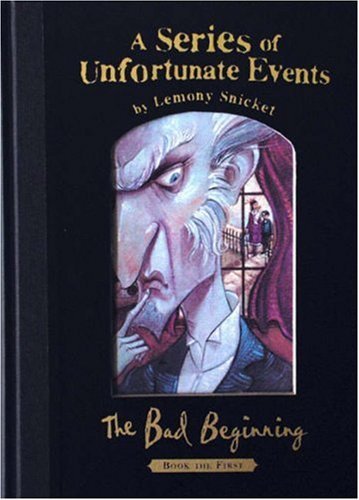
A Series of Unfortunate Events #1
The Bad Beginning
It's a good thing that Violet Baudelaire has a real knack for inventing things. When misery comes to call, the right invention at the right time can mean everything. It's also fortunate that her brother, Klaus, has read lots of books and knows many important things, like how to tell an alligator from a crocodile and who killed Julius Caesar. When everything that can possibly go wrong does, a small fact can be vital. It's lucky, too, that Sunny Baudelaire, the youngest sibling, likes to bite things. Even though she is an infant, and scarcely larger than a boot, she has four very big and sharp teeth. When trouble comes along, sharp teeth can save the day. But most of all, it is good fortune that Violet, Klaus, and Sunny Baudelaire are as sturdy and resilient as they are, for ahead of these three children lies a seemingly infinite series of unfortunate events.
80 pages, Hardcover
First published September 30, 1999
About the author
Lemony Snicket
387 books27.1k followersLemony Snicket had an unusual education and a perplexing youth and now endures a despondent adulthood. His previous published works include the thirteen volumes in A Series of Unfortunate Events, The Composer is Dead, and 13 Words. His new series is All The Wrong Questions.
For A Series of Unfortunate Events:
www.lemonysnicket.com
For All The Wrong Questions:
www.lemonysnicketlibrary.com
For A Series of Unfortunate Events:
www.lemonysnicket.com
For All The Wrong Questions:
www.lemonysnicketlibrary.com
Ratings & Reviews
Friends & Following
Create a free account to discover what your friends think of this book!
Community Reviews
Displaying 1 - 30 of 26,220 reviews

November 26, 2014
surely, i thought, rereading one of my childhood favorites will fix my life.
not entirely.
i think i imbued this book in my memory with some of the complexities and secrets and wittiness and mystery of the later installments in the series.
in reality it was less charming, less funny, less entertaining, less unique than i remembered. in fact, it was dark without much else.
there is a lot more violence and sexual harassment of children than i remember, which is crazy because i was such a nervous child i couldn't read harry potter (terf hogwarts) too close to bedtime.
i still liked it fine, but i await the actually suspenseful/layered/charming/funny books to come.
if i'm remembering those correctly.
bottom line: sorry to the whimsical young person i once was. preserved for posterity below.
(reading for a substack post)
----------------------
original full review
not entirely.
i think i imbued this book in my memory with some of the complexities and secrets and wittiness and mystery of the later installments in the series.
in reality it was less charming, less funny, less entertaining, less unique than i remembered. in fact, it was dark without much else.
there is a lot more violence and sexual harassment of children than i remember, which is crazy because i was such a nervous child i couldn't read harry potter (terf hogwarts) too close to bedtime.
i still liked it fine, but i await the actually suspenseful/layered/charming/funny books to come.
if i'm remembering those correctly.
bottom line: sorry to the whimsical young person i once was. preserved for posterity below.
(reading for a substack post)
----------------------
original full review

May 11, 2014
I'm reading through this series with my daughter Celyn (10 years old, very disabled, hence Dad does the reading).
Edit: Finished & reviewed all 13!
So, this is a clever, entertaining book set in a world like ours but populated with bizarre characters and with distinctly dark undercurrents.
Recurring themes throughout the series are:
i) Adults are mindbogglingly stupid.
ii) The narrator, Lemony Snicket, is a character we glimpse in tantalising snatches.
iii) Words that stretch a child's vocabulary are used regularly but defined in context (by the narrator) in an amusing way.
iv) The three siblings, Violet (14), Klaus (12), and Sunny (1) will use their singular talents (respectively inventor/bookworm/biter) to solve the problem.
v) That problem will be Count Olaaf
The book (like Roald Dahl's work) succeeds with a combination of wit, slapstick, and malice.
Short, very readable, will leave you wanting the next.
This one sets the scene, rapidly orphaning the children, establishing the goal (to survive long enough to take control of their huge inheritance), and their adversary (Count Olaaf and his theatre troop of sinister villains).
We have ten of the books because my elder children loved them when they were young. On book 5 I'm thinking we'll probably read them all.
EDIT: I have now posted reviews of all 13 books in the series - check them out!
Join my Patreon
Join my 3-emails-a-year mailing list #prizes
...
Edit: Finished & reviewed all 13!
So, this is a clever, entertaining book set in a world like ours but populated with bizarre characters and with distinctly dark undercurrents.
Recurring themes throughout the series are:
i) Adults are mindbogglingly stupid.
ii) The narrator, Lemony Snicket, is a character we glimpse in tantalising snatches.
iii) Words that stretch a child's vocabulary are used regularly but defined in context (by the narrator) in an amusing way.
iv) The three siblings, Violet (14), Klaus (12), and Sunny (1) will use their singular talents (respectively inventor/bookworm/biter) to solve the problem.
v) That problem will be Count Olaaf
The book (like Roald Dahl's work) succeeds with a combination of wit, slapstick, and malice.
Short, very readable, will leave you wanting the next.
This one sets the scene, rapidly orphaning the children, establishing the goal (to survive long enough to take control of their huge inheritance), and their adversary (Count Olaaf and his theatre troop of sinister villains).
We have ten of the books because my elder children loved them when they were young. On book 5 I'm thinking we'll probably read them all.
EDIT: I have now posted reviews of all 13 books in the series - check them out!
Join my Patreon
Join my 3-emails-a-year mailing list #prizes
...

Read
January 12, 2017*I'm not going to rate this, because I've already read this book & stand by my first rating of it.
I adore this story so much & I'm so happy that I took the time to re-read it. It made me feel SO nostalgic reading it. I can't wait for the netflix series!!
I adore this story so much & I'm so happy that I took the time to re-read it. It made me feel SO nostalgic reading it. I can't wait for the netflix series!!

July 13, 2022
SADNESS GALORE.
Violet, Klaus and Sunny are the pride and joy of their wealthy lovely parents, the Baudelaire. They all live merrily at an enormous mansion in the coastal city of Briny Beach. Until one sad day a fire destroys their beautiful home and burns everything in it, including their parents. The Baudelaire orphans, the embodiment of misfortune, must now face an uncertain future full of painfully sad moments. This is the beginning of a series. A series of unfortunate events.
This book specifically warns from the start that this is a sad story. Innocent me, I thought this was going to be haha sad, funny sad; but no, this is just sad. This is pure sadness. This is so fucking sad! What the hell is wrong with you Lemony? And I have twelve more books of crushing sadness to go through? YOU SICK TWISTED FUCK!
I have to admire the writer’s capacity to make me hate and love something so much in so few pages. LOVED the Baudelaire siblings, and their group strength and resilience to face all the crappy things that befalls them. Took me only two chapters to HATE Count Olaf with all my mangled heart. And I need more Justice Strauss please. I’m hoping for a diamond incrusted rainbow at the end of the series or else... Then again I must admit this book also specifically warns there is no happy ending at the end of this story; but I don’t care, I’m holding on to my little ray of hope. Fuck you Lemony. You are not bringing me down. YOU HEAR ME YOU SICK BASTARD??? You are not bringing me down!!
-----------------------------------------------
PERSONAL NOTE :
[1999] [176p] [Fiction] [3.5] [Recommendable] [Justice Strauss <3] [Die Olaf DIE!] [Tsunami of sadness] [I need a new heart] [Please make the pain stop] [Pardon my french!]
-----------------------------------------------
★★★★☆ 1. The Bad Beginning [3.5]
★★★★☆ 2. The Reptile Room [3.5]
★★★☆☆ 3. The Wide Window
★★☆☆☆ 4. The Miserable Mill [2,5]
★★★★★ 5. The Austere Academy [4.5]
★★★☆☆ 6. The Ersatz Elevator
★★★★★ 7. The Vile Village
★☆☆☆☆ 8. The Hostile Hospital
★★★☆☆ 9. The Carnivorous Carnival [3.5]
★★★☆☆ 10. The Slippery Slope [3.5]
★★★★☆ 11. The Grim Grotto
★★★☆☆ 12. The Penultimate Peril [3.5]
★★★★☆ 13. The End
★★★★☆ 14. The Complete Wreck
-----------------------------------------------
TRISTEZA EN ABUNDACIA.
Violet, Klaus y Sunny son el orgullo y alegría de sus amorosos y acaudalados padres, los Baudelaire. Todos viven felizmente en una enorme mansión en la costera ciudad de Briny Beach. Hasta que un triste día un incendio destruye su hermoso hogar y quema todo en ella, incluyendo sus padres. Los huérfanos Baudelaire, la encarnación del infortunio, deben enfrentar ahora un futuro incierto lleno de dolorosamente tristes momentos. Este es el comienzo de una serie. Una serie de eventos desafortunados.
Este libro específicamente advierte desde el inicio que ésta es una historia triste. Inocente yo, pensé que iba a ser jaja triste, triste gracioso; pero no, esto es sólo triste. Esto es pura tristeza. ¡Esto es tan malditamente triste! ¿Cuál demonios es tu problema Lemony? ¿Y tengo doce libros más de aplastante tristeza que sobrepasar? ¡MALDITO ENFERMO RETORCIDO!
Tengo que admirar la capacidad del autor para hacerme amar y odiar tanto sobre algo en tan escasas páginas. AME los hermanos Baudelaire, y su fortleza grupal y resiliencia para enfrentar todas las desgraciadas cosas que les sucedían. Me tomó sólo un par de capítulos para ODIAR a Olaf con todo mi magullado corazón. Y necesito más Justice Strauss por favor. Estoy esperado por un arcoriris incrustado de diamantes al final de esta serie o sino... Aun así debo admitir que este libro también específicamente advierte que no hay un final feliz al final de esta historia; pero no me importa, voy a aferrarme a mi rayito de esperanza. Vete al demonio Lemony. No me vas a hacer caer. ¿ME OYES BASTARDO ENFERMO? ¡¡No me vas a hacer caer!!
-----------------------------------------------
NOTA PERSONAL :
[1999] [176p] [Ficción] [3.5] [Recomendable] [Justice Strauss <3] [Muérete Olaf MUERETE!] [Tsunami de tristeza] [Necesito un nuevo corazón] [Por favor detengan el dolor] [Perdón por mi francés!]
-----------------------------------------------
Violet, Klaus and Sunny are the pride and joy of their wealthy lovely parents, the Baudelaire. They all live merrily at an enormous mansion in the coastal city of Briny Beach. Until one sad day a fire destroys their beautiful home and burns everything in it, including their parents. The Baudelaire orphans, the embodiment of misfortune, must now face an uncertain future full of painfully sad moments. This is the beginning of a series. A series of unfortunate events.
This book specifically warns from the start that this is a sad story. Innocent me, I thought this was going to be haha sad, funny sad; but no, this is just sad. This is pure sadness. This is so fucking sad! What the hell is wrong with you Lemony? And I have twelve more books of crushing sadness to go through? YOU SICK TWISTED FUCK!
I have to admire the writer’s capacity to make me hate and love something so much in so few pages. LOVED the Baudelaire siblings, and their group strength and resilience to face all the crappy things that befalls them. Took me only two chapters to HATE Count Olaf with all my mangled heart. And I need more Justice Strauss please. I’m hoping for a diamond incrusted rainbow at the end of the series or else... Then again I must admit this book also specifically warns there is no happy ending at the end of this story; but I don’t care, I’m holding on to my little ray of hope. Fuck you Lemony. You are not bringing me down. YOU HEAR ME YOU SICK BASTARD??? You are not bringing me down!!
-----------------------------------------------
PERSONAL NOTE :
[1999] [176p] [Fiction] [3.5] [Recommendable] [Justice Strauss <3] [Die Olaf DIE!] [Tsunami of sadness] [I need a new heart] [Please make the pain stop] [Pardon my french!]
-----------------------------------------------
★★★★☆ 1. The Bad Beginning [3.5]
★★★★☆ 2. The Reptile Room [3.5]
★★★☆☆ 3. The Wide Window
★★☆☆☆ 4. The Miserable Mill [2,5]
★★★★★ 5. The Austere Academy [4.5]
★★★☆☆ 6. The Ersatz Elevator
★★★★★ 7. The Vile Village
★☆☆☆☆ 8. The Hostile Hospital
★★★☆☆ 9. The Carnivorous Carnival [3.5]
★★★☆☆ 10. The Slippery Slope [3.5]
★★★★☆ 11. The Grim Grotto
★★★☆☆ 12. The Penultimate Peril [3.5]
★★★★☆ 13. The End
★★★★☆ 14. The Complete Wreck
-----------------------------------------------
TRISTEZA EN ABUNDACIA.
Violet, Klaus y Sunny son el orgullo y alegría de sus amorosos y acaudalados padres, los Baudelaire. Todos viven felizmente en una enorme mansión en la costera ciudad de Briny Beach. Hasta que un triste día un incendio destruye su hermoso hogar y quema todo en ella, incluyendo sus padres. Los huérfanos Baudelaire, la encarnación del infortunio, deben enfrentar ahora un futuro incierto lleno de dolorosamente tristes momentos. Este es el comienzo de una serie. Una serie de eventos desafortunados.
Este libro específicamente advierte desde el inicio que ésta es una historia triste. Inocente yo, pensé que iba a ser jaja triste, triste gracioso; pero no, esto es sólo triste. Esto es pura tristeza. ¡Esto es tan malditamente triste! ¿Cuál demonios es tu problema Lemony? ¿Y tengo doce libros más de aplastante tristeza que sobrepasar? ¡MALDITO ENFERMO RETORCIDO!
Tengo que admirar la capacidad del autor para hacerme amar y odiar tanto sobre algo en tan escasas páginas. AME los hermanos Baudelaire, y su fortleza grupal y resiliencia para enfrentar todas las desgraciadas cosas que les sucedían. Me tomó sólo un par de capítulos para ODIAR a Olaf con todo mi magullado corazón. Y necesito más Justice Strauss por favor. Estoy esperado por un arcoriris incrustado de diamantes al final de esta serie o sino... Aun así debo admitir que este libro también específicamente advierte que no hay un final feliz al final de esta historia; pero no me importa, voy a aferrarme a mi rayito de esperanza. Vete al demonio Lemony. No me vas a hacer caer. ¿ME OYES BASTARDO ENFERMO? ¡¡No me vas a hacer caer!!
-----------------------------------------------
NOTA PERSONAL :
[1999] [176p] [Ficción] [3.5] [Recomendable] [Justice Strauss <3] [Muérete Olaf MUERETE!] [Tsunami de tristeza] [Necesito un nuevo corazón] [Por favor detengan el dolor] [Perdón por mi francés!]
-----------------------------------------------

July 24, 2015
For some reason I had the sudden urge to re-read these books... so I decided to start listening to them on audiobook!
I have the 11th book in a physical copy, but I will eventually be picking the rest of them up as well.
I have the 11th book in a physical copy, but I will eventually be picking the rest of them up as well.

May 30, 2018
Up until now, the three Baudelaire children have lived a fairly lavish life, until a raging fire burns through their home with their parents inside. Their deaths are suspicious and nobody really knows how the fire started in the first place. Now they have nothing left and Mr. Poe must find a relative that’s willing to take on the responsibility of caring for them.
“Mr. Poe opened his mouth to say something, but erupted into a brief fit of coughing. “I have made arrangements,” he said finally, “for you to be raised by a distant relative of yours who lives on the other side of town. His name is Count Olaf.”
When the children are delivered to their new caretaker (Count Olaf), their hope is that their life will take a turn for the better. However, it seems that Count Olaf’s only interest is gaining their family fortune and the Baudelaire children must find a way to protect themselves from his nasty schemes.

There were comical parts in the book and surely the whole story isn’t just bad events happening to the children. I felt that there were positive aspects too. I personally admired how the children stood together and had each other’s back. They’re intelligent kids–effective problem solvers–and make the best out of the predicament they’re in. Also, there are many important messages about family, trust, embracing what you have and making the best of it. For me, the biggest takeaway was that justice and life in general don’t always work in our favor as the adults who are supposed to be the protectors make one mistake after another in this book. It’s enough to drive one mad and reminded me of how crazy things can get when deranged people have power and control over others, especially children.

I enjoyed the writing and thought it was really easy to follow. We loved the illustrations, but found ourselves wanting more because there aren’t that many and mainly just at the beginning of each chapter. There are frequent new vocabulary words introduced for children to learn and I appreciated the addition of them with thorough explanations.
“It is very useful, when one is young, to learn the difference between “literally” and “figuratively.” If something happens literally, it actually happens; if something happens figuratively, it feels like it is happening.
If you are literally jumping for joy, for instance, it means you are leaping in the air because you are very happy. If you are figuratively jumping for joy, it means you are so happy that you could jump for joy, but are saving your energy for other matters.”
The ending is left wide-open for the second book, The Reptile Room. I’m really looking forward to starting the next book and reading this whole series. My plan is to read them all with my kids before we start the Netflix series.
4****
You can see all my reviews@ www.readrantrockandroll.com
“Mr. Poe opened his mouth to say something, but erupted into a brief fit of coughing. “I have made arrangements,” he said finally, “for you to be raised by a distant relative of yours who lives on the other side of town. His name is Count Olaf.”
When the children are delivered to their new caretaker (Count Olaf), their hope is that their life will take a turn for the better. However, it seems that Count Olaf’s only interest is gaining their family fortune and the Baudelaire children must find a way to protect themselves from his nasty schemes.
There were comical parts in the book and surely the whole story isn’t just bad events happening to the children. I felt that there were positive aspects too. I personally admired how the children stood together and had each other’s back. They’re intelligent kids–effective problem solvers–and make the best out of the predicament they’re in. Also, there are many important messages about family, trust, embracing what you have and making the best of it. For me, the biggest takeaway was that justice and life in general don’t always work in our favor as the adults who are supposed to be the protectors make one mistake after another in this book. It’s enough to drive one mad and reminded me of how crazy things can get when deranged people have power and control over others, especially children.
I enjoyed the writing and thought it was really easy to follow. We loved the illustrations, but found ourselves wanting more because there aren’t that many and mainly just at the beginning of each chapter. There are frequent new vocabulary words introduced for children to learn and I appreciated the addition of them with thorough explanations.
“It is very useful, when one is young, to learn the difference between “literally” and “figuratively.” If something happens literally, it actually happens; if something happens figuratively, it feels like it is happening.
If you are literally jumping for joy, for instance, it means you are leaping in the air because you are very happy. If you are figuratively jumping for joy, it means you are so happy that you could jump for joy, but are saving your energy for other matters.”
The ending is left wide-open for the second book, The Reptile Room. I’m really looking forward to starting the next book and reading this whole series. My plan is to read them all with my kids before we start the Netflix series.
4****
You can see all my reviews@ www.readrantrockandroll.com

January 17, 2017
We have in Egypt this saying;

So I said, why not give this title a try

"accompanied by this mysterious black cat that sat with me the whole 2 hours read"
It's really dark-fun Misfortunekids Orphans' story..

And a Gothic villain.

And the author himself, Mr. Lemony Snicket;

who advises you repeatedly that this book is sad and misfortune and not with a happy endings..and please close it or return it if you can't handle all this misfortune..
Even the TV show latest adaptation tells u to just
LOOK AWAY, well... that's true... you should stop reading this review now as well..look for something happier.

BUT as our beloved mother Country saying...which I said earlier, I didn't Look Away.
And that was.....sickly fun.

The Story
-------
The Baudelaire 3 children lost their parents, their huge house and everything they own in a fire... But not their huge bank account.
Mr.Poe, the banker is the one responsible to see them to the 'proper' guardian. Proper here refer to something that never happened.. oh he delivered them to a guardian, but proper is not a suitable word to describe Count Olaf.

Who's has nothing to do with them but plotting to get his hand of their fortune. Which they even can't get their hand on it till the eldest -Violet,14- come of age.
To try to get their fortune. He puts them in a Series of Unfortunate Events.

And by the second half of the Book One.. his first grand plan is to wed Violet by deceive ..

How , how can they know the deceive, how can they escape his plan without endanger their lives??? that's the book one for you.
Oh and no matter what do you think.. the author stick to his word.
No Happy Endings here..
~~~~~~~~~~~~~~~~~~~~~~~~~~
The Writing Style
-------------

It's really like children book, the style, the easy sentences and even when the author use a big or fancy word he always give the meaning of it even if it's easy in a very funny way. Also he does that in expressions and literature techniques as well.
It's sarcastic and if it's really a children's book..it's the Darkest one ever written.
If you read of Mr. Lemony Snicket's real life you'll feel he's been 'forced' somehow to write a children books. It's 1999, the phenomenon of Harry Potter was on the catching fire stage.., that's why the result comes like it's a Satire of children books.. Satire here means a dark fun sarcastic imitation of normal life children books.
The creating of the Lemony Snicket constant commentaries through the book as a detective who investigate the Baudelaire orphans' Series and tell this as a story for ether very young readers, or slow ones, that worked as a very funny 'comic relief' amidst all the Misfortune Unfortunate Events Series.

'Comic Relief' here means small funny moments that gets between more tensed or serious ones.
Well..
That's it for a small book reviews. I over talked it I guess.. but I really loved this absurd dark fun of...
Unfortunate Events.
Mohammed Arabey
16 January 2017
To 17 January 2017
"Who sees the Unfortunate Events of others feel solace about his own Unfortunates"So, 2016 wasn't my year -EST, 2011- and now I'm hitting "rock bottom",having "A Series of Unfortunate Events"
"اللي يشوف أنفورشنت ايفينتس الناس تهون عليه أنفورشنته"
So I said, why not give this title a try
"accompanied by this mysterious black cat that sat with me the whole 2 hours read"
It's really dark-fun Misfortune
And a Gothic villain.
And the author himself, Mr. Lemony Snicket;
who advises you repeatedly that this book is sad and misfortune and not with a happy endings..and please close it or return it if you can't handle all this misfortune..
Even the TV show latest adaptation tells u to just
LOOK AWAY, well... that's true... you should stop reading this review now as well..look for something happier.
BUT as our beloved mother Country saying...which I said earlier, I didn't Look Away.
And that was.....sickly fun.
The Story
-------
The Baudelaire 3 children lost their parents, their huge house and everything they own in a fire... But not their huge bank account.
Mr.Poe, the banker is the one responsible to see them to the 'proper' guardian. Proper here refer to something that never happened.. oh he delivered them to a guardian, but proper is not a suitable word to describe Count Olaf.
Who's has nothing to do with them but plotting to get his hand of their fortune. Which they even can't get their hand on it till the eldest -Violet,14- come of age.
To try to get their fortune. He puts them in a Series of Unfortunate Events.
And by the second half of the Book One.. his first grand plan is to wed Violet by deceive ..
How , how can they know the deceive, how can they escape his plan without endanger their lives??? that's the book one for you.
Oh and no matter what do you think.. the author stick to his word.
No Happy Endings here..
~~~~~~~~~~~~~~~~~~~~~~~~~~
The Writing Style
-------------
It's really like children book, the style, the easy sentences and even when the author use a big or fancy word he always give the meaning of it even if it's easy in a very funny way. Also he does that in expressions and literature techniques as well.
It's sarcastic and if it's really a children's book..it's the Darkest one ever written.
If you read of Mr. Lemony Snicket's real life you'll feel he's been 'forced' somehow to write a children books. It's 1999, the phenomenon of Harry Potter was on the catching fire stage.., that's why the result comes like it's a Satire of children books.. Satire here means a dark fun sarcastic imitation of normal life children books.
The creating of the Lemony Snicket constant commentaries through the book as a detective who investigate the Baudelaire orphans' Series and tell this as a story for ether very young readers, or slow ones, that worked as a very funny 'comic relief' amidst all the Misfortune Unfortunate Events Series.
'Comic Relief' here means small funny moments that gets between more tensed or serious ones.
Well..
That's it for a small book reviews. I over talked it I guess.. but I really loved this absurd dark fun of...
Unfortunate Events.
Mohammed Arabey
16 January 2017
To 17 January 2017

August 22, 2016
If you are interested in stories with happy endings, you would be better off reading some other book. In this book, not only is there no happy ending, there is no happy beginning and very few happy things in the middle. This is because not very many happy things happened in the lives of the three Baudelaire youngsters. Violet, Klaus, and Sunny Baudelaire were intelligent children, and they were charming, and resourceful, and had pleasant facial features, but they were extremely unlucky, and most everything that happened to them was rife with misfortune, misery, and despair. I'm sorry to tell you this but that is how the story goes.

I am ashamed to say that I have had this 13 book hardback boxset since 2013 and I am just now getting around to it. I put it on one of my challenges for this year but now I'm thinking I might should wait for the tv show on Netflix. I wonder when that is coming out.
***SOME SPOILERS***
These poor kids! They are just having a day of play when they find out their parents die in a fire at their house and they have nothing.
And Mr. Poe who is oblivious and lives in his own little world sends them to life with a distant relative - the evil Count Olaf! All he count wants is the children's money that Violet is to get when she comes of age.
Olaf makes the children do horrible chores, cook, sleep in one bed and the house is atrocious! But the kids do find some peace with the neighbor, Justice Strauss. She lets them cover over and read books from her library. Oh the joy of that =)
But the evil Olaf has a plan to get the money all for himself and he almost succeeds but Violet is a little too smart for old Olaf and I loved it!
I saw the movie for this years ago and I think someone told me it is compiled of the first three books. I thought it was good though. I am really looking forward to the Netflix tv series and the rest of the books!
MY BLOG: Melissa Martin's Reading List
I am ashamed to say that I have had this 13 book hardback boxset since 2013 and I am just now getting around to it. I put it on one of my challenges for this year but now I'm thinking I might should wait for the tv show on Netflix. I wonder when that is coming out.
***SOME SPOILERS***
These poor kids! They are just having a day of play when they find out their parents die in a fire at their house and they have nothing.
And Mr. Poe who is oblivious and lives in his own little world sends them to life with a distant relative - the evil Count Olaf! All he count wants is the children's money that Violet is to get when she comes of age.
Olaf makes the children do horrible chores, cook, sleep in one bed and the house is atrocious! But the kids do find some peace with the neighbor, Justice Strauss. She lets them cover over and read books from her library. Oh the joy of that =)
But the evil Olaf has a plan to get the money all for himself and he almost succeeds but Violet is a little too smart for old Olaf and I loved it!
I saw the movie for this years ago and I think someone told me it is compiled of the first three books. I thought it was good though. I am really looking forward to the Netflix tv series and the rest of the books!
MY BLOG: Melissa Martin's Reading List

July 18, 2011
So the premise of this book (as the narrator keeps helpfully reminding us) is that this group of three children will continue to have difficult problems to overcome, and every time they succeed in dealing with one problem, another will crop up. In the writing business, this is what's known as 'a plot'.
But then he takes it one step further: in addition to all the difficulties along the way, he assures us that the characters will never break this pattern, and there will be no 'happy ending'. I think this is a good idea, especially in a children's book, because we, as a culture, don't have enough role models for failure.
We have lots of role models for how to behave when we win, but this isn't really very useful--it's not when we win that we most need guidance and aid. We need more examples of how to maintain, how to persevere, in the face of failure.
At this point, our only role models for what to do when we fail are villains, who tend to get angry, yell, whine, take it out on subordinates, and then develop vengeful plans to make everyone feel as bad as they do. The unfortunate result is that people often begin to act like villains when things don't go well, an effect which can be observed most easily by holding a job where you have a boss.
So I'm all for 'no easy wrap ups' at the end of the story, but unfortunately, Snicket is unable to develop a conclusion without this easy route. It takes a very skilled writer to eschew convention and still write something interesting, and his reasons for avoiding standard practices should not be merely to differentiate himself, but to achieve some alternative goal for his story.
There are authors who have achieved this, even in children's fiction--Lewis Carroll and Roald Dahl being the preeminent examples. When Snicket laid out the premise of his books, I began to look for something along the lines of those two authors, who, despite creating stories of children suffering constantly and unfairly, managed to write entertaining, enjoyable stories.
But then those stories were wild and vivid, even when they were dark. Dahl's ability to create grotesque, powerful characters made for dynamic, engrossing stories, while Carroll's quick, fertile mind kept us always guessing, and often laughing, despite Alice's constant frustrations.
Though Snicket is trying for a witty style, he rarely gets there. After the second chapter, all his jokes have already been established, the rest are only minor variations on the same themes. There are no surprising insights to back up his humor, nothing unexpected, just a continuance of the same tone: dry, but not acerbic.
The characters, likewise, show little variance. The vocabulary and speech patterns are all very similar, whether adults, children, villains, or heroes. We are often told of differences in character by the narrator, but these never actually make it into the characters' mouths.
Since the characters are fairly cliche and undifferentiated, Snicket cannot hang the plot on them, like Dahl would. They cannot provide the vibrant impetus for the plot, so Snicket's plot instead becomes a series of convenient (or conveniently inconvenient) events.
The writing itself is not bad, it's mostly just a case of Snicket not being clever or dark enough to buoy his premise. In the end, not much stands out, not the characters, nor the humor.
I applaud his attempt to address difficult and painful issues in his books, and without resorting to basic melodrama, but tragedy is measured by the subject's capacity for pain, so characters must be vivid and deep in order for events to feel truly unfortunate; otherwise, it just becomes the same array of problems common to every plot.
But then he takes it one step further: in addition to all the difficulties along the way, he assures us that the characters will never break this pattern, and there will be no 'happy ending'. I think this is a good idea, especially in a children's book, because we, as a culture, don't have enough role models for failure.
We have lots of role models for how to behave when we win, but this isn't really very useful--it's not when we win that we most need guidance and aid. We need more examples of how to maintain, how to persevere, in the face of failure.
At this point, our only role models for what to do when we fail are villains, who tend to get angry, yell, whine, take it out on subordinates, and then develop vengeful plans to make everyone feel as bad as they do. The unfortunate result is that people often begin to act like villains when things don't go well, an effect which can be observed most easily by holding a job where you have a boss.
So I'm all for 'no easy wrap ups' at the end of the story, but unfortunately, Snicket is unable to develop a conclusion without this easy route. It takes a very skilled writer to eschew convention and still write something interesting, and his reasons for avoiding standard practices should not be merely to differentiate himself, but to achieve some alternative goal for his story.
There are authors who have achieved this, even in children's fiction--Lewis Carroll and Roald Dahl being the preeminent examples. When Snicket laid out the premise of his books, I began to look for something along the lines of those two authors, who, despite creating stories of children suffering constantly and unfairly, managed to write entertaining, enjoyable stories.
But then those stories were wild and vivid, even when they were dark. Dahl's ability to create grotesque, powerful characters made for dynamic, engrossing stories, while Carroll's quick, fertile mind kept us always guessing, and often laughing, despite Alice's constant frustrations.
Though Snicket is trying for a witty style, he rarely gets there. After the second chapter, all his jokes have already been established, the rest are only minor variations on the same themes. There are no surprising insights to back up his humor, nothing unexpected, just a continuance of the same tone: dry, but not acerbic.
The characters, likewise, show little variance. The vocabulary and speech patterns are all very similar, whether adults, children, villains, or heroes. We are often told of differences in character by the narrator, but these never actually make it into the characters' mouths.
Since the characters are fairly cliche and undifferentiated, Snicket cannot hang the plot on them, like Dahl would. They cannot provide the vibrant impetus for the plot, so Snicket's plot instead becomes a series of convenient (or conveniently inconvenient) events.
The writing itself is not bad, it's mostly just a case of Snicket not being clever or dark enough to buoy his premise. In the end, not much stands out, not the characters, nor the humor.
I applaud his attempt to address difficult and painful issues in his books, and without resorting to basic melodrama, but tragedy is measured by the subject's capacity for pain, so characters must be vivid and deep in order for events to feel truly unfortunate; otherwise, it just becomes the same array of problems common to every plot.

October 23, 2022
3.5⭐️ gdybym była młodsza byłabym zakochana , a teraz jest to dla mnie super rozpoczęcie serii dziecięcej, którą na pewno będę kontynuowała!!

December 29, 2021
I’m ashamed to say that before today, I had not read this sorrowful series of books.
I grew up watching the Jim Carrey movie adaptation of A Series of Unfortunate Events, but this was my first time actually reading it!
And I’m extremely unhappy to say that I unfortunately loved it! 😉
Such terrible events!
I grew up watching the Jim Carrey movie adaptation of A Series of Unfortunate Events, but this was my first time actually reading it!
And I’m extremely unhappy to say that I unfortunately loved it! 😉
Such terrible events!
February 26, 2008
When I was a child, I learned a thing or two from reading the works of Roald Dahl. The most important of these lessons is that adults are, more often than not, either evil or oblivious and, to co-opt Lemony Snicket's writing style, by oblivious I mean "lacking conscious awareness; unmindful."
As an adult, I have only received mountains of proof substantiating the notion that adults are either evil or oblivious. All you need to do is watch the news or enter the workforce and you too will realize the same. So it is through this lens of animosity towards grown ups (hey, just become I am one doesn't mean I have to think like one) that I read the first installment of Lemony Snicket's 13-part serial A Series of Unfortunate Events.
Snicket, or his alter ego, seems mighty influenced by Dahl and Edward Gorey. Like the former, most of the adults in the book are worthless. Those who aren't are either dead or somehow taken away from the Baudelaire children. Like the later, bad things keep on happening to our protagonists.
The three Baudelaire children-- Violet, Klaus and Sunny-- live a rather charmed life with parents who love and respect them. Upon an unsupervised excursion to the beach, a fire consumes the Baudelaire home and kills the parents. The three children are taken into the temporary care of Mr. Poe (who has a son named Edgar, by the way) until a relative can be located. After some time, the children are pawned off on Count Olaf, a horrid actor with a title and no money. From the beginning, it is obvious that he has only taken in the children because of the vast fortune they are set to acquire. When he learns that the inheritance will be withheld until Violet is of age, he punishes the children repeatedly. We will stop there, lest I give away the end of this first book.
Aside from a page-turner plot, what works in the book's favor is the language. Snicket uses large grown-up words with the context of child-sized sentences. He defines the words without being condescending and goes on to explain many of the legal concepts that are used throughout the story. The characters are also intriguing. The adults in the story often appear as grotesque figures that make just enough sense to keep the storyline plausible. And, in the grand tradition of children's literature, the Baudelaire orphans are quick-witted and strong-willed.
I found this book as part of a three series boxed set at a thrift store by my house. Each book is small and hard covered, designed to look like a Victorian tome and filled with beautiful illustrations. Now, I can't wait to get started on volume two.
As an adult, I have only received mountains of proof substantiating the notion that adults are either evil or oblivious. All you need to do is watch the news or enter the workforce and you too will realize the same. So it is through this lens of animosity towards grown ups (hey, just become I am one doesn't mean I have to think like one) that I read the first installment of Lemony Snicket's 13-part serial A Series of Unfortunate Events.
Snicket, or his alter ego, seems mighty influenced by Dahl and Edward Gorey. Like the former, most of the adults in the book are worthless. Those who aren't are either dead or somehow taken away from the Baudelaire children. Like the later, bad things keep on happening to our protagonists.
The three Baudelaire children-- Violet, Klaus and Sunny-- live a rather charmed life with parents who love and respect them. Upon an unsupervised excursion to the beach, a fire consumes the Baudelaire home and kills the parents. The three children are taken into the temporary care of Mr. Poe (who has a son named Edgar, by the way) until a relative can be located. After some time, the children are pawned off on Count Olaf, a horrid actor with a title and no money. From the beginning, it is obvious that he has only taken in the children because of the vast fortune they are set to acquire. When he learns that the inheritance will be withheld until Violet is of age, he punishes the children repeatedly. We will stop there, lest I give away the end of this first book.
Aside from a page-turner plot, what works in the book's favor is the language. Snicket uses large grown-up words with the context of child-sized sentences. He defines the words without being condescending and goes on to explain many of the legal concepts that are used throughout the story. The characters are also intriguing. The adults in the story often appear as grotesque figures that make just enough sense to keep the storyline plausible. And, in the grand tradition of children's literature, the Baudelaire orphans are quick-witted and strong-willed.
I found this book as part of a three series boxed set at a thrift store by my house. Each book is small and hard covered, designed to look like a Victorian tome and filled with beautiful illustrations. Now, I can't wait to get started on volume two.

September 12, 2018
this should be called a series of USELESS ADULTS

April 11, 2013
Must read! Must read! Dve godine sam jurila informaciju ko drži prava, šetali me od jednog do drugog da bih na kraju sjurila samog Lemoni Sniketa na jednom javnom čitanju/druženju s čitaocima u knjižari Barnes & Noble u Njujorku davne 2002. godine i doživela nesvakidašnje iskustvo... Oko dvestotinjak dece (i njihovih roditelja) sedelo je na podu/stajalo i naizmenično se smejalo ili vrištalo i plakalo na Sniketove imitacije/interpretacije... Kako su deca nekada reagovala na Branka Kockicu samo još tri puta jače i glasnije... I na kraju sam sjurila prava za Narodnu knjigu... Nažalost, NK nije učinila dovoljno za ovaj serijal i ovog autora... I nadam se da ću jednoga dana uspeti ponovo da nagovorim nekog izdavača da objavi ovaj divan serijal...

May 27, 2018
MINI REVIEW IS POSTED
If you have ever lost some-
one very important to you,
then you already know
how it feels, and if you
haven't, you cannot
possibly imagine it.
I was pretty excited when I read this book because that was the first time I read this book and I also had no idea what the book was about and I quite enjoyed reading it. The book never bored me but the book wasn't really amazing either. it was just fine for me. Neither good nor bad. The characters in the book were pretty interesting ( except the villain, he creeped me out. ) and my favorite character was Sunny. She was so cute! and I also felt this urge to hug Violet, Klaus and Sunny while I was reading the book.
I don't think I will continue reading this series. I don't know why, but I just don't feel like I want to continue reading the series. This book was pretty good, nonetheless and I love the illustrations in this book! they're all so good! If you're interested in reading this book, I suggest you to try reading it. Maybe you'll enjoy it more than I did. :)
•••••••••••••••••••••••••••••••••••••••••••••
REVIEW TO COME TODAY.
•••••••••••••••••••••••••••••••••••••••••••••
This is my first time reading this book! I have been pretty curious about this series since ... I don't know when, quite long time, I guess and I am FINALLY reading it now! 😊👏🏻
Have you guys read it? If you have, what do you think of it? ( no spoiler, please! )

April 15, 2014
Easily one of the best children's stories I've read, The Bad Beginning is a high stakes, whimsical twist of a fairytale.
Count Olaf, the antagonist, ruins everything, but in a way that's super fun to read. As the stakes pile on, and bad luck for the main characters becomes the worst luck, and the tension reaches an all time high, the writing still maintains this playful even keel to keep everything fun and enjoyable.
It had me tearing through pages to see just how bad the beginnings got. And I loved every sentence.
Count Olaf, the antagonist, ruins everything, but in a way that's super fun to read. As the stakes pile on, and bad luck for the main characters becomes the worst luck, and the tension reaches an all time high, the writing still maintains this playful even keel to keep everything fun and enjoyable.
It had me tearing through pages to see just how bad the beginnings got. And I loved every sentence.

May 8, 2020
فقط از سر کنجکاوی خواستم جلد اولشو بخونم،
ولی فک کنم باید۱۲تا جلد دیگشم بخونم😅👊
ولی فک کنم باید۱۲تا جلد دیگشم بخونم😅👊

February 2, 2019
I started reading The Series of Unfortunate Events to help me with a small reading slump. Each book is easy to read and nice and short.
I wanted to read them as a child but never did so this was a perfect opportunity to do so.
I wanted to read them as a child but never did so this was a perfect opportunity to do so.

October 25, 2007
I never really did get into Harry Potter. I imagine that this is viewed as a crime by most everyone on this service. For some it is heresy. But, I refuse to stand shamefaced - Hogwarts just didn't do it for me.
I didn't think this would either.
However, I was more than pleasantly surprised. I am of a somewhat morbid streak, and the Series of Unfortunate Events books, I must say, tickles that grotesque bone in a way most pleasing.
The story of the Baudelaire Children is one filled with tragedy and dire peril. Orphaned after a massive house fire in which their parents burned to death, they are put in the care of their parents' will's executor until a distant relative, Count Olaf, comes to claim them... and their family fortune. The children however do manage to give him a run of it. In the end, they still have their money, but they simply are foisted off someplace else where there parents are still dead and their lot becomes more miserable. This is not a story for happy endings as the author will remind you, time and time again.
The real thing about the book that I love is the writing style and tone of the narrative. The author is quite the wordsmith, and he no doubt had it in mind that kids should be learning big, expansive words. He then mixes it up with subtle and unsubtle word play (in the fourth book, the narrator goes into the sensation of deja vu, and when you turn the page beginning that chapter it's the same page over again) that left me quite amused.
I only read about four of the books. The downfall of the series is that the villain never changes and the stories are all essentially the same at their core: the children go to live someplace horrible, and Uncle Olaf comes back to try and take their money. It's a one trick pony in that regard, but I really was quite taken by the wording of it.
It's worth the investment for the first book and it's a quick read. Give it a shot.
I didn't think this would either.
However, I was more than pleasantly surprised. I am of a somewhat morbid streak, and the Series of Unfortunate Events books, I must say, tickles that grotesque bone in a way most pleasing.
The story of the Baudelaire Children is one filled with tragedy and dire peril. Orphaned after a massive house fire in which their parents burned to death, they are put in the care of their parents' will's executor until a distant relative, Count Olaf, comes to claim them... and their family fortune. The children however do manage to give him a run of it. In the end, they still have their money, but they simply are foisted off someplace else where there parents are still dead and their lot becomes more miserable. This is not a story for happy endings as the author will remind you, time and time again.
The real thing about the book that I love is the writing style and tone of the narrative. The author is quite the wordsmith, and he no doubt had it in mind that kids should be learning big, expansive words. He then mixes it up with subtle and unsubtle word play (in the fourth book, the narrator goes into the sensation of deja vu, and when you turn the page beginning that chapter it's the same page over again) that left me quite amused.
I only read about four of the books. The downfall of the series is that the villain never changes and the stories are all essentially the same at their core: the children go to live someplace horrible, and Uncle Olaf comes back to try and take their money. It's a one trick pony in that regard, but I really was quite taken by the wording of it.
It's worth the investment for the first book and it's a quick read. Give it a shot.

April 25, 2026
✧・゚: ✧・゚: 📚 Reading My Teenage TBR 📚 :・゚✧:・゚✧
🌀✨ Day 9 ✨🌀
I love a book that promises and delivers 👏 Snicket really said "so we're suffering today".
“If you are interested in stories with happy endings, you would be better off reading some other book. In this book, not only is there no happy ending, there is no happy beginning and very few happy things in the middle. This is because not very many happy things happened in the lives of the three Baudelaire youngsters.”
This is how the story opens, and like the opening warns, it only gets worse from there.
I thought the tone would be humorous at least, but it’s just a sad book. Truly, consistently, and impressively sad 😭 one problem is hardly resolved before another rolls in, and the children can't seem to catch a break no matter how hard they try. Disney probably looked at this and said “yeah… maybe not.” And yet, I love it to bits.
Unless you have been very, very lucky, you have undoubtedly experienced events in your life that have made you cry. So unless you have been very, very lucky, you know that a good, long session of weeping can often make you feel better, even if your circumstances have not changed one bit.
Snicket’s writing is oddly mesmerising. He slips in reflections on real life problems and little snippets of wisdom that the reader can cling to, so even though this is a grim story about terrible things happening to children, it still feels strangely relatable. You can’t help but root for them anyway, even while actively questioning why you’re emotionally invested in this level of suffering.
You either hate it or love it. When Count Olaf's ploy was revealed, I couldn’t help but think, you twisted son of—HOW COULD YOU? If this is just the first book, I’m a little scared to see what the rest of the series has in store.
🌀✨ End of Day 9 ✨🌀
🌀✨ Day 9 ✨🌀
I love a book that promises and delivers 👏 Snicket really said "so we're suffering today".
“If you are interested in stories with happy endings, you would be better off reading some other book. In this book, not only is there no happy ending, there is no happy beginning and very few happy things in the middle. This is because not very many happy things happened in the lives of the three Baudelaire youngsters.”
This is how the story opens, and like the opening warns, it only gets worse from there.
I thought the tone would be humorous at least, but it’s just a sad book. Truly, consistently, and impressively sad 😭 one problem is hardly resolved before another rolls in, and the children can't seem to catch a break no matter how hard they try. Disney probably looked at this and said “yeah… maybe not.” And yet, I love it to bits.
Unless you have been very, very lucky, you have undoubtedly experienced events in your life that have made you cry. So unless you have been very, very lucky, you know that a good, long session of weeping can often make you feel better, even if your circumstances have not changed one bit.
Snicket’s writing is oddly mesmerising. He slips in reflections on real life problems and little snippets of wisdom that the reader can cling to, so even though this is a grim story about terrible things happening to children, it still feels strangely relatable. You can’t help but root for them anyway, even while actively questioning why you’re emotionally invested in this level of suffering.
You either hate it or love it. When Count Olaf's ploy was revealed, I couldn’t help but think, you twisted son of—HOW COULD YOU? If this is just the first book, I’m a little scared to see what the rest of the series has in store.
🌀✨ End of Day 9 ✨🌀

November 11, 2020
Lo peor que podría sucederte es tener la suerte de los Baudelaire.
En realidad 3,5
Estamos acostumbrados a que las historias tengan un final feliz, pero, ¿qué sucede cuando desde las primeras páginas e incluso desde la portada el autor nos advierte que su historia no lo tendrá? A pesar de que esta característica puede ahuyentar a muchos lectores por la revelación de algo tan importante como el final, para mí fue inevitable no sentir curiosidad por una historia tan extraña y diferente de lo tradicional. Eso ocurre porque como humanos que somos nos atrae lo excéntrico, lo prohibido y lo oculto. Claramente, este libro es un ejemplo de ello, ya que desde la sinopsis, el autor nos insinúa que no leamos su libro y obviamente esas palabras tienen un efecto contrario causándonos más intriga y deseo por sumergirnos en esta historia. Creo que con estas palabras es más que suficiente para explicar la forma como el autor juega con nosotros:
Y ya que escribo sobre el autor debo reconocer que no solo el libro es diferente de lo tradicional, sino también su prosa, eso sí, a pesar de ser extraña es sorprendente por su sencillez, fluidez y porque relata lo necesario. La trama principal de esta obra es muy simple, pero Lemony Snicket sabe jugar muy bien con ella; desde aclarar algunas frases mencionadas con un toque de originalidad, hasta usar el rol de narrador para participar, opinar y criticar sus propios personajes y los acontecimientos descritos, hacen que este autor tenga un estilo único e interesante. Claramente Lemony se divirtió creando esta obra por la forma como se burla del infortunio de Violet, Klaus y Sunny. El problema es que no todos nos reímos de lo mismo, por lo que dependiendo de tu humor, puedes llegar a consternarte al momento de leer este libro.
Justamente, por el humor, es que en este caso no podemos guiarnos por las calificaciones de los demás si deseamos determinar si leer o no esta saga. Las calificaciones serán variadas y dependerán exclusivamente del tipo de humor que tenga cada persona. En mi caso, en la primera parte del libro me reí mucho, pero más adelante Lemony nos presenta una situación de maltrato físico y psicológico hacia los niños, por lo que después de esa parte ya nada me pareció gracioso. Esa jocosidad se fue transformando en compasión y deseo por protegerlos porque les tomé cariño y naturalmente no me burlo de la mala suerte de quien aprecio. Deseaba la paz y felicidad para aquellos niños, pero como sabía que no les acontecería nada feliz, entonces ese sentimiento se convirtió en impotencia hasta el final. Por ello, si no te consideras cruel, si sufres con las desgracias ajenas o si lo que buscas es un texto del cual puedas recoger frases memorables, pues déjame decirte que este libro no es para ti. Para leer esta obra sin inmutarnos debemos tener un poco de frialdad, razón por la cual no estoy seguro de cuántos libros de esta saga hojearé. Sí, son libros cortos, pero son catorce y como la historia tendrá los mismos matices y características, no sé hasta qué punto pueda tolerar tanta desgracia. Suelo leer todos los volúmenes de una saga consecutivamente, pero en esta ocasión siento que esa no es la forma de afrontar estos textos, sino que es mejor alternarlo con otras lecturas para no contagiarnos de tanta negatividad, ya que puede ser perjudicial para nuestra salud mental y eso no es lo que buscamos al momento de leer.
Sin embargo, hay una contradicción: Este libro es altamente recomendado para los adolescentes. ¿Por qué? Porque en esa época de adolescencia estamos en el colegio y ese es el lugar donde irónicamente nos volvemos más crueles, irracionales y morbosos. Allí, estamos rodeados de tanta diversidad cultural y condiciones socioeconómicas, que así no lo deseemos nos volvemos rebeldes, nos contagiamos de las malas conductas de los demás alumnos y nuestro corazón se vuelve oscuro y despiadado porque en un colegio no solo se aprende lo bueno, sino también lo malo. Justamente, con esas características amaremos este libro. Además, el vocabulario es muy sencillo, no aburre nunca y los capítulos son muy cortos, por lo que puede convertirse este libro en una gran opción para acercar a los más jóvenes a la lectura. Estoy seguro que ellos lo disfrutarían más que los adultos, ya que entre más vamos creciendo en edad y si estamos por el buen camino, más nos duelen las desgracias ajenas porque ya entendemos y conocemos con más experiencia lo que significa el dolor. Las preocupaciones y angustias cambian mucho dependiendo de la edad.
Personalmente, de haberlo leído en octavo cuando tenía doce años, esta saga sería de mis historias favoritas. Donde yo estudie nos hacían dedicar veinte minutos diarios a la lectura y aunque el libro elegido era opcional, lo que realmente importaba eran los resúmenes que debíamos presentar para no perder la asignatura de Plan Lector. Esos resúmenes debían ser de quince a veinte renglones pero como los profesores no los leían, yo, en vez de escribir lo que debía, resultaba escribiendo historias inventadas sobre las desgracias de mi amigo Dioni al intentar conquistar a Leidy, su enamorada. Ese año creativamente fue muy especial y quedé muy sorprendido por la clase de historias que salían de mi imaginación. Recuerdo que escribí sobre mi amigo cayendo en una alcantarilla, siendo atacado por serpientes después de huir de un cocodrilo, declarándole su amor a Leidy con las más bonitas palabras pero descubriendo a la vez que ella era sorda, etc. Él también hacia historias sobre mis hipotéticas desgracias y nos divertíamos mucho a pesar de nuestra crueldad, por lo que en ese lejano 2005 este libro habría sido perfecto para tener ideas con que sorprender a mi amigo. Ah, y por si acaso, nunca me descubrieron porque era el estudiante con las mejores notas en mi salón.
En cuanto al desenlace me encantó porque Lemony nos ofrece un final alternativo. Ese detalle no lo ofrece casi ningún autor, por lo que agradezco ese detalle de pensar en quienes les gustan los finales felices, a pesar de la advertencia del inicio. Es como un premio para esos valientes que soportaron tantas desgracias... obviamente es un final falso, pero es una posibilidad.
Ya para terminar quiero aclarar que sí me gustó el libro, que la he pasado muy bien, que el trabajo del autor me pareció excelente y que esta obra es mucho mejor que la película protagonizada por Jim Carrey del año 2004. El desarrollo de los personajes también ha sido correcto, tanto de las víctimas como el villano, por lo que el único elemento de controversia es el tipo de humor usado por Lemony, pero como ya mencioné más arriba depende del lector. La enseñanza que rescato de esta corta historia es que cada uno elige como vivir las adversidades: Afrontándolas o con resignación.
En realidad 3,5
Estamos acostumbrados a que las historias tengan un final feliz, pero, ¿qué sucede cuando desde las primeras páginas e incluso desde la portada el autor nos advierte que su historia no lo tendrá? A pesar de que esta característica puede ahuyentar a muchos lectores por la revelación de algo tan importante como el final, para mí fue inevitable no sentir curiosidad por una historia tan extraña y diferente de lo tradicional. Eso ocurre porque como humanos que somos nos atrae lo excéntrico, lo prohibido y lo oculto. Claramente, este libro es un ejemplo de ello, ya que desde la sinopsis, el autor nos insinúa que no leamos su libro y obviamente esas palabras tienen un efecto contrario causándonos más intriga y deseo por sumergirnos en esta historia. Creo que con estas palabras es más que suficiente para explicar la forma como el autor juega con nosotros:
«Pero a ti nada te impide cerrar inmediatamente este libro y leer algo más alegre, si eso es lo que prefieres.»
Y ya que escribo sobre el autor debo reconocer que no solo el libro es diferente de lo tradicional, sino también su prosa, eso sí, a pesar de ser extraña es sorprendente por su sencillez, fluidez y porque relata lo necesario. La trama principal de esta obra es muy simple, pero Lemony Snicket sabe jugar muy bien con ella; desde aclarar algunas frases mencionadas con un toque de originalidad, hasta usar el rol de narrador para participar, opinar y criticar sus propios personajes y los acontecimientos descritos, hacen que este autor tenga un estilo único e interesante. Claramente Lemony se divirtió creando esta obra por la forma como se burla del infortunio de Violet, Klaus y Sunny. El problema es que no todos nos reímos de lo mismo, por lo que dependiendo de tu humor, puedes llegar a consternarte al momento de leer este libro.
Justamente, por el humor, es que en este caso no podemos guiarnos por las calificaciones de los demás si deseamos determinar si leer o no esta saga. Las calificaciones serán variadas y dependerán exclusivamente del tipo de humor que tenga cada persona. En mi caso, en la primera parte del libro me reí mucho, pero más adelante Lemony nos presenta una situación de maltrato físico y psicológico hacia los niños, por lo que después de esa parte ya nada me pareció gracioso. Esa jocosidad se fue transformando en compasión y deseo por protegerlos porque les tomé cariño y naturalmente no me burlo de la mala suerte de quien aprecio. Deseaba la paz y felicidad para aquellos niños, pero como sabía que no les acontecería nada feliz, entonces ese sentimiento se convirtió en impotencia hasta el final. Por ello, si no te consideras cruel, si sufres con las desgracias ajenas o si lo que buscas es un texto del cual puedas recoger frases memorables, pues déjame decirte que este libro no es para ti. Para leer esta obra sin inmutarnos debemos tener un poco de frialdad, razón por la cual no estoy seguro de cuántos libros de esta saga hojearé. Sí, son libros cortos, pero son catorce y como la historia tendrá los mismos matices y características, no sé hasta qué punto pueda tolerar tanta desgracia. Suelo leer todos los volúmenes de una saga consecutivamente, pero en esta ocasión siento que esa no es la forma de afrontar estos textos, sino que es mejor alternarlo con otras lecturas para no contagiarnos de tanta negatividad, ya que puede ser perjudicial para nuestra salud mental y eso no es lo que buscamos al momento de leer.
Sin embargo, hay una contradicción: Este libro es altamente recomendado para los adolescentes. ¿Por qué? Porque en esa época de adolescencia estamos en el colegio y ese es el lugar donde irónicamente nos volvemos más crueles, irracionales y morbosos. Allí, estamos rodeados de tanta diversidad cultural y condiciones socioeconómicas, que así no lo deseemos nos volvemos rebeldes, nos contagiamos de las malas conductas de los demás alumnos y nuestro corazón se vuelve oscuro y despiadado porque en un colegio no solo se aprende lo bueno, sino también lo malo. Justamente, con esas características amaremos este libro. Además, el vocabulario es muy sencillo, no aburre nunca y los capítulos son muy cortos, por lo que puede convertirse este libro en una gran opción para acercar a los más jóvenes a la lectura. Estoy seguro que ellos lo disfrutarían más que los adultos, ya que entre más vamos creciendo en edad y si estamos por el buen camino, más nos duelen las desgracias ajenas porque ya entendemos y conocemos con más experiencia lo que significa el dolor. Las preocupaciones y angustias cambian mucho dependiendo de la edad.
Personalmente, de haberlo leído en octavo cuando tenía doce años, esta saga sería de mis historias favoritas. Donde yo estudie nos hacían dedicar veinte minutos diarios a la lectura y aunque el libro elegido era opcional, lo que realmente importaba eran los resúmenes que debíamos presentar para no perder la asignatura de Plan Lector. Esos resúmenes debían ser de quince a veinte renglones pero como los profesores no los leían, yo, en vez de escribir lo que debía, resultaba escribiendo historias inventadas sobre las desgracias de mi amigo Dioni al intentar conquistar a Leidy, su enamorada. Ese año creativamente fue muy especial y quedé muy sorprendido por la clase de historias que salían de mi imaginación. Recuerdo que escribí sobre mi amigo cayendo en una alcantarilla, siendo atacado por serpientes después de huir de un cocodrilo, declarándole su amor a Leidy con las más bonitas palabras pero descubriendo a la vez que ella era sorda, etc. Él también hacia historias sobre mis hipotéticas desgracias y nos divertíamos mucho a pesar de nuestra crueldad, por lo que en ese lejano 2005 este libro habría sido perfecto para tener ideas con que sorprender a mi amigo. Ah, y por si acaso, nunca me descubrieron porque era el estudiante con las mejores notas en mi salón.
En cuanto al desenlace me encantó porque Lemony nos ofrece un final alternativo. Ese detalle no lo ofrece casi ningún autor, por lo que agradezco ese detalle de pensar en quienes les gustan los finales felices, a pesar de la advertencia del inicio. Es como un premio para esos valientes que soportaron tantas desgracias... obviamente es un final falso, pero es una posibilidad.
Ya para terminar quiero aclarar que sí me gustó el libro, que la he pasado muy bien, que el trabajo del autor me pareció excelente y que esta obra es mucho mejor que la película protagonizada por Jim Carrey del año 2004. El desarrollo de los personajes también ha sido correcto, tanto de las víctimas como el villano, por lo que el único elemento de controversia es el tipo de humor usado por Lemony, pero como ya mencioné más arriba depende del lector. La enseñanza que rescato de esta corta historia es que cada uno elige como vivir las adversidades: Afrontándolas o con resignación.

July 19, 2018
Wow! I feel like I’m finally capturing something that was missing from my childhood. Like there was some gap in my imagination that I didn’t know was there until I started reading this series.
I’ve seen the Netflix series, which only further reminded me that I had never read this series before and had been missing out. I’m in a very exciting part of the journey. The Baudelaires just escaped Count Olaf and his plot to steal their fortune and I find even though I know the basic premise of each story I’ve seen on the show, it hasn’t robbed the books of any of their magic.
I can see how Olaf would give children nightmares growing up and I love how the book breaks every rule of writing like avoid adverbs (especially very) and don’t use too many adjectives at once.
I’m really excited to start the Reptile Room today.
I’ve seen the Netflix series, which only further reminded me that I had never read this series before and had been missing out. I’m in a very exciting part of the journey. The Baudelaires just escaped Count Olaf and his plot to steal their fortune and I find even though I know the basic premise of each story I’ve seen on the show, it hasn’t robbed the books of any of their magic.
I can see how Olaf would give children nightmares growing up and I love how the book breaks every rule of writing like avoid adverbs (especially very) and don’t use too many adjectives at once.
I’m really excited to start the Reptile Room today.

November 18, 2016
Eu não aguentava mais ouvir toda a população mundial falar desse livro e eu não ter lido ainda. Acho que o trailer da série do netflix foi o estopim pra eu pegar e começar de vez. E eu gostei bastante.
Me surpreendi como, apesar de ser um livro infanto juvenil, ele é sombrio e sarcástico. Quase como se fosse uma crítica aos livros do gênero. Amei os personagens (Sunny dona da minha vida), e o ritmo da história é muito gostoso. Mesmo curto, é bem inteligente e com uma trama divertida. Gostei como ele é moderadamente violento e obscuro, e traz um toque único para o livro.
Não tenho costume de ler muitos livros do gênero, porque nem sempre consigo aproveitar tanto. Tenho dificuldades em colocar a minha "capinha de infanto juvenil" e apreciar como as outras pessoas, mas esse me deixou em casa. Estou ansioso para ler os próximos e assistir a série quando sair.
Me surpreendi como, apesar de ser um livro infanto juvenil, ele é sombrio e sarcástico. Quase como se fosse uma crítica aos livros do gênero. Amei os personagens (Sunny dona da minha vida), e o ritmo da história é muito gostoso. Mesmo curto, é bem inteligente e com uma trama divertida. Gostei como ele é moderadamente violento e obscuro, e traz um toque único para o livro.
Não tenho costume de ler muitos livros do gênero, porque nem sempre consigo aproveitar tanto. Tenho dificuldades em colocar a minha "capinha de infanto juvenil" e apreciar como as outras pessoas, mas esse me deixou em casa. Estou ansioso para ler os próximos e assistir a série quando sair.

July 24, 2015
so depressing omg

August 14, 2007
Okay, I know this is a popular series and all, but frankly, I just don't see the charm. I do like that there's lots of vocabulary lessons in the book, but I don't like that the book is basically about child abuse. No, really. You want to write a kid's book? Fine. You want to write a kid's book about child abuse? Fine. Great even. But for the love, abuse is a serious thing, m'kay? And? AND? THE PART WHERE THE EVIL, GREEDY UNCLE TRIES TO MARRY THE 14 YEAR OLD ORPHAN GIRL?! EW! HELLO?! MR. SNICKET, WHAT IN THE HELL IS THE MATTER WITH YOU? ALSO, KIDS ARE NOT IDIOTS, AND WE ALL GET THAT THE BABY LIKES TO BITE THINGS. YOU CAN STOP REITERATING THAT ANY TIME NOW.
Perhaps I was expecting too much from a kid's book?
Perhaps I was expecting too much from a kid's book?

December 27, 2017
The Baudelaire children - Violet, Klaus and Sunny - are suddenly orphaned when their parents tragically die in a fire. Their new legal guardian? A distant relative, the devilishly conniving Count Olaf, who will stop at nothing - not even murder most foul! - to get his hands on the Baudelaire family fortune. So begins the children’s Series of Unfortunate Events…
I know this is a kid’s book but I surprisingly really enjoyed it - it not only held my attention but entertained me quite a bit too! Everything about The Bad Beginning embraces/lovingly parodies macabre/Gothic fiction, one of my favourite literary subgenres, albeit in a child-friendly, cartoonishly over-the-top style, so I found the book very appealing on an aesthetic level.
The atmosphere of the world is bizarrely, but not off-puttingly, anachronistic. It’s kinda faux-Victorian but also modern enough to have walkie-talkies, as well as being oddly skewed in general, full of absurdly one-dimensional supporting characters. The tone, along with the clever title and presentation, is determinedly, almost comically, downbeat in positioning itself as an anti-kid’s book, a playfully subversive touch I liked very much.
Even the framing device plays into the Gothic impression. Daniel Handler is the real author but his name is nowhere on this book. Instead it’s attributed to yet another fictional character, “Lemony Snicket”, portrayed as a stereotypically gloomy writer a la Edgar Allan Poe (there’s even a character here called Poe) who dedicates the book to his dead love, Beatrice, while occasionally inserting himself into the text. A story within a story - an unexpectedly sophisticated device for a kid’s book and I loved it. It adds an element of mystery too - who is “Lemony Snicket” and will we discover more of his life as the series progresses?
That said the writing is appropriately accessible for the intended younger audience and the world as a whole, and plot, is also simplistic to match. It’s an effectively engaging approach overall.
Count Olaf is a deliciously evil villain and is by far the standout character. The Baudelaire kids were ok but not especially interesting and everyone else was basically just window-dressing. The story is entertaining enough but nothing too special or original - it didn’t blow me away and it’s a little too farcical in how it plays out, though it’s fine.
The Bad Beginning is a really good start to this promising series - a charmingly strange and fun read!
I know this is a kid’s book but I surprisingly really enjoyed it - it not only held my attention but entertained me quite a bit too! Everything about The Bad Beginning embraces/lovingly parodies macabre/Gothic fiction, one of my favourite literary subgenres, albeit in a child-friendly, cartoonishly over-the-top style, so I found the book very appealing on an aesthetic level.
The atmosphere of the world is bizarrely, but not off-puttingly, anachronistic. It’s kinda faux-Victorian but also modern enough to have walkie-talkies, as well as being oddly skewed in general, full of absurdly one-dimensional supporting characters. The tone, along with the clever title and presentation, is determinedly, almost comically, downbeat in positioning itself as an anti-kid’s book, a playfully subversive touch I liked very much.
Even the framing device plays into the Gothic impression. Daniel Handler is the real author but his name is nowhere on this book. Instead it’s attributed to yet another fictional character, “Lemony Snicket”, portrayed as a stereotypically gloomy writer a la Edgar Allan Poe (there’s even a character here called Poe) who dedicates the book to his dead love, Beatrice, while occasionally inserting himself into the text. A story within a story - an unexpectedly sophisticated device for a kid’s book and I loved it. It adds an element of mystery too - who is “Lemony Snicket” and will we discover more of his life as the series progresses?
That said the writing is appropriately accessible for the intended younger audience and the world as a whole, and plot, is also simplistic to match. It’s an effectively engaging approach overall.
Count Olaf is a deliciously evil villain and is by far the standout character. The Baudelaire kids were ok but not especially interesting and everyone else was basically just window-dressing. The story is entertaining enough but nothing too special or original - it didn’t blow me away and it’s a little too farcical in how it plays out, though it’s fine.
The Bad Beginning is a really good start to this promising series - a charmingly strange and fun read!

January 16, 2017
Ayyyy, me ha gustado mucho.
El primer libro de la saga Una serie de catastróficas desdichas (en inglés A Series of Unfortunate Events) me ha conquistado lo suficiente como para hacer la loca inversión de seguir leyendo la saga -y digo loca porque son 13 libros cortos con precios variables entre unos y otros.
Lemony Snicket me ha enamorado con su estilo... ¿o debería decir Daniel Handler? En cualquier caso, ha sido una novela con la que he estado entusiasmado mientras la leía. Cuando la dejaba, quería volver a meterme en sus páginas para saber más de Klaus, Violet y Sunny, unos personajes que me han encantado en todos los aspectos.
Y os preguntaréis por qué le pongo tres estrellas a una novela que me ha encantado tanto. Y es por el simple hecho de que me ha parecido una novela vaga en cierto sentido. Poca historia, una trama que avanzaba quizá demasiado rápido, unos personajes que llegas a conocer pero de los que quieres saber más, una ambientación que se queda demasiado corta... No sé, sé que es una novela infantil o middle-grade (aunque la puede disfrutar cualquier persona de cualquier edad), pero sinceramente he notado que le faltaban muchos detalles para hacer de esta una obra completa. Claro está que esa no era la intención del autor, pues se nota que la obra completa son los trece libros.
O sea, es un libro que voy a recordar con ilusión y del que hablaré mucho y bien. Sin embargo, no está la altura de otros libros del género. Destaca de estos por el estilo y la temática, pero no por la profundidad del mundo. Me entendéis, ¿no?
The Bad Beginning ha sido una novela que he disfrutado muchísimo y necesito leer la segunda parte cuanto antes. Estoy muy fascinado por todo (la edición es maravillosa, ¡y vaya ilustraciones!), pero he echado en falta más profundidad. Ya os contaré pronto qué me parece The Reptile Room.
El primer libro de la saga Una serie de catastróficas desdichas (en inglés A Series of Unfortunate Events) me ha conquistado lo suficiente como para hacer la loca inversión de seguir leyendo la saga -y digo loca porque son 13 libros cortos con precios variables entre unos y otros.
Lemony Snicket me ha enamorado con su estilo... ¿o debería decir Daniel Handler? En cualquier caso, ha sido una novela con la que he estado entusiasmado mientras la leía. Cuando la dejaba, quería volver a meterme en sus páginas para saber más de Klaus, Violet y Sunny, unos personajes que me han encantado en todos los aspectos.
Y os preguntaréis por qué le pongo tres estrellas a una novela que me ha encantado tanto. Y es por el simple hecho de que me ha parecido una novela vaga en cierto sentido. Poca historia, una trama que avanzaba quizá demasiado rápido, unos personajes que llegas a conocer pero de los que quieres saber más, una ambientación que se queda demasiado corta... No sé, sé que es una novela infantil o middle-grade (aunque la puede disfrutar cualquier persona de cualquier edad), pero sinceramente he notado que le faltaban muchos detalles para hacer de esta una obra completa. Claro está que esa no era la intención del autor, pues se nota que la obra completa son los trece libros.
O sea, es un libro que voy a recordar con ilusión y del que hablaré mucho y bien. Sin embargo, no está la altura de otros libros del género. Destaca de estos por el estilo y la temática, pero no por la profundidad del mundo. Me entendéis, ¿no?
The Bad Beginning ha sido una novela que he disfrutado muchísimo y necesito leer la segunda parte cuanto antes. Estoy muy fascinado por todo (la edición es maravillosa, ¡y vaya ilustraciones!), pero he echado en falta más profundidad. Ya os contaré pronto qué me parece The Reptile Room.

January 14, 2017
Even better the second time around!

March 19, 2020
5+
I don't read books for children much but I absolutely LOVE this! The audio production was phenomenal-narration, sound effects and music.
I don't read books for children much but I absolutely LOVE this! The audio production was phenomenal-narration, sound effects and music.

November 24, 2008
Made for kids, but adults like it too! The Bad Beginning is one of those kids' books that doesn't try to "talk down" to their level. Yes, it breaks the 4th wall and assists the reader with more advanced words, often for comedic purposes, but it never feels like the drudgery of a school lesson. This first book in the series concisely sets up the sympathetic main characters and their dilemna, pits them against their colorful arch enemy and sweeps you up in the saga straight away. A most excellent beginning indeed!
Displaying 1 - 30 of 26,220 reviews