

What do you think?

The Last Whale
From killers to conservationists, Carnegie-shortlisted Chris Vick tells the story of three generations of the Kristensen family, their history as whale hunters and later their mission to save the great whales and our planet.
Summer, the Present
Fiery and fierce, computer geek and eco-activist, Abi is holidaying with her grandmother on an island off the Norwegian coast. Having developed and befriended an AI device, Moonlight, she hopes to organise a global protest. On the island, she learns her great-grandfather rejected the family's whaling livelihood, instead creating the first whale song recording. Inspired by him, Abi and Moonlight translate the whales' songs and discover their stories. Whales are under threat, their numbers rapidly dwindling. Abi is determined to help.
Autumn, 30 years later
The world's ecosystems are collapsing. There is no sight or sound of whales. Abi, her daughter, Tonje, and a now almost conscious Moonlight live on an isolated island in the Atlantic. They search for any sign of whales, but so far there is only silence.
Winter, the Future
Tonje's search was not in vain. Despite climate crisis and the threat of extinction, there is always hope for the future, as nature and technology combine in a captivating, action-packed adventure with a powerful environmental call to arms.
Summer, the Present
Fiery and fierce, computer geek and eco-activist, Abi is holidaying with her grandmother on an island off the Norwegian coast. Having developed and befriended an AI device, Moonlight, she hopes to organise a global protest. On the island, she learns her great-grandfather rejected the family's whaling livelihood, instead creating the first whale song recording. Inspired by him, Abi and Moonlight translate the whales' songs and discover their stories. Whales are under threat, their numbers rapidly dwindling. Abi is determined to help.
Autumn, 30 years later
The world's ecosystems are collapsing. There is no sight or sound of whales. Abi, her daughter, Tonje, and a now almost conscious Moonlight live on an isolated island in the Atlantic. They search for any sign of whales, but so far there is only silence.
Winter, the Future
Tonje's search was not in vain. Despite climate crisis and the threat of extinction, there is always hope for the future, as nature and technology combine in a captivating, action-packed adventure with a powerful environmental call to arms.
291 pages, Kindle Edition
Published August 4, 2022
About the author
Chris Vick
7 books50 followersChris Vick writes books for young people about the sea, danger and the wonder of magic and stories.
He spent years working in whale and dolphin conservation and a lot of time surfing before enrolling on the Bath Spa MA in Writing for Young People. He has written four books, published in several countries.
Chris has appeared at festivals including Hay, Bath Children's Literature festival and Mare di Libri (Sea of Books) in Italy and has written blogs/features for the Guardian and Bustle.com. on YA issues. He lives near Bath, with his wife and daughter.
Girl. Boy. Sea.
Shortlisted for the CILIP Carnegie medal
'Perfect for your 14 yr old,' 'A world of near death and the discovery of an unlikely friendship.'
Jasbinder Bilan (The Guardian)
'Moral dilemmas, spiritual guidance and human cruelty underpin this rollicking adventure of unlikely friends.' (The Daily Mail)
Kook
'A no-holds-barred love story set in the Cornish surfer scene' 'A fast-paced read for older teens.' 'Kook is a gripping and heartbreaking story of love and obsession.' (The Guardian)
He spent years working in whale and dolphin conservation and a lot of time surfing before enrolling on the Bath Spa MA in Writing for Young People. He has written four books, published in several countries.
Chris has appeared at festivals including Hay, Bath Children's Literature festival and Mare di Libri (Sea of Books) in Italy and has written blogs/features for the Guardian and Bustle.com. on YA issues. He lives near Bath, with his wife and daughter.
Girl. Boy. Sea.
Shortlisted for the CILIP Carnegie medal
'Perfect for your 14 yr old,' 'A world of near death and the discovery of an unlikely friendship.'
Jasbinder Bilan (The Guardian)
'Moral dilemmas, spiritual guidance and human cruelty underpin this rollicking adventure of unlikely friends.' (The Daily Mail)
Kook
'A no-holds-barred love story set in the Cornish surfer scene' 'A fast-paced read for older teens.' 'Kook is a gripping and heartbreaking story of love and obsession.' (The Guardian)
Ratings & Reviews
Friends & Following
Create a free account to discover what your friends think of this book!
Community Reviews
Displaying 1 - 26 of 26 reviews
June 19, 2026
Audiobook narrated by Sophie Roberts (8/10)
I really enjoyed this novel for 12+ readers, which explores the importance of whales in our ecosystem and the impact of their extinction on humanity. When whales rise to the surface, they feed phytoplankton, which in turn create 50% of the world’s oxygen; yet our climate-altering behaviour is leading to the death of these whales due to warming seas. The author, Chris Vick, is actively involved with Whale and Dolphin Conservation (uk.whales.org), so he knows his stuff. As he explains in his Author’s Note at the end, while much of the narrative is speculative, the underlying science regarding the role of whales in our ecosystem is true.
The story is told over three generations, beginning with Abi’s adventures in Norway. There are hints already that the climate has changed for the worse, and while staying with her extended family, she becomes involved in harnessing the new power of AI and an old power bestowed on her via her grandfather in order to track down the last whale. I don’t want to ruin the story, so I won’t say more.
The novel offers a really interesting exploration of the impact of climate change, the potential future applications of AI (though the novel takes a bit of a leap here), the importance of old stories, and generational patterns. In a sense, while the novel is told through the close third-person narratives of a mother, daughter, and granddaughter, the presence of Abi's grandparents is significant. The novel is set in a near-future moment and leaps some way forward by the end, allowing Vick to paint a disturbing picture of what the world might look like with a considerably reduced quality of air.
There was so much that I really liked about this book. It was passionate, engaged, and I learned a good deal. I love stories set in remote places, and this novel absolutely hit the mark. However, I am not sure it worked as well once the new voices came in. There was a repetition in their experiences which I think was deliberate, aiming to show how we can repeat and learn from history, but for me, it felt a little laboured. I wasn’t fully convinced by the ending. Maybe I am too cautious about the speed of AI’s development (I suspect I am), or perhaps I simply needed to suspend my disbelief to let my imagination take flight, but I don’t think the novel needed the Coda.
I will definitely read more books by Vick and I highly recommend this novel.
I really enjoyed this novel for 12+ readers, which explores the importance of whales in our ecosystem and the impact of their extinction on humanity. When whales rise to the surface, they feed phytoplankton, which in turn create 50% of the world’s oxygen; yet our climate-altering behaviour is leading to the death of these whales due to warming seas. The author, Chris Vick, is actively involved with Whale and Dolphin Conservation (uk.whales.org), so he knows his stuff. As he explains in his Author’s Note at the end, while much of the narrative is speculative, the underlying science regarding the role of whales in our ecosystem is true.
The story is told over three generations, beginning with Abi’s adventures in Norway. There are hints already that the climate has changed for the worse, and while staying with her extended family, she becomes involved in harnessing the new power of AI and an old power bestowed on her via her grandfather in order to track down the last whale. I don’t want to ruin the story, so I won’t say more.
The novel offers a really interesting exploration of the impact of climate change, the potential future applications of AI (though the novel takes a bit of a leap here), the importance of old stories, and generational patterns. In a sense, while the novel is told through the close third-person narratives of a mother, daughter, and granddaughter, the presence of Abi's grandparents is significant. The novel is set in a near-future moment and leaps some way forward by the end, allowing Vick to paint a disturbing picture of what the world might look like with a considerably reduced quality of air.
There was so much that I really liked about this book. It was passionate, engaged, and I learned a good deal. I love stories set in remote places, and this novel absolutely hit the mark. However, I am not sure it worked as well once the new voices came in. There was a repetition in their experiences which I think was deliberate, aiming to show how we can repeat and learn from history, but for me, it felt a little laboured. I wasn’t fully convinced by the ending. Maybe I am too cautious about the speed of AI’s development (I suspect I am), or perhaps I simply needed to suspend my disbelief to let my imagination take flight, but I don’t think the novel needed the Coda.
I will definitely read more books by Vick and I highly recommend this novel.

January 31, 2023
THE LAST WHALE
Chris Vick
A young adult's eco-fiction really more about AI (Artificial Intelligence) than the last whale. I was expecting more about whales than what I got. However, that said I enjoyed the information about whales and what they did for the industrialization of the world.
But I was looking for more about the whale than what I got. I believe it was a misconception and expectation on my part. I am not a big sci-fi reader and thankfully this was very light reading in that area.
3 stars for an average read.
Happy Reading!
Chris Vick
A young adult's eco-fiction really more about AI (Artificial Intelligence) than the last whale. I was expecting more about whales than what I got. However, that said I enjoyed the information about whales and what they did for the industrialization of the world.
But I was looking for more about the whale than what I got. I believe it was a misconception and expectation on my part. I am not a big sci-fi reader and thankfully this was very light reading in that area.
3 stars for an average read.
Happy Reading!

August 30, 2022
The Last Whale opens in the present and spans three generations of the Petersen family as they try to save first the planet, then the whales and finally the human race. Abi is a climate change activist and a brilliant student. She uses her tech abilities to hack the systems of companies causing environmental harm. Forced to go on holiday to a remote island off the coast of Norway to visit her grandmother, Abi happens to "borrow" a valuable piece of AI technology from NewTek, the company that she's had a summer studentship with. Moonlight, as the AI comes to be known, is able to read the patterns and sounds of the natural world and harness the power of other computer systems.
Reunited with her grandmother, one night Abi is woken by whale song as they pass by the island. Finding some recordings of whale song made by her great-grandfather, she becomes fascinated by whales and believes that they are the key to saving the planet. However, when the story moves forward 30 years it's clear that we weren't in time to stop climate change causing severe weather events, mass human migration and crop shortages. Abi and her daughter Tonje are now living on an island still desperately seeking whales with the help of Moonlight who has become more powerful and sentient over the decades.
This middle-grade book deals with some difficult issues and yet, like the best of children's fiction, it makes them entirely approachable. The relationship between Abi and her grandmother, together with the Scandinavian setting, reminded me a little of Tove Jansson's summer book. The Last Whale never preaches, it shows not tells and even into the far future, there remains some hope, albeit in a choice that we hope that we would never have to make about our home planet. The story raises questions about the role of technology in reversing climate change and about what makes a sentient being and whether that is even something that we, with our human fallibilities, can judge. However, ultimately, even in the face of planetary destruction, what sings off the page is the majesty of the whales and the sacrifices we humans will make for love.
Reunited with her grandmother, one night Abi is woken by whale song as they pass by the island. Finding some recordings of whale song made by her great-grandfather, she becomes fascinated by whales and believes that they are the key to saving the planet. However, when the story moves forward 30 years it's clear that we weren't in time to stop climate change causing severe weather events, mass human migration and crop shortages. Abi and her daughter Tonje are now living on an island still desperately seeking whales with the help of Moonlight who has become more powerful and sentient over the decades.
This middle-grade book deals with some difficult issues and yet, like the best of children's fiction, it makes them entirely approachable. The relationship between Abi and her grandmother, together with the Scandinavian setting, reminded me a little of Tove Jansson's summer book. The Last Whale never preaches, it shows not tells and even into the far future, there remains some hope, albeit in a choice that we hope that we would never have to make about our home planet. The story raises questions about the role of technology in reversing climate change and about what makes a sentient being and whether that is even something that we, with our human fallibilities, can judge. However, ultimately, even in the face of planetary destruction, what sings off the page is the majesty of the whales and the sacrifices we humans will make for love.

July 24, 2022
Thank you so much Head of Zeus for inviting me to read the arc of The Last whale by Chris Vick in exchange for my honest and unbiased review.
The Last Whale is a top MG / low YA story that tells the story of three generations of the Kristensen family, from whale hunters to missionaries to save the great whales and our planet. We meet Abi as a fierce teenage activist, as she is obliged to spend the summer with her family at her grandmother’s home on an island off the Norwegian coast. Abi along with the AI ‘Moonlight’ that she has ‘borrowed’ with the hope of organising a global protest, but on the island Abi learns more about her family’s history and inspired by her great-grandfather’s rejection of whaling and recording of whale songs, she learns more about whales, their songs and criticality to Earth’s future.
This book is written in such a way that it is perfectly toned to early teen awareness, understanding and experience of the world today. It’s definitely not a read for the beach, but what it does is deliver a well crafted story across the generations from Abi’s great-grandfather through to Abi’s daughter Tonje and her daughter.
A multi-generational story that carries a key message about our environment, the impact of humankind and how there is still hope for the future, that even in the depths of despair, hope and possibility are there.
Vick is brutally honest and factual regarding our negative impact on the environment and doesn’t shy away from politics and business as drivers for the delay in our response to the message, but he also delivers an engaging and captivating story that immerses you, and had you teetering on the edge, hoping and wanting a positive outcome. This is definitely an environmental call to arms that 12+ will embrace and empathise with…a great read with a powerful core message that should not be ignored.
The Last Whale is a top MG / low YA story that tells the story of three generations of the Kristensen family, from whale hunters to missionaries to save the great whales and our planet. We meet Abi as a fierce teenage activist, as she is obliged to spend the summer with her family at her grandmother’s home on an island off the Norwegian coast. Abi along with the AI ‘Moonlight’ that she has ‘borrowed’ with the hope of organising a global protest, but on the island Abi learns more about her family’s history and inspired by her great-grandfather’s rejection of whaling and recording of whale songs, she learns more about whales, their songs and criticality to Earth’s future.
This book is written in such a way that it is perfectly toned to early teen awareness, understanding and experience of the world today. It’s definitely not a read for the beach, but what it does is deliver a well crafted story across the generations from Abi’s great-grandfather through to Abi’s daughter Tonje and her daughter.
A multi-generational story that carries a key message about our environment, the impact of humankind and how there is still hope for the future, that even in the depths of despair, hope and possibility are there.
Vick is brutally honest and factual regarding our negative impact on the environment and doesn’t shy away from politics and business as drivers for the delay in our response to the message, but he also delivers an engaging and captivating story that immerses you, and had you teetering on the edge, hoping and wanting a positive outcome. This is definitely an environmental call to arms that 12+ will embrace and empathise with…a great read with a powerful core message that should not be ignored.

April 30, 2023
I really enjoyed this book, I loved the characters and the plot. With all the concerns about climate change I do think we really need a moonlight to come and save us.

October 8, 2022
The Last Whale is a brilliant eco sci-fi told through the experiences of three generations of Norwegian-heritage women – Bestemor, Abi and Tonje. It encompasses a history of man’s relationship with whales, from the old-time whalers through to present day marine scientists and onwards to the future, where mankind finally understands the creature’s link to humanity’s survival. And that’s where we come in…
Abi Kristensen has been expelled from school for her involvement in Earth Crisis – an activist group that aims to disrupt everyday life and annoy politicians in order to bring about change. Now she’s leaving England with her family, bound for Norway to stay with Bestemor, her grandmother. But she has taken something with her: an AI unit owned by Newtek. It's a state-of-the-art computer designed to evolve with use and the input of the user, to upgrade and self-programme. Abi intends to put it to work, building Earth Crisis campaigns using sensitive data, but when she hears that there might be whales cruising past the island, she turns hers and the AI’s attention to a different cause: recording whale song. With Bestemor’s help (reading old family diaries, written by her great-grandfather – a whaler), Abi begins to understand more about whale song and its purpose – not simply to communicate, but also to guide. And with modern life interrupting the concert hall of the ocean deep, she realises that these vital mapping songs are being destroyed, confusing the whales, causing them to lose their migration paths and each other. Paving their road to extinction.
Not only is this story fascinating – swimming with facts about whales’ role in our ecosystem – it’s utterly compelling. There are cold sea adventures and beautiful landscapes, the awesomeness of whales and the ocean, the apprehension of a future that is gasping for oxygen… And it’s all seen through the eyes of brave children. There is so much at stake here – happiness, lives, humanity itself – and before you know it, you’re swept up in the mission, clinging to the hope that human perseverance and technology will bring about a happy ending…
It’s brilliantly written, but what I find really clever is how everyone and everything in the story evolves. As the AI (a pivotal moment is when it is given a name: Moonlight) grows an awareness, so do the characters: their education brings about a realisation that the past isn’t all bad, there’s no time like the present, and the future is coming at us fast.
Abi Kristensen is the perfect (first) protagonist. She’s fiercely determined and principled – she wants to save the world – and it helps that she’s pretty good with technology. I love how her passion never dies, but her approach to campaigning changes as she learns. Rather than purely disrupt, she decides that she needs to educate, still retaining that original, steely rebelliousness that runs through her core; when Newtek arrives to demand the return of Moonlight, she is defiant and slippery as an eel.
All the characters in the story are strong, and it feels fitting that Mother Earth is being nurtured by these three generations of resourceful women, and right that we look back as well as forward and seek to learn from those that have learnt before us.
The Last Whale is a great story for middle-grade, and indeed for everyone who loves adventure, nature, sci-fi and climate issues. And for those that like to ponder what it means to be human, too. It’s my favourite kind of book – a thoughtful page-turner – and I hope that it is read widely, and that the message gets out, so that we are never left with the reality of a last whale.
One for fans of Tom Huddleston and Nicola Penfold.
Abi Kristensen has been expelled from school for her involvement in Earth Crisis – an activist group that aims to disrupt everyday life and annoy politicians in order to bring about change. Now she’s leaving England with her family, bound for Norway to stay with Bestemor, her grandmother. But she has taken something with her: an AI unit owned by Newtek. It's a state-of-the-art computer designed to evolve with use and the input of the user, to upgrade and self-programme. Abi intends to put it to work, building Earth Crisis campaigns using sensitive data, but when she hears that there might be whales cruising past the island, she turns hers and the AI’s attention to a different cause: recording whale song. With Bestemor’s help (reading old family diaries, written by her great-grandfather – a whaler), Abi begins to understand more about whale song and its purpose – not simply to communicate, but also to guide. And with modern life interrupting the concert hall of the ocean deep, she realises that these vital mapping songs are being destroyed, confusing the whales, causing them to lose their migration paths and each other. Paving their road to extinction.
Not only is this story fascinating – swimming with facts about whales’ role in our ecosystem – it’s utterly compelling. There are cold sea adventures and beautiful landscapes, the awesomeness of whales and the ocean, the apprehension of a future that is gasping for oxygen… And it’s all seen through the eyes of brave children. There is so much at stake here – happiness, lives, humanity itself – and before you know it, you’re swept up in the mission, clinging to the hope that human perseverance and technology will bring about a happy ending…
It’s brilliantly written, but what I find really clever is how everyone and everything in the story evolves. As the AI (a pivotal moment is when it is given a name: Moonlight) grows an awareness, so do the characters: their education brings about a realisation that the past isn’t all bad, there’s no time like the present, and the future is coming at us fast.
Abi Kristensen is the perfect (first) protagonist. She’s fiercely determined and principled – she wants to save the world – and it helps that she’s pretty good with technology. I love how her passion never dies, but her approach to campaigning changes as she learns. Rather than purely disrupt, she decides that she needs to educate, still retaining that original, steely rebelliousness that runs through her core; when Newtek arrives to demand the return of Moonlight, she is defiant and slippery as an eel.
All the characters in the story are strong, and it feels fitting that Mother Earth is being nurtured by these three generations of resourceful women, and right that we look back as well as forward and seek to learn from those that have learnt before us.
The Last Whale is a great story for middle-grade, and indeed for everyone who loves adventure, nature, sci-fi and climate issues. And for those that like to ponder what it means to be human, too. It’s my favourite kind of book – a thoughtful page-turner – and I hope that it is read widely, and that the message gets out, so that we are never left with the reality of a last whale.
One for fans of Tom Huddleston and Nicola Penfold.
October 10, 2022
I received an ARC from the publishers in exchange for an honest review. It has not affected my opinions.
THE LAST WHALE is a tale of the interconnected nature of the world, how creatures we often don't think about as being crucial have a major role in keeping the earth balanced, the consequences of not caring for the environment, and also the hope of change.
The book is mostly told from Abi's perspective as she learns about the whales and tries to do something about raising awareness - along with an AI she's absconded with. She is the most "relatable" of the three, as she's got the life closest to a reader, with a lot of teen rebellion and desperation. Plus it's set more or less in our timeframe, which made it feel the most pressing and immediate. The "do something now or else" (the "else" being the later POVs and the nightmarish world they live in.)
Tonje then narrates next. She's also relatable but her situation is different and requires a much more obvious form of courage (I wouldn't do what she does!) The world is pretty bleak then, pretty much all hope lost save for Tonje (and her mother, Abi.) By contrast, there's only a single chapter from the final generation, which takes the hope of Tonje's section to make the book feel less depressing (I always think a book with warnings about the future, telling us to act now, work so much better when we can see hope - and Chris Vick does that well here.)
This is also a story about family and legacy, both the good and the bad we can pass down. While there are three generations who narrate, the book actually involves characters from six generations, and seeing the world change and values change but also that link of family impacting one another was really interesting.
THE LAST WHALE is a tale of the interconnected nature of the world, how creatures we often don't think about as being crucial have a major role in keeping the earth balanced, the consequences of not caring for the environment, and also the hope of change.
The book is mostly told from Abi's perspective as she learns about the whales and tries to do something about raising awareness - along with an AI she's absconded with. She is the most "relatable" of the three, as she's got the life closest to a reader, with a lot of teen rebellion and desperation. Plus it's set more or less in our timeframe, which made it feel the most pressing and immediate. The "do something now or else" (the "else" being the later POVs and the nightmarish world they live in.)
Tonje then narrates next. She's also relatable but her situation is different and requires a much more obvious form of courage (I wouldn't do what she does!) The world is pretty bleak then, pretty much all hope lost save for Tonje (and her mother, Abi.) By contrast, there's only a single chapter from the final generation, which takes the hope of Tonje's section to make the book feel less depressing (I always think a book with warnings about the future, telling us to act now, work so much better when we can see hope - and Chris Vick does that well here.)
This is also a story about family and legacy, both the good and the bad we can pass down. While there are three generations who narrate, the book actually involves characters from six generations, and seeing the world change and values change but also that link of family impacting one another was really interesting.

August 9, 2022
Again, an absolutely gripping read from Chris Vick! The book itself is not my usual go to read….I prefer fantasy but I really enjoyed Girl, Boy, Sea by Chris Vick and thought I’d give it a go……and I’m glad I did!
The story follows Abi, a highly intelligent young girl who is very passionate about the climate and is forced to go on holiday with her family to see relatives in Norway. Whilst in Norway, Abi finds old tapes of her great grandfathers whale watching wand with the help of her AI, they translate what the whales are saying.
The adventure goes from past to present and then to the future and follows Abi and the AI and how they try to find the last whale.
Brilliant story line and very apt for our time right now and hopefully will encourage us all to change what we can now.
Thank you to the author, publisher and NetGalley for an advanced copy of this book in exchange for an honest review.
The story follows Abi, a highly intelligent young girl who is very passionate about the climate and is forced to go on holiday with her family to see relatives in Norway. Whilst in Norway, Abi finds old tapes of her great grandfathers whale watching wand with the help of her AI, they translate what the whales are saying.
The adventure goes from past to present and then to the future and follows Abi and the AI and how they try to find the last whale.
Brilliant story line and very apt for our time right now and hopefully will encourage us all to change what we can now.
Thank you to the author, publisher and NetGalley for an advanced copy of this book in exchange for an honest review.

August 15, 2022
Disclaimer: I received a free copy from the publisher The Head of Zeus in exchange for an honest feedback.
Summary: The storyline goes from past, to presence and then to the future. The book is split into three parts and covers three generations.
The first part of the story is told through the eyes of Abi, a teenage eco activist who works for NewTech. Abi is forced to go on a summer vacation in Norway with her family. Abi not only steals the AI and takes it with her all the way to Norway, but she also made some changes to the device. The AI , nicknamed Moonlight by Abi’s younger sister, Tig, starts behaving more….humanlike by the day. The big tech corporation is after her, trying to get back their property. But that’s the least serious problem. Abi, with the help of Moonlight, starts studying whales. She soon learns how valuable they are for our existence. But there is one problem. There is only one whale left. That means that the human race, along with the entire planet, will vanish in the very soon future.
The second part of the book. Thirty years later, Abi and her daughter Tonje needs to remain hidden because of NewTech. Abi still works on her studies as her health continues to rapidly deteriorate. One day a boy appears out of nowhere on the shore. His name is Lars and he just survived a storm. He speaks about the increasing migration, and lots of food shortages happening outside in the world. Which only confirm there isn’t much time left.
The book ends in 2070 with seven years old Astrid, daughter of Tonje. She is the future and the hope. The entire human race depends on her.
My thoughts: A captivating science fiction YA tale. The story shows humanity’s ignorance and arrogance. The book is targeted towards the younger readers, but awareness and importance of the message should reach as many adults too. The matter is suitable for our time right now. The writing style is steady and pleasant to read.
Summary: The storyline goes from past, to presence and then to the future. The book is split into three parts and covers three generations.
The first part of the story is told through the eyes of Abi, a teenage eco activist who works for NewTech. Abi is forced to go on a summer vacation in Norway with her family. Abi not only steals the AI and takes it with her all the way to Norway, but she also made some changes to the device. The AI , nicknamed Moonlight by Abi’s younger sister, Tig, starts behaving more….humanlike by the day. The big tech corporation is after her, trying to get back their property. But that’s the least serious problem. Abi, with the help of Moonlight, starts studying whales. She soon learns how valuable they are for our existence. But there is one problem. There is only one whale left. That means that the human race, along with the entire planet, will vanish in the very soon future.
The second part of the book. Thirty years later, Abi and her daughter Tonje needs to remain hidden because of NewTech. Abi still works on her studies as her health continues to rapidly deteriorate. One day a boy appears out of nowhere on the shore. His name is Lars and he just survived a storm. He speaks about the increasing migration, and lots of food shortages happening outside in the world. Which only confirm there isn’t much time left.
The book ends in 2070 with seven years old Astrid, daughter of Tonje. She is the future and the hope. The entire human race depends on her.
My thoughts: A captivating science fiction YA tale. The story shows humanity’s ignorance and arrogance. The book is targeted towards the younger readers, but awareness and importance of the message should reach as many adults too. The matter is suitable for our time right now. The writing style is steady and pleasant to read.
August 27, 2022
I read this from the point of view of being interested in animals and the sci-fi elements of the story. A lot of books seem to be written nowadays about climate change, with rather a lot of them lecturing the reader. This book was more interesting than that, and the lecturing, although there, was less annoying than some. From the sci-fi part and the historical, it was interesting, and I think many younger readers will like it.

January 22, 2024
I'm speechless.
I don't remember the last time a book made me feel so much, so many different emotions. Sadness, happines, fear, hope... they were all there.
They were all there when I followed a teenage Abi, fearless eco-fighter with great intelligence who was ready to do anything to save the planet and whales. They were all there when I was observing how years later she and her daughter were trying their best to prove the existence of the last whale, to find proof that not everything is lost. They were all there, when the hope for Earth's survival was growing but only if the one thing that brought the planet to its knees left it to recover.
God, this was such a beautiful story about the importance of saving our planet and every piece of the massive puzzle of nature. Honestly, I don't think many people think about how everything around us is connected. I'm usually trying not to think about how many species of animals and plants have gone extinct because of us, humans and our very skewed view on the world. Just like Abi and later her daughter, I also would like to have kids someday but I'm scared of what the future could bring if we we won't stop putting financial gain over the health of this planet.
'The last whale'is a eco sci-fi novel, which handles very heavy topics in an easy to understand way. Not to say this book is childish, hell no. I think even though the author's writing style is simple, definitely targeting younger readers, this book is a great read for everyone. I think making an evolving AI one of the main characters was a smart move, especially taking into consideration the rapid development of it over the past few years. I believe the author tried to show through this story that the use of Al may be one of the key ways to salvation for the Earth and by extention, for us. I'm not sure if I agree or disagree with him on this as I don't know how likely it is that AI corporations would use them for good as opposed to gaining money and control. As I said, we'll see what future brings.
I think ‘The last whale’ was more a story about us as humans, our need for family and human connections, and our strong will and determination than just a story about a lonely whale. I think this made this book even better, and made it easier for us readers to connect with the characters and their goals. In my opinion, the story of these three generations of women perfectly reflected what was happening with the whales. Starting with teenage Abi who was still surrounded by family members she deeply cared for. Then her adult self, stuck in a small island with her daughter desperately looking for a whale, just like when the last whale was looking for at least one more of his species. Finally, in the last part of the book, bringing hope in a form of a new life for people but also, symbolically, for whales.
Truthfully, this book was just incredible and I will definitely think about it and it’s meaning for a long time. Wonderful read!
I don't remember the last time a book made me feel so much, so many different emotions. Sadness, happines, fear, hope... they were all there.
They were all there when I followed a teenage Abi, fearless eco-fighter with great intelligence who was ready to do anything to save the planet and whales. They were all there when I was observing how years later she and her daughter were trying their best to prove the existence of the last whale, to find proof that not everything is lost. They were all there, when the hope for Earth's survival was growing but only if the one thing that brought the planet to its knees left it to recover.
God, this was such a beautiful story about the importance of saving our planet and every piece of the massive puzzle of nature. Honestly, I don't think many people think about how everything around us is connected. I'm usually trying not to think about how many species of animals and plants have gone extinct because of us, humans and our very skewed view on the world. Just like Abi and later her daughter, I also would like to have kids someday but I'm scared of what the future could bring if we we won't stop putting financial gain over the health of this planet.
'The last whale'is a eco sci-fi novel, which handles very heavy topics in an easy to understand way. Not to say this book is childish, hell no. I think even though the author's writing style is simple, definitely targeting younger readers, this book is a great read for everyone. I think making an evolving AI one of the main characters was a smart move, especially taking into consideration the rapid development of it over the past few years. I believe the author tried to show through this story that the use of Al may be one of the key ways to salvation for the Earth and by extention, for us. I'm not sure if I agree or disagree with him on this as I don't know how likely it is that AI corporations would use them for good as opposed to gaining money and control. As I said, we'll see what future brings.
I think ‘The last whale’ was more a story about us as humans, our need for family and human connections, and our strong will and determination than just a story about a lonely whale. I think this made this book even better, and made it easier for us readers to connect with the characters and their goals. In my opinion, the story of these three generations of women perfectly reflected what was happening with the whales. Starting with teenage Abi who was still surrounded by family members she deeply cared for. Then her adult self, stuck in a small island with her daughter desperately looking for a whale, just like when the last whale was looking for at least one more of his species. Finally, in the last part of the book, bringing hope in a form of a new life for people but also, symbolically, for whales.
Truthfully, this book was just incredible and I will definitely think about it and it’s meaning for a long time. Wonderful read!
July 5, 2024
2.5 to 3 stars. It was fine, but not more than fine. The most annoying thing with this book was the Norwegian languages.
When I read the author had Norwegian roots I would expect the Norwegian grama to be correct in the book. But it wasn't!
When I read the author had Norwegian roots I would expect the Norwegian grama to be correct in the book. But it wasn't!
August 23, 2023
A thought provoking and emotionally engaging novel, particularly suitable for age 11-14?

November 30, 2022
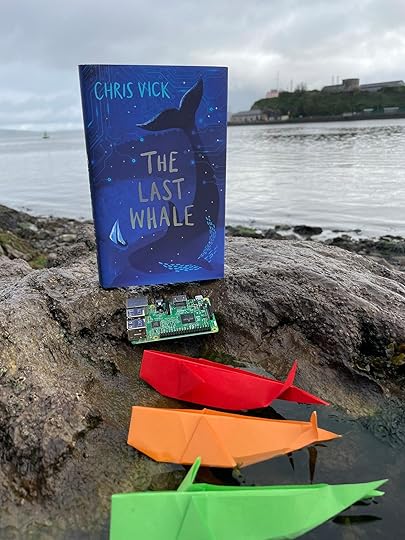
"We have no pity for these ferocious creatures. They are nothing but mouth and teeth." - Captain Nemo.
The Last Whale by Chris Vick is an exciting multi-generational story that carries a critical message about our environment, the impact of humankind and how there is still hope for the future. Even in the depths of despair, hope and possibility are there, even when it looks like there's none.
Eco-activist Abi, descended from whalers, helps to organise a global protest, and, with the help of her AI computer, Moonlight, she listens to and decodes whale songs. Already, the conditions in the seas are such that the whales are becoming fewer and fewer…When we meet her 30 years later, living on an isolated island with her daughter Tonje as the world's ecosystems collapse all around them, the search for whale song yields only silence. Are there any whales left? Can the damage humankind has done to the planet ever be repaired?
It's brilliantly written, but it is clever how everyone and everything in the story evolves; this is all about time and how it's running out. I appreciate how this book was written so that it is perfectly toned to early teen awareness, understanding and experience of the world today. It doesn't answer the questions of how to avoid it but instead examines how our actions affect the world around us, and we have to keep making good decisions and thinking about how our choices can change our world.
Mr Vick doesn't patronise the reader; he is brutally honest and factual regarding the negative impact on the environment and doesn't shy away from politics. The natural order will not be balanced if we continue to neglect it. Let's start by saving living organisms that help make this planet beautiful. All the destruction done by the human race was done for greed without much thought, if any, of what would lie ahead. It's about living in harmony with nature; in return, it will be bountiful and plentiful.

August 22, 2024
This teen book is about the connection of a Norwegian family with whales.
The story opens with our protagonist Abi as a teenager, a gifted computer scientist so passionate about the environment she gets involved in activities that got her expelled from school. She even steals an AI machine to carry out her environmental research. When she stumbles upon her great grandfather's research, it fuels her on.
I like the connection of her great-grandfather's whaling experience, and how this re-enforces Abi's passion for keeping the environment in balance, and a glimpse into the next generation. It sends a very strong message on how we are interconnected in this world. Human activities impact on the biodiversity and its consequences are detrimental, first our lifestyle, then health, then our very existence.
The AI machine, Moonlight, and her development in this story reminded me very much of I, Robot. But I was heartened to see Moonlight is a force for good, although the author has also made sure we are aware that it is also teetering on a fine balance between good and evil.
This book also demonstrates to its target audience the different disciplines needed to keep our world in balance for future generations: Computer science, physics and marine biology are three that come to mind.
I listened to the audiobook and I was very impressed with the narrator. I was able to tell who was speaking, especially distinguishing between the humanoid AI machine from the other characters in the story.
The story opens with our protagonist Abi as a teenager, a gifted computer scientist so passionate about the environment she gets involved in activities that got her expelled from school. She even steals an AI machine to carry out her environmental research. When she stumbles upon her great grandfather's research, it fuels her on.
I like the connection of her great-grandfather's whaling experience, and how this re-enforces Abi's passion for keeping the environment in balance, and a glimpse into the next generation. It sends a very strong message on how we are interconnected in this world. Human activities impact on the biodiversity and its consequences are detrimental, first our lifestyle, then health, then our very existence.
The AI machine, Moonlight, and her development in this story reminded me very much of I, Robot. But I was heartened to see Moonlight is a force for good, although the author has also made sure we are aware that it is also teetering on a fine balance between good and evil.
This book also demonstrates to its target audience the different disciplines needed to keep our world in balance for future generations: Computer science, physics and marine biology are three that come to mind.
I listened to the audiobook and I was very impressed with the narrator. I was able to tell who was speaking, especially distinguishing between the humanoid AI machine from the other characters in the story.

November 30, 2022
This book may be aimed at middle grade, but has been enjoyed very much by this adult reader.
An interesting, though depressingly realistic, view of what our future may hold if we don't look after our planet. The story follows Abi, through three stages in her life, as she searches for whales. There is also a sci-fi slant to this story which I found most unexpected but gave the story an original twist.
An interesting, though depressingly realistic, view of what our future may hold if we don't look after our planet. The story follows Abi, through three stages in her life, as she searches for whales. There is also a sci-fi slant to this story which I found most unexpected but gave the story an original twist.
January 16, 2024
The Last Whale!
-
An interesting, sci-fi - out of the ordinary - read!
This was good fun! I love exploring different genres! :)
Overall Rating: 3.0 🌟
~
Happy Reading!!
[mil ☁️]
-
An interesting, sci-fi - out of the ordinary - read!
This was good fun! I love exploring different genres! :)
Overall Rating: 3.0 🌟
~
Happy Reading!!
[mil ☁️]

August 1, 2022
As always I want to start by saying that I was given an ARC of this to review. My review is honest and left voluntarily. Thank you to The Head of Zeus and Netgalley for giving me access to this.
A beautiful, heart-breaking and poignant top middle grade to low young adult novel that will speak to any age range. I have no shame to say that I became very emotional upon finishing this book. A book I feel needs to be not only in school curriculum but something everyone needs to read and acknowledge before it is too late. Chris Vick tells the tale of The Last whale over three generations of the Kristensen family.
Told in part through the eyes of a fierce teen Abi, transcending to Abi’s hopeful daughter Tonje thirty years later and the start of Tonje’s daughter we follow the world to nearly the end of world’s echo system as we know it. The writing style is easy to follow and engaging for a younger audience but as a woman in her thirties it was still deeply touching. It is a beautiful story of hope and faith despite the odds. Of fighting for what is right in a world where corporations and businesses put profit before the world we live in. You need only look at the events of recent years that are beginning to plague us to see just how important fiction like this is for future generations.
That isn’t to say this is some woke agenda with no heart. The characters are layered, complex and believable. We experience the change in Abi from the fierce eco-warrior to jaded adult trying to keep that hope alive. This is juxtaposed by Tonje’s hopefulness and belief. A belief that had been once mirrored by Abi’s sister Teagan. This is why I feel that while the intended audience may be teen that even those older will find something to resonate with. The inclusion of Moonlight, although an AI, was also beautifully done. Seeing how the work and passions of those humans around it helped the AI awaken to full consciousness was a lovely touch.
It is a beautiful book that I would hope evokes emotions in all who read it, whether that be anger at those in power who do little to listen or help or hopefulness for the future. Perhaps a mixture of both. The ending in particular I enjoyed that instilled a message of hope, the same hope and wonder we had seen from Tig, Tonje and later Astrid. Of a better world and a world that was slowly beginning to repair itself.
I will honestly be recommending this book to any one who will listen. With it’s message being needed more now than ever before.
A beautiful, heart-breaking and poignant top middle grade to low young adult novel that will speak to any age range. I have no shame to say that I became very emotional upon finishing this book. A book I feel needs to be not only in school curriculum but something everyone needs to read and acknowledge before it is too late. Chris Vick tells the tale of The Last whale over three generations of the Kristensen family.
Told in part through the eyes of a fierce teen Abi, transcending to Abi’s hopeful daughter Tonje thirty years later and the start of Tonje’s daughter we follow the world to nearly the end of world’s echo system as we know it. The writing style is easy to follow and engaging for a younger audience but as a woman in her thirties it was still deeply touching. It is a beautiful story of hope and faith despite the odds. Of fighting for what is right in a world where corporations and businesses put profit before the world we live in. You need only look at the events of recent years that are beginning to plague us to see just how important fiction like this is for future generations.
That isn’t to say this is some woke agenda with no heart. The characters are layered, complex and believable. We experience the change in Abi from the fierce eco-warrior to jaded adult trying to keep that hope alive. This is juxtaposed by Tonje’s hopefulness and belief. A belief that had been once mirrored by Abi’s sister Teagan. This is why I feel that while the intended audience may be teen that even those older will find something to resonate with. The inclusion of Moonlight, although an AI, was also beautifully done. Seeing how the work and passions of those humans around it helped the AI awaken to full consciousness was a lovely touch.
It is a beautiful book that I would hope evokes emotions in all who read it, whether that be anger at those in power who do little to listen or help or hopefulness for the future. Perhaps a mixture of both. The ending in particular I enjoyed that instilled a message of hope, the same hope and wonder we had seen from Tig, Tonje and later Astrid. Of a better world and a world that was slowly beginning to repair itself.
I will honestly be recommending this book to any one who will listen. With it’s message being needed more now than ever before.
October 15, 2024
An extraordinary and deeply moving eco-adventure that captures the urgency of environmental activism and the interconnectedness of all life. The novel follows the interwoven stories of two generations: Abi, a young activist determined to save the whales, and her grandfather, a former whaler. Set in the Arctic's raw and beautiful landscape, Vick masterfully portrays both the breathtaking majesty of nature and the devastating impact of human actions on the environment.
The characters are vividly drawn, especially Abi, whose passion and courage shine throughout. The narrative balances heart-pounding adventure with thought-provoking reflections on conservation, responsibility, and the power of individual actions. The dual timelines give the story depth, creating a poignant contrast between the past and present.
Vick’s writing is lyrical and gripping, making the reader feel the weight of the story’s stakes. "The Last Whale" is not just a thrilling adventure but a powerful call to action, reminding us of the urgent need to protect our planet. It’s a must-read for anyone who cares about the environment and enjoys stories of courage and hope. Highly recommended!
The characters are vividly drawn, especially Abi, whose passion and courage shine throughout. The narrative balances heart-pounding adventure with thought-provoking reflections on conservation, responsibility, and the power of individual actions. The dual timelines give the story depth, creating a poignant contrast between the past and present.
Vick’s writing is lyrical and gripping, making the reader feel the weight of the story’s stakes. "The Last Whale" is not just a thrilling adventure but a powerful call to action, reminding us of the urgent need to protect our planet. It’s a must-read for anyone who cares about the environment and enjoys stories of courage and hope. Highly recommended!

September 16, 2022
The Last Whale by Chris Vick
Thank you so much, Head of Zeus, for inviting me to read the arc of Chris Vick's The Last Whale in exchange for an honest and unbiased review.
The Last Whale is a top MG / low YA story that follows three generations of the Kristensen family as they work to save the great whales and our planet, from whale hunters to missionaries. We meet Abi as a fiery adolescent activist as she is forced to spend the summer with her family on an island off the coast of Norway. Abi has 'borrowed' the AI 'Moonlight' in the hopes of organising a global protest, but on the island, Abi learns more about her family's history and is inspired by it.
#TheLastWhale #NetGalley#bookstagram #bookreview #goodreads
Thank you so much, Head of Zeus, for inviting me to read the arc of Chris Vick's The Last Whale in exchange for an honest and unbiased review.
The Last Whale is a top MG / low YA story that follows three generations of the Kristensen family as they work to save the great whales and our planet, from whale hunters to missionaries. We meet Abi as a fiery adolescent activist as she is forced to spend the summer with her family on an island off the coast of Norway. Abi has 'borrowed' the AI 'Moonlight' in the hopes of organising a global protest, but on the island, Abi learns more about her family's history and is inspired by it.
#TheLastWhale #NetGalley#bookstagram #bookreview #goodreads

August 23, 2022
Abi is an eco warrior and is planning a protest with the help of a "borrowed" AI machine, known as Moonlight. When she spends the summer on a Norwegian island with her grandmother, she discovers her great grandfather was a whaler and left behind tapes of the first ever recording of whale song. With the help of Moonlight Abi identifies a pattern, one that endangers the continuing existence of humankind, as it points to an important ecosystem between the whales and phytoplankton which is being threatened.
This is a wonderful story that pulls you in. It's a mix of history, dystopia, science fiction and adventure. It's also a book that makes you want to find out more ...
This is a wonderful story that pulls you in. It's a mix of history, dystopia, science fiction and adventure. It's also a book that makes you want to find out more ...

July 25, 2022
The target of this book are very young people but I think it should be read by people of all ages as we need to know what are the risks and what will happen when there's only silence.
There's a realistic description of what is happening and will happen but there's also hope.
And hope is what can makes wish that the whales will sing for a long time.
Highly recommended.
Many thanks to the publisher and Netgalley for this ARC, all opinions are mine
There's a realistic description of what is happening and will happen but there's also hope.
And hope is what can makes wish that the whales will sing for a long time.
Highly recommended.
Many thanks to the publisher and Netgalley for this ARC, all opinions are mine

August 20, 2023
The Last Whale is both hopeful and galvanising. It is a stunning depiction of the majesty of the creatures under threat from climate change, but most of all, a vital reminder that too much is at stake to mess this up. Inspiring and beautifully written.
January 29, 2023
I think this book is actually good. It's unique to have a story about eco-terrorism and climate change. It felt very real. Somehow it just wasn't holding my attention. I think it was just sorta more pragmatic and rigid sounding than I wanted from a whale story. Whales are magical to me and elegant and it just wasn't grabbing my attention. I'm not really the age for the audience of this book so maybe that was it. I think it is worth reading if you know someone who is into young adult fiction and also wants to be a scientist and help the planet.

August 7, 2022
This book moves with a ferocious pace, echoing Abis' own. Fast and focused, it proposes a situation within which we are already actually living. Abi, as a character is dedicated, determined and intelligent. She can be as irritating as any teenager; her energy driving her to take risks and push forward into action. It is her grandmother, determined in her own right and acting as Abis' confidant in many instances, that causes her to look again; not to assume the straight-forward and consider that maybe, just maybe, she doesn't know everything. And that, in taking the time to relax and enjoy herself a bit, other aspects will come to light.
Written with intelligence and clarity, an incredible inter-generational adventure unfolds that allows the reader to see and, more importantly, to feel the passion and urgency of the story and to understand the impact of the past on the present, while it also urges us to keep an eye on the future. The tale causes us to think about time; how it moves, its' acceleration. It encourages us to remember that what we do now matters. It posits a theory about the advancement of technology; the sentience of AI that we create and what it can possibly do. The Last Whale is a warning, filled with danger. But it is also a story of family and trust. It pushes the thought that, though things may look bleak, we still have to try...and try again. And at the moment when things seem darkest, there is still hope. In the end, we don't have a clear idea of the outcome of the story, but we have a glimmer of hope. Seize that. Hold on to it. Be smart, act quickly, but don't lose sight of it. Tenacious, heart-felt, gloriously fast-paced; this is quite a read!
Written with intelligence and clarity, an incredible inter-generational adventure unfolds that allows the reader to see and, more importantly, to feel the passion and urgency of the story and to understand the impact of the past on the present, while it also urges us to keep an eye on the future. The tale causes us to think about time; how it moves, its' acceleration. It encourages us to remember that what we do now matters. It posits a theory about the advancement of technology; the sentience of AI that we create and what it can possibly do. The Last Whale is a warning, filled with danger. But it is also a story of family and trust. It pushes the thought that, though things may look bleak, we still have to try...and try again. And at the moment when things seem darkest, there is still hope. In the end, we don't have a clear idea of the outcome of the story, but we have a glimmer of hope. Seize that. Hold on to it. Be smart, act quickly, but don't lose sight of it. Tenacious, heart-felt, gloriously fast-paced; this is quite a read!

November 2, 2022
This is an eco-thriller that follows the same family over three generations; we explore their previous history of whale-hunting, we spend time in the present day of a girl called Abi being expelled from school for her activism and then going on a family holiday to Norway with stolen artificial intelligence Moonlight, and finally we have a future timeline in which Abi is raising her daughter Tonje while still trying to discover the secret of the whales’ music, which she believes could also be the key to saving the planet from a climate disaster.
Abi is such an interesting, rather mysterious protagonist from the outset- I instantly wanted to get to know her better and learn all her secrets as soon as I met her. I think AI is so fascinating, and Moonlight almost felt like another human character as she became more developed. There are also fascinating questions raised about what makes us human, which I always find to be the best part of books exploring advanced technologies like this. And of course, the exploration of the climate crisis is as terrifying yet thought provoking as you’d expect.
I’ll definitely be thinking back to this clever story and the things it had to say frequently, I can tell you that! This was such an original, gripping read, that gives you a lot to think about at the exact same time as being a gripping page turner, with plenty of action. Definitely worth picking up if you’ve enjoyed books like Burning Sunlight or the Day of the Whale!
Abi is such an interesting, rather mysterious protagonist from the outset- I instantly wanted to get to know her better and learn all her secrets as soon as I met her. I think AI is so fascinating, and Moonlight almost felt like another human character as she became more developed. There are also fascinating questions raised about what makes us human, which I always find to be the best part of books exploring advanced technologies like this. And of course, the exploration of the climate crisis is as terrifying yet thought provoking as you’d expect.
I’ll definitely be thinking back to this clever story and the things it had to say frequently, I can tell you that! This was such an original, gripping read, that gives you a lot to think about at the exact same time as being a gripping page turner, with plenty of action. Definitely worth picking up if you’ve enjoyed books like Burning Sunlight or the Day of the Whale!
Displaying 1 - 26 of 26 reviews