Jump to ratings and reviews
Rate this book

Paradoxes of Catholicism

Rate this book
A collection of essays relating to his conversion to Catholicism.

174 pages, Hardcover

Published January 1, 1990

77 people are currently reading
227 people want to read

About the author

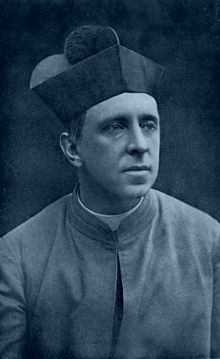
Robert Hugh Benson

321 books186 followers
Mrsgr. Robert Hugh Benson AFSC KC*SG KGCHS was an English Catholic priest and writer. First an Anglican pastor, he was received into the Catholic Church in 1903 and ordained therein the next year. He was also a prolific writer of fiction, writing the notable dystopian novel Lord of the World, as well as Come Rack! Come Rope!.

His output encompassed historical, horror and science fiction, contemporary fiction, children's stories, plays, apologetics, devotional works and articles. He continued his writing career at the same time as he progressed through the hierarchy to become a Chamberlain to Pope Pius X in 1911, and gain the title of Monsignor before his death a few years later.

Ratings & Reviews

What do you think?
Rate this book

Friends & Following

Create a free account to discover what your friends think of this book!

Community Reviews

5 stars
55 (49%)
4 stars
22 (19%)
3 stars
25 (22%)
2 stars
7 (6%)
1 star
3 (2%)
Displaying 1 - 9 of 9 reviews
Profile Image for Susan Molloy.
Author 149 books88 followers
December 22, 2025
It Is All Clear and Understandable Now.


🖊 Monsignor Robert Hugh Benson (1871-1914) was a Catholic priest and a convert from the Anglican church, where he was first a priest. He was also the son of the Archbishop of Canterbury. Monsignor Benson was a prolific writer and penned novels with a Roman Catholic theme.

NOTE from the Preface of Paradoxes of Catholicism: “These sermons (which the following pages contain in a much abbreviated form) were delivered, partly in England in various places and at various times, partly in New York in the Lent of 1912, and finally, as a complete course, in the church of S. Silvestro-in-Capite, in Rome, in the Lent of 1913.”

Each sermon/essay fully and clearly makes important points about what appears to be paradoxes in the Catholic faith. His writing style is clear, intelligent, and straightforward. There were many subjects touched upon that I never before thought about, and now I understand my faith even more.

One of the most poignant passages that struck me thoroughly because it has been a topic on my mind lately is this:
We have seen how the only reconciliation of the paradoxes of the Gospel lies in the Catholic doctrine of the Incarnation. It is only to him who believes that Jesus Christ is perfect God and perfect Man that the Gospel record is coherent and intelligible. The heretics—men who for the most part either rejected or added to the inspired record—were those who, on the one side, accepted Christ's Divinity and rejected the proofs of His Humanity, or accepted His Humanity and rejected the proofs of His Divinity.
I like that each chapter/sermon begins with a passage from the New Testament apropos to the topic at hand. The entirety of this publication is well-written with striking intelligence and simplicity – that is, if you want to hear the Truth.

CONTENTS:
I. PEACE AND WAR
II. WEALTH AND POVERTY
III. SANCTITY AND SIN
IV. JOY AND SORROW
V. LOVE OF GOD AND LOVE OF MAN
VI. FAITH AND REASON
VII. AUTHORITY AND LIBERTY
VIII. CORPORATENESS AND INDIVIDUALISM
IX. MEEKNESS AND VIOLENCE
X. THE SEVEN WORDS
XI. LIFE AND DEATH

📕Published — 1913.

જ⁀ 🍋 Read public domain on Project Gutenberg.
જ⁀🍇 Kindle.
༻ ༺ ༅ ✬ ༅ ༻ ༺ ༅ ✬ ༅ ༻༺ ༅ ✬ ༅ ༻ ༺
Profile Image for Manuel Alfonseca.
Author 80 books214 followers
August 17, 2024
ENGLISH: This is the first essay by Benson that I have read: I have read four of his novels. The last chapter of this book is more relevant today than when it was written, over one century ago.

ESPAÑOL: Este es el primer ensayo de Benson que he leído: he leído cuatro de sus novelas. El último capítulo de este libro es hoy más actual que cuando fue escrito, hace más de un siglo.
77 reviews6 followers
April 17, 2013
Since I have not found a blurb for this book, I will quote from the beginning of the last chapter, which also serves quite well as a summary of the book:

"We have considered, so far, a number of paradoxical phenomena exhibited in the life of Catholicism and have attempted to find their reconciliation in the fact that the Catholic Church is at once Human and Divine. In her striving, for example, after a Divine and supernatural Peace, of which she alone possesses the secret, she resists even unto blood all human attempts to supplant this by another. As a human society, again, she avails herself freely of human opportunities and aids, of earthly and created beauty, for the setting forth of her message; yet she can survive, as can no human society, when she is deprived of her human rights and her acquired wealth. As human she numbers the great multitude of the world’s sinners among her children, yet as Divine she has produced the saints. As Divine she bases all her gospel on a Revelation which can be apprehended only by Faith, yet as human she employs the keenest and most profound intellects for its analysis and its propagation. In these and in many other similar points it has been attempted to show why she offers now one aspect and now another to human criticism, and how it is that the very charges made against her become, when viewed in the light of her double claim, actual credentials and arguments on behalf of that claim. Finally, in the meditations upon the Seven Words of Christ, we considered very briefly how, in the hours of the deepest humiliation of His Humanity, He revealed again and again the characteristics of His Divinity.

It now remains to consider that point in which she most manifests that double nature of hers and, simultaneously therefore, presents, as in a kind of climax, her identity, under human terms, with Him Who, Himself the Lord of Life, conquered death by submitting to it and, by His Resurrection from the dead, showed Himself the Son of God with power."

The writing and apologetics are solid and true to the Church, but, though not boring, not delivered in a particularly fascinating way. However, though my rating is very much a reflection of my aesthetical value of the book, I would not hesitate to recommend it.
Profile Image for Michael.
38 reviews3 followers
January 7, 2013
Hard to say, but of Robert Hugh Benson's I think this is my favoriate. A cool book on gaining a vision of Christ working through His Church in our world. I'd like to read this again soon.
Profile Image for Edward Clark III.
5 reviews
August 6, 2017
As Usual Benson Rocks

Great throughout. Chesterton writes somewhere about there being no stick too good to beat the Church. She is too merciful or too cruel to spiritual for too practical, etc. Benson takes a dozen or so of these arguments head on. His last section which is a meditation on the words of Christ on the cross is worth the ( proverbial) price of the book.
Profile Image for Jacob.
14 reviews
March 31, 2019
Reminiscent of Chesterton

Like Chesterton, but a predecessor? I wonder if they new eachother. I find Chesterton a more enjoyable read, however, this book has great insights into the human and spiritual sides of the church as a body.
Profile Image for Orlando.
3 reviews
January 12, 2013
Increased my interest and understanding of Catholicism. Very deep and insightful.
3 reviews
September 13, 2023
Absolutely touching! A must-read for everyone who values Catholic literature and the power of faith.
Displaying 1 - 9 of 9 reviews

Can't find what you're looking for?

Get help and learn more about the design.