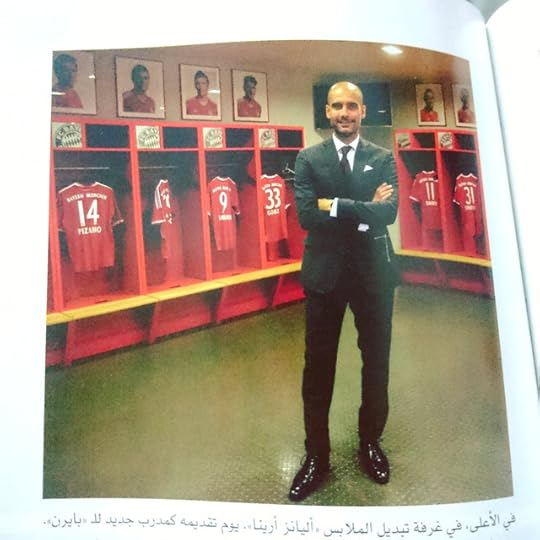
Una crónica íntima de Guardiola en el Bayern de Múnich: los éxitos, los problemas y las claves del nuevo equipo de Pep. Martí Perarnau ha tenido acceso al vestuario, al entrenador y a los jugadores, desde el fichaje de Guardiola y hasta el final de la temporada oficial, y nos ofrece un relato minucioso de la vocación de trabajo de Pep Guardiola, su obsesión por los detalles y su tozudez en la búsqueda de la excelencia. Una descripción detallada de todo lo que ha sucedido en la trastienda del Bayern durante la temporada 2013-14.
Martí Perarnau Grau (Barcelona, 7 de març de 1955) és un periodista i exatleta català. Durant la seva etapa esportiva va participar en els Jocs Olímpics de Moscou 1980, en la modalitat de salt d'alçada.
When you consider the fantastic opportunity afforded the author: total access for a year, with the freedom to write anything, I think Perarnau underachieves.
The result is part valentine, part banal diary of the day to day operations of a big club. We learn things about the club, and individual players but nothing really insightful. Guardiola works obsessively. He prepares for every possible scenario. He is crushed to lose to Real Madrid in the Champions.
As a soccer coach, I enjoyed every page, of course. But the ultimate feeling I have is that of seeing a forward sky an open shot from the six yard line over the crossbar: what a missed opportunity.
" ليس لأنه عبقري، مع أنه كذلك. ليس لأنه يحقق الفوز، مع أنه كذلك. قبل كل شيء، بيب هو رجل جيد بقلبٍ كبير. إنه شخص جيد جداً. "
قبل هذا الكتاب كنت أحب غوارديولا كشخص - لا كمدرب فقط - من دون أسباب واضحة وقابلة للشرح، أما الآن فأنا أعرف تماماً لماذا أحببته، وما مصادر السحر الذي يشع من شخصه ويصل لأبعد نقطة في قلبي.
" لن تراه سعيداً لأنه يسعى لتحقيق المستحيل، ألا وهو الكمال. "
نحن أمام شخص استثنائي، مثالي بكل معنى الكلمة، إنسان عظيم، ومدرب عظيم، بشخصية عميقة وجذابة، وطريقة تفكير وتحليل فريدة.
أود قول شيء للأشخاص الذين يبغضون كتب التنمية البشرية - مثلي -، لكنهم يحتاجون من وقت إلى آخر لما يرفع من حماسهم ويمنحهم الأمل: ما عليكم إلا بالكتب المختصة بالرياضة، فهي الدواء الناجع.
One of the most fascinating questions of the 2012/13 football season involved a man who wasn’t involved in it, but instead retreated from the game for a year. Just about everyone involved in top level football wanted to know where Pep Guardiola would go, what he was going to do after creating one of history’s great teams. His Barcelona side were in the line of Cruyff’s Dutch side of the 1970s and Sacchi’s Milan early of the 90s, sides which redefined how the game should be played. Every major tactical nuance seemed to derive from it; an action based on that style or a reaction to it. They accumulated trophies for fun with the footballing ideal of passing teams to death, adorned with footballing geniuses such as Leo Messi, Xavi and Andres Iniesta. And in the big games they produced signature displays, twice dismantling Manchester United in Champions League finals and recording several memorable victories over their great rivals Real Madrid.
Guardiola’s reign lasted just four years, the man himself walking away quite visibly exhausted. One of Marti Perarnau’s great insights here is just how necessary Guardiola’s sabbatical was – throughout this book the restlessness of Guardiola’s mind and the energy he puts into training and coaching is clear. After four years of relentless pressure, of endless thinking about opponents and giving so much energy to the team there’s barely a human being alive who wouldn’t be burned out. The rest was necessary, particularly with the political pressures peculiar to Barcelona. A refreshing of body and mind was necessary. That he chose New York to get away from it all is quite probably unique.
As Perarnau makes clear Guardiola was relentlessly pursued by many of the giants of European football, particularly from England. Many were willing to rebuild their sides just for him. His choice though was Bayern Munich, which in the end was as tough an assignment as he could have chosen. His predecessor, Jupp Heynckes ended up winning the treble of league, DFB Pokal and Champions League, a feat that had previously eluded even the mighty Bayern sides of the 1970s. Follow that.
What we get is an exhaustive account of Guardiola’s first year at the club, from his decision to take over to the season’s end and beginning of preparations for the next year. The level of access is faintly surprising for the modern game, going in depth into how Guardiola prepares his team, how he adopted his footballing ideals to the style of a different country. Guardiola’s work ethic is clear, as is his inability not to think about football and his restless search for how to win games. It’s made very clear that a straightforward transposition of the Barca ideal to Germany was never considered possible, but instead Guardiola worked out over his first few months the tactical wrinkles that would make this Bayern side dominant and provide them with a footballing identity Hoeness and Rummenigge wanted when appointing him. What fascinates is how, for all Guardiola is a great thinker of the game, some innovations are a result of trial and error – their ultimate masterstroke, moving Philip Lahm into midfield, was a result of a solution to an in-game problem suggested by an assistant. But Guardiola had the vision to turn this into a long term solution that ultimately made Bayern’s game function so well, along with the deliberate tactic of pushing full backs forward into midfield. Perarnau giving us accounts of so many gams allows us to see how this team and the players develop over the first half of the season, adjusting between the approaches of Heynckes and Guardiola.
This could of course veer toward hagiography, but it doesn’t. Guardiola’s good points are rightly lauded, but it’s always acknowledged he’s fallible – he talks of his own past tactical failings and how in the Champions League semi-final he makes egregious errors of judgement. And for all his hard work and innovation the team loses something of an edge after the league is secured ridiculously early. It’s an old footballing problem, but at this point you think that if anyone could find a solution to such an old saw you’re sure Guardiola could – something we’re likely to find out in the next year or two.
What might surprise is how open Guardiola is about possible future plans – whilst events may obviously overtake him, the plan is for a similar length of stay to Barca, then another possible sabbatical followed possibly by a sojourn in the English game. Hints in the book say that he’d go to one of the historically big clubs – perhaps, like Bayern, the appointment of Louis van Gaal is merely the laying of groundwork for Guardiola to be tempted to Old Trafford? History seems to be more of an attraction to him than the nouveau riche billionaires at Stamford Bridge and the Etihad Stadium.
We leave Guardiola on a note of triumph, the DFB Pokal secured to mark a treble of sorts with the league and World Club Cup. It sounds an ominous note for the rest of German football with a club now comfortable with Guardiola’s methods poised for perhaps an even greater dominance and the coach more comfortable than he was as Barcelona. Can he repeat his Barca trick of turning Bayern into Europe’s dominant force, overcoming the Madrid side that ultimately outplayed them in the Champions League semi-finals? As ever, only time has the answer. In the meantime, you can imagine coaches around Europe devouring this for hints and tips as to how to improve their own side and to undermine Guardiola. As an up close record of the methods of the man who’s probably the finest coach in the game today it’s a classic of intelligent modern footballing literature.
في حضرة مدرب في هذه الحلقه سنتضيف ملك التيكي تاكا بيب غورديولا مدرب مانشستر سيتي الحالي وبايرن ميونخ السابق مرحباً بك بيب معنا ، نتمى ان تستمتع معنا و توصف لنا افكارك التكتيكه للاستفاده من خبراتك . اولاً بيب كيف تلعب ما هو اسلوبك في اللعب ؟ يقول : في البدء كل المتابعين لي يعتقدون انني مؤسس التيكي تاكا هذا صحيح لكن هو ذلك اللعب التمركزي الذي استخرجت منه هذه الفكره . اذا ماهو اللعب التمركزي؟ يقول : اللعب التمركزي فلسفة لديها أساسيات عديدة لكن الأكثر أهمية هو البحث عن التفوق. هناك طرق مختلفة لربح التفوق وأشكال مختلفة للتفوق يمكن الوصول لها. متى تم الوصول للتفوق والأفضلية يمكن للفريق أن يستعمل الموقف للسيطرة على المباراة. كيف تتخلص من الضغط ؟ يقول :تمريرة طويلة تولد الضغط في وجهتها لأنها تعطي الدفاع مزيداً من الوقت لقراءة اللعب. لذلك، عند لعب تمريرة طويلة للهرب من الضغط، يتحولالضغط قرب وجهة تمرير الكرة ثم تنتقل الكرة لزميل آخر. وهذا يسمحأن تُرسل الكرة للاعب لديه الآن رؤية أفضل للملعب وضغط أقل من حوله مقارنة مع اللاعب الذي لعب التمريرة . مما يتكون اللعب التمركزي ؟ يقول : لا يتكون اللعب التمركزي من تمرير الكرة أفقيًا، ولكن شيئًا أصعبَ بكثير: يتكون من توليد التفوق وراء كل خط من الضغط. ويمكن القيام به أكثرَ أو أقلَّ بسرعة، أكثرَ أو أقلَّ عموديًا، أكثرَ أو أقلَّ مجمعًا، ولكن الشيء الوحيد الذي ينبغي الحفاظ عليه في جميع الأوقات هو السعي لتحقيق التفوق. أو بعبارة أخرى: خلق "الرجال الأحرار" بين الخطوط. اذا بعد تثبيت افكارك ، كيف تدافع ؟ يقول : انا مثل بيلسا احقق اسلوب man to man رجل لرجل اي انا كل لاعب يكون معه لاعب واحد فقط حتى لا اسبب مساحات تساعد الخصم على التقدم ،و في بعض الاحيان اضغط بطريقة الضغط عالي الذي يبدأ في أعلى أثلاث الملعب والهدف منه حرمان الخصم من بداية البناء الهجومي يبدأ الضغط العالي عند استلام أظهرة الخصم للكرة باختلاف موقع الكرة بحيث تكون أهمية الضغط على الأطراف تكمن في اغلاق زوايا التمرير وتقليص مساحة الاسناد من الزميل . كيف تهاجم؟ يقول : البناء ثم البناء اهم شي و الاستحواذ و كثرة التمرير يقول انا لا امرر لتمرير الكره فحسب بل لتحريك المنافس ، احبذ البناء من الخلف بدئاً من الحارس مروراً بلاعبي الوسط ثم المهاجمين ، و اعتمد على الكره الشامله و تغير المراكز كما حدث في الكلاسيكو عندما تغلبنا على ريال مدريد بنتيجه كبيره عندما دفعت بميسي كمهاجم وهمي false 9 حتى يفتح مساحات للاعبي الاطراف . شكراً بيب على هذه المقابله الرائعه على امل ان نلقاك مجددًا!
One of the most fascinating and revealing books I’ve read about professional football (and I’ve read quite a few). The author had unprecedented access to Pep Guardiola – the young manager who took Barcelona to the zenith of their powers between 2009 and 2012, which was arguably to the best team ever to play the game – during his first season with the almost-as-formidable Bayern Munich.
On the surface, the book is a diary of Guardiola’s first season with the German juggernaut, but it is in reality about so much more: a penetrating look at soccer tactics, sports psychology, elite fitness demands, club politics, and, finally, the unrelenting quest for sporting perfection.
Highly recommended for those with even a passing interest in soccer.
The standout aspect about Martí Perarnau's writeup is how complete the entire book feels. It describes Guardiola's inspirations, methodology, tactics and interactions with players & bosses along with detours on Bayern & German football but at no point does any chapter feel vestigial. Individual preferences, however mean that each person might end up expecting a bit more depth in some facet of Pep's life.
The writing style is pleasing - simply conveying the emotions without being overbearing - if a bit adulatory. There is none of the drama of The Damned United while being much more friendly than Inverting The Pyramid.
In conclusion, this is an enjoyable read for both, a casual fan and the fanatic.
Brilliant book, not because of the writing style but purely because of the content. You'll struggle to find such insight about a team and its season anywhere else, here you find it a few months after it happened.
Love or hate Guardiola, he's one of the more complex and confusing coaches of this era. This book will help you understand a person who's often misunderstood. Here's a guy who really breathes football.
It doesn't matter if you're a Bayern (or Barcelona) fan or not, I'd recommend you to read this anyway. Even if you find yourself disagreeing with Guardiola's ideas, at least you get to hear why he does what he does.
Que livro! Não é uma biografia, é um relato do 1º ano de Pep no Bayern. Suas conquistas, suas derrotas, seus acertos, suas mancadas e também suas mágicas. O livro mostra o empenho de Pep em transformar toda a cultura de jogo do time do Bayern para se adaptar ao seu estilo. Desde os treinos, táticas e jogos, até as conversas individuais com jogadores e relacionamento com a família. Tudo isso em uma escrita que prende do início ao fim! Top!
Perarnau’s narrative offers an astonishingly comprehensive account of Pep’s first year at the Säbener Straße, thanks to author’s unlimited access to Bayern’s staff, players, facilities, and to Pep himself, as Perarnau shadowed the celebrated coach through the entirety of his first year in Munich. The result is a carefully-layered portrait of world football’s most compelling auteur.
However, the book is much more than simply a retelling of the Pep’s first season at Bayern; it also functions as what is surely the most in-depth examination of Pep’s famed (and oftentimes misunderstood) coaching philosophy, methods, and tactics in the English language. This book will certainly please both the biography-craving set of readers, as well as the Zonal Marking set.
In his year-long account, Perarnau’s balances story-telling with deeply sophisticated, yet immensely accessible, tactical discussions both of Bayern’s training sessions and matches.
How did this book come about? The question is worth asking, given the Spaniard coach’s reputations for secrecy and control. Two explanations: first, Perarnau was already planning a lengthy project on Pep’s first year at Bayern. Second, when Guardiola himself was looking for a writer to document his German adventure – one whom he planned to grant unfettered access to – Perarnau emerged as a natural candidate, due to his friendship with Pep’s longtime companion and assistant coach, Manel Estiarte (“the Maradona of Water Polo,” according to Pep). Thus, a unique opportunity was born.
Perarnau was granted access to all team meetings, all training sessions, the locker room during matches, Pep’s office, as well as other intimate settings, like the team lounge/restaurant after matches, on the road with the team, or simply one-on-one coffee outings with individual players. For lovers of football narrative, Perarnau’s access to footballing elite is mouth-watering stuff. And the former-athlete-turned-journalist doesn’t disappoint readers with his privileged access.
Because of his intimate access, Perarnau crafts a true “insider account” of the famed coach and footballing club, granting the writer an authoritative vantage point for not only spelling out the Pep way, but also dispelling some stubborn myths around the Spanish coach. For example, we learn that Pep really, really hates tiki-taka:
"I hate tiquitaca. I hate it. Tiquitaca means passing the ball for the sake of it, with no clear intention. And it’s pointless. Don’t believe what people say. Barça didn’t do tiquitaca! It’s completely made up! Don’t believe a word of it! In all team sports, the secret is to overload one side of the pitch so that the opponent must tilt its own defence to cope. You overload on one side and draw them in so that they leave the other side weak. And when we’ve done all that, we attack and score from the other side."
We also learn that, in some key ways, Pep adapted his methods to his Bayern players and to the wider Bundesliga football culture, rather than reshape the Bavarians in dictatorial top-down fashion. Or we learn that that Pep is not doggedly committed to the short passing game as the heart of his philosophy; rather, it’s tactical flexibility – grounded in a few key principles – that define Pep’s on-pitch philosophy.
Pep Confidential dives into the big narrative questions emerging during Pep’s first year at Bayern, such as: “Why Pep and why Bayern?” (Answer: Hoeness, Rummenigge and company viewed hiring Pep as launching stage 3 of Bayern’s 4 stage strategic plan; meanwhile, Pep was utterly piqued by the opportunity to make an elite club into his own creation – “free from the Barça straitjacket” – freedom he lacked during his immensely successful tenure at Barça) Or why did Pep move Lahm to midfield? (Answer: it happened gradually in training, then suddenly Pep began trying it out regularly during matches, triggered by switching Lahm and Kroos’ roles during the Euro Super Cup match against Chelsea.) Or what the hell happened during the disastrous stretch of losing 0-3 at home to Dortmund, then losing 0-4 at home to Real Madrid in UCL play? (Answer: it’s complicated – read the damn book!)
Through the detritus of story-bits and quotes, Perarnau produces a lucid picture of Pep’s methods and tactics. For any football fan, Pep Confidential is worth the price of admission for these discussions alone. In terms of playing philosophy, we learn that Pep covets ball possession because he covets attack and wishes to avoid (a form of footballing anxiety?) a whole set of defensive situations. So Bayern’s short passing game will be always (at least theoretically!) in the service of this goal. Pep frames short passing in basketball terms, as he explains: “In basketball if you are dribbling the ball all the time, the defence has an easier time of it. But if instead you pass it rapidly from one player to another you create huge problems for your opponents. It’s exactly the same in football.” Later, we learn that Bayern’s stars ceaselessly work to exploit new spaces via the short passing, especially in the opponent’s box.
Perarnau breaks down other aspects of Pep’s complicated tactical system into discrete units. Pep’s tactical principles range from the positioning of the defensive line, the famed “15 pass build-up,” “managing the free man,” playing and moving forward from the back in total unison, superiority in the midfield (“This is the essence of Pep’s playing philosophy” as Perarnau explains), false attacking midfielders (“This is the big tactical innovation within Pep’s first season”), and playing without the false 9 (“From being the absolute key figure at Barcelona, the false 9 is now just one more potential tactic for Bayern”; Perarnau tells the origin story of Pep using of the false 9 at Barça). Moreover, Pep adapts prevalent German tactics into Bayern’s strategy, such as counter-attacks (Pep “sometimes branded it the Bundesliga-counter, based on the efficacy and speed of the counters he has had to plan for”), aerial passing, width across the pitch, or the double pivote in midfield. Perarnau observes Pep making in-match adjustments according to these principles.
Perarnau’s narrative is especially colorful during the training moments at the Säbener Straße, as we watch Bayern’s world class athletes learn Pep’s new way. It all starts with the famed rondos during the first training session in June:
The players are divided into three groups. In each group, six players form a circle. Their aim is to pass the ball to each other as quickly as possible whilst their two team-mates inside the circle try to stop them. Today the Bayern players are much less fluid than their Barcelona counterparts who have been doing this since they were kids. In fact, the champions of Europe appear a little slow and clumsy as they struggle through the exercise. Pep scratches his head. Apparently his players have come here expecting athletics training and here they are kicking a ball about.
Indeed, Perarnau amusingly reports that the Bayern players ask Pep’s permission to do some intense running after “kicking a ball about” in order to feel like real work was done. Pep obliges, but explains the truth to Perarnau: “Now they’ll come back thinking that they’ve trained really hard because they’ve had a 15-minute run, but it’s just the placebo effect. They think that when they’re doing these positioning and conservation exercises that they’re not really working.” A new way of doing things has indeed arrived at the Säbener Straße.
Starting with this first training session through all 279 sessions, Perarnau documents the various personalities on Bayern’s squad. We learn that Pep immediately has deep affection for the young Dane Pierre-Emile Højbjerg (both player and coach will later weep together inconsolably during the season, at one point), sees great potential Jerome Boateng, explains things repeatedly to the big-hearted “street kid” Franck Ribéry, talks football tactics nonstop with Basti, huddles with Philipp Lahn for long stretches on the pitch talking long term strategy, troubles over Mario Mandzukic’s passionate work ethic but tempestuous attitude, or admires Arjen Robben’s immense work ethic and injury prevention routines.
Through these training pitch moments, as well as dozens of vignettes of Pep in his office, in the restaurant lounge, or at home, Perarnau composes a portrait of an utterly football tactics mad coach, obsessional in his pursuit of the right tactical dynamics for each match. Pep is the classic first in / last out of the training center type, working long hours alone or with his assistants incessantly searching for tactical ways to disable his opponents. Estiarte jokes about the “law of 32 minutes” when it comes to Pep: “‘You invite him for a meal in a restaurant, hoping that he’ll forget about football, but 32 minutes later you can see his mind is already wandering.” Pep is so deeply emerged in his craft that Estiarte speaks about saving the man from himself.
However, Pep possesses more than simple obsession. Perarnau reveals a man wracked with intense anxiety, yet gifted with superb prescience. Interpersonally, we learn that Pep is skilled in offering his players individuated instruction, stemming from a framework he developed after studying the subject and even attending class at Columbia University in New York during his sabbatical. Perarnau also illustrates Pep’s ability to take complete responsibility for any and all outcomes during the season. For example, this virtue is especially displayed after Pep’s historic dismantling at the hands of Real Madrid in the Champions League. These character traits combine to create the portrait of a fascinating human being – a sort of switchboard of mental and physical activity. Pep himself manically hums with ideas and actions in Perarnau’s account. The coach is exhausting.
My critiques of Pep Confidential mostly stem from my own commitments about what a book like this should do. Specifically, I wish Perarnau would’ve pushed for his narrative’s meaning in three ways. First, despite the carefully-layered portrait of Pep developed through 488 pages, I was still left wondering who Pep really is, especially why he’s so utterly committed to football, to sport, or (basically) to play itself. Why? Ultimately, this question can be asked about any cultural figure, especially artists, athletes, and performers. And I sort of already know the answer to my question. We need “purposiveless” activity like sport, or, frankly, culture itself. In this sense, Pep is like any artist or craft person, obsessively pursuing excellence. Nonetheless, I’m always very intrigued by the answer artists themselves give to my question. A missed opportunity, because someone as crazily committed as Pep just begs this question.
Second, I would have liked a more robust interpretive framework from Perarnau around his own narrative – something like an interpretive epilogue, or “what does this mean?” check-ins scattered throughout the narrative. I say this, because Perarnau’s narrative is so richly populated with anecdotes, quotes, and observations that the larger interpretive picture becomes foggy. Perhaps this fogginess is the point, however, given Perarnau’s own immersion at the Säbener Straße, and the manic quality of Pep’s character. Regardless, I still expected slightly more framing from the author in this regard, as a way of cashing in on his privileged access.
Third, Perarnau would have benefited from a (even brief!) background discussion of German footballing history and culture to help establish a framework for understanding Pep’s work at Bayern. For example, we learn in piecemeal fashion about the physicality and enormous work rates of German players, as well as the Bundesliga’s reputation for skilled counter-attacking. We also learn that Pep is both smitten with German footballing culture and values, yet comes to chafe against this same culture by the time his first season ends and his methods are criticized in the media. That is, Pep really does embark on a footballing project against the grain in Germany, yet the details of this tension are left somewhat undeveloped.
Nonetheless, Pep Confidential remains required reading on multiple fronts. The book is indispensable for lovers of biography, narrative, and modern football tactics. Or even readers from fields outside football, studying leadership, quality, excellence, and strategic planning.
Above all these benefits, however, Pep Confidential should be read because Perarnau composes a portrait of football’s most compelling auteur coach, locked in obsession, in craft, and in agony and ecstasy. Basically, the book is a portrait of an artist. Perarnau seems to signal this intention in the anecdote framing the opening and closing of his book: Pep’s dinner with Garry Kasparov (former long time chess World Champion and current political activist in Russia). During this dinner, Pep and the greatest chess player of all time ponder the subject of passion – the ingredient driving greatness. In a statement that, perhaps, foreshadows Pep’s own fate, Kasparov claims that when he won the world chess championship from Antoly Karpov in 1985, he immediately knew who his eventual nemesis would be: “It was time, Pep, time …”
For an obsessional, manic, and life-filled auteur like Pep, who has a self-described “limited but intense career span,” I cannot think of more fitting final opponent for the man who must be saved from himself. Meanwhile, the rest of the Bundesliga clings on.
Even though the book contains interesting insides about Pep's methods, philosophy, etc., 90% of the book is quite boring describing day-to-day routine. It was OK but not exciting.
Pep Guardiola’s managerial record is, by any measure, astounding.
3 La Ligas, 2 Copa Del Reys, 3 Spanish Super Cups, 2 Champions Leagues, 3 European Super Cups, 3 FIFA World Club Cups, 3 Bundesligas, 2 German Cups, 1 Premier League, 1 EFL Cup and 1 Community Shield - all within the space of 10 years.
And yet somehow, in a way I still find utterly bizarre, Marti Perarnau’s most astonishing feat as author of this biography of Pep Guardiola is to actually leave the more astute reader with a significantly lesser opinion of the man commonly thought of as “the best manager in world football”. To completely misquote Winston Churchill in a completely unrelated context, never have so many words been given to so few actual achievements in Guardiola’s first season as Bayern Munich manager (the sole period this biography chronicles).
Yes, Bayern won the Bundesliga league and German Cup double in this 2013-14 season, but as the biggest club in Germany, with by far the best squad and coming off a treble-winning season under the previous manager Jupp Heynckes, this was practically a fait accompli on day 1. Expectations were much higher and therefore a sense of abject failure at the end of Pep’s first season looms very large, particularly in the final quarter of the book.
In many respects, this book is doomed to fail before it even begins. Primarily, this is because close observers of Pep’s career will note that not only did he fail to win the Champions League (the pinnacle of world club football) in his first season at Bayern, but he failed to win it in any of his 3 seasons there - and even more significantly, he was knocked out each time in very embarrassing fashion, for both himself and his team (similar could be said of his next 2 seasons at Manchester City too). Perarnau is far too much of a sycophant to admit it, but the only reason Bayern hired Pep was to win them the Champions League. To say Perarnau’s book has not aged well is an understatement for this reason. To be completely honest, the narrative structure of the book as it chronologically runs through the season is also frequently boring, something I notice other reviewers have also observed.
So why has Perenau’s book been serenaded with so much praise and reverence since the time it was published? The answer is simple: the myth of Pep Guardiola is so entrenched in the modern footballing world that any attempt to open up the enigma and understanding the working of this man is met with an almost palpable relief, particularly by the media community (see also the volcanic response to the recent Amazon documentary of Manchester City’s Premier League title winning season under Pep last year). At last we can have a look inside the box and observe the genius! To be frank, this explains the majority of my excitement too before I had even ripped off the excessive Amazon packaging and started reading the book.
Except, fatally, the lack of actual genius is astonishing by virtue of its absence throughout this book. Pep’s tactical “revolution” in European football can be distilled into 3 core concepts. First, superiority in midfield in order to dominate the game with the ball (numerical and positional) - led by an indispensable “pivote” playing as the number 6 in central midfield. Second, a high defensive line, so that the team is able to attack high up the pitch. Third, using full backs as false attacking midfielders high up the pitch to immediately cut off counter attacks of opponents. All of these are, as Pep himself acknowledges, football ideologies taken directly from the school of Johan Cruyff, under whom Guardiola played at Barcelona and considered his footballing mentor.
So far, so good. Except, when you look at these innovations in closer detail, certain inconsistencies arise. For example, is there anything particularly unique about the idea of a “pivote” in European football? Almost every major team in Europe plays some variant of 4-3-3 or 4-2-3-1 with a player or player(s) in the “pivote” role. Ah, but Pep eulogisers would argue, Guardiola’s innovation has been the use of only a single “pivote”, whereas most teams in Europe play in this era in a 4-2-3-1 with 2 players in this holding role. Sounds like a reasonable argument - except, in Bayern’s most important win of the 2013-14 season, in the Champions League Quarter Final second leg against Manchester United in Munich, the team was being comprehensively outplayed by a mediocre United team, until Pep was forced to abandon his single “pivote” and play Lahm and Goetze as double “pivotes” in a 4-2-3-1, a tacit acknowledgement that his initial formation had failed. The change back to the system the same team had won the treble with the prior season (and were more comfortable with) was the turning point and Bayern stumbled through to the next round.
There is this bizarre moment towards the end of the book when Pep, in response to a characteristically obsequious question from Perarnau, claims that the best moments of football in the season were wins against Arsenal in the Champions League round of 16, Manchester United in the Quarter Finals and Bayer Leverkusen to effectively clinch the Bundesliga title. Really? Bayern scraped through against an average Arsenal team (and could well have been been knocked out if Mesut Özil hadn’t missed a penalty in the first 15 minutes with the second leg at 0-0), they then barely beat a mediocre United team managed by David Moyes (the worst manager in United’s recent history) and they won the Bundesliga at a canter because they’ve spent the last 10 years cherry-picking and buying the rest of the league’s best players.
Casual football observers or Guardiola fans who are not partial to objective analysis have - in the time since this book was published - used Perarnau’s book as a reference point with which to lavish praise on Guardiola’s genius. No doubt, there are many, many praiseworthy elements of Guardiola’s coaching - not least his bravery in being an attacking football ideologue, particularly in an era where Mourinho, Ancelotti and Benitez were dominating European football with more pragmatic and defensive setups. Pep is undoubtedly a world class coach by any measure. However, Perarnau’s only major achievement with this book is perversely to raise very many troubling questions about just how much of a genius Pep Guardiola really is.
For example, it’s clear that for Guardiola’s intricate system to work, he essentially needs to either inherit a squad that is largely familiar with his “Cruyff-ian” principles (e.g. at Barcelona) or he needs to rebuild a squad by bringing in players who he can adapt and coach to his system (e.g. currently at Manchester City). But isn’t the obvious implication that - outside of Barcelona - he requires large sums of money to buy the world class players that he needs to build a new squad wherever he goes? Isn’t he then - as many of his detractors have argued - just a “chequebook manager”? In 3 years at Manchester City alone he has spent circa £400m net, more than any other team in Europe except PSG. And wouldn’t this explain why he essentially failed at Bayern, who are famous for their typically German restraint in the transfer market and only brought in a handful of inexpensive new signings while Pep was manager?
Or, perhaps more significantly, for a manager so ideologically-wedded to a certain system, why did he abruptly abandon this system to play 4-2-4 against Real Madrid in the Champions League semi final second leg, where Bayern were destroyed 4-0? In the buildup to this game, Perarnau chronicles how Pep changed his mind 4 times regarding which system he would play - smacking more of indecision and uncertainty than genius. More troublingly, in the following seasons Pep has been dumped out of the Champions League by Barcelona, Atletico Madrid, Monaco and Liverpool - all without exception in humiliating fashion. Have elite European teams in the latter stages of Europe’s premier cup competition learned quickly that the way to beat Pep’s teams in a one-off cup tie is to allow them to dominate the midfield with possession and then strike swiftly and decisively via the counter-press and subsequent counter-attack? It would seem so, but Perarnau is far too preoccupied with glorifying Pep than to consider such questions. One could even argue that the real hero of this book is not Guardiola, but Jurgen Klopp, who humbles Bayern in the German Super Cup (Pep’s first competitive match) and then again 3-0 in the Bundesliga later in the season. Klopp, of course, who has been a leading pioneer in European football of the counter-press and counter-attack over the past decade, and continues to be Pep’s bête noire in the present day Premier League.
In a footballing world where we are all looking for ways to explain and demystify the hugely successful manager that is Pep Guardiola, Perarnau’s book makes a truly abject attempt at both. The overriding sentiment for this reader is that Guardiola creates teams that easily and extremely reliably overwhelm lesser opposition over a 40 game season, but are quite straightforwardly exposed by higher calibre teams in one-off European games. If you are an at all educated viewer of European football, you do not need to read this book to learn this. Nothing that has happened since this book was published - at Bayern or Manchester City - dispels this idea. In fact, until Guardiola wins the Champions League again, with a team that does not contain a certain Lionel Messi, it’s extremely likely that these questions will only gather more and more momentum in the future.
Considering how amazing the opportunity afforded to Perarnau is I didn’t think this book was as insightful or revealing as it could have been and felt a little repetitive. That being said I really enjoyed parts of it and was an interesting look at probably the greatest manager of his generation.
Taking notes so I can be the best middle school volunteer assistant baseball coach in Virginia. But ya sports are just a framework to understand ppl, and this book is a good example of that!
"For us, the most important title is the Bundesliga because it represents 34 matches. The highest prize as always is the Champions League, but it is a competition where there are no guarantees and the things you take for granted in domestic football don't always work." -Bayern President Karl-Heinz Rumenigge pg. 8
"If I had a line of five rivals in front of me, as usual, they'd want to make sure that we could only circulate the ball in a U-like circular movement in front of them-searching from wing to wing for space via the midfield, but never getting any depth or creating any danger. This line of five midfielders would inevitably be tightly pegged to the four defenders behind them-there would be no space between the lines. These two compact lines of opposition obliged me to use the space wide in order to avoid danger. I'd use the two wingers-making themselves available on each touchline and capable of going deep when it was the right time. The other attackers needed to move between the two lines. To achieve that I had to lead the line of five astray-move it about, shake it up, introduce disorder, trick it into thinking that I was about to go wide again and then -boom!- split them with an inside pass to one of the strikers. And that's that. They are turned inside out, suddenly having to run towards their own goal. Basically, that's how I separated my team from others during my career." -Pep Guardiola pg. 38
"It's tough for him (Ribery) to understand that he can take a qualitative leap forward as a footballer if he quits the wing and plays in the middle..." -pg. 44
"...They are images taken from the first seven training sessions and the coach explains to his men that he doesn't want long runs. He doesn't want to see Ribery and Robben running 80 metres in every games as they attack the opposition defence. Pep wants attacking runs that last four seconds at peak performance." pg. 50
"For him, 'the core idea' is the essence of a team and its coach. More than a single concept, it is the synthesis between a particular belief system and the group's stated mission. It can be summed up in a phrase often used in Pep's playing days by Johan Cruyff...'The idea is to dominate the ball.' 'Language' is the way in which the core idea is expressed on the pitch and is the culmination of a training regime which uses a range of systems, exercises, and moves to reinforce understanding and mastery of the basic concepts. And finally, 'people.' The quality of the ideas and the complexity of the language are of no consequence if your players are reluctant students. Essential though it may be, it is not merely sheer talent that matters here. The player must also be completely open to learning the secrets of the language, to practise them and make improvements where necessary. They must have complete faith in this process. In Guardiola's view, these three concepts, the 'core idea,' 'language,' and 'people' are fundamental parts of any playing model and can determine a coach's chances of success or failure." -pg.55
"Medical studies in Italy have shown that the speed of post-match recovery depends entirely on the players' diet. If they eat properly then they should have recovered 80% of the glycogen in their muscles within three days. Only 80%! Just image what it would be if they ate unhealthily! And after four consecutive matches in cycles of three days, the risk of injury increases by 60%." -pg. 59
"Who are our unstoppable guys? The wide guys- Ribery and Robben. We have to use that weapon. We have to be superior down the middle of midfield, but open up the width with diagonal passes. That means we have to push the whole team upfield in order to release Robben and Ribery, because they can't be dropping deep to start the play... If they are the ones restarting play so deep, they'll have both the opposition midfielder and fullback in front of them to get away from. That makes it really difficult. However, if we set a really high line and establish our central defenders where the midfield would normally be, then it will limit our opponents' scope to double up on the wingers" -Pep pg. 69
"If he's working so hard on the defensive organisation, it is because he wants to attack. One day in Sabener Strasse, I said to him: 'You work on defensive strategy the most.' His response was short: 'Because it's absolutely essential if I want to attack a lot. Defensive organisation is the cornerstone of everything else I want to achieve in my football." -pg 74
"(On the Defensive Line) The four need to move constantly like links in a chain to prevent the channels becoming too wide or long. They must prevent it being easy for an attacker or the ball to get through those channels. When one centre-half attacks the ball, that's the precise moment the other centreback must slot into that vacated space and the pivote must drop in to cover him. The movements must be automatic, like the tightening and unfolding of a folding screen, or the folds in an accordion-instant and always linked." pg. 105
"(On the 15 pass Build Up) The percentage of possession a team has or the number of passes that the group or an individual makes is irrelevant in itself. What's crucial is the reason they are doing these things, what they're aiming to achieve and what the team plans to do when they have the ball. That's what matters!...If you lose the ball, if they get it off you, then the player who takes it will probably be alone and surrounded by your players, who will then get it back easily or, at the very least, ensure that the rival team can't manoeuvre quickly. It's these 15 passes that prevent your rival from making any kind of coordinated transition" -pg. 105
"(On managing the free man) Don't lose the ball in key midfield areas where it's easiest for your opponent to mount a dangerous counter; use 15 passes to make sure that your team is well positioned and close together at the point where a move might break down, so that it's easier to press and win the ball back swiftly; put high, effective pressure on the first opponent (the free man) who receives the ball after your possession breaks down - anticipate who the free man will be and react more quickly than him. In all of this the central defender, and his vigilance is vital." pg. 106
"... and Lorenzo Buenaventura leads the warmup, always short and intense. Never longer than 2o minutes." pg. 120
"Playing out from the back is not about passing the ball for its own sake, it is to advance the lines of the team. Right now Bayern are almost always passing the ball without advancing, the ball's movement drawing out a U shape: From Lahm to Boateng to Dante to Alaba, sometimes with Schweinsteiger back amongst them, five of them passing the ball to each other without advancing the team or pushing the opposition back.....He learned it from Johan Cruyff. 'If you bring the ball out well initially, then you'll play well. If you don't do that then there's no chance of playing well.'" pg. 123
"The only thing I want is that if Dante hits a long diagonal ball to Robben, he doesn't attempt it from in or around our own penalty box, but from a position around the centre of the field, once we've played up there. If Robben then loses the ball we are all up there relatively close to him and we can win it right back without a problem." pg.126
"Football language exists independently of victories, although it is those victories which give it influence." pg. 130
"He doesn't bother asking them to be more accurate in front of goal because that would be pointless, they're not missing deliberately." pg. 167
"We keep Lahm in the midfield. On either side of him, backing him up, Boateng and Dante, so that Lahm can make aggressive runs to break up the opposition. Bastian and Kroos in front as attacking midfielders and then we delineate the movements. Rafinha and Alaba are no longer fullbacks at that point- they join the midfield. In principle they occupy space slightly infield, although they can move to help Robben and Ribery on the touchlines if it's the right thing to do. When we are in possession we play vertically, building from the superiority in midfield which the addition of Rafinha and Alaba has given us. If we lose the ball then we've all the right players located close to each other high up in the centre of the pitch: it'll be easy to win the ball back. The formation looks like 3421. In the line of three there are Dante, Boateng, and Lahm. This is where the play begins again. Right now Lahm, the captain, is Bayern's best organizing midfielder-the best at bringing the ball out. He knows how to open up the opponents' attacking line and find gaps; he knows precisely what to do in each instance. The two fullbacks are to join up with the two creative midfielders to make a cluster of four attacking players, but also the first line of defence to put the brakes on the opposition counter should Bayern lose the ball. The line of two are Robben and Ribery with liberty to make runs inside or outside. If either of them moves inside, their fullback must take up the wide space to complement the movement. Then up top, single striker." -pg. 178.
"He (Pep) is well aware there are some players who have a high capacity for complex explanations and others whose understanding will be more limited."pg. 182
"In the last few days he has asked for up to date stats on the team's finishing, which continues to disappoint. It's not something you can teach in training and in any case, high goal scoring phases are just that: phases." pg. 198
"Never. When things are going badly we'd never give them a hard time. We can only do that when things are going well because that's when it can be useful. In the difficult moments all we do is change positions and adjust details. We'd never start telling them off. If the game's going badly you only earn credibility by correcting what they're doing rather than shouting about it." -Pep pg. 205
"When we attack via buildup from the back, the winger hangs wide and our centre forward must do that too, to drag his centrehalf with him. That space down the middle is created so that our attacking midfielder or fullback can take advantage." Pep pg. 208
"Muller played wide, like a winger, but with licence to make constant diagonal runs infield; Mandzukic started centrally but repeatedly drifted wide left, leaving the centre forward position wide open; and Ribery dropped in to combine with the midfielders, effectively performing like a false 9." pg. 233
"People are very open-minded about new things-as long as they're exactly like the old ones. -Chalres Kettering" pg. 241
"The character of a team is a character of its coach." pg. 266
"Why have the team completely failed to follow his instructions? 'Because it's football,' Pep explains. 'Because we're men not robots. Because we want to get it right but sometimes we don't know how, we just mess up. Because training is relaxed and a game is very tense. Because our opponents are also talented despite the fact that people often criticise the other team. Because that's football my friend." pg. 275
"Guardiola had drawn on previously-learned lessons. Against 10 men while with Barca he had used too many strikers against banked defences, with nine men defending their area. He made sure not to repeat the error here in the Emirates Stadium." pg. 276
"In football, it's the ball that gives you speed, your passing. In basketball if you are dribbling the ball all the time, the defence has an easier time of it. But if instead you pass it rapidly from one player to another you create huge problems for your opponents." pg. 301
"No. The really good players are the ones who never lose the ball. Those who know how to pass it and who never lose it. They are the good ones. And that's who you must always use, even if they are lower-profile than the rest." pg. 311
"Zonal defending is much more effective than man marking. It's so much simpler for a player to stick to his own zone. He knows he's responsible for that area and that sense of individual responsibility then becomes collective responsibility and in turn strengthens team solidarity." (pg. 313)
"In reality, Bayern had played extraordinarily well although their finishing had been poor. Despite the visitors' shortcomings on the night, the commentary focused on Benzema's goal, as well as Ronaldo and Di Maria's two chances. There was very little appreciation of the domination and character shown by Bayern in one of the greatest sporting theatres in the world. This was a serious error of judgement." pg. 340
"Remember, Pep, you don't win games just because you've moved your pieces to the front.-Garry Kasparov" pg. 344
"Those of us who have been around the game for a long time can't afford to be influenced too much by a goal here or there. You have to analyse the game as well-KHR" pg. 353
"There was a stage at which Pep told me not to obsess about getting goals. He said that if I just got on with playing the goals would come anyway. And that's exactly what happened. If you just focus on playing, looking for spaces, holding on to the ball and working with your teammates then you almost always get a goal in the end.-Arjen Robben" pg. 377
I read this book because I wanted to be a high school soccer coach and I think I went a little too far. Regardless, great book. Pep is my king and what he did to make Bayern unstoppable was beautiful to read.
O livro começa em um ótimo ritmo, mas logo se perde em algumas repetições (quantas vezes é citado, por exemplo, o fato de Guardiola não conseguir comer nos dias de jogo?) e num exagero ao contar alguns casos com um "glamour" desnecessário. Uma visão muito romantizada do treinador e suas ideias, que não precisa de nada mais que a realidade para ser idolatrado, mas às vezes alguns exageros irritam e atrapalham uma imagem de um Pep agradável. A obsessão, característica fundamental e, até certo ponto, positiva do treinador, logo se transforma em algo negativo pelas muitas repetições, como se o escritor tentasse martelar a ideia na nossa cabeça, sempre usando as mesmas frases a cada 5 parágrafos. Tenta criar uma imagem de super-humano até nas derrotas, martirizando a "catástrofe" na Champions, repetindo várias vezes que ele traiu seus próprios ideais. Tenta forçar um favoritismo do Borussia Dortmund na final da Copa da Alemanha para o livro terminar com um final feliz e heroico, mesmo com o Bayern tendo vencido 29 dos 34 jogos do Campeonato Alemão e terminado 19 pontos à frente do rival. No geral é ótimo, leve e fluido, que te faz querer ler o livro inteiro em um dia, com detalhes realmente confidenciais do dia-a-dia do maior treinador do mundo, numa temporada brilhante do mais alto nível do futebol mundial. Detalhes incríveis de treinamentos, viagens, vestiários, táticas, gestão de elenco e mais treinamentos. Mas, às vezes, se perde na tentativa de transformar um texto jornalístico direto em um romance épico.
Like many said, with the opportunity the author had, i expected a lot more exclusive content and behind the scenes material. There isn't that much. Which is really disappointing, because when it does, it's awesome.
Of course, we don't know for sure what "unrestricted access" really meant. There could have been a lot of informal agreements of what could be written and not for the author to remain with the group.
There are awesome moments, boring ones when nothing interesting happens and most of the book is good.
The author reveres Pep, that much is super clear in the book.
Another let down is that whenever Pep talks good about a player, this get's a whole chapter of praise. But there's never a more acid or angry talk with anyone in particular. The author just writes "Pep was not happy and told the players that". "Pep was not satisfied with X". What does that mean? Did he swore at them? What did he really said? What he said to motivate? What he says to demand something from the player? How he really explain things?
Detailing the individual and team management of players could be the highest point of the book, specially when things went bad. But the author never does that, and it's clear it's to preserve the image of the coach. It was not authentic journalism.
Depois de ler esse livro fica claro porque do domínio absurdo dos times de Guardiola, porque ele tem 7 títulos de liga em 9 disputados, porque a Espanha foi campeã do mundo na mesma época em que ele treinava o Barcelona (e o meio da Espanha era formado por nada menos que Busquets, Xavi e Iniesta) e porque a Alemanha tratorizou o Brasil em 2014 na época em que ele dirigia o Bayern. (e 6 dos 11 titulares da Alemanha eram do time de Munique)
Guardiola não inventou nada, apenas aperfeiçoou e implantou conceitos e ideias, mas a paixão e a quase "loucura" pelo esporte são admiráveis.
Pep Confidential is a landmark book of its genre which chronicles Guardiola's first season at Bayern Munich. If you've ever wondered how great coaches Think about the game this is the book for you. The author makes the reader feel as if you are downloading Pep's brain. Even if you can't understand the tactics, there are lessons here for every level of football fan. My only complaint is that the author repeats the same information in multiple chapters. Otherwise this is a book that should be studied for years.
As a football fan, the subject matter of course couldn't be more interesting. Getting a close up insight over the course of a whole season of one of the defining football managers of this era is fascinating. But the writing itself is pretty underwhelming. Plus, with the kind of access Perarnau had, you'd expect even closer insights and analysis, whereas at times the book almost seemed like a diary.
Nevertheless, well worth the read for football obsessed.
More like a 2.5 stars. This book had so much potential but failed to deliver. Gushing beyond belief. The behind-the-scenes player interviews are just one big series of banal "What do you love most about Pep" questions, followed by a never-ending stream of droll Michael Owen-y responses.
So well done to Marti Pernarnau, he got his second book, but you can't help wondering if it was really worth it.
Li o livro na intenção de tentar entender melhor a personalidade do vencedor técnico Guardiola. Acredito que em partes o livro entrega isso, nos capítulos que analisa os trejeitos dele, suas relações pessoais, familiares, com os jogadores e suas idiossincrasias. Além disso, o livro tem uma estrutura um pouco repetitiva (Pep pensando sobre o jogo - jogo - pep pensando sobre o jogo - jogo).
No geral, é uma biografia interessante sobre um personagem interessante.
Si antes se decía con cierta regularidad que Pep Guardiola es un genio, este libro nos da una vista íntima del porqué. Una obra que en ocasiones peca de exaltar de más los aspectos más positivos del entrenador, y me parece que es más por la notable admiración que el autor siente hacia la figura de Guardiola, pero, él conoce al hombre, la mayoría solo le vemos desde fuera.
للمهتمين بكرة القدم الحديثة وخاصة تاثير بيب جوارديولا على تطورير كرة القدم واسلوبه في الاستحواذ والتيكي تاكا هذا الكتاب يلقي الضوء نوعا ما على ذلك من المثير الاهتمام تركيز جوارديولا على الدفاع وكيفية استرجاع الكرة رغم شهرة انه مدرب هجومي بشدة
O livro inicia e termina com uma conversa entre o treinador Pep e o enxadrista Kasparov, sobre como se manter vencendo. Dois "melhores da história" em suas respectivas profissões e esportes, o que já é suficiente para prender a atenção, principalmente de um leitor apaixonado por esportes, como eu. O desenrolar do livro conta um pouco da experiência vivida do autor, junto ao personagem principal, Guardiola, durante o primeiro ano a frente do Bayern de Munich. Achei extremamente interessante acompanhar como um profissional do nível dele encarou os desafios, vitórias e derrotas. Como é a rotina dele e pontos fortes e fracos de sua personalidade. Junto a isso, soma-se o fato de conhecer um pouco do dia a dia de diversos jogadores de futebol de alto rendimento, celebridades do esporte. De forma geral gostei bastante, o livro é bem escrito e prende o leitor. Recomendo, principalmente para apaixonados por futebol, tática e alto rendimento.
Purely for all the Pep Guardiola fans. This book goes in-depth into Pep's strategies and his work ethic during his first year at Bayern. It would be an amazing read for a football fan. Loved how the author has provided real details on the training, schedule, and in-game strategies.