"He had to be fought, mainly by physical force, and enormous material ruin was a probable consequence of any direct combat with him, victorious or otherwise. This is the chief explanation of the constant reluctance of the Valar to come into open battle against Morgoth. Manwë's task and problem was much more difficult than Gandalf's. Sauron's, relatively smaller, power was concentrated; Morgoth's vast power was disseminated. The whole of 'Middle-earth' was Morgoth's Ring… "
Five years passed between the completion of The Lord of the Rings and its initial book publication. During those years, Tolkien once again revised and expanded many of the First Age legends to incorporate new names, characters, and events referenced in the trilogy.
Tolkien never completed the revisions. Lord of the Rings became an instant sensation in 1954. Tolkien was suddenly swamped with requests for more books, thousands of letters of fan mail, and all sorts of questions and speculations about Middle Earth. These distractions sent his creative energies spinning in new directions. He was never able to pull his entire legendarium into a wholly consistent cosmological framework during his lifetime.
The 10th and 11th volumes of History of Middle Earth (subseries: The Later Silmarillion) curate all the post-LotR material from 1949-1969 and examine changes from earlier iterations. Morgoth's Ring specifically focuses on the Valinor myths, up to the Flight of the Noldor and the creation of the Sun and Moon:
1. Ainulindalë
This is a new myth of creation. It alters some of the previous conceptions of the Ambarkanta.
2. Annals of Aman
An expansion of the Annals of Valinor. Lady Galadriel and Círdan the Shipwright make their initial First Age appearance.
"Aman" is the Adunaic name for the Blessed Realm, which was probably meant originally to imply these annals are kept by the men of Númenor, while the earlier annals come from Tol Eressëa.
3. Later Quenta Silmarillion
The canonical text is reached in many passages. Includes Olorin-- i.e., Gandalf in his true maiar form before he sets aside a portion of his powers and enters Middle Earth in the guise of a wizard of the Third Age.
It also includes an extended essay discussing the laws and customs of the Elves pertaining to childbirth, reincarnation, marriage, and divorce.
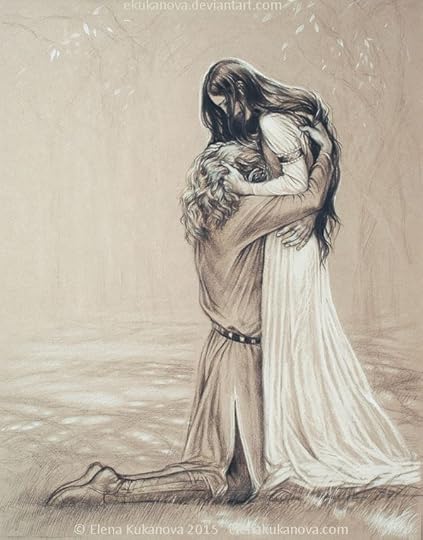
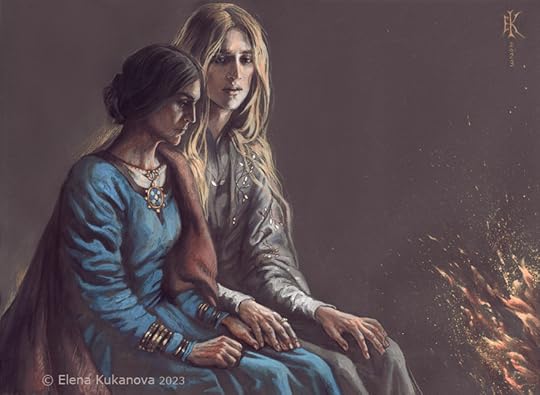
Also included are three versions of the story of Finwë and Míriel, an important episode that leads to a fascinating theological discussion among the Valar (law versus liberty in Arda Marred). This story was unfortunately boiled down to less than two paragraphs in the published Silmarillion.
4. Athrabeth Finrod ah Andreth
This work (still a draft) presents a philosophical conversation between Finrod and a woman of the house of Bëor. Their discourse takes place against the backdrop of the Siege of Angbad, but it is presented here because it is closely related to the theological debates in the preceding story of Finwë. The author addresses "fundamental differences of destiny, nature, and experience between Elves and Men." Finrod and Andreth discuss the Incarnation of an infinite deity into a finite reality, the differences between the souls (frëar) of Men and Elves, and the tolls of a fallen world on near-immortals versus beings with short lifespans.
5. "The Tale of Adanel"
This short story is the only narrative that tells of the fall and corruption of Men by Morgoth.
6. "Myths Transformed"
This chapter outlines competing, often contradictory ideas that Tolkien was considering by the end of the 1950's. Tolkien’s quest to achieve consistency led him to consider many esoteric questions: Do Orcs and Eagles have souls, or are they just highly intelligent beasts? If the Eldar learned science from the Valar in Aman, then how could they have a myth of the creation of the Sun that accepts a flat earth as a paradigmatic assumption?
Some of these ideas begin to tear at the roots of the entire invented cosmology. If the sun exists from the beginning of time, then Oromë does not name the Elves ‘People of the Stars’ and the Two Trees are not needed to illuminate the world… and so forth. Had Tolkien carried his later ideas forward, it would have significantly changed the legendarium and superseded much of what came before.
My evolving thoughts on the published Silmarillion:
I wish this book included more discussion of how Christopher Tolkien assembled the canonical Silmarillion out of thousands of pages of drafts written over five decades. Why did he choose some stories, texts, and ideas over others?
He seems to defer to his father's latter texts whenever possible, but since those texts are incomplete, he often relies on earlier texts to complete the narrative. This forces him to jettison some of the latter material where it would contradict the earlier.
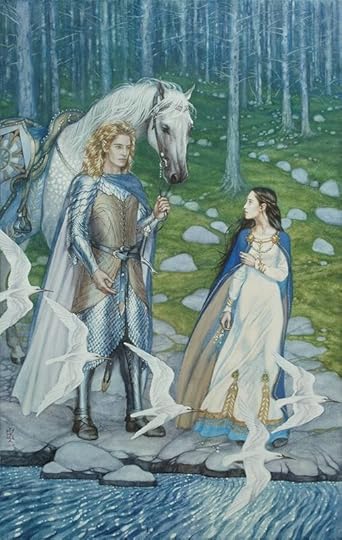
For example, both the Finwë-Míriel texts and Athrabeth contain statements about the reincarnation of Elves that are at odds with the earlier story of Lúthien's reincarnation. Reconciling these inconsistencies, even if possible, would have required Christopher to make drastic alterations to his father's words. Since the legendarium obviously cannot stand without The Saga of Beren and Lúthien, the latter texts could surely not be included as written. (Also, it appears Tolkien changed his mind about reincarnation again, based on his letters late in life concerning the strange history of Glorfindel.)
In other cases, it appears Christopher acted conservatively whenever his father's ultimate intentions are not clear. I suspect "Adanel" was omitted because the author wrote in the margins of the typescript that he was worried this story pushed the legendarium too far into "parody of Christianity."
Still, at other times I believe Christopher probably just selected the versions he preferred. Tolkien had decided by 1969 that Orcs are descended from corrupted Men, not Elves. Christopher chose to stick with the original idea but with no explanation why.
3 stars.