

What do you think?

Lays of Ancient Rome
That what is called the history of the Kings and early Consuls of Rome is to a great extent fabulous, few scholars have, since the time of Beaufort, ventured to deny, boldly ventures the preface.
112 pages, Paperback
First published January 1, 1842
About the author
Thomas Babington Macaulay
2,798 books138 followersThomas Babington Macaulay, 1st Baron Macaulay PC was an English poet, historian and Whig politician. He wrote extensively as an essayist and reviewer, and on British history. He also held political office as Secretary at War between 1839 and 1841 and Paymaster-General between 1846 and 1848.
As a young man he composed the ballads Ivry and The Armada, which he later included as part of Lays of Ancient Rome, a series of very popular ballads about heroic episodes in Roman history which he composed in India and published in 1842.
During the 1840s he began work on his most famous work, The History of England from the Accession of James the Second, publishing the first two volumes in 1848. At first, he had planned to bring his history down to the reign of George III. After publication of his first two volumes, his hope was to complete his work with the death of Queen Anne in 1714. The third and fourth volumes, bringing the history to the Peace of Ryswick, were published in 1855. However, at his death in 1859, he was working on the fifth volume. This, bringing the History down to the death of William III, was prepared for publication by his sister, Lady Trevelyan, after his death.
As a young man he composed the ballads Ivry and The Armada, which he later included as part of Lays of Ancient Rome, a series of very popular ballads about heroic episodes in Roman history which he composed in India and published in 1842.
During the 1840s he began work on his most famous work, The History of England from the Accession of James the Second, publishing the first two volumes in 1848. At first, he had planned to bring his history down to the reign of George III. After publication of his first two volumes, his hope was to complete his work with the death of Queen Anne in 1714. The third and fourth volumes, bringing the history to the Peace of Ryswick, were published in 1855. However, at his death in 1859, he was working on the fifth volume. This, bringing the History down to the death of William III, was prepared for publication by his sister, Lady Trevelyan, after his death.
Ratings & Reviews
Friends & Following
Create a free account to discover what your friends think of this book!
Community Reviews
Displaying 1 - 30 of 62 reviews

April 19, 2018
In Darkest Hour, Winston Churchill recites the following verses from "Horatius" (one of the Lays of Ancient Rome) to his fellow passengers in the London Underground:
“Then out spake brave Horatius,The last two lines are spoken by another passenger, Marcus Peters, a young black male—someone from the far reaches of the Empire, possibly the Caribbean. When Churchill hesitates, Peters completes the verse, and the result is extraordinarily moving.
The Captain of the Gate:
“To every man upon this earth
Death cometh soon or late.
And how can man die better
Than facing fearful odds
For the ashes of his fathers
And the temples of his gods…”
Was I moved by this? Hard to tell, for I was already weeping. I had begun to weep the moment Churchill began his recitation, for I remembered how my Aunt Alice--a contemporary of Sir Winston's--had often recited the very same passage to me. She was of Irish heritage, daughter of an immigrant from England, and had memorized these verses in a Cincinnati grade school during the final years of the First World War. (Aunt Alice also possessed a foot-high iron statue, of a Roman warrior with upraised sword, which she called "Horatius" and used as a door stop. He is still in service to our family, having guarded my bookshelves for most of the last twenty years.)
These poems of courage and patriotism became popular at the height of the British Empire, around the time Victoria was proclaimed "Empress of India," but Macaulay wrote them much earlier, long before he won his fame as an historian, in the years immediately before Victoria was crowned a queen.
Macaulay was in his thirties serving as "the legal member" of the Governor-General’s Supreme Council for India. While ministering to the fledgling empire of the British, Macaulay reflected upon the origin of the Roman; he read closely the first five books of Livy, which are filled with the myths and legends preserved from Rome’s earliest days. Scholars of Macaulay’s time believed the theory—since rejected—that Livy based his history on ballads now lost—works of the early empire which praised the city’s ancient origins—and it was reflecting upon these lost ballads that sparked Macaulay’s creativity. What would these old ballads have looked like? How would they have treated their already mythic material? Would their writers’ view of the present have helped them organize the myths of the past?
Using the English ballad tradition as a model, the young Macaulay wrote four long narrative poems, each an example of what he imagined might be the ancient Roman style: “Horatius” (Horatius Cocles and his companions defend a bridge against the Etruscans), “The Battle of Lake Regillus” (the Roman’s defeat of the Tarquin’s Latin League due to the intervention of twin gods Castor and Pollux), “Virginia” (the decemvir Appius Claudius’ attack upon the maiden Virginia, and its public consequences), and “The Prophecy of Capys” (old prophet Capys tells the victorious Romulus and Remus of the coming empires’ great victories).
The poems themselves are fun, in an old-fashioned bumptious way. They aren’t first-rate poetry, but they are first-rate second-rate poetry, and that’s good enough for me. (“The Raven,” “The Charge of the Light Brigade,” and “The Highwayman” are all excellent examples of my idea of first-rate second-rate verse.)
Just as fun as the poems themselves, though, are the essays that precede them, in which Macaulay discusses the characteristics of the Roman ballad tradition—which is of course his own fabrication—in a way that explains (and excuses) many features of his poems, including the occasional anachronism.
One of my favorite features of ancient poetry is its catalogs: the lists of gods, warriors or cities, each labeled with the appropriate epithet or characteristic. Macaulay excels at this sort of poetry. Here is his list of the Latin League towns and territories from “The Battle of Lake Regillus” (including the Rex Nemorensa of Aricia, memorialized by James Frazer in The Golden Bough):
From every warlike city
That boasts the Latian name,
Fordoomed to dogs and vultures,
That gallant army came;
From Setia's purple vineyards,
From Norba's ancient wall,
From the white streets of Tusculum,
The proudist town of all;
From where the Witch's Fortress
O'er hangs the dark-blue seas;
From the still glassy lake that sleeps
Beneath Aricia's trees—
Those trees in whose dim shadow
The ghastly priest doth reign,
The priest who slew the slayer,
And shall himself be slain;
From the drear banks of Ufens,
Where flights of marsh-fowl play,
And buffaloes lie wallowing
Through the hot summer's day;
From the gigantic watch-towers,
No work of earthly men,
Whence Cora's sentinels o'erlook
The never-ending fen;
From the Laurentian jungle,
The wild hog's reedy home;
From the green steeps whence Anio leaps
In floods of snow-white foam.

December 18, 2009
Celebrity Death Match Special: Horatio at the Bridge versus Austin Powers, International Man of Mystery
[Late 6th century B.C. A plain before Rome. Enter LARS PORSENA, MAMILIUS, SEXTUS, their various VASSALS and RETAINERS, the ENTIRE TUSCAN ARMY and DR and SCOTT EVIL]
DR EVIL: [rubbing hands gleefully] We're almost there. We just cross the bridge, eliminate the token guard force, enter the now undefended city and sack and plunder it to our heart's content. Oh, this is so evil! Why have we stopped?
LARS PORSENA: Their captain, Horatio, has come out to meet us with two of his stout followers. They challenge us to trial by single combat.
DR EVIL: But if there's three of them, it can't be single combat?
LARS PORSENA: Triple combat, if you like. I am a general, not a sophistical philosopher.
DR EVIL: So what's your plan?
LARS PORSENA: I will send against them three of my finest champions, Aunus, Seius and Picus.
DR EVIL: And if they don't deliver?
LARS PORSENA: I will send three more champions, Aruns, Ocnus and Lausulus.
DR EVIL: And if that doesn't work?
LARS PORSENA: I will send my greatest champion, Astur of Luna.
DR EVIL: All on his own?
LARS PORSENA: If the Fates have written it so, he will triumph.
DR EVIL: Sounds good to me.
SCOTT EVIL: Hold on. I mean, WTF dude?
LARS PORSENA: I grasp not thy uncouth words.
SCOTT EVIL: Can you translate, Dad?
DR EVIL: Quod coïtum, homine?
LARS PORSENA: Speak, slave, but be brief.
SCOTT EVIL: Thank you. I mean, hey, but this is totally not real. Like, how many archers you got there, Mister Tuscan General?
LARS PORSENA: A company of the finest Scythian archers, their breastplates gleaming in the--
SCOTT EVIL: Right. That's, what, one hundred crack archers? Tell me how to say it in Latin, and I'll order them to turn those three mo-fos into pincushions. It'll take less than a minute.
[LARS PORSENA and DR EVIL look at each other and shake their heads sadly]
DR EVIL: I'm sorry, Scott. You just don't get it, do you?
[Late 6th century B.C. A plain before Rome. Enter LARS PORSENA, MAMILIUS, SEXTUS, their various VASSALS and RETAINERS, the ENTIRE TUSCAN ARMY and DR and SCOTT EVIL]
DR EVIL: [rubbing hands gleefully] We're almost there. We just cross the bridge, eliminate the token guard force, enter the now undefended city and sack and plunder it to our heart's content. Oh, this is so evil! Why have we stopped?
LARS PORSENA: Their captain, Horatio, has come out to meet us with two of his stout followers. They challenge us to trial by single combat.
DR EVIL: But if there's three of them, it can't be single combat?
LARS PORSENA: Triple combat, if you like. I am a general, not a sophistical philosopher.
DR EVIL: So what's your plan?
LARS PORSENA: I will send against them three of my finest champions, Aunus, Seius and Picus.
DR EVIL: And if they don't deliver?
LARS PORSENA: I will send three more champions, Aruns, Ocnus and Lausulus.
DR EVIL: And if that doesn't work?
LARS PORSENA: I will send my greatest champion, Astur of Luna.
DR EVIL: All on his own?
LARS PORSENA: If the Fates have written it so, he will triumph.
DR EVIL: Sounds good to me.
SCOTT EVIL: Hold on. I mean, WTF dude?
LARS PORSENA: I grasp not thy uncouth words.
SCOTT EVIL: Can you translate, Dad?
DR EVIL: Quod coïtum, homine?
LARS PORSENA: Speak, slave, but be brief.
SCOTT EVIL: Thank you. I mean, hey, but this is totally not real. Like, how many archers you got there, Mister Tuscan General?
LARS PORSENA: A company of the finest Scythian archers, their breastplates gleaming in the--
SCOTT EVIL: Right. That's, what, one hundred crack archers? Tell me how to say it in Latin, and I'll order them to turn those three mo-fos into pincushions. It'll take less than a minute.
[LARS PORSENA and DR EVIL look at each other and shake their heads sadly]
DR EVIL: I'm sorry, Scott. You just don't get it, do you?
August 7, 2013
Informs as it fascinates, Macaulay's Lays is altogether my favorite work of poetry. The words are evocative like no other poet I've read - Macauley manages to spin together action, suspense, gore, horror, and melodrama. Horatius at the Bridge is the highlight of the whole book, although the others are enjoyable too (Capys the least of the bunch): Regillus takes Horatius's Iliadic tone and expands it into a larger epic, Virginia brings to mind a short stage melodrama, and Capys is mostly a historical footnote to bring everything together. My two favorite stanzas (How can a man choose?!) are from Horatius and Regillus, respectively:
Which achieve action and horror better than prose of the same sort.
Which achieve action and horror better than prose of the same sort.
November 26, 2025
My Roman Empire is the Roman Republic

February 17, 2023
My boys (age 14, 12, 10 and 8) and I read this aloud in our homeschool. Everyone really enjoyed it…it was lively and went along with stories they already knew. Of course the one about Horatius at the Bridge was the favourite.

July 21, 2014
I had a Latin teacher in high school who assigned this and at the time, I found it boring because I didn’t understand the history that underlay the poems or the influence of the period in which they were written. This time around, I enjoyed them, especially “Horatius” and “The Battle of Lake Regillus”. The poem, “Ivry” is an interesting look at a battle between the Huguenots and the Catholic League in 1590, and “The Armada” is a thrilling look at the arrival of the Spanish Armada in 1588. Not light reading, by any stretch, but they reward the reader who will take the time to read them aloud, and they are evocative in the way a good prose story can be.
“Then out spake brave Horatius,
The Captain of the Gate;
‘To every man upon this earth
Death cometh soon or late.
And how can man die better
Than facing fearful odds,
For the ashes of his fathers,
And the temples of his Gods,…’”
“Then out spake brave Horatius,
The Captain of the Gate;
‘To every man upon this earth
Death cometh soon or late.
And how can man die better
Than facing fearful odds,
For the ashes of his fathers,
And the temples of his Gods,…’”

October 27, 2015
Once you've looked up the names and references you don't understand (thank you, O Wikipedia), this book is pure gravy.
It's a very Victorian collection of poetry: there is more blood, honor, guts, and glory in a sterner, straighter telling than you would get from a modern author. At the same time, there are entire stanzas that just give you a view of the countryside -- nothing else. And the stories are unforgettable.
image: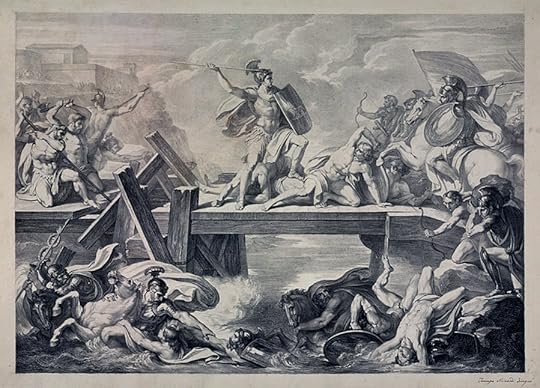
Macualay's emphasis is on telling a thundering good story, a content rather than a style writer. Nevertheless, he's quite the poet. He has a way of making the language not only sing, but clang and shout and laugh when it needs to. Sometimes he conveys a great deal with a few words.
Thank you, Mr. Macaulay, for a few days with the ancient Romans. I'll borrow your time machine again someday.
It's a very Victorian collection of poetry: there is more blood, honor, guts, and glory in a sterner, straighter telling than you would get from a modern author. At the same time, there are entire stanzas that just give you a view of the countryside -- nothing else. And the stories are unforgettable.
image:
Macualay's emphasis is on telling a thundering good story, a content rather than a style writer. Nevertheless, he's quite the poet. He has a way of making the language not only sing, but clang and shout and laugh when it needs to. Sometimes he conveys a great deal with a few words.
Thank you, Mr. Macaulay, for a few days with the ancient Romans. I'll borrow your time machine again someday.

November 4, 2019
Superb reading. Calls to mind the same heroic model evidenced by Browning, in "Childe Harold to the Dark Tower Came" or Tennyson's "Ulysses". Full-throated, muscular, forthright rhapsodizing without frills or adornments. Manly poetry for manly men. Maces, and staves, blows-thrust-aside by glossy shields, camrades leaping forward with arms flashing down to cleave an enemy's helm. Selflessness and sacrifice. Taunts and challenges on the plain of Mars, heralds and ramparts, banners and women's wails. Battles, sieges, trumpets, and crumpled foes on the ground at one's feet. Fans of Tolkien, look ye here.

March 24, 2018
Then out spake brave Horatius,
The Captain of the Gate:
To every man upon this earth
Death cometh soon or late.
And how can man die better
Than facing fearful odds,
For the ashes of his fathers,
And the temples of his gods

April 22, 2013
OMG THIS IS SUCH A GOOD BOOK OF WISDOM IT'S JUST THESE FOUR POEMS ABOUT THE MAJESTICNESS AND MAJESTY OF ROME AND THE EPIC BATTLES AND HONORABLE PEOPLE #DYING OF ROMAN FEELS

January 25, 2018
You can see why the Victorians loved these verses by Macaulay, celebrating as they do the very Victorian virtues of Courage and Patriotism. I myself was swept up in some of Macaulay’s Lays, in particular I was moved by the poem “Horatius” whose famous lines pop up in films from time to time (such as Tom Cruise’s “Oblivion” and, more recently, the Churchill biopic “Darkest Hour.”):
Then out spake brave Horatius,
The Captain of the Gate:
"To every man upon this earth
Death cometh soon or late.
And how can man die better
Than facing fearful odds,
For the ashes of his fathers,
And the temples of his gods.”
The other poems were more obscure, but still interesting and sprinkled with some memorable lines. Unfortunately, the poems are preceded by boring chunks of prose that are like hot sand at the beach that you want to hurry through so you can get to the waves. I would have likes this much better without the prose bombs (not that Macaulay can’t write prose, I really enjoyed his history of England from the Accession of James the Second).
Then out spake brave Horatius,
The Captain of the Gate:
"To every man upon this earth
Death cometh soon or late.
And how can man die better
Than facing fearful odds,
For the ashes of his fathers,
And the temples of his gods.”
The other poems were more obscure, but still interesting and sprinkled with some memorable lines. Unfortunately, the poems are preceded by boring chunks of prose that are like hot sand at the beach that you want to hurry through so you can get to the waves. I would have likes this much better without the prose bombs (not that Macaulay can’t write prose, I really enjoyed his history of England from the Accession of James the Second).

May 4, 2011
Not a lot is written or read about the very far-off, ancient days of Rome, before Rome became Mistress of the World, the immense politic figure that we remember today. These poems, of heroes and their battles, are just the sort of inspiring thing which captures my imagination. The unabashed vividness, the potency, even the basic beauty of the metre which begs to be read aloud, all mark this collection as a keeper.

August 28, 2012
This is a 100-year-old textbook filled with Macaulay's heroic poetry. I enjoyed it very much. It was originally of interest as Winston Churchill memorized the first very long poem in the book. I wish that when I was being force fed poetry in my junior high and high school English classes this had been on the reading list.
May 23, 2022
I enjoyed the history of the ballads that the Leopold Classic Library had in the introduction. The ballads were a good glimpse into Roman culture - lots of connections to “Iliad” & “Odyssey” that we read during our 2021-2022 edu year. But these ballads are gory- not for young readers!
Pre-read of 2022-2023 educational year.
Pre-read of 2022-2023 educational year.

April 21, 2017
Believe it or not the epigram “Rome was not built in a day”, meaning that some things cannot be done at once, but require time and patience, was not coined by Romans. As a matter of fact it first appeared in England in John Heywood’s “A Dialogue Containing the Number in Effect of All the Proverbes in the English Tongue” (1546). It was also used in “Don Quixote” (1605) by Miguel de Cervantes. Nowadays modern Romans usually do as they like, and do not expect others do as they do.
The same story of Romulus and Remus is just a story which says that they founded on this day Rome. Read what a famous English historian wrote in his “Lays of Ancient Rome”, a collection of narrative poems, or lays: Thomas Babington Macaulay. Four of these recount heroic episodes from early Roman history with strong dramatic and tragic themes, giving the collection its name. The Lays were composed by Macaulay in his thirties, during his spare time while he was the "legal member" of the Governor-General of India's Supreme Council from 1834 to 1838.
The Roman ballads are preceded by brief introductions, discussing the legends from a scholarly perspective. Macaulay explains that his intention was to write poems resembling those that might have been sung in ancient times.The Lays were first published by Longman in 1842, at the beginning of the Victorian Era. They became immensely popular, and were a regular subject of recitation, then a common pastime. The Lays were standard reading in British public schools for more than a century. Here follows what he says about this legend:
“That what is called the history of the Kings and early Consuls of Rome is to a great extent fabulous, few scholars have, since the time of Beaufort, ventured to deny. It is certain that, more than three hundred and sixty years after the date ordinarily assigned for the foundation of the city, the public records were, with scarcely an exception, destroyed by the Gauls. It is certain that the oldest annals of the commonwealth were compiled more than a century and a half after this destruction of the records.
It is certain, therefore, that the great Latin writers of the Augustan age did not possess those materials, without which a trustworthy account of the infancy of the republic could not possibly be framed. Those writers own, indeed, that the chronicles to which they had access were filled with battles that were never fought, and Consuls that were never inaugurated; and we have abundant proof that, in these chronicles, events of the greatest importance, such as the issue of the war with Porsena and the issue of the war with Brennus, were grossly misrepresented.
Under these circumstances a wise man will look with great suspicion on the legend which has come down to us. He will perhaps be inclined to regard the princes who are said to have founded the civil and religious institutions of Rome, the sons of Mars, and the husband of Egeria, as mere mythological personages, of the same class with Perseus and Ixion. As he draws nearer to the confines of authentic history, he will become less and less hard of belief.
He will admit that the most important parts of the narrative have some foundation in truth. But he will distrust almost all the details, not only because they seldom rest on any solid evidence, but also because he will constantly detect in them, even when they are within the limits of physical possibility, that peculiar character, more easily understood than defined, which distinguishes the creations of the imagination from the realities of the world in which we live.
The early history of Rome is indeed far more poetical than anything else in Latin literature. The loves of the Vestal and the God of War, the cradle laid among the reeds of Tiber, the fig-tree, the she-wolf, the shepherd's cabin, the recognition, the fratricide, the rape of the Sabines, the death of Tarpeia, the fall of Hostus Hostilius, the struggle of Mettus Curtius through the marsh, the women rushing with torn raiment and dishevelled hair between their fathers and their husbands, the nightly meetings of Numa and the Nymph by the well in the sacred grove, the fight of the three Romans and the three Albans, the purchase of the Sibylline books, the crime of Tullia, the simulated madness of Brutus, the ambiguous reply of the Delphian oracle to the Tarquins, the wrongs of Lucretia, the heroic actions of Horatius Cocles, of Scaevola, and of Cloelia, the battle of Regillus won by the aid of Castor and Pollux, the defense of Cremera, the touching story of Coriolanus, the still more touching story of Virginia, the wild legend about the draining of the Alban lake, the combat between Valerius Corvus and the gigantic Gaul, are among the many instances which will at once suggest themselves to every reader.
In the narrative of Livy, who was a man of fine imagination, these stories retain much of their genuine character. Nor could even the tasteless Dionysius distort and mutilate them into mere prose. The poetry shines, in spite of him, through the dreary pedantry of his eleven books. It is discernible in the most tedious and in the most superficial modern works on the early times of Rome. It enlivens the dulness of the Universal History, and gives a charm to the most meagre abridgements of Goldsmith. Even in the age of Plutarch there were discerning men who rejected the popular account of the foundation of Rome, because that account appeared to them to have the air, not of a history, but of a romance or a drama …”
The same story of Romulus and Remus is just a story which says that they founded on this day Rome. Read what a famous English historian wrote in his “Lays of Ancient Rome”, a collection of narrative poems, or lays: Thomas Babington Macaulay. Four of these recount heroic episodes from early Roman history with strong dramatic and tragic themes, giving the collection its name. The Lays were composed by Macaulay in his thirties, during his spare time while he was the "legal member" of the Governor-General of India's Supreme Council from 1834 to 1838.
The Roman ballads are preceded by brief introductions, discussing the legends from a scholarly perspective. Macaulay explains that his intention was to write poems resembling those that might have been sung in ancient times.The Lays were first published by Longman in 1842, at the beginning of the Victorian Era. They became immensely popular, and were a regular subject of recitation, then a common pastime. The Lays were standard reading in British public schools for more than a century. Here follows what he says about this legend:
“That what is called the history of the Kings and early Consuls of Rome is to a great extent fabulous, few scholars have, since the time of Beaufort, ventured to deny. It is certain that, more than three hundred and sixty years after the date ordinarily assigned for the foundation of the city, the public records were, with scarcely an exception, destroyed by the Gauls. It is certain that the oldest annals of the commonwealth were compiled more than a century and a half after this destruction of the records.
It is certain, therefore, that the great Latin writers of the Augustan age did not possess those materials, without which a trustworthy account of the infancy of the republic could not possibly be framed. Those writers own, indeed, that the chronicles to which they had access were filled with battles that were never fought, and Consuls that were never inaugurated; and we have abundant proof that, in these chronicles, events of the greatest importance, such as the issue of the war with Porsena and the issue of the war with Brennus, were grossly misrepresented.
Under these circumstances a wise man will look with great suspicion on the legend which has come down to us. He will perhaps be inclined to regard the princes who are said to have founded the civil and religious institutions of Rome, the sons of Mars, and the husband of Egeria, as mere mythological personages, of the same class with Perseus and Ixion. As he draws nearer to the confines of authentic history, he will become less and less hard of belief.
He will admit that the most important parts of the narrative have some foundation in truth. But he will distrust almost all the details, not only because they seldom rest on any solid evidence, but also because he will constantly detect in them, even when they are within the limits of physical possibility, that peculiar character, more easily understood than defined, which distinguishes the creations of the imagination from the realities of the world in which we live.
The early history of Rome is indeed far more poetical than anything else in Latin literature. The loves of the Vestal and the God of War, the cradle laid among the reeds of Tiber, the fig-tree, the she-wolf, the shepherd's cabin, the recognition, the fratricide, the rape of the Sabines, the death of Tarpeia, the fall of Hostus Hostilius, the struggle of Mettus Curtius through the marsh, the women rushing with torn raiment and dishevelled hair between their fathers and their husbands, the nightly meetings of Numa and the Nymph by the well in the sacred grove, the fight of the three Romans and the three Albans, the purchase of the Sibylline books, the crime of Tullia, the simulated madness of Brutus, the ambiguous reply of the Delphian oracle to the Tarquins, the wrongs of Lucretia, the heroic actions of Horatius Cocles, of Scaevola, and of Cloelia, the battle of Regillus won by the aid of Castor and Pollux, the defense of Cremera, the touching story of Coriolanus, the still more touching story of Virginia, the wild legend about the draining of the Alban lake, the combat between Valerius Corvus and the gigantic Gaul, are among the many instances which will at once suggest themselves to every reader.
In the narrative of Livy, who was a man of fine imagination, these stories retain much of their genuine character. Nor could even the tasteless Dionysius distort and mutilate them into mere prose. The poetry shines, in spite of him, through the dreary pedantry of his eleven books. It is discernible in the most tedious and in the most superficial modern works on the early times of Rome. It enlivens the dulness of the Universal History, and gives a charm to the most meagre abridgements of Goldsmith. Even in the age of Plutarch there were discerning men who rejected the popular account of the foundation of Rome, because that account appeared to them to have the air, not of a history, but of a romance or a drama …”

July 25, 2020
Lord Macaulay's nearly perfect collection of poems based on Ancient Roman literature sweep the reader into great vistas of Classical history while also providing an important literary history.

Read
December 29, 2022Dark, bloody, rhythmic, glorious poetry.

January 3, 2026
Horatio!
Thomas Babington Macaulay believed that Rome should have an epic tradition of poetry that pre-dated its conquest of Greece and the Greek artistic influence. He writes a convincing forward about Rome's supposed history of narrative poems. And then he invents some poetry that probably should have been what the Romans would have been writing if they were writing in the way that Babington Macaulay thinks they should have. It's very much in the style of Tennyson. If you think poetry should rhyme, it sure does.
The first two poems are great epics about stalwart men heroically holding bridges. I guess the British used Horatio to inspire its youth and Churchill quotes it in that movie. Then there's a poem about an affluent guy who is horny for a schoolgirl, so her father stabs her right there in the marketplace. Fleeing in the night, sending her away, fighting him legally, none of these are options; just stabbing. "Her" sacrifice is heroic. Meh. Gross. And then there's an even rhymier poem about Castor and Pollux.
If I had just read Horatio, I would have been very happy.
Good Librivox reader.
Thomas Babington Macaulay believed that Rome should have an epic tradition of poetry that pre-dated its conquest of Greece and the Greek artistic influence. He writes a convincing forward about Rome's supposed history of narrative poems. And then he invents some poetry that probably should have been what the Romans would have been writing if they were writing in the way that Babington Macaulay thinks they should have. It's very much in the style of Tennyson. If you think poetry should rhyme, it sure does.
The first two poems are great epics about stalwart men heroically holding bridges. I guess the British used Horatio to inspire its youth and Churchill quotes it in that movie. Then there's a poem about an affluent guy who is horny for a schoolgirl, so her father stabs her right there in the marketplace. Fleeing in the night, sending her away, fighting him legally, none of these are options; just stabbing. "Her" sacrifice is heroic. Meh. Gross. And then there's an even rhymier poem about Castor and Pollux.
If I had just read Horatio, I would have been very happy.
Good Librivox reader.

January 26, 2019
"To every man upon this earth
Death cometh soon or late"
Horaius was the only story I really liked, but to be fair the only one i really wanted to read to begin with.
I've wanted to read of Horaius for so long, I've been quoting him for years, so it was about time that I read it. And it sure was glorious, someting about the old days are really fascinating. It was a very cool lay of brave Horatius and it was everything I wanted it to be :D
"Still is the story told,
How well Horatius kept the bridge
In the brave days of old. "
Death cometh soon or late"
Horaius was the only story I really liked, but to be fair the only one i really wanted to read to begin with.
I've wanted to read of Horaius for so long, I've been quoting him for years, so it was about time that I read it. And it sure was glorious, someting about the old days are really fascinating. It was a very cool lay of brave Horatius and it was everything I wanted it to be :D
"Still is the story told,
How well Horatius kept the bridge
In the brave days of old. "
April 9, 2016
Like many others, Horatius at the Bridge was what drew my initial attention to this book. However, the other lays contain beautiful narrative poetry on politics, heroism and character. A 2000 year old story told, retold and finally captured in poetry by Lord Macaulay still remains relevant and entertaining. The language is clear and easy to follow, and the rhymes make the lays easy to remember. I would say that this is a fantastic book which should be on everyone's must-read list.

August 8, 2017
XLIII, from Horatius
He smiled on those bold Romans
A smile serene and high;
He eyed the flinching Tuscans,
And scorn was in his eye.
Quoth he, "The she-wolf's litter
Stand savagely at bay:
But will ye dare to follow,
If Astur clears the way?''
oh my...叫人怎么不喜欢Astur!

May 14, 2018
Books like this are what make e-publishing and free kindle books great. I never would have read this, and didn't even know what a "Lay" was, I thought I was down loading something about early city planning in Rome.
That said, the author reconstructs and tells a bit of the history of early ballad poetry in preliterate Rome. It was interesting.
That said, the author reconstructs and tells a bit of the history of early ballad poetry in preliterate Rome. It was interesting.

December 4, 2013
Gave up on it after about 25% of way through. Accompanying text too hard to follow, too "scholarly", and the lays themselves not that interesting. Just thought I'd try it, after seeing the book in the movie, "Oblivion", starring Tom Cruise.

August 12, 2019
“To every man upon this earth
Death cometh soon or late.
And how can man die better
Than facing fearful odds,
For the ashes of his fathers,
And the temples of his gods...”
🙌🙌🙌🙌🙌
Death cometh soon or late.
And how can man die better
Than facing fearful odds,
For the ashes of his fathers,
And the temples of his gods...”
🙌🙌🙌🙌🙌
January 20, 2021
This book is simply good. It is quality poetry that begs to be read aloud (or at the very least subvocalized if you are reading in a doctor's office like I was). Macaulay's introduction gives a fascinating description of the role of ballads and song in establishing and passing on culture. Each poem is then introduced with a description of the period and events it is describing. To read them is to be immersed in the contemplation of honor, love, courage, and sacrifice.
I get a weekly allergy shot and have to wait in the doctor's office half an hour after each shot. This has been the treat that makes me look forward to those visits. I wouldn't allow myself to read it any other time.
The only downsides to this work that I found is that it is a vocabulary builder. The kindle edition makes it easy enough to look up archaic words, and the built in dictionary usually gives clarity. Most instances looking up the word is not absolutely necessary as context makes the passage clear enough. Also, the introductions sometimes makes comparisons to 18th or 19th century British history, some of which were lost on me. Together the vocabulary and historical issues added a small degree of tediousness to the read, but I still give it 5 stars because the deficiency is in the reader, not the text. This book is exactly what it claims to be. It is enjoyable and memorable. I will probably come back to the poems many times.
I get a weekly allergy shot and have to wait in the doctor's office half an hour after each shot. This has been the treat that makes me look forward to those visits. I wouldn't allow myself to read it any other time.
The only downsides to this work that I found is that it is a vocabulary builder. The kindle edition makes it easy enough to look up archaic words, and the built in dictionary usually gives clarity. Most instances looking up the word is not absolutely necessary as context makes the passage clear enough. Also, the introductions sometimes makes comparisons to 18th or 19th century British history, some of which were lost on me. Together the vocabulary and historical issues added a small degree of tediousness to the read, but I still give it 5 stars because the deficiency is in the reader, not the text. This book is exactly what it claims to be. It is enjoyable and memorable. I will probably come back to the poems many times.

August 13, 2021
If this book—particularly "Horatius at the Bridge"—was good enough for Winston Churchill, then it's good enough for me:
"And how can man die better /
Than facing fearful odds, /
For the ashes of his fathers, /
And the temples of his Gods"
Also liked the end as well:
"And they made a molten image, and set it up on high, /
And there it stands unto this day to witness if I lie. /
It stands in the Comitium, plain for all folk to see; /
Horatius in his harness, halting upon one knee: /
And underneath is written, in letters all of gold, /
How valiantly he kept the bridge in the brave days of old. /
And still his name sounds stirring unto the men of Rome, /
As the trumpet-blast that calls to them to charge the Volscian home; /
And wives still pray to Juno for boys with hearts as bold /
As his who kept the bridge so well in the brave days of old"
"And how can man die better /
Than facing fearful odds, /
For the ashes of his fathers, /
And the temples of his Gods"
Also liked the end as well:
"And they made a molten image, and set it up on high, /
And there it stands unto this day to witness if I lie. /
It stands in the Comitium, plain for all folk to see; /
Horatius in his harness, halting upon one knee: /
And underneath is written, in letters all of gold, /
How valiantly he kept the bridge in the brave days of old. /
And still his name sounds stirring unto the men of Rome, /
As the trumpet-blast that calls to them to charge the Volscian home; /
And wives still pray to Juno for boys with hearts as bold /
As his who kept the bridge so well in the brave days of old"

April 4, 2020
It's a little silly to rate this nearly two century old classic of ancient poems mostly devoted to familiar conflict drama. Familiar because it resembles more familiar Homeric works -especially the tale of the three defending the bridge against the hordes. And the Maddened king enraged at losing his wife to a Paris like rival.
The old tales are fascinating for their antiquity and window Into an ancient means of communicating news and entertainment.
A quick read.
The old tales are fascinating for their antiquity and window Into an ancient means of communicating news and entertainment.
A quick read.
June 3, 2024
»Then out spake brave Horatius,
The Captain of the gate:
‘To every man upon this earth
Death cometh soon or late.
And how can man die better
Than facing fearful odds,
For the ashes of his fathers,
And the temples of his Gods,
[…]
‘Hew down the bridge, Sir Consul,
With all the speed ye may;
I, with two more to help me,
Will hold the foe in play.
In yon strait path a thousand
May well be stopped by three.
Now who will stand on either hand,
And keep the bridge with me?«
The Captain of the gate:
‘To every man upon this earth
Death cometh soon or late.
And how can man die better
Than facing fearful odds,
For the ashes of his fathers,
And the temples of his Gods,
[…]
‘Hew down the bridge, Sir Consul,
With all the speed ye may;
I, with two more to help me,
Will hold the foe in play.
In yon strait path a thousand
May well be stopped by three.
Now who will stand on either hand,
And keep the bridge with me?«

June 23, 2021
Horatius is a 5 star poem. But none of the others really hit me as hard.
I found the really long Preface, and some of the introductions of the poem rather tedious. Maybe I’m just not super into the literary history of the ancient world. I think I would have liked shorter descriptions of the context of the poems better, and then just getting straight into them.
I found the really long Preface, and some of the introductions of the poem rather tedious. Maybe I’m just not super into the literary history of the ancient world. I think I would have liked shorter descriptions of the context of the poems better, and then just getting straight into them.

April 27, 2022
A great read! Macaulay introduces the book by showing that a tradition of native Roman poetry was lost as Greek styles became popular among the writers of Rome. To attempt to show this native Latin style of poetry Macaulay composes four poems written as if by a citizen in the early years of the Roman Republic.
Displaying 1 - 30 of 62 reviews