Great book featuring Aboriginal art of Australia. 187 illustrations (31 in color) of works of art - paintings, bark paintings, Dreaming images, sculpture, bone coffins, boxes, contemporary art, performance, installations, contemporary painting. Includes glossary, notes / bibliography. Softcover. 216 pages. Measures 6 by 8 inches. Interesting book, nicely illustrated.
An overall background on the acceptance of Aboriginal art in Austrailia, along with the social structures and traditions of the people. A rather small format, but I still thoroughly enjoy the illustrations and photos. The more I see the individual pieces, the more excitement I feel about them. In Aborigianl culture one attains status through the acquistion of knowledge, not material possessions and "Art is an expression of knowledge, and hence a statement of authority." I say bravo!
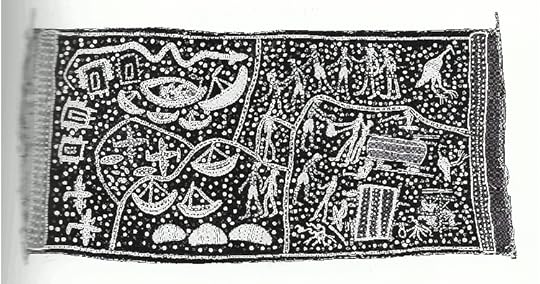
Es un libro escrito con intenciones bastante modestas, Un catálogo del arte en circulación producido por aborigenes australianos del siglo XX. Caruana no escribe con pretensiones históricas o antropológicas. Lo que hace es defender una continuidad en términos de lenguaje visual con una tradición milenaria, y dar unos elementos mínimos para leer las obras. Las imágenes que reproduce en el libro tienen un atractivo muy inmediato que se extiende mucho con esas indicaciones. Algunas de las obras (en su mayoría pinturas sobre corteza de eucalipto) están fragmentadas en paneles con una dirección narrativa - como un comic-. Es el caso de Cómo empezó la Segunda Guerra Mundial (a los ojos de los rembarrnga), de Paddy Fordham Wainburranga:
Del texto: "Cómo empezó la Segunda Guerra Mundial (a los ojos de los rembarernga) registra un suceso concerniente a los buscadores de perlas japoneses que solían trabajar en las costas septentrionaloes de Australia. El panel inferior derecho muestra un intercambio que afecta a mujeres aborígenes (se identifica a los japoneses por sus pantalones cortos). El panel inferior central muestra a un buscador de perlas conduciendo a una mujer a las barcas. En 1941 se produjo un incidente entre los pobladores locales y los japoneses que obligó a a estos últimos a retirarse a Darwin, donde fueron expulsados por los funcionarios del Gobierno (que aparecen en el panel superior derecho llevando pistolas y sombreros cowboy). Pocos meses después, en 1942, los aeroplanos japonesesw (representados a la izquierda) bombardearon la costa septentrional de Australia. Los rembarrnga, entre quienes la guerra tuvo efectos sociales de muy amplio alcance ya que muchos de ellos fueron reclutados para trabajar en las instalaciones militares, creyeron que habían contribuido al inicio de las hostilidades".
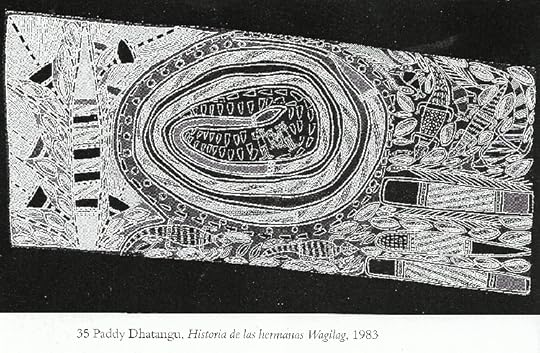
La fragmentación en paneles para introducir una secuencia y el carácter histórico de la narración señalan una innovación fruto del contacto. Pero la mayoría de las obras son mucho más sintéticas, más vinculadas al mito, y plasman un relato entero en una sola imagen sin imponer una dirección o siquiera una orientación espacial de arriba-abajo, acercándose a los mitogramas de los que hablaba Leroi-Gourhan. Un ejemplo es la Historia de las hermanas Wagilag, compuesta por un solo panel:
Del texto: "Las dos hermanas Wagilag tuvieron hijos nacidos de relaciones incestuosas con los hombres de su clan, quienes las obligaron a abandonar su tierra del interior y a viajar primero hacia el Norte y después hacia el Oeste hasta llegar al mar. Durante su viaje vieron animales, plantas y territorios a los que pusieron nombres y, al hacerlo, los despertaron a la vida. Acamparon junto al pozo de Mirrarrmina en el territorio de Liyagalawumirri, sin saber que se trataba del hogar sagrado del Wititj, la Pitón, quien se enfadó por su presencia. Sorbiendo las aguas del pozo, Wititj se alzó erecta y escupió al cielo para formar las nubes de lluvia de la primera estación monzónica. Las hermanas ejecutaron canciones y danzas para desviar el diluvio y la tormenta que le siguió y se refugiaron en una cabaña de corteza que habían fabricado. Entonces Wititj descendió de repente y se tragó a las mujeres, a sus hijos y sus pertenencias. Cuando Wititj volvió a alzarse hacia el cielo, las aguas inundaron la tierra."
El arte aborigen sirve muy bien como colección de ejemplos de obras visuales que pueden ser leídas sin la mediación de la escritura lineal ni el peso del naturalismo ramplón de la tradición occidental.
I learned a lot about Aboriginal culture and the art produced by it. It was interesting to see how the effects of colonialism influenced the art created by the community. I do wish most of the art pieces were displayed in full color in the book.
NF book group theme: art history or history through art. My rating is not so much a judgement on how useful or "good" this book is but in how much I enjoyed reading it. It was a bit of a slog, but not so much that I couldn't get through it, slowly but surely.
It was very dense with information and covered a massive topic, the history of art of an entire continent, over 200 cultures (as defined by language) with 50,000 years of art traditions. But having no other background in the study of Aboriginal art history (or any other "world of art" books) I have no idea if it was a well written book or not. I'm guessing it was though, since I read the whole thing.
I got a good sense of how Australian Aboriginal art functions within the enduring traditional cultures and how entwined with religion and ritual it is. Some of the forms were familiar to me, but I had no idea how many layers of meaning there were and how artists are bound by affiliations and ritual secrets. I probably didn't need to read explanations of all 206 plates in this book (which was the purpose of the book). Most of the information I was really interested in was in the introduction. The unfamiliar names, cosmologies, cultural groups, and languages made my eyes glaze over at times, but I did learn some very interesting things.
I have the fourth edition, published in 2025, and I realized that there is a separate page for that edition, but I am leaving this review here as it seems to be the more common place for reviews of this book. Fourth edition is great, and I'm glad to see that this book is being continuously updated.
I picked this book up at an aboriginal art shop/gallery in Cairns after finishing "Songlines" by Lynne Kelly and Margot Neale. I have had aborignal art prints hanging in my house and various items with with aboriginal designs (dishes, tablecloths, bags, etc.) on them for 20+ years, but after reading "Songlines" I realized how little I truly know about the history and meaning behind aboriginal art and its evolution from millennia old rock art to the paintings and myriad items sold in places from tourist shops to fine art galleries today. This book gives a great overview, though it primarily focuses on the 20th century. It is organized by region, and is very dense. After the introduction, it is somewhat difficult to read straight through, and is almost more like a reference book. The organization is good, and the images are wonderful, if sometimes a bit small. Highly recommend.