Jump to ratings and reviews
Rate this book

A Man with No Talents: Memoirs of a Tokyo Day Laborer

Rate this book
San'ya, Tokyo's largest day-laborer quarter and the only one with lodgings, had been Oyama Shiro's home for twelve years when he took up his pen and began writing about his life as a resident of Tokyo's most notorious neighborhood. After completing a university education, Oyama entered the business workforce and appeared destined to walk the same path as many a "salaryman." A singular temperament and a deep loathing of conformity, however, altered his career trajectory dramatically. Oyama left his job and moved to Osaka, where he lived for three years. Later he returned to the corporate world but fell out of it again, this time for good. After spending a short time on the streets around Shinjuku, home to Tokyo's bustling entertainment district, he moved to San'ya in 1987, at the age of forty.

Oyama acknowledges his eccentricity and his inability to adapt to corporate life. Spectacularly unsuccessful as a salaryman yet uncomfortable in his new surroundings, he portrays himself as an outsider both from mainstream society and from his adopted home. It is precisely this outsider stance, however, at once dispassionate yet deeply engaged, that caught the eye of Japanese readers. The book was published in Japan in 2000 after Oyama had submitted his manuscript on a lark, he confesses for one of Japan's top literary awards, the Kaiko Takeshi Prize. Although he was astounded actually to win the award, Oyama remained in character and elected to preserve the anonymity that has freed him from all social bonds and obligations. The Cornell edition contains a new afterword by Oyama regarding his career since his inadvertent brush with fame."

160 pages, Hardcover

First published January 1, 2000

7 people are currently reading
358 people want to read

About the author

Shirō Ōyama

1 book1 follower

Ratings & Reviews

What do you think?
Rate this book

Friends & Following

Create a free account to discover what your friends think of this book!

Community Reviews

5 stars
46 (28%)
4 stars
71 (43%)
3 stars
39 (23%)
2 stars
8 (4%)
1 star
0 (0%)
Displaying 1 - 20 of 20 reviews
Profile Image for Ryandake.
405 reviews58 followers
April 17, 2015
wow, what a perspective-bending book.

the author is a man who worked as a day laborer in tokyo. not just for a few weeks or a year in order to write a book. he'd done so for 13 years before he penned this book.

and it wasn't some misfortune or a lost job that landed him in that position--he chose it quite freely despite other opportunities. he'd had "normal" jobs for years, and decided that he just wasn't made for the salaryman life.

for 13 years, then, working day labor jobs, living pretty much hand to mouth. then, when japan's real estate bubble burst, he found himself with rather too much time on his hands, and so he wrote this book.

the man's observational skills are a master class for writers. or i suppose for anyone who needs to see people minutely. perhaps when you are at the bottom of the heap, these skills sharpen--they'd have to, as a matter of self-preservation. when you do not have a door you can lock, or indeed any door or walls at all, you'd best have a really good grip on what the guy in the next bunk is all about.

his attitudes toward society and towards many of the things that most normal people live and work for are quite breathtaking. he's not disrespectful, but he also has no use for material greed or social approval or many of the bedrock values we (both east and west) live by.

he's not at all arrogant or disdainful. he doesn't proselytize. he's not trying to convert anyone, and he's not mentally ill. in fact, he seems to me to be someone who has considered his own life philosophy with a depth and care that most people never take.

i am in awe, and even more so after reading the afterword.

read the book.
Profile Image for Fábio de Carvalho.
246 reviews14 followers
May 20, 2021
C'était ultra précis comme sujet, mais c'était super intéressant, ces impressions données par un homme assez éduqué de l'univers des journaliers du monde de la construction dans un quartier ouvrier du Japon. J'ai préféré lire à propos de son univers et de son travail plutôt que de ses quelques élucubrations libertariennes auxquelles on a droit dans les 2 derniers chapitres (le pire doit être le bout où il chiâle contre un collègue que ça ferait chier de voir un riche en limousine passer à côté d'un itinérant fouillant dans une poubelle en disant que "I, on the other hand, would be thinking about the heavy responsibilities shouldered by that same executive and feel very grateful not to be sitting in his seat"), mais bon, ça donnait quand même un insight intéressant overall.

Merci à Claudia qui me l'a prêté, parce que j'serais définitivement jamais tombé là-dessus autrement.
258 reviews5 followers
December 6, 2021
A difficult book to give a rating to because of it's short length but one that is well worth the read because of the frankness and honesty Shiro uses in writing about his subject matter. Before even starting with a review it's important to note that as a translation this work should be viewed as a cut above because it's translator, Edward Fowler, actually met with Shiro to iron out the transfer of the work. It's rare for me, as someone who usually reads older works where the original author has died, to read a translation that has the original author's seal of approval, especially considering the author has sworn himself to anonymity and could have easily ignored the summons to meet with a translator in person multiple times. When you further consider that aside from anonymity, the author has aimed to completely isolate himself from society, collaborating with a translator is a lucky boon for non-Japanese readers and offers us an opportunity to learn about a completely foreign community.

The subject matter at hand, the life of the poverty stricken Japanese day-laborer, is something that I assume almost no westerner is familiar with. The fact that it's autobiographical gives it the sense of reality necessary to make it appreciable by a reader, especially a foreign one. You feel a sense of camaraderie with Shiro, if you are an educated empathetic person (basically the normal average reader), you will notice similarities between yourself and Shiro. The fact that Shiro purposefully says almost nothing about his personal life before deciding to become a day-laborer only aids this effect. I'm sure he choose to do this out of a sense of privacy but as a reader it only makes his story more relatable. Certain aspects of Shiro's personality, his sense of not wanting to be bothered by the world, is something almost everyone can relate to, no matter what their background or culture, the difference is that Shiro takes it to the extreme, and then tells the reader the consequences of his actions. Of course, at this point, the difference between the casual reader and Shiro makes itself apparent, Shiro is perfectly happy living the rest of his life completely separate from humanity while most of are unwilling to take the leap.

Shiro was an educated person, once living a normal life in a corporate job, until the strain of essentially mental illness (mild depression, in his words, and an inability to conform with others) drove him to seek out the lifestyle of a day-laborer. He'd wake up in the middle of the night, stake out a place in line at the job center, and generally take whatever came his way until he worked enough days to qualify for unemployment. Most of his off days are spent reading, watching TV, and taking long walks around Tokyo. It was frightening to see aspects of myself in Shiro's personality and almost a marvel to see his equanimity in facing a lifestyle of poverty most people, myself included, are terrified of. The fact that Shiro himself openly and humbly talks about his flaws in facing the daily challenges of his life, and lists examples of those he met who do a better job of it, is crazy to me. It's also sad to see that most of those living this lifestyle are older men (40s-60s) who simply had nowhere else to go and are either stoically awaiting their deaths or completely consumed by their vice of choice (gambling or alcoholism). There's definitely a sense of culture shock here as many are unwilling to inform their families of what's become of them and, in one case, would rather seek out an anonymous suicide rather than burden their well-adjusted next of kin.

Shiro's reasoning as to why he prefers his current way of life makes up one of the more eccentric and interesting sections of this work. His way of convincing himself as to why he's perfectly fine with living a life scavenging for food and sleeping on the street is worth reading. His level of writing and thought process is really something most people would not expect from a homeless person, and, in a way, makes you self-conscious of looking down on those who may have a more enlightened view of the world than yourself. At the same time, he admits his eccentricity, and cautions against looking at the homeless or near-homeless with rose-colored glasses. Many of whom are just as bad-natured and ignorant as those in the upper classes, or completely addicted to their vice of choice. An element of luck comes into play as the novel covers, I believe, a period of twelve years in Shiro's life. Some of the characters Shiro meets and admires end up poorly, or disappear altogether, while others find a way to survive and return to living a normal life.

All in all, I think this is a work worth reading, if you can find it. I was lucky enough to have a copy in my local library. I think it gives a lot of insight into a segment of Japanese culture that is basically invisible to westerners, and provides a reality check on the rosy picture most Japanese media paints for tourists and Japanese culture fans (like myself).

One quote I wanted to note down:
"We do not live in a world in which we must choose between (a) +100 or (b) -100. Our actual choice is something closer to that between a -2 and a -5; we can't even determine, moreover, which choice is the -2 and which the -5. Or maybe it is in fact a choice between, say, the red-3 and the black-3. It's a choice, in other words, between two totally different but equally bad things. I am really put off by the simplemindedness of those who insist that ours is a world in which absolute good (+100) butts heads with absolute evil (-100)."
"The choice I will be making as I face old age is between two very different lifestyles, both with negative values. The first is working at a hanba, leading a dog's life from which there is no escape (and for the sake of which one must constantly maneuver and jockey for position), but which guarantees the daily necessities. The second is a life of scavenging for food which, however, liberates one completely from dealings with other people while allowing one to enjoy such activities as reading in the library. I shall opt for the latter choice without hesitation. Both choices have negative values, but I would rate the former at about -50, and the latter at only a -10. (A -50 would be for me just about the worst rating imaginable." (Pg. 114)
Profile Image for William.
155 reviews31 followers
November 7, 2019
Quick read standing up at work (dog daycare). The perspective is very interesting and welcomed but I disagree as a person to some of the conclusions the author comes to. Dismissing the pursuit of love as just another pursuit of power over another with no real follow up or explanation strikes me as a supreme copout, but one could characterize his departure from traditional working life to be a similar sort of giving up on even attempting to hold a more advanced opinion or coping mechanism. Although maybe he’d really felt like he tried everything by the time he reached the age he started looking for day laborer work, I dunno. Just hard to sympathize with an acerbic observer of human nature, choosing willfully to live on the street, working, who hates interacting with absolutely any people, and hates work, and will gladly do nothing as long as possible. Book is good though. Don’t have to sympathize to find it interesting.
Profile Image for Lisa.
379 reviews22 followers
May 15, 2018
Really fascinating. I didn't realize that this element of society existed/exists in Japan and Shiro's experiences and insights were quite surprising. I liked his voice and how he reflected on his life so honestly - a rare find.
Profile Image for gordon.
47 reviews2 followers
November 20, 2022
How might your life look if its guiding principle was simply: minimize responsibility? Shirō Ōyama gives his candid answer in A Man with No Talents, a memoir of his unfettered life as a day laborer in Tokyo’s San’ya district and the Buddhist philosophy that led him there.

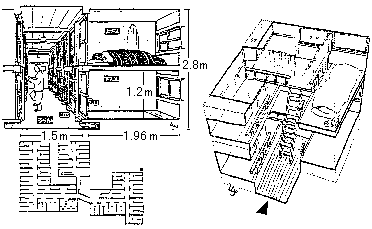
To the foreign reader’s great benefit, Ōyama meticulously depicts the mechanics and dynamics of the San’ya day laborer scene and of life at the bottom of Japan’s social hierarchy. Details include the taxonomy of bunkmates encountered over fifteen years renting the same few square meters in a doya (flophouse). The tactics of the queue at the front gate of the employment center. Recession pushing the start of this queue from 6:00am to 1:00am to just after the gates shut on the previous day. The common vices and uncommon virtues of his queuemates. A navigation guide for the restrictions placed on the unemployment dole and the officious clerks who administer it.


That being said, the success of A Man with No Talents isn’t owed to these details. No — it succeeds because Ōyama is a shrewd observer with zero artifice or pretense, a self-proclaimed “average loser” with no swollen ego to stop him from telling things as they are.

A person cannot be gentle if he lacks strength; nor can he embrace others if he is not himself brimming with quiet self-confidence.


Not strong or self-confident, Ōyama is nothing if not self-aware. In true Japanese form, he rigorously catalogs the spectrum between salaryman and street scavenger and describes his slide down this social ladder as an inevitable consequence of his innate unreliability and his uncompromising values system in which freedom from restraint outranks access to material comforts.

It is easy enough to conjure up the sort of scene that would spark the outrage of someone like the activist Saitō: a wealthy executive riding in a chauffeured limousine driving by a homeless man foraging garbage from a trash can on the streets somewhere in the metropolis. Were he to witness such a scene, Saitō would be crying out for social justice until he was blue in the face. I, on the other hand, would be thinking about the heavy responsibilities shouldered by that same executive and feel very grateful not to be sitting in his seat. Since I can imagine just how carefree the life of a vagrant is, once he gets used to the idea of people watching him scavenge for his food, I don’t think of it as the ultimate tragedy that it is usually made out to be. Most important, a society that exhibits such an obvious gap between rich and poor is also one that tolerates diversity (insofar as it doesn’t round up the scavengers and cart them off to an institution). Just what a person considers to be the ultimate misfortune depends on that particular person’s values.


Ōyama’s is a diverse perspective I would recommend to anyone in this era when the phrase “men are opting out” is leaking into the mainstream.

Further reading:

- No Longer Human (1948) by Osamu Dazai
- Hunger (1890) by Knut Hamsun
- The Burnout Society (2010) by Byung-Chul Han
- Bartleby, the Scrivener (1853) by Herman Melville

--

Read this and other reviews on Perikrone
Profile Image for Emmanuel Sahagún.
20 reviews
August 30, 2024
Un libro corto pero durisisimo. Es este tipo de textos que me demuestran que no necesitas ser un gran escritor para poder transmitir sentimiento y emociones al lector. Es triste como no es completamente un final feliz (Depende de que ojos se vea) pero hay cierta satisfaccion al leer las experiencia de esta persona, trabajar al dia sin certeza del mañana y con el golpe que ocasiono la burbuja de japon en los 90's. La situacion que corren los adultos abajo de los 60 años durante esta decada perdida esta muy cabrona, solamente puedes sobrevivir hasta esa edad. En resumen, un libro para leer real shit.
Profile Image for Julia Arciga.
86 reviews4 followers
February 8, 2024
There are some shining moments in this book -- where he talks about his life philosophy, political views, reflects on his life choices and mulls on the economic environment of Japan -- but majority of the book was a slice-of-life type read, which was a bit mundane at times. I wish we could have gotten his point of view on big ideas more, rather than the day-to-day activities.
Profile Image for Fred Kohn.
1,412 reviews27 followers
September 7, 2018
This book was recommended to me by my son who is a big fan of Japanese culture. You would think that the memoirs of just an average joe would be boring as hell, but they're not.
Profile Image for Yakub.
59 reviews1 follower
October 27, 2021
Pretty quick and easy read, an expression of what it must have been like at that place, and that time in that little corner of the world
Profile Image for Nick Tramdack.
131 reviews43 followers
April 25, 2011
"These Christian volunteers depend in a far more profound way on San'ya men - as objects for their "good deeds" (that is, relief work) - than San'ya men do on the volunteers... If, for example, the government were to conduct relief work on a larger scale, San'ya men would no longer need these people; the volunteers, on the other hand, will always require San'ya men as their very own "needy" and as living proof of their own spiritual redemption."

Interesting memoir of life as a day laborer in Japan. It's hard for me to judge how much of the author's style is unique and how much is a convention of Japanese nonfiction. (I'd bet that the technique of presenting facts only as gentle qualifications like "I'd say", "I can say," "It should be clear that"... is not unique to Oyama Shiro's writing.) Still, some of the observations, like the ones I've quoted above, really make it worth the read.


Profile Image for Simon.
85 reviews8 followers
March 9, 2012
This book gives fascinating insights into the community of day workers and homeless people living in Tokyo. Japanese society places a high value on conformity. This book describes the everyday life of a man who was unable to live up to the expectations imposed on him by Japanese society. He graduated from university and worked in a company as a "salary man", but found the pressure too much so he dropped out from society and became a day laborer. I found this book interesting because gives a peek into a section of Japanese society that is largely unnoticed.
Profile Image for Karen.
18 reviews2 followers
August 3, 2023
I suspect the biggest problem with this book is a combination of the cultural aspects being too unfamiliar to me as a westerner and loss of the subtle aspects of any book, such as the mood, in translation. I get the impression this translation is technically accurate but it reads very cold and distant.
Profile Image for Stephen.
60 reviews
January 15, 2010
The day laborer never made much sense to me and definitely never got much sympathy from my direction. Oyama Shiro (or so he calls himself) provides, almost by accident, an amazing insight into the day laborers life.

It's a little scary how much anybody can relate with this person.
Profile Image for Millie.
237 reviews3 followers
September 12, 2016
I love this book. I love this man and that he shared everything he's been through.
Profile Image for Peyton.
14 reviews1 follower
March 4, 2018
I had to read this for my history of Tokyo class last semester and I actually quite enjoyed it.

Note/s: Accurate insight into Japanese culture. I enjoyed the author and his ability to self-reflect.

General summary: This is the story of a man who left behind his white collar job and all social norms, moved to the outskirts of Tokyo, and lived as a day laborer. // what he learned and observed during these years.

(I see how it could be boring to some, but I found it to be engaging.)

Displaying 1 - 20 of 20 reviews

Can't find what you're looking for?

Get help and learn more about the design.