Evolving from a series of road trips along the Mississippi River, Alec Soth's Sleeping by the Mississippi captures America's iconic yet oft-neglected "third coast." Soth's richly descriptive, large-format color photographs present an eclectic mix of individuals, landscapes, and interiors. Sensuous in detail and raw in subject, Sleeping by the Mississippi elicits a consistent mood of loneliness, longing, and reverie. "In the book's 46 ruthlessly edited pictures," writes Anne Wilkes Tucker, "Soth alludes to illness, procreation, race, crime, learning, art, music, death, religion, redemption, politics, and cheap sex." Like Robert Frank's classic The Americans , Sleeping by the Mississippi merges a documentary style with a poetic sensibility. The Mississippi is less the subject of the book than its organizing structure. Not bound by a rigid concept or ideology, the series is created out of a quintessentially American spirit of wanderlust.
Alec Soth (b. 1969) is a photographer born and based in Minneapolis, Minnesota. He has published over thirty books including Sleeping by the Mississippi (2004), NIAGARA (2006), Broken Manual (2010), Songbook (2015), I Know How Furiously Your Heart is Beating (2019), A Pound of Pictures (2022), and Advice for Young Artists (2024).
Soth has had over fifty solo exhibitions including survey shows organized by Jeu de Paume in Paris (2008), the Walker Art Center in Minnesota (2010), Media Space in London (2015), and the Tokyo Photographic Art Museum (2024). Soth has been the recipient of numerous fellowships and awards, including the Guggenheim Fellowship (2013). In 2008, Soth created Little Brown Mushroom, a multi-media enterprise focused on visual storytelling. Soth is represented by Sean Kelly in New York, Weinstein Hammons Gallery in Minneapolis, Fraenkel Gallery in San Francisco, Loock Galerie in Berlin, and is a member of Magnum Photos.
Sleeping by the Mississippi by photographer Alec Soth spotlights life near the Mississippi River. His pictures begin near the headwaters of the river in Minnesota and conclude in Louisiana near New Orleans. The first edition of the book came out in 2004, so I am assuming many of the photographs were taken sometime from the late 80s to the early 00s. His pictures were of a mix of people, landscapes, and careworn interiors. He gave a brief description of who or what was in the photograph along with the location, plus a notes section at the end of the book included additional information on about a third of the pictures. The title of his book ties in with some of the photos, as beds or mattresses can be found in several of the pictures he chooses to share. He shares the underbelly of life along the river, as many of the people in his pictures were struggling and his pictures showed grim locations. Some of the most arresting photos from this collection are the Minnesota houseboat and inhabitant, a cemetery in Wisconsin, an abandoned church in Kaskaskia, a massage parlor in Iowa, a daughter and mother, a swamp hangout, Angola State Prison, a Bible study book, and the final pictures of a bed frame found outdoors near Venice, Louisiana (that has probably fallen into the river by now because of erosion). However, I did not care for the cover of the 2017 edition I read, the faded yellow walls don't fully do the photos found inside justice or represent the book's theme. (Actual review 3.5/5)
I’m sure this is one of those books that you open any page and stare at the photos in awe. I’m still dabbling here and there in photography, but wow—so many of the photos made my jaws drop.
What beautiful, sad and lonely pictures these are of the bottom, half of our society. Soth takes as his point of reference the Mississippi river from its beginnings in cold Minnesota to the lush orgies of Louisiana.
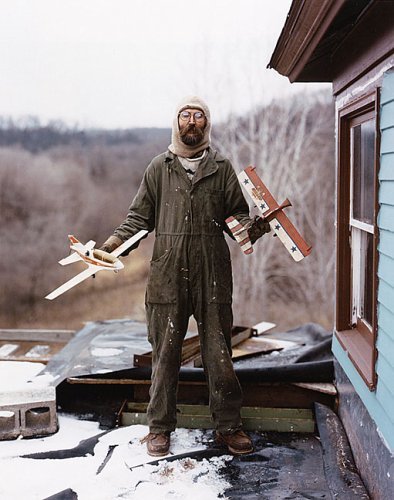
I had seen the cover of this book in a photography magazine and was intrigued by the cover image - a man in a baggy jumper, balaclava and walrus mustache holding two toy airplanes on a junk and snow covered deck. And you know what? I still have no idea who he is or what he is doing because the book only provides explanations of about half the images. But then again, sometimes that's half the fun with photography books. Sifting through images of the righteous, downtrodden, dreamers and the deserted you can create your own stories and ideas. Sometimes the truth, such as it is, can be a real let-down.
The book itself is a collection of images loosely held together by their ties to the Mississippi river. As though you are a traveler wandering aimlessly down the river - a later day Mark Twain - the photographer gives an unbiased view of the people and places - snowy convenience stores, convicts on work detail, junk filled marshes, fishermen, homemade shrines and street preachers. What a strange and fascinating country we live in.
Believe the hype. This is a book that has spawned literally thousands of imitators, and with good reason. Soth himself has not quite managed to top Mississippi in the intervening 15+ years.
Feels like a proper addition to the Gummo Cinematic Universe. Lots of gritty, grimy, slightly cozy Real America-type pics. My only complaint is that I wish there were more photographs included. Alex Soth's work is unique and delightful.
Un viaggio lungo il Mississippi, dal Minnesota alla Louisiana, che racconta l'America (non solo) contemporanea partendo dal letto usato in gioventù da Charles Lindbergh e mostrandone diversi altri, raccontando storie di solitudine, religione, violenza, desiderio e costruendo un affresco potentissimo. Le immagini, prese con una camera di grande formato, sono frutto di un lavoro di meticolosa attenzione, composizione e uso del colore, collocandosi fra Eggleston e Shore e facendo di Soth un maestro della contemporaneità (e di questo libro un immediato classico).
I shot with an 8x10 camera for a year after looking at the photographs from this book. These photographs are simultaneously airy and possessed of the greatest gravity.
In short, this is one of my favorite artists at the top of his game. Although there are many examples of Soth at the top of his game, this book is perhaps his best known. It is also one of his first. Depicting life on and around the Mississippi River, he thankfully avoids making this a travelogue or an essay with a narrative and moral. Instead, he finds scenes that feel honest, uncontrived, and eclectic. Religion, sex, and the quaint attempt by people to bring joy, entertainment, or beauty into their lives are themes that emerge. Mostly, though, this book is meant to be taken bit by bit. Linger on a handful of images for awhile before moving on. It is non-narrative, so there is no need to rush on to find out what happens next. Just take in what you see on one page and let that be enough for the moment.
E' davvero il classico che si dice. Fotografie in grande formato scattate lungo il grande fiume, con letti (vuoti o occupati) e religione a fare da fili conduttori. Grande respiro, tanti spunti, malinconia e vitalità. Con un testo della scrittrice Patrici Hampl che cerca di emulare il tono del rqacconto legato al Missisippi che ho trovato poco rilevante, forse per lacune culturali mie in merito, ed un altro della curatrice museale Anne Tucker molto più interessante ed emozionante.
Do photo books count on goodreads? Either way, I just started using my view camera again so naturally I had to revisit this classic book by Alec. Truly captivating. I really need more of his books. The intro and epilogue were also brilliant writing that add so much more depth to the imagery. So good.
Simply wonderful stuff by Alex Soth. Pictures that speak a thousand words. Insanely beautiful, especially knowing how much effort was put in every single picture. My favourite was the gas station with the graveyard and the mountain.
A beautiful, slow book of images. They read like a lonely lament, but Soth is never condescending to his subjects. The afterword by Anne Wilkes Tucker is an insightful review, sensitively written.