I very clearly (and fondly) do remember that when I had to read E.T.A. Hoffmann’s fairy tales for a course on German Romanticism I was taking during my undergraduate degree (in 1986, at Mount Allison University in Sackville, New Brunswick, Canada) how strangely surprised I was at just how creepily uncanny and also how generally quite majorly different his 1816 Nussknacker und Mausekönig is from the main storyline of Pyotr Ilyich Tchaikovsky's The Nutcracker ballet so universally known as well as beloved on a global basis, with our professor then telling us that Tchaikovsky's ballet is in fact based on a very loose French adaptation of Nussknacker und Mausekönig by Alexandre Dumas père (his 1844 Histoire d’un casse-noisette), a story which is of course still vaguely similar to E.T.A. Hoffmann’s original theme and contents wise, but leaves out all of the psychological questions, the possibility that Marie is actually emotionally and perhaps also medically, physically afflicted and is thus “seeing things” and equally has a standard fairy tale ending for Clara (not Marie) and her princely suitor that is pure and sweet fantasy and not the vacillation between fairy tale and reality found in Nussknacker und Mausekönig (and where readers themselves are not ever really all that sure exactly what is fantasy and what are Marie’s fever visions).
Now while in 1986, I was actually a bit disappointed that Nussknacker und Mausekönig was so very different from The Nutcracker ballet storyline, over the years and after multiple rereads, I have come to absolutely and totally adore E.T.A. Hoffmann’s poetic vision and in particular that there are no easy answers with regard to Marie and what she sees and experiences throughout Nussknacker und Mausekönig. But yes indeed, the entire not knowing what is reality and what is fantasy scenarios, including that decisive battle of the Nutcracker with the Mouse King, albeit I do consider this absolutely readable and most delightful as an adult reader, just to point out, that if I had read, if I had encountered Nussknacker und Mausekönig as a child, much of E.T.A. Hoffmann’s presented text would definitely have massively freaked me out, and I do thus also totally understand and appreciate why Alexandre Dumas père did such a very much less Hoffmannesque and more standardly traditional fairy tale adaptation of Nussknacker und Mausekönig for his Histoire d’un casse-noisette and why Tchaikovsky then also used the Dumas adaptation as the basis for his ballet.
And yes, for Nutcracker (published in 1984 and in my opinion suitable for readers from about the age of twelve or so onwards), Ralph Manheim's English language translation is absolutely spectacular and as thus totally spot-on so to speak, following E.T.A. Hoffmann's Nussknacker und Mausekönig very closely both contents and thematics wise (see above as to the specifics) but also without ever sounding pedantic, without ever sounding awkward and like a word for word translation of German into English, that Manheim's text is therefore not an adaptation of E.T.A. Hoffmann's Nussknacker und Mausekönig but that (and thankfully so) Nutcracker also sounds like an engaging and readably entertaining story in and of itself (absolutely perfect in my opinion, and that frankly, all of Ralph Manheim's German to English translations I have read have been absolutely wonderful and solidly rating five stars).
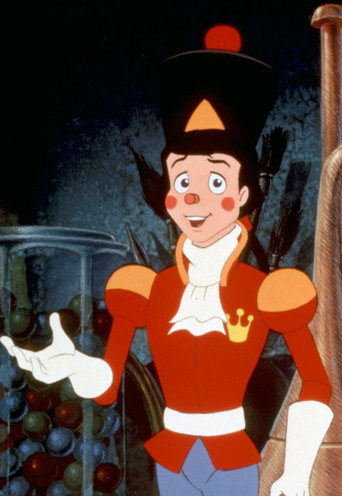
Now with regard to Maurice Sendak's colourfully lavish accompanying artwork for Nutcracker, although there are a few visual discrepancies regarding the images reflecting the text (such as for example how the seven-headed mouse king in Sendak's pictures sometimes only has one head and how Drosselmeier's eyepatch is at times on his left and in other pictures on his right eye, which is a bit annoying since in the story, the eyepatch is always on his right and never on his left eye) this is indeed extremely minor and pretty much insignificant for me and that therefore and in my opinion the combination of Ralph Manheim's translation and Maurice Sendak's illustrations for Nutcracker are definitely five solid stars (and that Manheim's translation is also and as such equally and absolutely the best rendition of E.T.A. Hoffmann's Nussknacker und Mausekönig into English I personally have read and encountered).