

What do you think?

Black Snow: Curtis LeMay, the Firebombing of Tokyo, and the Road to the Atomic Bomb
“Riveting.… This book is required reading for anyone with even a passing interest in World War II and the Pacific Theater.” ―Bob Carden, Boston Globe Seven minutes past midnight on March 10, 1945, nearly 300 American B-29s thundered into the skies over Tokyo. Their payloads of incendiaries ignited a firestorm that reached up to 2,800 degrees, liquefying asphalt and vaporizing thousands; sixteen square miles of the city were flattened and more than 100,000 men, women, and children were killed. Black Snow is the story of this devastating operation, orchestrated by Major General Curtis LeMay, who famously “If we lose the war, we’ll be tried as war criminals.” James M. Scott reconstructs in granular detail that horrific night, and describes the development of the B-29, the capture of the Marianas for use as airfields, and the change in strategy from high-altitude daylight “precision” bombing to low-altitude nighttime incendiary bombing. Most importantly, the raid represented a significant moral shift for America, marking the first time commanders deliberately targeted civilians which helped pave the way for the atomic bombing of Hiroshima and Nagasaki five months later. Drawing on first-person interviews with American pilots and bombardiers and Japanese survivors, air force archives, and oral histories never before published in English, Scott delivers a harrowing and gripping account, and his most important and compelling work to date. 24 photographs and 3 maps
448 pages, Paperback
First published September 6, 2022
About the author
James M. Scott
7 books168 followersLibrarian Note: There is more than one author in the Goodreads database with this name.
Ratings & Reviews
Friends & Following
Create a free account to discover what your friends think of this book!
Community Reviews
Displaying 1 - 30 of 133 reviews

December 12, 2022
“America had invested heavily to arrive at this pivotal moment. The United States had spent $3.7 billion to develop the four-engine bombers that lined the crushed coral taxiway on Saipan, making the B-29 the single most expensive weapons system of the war. The exorbitant price tag of Boeing’s aeronautical monster did not account for the casualty toll – 25,000 dead and wounded – exacted by the capture of the Mariana Islands of Saipan, Tinian, and Guam. This prized Pacific real estate placed Tokyo for the first time within range of American bombers…”
- James M. Scott, Black Snow: Curtis LeMay, the Firebombing of Tokyo, and the Road to the Atomic Bomb
In 1943, the United States Army built a mock Japanese-German village at the Dugway Proving Grounds in Utah. The purpose of these miniature towns was to practice the best ways in which to raze a city using incendiary bombs, should America decide to leave behind the practice of precision bombing.
The level of detail that went into the Japanese village was astounding. Houses were surrounded by narrow roads to mimic the congestion of Japanese urban centers. The roof-area percentage likewise tracked the coverage found in places like Tokyo, Yokohama, and Osaka. Instead of utilizing stud-frame construction, as found in typical American houses, the workers applied a more accurate keyed or mortised joint style. Comparable woods were selected to best reflect the moisture content in Japan.
The specifics of this reconstruction extended to the interiors of the houses, which were furnished with futons, hibachi stoves, amado shutters, and straw tatami mats on the floors. As James M. Scott points out in Black Snow, the military even outfitted one bedroom with two single beds pushed together, next to an infant’s cradle.
The reason, of course, is that Army Air Force leadership wanted to know how a Japanese family burned.
***
The decision to rain fire from the sky, the execution of that decision, and its grisly aftermath forms the three-part tale told in Black Snow.
In the first section, Scott takes a looping approach, beginning in Saipan – with American B-29s about to begin their assault – but frequently flashing back to broadly cover the history of bombing in general, and the air war in Europe in particular. He also intersperses the action with biographical sketches of some of the major players, including commanding general of the Army Air Force Henry “Hap” Arnold; General Haywood S. Hansell, who initially led XXI Bomber Command, and advocated for precision attacks rather than incendiaries; and General Curtis LeMay, who took over from Hansell and – essentially on his own authority – changed the rules of the game.
Scott’s handling of LeMay is extremely well done. Devastatingly parodied as General Jack D. Ripper in Stanley Kubrick’s Dr. Strangelove, LeMay is one of the most controversial and polarizing soldiers in American history. As head of the postwar Strategic Air Command, he played an important role in developing America’s nuclear deterrence. Later, he nearly ended the world, strongly advocating for bombing and invading Cuba during the Missile Crisis. He then cemented his reputation for questionable doctrine and ethics by advocating – in his memoirs – that America bomb Vietnam back to the Stone Age.
Before all this, LeMay was a hard-luck kid who worked his way through college, joined the Air Corps, and served admirably in Europe, before being given Hansell’s job. LeMay realized that Hansell had failed because precision bombing from high altitude would not work with the weather patterns over Japan. Against fierce opposition – some moral, but mainly tactical – he scrapped high-level raids and decided to strip the Superfortresses of guns and ammunition, pack them with M-69 incendiary devices, and send them in at 5,000 feet.
After some initial test runs, he targeted Tokyo for the big show.
***
Toggling back and forth between Japanese and American perspectives, Scott sets the stage by discussing Tokyo’s woeful preparations for an air raid. The fire department was tiny, their equipment insufficient, the shelters too few (with many only partially-finished), and fire mediation measures far below what proved to be necessary (despite the warning provided by the Great Kantō Earthquake of 1923). Scott also gives a sympathetic portrayal of the people living in Tokyo at the time: the hunger, the rationing, the families split apart as children were sent to the countryside, and the gnawing doubts that rose even as Japanese leadership kept the losing tide of war a secret.
The account of the infamous March 10, 1945 fire raid is top notch. While Scott presents some viewpoints from the air, he mostly focuses on the Japanese victims. Moreover, instead of throwing out a bunch of unconnected anecdotes, he tethers the fire-bombing sequence to a smaller number of participants, allowing us to get to know them, before following them through the nightmarish experience of a flaming hurricane. As in his prior books, Scott is uncannily good at finding nasty, pungent recollections that show war as an uncontrollably savage sundering of humanity.
Unsurprisingly, given the context, most people involved, both the bombers and the bombed, fell back on the obvious cliché: It was hell.
***
The final section, after the dramatic peak of the Tokyo inferno – which killed between 80,000 and over 100,000 people – is necessarily a bit of a letdown. At its most heartrending, it remains in Tokyo, as the ash-covered survivors try to collect and bury the dead.
Much of the narrative, though, is given over to a pretty quick recounting of LeMay’s other firebombing raids, and ultimately, the dropping of the twin atomic bombs. There’s nothing inherently wrong with these portions, but they don’t stand out, either. The dawn of nuclear war has been covered in many, many fine books, and Scott’s telling breaks no new ground. If you haven’t read much about Hiroshima and Nagasaki, the finale might work better for you.
***
The fire-bombings of Japan received a great deal of contemporary support, both within the American military and the public. In the years since, though, it has become one of the most controversial aspects of the Second World War, along with Hamburg and Dresden, Hiroshima and Nagasaki.
Two broad discussions have sprung up around the fire bombing campaign, with a great deal of overlap.
First, there is the moral component, which typically breaks down between the utilitarian view that the bombings ultimately saved lives by shortening the war, and the deontological perspective, which holds that burning people in their homes is never justified.
Second, there is the question of strategy, which asks whether bombing – as opposed to a naval blockade or even a negotiated peace – might have worked better.
Interestingly – though not surprisingly, given his past work – Scott does not engage these issues directly. To be sure, they come up within Black Snow, but he does not take a side or set forth any analysis. The only ethical framework that Scott creates is that of the brutal context of war. He shows how the horrific decision to drop fire from the sky came at the end of a long and horrific war that not only blurred the lines of decency, but erased them altogether.
It is axiomatic of war that the innocent are punished with the guilty. Many of the war’s individual perpetrators – the rapists of Nanking and Manila, the death squads in Bataan and Singapore – faced no repercussions for their actions. Sure, some eventually died in combat, in captivity, or from disease. But most probably slipped back into civilian life when hostilities ended. Meanwhile, thousands of noncombatants, including the very old and very young, endured heat and flame and suffocation as punishment for a conflict started and waged by others. Rather than trying to disentangle the threads of blame and justification, Scott does a good job focusing on the people below the bombs, with the empathy to which they are entitled as humans.
- James M. Scott, Black Snow: Curtis LeMay, the Firebombing of Tokyo, and the Road to the Atomic Bomb
In 1943, the United States Army built a mock Japanese-German village at the Dugway Proving Grounds in Utah. The purpose of these miniature towns was to practice the best ways in which to raze a city using incendiary bombs, should America decide to leave behind the practice of precision bombing.
The level of detail that went into the Japanese village was astounding. Houses were surrounded by narrow roads to mimic the congestion of Japanese urban centers. The roof-area percentage likewise tracked the coverage found in places like Tokyo, Yokohama, and Osaka. Instead of utilizing stud-frame construction, as found in typical American houses, the workers applied a more accurate keyed or mortised joint style. Comparable woods were selected to best reflect the moisture content in Japan.
The specifics of this reconstruction extended to the interiors of the houses, which were furnished with futons, hibachi stoves, amado shutters, and straw tatami mats on the floors. As James M. Scott points out in Black Snow, the military even outfitted one bedroom with two single beds pushed together, next to an infant’s cradle.
The reason, of course, is that Army Air Force leadership wanted to know how a Japanese family burned.
***
The decision to rain fire from the sky, the execution of that decision, and its grisly aftermath forms the three-part tale told in Black Snow.
In the first section, Scott takes a looping approach, beginning in Saipan – with American B-29s about to begin their assault – but frequently flashing back to broadly cover the history of bombing in general, and the air war in Europe in particular. He also intersperses the action with biographical sketches of some of the major players, including commanding general of the Army Air Force Henry “Hap” Arnold; General Haywood S. Hansell, who initially led XXI Bomber Command, and advocated for precision attacks rather than incendiaries; and General Curtis LeMay, who took over from Hansell and – essentially on his own authority – changed the rules of the game.
Scott’s handling of LeMay is extremely well done. Devastatingly parodied as General Jack D. Ripper in Stanley Kubrick’s Dr. Strangelove, LeMay is one of the most controversial and polarizing soldiers in American history. As head of the postwar Strategic Air Command, he played an important role in developing America’s nuclear deterrence. Later, he nearly ended the world, strongly advocating for bombing and invading Cuba during the Missile Crisis. He then cemented his reputation for questionable doctrine and ethics by advocating – in his memoirs – that America bomb Vietnam back to the Stone Age.
Before all this, LeMay was a hard-luck kid who worked his way through college, joined the Air Corps, and served admirably in Europe, before being given Hansell’s job. LeMay realized that Hansell had failed because precision bombing from high altitude would not work with the weather patterns over Japan. Against fierce opposition – some moral, but mainly tactical – he scrapped high-level raids and decided to strip the Superfortresses of guns and ammunition, pack them with M-69 incendiary devices, and send them in at 5,000 feet.
After some initial test runs, he targeted Tokyo for the big show.
***
Toggling back and forth between Japanese and American perspectives, Scott sets the stage by discussing Tokyo’s woeful preparations for an air raid. The fire department was tiny, their equipment insufficient, the shelters too few (with many only partially-finished), and fire mediation measures far below what proved to be necessary (despite the warning provided by the Great Kantō Earthquake of 1923). Scott also gives a sympathetic portrayal of the people living in Tokyo at the time: the hunger, the rationing, the families split apart as children were sent to the countryside, and the gnawing doubts that rose even as Japanese leadership kept the losing tide of war a secret.
The account of the infamous March 10, 1945 fire raid is top notch. While Scott presents some viewpoints from the air, he mostly focuses on the Japanese victims. Moreover, instead of throwing out a bunch of unconnected anecdotes, he tethers the fire-bombing sequence to a smaller number of participants, allowing us to get to know them, before following them through the nightmarish experience of a flaming hurricane. As in his prior books, Scott is uncannily good at finding nasty, pungent recollections that show war as an uncontrollably savage sundering of humanity.
Unsurprisingly, given the context, most people involved, both the bombers and the bombed, fell back on the obvious cliché: It was hell.
***
The final section, after the dramatic peak of the Tokyo inferno – which killed between 80,000 and over 100,000 people – is necessarily a bit of a letdown. At its most heartrending, it remains in Tokyo, as the ash-covered survivors try to collect and bury the dead.
Much of the narrative, though, is given over to a pretty quick recounting of LeMay’s other firebombing raids, and ultimately, the dropping of the twin atomic bombs. There’s nothing inherently wrong with these portions, but they don’t stand out, either. The dawn of nuclear war has been covered in many, many fine books, and Scott’s telling breaks no new ground. If you haven’t read much about Hiroshima and Nagasaki, the finale might work better for you.
***
The fire-bombings of Japan received a great deal of contemporary support, both within the American military and the public. In the years since, though, it has become one of the most controversial aspects of the Second World War, along with Hamburg and Dresden, Hiroshima and Nagasaki.
Two broad discussions have sprung up around the fire bombing campaign, with a great deal of overlap.
First, there is the moral component, which typically breaks down between the utilitarian view that the bombings ultimately saved lives by shortening the war, and the deontological perspective, which holds that burning people in their homes is never justified.
Second, there is the question of strategy, which asks whether bombing – as opposed to a naval blockade or even a negotiated peace – might have worked better.
Interestingly – though not surprisingly, given his past work – Scott does not engage these issues directly. To be sure, they come up within Black Snow, but he does not take a side or set forth any analysis. The only ethical framework that Scott creates is that of the brutal context of war. He shows how the horrific decision to drop fire from the sky came at the end of a long and horrific war that not only blurred the lines of decency, but erased them altogether.
It is axiomatic of war that the innocent are punished with the guilty. Many of the war’s individual perpetrators – the rapists of Nanking and Manila, the death squads in Bataan and Singapore – faced no repercussions for their actions. Sure, some eventually died in combat, in captivity, or from disease. But most probably slipped back into civilian life when hostilities ended. Meanwhile, thousands of noncombatants, including the very old and very young, endured heat and flame and suffocation as punishment for a conflict started and waged by others. Rather than trying to disentangle the threads of blame and justification, Scott does a good job focusing on the people below the bombs, with the empathy to which they are entitled as humans.

October 21, 2022
Audible Audiobook – Unabridged
James M. Scott (Author), L.J. Ganser (Narrator), HighBridge, a division of Recorded Books (Publisher)
Generously provided by

James M. Scott (Author), L.J. Ganser (Narrator), HighBridge, a division of Recorded Books (Publisher)
Generously provided by

January 11, 2023
I don’t think Mr. Scott can write a bad/boring book. I’ve now read all 4 of his WW II books and they are all excellent. In this offering, the author looks at the fire bombings of Japan’s cities in the spring and summer of 1945. In telling the story, Mr Scott also looks at the doctrine, tactics and personalities of the men who were tasked to carry out the strategic bombing of Japan staring in the spring of 1944. The two men, Hayward Hansel and his replacement Curtis LeMay were opposites in both experience and temperament. Hansel who was the first commander of the B-29s based in the Mariannas was a career staff officer and an Arnold acolyte with not a whole lot of command experience. Mr. Scott characterized him as the last true believer of the concept Daylight Precision Bombing. LeMay was a very experienced combat commander and had a reputation of a problem solver– he flew on some of the toughest missions the 8th AF flew against Germany and developed many of the tactics used by the Americans in Europe.
As the B-29s arrived in Saipan to begin the bombing offensive against Japan, Hansel was their commander. There were immediate problems. The B-29 was a buggy aircraft to say the least, with constant problems with engines. There were mission that less than half the A/C dispatched actually bombed the target. The bombing altitudes (30,000+ ft) brought the previous unknown Jet Stream into play. This caused havoc with bombing accuracy. There was also the problem of weather. It was estimate there were only 3 days a month that were clear enough to bomb visually. Mr Scott states that on the first mission to Japan, the Saipan based bombers utterly failed in hitting their target. Of 120+ A/ dispatched, less than 80 aircraft bombed the primary target and only only 2 of their bombs actually landed in the target area – a 100+ acre engine factory. Hansel was never able to solve the reliability or accuracy problems and was replaced by LeMay who had been the commander of the B-29s based in India/China.
The author makes a point that the firebombing of Japan’s cities was not a spur of the moment tactical change. He goes into some length in describing the research the AAF had done on the makeup of Japan’s cities and how best to destroy them. Some of Hansel’s subordinates were urging him to switch to area bombing and incendiaries long before LeMay came on the scene. That said the decision to go in low, at night and burn Tokyo to the ground was LeMays alone. He did not run it by higher, but made the decision. Hansel later called it the gutsiest decision of the War.
In looking at LeMay’s decision, Mr. Scott looks at the pressure Gen Arnold was putting on him to get results. Some of the reasons for this were the post war future of the Air Force, the fact that the B-29 was the single most expensive weapons program of the war and Arnolds desire to cause Japan to quit before an invasion was needed thus proving the worth of the Air Force.
This is not just a high level look at the bombing campaign. The author also looks at the crews who carried out the campaign and probably just as importantly, what the experience of the people getting bombed was like. To say that it was horrific is an understatement! He relates several first person accounts of survivors of the March Tokyo raid in particular.
Mr Scott also recounts the Hiroshima mission from both the American and Japanese perspective. Again as with the Tokyo mission – the experiences of those underneath the B-29 was horrific.
By the end of the bombing campaign – LeMay had burned out more than 170 square miles of Japans largest 60+ cities. By July/August he was running out of targets.
Finally Mr. Scott talks about the the Atomic Bomb missions and their effect. His opinion is that they along with the USSR’s declaration of War on the same day as Hiroshima finally convinced the Emperor to call it quits
All in all and superb/excellent/fantastic or whatever superlative you care to use read. Definitely a 5 star read.
As the B-29s arrived in Saipan to begin the bombing offensive against Japan, Hansel was their commander. There were immediate problems. The B-29 was a buggy aircraft to say the least, with constant problems with engines. There were mission that less than half the A/C dispatched actually bombed the target. The bombing altitudes (30,000+ ft) brought the previous unknown Jet Stream into play. This caused havoc with bombing accuracy. There was also the problem of weather. It was estimate there were only 3 days a month that were clear enough to bomb visually. Mr Scott states that on the first mission to Japan, the Saipan based bombers utterly failed in hitting their target. Of 120+ A/ dispatched, less than 80 aircraft bombed the primary target and only only 2 of their bombs actually landed in the target area – a 100+ acre engine factory. Hansel was never able to solve the reliability or accuracy problems and was replaced by LeMay who had been the commander of the B-29s based in India/China.
The author makes a point that the firebombing of Japan’s cities was not a spur of the moment tactical change. He goes into some length in describing the research the AAF had done on the makeup of Japan’s cities and how best to destroy them. Some of Hansel’s subordinates were urging him to switch to area bombing and incendiaries long before LeMay came on the scene. That said the decision to go in low, at night and burn Tokyo to the ground was LeMays alone. He did not run it by higher, but made the decision. Hansel later called it the gutsiest decision of the War.
In looking at LeMay’s decision, Mr. Scott looks at the pressure Gen Arnold was putting on him to get results. Some of the reasons for this were the post war future of the Air Force, the fact that the B-29 was the single most expensive weapons program of the war and Arnolds desire to cause Japan to quit before an invasion was needed thus proving the worth of the Air Force.
This is not just a high level look at the bombing campaign. The author also looks at the crews who carried out the campaign and probably just as importantly, what the experience of the people getting bombed was like. To say that it was horrific is an understatement! He relates several first person accounts of survivors of the March Tokyo raid in particular.
Mr Scott also recounts the Hiroshima mission from both the American and Japanese perspective. Again as with the Tokyo mission – the experiences of those underneath the B-29 was horrific.
By the end of the bombing campaign – LeMay had burned out more than 170 square miles of Japans largest 60+ cities. By July/August he was running out of targets.
Finally Mr. Scott talks about the the Atomic Bomb missions and their effect. His opinion is that they along with the USSR’s declaration of War on the same day as Hiroshima finally convinced the Emperor to call it quits
All in all and superb/excellent/fantastic or whatever superlative you care to use read. Definitely a 5 star read.

February 6, 2023
A tough book to read. Not because the author hasn't done a great job, but because he has: his is a dynamic, high-stakes account of a terrible campaign. And I was a bag of contradictory feelings reading it because he does such a fine job presenting things from all sides. Here you get the real Curtis LeMay: in many ways a ruthless and stoic figure, but also a competent and effective field commander who cared about his airmen and ending the war as soon as possible (because, as Scott notes, every day the war went on thousands more lives were lost), and who had tried high-altitude precision bombing like his predecessor but also made a failure of it. What to make of the man is ultimately up to the reader, but the facts are there before you.
And then the firebombing campaign itself. Easy to say it shouldn't have been done when it wasn't you or your son, father, brother or husband storming Peleliu, Iwo Jima, or Okinawa; easy to forget about what it would have cost to invade the Japanese home islands, and who can even begin to imagine, after the Battle of Manila, just what that would have been like, what it would have cost the Japanese people and American GIs? And how can one discount the absolute barbarism of the Japanese Imperial Army in China, in POW camps, in the Philippines? It's almost beyond reckoning. And yet... as a husband and father, it is so difficult, impossible really, to read of the firebombing of Tokyo and not imagine my own wife or sons there, a literal hell on earth. Could nothing else have been done? Could less cities have been razed? Any alternative at all? And how could Japan's leaders have been so selfish, so blind to the misery they were plunging their own people into?
Then there are the American military leaders whose foresight, energy, and determination helped to win the war, but who were not above self seeking, back biting, and such tertiary aims as the establishment of an independent air force. But, at the risk of sounding too philosophical, who among us are not like them? These were real people, and Scott portrays them as such.
All in all, a great book about terrible events. And may we never forget them.
And then the firebombing campaign itself. Easy to say it shouldn't have been done when it wasn't you or your son, father, brother or husband storming Peleliu, Iwo Jima, or Okinawa; easy to forget about what it would have cost to invade the Japanese home islands, and who can even begin to imagine, after the Battle of Manila, just what that would have been like, what it would have cost the Japanese people and American GIs? And how can one discount the absolute barbarism of the Japanese Imperial Army in China, in POW camps, in the Philippines? It's almost beyond reckoning. And yet... as a husband and father, it is so difficult, impossible really, to read of the firebombing of Tokyo and not imagine my own wife or sons there, a literal hell on earth. Could nothing else have been done? Could less cities have been razed? Any alternative at all? And how could Japan's leaders have been so selfish, so blind to the misery they were plunging their own people into?
Then there are the American military leaders whose foresight, energy, and determination helped to win the war, but who were not above self seeking, back biting, and such tertiary aims as the establishment of an independent air force. But, at the risk of sounding too philosophical, who among us are not like them? These were real people, and Scott portrays them as such.
All in all, a great book about terrible events. And may we never forget them.

February 6, 2024
As the sun began to peek over the horizon, the airfield on Saipan stirred with activity. It was the dawn of another day in the heart of World War II, and a squadron of B-29 Superfortress bombers stood ready on the runway, their sleek silhouettes contrasting against the backdrop of palm trees and distant coral reefs. As the engines roared to life, the B-29s taxied down the runway, gathering speed as they prepared to take flight. Their cargo: a combined total 277.5 tons of bombs. Their destination: Tokyo, Japan.
It was their first mission. Expectations were high. The B-29 Superfortress was an engineering marvel, consisting of 55.000 parts and 600.000 rivets with pressurized cabins that allowed the crew to fly in their t-shirts. Rushed into production, general Hap Arnold had staked his career on this plane. The 8th air force had begun the war in the skies above Europe with great expectations but had devolved into a slug. In the end, the infantry still had to storm the beaches. Arnold wanted to promote the cause of military aviation by bombing Japan to their knees, hoping to establish once and for all an independent United States Air Force. General Haywood S. Hansell Jr. served as the commander of the XXI Bomber Command in the Pacific and as a proponent high-altitude precision daylight bombing missions, was determined to target key industrial and military facilities with accuracy.
But the high expectations proved not to be. Although the fear of Japanese fighters and Flak proved non-existent, the results of Hansell's precision bombing had difficulty of accurately hitting targets from high altitudes. None of his strikes had succeeded in destroying a single plant. Japan's war machine still hummed. Hap Arnold had enough: Hansell out, Curtis LeMay in. LeMay quickly decided to a change in tactics. Instead of precision bombing, he would switch to low-altitude nighttime incendiary bombing raids. The raids targeted Tokyo's urban area created, combined with the tactic of flying at low altitudes to evade Japanese air defenses, created a firestorm of unprecedented scale and intensity.
In his narrative history "Black Snow," James M. Scott skillfully captures the essence of these events, delving into the personalities and motivations of figures like Arnold, Hansell, and LeMay. Through his vivid portrayal, Scott confronts readers with the harrowing experiences of those affected by the bombing raids, leaving a profound impact that underscores the human cost and tragedy of war. Few writers possess Scott's ability to convey the brutal realities of conflict with such depth and clarity.
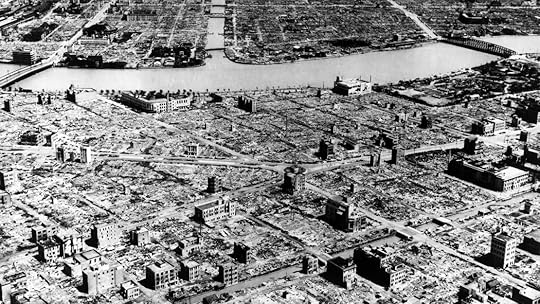
Tokyo, after the firebombing (Source)
It was their first mission. Expectations were high. The B-29 Superfortress was an engineering marvel, consisting of 55.000 parts and 600.000 rivets with pressurized cabins that allowed the crew to fly in their t-shirts. Rushed into production, general Hap Arnold had staked his career on this plane. The 8th air force had begun the war in the skies above Europe with great expectations but had devolved into a slug. In the end, the infantry still had to storm the beaches. Arnold wanted to promote the cause of military aviation by bombing Japan to their knees, hoping to establish once and for all an independent United States Air Force. General Haywood S. Hansell Jr. served as the commander of the XXI Bomber Command in the Pacific and as a proponent high-altitude precision daylight bombing missions, was determined to target key industrial and military facilities with accuracy.
But the high expectations proved not to be. Although the fear of Japanese fighters and Flak proved non-existent, the results of Hansell's precision bombing had difficulty of accurately hitting targets from high altitudes. None of his strikes had succeeded in destroying a single plant. Japan's war machine still hummed. Hap Arnold had enough: Hansell out, Curtis LeMay in. LeMay quickly decided to a change in tactics. Instead of precision bombing, he would switch to low-altitude nighttime incendiary bombing raids. The raids targeted Tokyo's urban area created, combined with the tactic of flying at low altitudes to evade Japanese air defenses, created a firestorm of unprecedented scale and intensity.
In his narrative history "Black Snow," James M. Scott skillfully captures the essence of these events, delving into the personalities and motivations of figures like Arnold, Hansell, and LeMay. Through his vivid portrayal, Scott confronts readers with the harrowing experiences of those affected by the bombing raids, leaving a profound impact that underscores the human cost and tragedy of war. Few writers possess Scott's ability to convey the brutal realities of conflict with such depth and clarity.
Tokyo, after the firebombing (Source)

February 28, 2025
A comprehensive, well-written and well-researched work.
Most of the book deals with LeMay's change in tactics and how they increased the risks to B-29 crews and the casualties among Japanese civilians; the pace and drama of the narrative definitely picks up once Scott introduces him (Hap Arnold and Haywood Hansell also figure prominently in the book) Scott details how previous daytime high-altitude air operations over Japan war were hampered by the jet stream and the varying weather, and how LeMay changed to nighttime firebombing at very low altitudes, with B-29s stripped of their defensive guns in order to carry more fuel and more bombs. Scott notes that LeMay implemented this change on his own, with no guidance or approval from any superiors.
LeMay is the book’s main character, and Scott’s portrait of him is nuanced. Was he a homicidal maniac? No. Was he an intellectual or a visionary, struggling to come to terms with tortuous moral dilemmas? Not really. In this book he comes off as a practical problem-solver faced with enormous challenges. Unsurprisingly, the terrible destruction weighed heavily on the minds of American airmen (they could smell burning flesh from thousands of feet up). Scott does, however, note that the Japanese started the Pacific War, and committed unspeakable brutalities during its course. Still, Scott doesn’t really try to provide definitive answers to moral questions, instead focusing on the human stories of the people involved.
The writing is clear and the story is vivid and intimate, and moves along at a good pace. LeMay really comes to life in the narrative. Scott’s account of the actual fire raid on Tokyo is, as expected, utterly horrifying. “This was no ordinary mission——and LeMay knew it,” he writes. “This was murder.” The descriptions of the suffering of Japanese civilians on the ground are some of the most memorable parts of the book.
A thoughtful, balanced and engaging work.
Most of the book deals with LeMay's change in tactics and how they increased the risks to B-29 crews and the casualties among Japanese civilians; the pace and drama of the narrative definitely picks up once Scott introduces him (Hap Arnold and Haywood Hansell also figure prominently in the book) Scott details how previous daytime high-altitude air operations over Japan war were hampered by the jet stream and the varying weather, and how LeMay changed to nighttime firebombing at very low altitudes, with B-29s stripped of their defensive guns in order to carry more fuel and more bombs. Scott notes that LeMay implemented this change on his own, with no guidance or approval from any superiors.
LeMay is the book’s main character, and Scott’s portrait of him is nuanced. Was he a homicidal maniac? No. Was he an intellectual or a visionary, struggling to come to terms with tortuous moral dilemmas? Not really. In this book he comes off as a practical problem-solver faced with enormous challenges. Unsurprisingly, the terrible destruction weighed heavily on the minds of American airmen (they could smell burning flesh from thousands of feet up). Scott does, however, note that the Japanese started the Pacific War, and committed unspeakable brutalities during its course. Still, Scott doesn’t really try to provide definitive answers to moral questions, instead focusing on the human stories of the people involved.
The writing is clear and the story is vivid and intimate, and moves along at a good pace. LeMay really comes to life in the narrative. Scott’s account of the actual fire raid on Tokyo is, as expected, utterly horrifying. “This was no ordinary mission——and LeMay knew it,” he writes. “This was murder.” The descriptions of the suffering of Japanese civilians on the ground are some of the most memorable parts of the book.
A thoughtful, balanced and engaging work.

September 6, 2022
Thank you NetGalley and HighBridge Audio for accepting my request to audibly read and review Black Snow.
Author: James M. Scott
Published: 09/06/22
Genre: History -- Nonfiction (Adult)
Narrator: L.J. Ganser
At 13 hours, I found this as an incredibly long audiobook. The narrator did his job. He read the text. I was struggling to focus and stay there. The text with full respect to the author and all those this book represents is dry.
I've come to realize that I like a story. Black Snow is a book, that resembles a textbook. I refer you back to the synopsis. While this includes documented world history, the line is thin between spoiler and known facts. This is written following a dark day in history, March 10, 1945 (Tokyo). The question posed in the synopsis will stay with me forever. "Should civilians be considered legitimate targets?"
I would recommend this for history buffs, someone who enjoys reading and does not need entertained.
I'm rounding up to 4 stars from my 3.5. This is written for smart people.
Author: James M. Scott
Published: 09/06/22
Genre: History -- Nonfiction (Adult)
Narrator: L.J. Ganser
At 13 hours, I found this as an incredibly long audiobook. The narrator did his job. He read the text. I was struggling to focus and stay there. The text with full respect to the author and all those this book represents is dry.
I've come to realize that I like a story. Black Snow is a book, that resembles a textbook. I refer you back to the synopsis. While this includes documented world history, the line is thin between spoiler and known facts. This is written following a dark day in history, March 10, 1945 (Tokyo). The question posed in the synopsis will stay with me forever. "Should civilians be considered legitimate targets?"
I would recommend this for history buffs, someone who enjoys reading and does not need entertained.
I'm rounding up to 4 stars from my 3.5. This is written for smart people.

August 23, 2022
I received this audiobook from Netgalley in exchange for an honest review. The description above pretty accurately describes the subject matter of the book, so I won't go into plot details here.
Although the beginning of the book dragged a little bit, the pace picked up speed when America starting bombing the Japanese. The description of the animals and people, especially children, being burned to death was so heart wrenching that I nearly broke down in tears several times. I would even go so far as to provide a trigger warning here, as at times it was really hard to listen to. People being burned alive, boiling to death in super heated rivers, or drowning to death while trying to escape the flames. Yikes. It is the stuff of nightmares -- and this really happened.
If this were fiction, it would be classified as a horror novel.
It is unfathomable to me that after seeing all this death and destruction, humans CONTINUE to do engage in war, death, destruction -- right now we are amidst a war that is decimating an entire people and culture. WHY DO WE NEVER LEARN???
The book is immensely well researched and well written and is regarding a subject that I had not known about previously. Yes, everyone has (surely) learned about the atomic bomb in school, but I do not remember ever learning about prior incendiary attacks on Tokyo.
My emotions on the subject are so torn. On the one hand it is shameful that America was responsible for such atrocities. On the other hand, the Japanese were not saints, and they were also guilty of their own atrocities for which they should feel equally ashamed. That is not to say that anyone "deserved" it -- especially not the innocent children and babies who were killed in the air raids. I hugged my daughter a little tighter after hearing some scenes.
I think war is ugly and stupid and that there must be better ways to resolve conflict. It is for this reason that books like this are important to make people SEE / HEAR / LEARN about what the impact of war is, in the hopes to avoid the same in the future.
I highly recommend this book.
Although the beginning of the book dragged a little bit, the pace picked up speed when America starting bombing the Japanese. The description of the animals and people, especially children, being burned to death was so heart wrenching that I nearly broke down in tears several times. I would even go so far as to provide a trigger warning here, as at times it was really hard to listen to. People being burned alive, boiling to death in super heated rivers, or drowning to death while trying to escape the flames. Yikes. It is the stuff of nightmares -- and this really happened.
If this were fiction, it would be classified as a horror novel.
It is unfathomable to me that after seeing all this death and destruction, humans CONTINUE to do engage in war, death, destruction -- right now we are amidst a war that is decimating an entire people and culture. WHY DO WE NEVER LEARN???
The book is immensely well researched and well written and is regarding a subject that I had not known about previously. Yes, everyone has (surely) learned about the atomic bomb in school, but I do not remember ever learning about prior incendiary attacks on Tokyo.
My emotions on the subject are so torn. On the one hand it is shameful that America was responsible for such atrocities. On the other hand, the Japanese were not saints, and they were also guilty of their own atrocities for which they should feel equally ashamed. That is not to say that anyone "deserved" it -- especially not the innocent children and babies who were killed in the air raids. I hugged my daughter a little tighter after hearing some scenes.
I think war is ugly and stupid and that there must be better ways to resolve conflict. It is for this reason that books like this are important to make people SEE / HEAR / LEARN about what the impact of war is, in the hopes to avoid the same in the future.
I highly recommend this book.

October 6, 2024
Fascinating and well told history of the B-29 and the strategic bombing offensive against Japan starting with the seizure of Saipan in November 1944 through August 1945. LeMay was only 38 years old when he took command of the 21st Bomber Command in January 1945. He quickly realized precision bombing wasn't working and changed course to area bombing with incendiaries and bold new tactics which quickly produced results. The B-29 rivaled the Manhattan Project in cost and was built without a prototype ever being made- quite the gamble.
October 29, 2022
Comprehensive narrative covering a very dark period of American history. James Scott brings the history to life, holding nothing back in the sense of graphic or grit. I could feel the heat, I could see the devastation, and I wanted to look away. It is quite clear that this book is research driven, and that thousands of hours were spent perusing archives, diaries, journals, and conducting interviews with participants and survivors.
I am hoping this one makes the Pulitzer.
I am hoping this one makes the Pulitzer.

September 13, 2025
This is my second James M. Scott book, and the second one I'm giving five stars. Black Snow really was eye-opening. I think we tend to fixate on the atomic bombs, but the firebombing of Tokyo was incredibly destructive and killed more people than either of the atomic bombs. This book provides a clear picture of how the firebombings came to be: the development of incendiary bombs, the planning and construction of the B-29s, failures of earlier daytime precision bombing, and ultimately the terror brought to Japanese cities and civilians in March 1945 and beyond.
Tokyo, like many of Japan's larger cities, had a high population density. It was tightly packed with homes made of wood, with few firebreaks to stop any potential flames. The government had tried to increase this, demolishing scores of homes, but it would prove to be wholly insufficient. Cities also included small factories that were littered throughout residential neighbourhoods, which aided Japan's war machine.
As earlier daylight precision bombing had proved to be mostly unsuccessful, LeMay wanted to go in at night, and go in low. He would target these densely populated areas, as they still proved to be military targets. But as Scott writes, "This was no ordinary mission - and LeMay knew it. This was murder." Bombing a large area means bombing everything within it. It wasn't just the large and small factories that would be destroyed, men, women and children were going to die. But at the time, trying to bring Japan to its knees through bombing was the goal to prevent an invasion by US troops.
The details on the bombing are gruesome and haunting. But like in Rampage, Scott doesn't revel in it. It's not gratuitous simply for the sake of shocking readers, it serves its purpose to drive home the intensity, severity and suffering. How many children were left orphans. How many parents were only able to save some but not all of their children. How many people watched loved ones perish. How many bodies were so burned or disfigured that they could not even be identified. It's brutal, horrible reading. It's also incredible that Japan didn't surrender.
To round things up, my only little nitpick is that, even though it's part of the subtitle, the book really is not about the atomic bombs at all. I was kind of expecting the book to shift into that territory after the firebombing of Tokyo, but it never really does. There's not much about the development of the atomic bombs, any political or military discussions about using them, and even the dropping and after-effects are only covered briefly. The 'road to the atomic bomb' part of the subtitle really is just the firebombings themselves.
Scott does include some reactions to the firebombing and atomic bombs, but the post-war moral justifications and debates are not discussed. I could see some readers finding this perhaps a mistake not to include. As there are other books that go into that topic, I didn't mind but I would've welcomed the addition if Scott had included it. The picture section isn't very good, with just a few black and white pictures printed on the same paper as the rest of the book. But otherwise, this was absolutely excellent.
Tokyo, like many of Japan's larger cities, had a high population density. It was tightly packed with homes made of wood, with few firebreaks to stop any potential flames. The government had tried to increase this, demolishing scores of homes, but it would prove to be wholly insufficient. Cities also included small factories that were littered throughout residential neighbourhoods, which aided Japan's war machine.
As earlier daylight precision bombing had proved to be mostly unsuccessful, LeMay wanted to go in at night, and go in low. He would target these densely populated areas, as they still proved to be military targets. But as Scott writes, "This was no ordinary mission - and LeMay knew it. This was murder." Bombing a large area means bombing everything within it. It wasn't just the large and small factories that would be destroyed, men, women and children were going to die. But at the time, trying to bring Japan to its knees through bombing was the goal to prevent an invasion by US troops.
The details on the bombing are gruesome and haunting. But like in Rampage, Scott doesn't revel in it. It's not gratuitous simply for the sake of shocking readers, it serves its purpose to drive home the intensity, severity and suffering. How many children were left orphans. How many parents were only able to save some but not all of their children. How many people watched loved ones perish. How many bodies were so burned or disfigured that they could not even be identified. It's brutal, horrible reading. It's also incredible that Japan didn't surrender.
To round things up, my only little nitpick is that, even though it's part of the subtitle, the book really is not about the atomic bombs at all. I was kind of expecting the book to shift into that territory after the firebombing of Tokyo, but it never really does. There's not much about the development of the atomic bombs, any political or military discussions about using them, and even the dropping and after-effects are only covered briefly. The 'road to the atomic bomb' part of the subtitle really is just the firebombings themselves.
Scott does include some reactions to the firebombing and atomic bombs, but the post-war moral justifications and debates are not discussed. I could see some readers finding this perhaps a mistake not to include. As there are other books that go into that topic, I didn't mind but I would've welcomed the addition if Scott had included it. The picture section isn't very good, with just a few black and white pictures printed on the same paper as the rest of the book. But otherwise, this was absolutely excellent.

September 3, 2022
This was a well-constructed telling of this period of history. The book didn't stay focused on the atomic bombs dropped on Hiroshima and Nagasaki. In fact, this was a very small portion of the book. It focused more on Curtis LeMay and the firebombing of Tokyo (as mentioned in the title). The author not only told this history, but also weaved in what was going on in Europe and America at this time. The author showed the horrific devastation of the firebombing and the thought processes of the various leaders that led up to their decisions. Sometimes historical books can just tell a straight chronological tale of events, but this one added details from other areas that enriched the story.
Thank you to NetGalley and HighBridge Audio for giving me an ARC audiobook in exchange for an honest review.
Thank you to NetGalley and HighBridge Audio for giving me an ARC audiobook in exchange for an honest review.

June 30, 2022
Are you ready to talk military bombing strategy? It’s towards the end of World War II and the U.S is preparing for the final push to the home Japanese islands. The question becomes, how badly can the U.S. bomb population centers without seeming like villains at the end? One general would lose his job trying to be as precise as possible. The other would bomb all of Japan into oblivion.
Before you say, “military strategy bombing is boring,” let me assure you that it absolutely can be. This book, however, is not. James Scott knows how to write about the Pacific Theater of World War II. There is philosophy, there are character studies, and there are harrowing tales of bombing runs from both on the ground and in the air. There is no slow part to this book because Scott keeps the story moving forward while revealing facts you never knew before. His ability to also describe what life was like in Tokyo around this time is especially moving. You won’t be disappointed.
Before you say, “military strategy bombing is boring,” let me assure you that it absolutely can be. This book, however, is not. James Scott knows how to write about the Pacific Theater of World War II. There is philosophy, there are character studies, and there are harrowing tales of bombing runs from both on the ground and in the air. There is no slow part to this book because Scott keeps the story moving forward while revealing facts you never knew before. His ability to also describe what life was like in Tokyo around this time is especially moving. You won’t be disappointed.

May 8, 2025
Scott has written a number of dadly WW2 histories. I own and read a few, and they are consistently solid. Black Snow covers one of the more shameful moments in American military history; the campaign to obliterate Japan via firebombing during WW2.
The B-29 was the single most expensive weapon project of the war, more expensive than the Manhattan project. A solid generation ahead of the B-17s and B-24s that had devastated Germany, the B-29 was designed for high-altitude precision bombing. However, these early missions had no effect, with the jet stream scattering bombs, weather cutting out raids, and many planes lost to Japanese air defenses and accidents. The genial General Haywood Hansell, in charge of the operation, was wedded to doctrine and didn't have the guts to force a tactical change. He was dismissed and replaced with Lemay, an iron-hard veteran of Europe and the fiasco of bombing from China.
Lemay ran the numbers and switched from high altitude bombing to low-level incendiary raids. Japan's tightly packed wooden cities were tinderboxes, their night fighters lacking, and napalm cluster bombs could easily hit a target the size of a city. The results were catastrophic. The first raid killed perhaps 100,000 people in a single night. Subsequent raids killed tens of thousands. Lemay's bombers hit a city a night, limited only by the ability of the US Navy to keep shipping in incendiaries.
This book is at its best drawing from translated Japanese oral histories, a comprehensive account of survivors recorded in the 1970s. The raids were sheer horror, entire families dying by flame, smoke, heat, spontaneous combustion. Numbers can only say so much, stories of parents running from the flames, only to find their children roasted to death on their backs, say so much more. This is a hard book, and a necessary one.
Sherman was right. War is hell.
The B-29 was the single most expensive weapon project of the war, more expensive than the Manhattan project. A solid generation ahead of the B-17s and B-24s that had devastated Germany, the B-29 was designed for high-altitude precision bombing. However, these early missions had no effect, with the jet stream scattering bombs, weather cutting out raids, and many planes lost to Japanese air defenses and accidents. The genial General Haywood Hansell, in charge of the operation, was wedded to doctrine and didn't have the guts to force a tactical change. He was dismissed and replaced with Lemay, an iron-hard veteran of Europe and the fiasco of bombing from China.
Lemay ran the numbers and switched from high altitude bombing to low-level incendiary raids. Japan's tightly packed wooden cities were tinderboxes, their night fighters lacking, and napalm cluster bombs could easily hit a target the size of a city. The results were catastrophic. The first raid killed perhaps 100,000 people in a single night. Subsequent raids killed tens of thousands. Lemay's bombers hit a city a night, limited only by the ability of the US Navy to keep shipping in incendiaries.
This book is at its best drawing from translated Japanese oral histories, a comprehensive account of survivors recorded in the 1970s. The raids were sheer horror, entire families dying by flame, smoke, heat, spontaneous combustion. Numbers can only say so much, stories of parents running from the flames, only to find their children roasted to death on their backs, say so much more. This is a hard book, and a necessary one.
Sherman was right. War is hell.
June 3, 2025
Audible credit 13 hours Narrated by L.J.Ganser (5)
Excellent! General Curtis LeMay was a gutsy leader. The firebombing of Japan was much more extensive than I had visualized. The story focuses on the effect on the civilian population and how the emperor and his government turned a blind eye to their plight.
Excellent! General Curtis LeMay was a gutsy leader. The firebombing of Japan was much more extensive than I had visualized. The story focuses on the effect on the civilian population and how the emperor and his government turned a blind eye to their plight.
November 20, 2025
Really good telling of the air war in the pacific and what led to its conclusions. Much better history than Gladwell’s fiction (bomber mafia).
Important reading as it’s clear Lemay would’ve been tried as a war criminal had we lost the war.
Important reading as it’s clear Lemay would’ve been tried as a war criminal had we lost the war.

April 24, 2026
Great. We've never been the good guys. Nice to know :)

Read
June 17, 2026No rating because this is nonfiction and I don’t know how to rate a book that describes, in depth, so much death and destruction. All I can say is war is a very ugly thing. This book resonated with me deeply because I am currently deployed in the same places this book talks about, which is why I read it. I enjoyed learning the history of these islands but parts were definitely hard to get through. Not recommended if you aren’t a military history fan.

October 14, 2022
Unlike LeMay, I don't think I'll be able to sleep again

March 18, 2024
The author spares no one in this excellent book on the two pivotal events that culminated in the surrender of Japan. From the details of the firebombing of Tokyo to the final bombing of two cities with one bomb for each city, the details are gruesome at times and necessary to understand how terrible war from the air can be, both mentally and physically. For a better understanding of these events, this is a must-read.

September 16, 2025
Black Snow
by James M. Scott is not a bad book. It focuses on the USAAF Air raids on Japan during World War II, with the main focus on the increasingly heavy raids from mid-1944 to the war's end in August, 1945 that relied mainly on the Boeing B-29 Superfortress. If you've read much military history of the 20th century, the technical details won't tax you much, and the narrative style makes the book an easy read despite its length.
Scott describes what happened, in grisly detail, after Curtis LeMay largely abandoned high-altitude, daylight "precision" bombing of strictly military targets in favor of area-bombing Japanese cities with fire weapons such as the M69 incendiary. The resulting civilian casualties were probably the highest in the history of warfare, and along with the knockout blow of the first two atomic bombs, drove Japan to surrender without the need for an even more deadly Allied amphibious invasion of the Japanese Home Islands.
Scott focuses mainly on what happened, and not so much on the underlying social psychology that caused it to happen. By any objective measure, Japan's decision to start World War II by attacking the far more industrially capable USA was one of the most catastrophic errors in history. And then Japan prolonging the war after all hope of victory was lost was downright stupid. Japan should have surrendered immediately after losing the Battle of the Philippine Sea on 19–20 June 1944. At that point the outcome of the Pacific War was never in any doubt. That battle, and the Allied capture of the Mariana Islands, provided unsinkable airbases for the American superweapon, the B-29 Stratofortress, which would in about a year erase most Japanese cities and, in combination with the Allied naval blockade, break the Japanese economy and unleash untold suffering on Japanese civilians.
So what can cause an entire nation to basically go insane? Obviously we didn't learn the causes, much less a cure, because now we have Trump.
Scott briefly mentions the interservice rivalry between the USAAF and the USN. That hints at an interesting counterfactual that could make an interesting alternative history exercise. What if the billions spent on the B-29 program had instead been redirected to accelerating and increasing the US naval buildup? The technical problems and delays that plagued the B-29 resulted in a lot of money being spent during several critical years before getting any payoff in combat. Pouring the money instead into building more aircraft carrier groups might have allowed naval aviation to do the conventional bombing job that the B-29s did, but sooner. Consider: the USN had studied the early war combat experience of Royal Navy aircraft carriers, and concluded that armored flight decks were essential for minimizing bomb damage from enemy air attacks. The Royal Navy's carriers weathered many such attacks, because they frequently operated close to Axis-held land air bases. Meanwhile, the US pressed ahead with building wooden-decked carriers up to and including the Essex class, which became the mainstay for the critical sea battles and amphibious invasions of 1944-1945. US Navy planners had for several years understood they needed armored flight decks, and this became painfully clear after an increasingly desperate Japan started its deadly kamikaze attacks in late 1944. The US Navy's Midway class carriers would be its first with armored flight decks, but they arrived too late to see combat. The Midway herself was commissioned on 10 September 1945, just after Japan had surrendered.
So, consider the alternative scenario in which the B-29 program wasn't pursued. All that money could have gone into building more ships, and sooner, including the Midways which would have been able to weather the kamikazes as effectively as the Royal Navy carriers of its Pacific Fleet did late in the war. The money spent on the B-29 could have delivered a number of carriers and support ships, which could have accelerated the island-hopping campaign. This could have put the Midways within range of the Japanese Home Islands sooner, to greatly expand on the carrier-based raids that were undertaken in 1945 in the real timeline. And the Navy could have developed its relatively conventional (for the time) Douglas A-1 Skyraider sooner, but the Navy's existing airplanes could probably have done the job in greater numbers. In the real timeline, the Skyraider entered service in 1946, but it was far from the radical design of the B-29 and likely could have been built sooner. The Skyraider despite its single engine had roughly the same bombload as the B-29 at the limit of the heavy bomber's range, and carrier-based aircraft could bomb far more accurately from low altitude than the heavy bombers could from high altitude. And carrier-based bombers could operate with their own carrier-based fighter escort, and carrier-based fighters could operate as fighter-bombers, providing their own escort. If burning down Japanese cities turned out to be necessary, even with the increased precision of carrier aircraft strikes, more numerous carrier aircraft could have done that easily.
So while the B-29 turned out to be the war-winning weapon in the real timeline, it's far from clear that the B-29 was the most optimal way to fight the war. Building more ships and building them sooner with the redirected B-29 money would almost certainly have accelerated the island-hopping campaign and brought Japan in range of America's older and proven bomber designs and expanded carrier fleets sooner. Thus the B-29 program arguably had an opportunity cost that doesn't often (or ever?) get mentioned in the usual blinded-by-hindsight accounts of what actually happened.
Scott describes what happened, in grisly detail, after Curtis LeMay largely abandoned high-altitude, daylight "precision" bombing of strictly military targets in favor of area-bombing Japanese cities with fire weapons such as the M69 incendiary. The resulting civilian casualties were probably the highest in the history of warfare, and along with the knockout blow of the first two atomic bombs, drove Japan to surrender without the need for an even more deadly Allied amphibious invasion of the Japanese Home Islands.
Scott focuses mainly on what happened, and not so much on the underlying social psychology that caused it to happen. By any objective measure, Japan's decision to start World War II by attacking the far more industrially capable USA was one of the most catastrophic errors in history. And then Japan prolonging the war after all hope of victory was lost was downright stupid. Japan should have surrendered immediately after losing the Battle of the Philippine Sea on 19–20 June 1944. At that point the outcome of the Pacific War was never in any doubt. That battle, and the Allied capture of the Mariana Islands, provided unsinkable airbases for the American superweapon, the B-29 Stratofortress, which would in about a year erase most Japanese cities and, in combination with the Allied naval blockade, break the Japanese economy and unleash untold suffering on Japanese civilians.
So what can cause an entire nation to basically go insane? Obviously we didn't learn the causes, much less a cure, because now we have Trump.
Scott briefly mentions the interservice rivalry between the USAAF and the USN. That hints at an interesting counterfactual that could make an interesting alternative history exercise. What if the billions spent on the B-29 program had instead been redirected to accelerating and increasing the US naval buildup? The technical problems and delays that plagued the B-29 resulted in a lot of money being spent during several critical years before getting any payoff in combat. Pouring the money instead into building more aircraft carrier groups might have allowed naval aviation to do the conventional bombing job that the B-29s did, but sooner. Consider: the USN had studied the early war combat experience of Royal Navy aircraft carriers, and concluded that armored flight decks were essential for minimizing bomb damage from enemy air attacks. The Royal Navy's carriers weathered many such attacks, because they frequently operated close to Axis-held land air bases. Meanwhile, the US pressed ahead with building wooden-decked carriers up to and including the Essex class, which became the mainstay for the critical sea battles and amphibious invasions of 1944-1945. US Navy planners had for several years understood they needed armored flight decks, and this became painfully clear after an increasingly desperate Japan started its deadly kamikaze attacks in late 1944. The US Navy's Midway class carriers would be its first with armored flight decks, but they arrived too late to see combat. The Midway herself was commissioned on 10 September 1945, just after Japan had surrendered.
So, consider the alternative scenario in which the B-29 program wasn't pursued. All that money could have gone into building more ships, and sooner, including the Midways which would have been able to weather the kamikazes as effectively as the Royal Navy carriers of its Pacific Fleet did late in the war. The money spent on the B-29 could have delivered a number of carriers and support ships, which could have accelerated the island-hopping campaign. This could have put the Midways within range of the Japanese Home Islands sooner, to greatly expand on the carrier-based raids that were undertaken in 1945 in the real timeline. And the Navy could have developed its relatively conventional (for the time) Douglas A-1 Skyraider sooner, but the Navy's existing airplanes could probably have done the job in greater numbers. In the real timeline, the Skyraider entered service in 1946, but it was far from the radical design of the B-29 and likely could have been built sooner. The Skyraider despite its single engine had roughly the same bombload as the B-29 at the limit of the heavy bomber's range, and carrier-based aircraft could bomb far more accurately from low altitude than the heavy bombers could from high altitude. And carrier-based bombers could operate with their own carrier-based fighter escort, and carrier-based fighters could operate as fighter-bombers, providing their own escort. If burning down Japanese cities turned out to be necessary, even with the increased precision of carrier aircraft strikes, more numerous carrier aircraft could have done that easily.
So while the B-29 turned out to be the war-winning weapon in the real timeline, it's far from clear that the B-29 was the most optimal way to fight the war. Building more ships and building them sooner with the redirected B-29 money would almost certainly have accelerated the island-hopping campaign and brought Japan in range of America's older and proven bomber designs and expanded carrier fleets sooner. Thus the B-29 program arguably had an opportunity cost that doesn't often (or ever?) get mentioned in the usual blinded-by-hindsight accounts of what actually happened.

December 13, 2022
A fairly slow first half and a perfunctory ending, with about 40 pages of hell in between. It's one thing to see aerial photos of the destruction wrought by firebombing a population center, read a chart of acreage burned and buildings destroyed; it is something different to put words into the mouths of those who survived, on the ground, as the bombs fell and the fires raged and the people died. Those words are here, more so than in any other book on the topic I have ever read.
Mid-way through so many quotes and recollections, I had to go to author James M. Scott's notes on sources to believe he wasn't doing some cheap Bill O'Reilly inventions of dialogue, feelings, and internal thoughts. Scott professes to have only included what was sourced from diaries, interviews, and historic records, and that verisimilitude is harrowing.
Mid-way through so many quotes and recollections, I had to go to author James M. Scott's notes on sources to believe he wasn't doing some cheap Bill O'Reilly inventions of dialogue, feelings, and internal thoughts. Scott professes to have only included what was sourced from diaries, interviews, and historic records, and that verisimilitude is harrowing.

August 11, 2023
This was no ordinary mission – and LeMay knew it.
There’s a (very) solid argument that World War II was “good guys” versus “bad guys”, even if you want to put in some awkward caveats about the good guys (horrors of communism, holdovers of imperialism, internment camps etc).
Black Snow challenges the narrative without overthrowing it. It makes you feel uncomfortable about the actions of the US Army Airforce, while keeping an eye on the context, which elevates the book about being a straight retelling of events.
Japan Should Have Surrendered
While Black Snow does devote significant space to the preparatory matters such as leadership and the production of the B-29, I’m not overly interested in that. It’s fine, necessary even, but there’s little additional material from reading the manual Aces Of the Pacific in 1992.
What Black Snow does get across is that from November 1944, at the very latest, Japan was done:
No one was exempt from sacrifice, including the deceased. “One borrows coffins for the dead but cannot buy them,” journalist Kiyoshi Kiyosawa noted in his diary. “They are used any number of times.”
Distinct from “Britain Alone” in 1940, or the privations suffered by the Soviet Union in 1941-42, Japan was unable to protect or properly feed its people, could expect no meaningful help from friendly-aligned parties, nor do anything to remedy its strategic situation. The unrealness of Hirohito, requiring one more victory first to guarantee a better position at the bargaining table is damning.
Black Snow does not specifically say that Japan should have surrendered, but it sets out very well Japan’s inability to meaningfully resist the destruction of its cities and the suffering continued war inflicted on its people. The lack of moral courage of its leaders to accept defeat should feature in any discussion of the Tokyo Fire Bombing and subsequent campaign against Japan’s cities.
Was it a War Crime?
Black Snow shows in detail that the intent of the Tokyo Fire Bombing was to kill vast numbers of people:
Those failings left the winding Sumida River as the largest firebreak in the target area, aided only by a few smaller rivers, canals, and thoroughfares. LeMay countered this by spreading his four primary aiming spots equally across both sides of the Sumida. Residents on the ground would be trapped with nowhere to flee. “No mission in history,” Nutter marveled, “had ever been planned to create such mass devastation.”
You should not, because of one book, make a call whether the Tokyo Fire Bombing or elements of the Allies bombing campaign(s) were war crimes. Black Snow should make you uncomfortable about them though. You should read this and compare the actions with terrorist attacks such as 9/11, particularly the terrorism part. What should draw your attention is not whether the acts are morally equal, rather the ways they could be.
Black Snow does provide comparative actions by the Axis in World War II, as well as Japan’s atrocities, but Black Snow also notes that LeMay thought the Allied leaders would be “tried as war criminals” if they had lost the war over the bombings. The book also that care was taken in how information was provided to the press:
“Editorial comment beginning to wonder about blanket incendiary attacks upon cities therefore urge you continue hard hitting your present line that this destruction is necessary to eliminate Jap home industries and that it is strategic precision bombing,” the March 14 cable warned. “Guard against anyone stating that this is area bombing.”
Again, like Japan’s complicity, Black Snow does not pass any judgement on whether the Tokyo Firebombing was a war crime. It doesn’t have to – it provides plenty of information (both supportive of the case and otherwise) for a reader to consider.
This was murder.
Along with its harrowing recountings of the bombing from Japanese civilians, Black Snow makes itself necessary World War II reading by making you think – just how right were we?
There’s a (very) solid argument that World War II was “good guys” versus “bad guys”, even if you want to put in some awkward caveats about the good guys (horrors of communism, holdovers of imperialism, internment camps etc).
Black Snow challenges the narrative without overthrowing it. It makes you feel uncomfortable about the actions of the US Army Airforce, while keeping an eye on the context, which elevates the book about being a straight retelling of events.
Japan Should Have Surrendered
While Black Snow does devote significant space to the preparatory matters such as leadership and the production of the B-29, I’m not overly interested in that. It’s fine, necessary even, but there’s little additional material from reading the manual Aces Of the Pacific in 1992.
What Black Snow does get across is that from November 1944, at the very latest, Japan was done:
No one was exempt from sacrifice, including the deceased. “One borrows coffins for the dead but cannot buy them,” journalist Kiyoshi Kiyosawa noted in his diary. “They are used any number of times.”
Distinct from “Britain Alone” in 1940, or the privations suffered by the Soviet Union in 1941-42, Japan was unable to protect or properly feed its people, could expect no meaningful help from friendly-aligned parties, nor do anything to remedy its strategic situation. The unrealness of Hirohito, requiring one more victory first to guarantee a better position at the bargaining table is damning.
Black Snow does not specifically say that Japan should have surrendered, but it sets out very well Japan’s inability to meaningfully resist the destruction of its cities and the suffering continued war inflicted on its people. The lack of moral courage of its leaders to accept defeat should feature in any discussion of the Tokyo Fire Bombing and subsequent campaign against Japan’s cities.
Was it a War Crime?
Black Snow shows in detail that the intent of the Tokyo Fire Bombing was to kill vast numbers of people:
Those failings left the winding Sumida River as the largest firebreak in the target area, aided only by a few smaller rivers, canals, and thoroughfares. LeMay countered this by spreading his four primary aiming spots equally across both sides of the Sumida. Residents on the ground would be trapped with nowhere to flee. “No mission in history,” Nutter marveled, “had ever been planned to create such mass devastation.”
You should not, because of one book, make a call whether the Tokyo Fire Bombing or elements of the Allies bombing campaign(s) were war crimes. Black Snow should make you uncomfortable about them though. You should read this and compare the actions with terrorist attacks such as 9/11, particularly the terrorism part. What should draw your attention is not whether the acts are morally equal, rather the ways they could be.
Black Snow does provide comparative actions by the Axis in World War II, as well as Japan’s atrocities, but Black Snow also notes that LeMay thought the Allied leaders would be “tried as war criminals” if they had lost the war over the bombings. The book also that care was taken in how information was provided to the press:
“Editorial comment beginning to wonder about blanket incendiary attacks upon cities therefore urge you continue hard hitting your present line that this destruction is necessary to eliminate Jap home industries and that it is strategic precision bombing,” the March 14 cable warned. “Guard against anyone stating that this is area bombing.”
Again, like Japan’s complicity, Black Snow does not pass any judgement on whether the Tokyo Firebombing was a war crime. It doesn’t have to – it provides plenty of information (both supportive of the case and otherwise) for a reader to consider.
This was murder.
Along with its harrowing recountings of the bombing from Japanese civilians, Black Snow makes itself necessary World War II reading by making you think – just how right were we?

October 26, 2022
There is a unique and deeply affecting permanent exhibit on the Battle of Gallipoli at the Museum of New Zealand in Wellington. One part of that exhibit is an interactive kiosk. Visitors can choose an individual who was killed in the battle, view their personal history, and then learn the cause of death of each soldier—the exact physical effects of the terrible weapons of the First World War on a fragile human body. The kiosk is not in the least sensationalist. Instead, it generates compassion and engagement. My wife and I could hardly pull ourselves away even though the rest of the exhibit beckoned.
I thought of that exhibit more than once while reading James M. Scott’s extraordinary new book, Black Snow: Curtis LeMay, the Firebombing of Tokyo, and the Road to the Atomic Bomb, from which I also found it very hard to pull away. In Black Snow, Scott chronicles the lives of ordinary civilians in wartime Japan, who by late 1944 were always hungry, often cold, and mostly alienated from the adventurist war their leaders have inflicted on them. But their afflictions, of course, had just begun, and Scott describes in empathetic detail the effects on these civilians and their built environments of the vicious weapons—napalm, high explosives, and radioactivity--employed intentionally against them in the American effort to force the surrender of Japan.
As the subtitle signals, Black Snow interweaves three stories. It is the story of Curtis LeMay, a child of poverty and neglect who became a bold and brilliant air commander but remained an outsider and loner throughout his military career. LeMay planned and implemented the firebombing campaign—the most destructive in the history of warfare--entirely on his own, without the input, or even the express permission, of his superiors. To his last day he insisted that the 159-day campaign, which killed more than 100,000 Japanese men, women, and children in a single night, was “not conceived as a terror [campaign] against the civilian population of Japan.”
Terror, however, was what LeMay’s B-29 Superfortress bombers sowed in every major city in Japan, as well as several minor ones. As he did in his previous book on the Battle of Manila, Rampage, Scott treats the horrible toll of total war on helpless civilians with great humanity by never losing the perspective of ordinary individuals caught in the cataclysm, suffering, surviving, grieving, and overcoming.
Black Snow is also a complex morality tale about how a nation which entered World War II declaring that the intentional bombing of civilians was “abhorrent to our humanity”, ended the war by dropping an atomic bomb on Hiroshima. By the time that bomb appears at the end of the book, Scott has prepared us to view the nuclear attack on Hiroshima –undeniably a watershed event in the history of humanity—in the context of the previous 159 days. For Japan, a nation utterly devastated by LeMay’s firebombing campaign, Hiroshima was one more destroyed city. If was not the fact of its destruction, but the ease with which it occurred (with only a single bomb rather than thousands) that prompted the already-defeated Japanese Empire to capitulate at last.
James Scott tells a larger-than-life story of total war with remarkable intimacy. Black Snow is a must-read book for anyone interested in knowing more about how the Pacific War was won and how the two nations who fought it were profoundly transformed in the process.
I thought of that exhibit more than once while reading James M. Scott’s extraordinary new book, Black Snow: Curtis LeMay, the Firebombing of Tokyo, and the Road to the Atomic Bomb, from which I also found it very hard to pull away. In Black Snow, Scott chronicles the lives of ordinary civilians in wartime Japan, who by late 1944 were always hungry, often cold, and mostly alienated from the adventurist war their leaders have inflicted on them. But their afflictions, of course, had just begun, and Scott describes in empathetic detail the effects on these civilians and their built environments of the vicious weapons—napalm, high explosives, and radioactivity--employed intentionally against them in the American effort to force the surrender of Japan.
As the subtitle signals, Black Snow interweaves three stories. It is the story of Curtis LeMay, a child of poverty and neglect who became a bold and brilliant air commander but remained an outsider and loner throughout his military career. LeMay planned and implemented the firebombing campaign—the most destructive in the history of warfare--entirely on his own, without the input, or even the express permission, of his superiors. To his last day he insisted that the 159-day campaign, which killed more than 100,000 Japanese men, women, and children in a single night, was “not conceived as a terror [campaign] against the civilian population of Japan.”
Terror, however, was what LeMay’s B-29 Superfortress bombers sowed in every major city in Japan, as well as several minor ones. As he did in his previous book on the Battle of Manila, Rampage, Scott treats the horrible toll of total war on helpless civilians with great humanity by never losing the perspective of ordinary individuals caught in the cataclysm, suffering, surviving, grieving, and overcoming.
Black Snow is also a complex morality tale about how a nation which entered World War II declaring that the intentional bombing of civilians was “abhorrent to our humanity”, ended the war by dropping an atomic bomb on Hiroshima. By the time that bomb appears at the end of the book, Scott has prepared us to view the nuclear attack on Hiroshima –undeniably a watershed event in the history of humanity—in the context of the previous 159 days. For Japan, a nation utterly devastated by LeMay’s firebombing campaign, Hiroshima was one more destroyed city. If was not the fact of its destruction, but the ease with which it occurred (with only a single bomb rather than thousands) that prompted the already-defeated Japanese Empire to capitulate at last.
James Scott tells a larger-than-life story of total war with remarkable intimacy. Black Snow is a must-read book for anyone interested in knowing more about how the Pacific War was won and how the two nations who fought it were profoundly transformed in the process.
September 14, 2022
“Black Snow” details the development of the B-29 bomber and its deployment against Japan in World War II. At its core, the book deals with the ensuing strategies from strategic bombing to the large scale firebombing of major Japanese cities. To his credit, the author James Scott details the frustrating efforts to develop both an effective weapon as well as successful military tactics to defeat Japan. The development and manufacturing off the B-29 was viewed as “the perfect weapon to bring the war home to the Japanese people.”
The book centers on the careers of three individuals, Hap Arnold, the father of the B-29 as well as the early advocate of an independent Air Force branch; Haywood Hansell, the military leader of the early efforts to deploy the B-29 against Japan; and lastly, Curtis LeMay, the dominant figure in the air war against Japan.
Scott portrays the Japanese citizen as constantly being buffeted from war with increasing privations in daily life as well as the daily fears of American bombing. On the other hand, the Japanese record of wartime atrocities, led the American public to view the Japanese as “barbaric”. Therefore, bringing the war home to the enemy was justified in the minds of the American public.
The central figure of Curtis LeMay emerges as an individual who rose from poverty to becoming a leader in the military who personally flew on missions to evaluate for himself the outcomes of strategic bombing as well as its effects on men and material. It is LeMay whose knowledge of the effects of incendiary bombing against German cities, would now propose the same tactics against Japan. The utilization of home industries in Japanese cities validated for LeMay the use of incendiary bombing.
Scott’s portrayal of the March 1945 bombing of Tokyo is quite horrifying with his effective use of oral histories and the author’s interviews from later survivors. The casualty figures of over a hundred thousand killed for the March 9-10 Tokyo bombing would exceed the atomic bombing of Nagasaki. LeMay’s positive evaluation of incendiary bombing led to its further deployment against more and more Japanese cities. Ultimately, by June, 1945 the Japanese emperor asked of his wartime council for ways to end the war. But it would be 159 days from the March Tokyo bombing to Emperor Hirohito’s order to surrender in August 1945.
Scott is able to demonstrate the seamless way the United States had moved to the combination of the B-29 and atomic weaponry in order to end the war. The moral question of bombing civilians had been answered in the affirmative with the incendiary bombing of cities as an approved tactic. Ending the war before an invasion of Japan became the supreme guiding principle for American military leadership. Scott shows that for some military veterans, the use of incendiaries plagued their consciences for years afterwards.
Scott’s volume is disturbing reading. Few Americans at the time questioned the morality of wide scale bombing against Japanese cities. As Scott accounts, one letter to a Connecticut paper asking fellow citizens to temper wartime jubilation considering that it was innocent civilians who were mainly the victims of wartime bombing, was an exception to the American mind set.
James Scott writes well in a good narrative style that moves the reader to understand the development of wartime policy as well as the impact of certain individuals had on such evolving wartime strategies. Scott combines a depth of research and a writing style that makes “Black Snow” an excellent volume that asks troublesome questions of past policy.
The book centers on the careers of three individuals, Hap Arnold, the father of the B-29 as well as the early advocate of an independent Air Force branch; Haywood Hansell, the military leader of the early efforts to deploy the B-29 against Japan; and lastly, Curtis LeMay, the dominant figure in the air war against Japan.
Scott portrays the Japanese citizen as constantly being buffeted from war with increasing privations in daily life as well as the daily fears of American bombing. On the other hand, the Japanese record of wartime atrocities, led the American public to view the Japanese as “barbaric”. Therefore, bringing the war home to the enemy was justified in the minds of the American public.
The central figure of Curtis LeMay emerges as an individual who rose from poverty to becoming a leader in the military who personally flew on missions to evaluate for himself the outcomes of strategic bombing as well as its effects on men and material. It is LeMay whose knowledge of the effects of incendiary bombing against German cities, would now propose the same tactics against Japan. The utilization of home industries in Japanese cities validated for LeMay the use of incendiary bombing.
Scott’s portrayal of the March 1945 bombing of Tokyo is quite horrifying with his effective use of oral histories and the author’s interviews from later survivors. The casualty figures of over a hundred thousand killed for the March 9-10 Tokyo bombing would exceed the atomic bombing of Nagasaki. LeMay’s positive evaluation of incendiary bombing led to its further deployment against more and more Japanese cities. Ultimately, by June, 1945 the Japanese emperor asked of his wartime council for ways to end the war. But it would be 159 days from the March Tokyo bombing to Emperor Hirohito’s order to surrender in August 1945.
Scott is able to demonstrate the seamless way the United States had moved to the combination of the B-29 and atomic weaponry in order to end the war. The moral question of bombing civilians had been answered in the affirmative with the incendiary bombing of cities as an approved tactic. Ending the war before an invasion of Japan became the supreme guiding principle for American military leadership. Scott shows that for some military veterans, the use of incendiaries plagued their consciences for years afterwards.
Scott’s volume is disturbing reading. Few Americans at the time questioned the morality of wide scale bombing against Japanese cities. As Scott accounts, one letter to a Connecticut paper asking fellow citizens to temper wartime jubilation considering that it was innocent civilians who were mainly the victims of wartime bombing, was an exception to the American mind set.
James Scott writes well in a good narrative style that moves the reader to understand the development of wartime policy as well as the impact of certain individuals had on such evolving wartime strategies. Scott combines a depth of research and a writing style that makes “Black Snow” an excellent volume that asks troublesome questions of past policy.

November 18, 2022
This is a well-told story about a controversial military campaign in the waning days of WW II. From the perspective of the 21st century, the decison to firebomb Japanese cities starting in Spring, 1945 could be considered one of the most shameful episodes in American military strategy. Hap Arnold even commented that American decision-makers would be considered war criminals if the campaign failed and the US lost the war.
American military leaders justfied the decision based on the estimates that the US could lose hundreds of thousands of lives if required to invade the Japanese home islands. This campaign was designed to "soften up" the country and reduce public support in Japan, already waning by this narrative, for continuation of the war. The civilan lives lost were collateral damage in the larger campaign to save American lives from any planned invasion.
The logistics of incorporating a new weapon, the B-29 bomber, flying thousands of miles in thousands of sorties to bomb the home islands was incredible in its design and execution. The men who planned the campaign achieved astoundingly successful results despite the obstacles they had to overcome to do so.
This book focuses primarily on General Curtis LeMay, put in charge of the campaign to bomb Japan. It was his idea to initiate and sustain night-time, low-altitude incendiary bombing on civilian targets, given the middling success of high-altitude "strategic" bombing of military targets by his predecessor. LeMay's plan succeeded wildly.
For those my age, we remember LeMay as George Wallace's crackpot running mate in the 1968 presidential election, and for his comments about bombing the Vietnamese "back into the stone age." This book shows that before that, he was a successful bomber pilot, stratgeist, commander and logistical wizard.
The grusome results of the firebombing exceeded in some instances the death and destruction of the two atomic bomb blasts in August, 1045. The initial raid on Tokyo is believed to have take more Japanese lives than either of the atomic explosions.
After these harrowing raids, the idea of using the A bomb doesn't seem so horrible in contrast. Seventy-seven years later, both decisions are likely ones we'd find abhorrent today, regardless of the rationale given for their use.
War is indeed hell and this story is a prime example of that writ large in the 1940s. Scott has written a thoroughly-researched, objective, and page-turning recounting of this horrible chapter of WW II history. The horror and atrocity of the tale he tells in no way detract from this well-written book.
Strongly recommend for anybody with interest in WW II history, specifically the final year of the Pacific campaign to induce the Japanese surrender.
American military leaders justfied the decision based on the estimates that the US could lose hundreds of thousands of lives if required to invade the Japanese home islands. This campaign was designed to "soften up" the country and reduce public support in Japan, already waning by this narrative, for continuation of the war. The civilan lives lost were collateral damage in the larger campaign to save American lives from any planned invasion.
The logistics of incorporating a new weapon, the B-29 bomber, flying thousands of miles in thousands of sorties to bomb the home islands was incredible in its design and execution. The men who planned the campaign achieved astoundingly successful results despite the obstacles they had to overcome to do so.
This book focuses primarily on General Curtis LeMay, put in charge of the campaign to bomb Japan. It was his idea to initiate and sustain night-time, low-altitude incendiary bombing on civilian targets, given the middling success of high-altitude "strategic" bombing of military targets by his predecessor. LeMay's plan succeeded wildly.
For those my age, we remember LeMay as George Wallace's crackpot running mate in the 1968 presidential election, and for his comments about bombing the Vietnamese "back into the stone age." This book shows that before that, he was a successful bomber pilot, stratgeist, commander and logistical wizard.
The grusome results of the firebombing exceeded in some instances the death and destruction of the two atomic bomb blasts in August, 1045. The initial raid on Tokyo is believed to have take more Japanese lives than either of the atomic explosions.
After these harrowing raids, the idea of using the A bomb doesn't seem so horrible in contrast. Seventy-seven years later, both decisions are likely ones we'd find abhorrent today, regardless of the rationale given for their use.
War is indeed hell and this story is a prime example of that writ large in the 1940s. Scott has written a thoroughly-researched, objective, and page-turning recounting of this horrible chapter of WW II history. The horror and atrocity of the tale he tells in no way detract from this well-written book.
Strongly recommend for anybody with interest in WW II history, specifically the final year of the Pacific campaign to induce the Japanese surrender.

December 23, 2024
James M. Scott's "Black Snow: Curtis LeMay, the Firebombing of Tokyo, and the Road to the Atomic Bomb" is a meticulously researched and harrowing account of one of the most devastating air raids in history. Scott masterfully reconstructs the events leading up to and following the March 10, 1945 firebombing of Tokyo, which killed over 100,000 civilians and destroyed 16 square miles of the city. The book centers on Major General Curtis LeMay, the architect of the low-altitude nighttime incendiary bombing strategy that would change the course of the Pacific War. Scott provides a nuanced portrayal of LeMay, exploring his background, motivations, and the moral implications of his tactics. Scott's narrative is particularly powerful in its depiction of the raid's human toll. Drawing from interviews with American airmen and Japanese survivors, as well as previously untranslated oral histories, he vividly describes the horrors experienced by Tokyo's residents during the firestorm. These firsthand accounts offer a sobering reminder of war's devastating impact on civilian populations. The author also delves into the broader context of the American bombing campaign against Japan, including the development of the B-29 Superfortress and the capture of the Marianas Islands for use as airfields. He explores the shift in American strategy from high-altitude precision bombing to area bombing, and how this change represented a significant moral turning point in the war. Scott's work is not just a recounting of historical events, but a thought-provoking examination of the ethics of warfare. He raises important questions about the targeting of civilians and the long-term consequences of such actions, including how the firebombing campaign paved the way for the use of atomic weapons. “Black Snow" is a compelling and comprehensive study of a pivotal moment in World War II. Scott's meticulous research, engaging prose, and balanced approach make this book an essential read for anyone seeking to understand the complexities of strategic bombing and its lasting impact on military tactics and ethics.
January 5, 2023
After extensive reading about WWII over many years, I still find books which significantly add to my understanding of the big picture; this was one of them. I knew, of course, of Hiroshima and Nagasaki and that more Japanese were killed by firebombing than the nuclear weapons, but I did not have a feeling for the extent and duration of the firebombing. Some thoughts:
1. If one viewed the U.S. attacks on Japan's homeland in isolation, war crimes would understandably come to mind. It would be hard to read the descriptions of the devastation and suffering. However, these events did not take place in isolation. Knowledge of the Japanese actions in the preceding years throughout the region and continuing in the Pacific contemporaneously with the U.S. firebombing eliminate any thoughts of moral equivalency between the U.S. and Japanese actions.
2. This story reemphasizes in my mind the extreme importance of freedom of thought, speech, and press. In both Japan and Europe, you can blame evil leaders and organizations for taking their countries into wars of aggression. However, in both cases the wars were popular until they were not. In both cases, it was clear early on that the war could not be won. Totalitarianism and suppression of freedom of expression were critical to both the initiation of the wars and the continuation of them.
3. We are slowly giving up our freedoms in the U.S. Our government is corrupt, incompetent, far too large and bloated, and constantly lying to us. The thought that our political parties have combed through all the possibilities and chosen Biden and Trump as the best individuals to lead us is pretty depressing. It makes it harder to criticize Germany for supporting Hitler or Japan for supporting their warlord class.
4. We would love to live in a world without war, but one side cannot achieve lasting peace by disarming and assuming the other side will behave the same way. Perhaps the Startrek model of a powerful enforcer of peace is as realistic as it gets.
1. If one viewed the U.S. attacks on Japan's homeland in isolation, war crimes would understandably come to mind. It would be hard to read the descriptions of the devastation and suffering. However, these events did not take place in isolation. Knowledge of the Japanese actions in the preceding years throughout the region and continuing in the Pacific contemporaneously with the U.S. firebombing eliminate any thoughts of moral equivalency between the U.S. and Japanese actions.
2. This story reemphasizes in my mind the extreme importance of freedom of thought, speech, and press. In both Japan and Europe, you can blame evil leaders and organizations for taking their countries into wars of aggression. However, in both cases the wars were popular until they were not. In both cases, it was clear early on that the war could not be won. Totalitarianism and suppression of freedom of expression were critical to both the initiation of the wars and the continuation of them.
3. We are slowly giving up our freedoms in the U.S. Our government is corrupt, incompetent, far too large and bloated, and constantly lying to us. The thought that our political parties have combed through all the possibilities and chosen Biden and Trump as the best individuals to lead us is pretty depressing. It makes it harder to criticize Germany for supporting Hitler or Japan for supporting their warlord class.
4. We would love to live in a world without war, but one side cannot achieve lasting peace by disarming and assuming the other side will behave the same way. Perhaps the Startrek model of a powerful enforcer of peace is as realistic as it gets.

August 9, 2026
Whether the March 9–10, 1945, firebombing of Tokyo (Operation Meetinghouse) during WWII was justified remains a profound moral and historical debate. The raid killed an estimated 100,000 civilians, left one million homeless, and destroyed 16 square miles of the city. Opinions are divided on whether the massive loss of civilian life was a military necessity. Proponents argued that destroying Japan's industrial capacity and breaking national morale was necessary to force a Japanese surrender without a bloody ground invasion of the mainland, which would have cost hundreds of thousands of Allied lives and millions of Japanese lives. Prior to the atomic bomb, proponents argued that destroying Japan's industrial capacity and breaking national morale was necessary to force a Japanese surrender without a bloody ground invasion of the mainland, which would have cost hundreds of thousands of Allied lives and millions of Japanese lives.
James M. Scott book does much more than give readers the big picture. The horror of firestorms created by area bombing with incendiaries—the death and maiming of individual Japanese civilians and the destruction of infrastructure is discussed in detail. The carnage weighed on the minds of airmen who flew the missions.
Many historians and military analysts contend that the firebombing's did not significantly hasten the Japanese capitulation any more than the crippling naval blockades and sea mining campaigns already underway, rendering the extreme human cost unnecessary. Scotts careful research creates a picture of an air war that, together with a naval blockade, brought the Japanese homeland to its knees before the climactic events at Hiroshima and Nagasaki. One can sit back with today's thinking and say how could we make such a decision? But this event happened in 1945 when a war weary nation just wanted the war to end. "Black Snow" is the story of this devastating operation, orchestrated by Major General Curtis LeMay, who famously remarked: "If we lose the war, we'll be tried as war criminals." Highly recommended.
James M. Scott book does much more than give readers the big picture. The horror of firestorms created by area bombing with incendiaries—the death and maiming of individual Japanese civilians and the destruction of infrastructure is discussed in detail. The carnage weighed on the minds of airmen who flew the missions.
Many historians and military analysts contend that the firebombing's did not significantly hasten the Japanese capitulation any more than the crippling naval blockades and sea mining campaigns already underway, rendering the extreme human cost unnecessary. Scotts careful research creates a picture of an air war that, together with a naval blockade, brought the Japanese homeland to its knees before the climactic events at Hiroshima and Nagasaki. One can sit back with today's thinking and say how could we make such a decision? But this event happened in 1945 when a war weary nation just wanted the war to end. "Black Snow" is the story of this devastating operation, orchestrated by Major General Curtis LeMay, who famously remarked: "If we lose the war, we'll be tried as war criminals." Highly recommended.
July 26, 2024
Excellent history of the bombing campaign against Japan in WWII. There's plenty of technical data, mostly concerning the development of the B-29; the commanders are also featured, especially General LeMay.
The author doesn't neglect the emotional and moral aspects of the bombing, which killed about half a million Japanese civilians. Strangely, LeMay comes off as pragmatic rather than merely ruthless. LeMay was given the B-29 as a tool, which he applied to a specific job--destroying Japanese cities.
The imprecise technology of the time made the concept of strategic bombing either terrible or useless; burning and blowing people up, or sometimes missing a target altogether. It's obvious that daylight attacks on purely military targets were not working. What was the use of a gigantic bomber force if it couldn't have a decisive effect in the war?
Comparisons with Japanese Army atrocities, mostly in China, are relevant, if only to illustrate the purely pointless cruelty of, for example, the Rape of Nanking. The author points out that no one on either side would say that the bombing of Japanese cities wasn't awful.
The final part of the book covers the Hiroshima and Nagasaki A-Bomb attacks. After so many casualties from the incendiary attacks all over Japanese cities in 1945, the nuclear blasts almost seem inevitable. Fortunately, the Emperor was wise enough to give in at that point, and the bureaucracy and Army was loyal enough to follow his decision to surrender.
This is a complex topic of geography, weaponry, leadership, and decision-making that's covered with a remarkably smooth and concise narrative.
Highly recommended for those interested in WWII history
The author doesn't neglect the emotional and moral aspects of the bombing, which killed about half a million Japanese civilians. Strangely, LeMay comes off as pragmatic rather than merely ruthless. LeMay was given the B-29 as a tool, which he applied to a specific job--destroying Japanese cities.
The imprecise technology of the time made the concept of strategic bombing either terrible or useless; burning and blowing people up, or sometimes missing a target altogether. It's obvious that daylight attacks on purely military targets were not working. What was the use of a gigantic bomber force if it couldn't have a decisive effect in the war?
Comparisons with Japanese Army atrocities, mostly in China, are relevant, if only to illustrate the purely pointless cruelty of, for example, the Rape of Nanking. The author points out that no one on either side would say that the bombing of Japanese cities wasn't awful.
The final part of the book covers the Hiroshima and Nagasaki A-Bomb attacks. After so many casualties from the incendiary attacks all over Japanese cities in 1945, the nuclear blasts almost seem inevitable. Fortunately, the Emperor was wise enough to give in at that point, and the bureaucracy and Army was loyal enough to follow his decision to surrender.
This is a complex topic of geography, weaponry, leadership, and decision-making that's covered with a remarkably smooth and concise narrative.
Highly recommended for those interested in WWII history
Displaying 1 - 30 of 133 reviews