

What do you think?
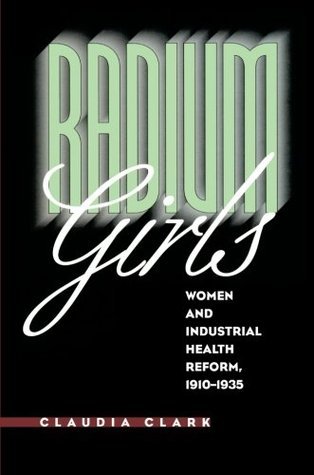
Radium Girls: Women and Industrial Health Reform, 1910-1935
In the early twentieth century, a group of women workers hired to apply luminous paint to watch faces and instrument dials found themselves among the first victims of radium poisoning. Claudia Clark's book tells the compelling story of these women, who at first had no idea that the tedious task of dialpainting was any different from the other factory jobs available to them. But after repeated exposure to the radium-laced paint, they began to develop mysterious, often fatal illnesses that they traced to conditions in the workplace. Their fight to have their symptoms recognized as an industrial disease represents an important chapter in the history of modern health and labor policy. Clark's account emphasizes the social and political factors that influenced the responses of the workers, managers, government officials, medical specialists, and legal authorities involved in the case. She enriches the story by exploring contemporary disputes over workplace control, government intervention, and industry-backed medical research. Finally, in appraising the dialpainters' campaign to secure compensation and prevention of further incidents--efforts launched with the help of the reform-minded, middle-class women of the Consumers' League--Clark is able to evaluate the achievements and shortcomings of the industrial health movement as a whole.
289 pages, Paperback
First published July 31, 1997
Ratings & Reviews
Friends & Following
Create a free account to discover what your friends think of this book!
Community Reviews
Displaying 1 - 30 of 41 reviews

March 4, 2018
4.5 rounded up. In my opinion, this book runs rings around Moore's Radium Girls, which was okay and did the job the author meant it to do. But after that one, I wanted to read an historical account of this story. Where Moore's account is more firmly focused on providing the human face of this tragedy, here we get down to the forces that allowed it to happen in the first place and the attempts made toward reform so that it could never happen again.
The women's fight to gain recognition for illnesses associated with the industry in which they worked was a long one, and despite the reformers' actions, was often impeded on several fronts. Clark discusses how the factory owners knew about the dangers of radium yet continued to not only deceive these women as to their safety, but it doesn't stop there. Self interest was another factor, in which scientists and physicians who received funding from these companies refused to divulge what they knew so as not to alienate those who funded their work. As she notes, the book traces "the failures of industrial health reform to a faith in the autonomy of 'experts' in both government and medicine." There's much more here, as she examines the "social and political factors that influenced the responses" of everyone involved.
I was completely absorbed in this book, but I will acknowledge that it wasn' t perfect -- as just one example, as various topics are introduced into the narrative the author ends up having to provide a brief background so that the book becomes a bit overwhelming in terms of many histories going on at the same time which sort of pulls attention away from the real focus of her work.
Many readers found this book to be "dry" or lacking sympathy for the dial painters themselves, but I didn't get those vibes at all. I know that a straightforward historical account is not everyone's cup of tea, but I was thoroughly engrossed throughout.
more here:
http://www.nonfictionrealstuff.com/20...
The women's fight to gain recognition for illnesses associated with the industry in which they worked was a long one, and despite the reformers' actions, was often impeded on several fronts. Clark discusses how the factory owners knew about the dangers of radium yet continued to not only deceive these women as to their safety, but it doesn't stop there. Self interest was another factor, in which scientists and physicians who received funding from these companies refused to divulge what they knew so as not to alienate those who funded their work. As she notes, the book traces "the failures of industrial health reform to a faith in the autonomy of 'experts' in both government and medicine." There's much more here, as she examines the "social and political factors that influenced the responses" of everyone involved.
I was completely absorbed in this book, but I will acknowledge that it wasn' t perfect -- as just one example, as various topics are introduced into the narrative the author ends up having to provide a brief background so that the book becomes a bit overwhelming in terms of many histories going on at the same time which sort of pulls attention away from the real focus of her work.
Many readers found this book to be "dry" or lacking sympathy for the dial painters themselves, but I didn't get those vibes at all. I know that a straightforward historical account is not everyone's cup of tea, but I was thoroughly engrossed throughout.
more here:
http://www.nonfictionrealstuff.com/20...

August 15, 2017
I couldn't put it down, yet found my skin crawling from both the inhumanity of the corporate world in its treatment of its workers as well as from the horrific injuries and illnesses described. I looked up images of the women; their faces haunted me. The Afterward was chilling as I realized that, although the book begins at the turn of the century, some of the companies involved were still both handling and denying residual radium into the 1990s. It also left me wondering...poisons that affected early twentieth century workers have been largely identified and regulated or banned, I.e., radium, benzene, mercury. What toxic substances are twenty first century industrial workers handling, that will be recognized and lamented by future generations? Are the workers toiling at outsourced factories any better protected than those that came before?

January 18, 2016
This book started out to be the author's disseration, and it sure reads like one. She almost lost me right away by starting out with a lot of tedious stuff about the various committees, government agencies and special-interest groups involved in deciding where the radium dial painters' cases against their employers would lead in the future -- none of it handled lightly or grippingly, I'm afraid. A deeper search into the text brought me some of what I was looking for -- what the factory workers actually went through after ingesting radioactive paint and dust for months or years, and what they did about it.

March 23, 2019
So very hard to continue reading about these poor women that I had to take several “breaks” from it. I had no idea about this situation and the book did a good job educating around the events/timeline. Not a “feel good” book, but important information.

November 28, 2023
In this book, Claudia Clark has done a remarkable job of linking the tragic story of the Radium Girls to a century of industrial health reform. Connecting the narrative of the dialworkers to miners, autoworkers, and scientists, Clark creates a compelling sense of continuity between the occupational regulation movements of the 20th century. She also briefly makes an interesting argument regarding the basis of radioactive safety precautions and their origins in the lives and bodies of the Radium Girls. Clark often approaches issues of female organization and how it grew/developed within a patriarchal labor and union environment which effectively develops an understudied aspect of the movement.
Clark's narrative is far less personal than others by Moore and Cy, and is more interested in questions of knowledge production, government reform, and industrial progress. As a result, the narrative moves quickly through the actual experiences of the dialworkers and devotes plenty of time and attention to other labor movements, scientific developments, and legislative changes. Though Clark's inclusion of this material supports her thesis, creates a natural sense of progression (or rather, effort) and displays a wide range of research, it makes for a less affecting work. It also bounces around somewhat, and some connected issues receive so much attention it distracts from the Radium Girls themselves.
I would recommend this to my friend Tom, who has worked on issues of industrial reform in America's heartland. I may also recommend this to my friend Matt. However, I would recommend Moore's work on the topic more than I would recommend Clark's because of Moore's narrative, personal focus. For academic purposes or readers interested in the event's connections to industrial reform as a whole, I would recommend this one instead. Both are good!
Clark's narrative is far less personal than others by Moore and Cy, and is more interested in questions of knowledge production, government reform, and industrial progress. As a result, the narrative moves quickly through the actual experiences of the dialworkers and devotes plenty of time and attention to other labor movements, scientific developments, and legislative changes. Though Clark's inclusion of this material supports her thesis, creates a natural sense of progression (or rather, effort) and displays a wide range of research, it makes for a less affecting work. It also bounces around somewhat, and some connected issues receive so much attention it distracts from the Radium Girls themselves.
I would recommend this to my friend Tom, who has worked on issues of industrial reform in America's heartland. I may also recommend this to my friend Matt. However, I would recommend Moore's work on the topic more than I would recommend Clark's because of Moore's narrative, personal focus. For academic purposes or readers interested in the event's connections to industrial reform as a whole, I would recommend this one instead. Both are good!
Read
May 20, 2024joey king why would you do that to me
July 12, 2017
This was a hard one to read because of the horror these women went through. The postscript was so shocking that I had to read it twice. God bless these wonderful women.

May 13, 2017
Excellent research on amazing event in history.
March 23, 2018
Ponderous. A slog.

April 14, 2022
A very probing, heavy read: That’s how I’d describe The Radium Girls, by Kate Moore.
It took me weeks to work my way through this 400-page book. Normally, I cruise through thick books. But this one has a lot of details to absorb. After awhile, the stories sound much the same. So I’d set the book aside for a few days. Parts of it were monotonous, but I was interested in learning about this true story. So I plugged along.
During WWI, radium was considered by many to be a wonder drug, something healthy to consume. Its glow when mixed in paint also proved highly useful in making glow-in-the-dark watch dials and equipment for military use.
The problem is that it was expensively scarce and had to be painted by hand. Skilled young women used a lip-dip-paint method to apply it. Camel-hair brushes were carefully loaded with paint, then formed into a perfect tip by inserting the brush tip in the mouth. Repeated thousands of times per girl, this technique proved to be eventually fateful.
Radium poisoning killed many employees of the Radium Dial Company and others. Agonizing and debilitating, the poisonous effects maimed and destroyed young women in the prime of their lives.
Regret from the companies involved? None. In fact, they denied, stalled, lied—did everything but offer compassion and compensation.
So the girls fought industry giants for over a decade—until finally their cause was justified.
⭐️I’m glad I now know the story. Our bookclub read this together and watched the movie last night. It differs significantly from the book but also provides much of the story. Depending on how much you want to know about The Radium Girls will depend on how much time you want to invest. There’s also a young readers’ edition that some have suggested as a quicker read.
It took me weeks to work my way through this 400-page book. Normally, I cruise through thick books. But this one has a lot of details to absorb. After awhile, the stories sound much the same. So I’d set the book aside for a few days. Parts of it were monotonous, but I was interested in learning about this true story. So I plugged along.
During WWI, radium was considered by many to be a wonder drug, something healthy to consume. Its glow when mixed in paint also proved highly useful in making glow-in-the-dark watch dials and equipment for military use.
The problem is that it was expensively scarce and had to be painted by hand. Skilled young women used a lip-dip-paint method to apply it. Camel-hair brushes were carefully loaded with paint, then formed into a perfect tip by inserting the brush tip in the mouth. Repeated thousands of times per girl, this technique proved to be eventually fateful.
Radium poisoning killed many employees of the Radium Dial Company and others. Agonizing and debilitating, the poisonous effects maimed and destroyed young women in the prime of their lives.
Regret from the companies involved? None. In fact, they denied, stalled, lied—did everything but offer compassion and compensation.
So the girls fought industry giants for over a decade—until finally their cause was justified.
⭐️I’m glad I now know the story. Our bookclub read this together and watched the movie last night. It differs significantly from the book but also provides much of the story. Depending on how much you want to know about The Radium Girls will depend on how much time you want to invest. There’s also a young readers’ edition that some have suggested as a quicker read.

October 22, 2019
Whatever happened to the Radium Girls? Read this book and find out.
I’ve been interested in the world of the radium girls for quite a while. I found this book and knew I had to read it. The information in this book is all there. The author digs deep to make the reader feel like he or she is right in the world of the girls. The good, the bad, the really bad…you’re there. For a story that has such a terrible ending, this book certainly captures all of the details.
The thing is, this book reads like a textbook. If it’s supposed to be one, then fabulous. If it’s not, then it can get a bit tedious. The writing is reminiscent of a textbook, which might not appeal to many readers. Then again, if you’re doing a paper about the radium girls, then this is exactly the book needed.
If you’re interested in learning about the radium girls, then try this book. It might be the one you’re looking for.
I’ve been interested in the world of the radium girls for quite a while. I found this book and knew I had to read it. The information in this book is all there. The author digs deep to make the reader feel like he or she is right in the world of the girls. The good, the bad, the really bad…you’re there. For a story that has such a terrible ending, this book certainly captures all of the details.
The thing is, this book reads like a textbook. If it’s supposed to be one, then fabulous. If it’s not, then it can get a bit tedious. The writing is reminiscent of a textbook, which might not appeal to many readers. Then again, if you’re doing a paper about the radium girls, then this is exactly the book needed.
If you’re interested in learning about the radium girls, then try this book. It might be the one you’re looking for.

December 9, 2021
Very academic, not a light read. But an interesting blend of disciplines (science, history, worker’s rights, TORTS!…) and full of eye-opening perspectives (scientific ‘neutrality’ may aid corporate interests; patients who choose dangerous medicine receive compensation more easily than workers who choose dangerous jobs, choice being limited in both cases; and heartbreakingly, young women dying absolutely crippled in their 20s and 30s just because of their employment; because radioactivity was probably healthy for you back in 1910/1920s, and even when it clearly wasn’t, well, it wasn’t /dangerous/ …)Would recommend.
June 23, 2020
This shocking story seemed too horrible to be reality. Kate Moore paints a vivid picture of these young vivacious women and their enthusiasm for life and work as their hopes and dreams turn to unimaginable nightmares. This true and tragic piece of history was disturbing but both inspiring and empowering at the same time. It was a perfect balance of personal story and historical detail to bring this story to light!
August 13, 2018
I finally bought a copy of this book after failing to get it at the library. It is an amazing story and generally is well-written, but sinks to a preachy tone in a few places. Having worked with radioactive materials for much of my career, this story left me aghast, although the ability of the company owners to weasel out of accountability does not.

January 17, 2019
What a horrible journey through the history of radium and it’s use in watch dials. I was so shocked and sad learning about the blatant cover up and disregard for human life to make money. This could happen again with any new substance ! I was even more drawn to the story when I discovered that my grandmother worked in the Waterbury watch factory .
October 1, 2019
I was very into this book for the first half, incredible topic that needed to be shared.
I felt like the book went into depth about each person & their character/family/traits which was great, however I found myself losing attention after the first half.
A book with a great topic, however my attention swayed after the first half
I felt like the book went into depth about each person & their character/family/traits which was great, however I found myself losing attention after the first half.
A book with a great topic, however my attention swayed after the first half

June 3, 2018
Significant story that should be much more well known! This isn't just a story about a few young women, but of an entire case which changed the way we see and deal with company safety procedures. It led to safety precautions during the Manhattan project and even today.

August 29, 2018
Such a tragic story of these young women’s senseless death. But the change that they brought to our country was immense. The book was long and drug in some areas but is a story that needed to be told.
January 12, 2024
Radium Girls
I was trying to study about the radium girls, and Clark often went off on many tangents about other occupational diseases or many almost unrelated things… but otherwise very helpful and a good read
I was trying to study about the radium girls, and Clark often went off on many tangents about other occupational diseases or many almost unrelated things… but otherwise very helpful and a good read
April 2, 2024
This book provides more in depth information about how the Radium Girls' cases transformed workplace injury/death into a full blown part of the before-OSHA regulations came to be and their cases changes for the better of women, (and men and children's) protection in the workplace.

November 6, 2017
Such a sad story of corporate greed. I felt drawn to this book and all the horrific things that happened to these girls. I feel sick on what they had to endure.

December 24, 2017
Sad to think about how business is more than people's health to some. These women fought to make life better for all of us.

March 9, 2018
Could not put this book down.

December 26, 2018
Worth your while. I was hoping they've made this into a movie... and they have (2018)!
February 3, 2019
Rather disturbing account of big business versus the little guy. Or in this case, woman. Women being knowingly exposed to a deadly element for profit. They were expendable.
April 10, 2019
It started out slow and I was thinking how is the author going to make an entire book out of this subject. She definitely succeeded! A must read in the truth-is-stranger-than fiction category.

June 24, 2019
Interesting content and information, but I was not a fan of how the story was told.

June 27, 2019
A very interesting book and the battle women fought to be compensated for injury and death.

January 20, 2020
Everyone should read it. Everyone.

March 13, 2020
Amazing story, amazing women, amazing writing to weave all the facts/headlines/history together to make an engaging and eye opening book.
Displaying 1 - 30 of 41 reviews