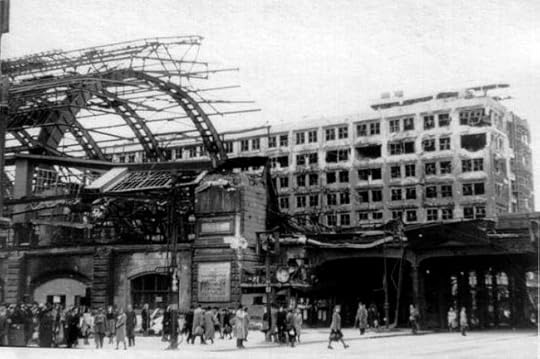
Every great city is a restless work in progress, but nowhere is the urban impulse more in flux than in Berlin, that sprawling metropolis located on the fault line of history. A short-lived fever-dream of modernity in the Roaring Twenties, redubbed Germania and primped up into the megalomaniac fantasy of a Thousand-Year Reichstadt in the Thirties, reduced in 1945 to a divided rubble heap, subsequently revived in a schizoid state of post-World War II duality, and reunited in 1989 when the wall came tumbling down — Berlin has since been reborn yet again as the hipster hub of the 21st century. This book is a hopscotch tour in time and space.
Part memoir, part travelogue, Ghost Dance in Berlin is an unlikely declaration of love, as much to a place as to a state of mind, by the American-born son of German-speaking Jewish refugees. Peter Wortsman imagines the parallel celebratory haunting of two sets of ghosts, those of the exiled erstwhile owners, a Jewish banker and his family, and those of the Führer’s Minister of Finance and his entourage, who took over title, while in another villa across the lake another gaggle of ghosts is busy planning the Final Solution.
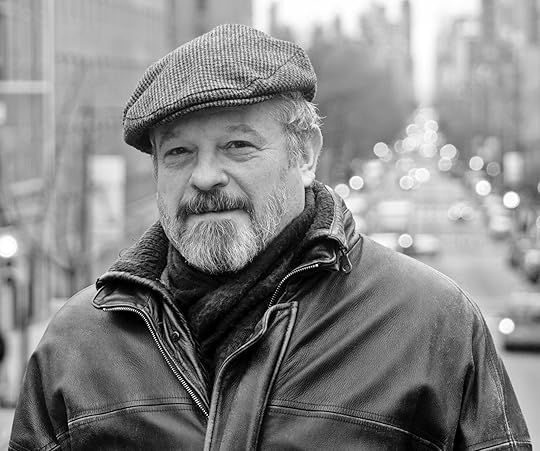
Peter Wortsman is the author of a novel (Cold Earth Wanderers, 2014), thee collections of stories (A Modern Way to Die, 1991, second edition, 2019, Footprints in Wet Cement, 2017, and Stimme und Atem/Out of Breath, Out of Mind, forthcoming in 2019), two stage plays (Burning Words, premiered in 2006, and in German translation in 2014, and The Tattooed Man Tells All, first staged in 2018), a travel memoir (Ghost Dance in Berlin, 2013), as well as a work of nonfiction (The Caring Heirs of Doctor Samuel Bard, 2019).
Wortsman is also a literary translator from the German into English of works by von Chamisso, the Brothers Grimm, Heine, E.T.A. Hoffmann, Kafka, Kleist, Musil, and Mynona, among others.
He was a 1973 Fulbright Fellow at the Albert Ludwig Universität in Freiburg im Breisgau, a 1974 Fellow of the Thomas J. Watson Foundation in Vienna, and a 2010 Holtzbrinck Fellow at the American Academy in Berlin.
His travel texts have appeared in The New York Times, the Los Angeles Times, and other major newspapers, and were included five years in a row in The Best Travel Writing, 2008-2012, and again in 2016.
His interviews with survivors of the Nazi concentration camps can be found in the "Peter Wortsman Collection of Oral History" at the U.S. Holocaust Memorial Museum in Washington D.C.
I originally took this as a serious book about Berlin and something I could learn enough from to make me want to travel there, or at least to feel satisfied in my reading of it enough to save a future trip for someplace else I might need to visit more importantly. Frankly, the text was dead and I was disappointed.
"…my circumcised identity hanging prone between my legs."
Instead of maintaining an interesting and serious stance within his text, Peter Wortsman, the author of this travelogue, cannot help himself but refer in any way he can about his obvious love object, his penis. Because of his repeated exposures of his privates to anyone reading, the book is perhaps unforgettable, but certainly for all the wrong reasons. I cannot quite put my finger on what was the most extreme of the problems here for me except to say his silly idea of being clever and amusing, as well as somebody we might be overly enamored with, reminded me too much of another popular writer I completely despise by the name of David Shields. They have the same problems with delusions of grandeur.
After reading several books written by the great W.G. Sebald I suppose I have been spoiled over what a good travelogue should be. It is not Ghost Dance in Berlin. Not by a long shot. Forget what the blurbs on the book say, this book is for camera-toting bus-riding sissies and not for a gal on foot with a pack on her back and the courage of a Panthera Onca. Sebald comes at you with all the fervor and historical bald truths he can muster. Plus he makes it riveting. This Wortsman guy thinks he's tough because he can fantasize an attack on a moron the likes of Henry Kissinger, sidle up next to him in the German john, and proudly shake his love-club in the face of Henry at the urinal. Wortsman is sickening to me and more than disgusting. How a translator of such work as the great artist Kleist's can stoop so low as this, and with a subject like Berlin so absolutely interesting and relevant to our time. Plus he makes all men look bad, and that really pisses me off.
I thought I might also share what the author himself most recently messaged me: Greetings from the "pretentious buffoon," whose book "Ghost Dance in Berlin" you slashed. Fortunately, your opinion, such as it is, bore little weight. The book just won an Independent Publishers Book Award. Better save your rattlesnake venom for your verse.
I wasn't aware of any "rattlesnake venom" dished on my part. Nonetheless, I stand by my original assessment of this book. It is disgusting. And Peter (a very good name for the author of this book) is correct in using his own word pretentious to say the least about him. But he is obviously proud of it. I answered his message with a heartfelt and simple, “Cool. Congratulations.”
"Like New York, I think of Berlin not as a proper noun, but rather as a “proper,” albeit transitive, verb—with a mass transit(ive) system that actually works—forever evolving, boomeranging, or “Berlining” (sich Berlinernd) into the city of tomorrow. "
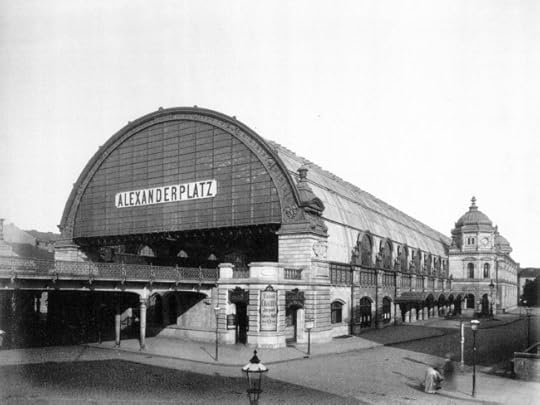
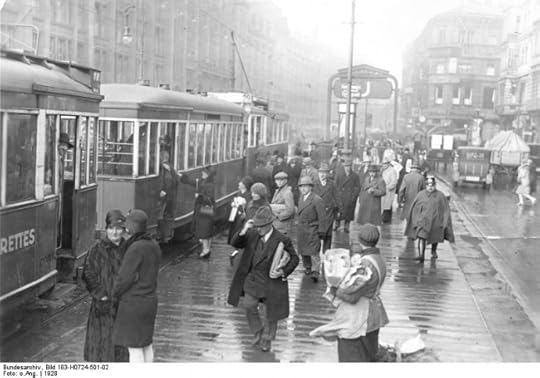
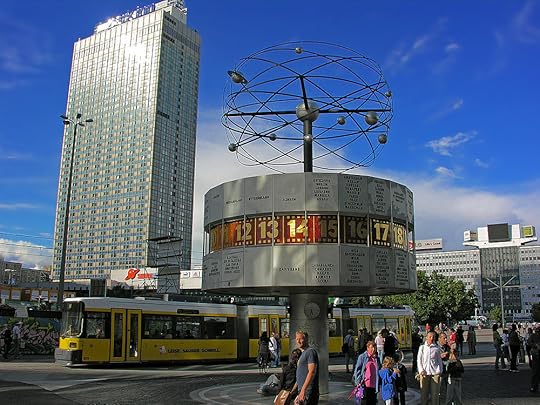
"But Alexanderplatz is positively electric, pure current unmediated by wires".
Berlin of the past and present, Berlin in all seasons, Berlin of Rilke, Berlin of Lotte Lenya, Marlene Dietrich and Nefertiti.
Let me start at the end. Once you’ve finished Peter Wortsman’s Ghost Dance in Berlin it will be clear that, whether you’ve been there or not, Wortsman’s Berlin likely won’t be your Berlin. And that’s part of the charm of the book (and I suppose the city too, though I’ve never been there myself). Wortsman brilliantly conveys the mood and atmosphere of this kaleidoscopic city from one American’s viewpoint, but that of an American fluent in German (he’s the child of Viennese immigrants). What shines through all the chapters of this impressionistic memoir is Wortsman’s profound joy and engagement with his Berlin, a joy that is vividly conveyed in the flavor of the prose.
This book is full of “characters,” Wortsman himself and a variety of Berliners (no, not jelly donuts). Not all of the characters are animate though, as the first we meet is a Nefertiti statue. And we soon learn that Berlin itself is a character, a character-vessel, so to speak, for all its other characters. The dual modalities of Wortsman’s urban observations and the human ones provide a constantly compelling, forward moving narrative out of an episodic compendium. One of my favorite “human interest” stories in the book is the chapter titled, “Professors of the Pavement,” Wortsman’s meditation on Berlin taxi drivers, and one of them in particular.
The bulk of the book is based Wortsman’s experiences during a recent residency in Berlin. At the end of the book there is also a short section of pieces written during earlier visits to the city. While missing some of the verve and energy of the more recent prose, it provides an interesting perspective, as Wortsman, who now can write of a Berlin without a wall (though, we learn, there are still plenty of metaphoric walls), knows his Cold War Berlin too. In a sense, Berlin is Wortsman’s own mysterious east, where he goes to find himself, or a part thereof. We share the author’s journey and look forward to our own.
This is an exquisite little book, gauzy in the way a bandage does more good than its weight would suggest; gauzy in the way dreams talk to us; gauzy in the way fog settles on cemeteries.
This isn't a travelog or even a travel journal, but (to use Wortsman's own term) a "reverie," a grainy meeting of twilight and darkness, daylight and crepuscule, hate and love, reality and vapor. It is mystical and metaphoric, literal and lyrical. It's a Wagner symphony in the rain, romantic and dread-leaden.
Wortsman, the American son of Austrian Jews, visits the land of his people's persecutors, trying to sort out allegiances, reconcile pain and passion. Like his parents, he can't quite get Germany out of his system, though of course he can't forgive it. What to do? A writer writes. Wortsman faces his demons, and those of his generation, by wandering the misty graveyards of "inflicted memory," watching and listening for ghosts. And ghosts are many, watching him back.
As we might expect, what he finds in the place that part of him longs for is "split between an unhappy past and an uncertain present." On the one hand, in parts of Germany, "even an American traveler can forget, or at least momentarily suspend, the traumatic dimension of his German-Jewish roots. He can let his fantasy languish in a childhood reverie not yet corrupted by history; follow the bread crumbs strewn by Hänsel and Gretel all the way to a gingerbread house, almost but not quite forgetting, even as he nibbles on its sweet foundation...that the oven within was not used only for baking cake."
On the other hand, he "cannot look an aging German in the eye without wondering what he or she was doing back then." No surprise there—no phantoms leaping out from behind patches of fog. More insidious ghosts appear not behind headstones but in cafes and on buses, over wine and crackers, in snippets of conversation from the mouths of those who should know better. "'We know intellectually [w]hat we ought to feel,' [a young German woman] says, 'but the feeling just isn't there.'"
That's the real haunted Germany, for Wortsman the "yellow jacket...drowning in my cup, its tiny wings fluttering desperately, stirring up the fizz of its imminent death—if I save it, it'll sting me for sure."
He can't save it, of course, and the "wave of love and revulsion that [he] feels for everything German" must remain unreconciled. As the speed-limitless autobahn, with its implied bravado tearing into the horizon, represents "the last hurrah of German Wanderlust...all that's left of the Teutonic dream of grandeur," so Wortsman's own wanderlust must flatten out and funnel into "a sublimated hormonal rush that could only be indulged at the wheel of a speeding car."
In Ghost Dance In Berlin, Wortsman visits the scar of wall between east and west, good and evil, past and present. More importantly, he visits the scar of wall that separates our wanderings from our wonderings. If for no other reason—if not for its evocative prose or tale of haunted-soul-searching—read this book to appreciate having had the extraordinary luck to be born when and where you were.
I just finished reading Peter Wortsman's new book Ghost Dance in Berlin. I have read a lot of Mr. Wortsman's travel writing, and I have enjoyed it. Hearing the title of this book, I expected that it too would be travel writing. It was, after all, published by Travelers' Tales.
But at some point during the reading, you forget that it's travel writing. From that point on, it's just writing. Great writing at that. The words have a physical presence, and despite the book's title, those words spin stories into the stuff of flesh and blood. But there are ghosts here too, not only the ghosts of Nazis and Jews, but of East Germans as well. And many of the characters we meet--including Mr. Wortsman himself--are haunted by the ghosts of their own past.
This book gets very personal. As a result, it arrives at truths that are universal. There is no question that Wortsman tells us about himself and his family history. But in addition, he has a way of talking to people that gets them to tell us about their personal lives. They tell us stories that you suspect they haven't told for years.
One woman tells of her Nazi father's suicide just as the war was ending. In return, Wortsman tells her of his Jewish father's escape from Austria. Change the names and dates of some of these stories and you're left with something from the Brothers Grimm--no need to change the places.
The subtitle is Rhapsody in Gray, and though Mr. Wortsman presents winter in Berlin in black and white, the people we meet, including the ghosts, are all brought to you in living color.
GHOST DANCE IN BERLIN is a great pleasure to read~lyrical, engaging, personal, scholarly, exquisitely detailed! Peter Wortsman finds the poetry in every experience in Berlin and is the best of virtual companions! Read this book and find yourself voyaging not only through Berlin, but into your own experiences~whether you are a world traveler or, to riff Thoreau, traveling widely in your home town. Read this book and find yourself.
I really struggled to enjoy this book. I heard the writer on a podcast and thought his view on Berlin was unique and refreshing, and I still agree. However, I expected something more like a travelogue or memoir rather than these disjointed little scenes that read more like prose-poetry than actual prose. I gave it three stars because if you're expecting prose-poetry, you may love it - I could see the allure in that case. However, my personal enjoyment of it was closer to 2/5 stars.
i couldn't get into this. the writer tries to be all lyrical and whimsical but it just fell flat for me :( and here i was hoping for some wonderful story about my favourite city. oh well.. on to the next book.