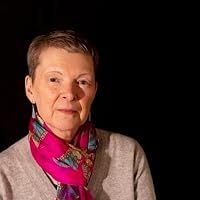
Cloudless May explores the political and psychological circumstances of the defeat of France in the spring of 1940. The audiobook follows the life of a French businessman, his friends, and his mistress, as they try to weather the storm that is the fall of France, during the devastation of the war. Storm Jameson (1891-1986) was born to a North Yorkshire family of shipbuilders. Jameson's fiery mother, who bore three girls, encouraged Storm (christened Margaret Storm) to pursue an academic education. After being taught privately and at Scarborough municipal school she won one of three county scholarships which enabled her to read English Literature at Leeds University. She then went on to complete an MA in European drama at King's College London. During her career Jameson wrote 45 novels, numerous pamphlets, essays, and reviews, in an effort to make money. Her personal life suffered, and her first marriage to schoolmaster Charles Douglas Clarke was an unhappy one. After they divorced in 1925, Jameson went on to marry Guy Chapman, a fellow author, and remained with him despite her apparent rejection of normal domestic life. Storm Jameson was always politically active, helping to publish a Marxist journal in the British section of the International Union of Revolutionary Writers in 1934 and attending anti-fascist rallies.
Margaret Storm Jameson was an English writer, known for her 45 novels, and criticism.
Jameson studied at the University of Leeds, later moving to London, where in 1914 she earned an MA from King's College London. She was a teacher before becoming a full-time writer. She married writer Guy Chapman, but continued to publish as Storm Jameson.
From 1939, Jameson was a prominent president of the British branch of the International PEN association, and active in helping refugee writers. She wrote three volumes of autobiography.
A well-received biography, by Jennifer Birkett, Professor of French Studies at Birmingham University, was published by the Oxford University Press in March 2009.
Jameson talked about some of her novels, and this is one, as being ‘Soundings’ - a way in which the microcosmic might be used to express the macrocosmic, when the macro is too complex and overwhelming to deal with. These give reader and writer an insight into a problem, issue, or crisis through a kind of sampling, the digging of a bore hole to pull out a slice of arctic ice from which one can extrapolate the climate of the whole world.
To do so she dances between the borders of the modernist avant-garde and the social realist or documentary novel. Her foregrounding of the need for social engagement, social criticism, means she could never withdraw into the disconnected world of the experimental, but she knows her Woolf and her Joyce and all of the others. As such, there are touches of high modernism here, but also something of Balzac or Zola.
Someone else said of this novel: "In highly affecting and affective terms, Jameson fleshes out the deep and ineluctable relationship between history and landscape, inhabitant and home, through the characters’ phenomenological intimacy with their surroundings. "
I agree. Note that she was writing this in 1942, looking back from the darkest days to the fall of France two years earlier, so there is an immediacy to it, and urgency, that has an illuminative quality all these years later. The petty and the self-serving undercurrents beneath the well-known historical surface. Echoes too of our modern times in the way in which events, news, was interpreted to fit one's personal and political aims, so that our blind spots grew to cover our eyes.
Highly recommended, particularly if you have an interest in WW2 novels. I certainly think that if this was in print and better known, it would be very widely read.
I just found it a clever investigation into the way different people deal with the inevitable struggles, fears and selfish temptations when confronted with a totally uncertain and possibly wholly destructive future. The descriptions by Jameson, the words and phrases she uses are beautiful. Fantastic images and you get a real sense of a huge number of different characters and the way they think adn love. it took me a little time to get the different people clear in my head but I think it was truly worth the effort. A book from many years ago but still with a lot thats worth hearing
I loved this book. Set in a fictitious French town during World War Two in the days before the invading Nazi army arrives to take control, it brings home the dread and terror of that terrible conflict. The town is divided between those who want to make a stand and resist the invaders, those who think surrender the best course, and those who positively welcome the Nazi regime. A powerful study of war, collaboration, resistance and defeat written in astonishingly beautiful prose.