George Cruikshank was an English caricaturist and book illustrator, praised as the "modern Hogarth" during his life. Born in London, he was a member of the Cruikshank family of caricaturists and artists, the son of Scottish painter and caricaturist Isaac Cruikshank.
Cruikshank's early career was renowned for his social caricatures of English life for popular publications such as The Comic Almanack (1835 - 1853) and Omnibus (1842) but later in his career, his book illustrations for Charles Dickens and many other authors reached an international audience. He created folios of prints with moralistic themes inspired by the temperance movement. The best known of these are The Bottle, 8 plates (1847), with its sequel, The Drunkard's Children, 8 plates (1848), with the ambitious work, The Worship of Bacchus, published by subscription after the artist's oil painting, now in the National Gallery, London. For Charles Dickens, Cruikshank illustrated Sketches by Boz (1836), The Mudfog Papers (1837-38) and Oliver Twist (1838). His works include: Sinks of London Laid Open (1848), Hop O' my Thumb (1853), Jack and the Beanstalk (1854), Cinderella (1854), Puss in Boots (1854) and George Cruikshank's Fairy Library (1870).
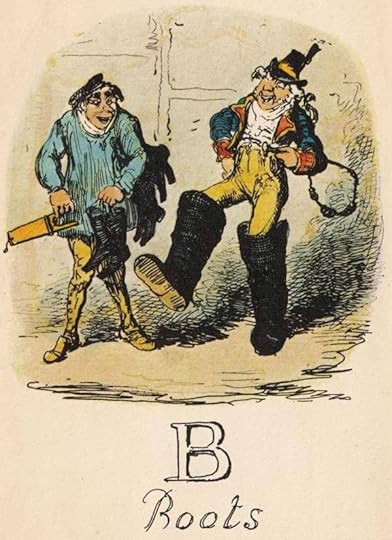
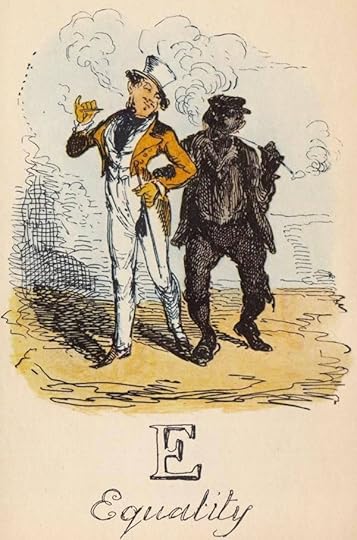
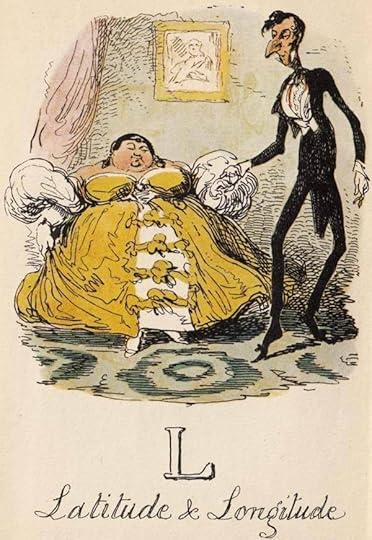
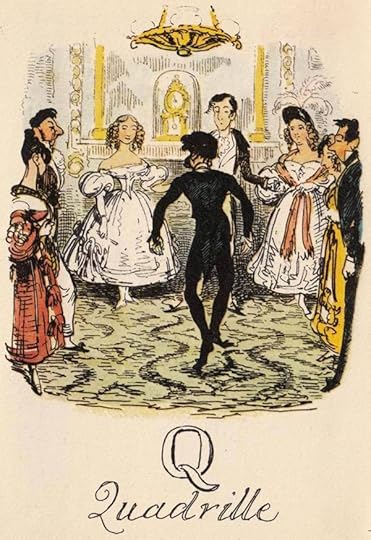
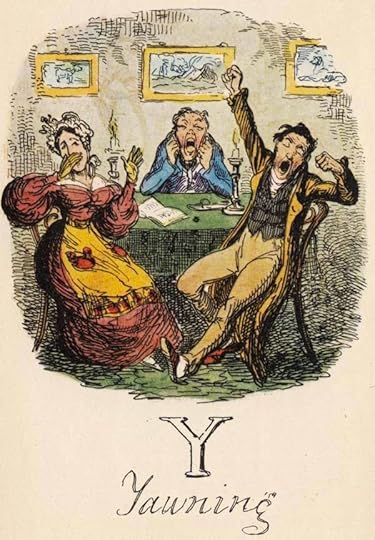
Comic Alphabet is an unusual little book. Each letter is illustrated, with a word starting with that initial underneath. This is fairly standard, but the pages are concertinaed together, so that it would be possible to pull out the entire alphabet with both ends fixed. And the illustrations are not contemporary, but coloured engravings by George Cruikshank, an early 19th century caricaturist.
During his lifetime, Cruikshank was very popular, and known as "the modern Hogarth". One look at some of these illustrations reveals why. They are droll, even satirical, very funny, and full of social comment.
George Cruikshank started his career in caricature, for various periodicals, but now his work is best known through his book illustrations. At the age of 31 he illustrated the first English translation of Grimms' Fairy Tales, published in two volumes as "German Popular Stories". He illustrated the works of authors, perhaps most famously for his friend Charles Dickens, and his work achieved worldwide recognition.
Charles Dickens and George Cruikshank were great friends, and Cruikshank illustrated Dickens's earliest published pieces: "Sketches by Boz"(1836), "The Mudfog Papers" (1837–38) and "Oliver Twist" (1838). He even acted on stage alongside Dickens, in Dickens's theatrical company.
However, as with many of Dickens's friendships, it began to turn sour when George Cruikshank attempted to take the credit for "Oliver Twist". This was not the first time someone else had claimed theirs was the inspiration for Dickens's writing. Robert Seymour, earlier, had claimed that many of "The Pickwick Papers" were originally his ideas. Seymour, an established artist, had the original commission for humorous prints, and Dickens, a little-known young writer, was employed to write short pieces to go with them. Charles Dickens expanded his short commission to produce "The Pickwick Papers". Dickens strenuously denied that the ideas originated with Seymour, and tragically Robert Seymour shot himself, so the public argument died down. In the case of George Cruikshank, there was again a public dispute as to who was the true creator of "Oliver Twist".
Sadly the friendship between George Cruikshank and Charles Dickens began to deteriorate. It soured even further when George Cruikshank spurned drink, and became a fanatical teetotaller, whereas Dickens's own views were those of moderation. Perhaps the final nail in the coffin came over a year after Dickens's death. On 30th December 1871, "The Times" newspaper published a letter by George Cruikshank, in which he claimed that he had thought of much of the plot of "Oliver Twist", fuelling a public controversy once again.
This book however, is a rare treat. It is truly "pocket-sized", and small enough to pop in your top pocket. If you enjoy these types of cartoons, they will have you chuckling in no time. If you find yourself wanting more, novels illustrated by George Cruikshank are easy enough to obtain. During his lifetime he made almost 10,000 prints and illustrations. Both the "British Museum" and the "Victoria and Albert Museum" hold collections of his works on public display.
I found this quirky, bizarre little book in a Little Free Library today- I’ve wanted to read it for years. It’s very silly and I’m glad I found it (even if the alphabet goes “V” then “U” 😅)