Jump to ratings and reviews
Rate this book

Bali: A Paradise Created

Rate this book
To this "old Bali" has been added the lush and erotic Bali of the European imagination - the tropical paradise that in the 193Os became an extension of salon life for the rich and famous, providing inspiration for artists and Hollywood writers. During the 196Os, "hippie" surfers discovered Bali's beaches, waves and cheap digs, and today young European, Australian and Japanese visitors barter for bargains and dance till dawn on Kuta Beach.
Tourists, students and armchair travelers alike will appreciate the fresh insights which this book brings to the history and culture of a traditional island faced with a massive invasion of paradise-seekers. After reading this book, your view of Bali will never be quite the same again!

240 pages, Paperback

First published January 1, 1997

29 people are currently reading
177 people want to read

About the author

Adrian Vickers

21 books3 followers

Ratings & Reviews

What do you think?
Rate this book

Friends & Following

Create a free account to discover what your friends think of this book!

Community Reviews

5 stars
20 (17%)
4 stars
51 (45%)
3 stars
33 (29%)
2 stars
6 (5%)
1 star
2 (1%)
Displaying 1 - 13 of 13 reviews
Profile Image for Warwick.
Author 1 book15.4k followers
February 4, 2017
As a pure history, this isn't great – the first couple of chapters, about early Balinese kingdoms and Dutch colonisation, seemed to get bogged down too often in lists of names, dates and assassinations, with little ear for anecdotal value. Maps would have helped. However, things start looking up when Vickers gets to the modern era and is able to concentrate more directly on his overall thesis, which has to do with how Bali's image – variously as savage hinterland, untouched paradise, erotic idyll or tourist trap – has been created and propagated by the island's visitors and locals.

As with many colonies, the Dutch East Indies (as Indonesia then was) drew the attention of all kinds of travelling explorer-scholars in the grand nineteenth-century tradition. Despite the many evils of colonialism, I have always had a soft spot for these figures and Bali's examples are no exception. From the pioneering philologist Herman Neubronner van der Tuuk, who grew up in Surabaya and wandered around Bali wearing pyjamas and carrying a gigantic cudgel, to the archaeologist Pieter van Stein Callenfels, who went everywhere with a skull called Ahmad, the island had an extensive roster of eccentric orientalists.

One of the most interesting, and influential, was a medical doctor called Julius Jacobs, whom Vickers refers to as ‘the man who discovered the Balinese female breast’. Jacobs wrote detailed, prurient and scholarly examinations of Balinese sexual culture, painting the island as a place of erotic license, and lacing his papers with Latin, French and German terms for a veneer of respectability. His description of what he called Lesbische liefde, for instance, included a helpful account of Balinese scissoring, or ‘(metjèngtjèng djoeoek), literally “to hit cymbals against each other without making a sound”.’ Also, with a wink: ‘Yams and bananas are much used by the Balinese girls as delicacies, but not only for eating.’

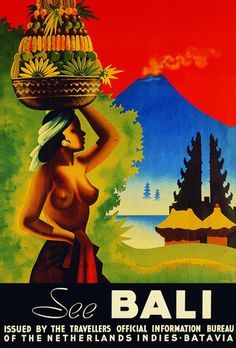
This image was to have lasting endurance, and KLM marketed Bali explicitly as ‘the island of bare breasts’, with postcards and posters to match—


(a more decorous version of which is used on the book's cover). This iconography in turn would be picked up by the artists who gathered in Bali, especially after the 1930s set that coalesced around the German painter Walter Spies. (Though ironically, Spies and his friends were more interested in Balinese boys than girls, and most of them, Spies included, ended up in jail following a crackdown from Dutch Calvinists.)

Towards the end of the twentieth century, Bali went, as Vickers puts it, ‘from being one of the most densely populated islands on earth to one of the most densely toured islands’. First the hippies, then the surfers, and now the package tourists have changed the island quite dramatically. The original tourist plan drawn up by Bali's governors in the early 70s was quite sensible – forbidding any hotel from being higher than two-thirds the height of a palm tree, or within a hundred meters of a beach – but most of these restrictions were ignored or overturned during the 1990s, when the Suharto regime had a lot of financial stakes in Balinese developments.

In the original 1989 version of this book, Vickers is quite sanguine about the effect of tourism on Bali, making the obvious point that ‘Balinese culture is strong because of tourism, not despite it’. The 2012 edition, though, following the escalation of package tours as well as the Bali bombings of 2002 and 2005, takes a more cynical tone.

For tourists coming to Bali the impressions of Balinese culture became quite limited, and the emphasis shifted to staying in self-contained accommodation. The old problems of tourism in a poor country have remained: when tourists step outside their hotel areas they are assailed by heavy traffic and harassed by touts: “You want massage, you want special young girl massage, you want boy massage, just looking my shop, come just look, transport” etc. This kind of harassment has made resorts a welcome refuge from the street life of the island. When tourists are taken to see Balinese “art” it is the low grade products of the artshops, and their guides are only interested in taking them to places where major commissions are on offer. If tourists see beautiful landscapes the experience only comes after sitting through traffic jams, and if they see Balinese performances it is usually the tired old lègong and “welcome dance” of hotels and restaurants. There is little of the direct experience had by the hippies and surfies of an earlier era.



This was my experience too. It is a hard country in which to travel ‘responsibly’, that is, without contributing to a rather destructive kind of large-scale tourism. Nevertheless, Balinese culture and history does reward the effort required to unearth it, and this book seems a pretty good grounding in trying to understand where it came from and where it's going.
Profile Image for jochem.
4 reviews2 followers
December 10, 2009
Bit of a disappointment. Vickers offers an extensive if not exhaustive overview of the images of Bali throughout modern history. The main thread in this story is that what we know of Balinese culture is in the end a Western concoction. Although Vickers seems to come very close to that conclusion he apparently is not willing to take that last step. Still Vickers himself clearly states that Balinese and Indonesians have taken over the Western image of Bali as an island of culture.

Moreover, whilst claiming that tourism has encouraged Balinese to articulate their culture (he means answering questions by Western (trained) anthropologists/tourists) he does not offer even one example of that kind of articulation.

Profile Image for Bea Daisy.
78 reviews
January 6, 2025
A little dry and academic for me but I found it interesting anyway as I'm trying to read as much as I can about Indonesia and Bali :)
4 reviews
September 8, 2024
Author does a great job putting Balinese history in the context of its religion, its place in Indonesia and its modern tourism industry. The book could have been alternatively titled as "Changing images of Bali" since that is also a key focus, both from the perspective of Balinese as well as rest of the world.
However, some historic details become too dry to read as the book progresses on. Even some of the modern history with names of artists and royal families would be less engaging to a casual reader with no background in these topics.
Profile Image for Mark Harris.
345 reviews5 followers
August 25, 2023
A survey of portrayals and imaginings of Bali, mostly from a Western point of view, from colonial times to 2012 (the 2nd edition). Includes some Balinese history.
Profile Image for Harry Fozzard.
12 reviews
July 28, 2015
Vickers is definitely up to the task and has broad and deep knowledge of his subject. His discussion of what he calls "Savage Bali" in Chapter One delineates European thinking about the island as proto-colonists show up to open trade and generally explore and assess. As the author moves into a fairly detailed summary of the pre-Dutch political structure of the island, which is pretty complex, it's unclear until later in the book how the royal houses come to play a role in our modern understanding of Bali. Or, at least, it was for me.

In the early sections it's easy to be lulled into the sense that the book is a basic history primer since it seems that Vickers' underlying theme is that Bali really exists as a construct as much as an actual place given its emblematic role of South Pacific meets Exotic SE Asia. These developments beginning with Dutch colonial administrators invested in the preservation of the authentic Balinese culture (yes, it does sound absurd) through the artists and academics — particularly Walter Spies and Margret Mead and then the post colonial efforts to preserve an authentic Bali through tourism are fascinating going. The book maps not only the intriguing aspects of Bali woven into "Brand" Bali's development over time, but manages to discuss a fair amount of the cultural aspects of the island that serve as the undeniable foundation for its casting as Paradise.

Perusing Air Asia for a firsthand view in my other tab.
Profile Image for Meg.
1,187 reviews24 followers
September 20, 2014
This was one of the driest books I read this year...and the only reason I dragged myself through it is because I am living in Bali...and hoped it would get better. Sadly, it did not.

My Bahasa Indonesia teacher recommended the book...so I got it as a continuation of my study of this world...but wow. It was a painful read.

It covers the history of Bali...but it covers it so slowly and without any flavor...I am not sure I will remember most of it.

Read if you want to know about Bali....and don't mind falling asleep at your book.
Profile Image for Doody Richards.
Author 1 book
September 8, 2013
Slow progress ... It's a text book history lesson about a little paradise from a colonial time to modern time with a little glimpse of java kingdoms glory time. This book is very well researched, and informative.
Profile Image for Erin.
75 reviews8 followers
April 30, 2009
If you ever want to read a detailed but narrative history of Bali this is a great book.
Displaying 1 - 13 of 13 reviews

Can't find what you're looking for?

Get help and learn more about the design.