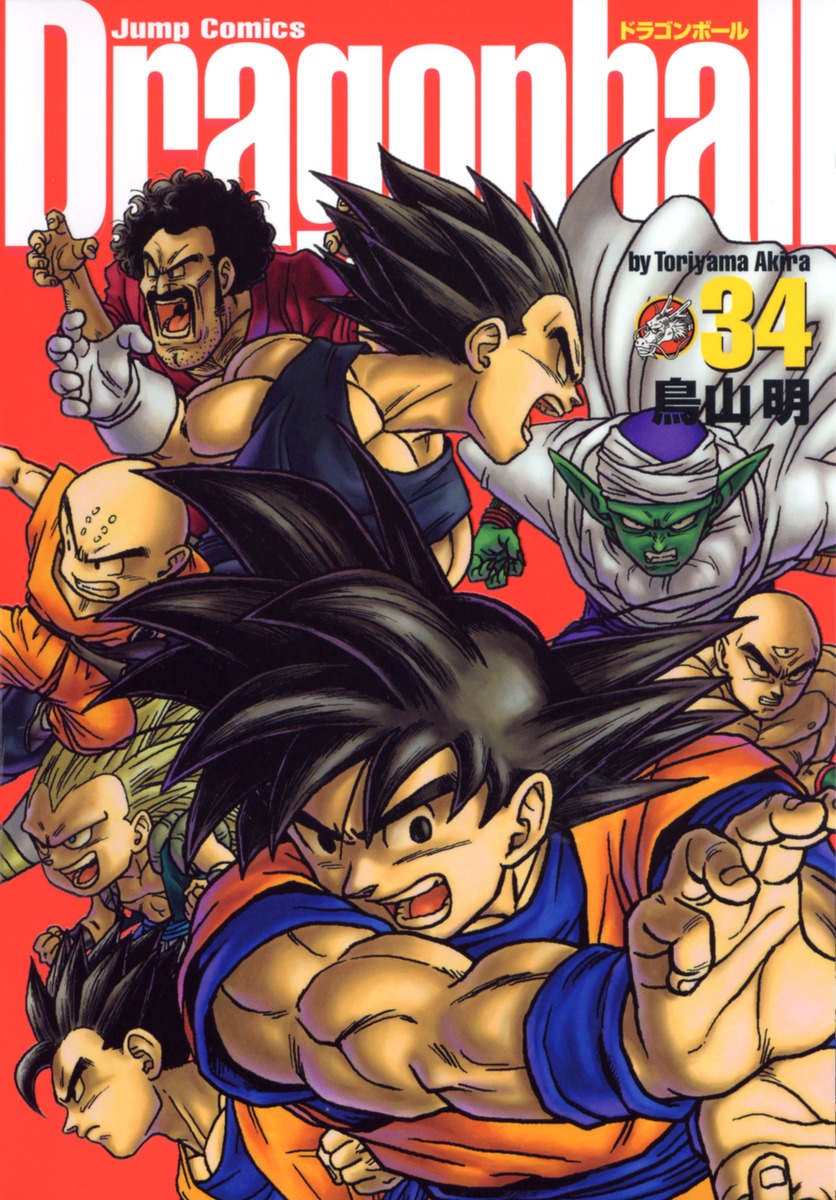
Well, I finished reading all of Dragon Ball. I watched DBZ religiously for a couple years when I was young, but there were some big chunks I missed out on. I had only seen a couple episodes of the original anime, too. I thought I'd fill in the blanks by reading all of the manga, which is much faster and more enjoyable than the show. It's hard to overstate how influential this series is, but I was surprised to find that even in the manga, the later sagas dragged on, full of explication and never ending fights.
The original series (before Z begins) was the best. I really liked Toriyama's "chubby" drawing style. It was more cartoony than Z, in which he made everything pointy. One of the most enjoyable parts was the amount of outfits the characters appeared in. I really like this kind of thing in a comic. I think my favorite part was the bit leading up to Buu's first appearance, when there was a calm before the Budokai. The humor returned and a lot of new characters appeared. I think Buu was my favorite villain in the series. The fight against Buu had a great bit where it showed several characters from DB hearing and recognizing Goku's voice.
Despite its flaws, it was an enjoyable read. The last chapter had a couple pages without any talking where the characters just looked at each other, and it felt more organic than most of the dialogue in the series. It really made me wonder what it would be like with most of the talking removed, and fights shortened, and nothing about power levels. It could just stand for itself, and not be explained to death by the weak characters. I can imagine an amazing fan edit with all of the unnecessary pieces missing-- maybe some day.
I’ve done a lot of rereading throughout 2023, particularly when it comes to childhood favourites. Maybe it’s got something to do with turning 30 this year. Yes, I know it’s just an arbitrary number and that I shouldn’t read too much into it, but dang, what the hell happened to my teens and twenties?! I barely remember anything, not because I spent those years pie-eyed, but because… I don’t know. They just… Passed.
I don’t understand time.
Anyways, I’ve been feeling pretty nostalgic for Dragon Ball for a while now. And so, with Dragon Ball’s 40th anniversary just around the corner, I decided to dedicate 2023 to slowly rereading the manga. Only, when I went to Goodreads, I saw that it wasn’t in my read pile. Turns out that it had been so bloody long since I first read the manga, that I wasn’t even on Goodreads back then. And I joined the website in 2011. Apparently, I’d completely forgotten to even list this manga as something I’d read.
So, with all that out of the way, let’s jump into Toriyama Akira’s whimsical world.
Initially, I planned on writing separate reviews for each section of the story as I made my way through the kanzenbans. But do you know how many of those bloody things there are? It would’ve been nigh impossible. So I instead jotted down notes that would go into the making of one (incomprehensive) review of the entire manga. This review, to be exact.
And, boy, where do I even start? I love Toriyama for his missteps as much as I do for his triumphs. The man can be said—and has been said—to be lazy, forgetful, and scatterbrained, though also something of a genius. He singlehandedly managed to create two hit manga and change the shōnen manga landscape forever.
You name a popular (or unpopular) contemporary battle manga, and I guarantee it owes a great deal to either Akira or Dragon Ball. Or both. Naruto, One Piece, My Hero, Bleach, and countless others would either not exist today, or not exist as we know them without the groundwork laid by Dragon Ball.
Perhaps unfairly, I’ve always considered Toriyama an artist who not so much created great stories as stumbled on them. It’s no secret he pens everything on the fly, and his storytelling skills sometimes leave much to be desired. And yet, he created some of the most memorable scenes and character arcs in all of manga, scenes that, to this day, still make audiences around the world weep and cheer.
Just as Shylock is famously said to have been a character who got away from Shakespeare and was simply too complex for the confines of a comedy like The Merchant of Venice, I am convinced there are characters and story arcs that got away from Toriyama—kernels of a larger narrative that he stumbled on without fully understanding their potential at the time, elements that, to put it bluntly, are too complex and sophisticated for a comedic manga artist like him.
Now, don’t get me wrong, I don’t hold that against Toriyama. This is just a personal opinion, one hypothesis among many, on how Dragon Ball developed and changed over a period of ten years.
I’m sure everybody already knows how this series came to be, the various works and influences that went into the creation of that first arc, et cetera, so I won’t waste anyone’s time on that. I’ll just say that the first arc is a fantastic introduction to the magical world of DB. I mean, you have talking dinosaurs coexisting with the kind of technology we don’t have.
Forget the ability to fly or bench-press a planet—the one DB superpower I want is capsules! Think about it—you can put a house, a vehicle, food, books, and just about anything else you can think of inside a capsule that can fit in your pocket! You can go anywhere you want and, wherever you call it a night, you’re home! I would travel the shit out of DB’s Earth. Shut up and take my money! Some genius had better invent those in my lifetime!
Rereading that first story arc made me realise my sexual misconduct tolerance threshold is far lower than it used to be, specifically when it comes to narratives that frame said misconduct in a humourous, light-hearted way. I hate everything that’s done to (predominantly) Bulma throughout DB’s run. That also makes Rōshi my least favourite character. Even so, I managed to look past the more unsavoury parts of the story and find it deeply captivating.
I love Pilaf. Maybe because I love comically inept villains in general. He is so cute! Whenever he starts talking about wanting to become a dictator, I feel like picking him up and nuzzling him and talking to him in a voice reserved for pets and babies. Well, of course you’re a mighty emperor! Yes, you are! Yes, you are!
What even is Pilaf? He’s neither an animal-type nor a human-type earthling. He looks like some adorable little goblin-troll. I’m sure there’s an exact explanation somewhere on the DB Wiki or Kanzenshuu, but I don’t want to know! Not knowing what exactly he is is part of his charm.
Pilaf and his equally incompetent crew are so much fun. I always light up when I see them on the page. Reading about the clueless emperor negotiating with Piccolo about how much of the planet he’s owed is the best thing ever. I’m so glad later DB works decide to bring the Pilaf gang back.
The whole Red Ribbon Army thing… Ugh… I tried! I keep trying, whether by page or screen, to find some enjoyment in this arc, but I never succeed. I downright hate it. The Muscle Tower section damn near broke me.
It has its moments, of course. The design of the army’s HQ is great, for instance. On the whole, though, it’s a boring slog I never look forward to watching or reading.
Except for Baba’s fights. Love those. Love the Devil’s Toilet! Two demons, sitting on opposite toilets, pooping, their tongues meeting in the middle? And there’s even a toilet roll on the wall? Yes! Thank you, Toriyama! That’s the part of your brain I love, not the low-hanging sexual harassment humour! Sidenote—Krillin could’ve easily helped Yamcha without humiliating Bulma by, oh I don’t know, flinging some mud on the arena until it hit the invisible fighter?
I adore all three tournament arcs. The 21st is a wonderful introduction to the wider world that features some of DB’s most whimsical fights. And allows Gokū to cheat his way into the finals? The 22nd has some neat themes of rivalry and loyalty. And the 23rd is just all around fantastic.
All three tournaments show us a clear progression of the characters’ designs, skills, abilities, intelligence, and maturation. I love them all almost equally. If I had to rank them, I’d say the 22nd is my least favourite and that the 23rd is the best.
The 23rd introduces us to the grownup versions of several characters. It shows us the many skills they’ve picked up since the last tournament. It has end-of-the-world stakes. I mean, Piccolo swallows God!
It also gives us Gokū at his smartest and most charming. He constantly outsmarts and one-ups the literal child/reincarnation of a demon king! I think that’s a subtle way of showing that Piccolo might be powerful, but he is still a literal child, an inexperienced three-year-old facing off against a much battle-savvier Gokū.
I don’t have much to say about the fight against our Big Green demon king. I find it one of the least interesting and least memorable sections of the storyline. It’s fine? A bit dull and repetitive, if you ask me. That said, it has one of the greatest WTF moments in the entire manga. Piccolo Sr. killing Shenron totally blindsided me the first time I saw it happen, and the shock of that moment is just as potent on repeat viewings.
The Namek/Freeza arc starts off brilliantly, absolutely brilliantly. Following the torturous fight against Saiyans, the story slows down a bit to allow for some mourning, contemplation, and planning. Healing, resting, finding spaceships, finding Namek, organising—it’s all brilliant! The intensity abates, but the story very much goes on in a more tactical manner.
This strategic plotting continues when the characters arrive on Namek. It’s all about scrambling for the Dragon Balls, outwitting and outmanoeuvring the enemy. We have three factions—Freeza’s crew, Krillin’s crew, and Vegeta’s crew… Which is mostly just Vegeta by himself, since he needs nobody… Until he does.
I honestly can’t decide who the smartest, best tactician in this section of the story is. They’re all amazing, constantly coming up with new ways of one-upping their rivals. Especially Vegeta, who somehow always manages to find a way out of almost any pinch. Watching him humiliate Freeza time and again was such a bloody joy.
I reckon the Namek arc has a brilliant beginning and a brilliant ending, as both are concerned with plotting and organising, rely more on brains than brawn, and are all about testing the limits of the Dragon Balls. What if we could go to Namek and use their Balls? What if someone died prematurely from emotional distress? What if we somehow coordinated the two sets of Dragon Balls? What if this, what if that?
Compared to all that scheming and outwitting, the middle section is boring and unmemorable, consisting mainly of strong guys punching and getting punched by other strong guys.
Needless to say, that’s a pretty broad, reductive statement. There are plenty of great moments and character interactions peppered throughout, even in arcs that I can’t stand. I already said I all but hate the Red Ribbon Army arc, but Gokū putting a mouse in his mouth to save it is still the single greatest thing Toriyama’s given the world. Likewise, Freeza’s feet are awesome. See? That’s the beauty of this manga—it gives you something to enjoy even in the sections you aren’t particularly fond of.
I consider the entire Cell arc one major shift in tone, style, characterisation, et cetera. Or, rather, a series of shifts that take the story in a new direction and expand the in-universe horizons for characters and readers alike. Some of my earliest memories of DB come from this section of the tale and I’ll always hold it in high regard. Even after twenty-plus years, knowing where the story’s going, reading and watching the many juicy twists and turns is still such a bloody joy.
That said, it can also be a bloody slog at times. Considering how much Toriyama was being jerked around behind the scenes, constantly forced to steer the plot in a different direction, it’s a miracle we even got a narrative this satisfying, its enduring popularity a testament to Toriyama’s quick thinking and inventiveness.
This story arc features some of the best mystery and drama. It’s also got some of my favourite character interactions and introduces us to Future Trunks, one of the franchise’s most beloved characters. The whole time-travel shebang is a Swiss cheese of a storyline, riddled with plotholes, oversights, and inconsistencies. Still, I am and always have been willing to let all that slide, since the resulting story, for the most part, is so bloody satisfying.
The Buu arc is a similarly jumbled mess. It’s at once DB’s gravest and goofiest arc. Somehow. Over the years, it’s gained a reputation as the weakest saga. Given that I couldn’t remember what I thought of it when I’d initially read it and that I’ve since absorbed plenty of negative opinions about it, I fully expected to loathe this closing chapter.
While I can certainly see where those overwhelmingly negative opinions stem from—and even largely agree with them—I still love Buu. I think it’s a fantastic plotline worth reassessing. Let’s not forget that this was also DB’s final storyline, and thus had the unenviable task of bringing to an end a manga of monumental importance and popularity.
I will never not cry when Vegeta embraces his son and sacrifices himself for the greater good. I will never not cheer for him when he’s desperately fighting to buy Gokū that precious one minute. I will never not raise my hands in the air when Gokū begs the earthlings to help him complete the Genki Dama.
There is so much dramatic tension in this plotline, so much sacrifice, so much to lose. The stakes are at their highest in Buu. Character after character perishes, even the ones most of us considered exempt from carnage. There are multiple heroes training to take down this new threat, each pushing past his own limits, desperate to restore peace to Earth.
Sure, it’s messy as all hell. But did Toriyama succeed in salvaging this arc despite the colossal messiness? It depends on who you ask. Some fans loathe this final chapter of DB, whereas others consider it a shining example of how to conclude a long-running manga. I reckon both opinions are valid. Depending on the section it’s currently dealing with, the plot can feel either too rushed or too dragged out.
Overall, I enjoyed it, my favourite chapters the ones concerning Vegeta’s culminating character arc. But more on that later.
The Cell and Buu arcs are very similar in this regard. Both start off great, but get lost somewhere along the way. Their weaker sections are disappointing in much the same way—promising ideas that somehow fail to reach their full potential. I love them both, but I’m not blind to the fact they could’ve been monumentally better.
I’ve saved the best for last. Look, I hate to be a basic bitch, but the Saiyan arc is where it’s at for me. In my opinion, it’s not only DB’s greatest plotline, but also one of the best story arcs in all of shōnen. It’s out-of-this-world good. I guess that’s an apt way to describe it, given that it very much revolves around out-of-this-world elements. It’s so good that I actually have nothing to say about it.
I could fill an entire wall with printouts of my favourite panels and pages. Toriyama is a master of his craft and there’s no end to the illustrations I consider exceptional. So, instead of subjecting anyone to that, let’s talk characters. I am sacrificing a lot of specifics here for the sake of brevity, so I’ll mention only the most prominent ones.
Son Gokū is… A perfectly serviceable protagonist. I reckon he’s at his best in the earlier years, concluding with his fight against the Saiyans. After that point, he loses much of his appeal. Paradoxically, it’s in the post-Saiyan DB that Gokū transcends a mere character and becomes something more. Namely, a blueprint for all future shōnen manga protagonists—tenacious, gluttonous, not terribly smart loudmouths. In a way, you could say that Gokū sacrifices his individual character to pave the way for subsequent heroes.
Krillin is fantastic! He goes from an insecure brat perfectly willing to walk all over others to a humble, relatable everyman. He is far from the strongest, yet remains relevant throughout the story. Precisely because he isn’t the strongest, Krillin has to be the tactician, the planner, the strategist, the organiser. He is consistently shown to be one of the smartest fighters and frequently has all the most interesting subplots revolving around him.
I think Piccolo works best in the nanny/mentor role. And I’m referring here to Junior, not his Big Green papa. Though most fans will be quick to point out his chemistry with Gohan, I believe he works even better as a foil to Goten and Trunks and their smug fusion. Piccolo facepalming amid one heart-attack-inducing stupidity of Gotenks’s after another makes my day every single time.
Speaking of Son Gohan, I love everything about him from start to finish. I love that he isn’t like his dad. I love his reluctance, his fears and insecurities. While most DB fans aren’t too happy about Gohan’s retirement to nerdom, I can think of no better way for his journey to wrap up. He spent years and years of his life fighting to secure a safe, stable planet he can become a scholar on. Of course I want him to do what he loves after he’s sacrificed so much to ensure that peace and stability.
I fully expected to hate Mister Satan, mostly because I don’t like what Toei does with him in both Z and Kai. Having now reacquainted myself with Toriyama’s Mr. Satan, I can only say that I adore this blustering buffoon so much that I’m never jumping off the Hail Satan bandwagon. This arrogant, cowardly, limelight-hogging idiot may not be the hero we expected, but he still managed to save the world (or contribute immensely to its saving) twice.
Lastly, my favourite character is technically my favourite family. From Bulma’s ditsy mother to her even ditsier father and their menagerie, across both Trunkses, to the absolute power couple that is Bulma and Vegeta, our wealthy capsule family, in my humble opinion, is Toriyama’s greatest contribution to the world. Am I slightly biased in saying that, swayed by years and years of consuming VegeBul fanfiction? . . . . . Perhaps.
But, come on! Be honest, if you could choose to be anyone in the world, you’d choose to be Bulma, right? A superrich genius with access to amazing technology, piles of Zeni and Dragon Balls? Fuck yes, sign me up!
Yes, she can be brash and conceited and spoiled, but Bulma is also highly adaptable and matures immensely over the course of the manga. She starts out as a pampered brat more than willing to throw others under the bus, but gradually evolves into a quintessential asset, someone who helps others and actively fights that good fight. Just look at everything she manages to achieve in the future timeline that’s been all but eradicated by Dr. Gero.
And Vegeta? Aah, Vegeta… *melting* What is it about this genocidal mass murderer that we love so much? As an unapologetic Vegeta fangirl, I’m not sure I have an objective answer to that. Vegeta constitutes such a large chunk of my fanfic diet that it’s hard for me to divorce his ff character from the character Toriyama created.
Even so, it’s clear why so many fanfiction writers latch onto him. There is something inherently changeable about Vegeta, and I believe it is precisely this quality that prompts so many creators to take him down so many different paths and reinvent him in so many different scenarios.
On a personal level, I have to admit that Vegeta is the most relatable character I’ve come across in fiction. Yep—out of all the numerous characters I’ve met in movies, manga, TV shows, books, anime and all other forms of media, Vegeta is the character I identify with the most. Think of me what you will…
Aaaand I'm out of characters... Thanks, Goodreads, you're a real doll. You can read the full review on my blog.
Un tome qui conclut parfaitement cette épopée mythique du shônen largement inspiré par la pérégrination vers l'ouest. J'ai beaucoup aimé suivre les aventures de Goku bien que parfois improvisées elles étaient toutes agréables à vivre pour ce shônen nekketsu qui va poser les jalons de ce genre si particulier. J'ai trouvé que c'était un bon tome de conclusion avec notamment de très bonnes évolutions notamment pour le personnage de Vegeta qui m'a agréablement surprise dans ce dernier tome. Ici on retourne aux bases avec un combat final dont le protagoniste est Goku, que cela soit dans le combat avec le fameux genki dama qui utilise la puissance de tout le monde, très classique et pourtant toujours aussi efficace, dans l'histoire avec la transmission spirituelle et familiale ou encore dans la volonté de toujours se surpasser.
En bref Dragon Ball malgré des défauts reste un incontournable, une série très représentative du shônen nekketsu que nombre d'auteurs ont repris plus tard, pour tout ceux qui aiment les shônens, les plus jeunes qui souhaitent lire des graphiques je le recommande !
This entire review has been hidden because of spoilers.
Re-reading the series was entertaining and quite fun. I didn’t expect it to age so well, but it did. There were some parts more exciting or moving than others, and some I found a bit long (Cell could have been shorter). The first part of the series, when Son Goku was young, was original, with likable characters, a lazy humor and enough world building to appreciate what was happening. The DBZ part was clearly more oriented toward fights, giving a repetitive tone to several chapters, but I enjoyed very much to finally follow Vegeta & Trunks (Son Goku is a good hero, but he’s too nice, I prefer Vegeta’s evolution). The last volumes, with Boo, were on a crazy mood and I’m not surprised I didn’t fully appreciate or remember them, but at least the characterization wasn’t bad (I finally enjoyed spending time with Gohan...). It’s a long series, but a good one. I’m now curious to discover Super!
Dragon Ball (o Bola de Drac) es sin duda una obra maestra que ha influido sobretodo en el género shonen del manga a lo largo de la historia. No había visto / leído nunca Dragon Ball, siendo esta mi primera vez recorriendo esta historia, y me ha sorprendido gratamente. Lo que más me ha gustado es la originalidad de Toriyama en diseños de personajes, escenarios, world-building, técnicas/ habilidades... El dibujo del manga es limpio y con diseños de personajes memorables.
Me ha encantado, recomendable a cualquier amante del manga/anime.
I did it! I read the whole series in Japanese! What a trip!
It took me several years, until I bought the physical set in Japan. Then I buckled down and fairly consistently read them this past year—reading just over half the series in about 14 months, between all the rest of the reading I’ve done.
Such a fun and seminal series. So glad I got to experience it in its original language.
Después de muchos años he podido leer el manga del anime que me acompañó en mi infancia. Doy gracias a Toriyama por crear esta obra y ojalá siguiese entre nosotros para seguir ofreciéndonos sus creaciones y poder disfrutar como los niños que hemos sido al crecer con sus historias…
amei ❤️ pena só ter conhecido dragon ball e toda sua história só depois do Toriyama ter falecido. Da pra entender pq essa história durou tantos anos e o pq dela ser tão aforada até os dias de hoje ✨
wat i think is that this book is really good.also this book is about a saiyan whos thought he was a human. later on in dragon ball z he could turn t a super saiyan. wat is interesting about this book is that goku never guve up on a fight he alway want to keep trying. even if he lose hes not a sore losing. he always say i will go tran can u fight me after