

What do you think?
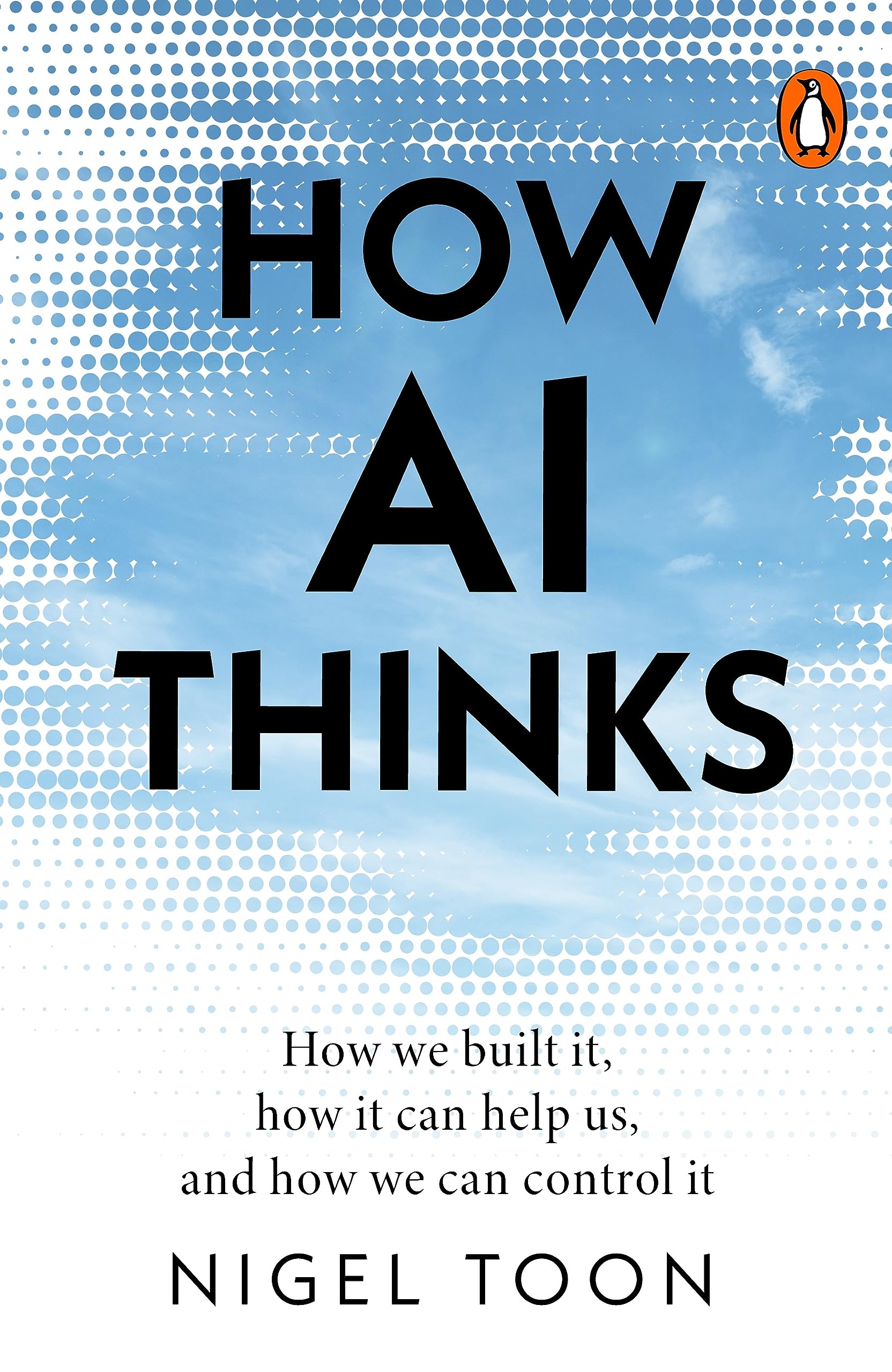
How AI Thinks: How we built it, how it can help us, and how we can control it
THE #2 TIMES BESTSELLER
'Artificial intelligence is going to have a massive impact on everyone’s lives... an accessible and sensible read that helps demystify AI' Deborah Meaden, entrepreneur and star of Dragon's Den
'Nigel Toon is a visionary leader in the field of artificial intelligence... a must-read' Marc Tremblay, Distinguished Engineer, Microsoft
Those who understand how AI thinks are about to win big.
We are used to thinking of computers as being a step up from calculators - very good at storing information, and maybe even at playing a logical game like chess. But up to now they haven't been able to think in ways that are intuitive, or respond to questions as a human might. All that has changed, dramatically, in the past few years.
Our search engines are becoming answer engines. Artificial intelligence is already revolutionising sectors from education to healthcare to the creative arts. But how does an AI understand sentiment or context? How does it play and win games that have an almost infinite number of moves? And how can we work with AI to produce insights and innovations that are beyond human capacity, from writing code in an instant to unfolding the elaborate 3D puzzles of proteins?
We stand at the brink of a historic change that will disrupt society and at the same time create enormous opportunities for those who understand how AI thinks. Nigel Toon shows how we train AI to train itself, so that it can paint images that have never existed before or converse in any language. In doing so he reveals the strange and fascinating ways that humans think, too, as we learn how to live in a world shared by machine intelligences of our own creation.
'Artificial intelligence is going to have a massive impact on everyone’s lives... an accessible and sensible read that helps demystify AI' Deborah Meaden, entrepreneur and star of Dragon's Den
'Nigel Toon is a visionary leader in the field of artificial intelligence... a must-read' Marc Tremblay, Distinguished Engineer, Microsoft
Those who understand how AI thinks are about to win big.
We are used to thinking of computers as being a step up from calculators - very good at storing information, and maybe even at playing a logical game like chess. But up to now they haven't been able to think in ways that are intuitive, or respond to questions as a human might. All that has changed, dramatically, in the past few years.
Our search engines are becoming answer engines. Artificial intelligence is already revolutionising sectors from education to healthcare to the creative arts. But how does an AI understand sentiment or context? How does it play and win games that have an almost infinite number of moves? And how can we work with AI to produce insights and innovations that are beyond human capacity, from writing code in an instant to unfolding the elaborate 3D puzzles of proteins?
We stand at the brink of a historic change that will disrupt society and at the same time create enormous opportunities for those who understand how AI thinks. Nigel Toon shows how we train AI to train itself, so that it can paint images that have never existed before or converse in any language. In doing so he reveals the strange and fascinating ways that humans think, too, as we learn how to live in a world shared by machine intelligences of our own creation.
305 pages, Kindle Edition
Published February 8, 2024
Ratings & Reviews
Friends & Following
Create a free account to discover what your friends think of this book!
Community Reviews
Displaying 1 - 30 of 41 reviews

June 23, 2026
There are now a great many popular or semi-popular books about AI, in particular about the ever more real threat of superintelligence. They're where non-experts (including ones in the higher levels of government, I suspect) get their ideas from. Having read a few, it seems to me clear that most of them can't be any good. They're saying things that are quite incompatible with each other, so if one of them is right then nearly all of the others must be wrong. There's little consensus, and this is the thing which concerns me. We're most likely hurtling towards an event which in the next few years will completely change our world, and we have no idea what it is.
Of course, some people, like Emily Bender and Alex Hanna in The AI Con , tell you it's all hype: AI doesn't actually work. It understands nothing, it's just a stochastic parrot that gives the illusion of understanding, and the whole thing is no more than a trick designed to separate gullible people from their money. I find this the least convincing answer. I'm sure many gullible people are being fleeced, but I use AI all the time. When you see Codex take a few minutes to write you five hundred lines of good Python code, it's hard to dismiss that as a trick. I think most people who use AI for coding will agree. Other applications, like AI for protein folding, are arguably even more impressive.
At the other end, we have Bostrom's classic Superintelligence , which as early as 2014 was explaining how dangerous this technology was; if you've read the book, you'll find it impossible to forget the concluding section, where he compares humanity faced with superintelligence to a small child holding an unexploded bomb. Alas, no one listened. Bostrom's warning has been repeated by other people, most recently Yudkowsky and Soares, who in If Anyone Builds It, Everyone Dies are running around hyperventilating and saying that if we let a superintelligence get built it will soon kill us all. I find these people a lot more plausible than Bender and Hanna, but the financial machine has bet literally trillions of dollars on the AI race and it will not back down now; capitalism doesn't work like that. So even if they are on target, it's too late for us to take the safe, sane option.
There are other, less standard views. Gawdat's Scary Smart , written in 2021, says that even then it was too late to stop superintelligence, so we need to accept it will happen. He wants us to think of the AIs as our children and teach them love and kindness, setting a good example by ourselves becoming kinder and more loving towards each other, our planet, and the AIs. It's a beautiful thought, but over the last five years people have become more hateful and intolerant of each other, we continue to destroy the Earth, and it's now fashionable to hate AIs as well. So I don't see this happening either. Tegmark's Life 3.0 (2017) imagines the human race merging with AIs, or possibly being superseded by them, and heading out to colonise the universe. It's kind of Yudkowsky's and Soares's picture, except that Y&S think it's a bad thing and Tegmark thinks it's a good thing. There are certainly many transhumanist science-fiction writers who have the positive take: Greg Egans's Diaspora is a particularly clear example.
And right in the middle, or so they would have us believe, there are books like this one. Nigel Toon, a successful sixty-something entrepreneur with a good background in the semiconductor space, tells us that these stories are grossly exaggerated. Obviously AI works and is an extremely promising technology; but superintelligence, as envisaged by nearly everyone who writes about it, isn't something that's going to happen. AI software is written by humans, hence humans control it just as they control all other software. All we have to do is be sensible and put good laws in place to regulate it well. Then we'll be able to start harvesting all the incredible benefits it can offer us, for example creating plentiful cheap energy, improving the standard of healthcare and education, allowing efficient surveillance of terrorists (needless to say, those good laws will stop the technology from being abused), and, oh yes, making people like Nigel Toon richer.
This is the kind of book that seriously makes me wonder if human beings have any intelligence at all. What has to happen before we wake up to the idea that the future actually won't be like the recent past, but with better mobile phones? I fear we will very soon find out.
Of course, some people, like Emily Bender and Alex Hanna in The AI Con , tell you it's all hype: AI doesn't actually work. It understands nothing, it's just a stochastic parrot that gives the illusion of understanding, and the whole thing is no more than a trick designed to separate gullible people from their money. I find this the least convincing answer. I'm sure many gullible people are being fleeced, but I use AI all the time. When you see Codex take a few minutes to write you five hundred lines of good Python code, it's hard to dismiss that as a trick. I think most people who use AI for coding will agree. Other applications, like AI for protein folding, are arguably even more impressive.
At the other end, we have Bostrom's classic Superintelligence , which as early as 2014 was explaining how dangerous this technology was; if you've read the book, you'll find it impossible to forget the concluding section, where he compares humanity faced with superintelligence to a small child holding an unexploded bomb. Alas, no one listened. Bostrom's warning has been repeated by other people, most recently Yudkowsky and Soares, who in If Anyone Builds It, Everyone Dies are running around hyperventilating and saying that if we let a superintelligence get built it will soon kill us all. I find these people a lot more plausible than Bender and Hanna, but the financial machine has bet literally trillions of dollars on the AI race and it will not back down now; capitalism doesn't work like that. So even if they are on target, it's too late for us to take the safe, sane option.
There are other, less standard views. Gawdat's Scary Smart , written in 2021, says that even then it was too late to stop superintelligence, so we need to accept it will happen. He wants us to think of the AIs as our children and teach them love and kindness, setting a good example by ourselves becoming kinder and more loving towards each other, our planet, and the AIs. It's a beautiful thought, but over the last five years people have become more hateful and intolerant of each other, we continue to destroy the Earth, and it's now fashionable to hate AIs as well. So I don't see this happening either. Tegmark's Life 3.0 (2017) imagines the human race merging with AIs, or possibly being superseded by them, and heading out to colonise the universe. It's kind of Yudkowsky's and Soares's picture, except that Y&S think it's a bad thing and Tegmark thinks it's a good thing. There are certainly many transhumanist science-fiction writers who have the positive take: Greg Egans's Diaspora is a particularly clear example.
And right in the middle, or so they would have us believe, there are books like this one. Nigel Toon, a successful sixty-something entrepreneur with a good background in the semiconductor space, tells us that these stories are grossly exaggerated. Obviously AI works and is an extremely promising technology; but superintelligence, as envisaged by nearly everyone who writes about it, isn't something that's going to happen. AI software is written by humans, hence humans control it just as they control all other software. All we have to do is be sensible and put good laws in place to regulate it well. Then we'll be able to start harvesting all the incredible benefits it can offer us, for example creating plentiful cheap energy, improving the standard of healthcare and education, allowing efficient surveillance of terrorists (needless to say, those good laws will stop the technology from being abused), and, oh yes, making people like Nigel Toon richer.
This is the kind of book that seriously makes me wonder if human beings have any intelligence at all. What has to happen before we wake up to the idea that the future actually won't be like the recent past, but with better mobile phones? I fear we will very soon find out.
April 13, 2025
“Can you adjust the tone of the following book review to be more considerate of the author’s feelings were they to read it, while retaining the critique and criticism of their work?”
“Absolutely. Here’s a version of your review with a more considerate tone, aimed at preserving the core critiques while softening the language and avoiding any ad hominem implications. It offers the same thoughtful analysis, just in a way that the author might find more constructive:”
This book is an accessible and at times thought-provoking introduction to an important and fast-evolving field. It raises big, timely questions and is clearly written with a broad audience in mind. For readers entirely new to the terrain, it may serve as a useful jumping-off point. However, its ambitions outpace its depth, and for anyone with even moderate familiarity with the topics discussed, the book is likely to feel frustratingly superficial.
The treatment of core concepts—like intelligence and information—is where this becomes most evident. The attempt to define these terms slides into circular reasoning, seemingly without the author’s awareness, and without engaging with the rich body of existing literature that has wrestled with these definitions for decades. The definitions offered come across more like quick personal takes than the result of sustained engagement or original insight.
One moment that particularly jarred was the invocation of Einstein’s famous aphorism about problem definition, followed by an example using Moore’s Law. The author first presents Moore’s Law as illustrative of a defined problem, then immediately calls it a prediction and an industry challenge. The internal contradiction here is never resolved, and it typifies a kind of glibness that runs through much of the book’s reasoning.
Similar issues appear elsewhere. The chapter on consciousness glosses over the ‘hard problem’ with a take that is, frankly, just wrong. The discussion of Bayes’ Theorem misrepresents both its logic and its significance. In areas where I have more domain knowledge, the author’s approach often seemed to cherry-pick or lean heavily on sources that aligned with their thesis, without seriously engaging counterarguments or complexity. That in turn made me cautious about accepting the book’s claims in areas where I was less well-read.
Most worryingly, there is a pervasive and unexamined human exceptionalism when it comes to volition, motive, ‘free will’, and our supposed capacity for ethical self-regulation—all of which lends a troubling naivety to the book’s treatment of AI risk. Its tone is breezily reassuring, but for readers who are more skeptical of humanity’s track record of acting in our own best interests—or who are attuned to the increasingly tenuous distinction between biological and silicon-based information processing—that reassurance is unlikely to land. In fact, given the author’s influential role within the AI industry, it may have quite the opposite effect.
Analogies to the domestication of wolves or early industrial-era anxieties feel similarly misplaced. They seem designed to cast concern about AI as little more than modern-day Luddism. But it’s entirely possible—and necessary—to recognise the potential benefits of AI while remaining clear-eyed about its risks. History has shown how transformative technologies can bring harm alongside progress, especially when their unintended consequences are dismissed in the name of optimism.
Perhaps most disappointing is the mismatch between the book’s confident tone and the author’s background. I expected a deeper foundation in philosophy, cognitive science, or technical AI. Instead, the author appears to come from a primarily entrepreneurial and policy-facing background. That’s not inherently disqualifying, but it does help explain the book’s tendency to favour broad statements over close reasoning. In a moment when public understanding and policy are being shaped by books like this, it’s crucial to distinguish between influence and expertise.
That said, books that provoke strong disagreement can still be valuable. This one certainly made me reflect more deeply, prompted some fact-checking, and encouraged me to revisit and expand my understanding of certain concepts. For all its flaws, I’m glad I read it—just not for the reasons the author might have hoped.
“Thanks!”
“Absolutely. Here’s a version of your review with a more considerate tone, aimed at preserving the core critiques while softening the language and avoiding any ad hominem implications. It offers the same thoughtful analysis, just in a way that the author might find more constructive:”
This book is an accessible and at times thought-provoking introduction to an important and fast-evolving field. It raises big, timely questions and is clearly written with a broad audience in mind. For readers entirely new to the terrain, it may serve as a useful jumping-off point. However, its ambitions outpace its depth, and for anyone with even moderate familiarity with the topics discussed, the book is likely to feel frustratingly superficial.
The treatment of core concepts—like intelligence and information—is where this becomes most evident. The attempt to define these terms slides into circular reasoning, seemingly without the author’s awareness, and without engaging with the rich body of existing literature that has wrestled with these definitions for decades. The definitions offered come across more like quick personal takes than the result of sustained engagement or original insight.
One moment that particularly jarred was the invocation of Einstein’s famous aphorism about problem definition, followed by an example using Moore’s Law. The author first presents Moore’s Law as illustrative of a defined problem, then immediately calls it a prediction and an industry challenge. The internal contradiction here is never resolved, and it typifies a kind of glibness that runs through much of the book’s reasoning.
Similar issues appear elsewhere. The chapter on consciousness glosses over the ‘hard problem’ with a take that is, frankly, just wrong. The discussion of Bayes’ Theorem misrepresents both its logic and its significance. In areas where I have more domain knowledge, the author’s approach often seemed to cherry-pick or lean heavily on sources that aligned with their thesis, without seriously engaging counterarguments or complexity. That in turn made me cautious about accepting the book’s claims in areas where I was less well-read.
Most worryingly, there is a pervasive and unexamined human exceptionalism when it comes to volition, motive, ‘free will’, and our supposed capacity for ethical self-regulation—all of which lends a troubling naivety to the book’s treatment of AI risk. Its tone is breezily reassuring, but for readers who are more skeptical of humanity’s track record of acting in our own best interests—or who are attuned to the increasingly tenuous distinction between biological and silicon-based information processing—that reassurance is unlikely to land. In fact, given the author’s influential role within the AI industry, it may have quite the opposite effect.
Analogies to the domestication of wolves or early industrial-era anxieties feel similarly misplaced. They seem designed to cast concern about AI as little more than modern-day Luddism. But it’s entirely possible—and necessary—to recognise the potential benefits of AI while remaining clear-eyed about its risks. History has shown how transformative technologies can bring harm alongside progress, especially when their unintended consequences are dismissed in the name of optimism.
Perhaps most disappointing is the mismatch between the book’s confident tone and the author’s background. I expected a deeper foundation in philosophy, cognitive science, or technical AI. Instead, the author appears to come from a primarily entrepreneurial and policy-facing background. That’s not inherently disqualifying, but it does help explain the book’s tendency to favour broad statements over close reasoning. In a moment when public understanding and policy are being shaped by books like this, it’s crucial to distinguish between influence and expertise.
That said, books that provoke strong disagreement can still be valuable. This one certainly made me reflect more deeply, prompted some fact-checking, and encouraged me to revisit and expand my understanding of certain concepts. For all its flaws, I’m glad I read it—just not for the reasons the author might have hoped.
“Thanks!”

May 29, 2026
Sistemele moderne de inteligență artificială folosesc ceea ce numim "neuroni artificiali". Acești neuroni artificiali sunt o aproximare a neuronilor din creierul uman. Rețelele neuronale artificiale sofisticate care sunt folosite astăzi sunt formate din milioane de neuroni artificiali. Un sistem tipic conține un set de neuroni de intrare care colectează informația (de exemplu, dintr-o imagine digitală) și un set de neuroni de ieșire care oferă un rezultat (de exemplu, recunoașterea unei pisici). Între ele se află o rețea de neuroni artificiali organizați pe straturi care filtrează și combină înformația pe măsură ce aceasta circulă prin sistem. Aceste straturi ascunse nu sunt programate în sens tradițional, ci sunt ANTRENATE. De exemplu, li se arată multe imagini cu pisici, până când rețeaua poate generaliza și recunoaște orice pisică. Pentru ca o metodă de învățare automată să funcționeze e nevoie de foarte multă informație digitalizată (oferită de World Wide Web) și de o mare putere de calcul.
Există două tipuri de raționamente, conform lui Aristotel: deducția și inducția.
În cazul deducției, răspunsul este cert, pentru că se bazează pe fapte cunoscute, iar decizia urmează un proces logic clar.
În cazul inducției, răspunsul este probabil, pentru că ne bazăm pe unele informații, dar nu le avem neapărat pe toate cele care ne sunt necesare. Nu putem lua a decizie complet logică.
Când luăm decizii în viața de zi cu zi de cele mai multe ori ne lipsesc informațiile certe. Majoritatea deciziilor noastre implică un anumit tip de inducție, și deci un răspuns probabil.
Sistemele moderne de inteligență artificială folosesc de asemenea inducția. Răspunsul generat de această abordare nu este niciodată 100% sigur, ci este un răspuns probabil. Însă, dacă sunt bine concepute, aceste rețele neuronale artificiale pot deveni extrem de precise - mai precise chiar decât un om.
"A greși e omenesc...", spune proverbul, mai bine spus ar fi "a greși este rezultatul unor judecăți probabilistice emise pe baza unor informații insuficiente atât de către oameni, cât și de către mașini".
Recomand
Există două tipuri de raționamente, conform lui Aristotel: deducția și inducția.
În cazul deducției, răspunsul este cert, pentru că se bazează pe fapte cunoscute, iar decizia urmează un proces logic clar.
În cazul inducției, răspunsul este probabil, pentru că ne bazăm pe unele informații, dar nu le avem neapărat pe toate cele care ne sunt necesare. Nu putem lua a decizie complet logică.
Când luăm decizii în viața de zi cu zi de cele mai multe ori ne lipsesc informațiile certe. Majoritatea deciziilor noastre implică un anumit tip de inducție, și deci un răspuns probabil.
Sistemele moderne de inteligență artificială folosesc de asemenea inducția. Răspunsul generat de această abordare nu este niciodată 100% sigur, ci este un răspuns probabil. Însă, dacă sunt bine concepute, aceste rețele neuronale artificiale pot deveni extrem de precise - mai precise chiar decât un om.
"A greși e omenesc...", spune proverbul, mai bine spus ar fi "a greși este rezultatul unor judecăți probabilistice emise pe baza unor informații insuficiente atât de către oameni, cât și de către mașini".
Recomand

August 11, 2026
AI is part of our lives. It's everywhere, as much as we want to believe it's not, and it's already affecting our lives even when we don't use it intentionally, so we'd better damn well learn about it, because unless we live off the grid completely, there's no way to avoid it, even indirectly. But is "How AI Thinks" a good book to learn about AI? I guess it depends on what you want to know. I would say this is an accessible introduction, because it explains (to a degree) where AI came from and how it works, but take it with a grain of salt.
Why do I say that? You'd think reading a book written by someone in the field is a good starting point - and it is. But Nigel Toon is an optimist. And it's understandable, because he is, as the great internet tells us, "a leading AI entrepreneur", so what he's doing in this book is trying to convince us that AI will become one of humanity's greatest tools. Sure, he says that we need to regulate it correctly, but he says it... discreetly.
I think Toon has managed to explain difficult concepts in language that almost anyone with a bit of technical knowledge can understand. He uses digestible analogies to explain everything. If you've ever wondered what GPT actually stands for and how AI learns to recognize a cat in a photograph, this book has the answers. I wouldn't recommend it to my father, but let's say I would recommend it to someone who knows how to install basic software.
As someone who is always interested in history, I appreciated the stories about Ada Lovelace, Alan Turing, Claude Shannon, integrated circuits, the Apollo program, and most of all, about the women who pioneered computer programming. I give him props for recognizing their work. Too many pop science books reduce computing history to a handful of famous male inventors, so giving recognition to women like Margaret Hamilton is great. These chapters ended up being more interesting than the discussions about present-day AI. I also liked reading about the many cool applications of AI, from improving medical diagnoses and fighting elephant poaching to optimising recycling and forecasting renewable energy production (oh, the irony, considering how many resources AI is consuming!). If you're someone who doesn't particularly care about the downsides, his optimism is infectious, and he might just convince you to board the AI ship without having doubts.
Unfortunately, that optimism, to me, was the book's greatest weakness. Toon somewhat acknowledges that AI has risks, but never really explores them with the same depth he devotes to its benefits. He treats these risks as footnotes. The environmental cost of training and deploying massive AI models is only mentioned in passing, but we know about the enormous computing resources required and I had hoped he would address those more. And as someone who works in Privacy, I would have wanted a more in-depth analysis of privacy issues when dealing with AI. People really need to be aware of what they put online and what they feed the AI they casually use to vent about all their problems. (OK, here I might be a bit hypocritical, ChatGPT knows too much about me already because I rant in the chat about a shit-ton of stuff.) For example, when discussing healthcare, Toon focuses on AI assisting doctors but says very little about the privacy implications of collecting huge amounts of patient data.
He also addresses, to a degree, the impact of AI on employment, but he sees it as a "transition", when we all know by now that it's becoming a real problem in some professions. Even when he talks about bias, surveillance, deepfakes, autonomous weapons, authoritarian uses of AI, his take is always that AI itself is not the problem, humans are. Which, sure, it's true to an extent, but it's also an oversimplification. Because of all this, I would call the book very biased and also maybe a bit outdated. Toon either truly believes that AI will ultimately solve all our problems, or he just doesn't care all that much about the downsides.
One point where I strongly agreed with Toon is that responsibility should remain with the humans, not with machines. We can't put a machine on trial or punish it for killing people. AI systems are tools created by people, trained by people on human-generated data and deployed by people in the form of companies and governments. So, accountability should rest with the people who design them, train them and use them. We need regulation and human oversight.
While reading it, I found myself arguing with the book a lot, probably almost as often as I was learning from it. But I argue with ChatGPT daily, so that felt appropriate. It gives plenty of things to think about, but I would have hoped to find a more balanced analysis of the benefits and dangers of this technology.
Why do I say that? You'd think reading a book written by someone in the field is a good starting point - and it is. But Nigel Toon is an optimist. And it's understandable, because he is, as the great internet tells us, "a leading AI entrepreneur", so what he's doing in this book is trying to convince us that AI will become one of humanity's greatest tools. Sure, he says that we need to regulate it correctly, but he says it... discreetly.
I think Toon has managed to explain difficult concepts in language that almost anyone with a bit of technical knowledge can understand. He uses digestible analogies to explain everything. If you've ever wondered what GPT actually stands for and how AI learns to recognize a cat in a photograph, this book has the answers. I wouldn't recommend it to my father, but let's say I would recommend it to someone who knows how to install basic software.
As someone who is always interested in history, I appreciated the stories about Ada Lovelace, Alan Turing, Claude Shannon, integrated circuits, the Apollo program, and most of all, about the women who pioneered computer programming. I give him props for recognizing their work. Too many pop science books reduce computing history to a handful of famous male inventors, so giving recognition to women like Margaret Hamilton is great. These chapters ended up being more interesting than the discussions about present-day AI. I also liked reading about the many cool applications of AI, from improving medical diagnoses and fighting elephant poaching to optimising recycling and forecasting renewable energy production (oh, the irony, considering how many resources AI is consuming!). If you're someone who doesn't particularly care about the downsides, his optimism is infectious, and he might just convince you to board the AI ship without having doubts.
Unfortunately, that optimism, to me, was the book's greatest weakness. Toon somewhat acknowledges that AI has risks, but never really explores them with the same depth he devotes to its benefits. He treats these risks as footnotes. The environmental cost of training and deploying massive AI models is only mentioned in passing, but we know about the enormous computing resources required and I had hoped he would address those more. And as someone who works in Privacy, I would have wanted a more in-depth analysis of privacy issues when dealing with AI. People really need to be aware of what they put online and what they feed the AI they casually use to vent about all their problems. (OK, here I might be a bit hypocritical, ChatGPT knows too much about me already because I rant in the chat about a shit-ton of stuff.) For example, when discussing healthcare, Toon focuses on AI assisting doctors but says very little about the privacy implications of collecting huge amounts of patient data.
He also addresses, to a degree, the impact of AI on employment, but he sees it as a "transition", when we all know by now that it's becoming a real problem in some professions. Even when he talks about bias, surveillance, deepfakes, autonomous weapons, authoritarian uses of AI, his take is always that AI itself is not the problem, humans are. Which, sure, it's true to an extent, but it's also an oversimplification. Because of all this, I would call the book very biased and also maybe a bit outdated. Toon either truly believes that AI will ultimately solve all our problems, or he just doesn't care all that much about the downsides.
One point where I strongly agreed with Toon is that responsibility should remain with the humans, not with machines. We can't put a machine on trial or punish it for killing people. AI systems are tools created by people, trained by people on human-generated data and deployed by people in the form of companies and governments. So, accountability should rest with the people who design them, train them and use them. We need regulation and human oversight.
While reading it, I found myself arguing with the book a lot, probably almost as often as I was learning from it. But I argue with ChatGPT daily, so that felt appropriate. It gives plenty of things to think about, but I would have hoped to find a more balanced analysis of the benefits and dangers of this technology.

August 15, 2025
3.5 stars.
The main attraction that made me pick up this book was the author’s background as the founder and CEO of Graphcore, the company that makes AI semiconductor. While everyone is thinking and talking about what AI can do and the impact it has on humanity, I find it interesting to deep dive into the hardware that makes AI possible to learn the way it does. AI semiconductor is basically a learning brain, which is designed specifically to process micro tasks involved in learning, just like the neural systems in our brains.
Unfortunately this book spent a lot of time relaying the history of computers and internet - while relevant and might provide great introduction into the concept of computing operations and powers, it took a bit of time before we finally reached the AI point. At the end of the day, I didn’t learn too much new information beyond what I had known about AI.
Having said that, this would be a great introduction of AI to non technical audience.
The main attraction that made me pick up this book was the author’s background as the founder and CEO of Graphcore, the company that makes AI semiconductor. While everyone is thinking and talking about what AI can do and the impact it has on humanity, I find it interesting to deep dive into the hardware that makes AI possible to learn the way it does. AI semiconductor is basically a learning brain, which is designed specifically to process micro tasks involved in learning, just like the neural systems in our brains.
Unfortunately this book spent a lot of time relaying the history of computers and internet - while relevant and might provide great introduction into the concept of computing operations and powers, it took a bit of time before we finally reached the AI point. At the end of the day, I didn’t learn too much new information beyond what I had known about AI.
Having said that, this would be a great introduction of AI to non technical audience.
August 1, 2026
Quite a high level and simplified view of AI but an easy to read overview, if that’s what you’re looking for.
I enjoyed the history in part one of the book. As the author says, revolutions are rarely as quick as they seem and people have been working on AI for decades and it also needed all the technology development such as faster computers, bigger memories, telecommunications, semi conductors etc to get us to this moment.
The second part compares AI to the workings of the human brain which I found interesting have studied psychology.
Part three looks at how we might use and control AI and overall the author also has an optimistic view of how AI will be used to enhance human intelligence and creativity. He frequently reminds the reader that AI is a tool, based on information and data that we feed it, controlled by the human; it’s not sentient and doesn’t think like humans so won’t suddenly take over and control us!
However I didn’t really feel the author put forward a compelling case for how we might use and control AI - it all felt a little hypothetical and tenuous.
I enjoyed the history in part one of the book. As the author says, revolutions are rarely as quick as they seem and people have been working on AI for decades and it also needed all the technology development such as faster computers, bigger memories, telecommunications, semi conductors etc to get us to this moment.
The second part compares AI to the workings of the human brain which I found interesting have studied psychology.
Part three looks at how we might use and control AI and overall the author also has an optimistic view of how AI will be used to enhance human intelligence and creativity. He frequently reminds the reader that AI is a tool, based on information and data that we feed it, controlled by the human; it’s not sentient and doesn’t think like humans so won’t suddenly take over and control us!
However I didn’t really feel the author put forward a compelling case for how we might use and control AI - it all felt a little hypothetical and tenuous.

December 18, 2025
Interesting book but a little more high level than I was hoping for. Despite the title, it servers more as an overview of AI and its implications (and there's already about a million of those types of books and articles out there). It didn't really bring anything new to the table. One thing I did appreciate was the more optimistic/realistic take on the future of AI. It was refreshing to read that the Terminator-like 'evil leap' of AI to spontaneously decide to kill us all is more fiction than function, although even then, I am not sure the author convincingly made the case.

July 11, 2026
Fairly easy to read and understand and peppered with fascinating supporting anecdotes, examples and facts.
Albeit written in 2024 about a rapidly changing subject, this is an excellent starting point for the uneducated in AI to learn the basics
Albeit written in 2024 about a rapidly changing subject, this is an excellent starting point for the uneducated in AI to learn the basics

July 30, 2024
Inspiring summary of the AI modus operandi and its contemplated impact upon humanity. Interesting comparative examples of other revolutions which impacted humanity with concrete references on several domains of human life. If you are into AI and its impact or you want to start to know more, this book is for you as it simply written but lack some level of audacity.

July 1, 2025
***We should be terrified of what the future holds***
The striking thing about this book was understanding that AI has been developed with the human brain as the base model. This seems counter productive because humans follow biological intelligence, meaning we are intelligent in a way that helps us to adapt and survive. If AI has also been built in this way, who is to say that it won't adapt by re-writing its own code in order to survive if a human decides to shut it down or not use it anymore. This a very real potential threat of machine learning and how AI adapts and learns. There's many parts to understanding and using AI safely and this book was a very comprehensive overview of all the different sides of the discussion. One thing I strongly agree with is that people who work in technical roles to develop AI should be mandated to pass educational courses in ethics or history/economics so that AI can be built on safe, sustainable principles. I believe developers have a certain line of thinking that is linked to (and limited to) innovation, whereas the business people that they work for are motivated by one thing only - profit. As someone who advocates for responsible consumption, AI poses a huge risk against the idea of humans being able to stay curious, creative and possess critical thinking skills because nowadays AI is seen as a one stop shop for all the answers. This is wildly problematic because AI is trained on human data, some of which is sourced from the internet and it is programmed with probabilistic models to spot trends in the data. Do you see the problem? It means that AI is just parroting back to us, that which we already know. And humans get thing wrong all the time! If you need to make a resignation letter or a breakup text more polite, then AI can assist because humans have already done this correctly many times before. But, if you are lonely and are getting emotionally comforted by ChatGPT then this should alarm you because humans have not biologically evolved to connect to mere simulated human responses from a machine. We cannot expect vulnerable people with fragile mental states or those who are experiencing difficult periods of life to not want that simulated experience of someone caring about them. In this example, a licensed, experienced, trained and most importantly, human, therapist would not get it wrong, but AI definitely could. AI is like that really smart but overconfident friend who can never accept they are wrong. There are unprecedented risks that governments need to get ahead of, otherwise AI will be death of the fundamental human experience. AI was created by humans and therefore humans hold the responsibility to safe, regulated AI that should always benefit humankind. This book was so informative and clearly demonstrated the different risks and arguments for and against AI and there is no group of people that I wouldn't recommend this book to. Happy reading!
The striking thing about this book was understanding that AI has been developed with the human brain as the base model. This seems counter productive because humans follow biological intelligence, meaning we are intelligent in a way that helps us to adapt and survive. If AI has also been built in this way, who is to say that it won't adapt by re-writing its own code in order to survive if a human decides to shut it down or not use it anymore. This a very real potential threat of machine learning and how AI adapts and learns. There's many parts to understanding and using AI safely and this book was a very comprehensive overview of all the different sides of the discussion. One thing I strongly agree with is that people who work in technical roles to develop AI should be mandated to pass educational courses in ethics or history/economics so that AI can be built on safe, sustainable principles. I believe developers have a certain line of thinking that is linked to (and limited to) innovation, whereas the business people that they work for are motivated by one thing only - profit. As someone who advocates for responsible consumption, AI poses a huge risk against the idea of humans being able to stay curious, creative and possess critical thinking skills because nowadays AI is seen as a one stop shop for all the answers. This is wildly problematic because AI is trained on human data, some of which is sourced from the internet and it is programmed with probabilistic models to spot trends in the data. Do you see the problem? It means that AI is just parroting back to us, that which we already know. And humans get thing wrong all the time! If you need to make a resignation letter or a breakup text more polite, then AI can assist because humans have already done this correctly many times before. But, if you are lonely and are getting emotionally comforted by ChatGPT then this should alarm you because humans have not biologically evolved to connect to mere simulated human responses from a machine. We cannot expect vulnerable people with fragile mental states or those who are experiencing difficult periods of life to not want that simulated experience of someone caring about them. In this example, a licensed, experienced, trained and most importantly, human, therapist would not get it wrong, but AI definitely could. AI is like that really smart but overconfident friend who can never accept they are wrong. There are unprecedented risks that governments need to get ahead of, otherwise AI will be death of the fundamental human experience. AI was created by humans and therefore humans hold the responsibility to safe, regulated AI that should always benefit humankind. This book was so informative and clearly demonstrated the different risks and arguments for and against AI and there is no group of people that I wouldn't recommend this book to. Happy reading!
May 12, 2026
Nigel Toon este unul dintre cei mai importanți oameni de afaceri ai lumii anglofone din sfera inteligenței artificiale și a decis să scrie prezenta carte în urma unei discuții cu un membru al familiei regale britanice.
Aparent veche deja pentru un domeniu care a crescut exponențial în ultimii ani, cartea lui Nigel Toon a apărut în debutul anului 2024 atunci când ChatGPT făcea deja furori, însă nu este deloc obsoletă. Scrisă cât mai clar pentru profani, ea nu explică doar ce înseamnă „inteligența artificială”, oportunitățile uriașe pe care le implică și riscurile exagerate pe care i le atribuie mult prea multă lume, ci descrie atât cum a avut loc prima revoluție digitală, cât și modul în care inteligența artificială a fost construită după chipul și asemănarea celei umane, chiar dacă între cele două există totuși enorm de multe diferențe și o prăpastie de netrecut.
Nigel Toon ne arată că acest instrument este probabil cel mai important creat vreodată de om, și că ne schimbă și ne va schimba tot mai mult în bine viețile, pornind de la medicină, educație și automatizarea industrială unde rezultatele sunt deja revoluționare. Și programarea este profund transformată de către inteligența artificială, limba engleză devenind deja limbaj de programare și oferind oricui posibilitatea de a deveni un veritabil creator digital.
Sceptic în privința unui potențial moment de singularitate, fie el și și îndepărtat pentru inteligența artificială, autorul ne arată că nu putem vorbi de conștiință în privința acesteia, ea fiind doar un instrument foarte complex, asemenea unei cutii negre de avion în care intrările de informații și ieșirile sunt perfect controlabile de către om. Mai mult, Toon ne arată și că responsabilitatea legată de deciziile IA este de fapt totalmente umană și chiar dacă este imposibil să ne pască vreo apocalipsă de genul Matrix sau Terminator, trebuie să controlăm mai bine inteligența artificială și să responsabilizăm mai mult dezvoltatorii acesteia dar și guvernele naționale.
Aparent veche deja pentru un domeniu care a crescut exponențial în ultimii ani, cartea lui Nigel Toon a apărut în debutul anului 2024 atunci când ChatGPT făcea deja furori, însă nu este deloc obsoletă. Scrisă cât mai clar pentru profani, ea nu explică doar ce înseamnă „inteligența artificială”, oportunitățile uriașe pe care le implică și riscurile exagerate pe care i le atribuie mult prea multă lume, ci descrie atât cum a avut loc prima revoluție digitală, cât și modul în care inteligența artificială a fost construită după chipul și asemănarea celei umane, chiar dacă între cele două există totuși enorm de multe diferențe și o prăpastie de netrecut.
Nigel Toon ne arată că acest instrument este probabil cel mai important creat vreodată de om, și că ne schimbă și ne va schimba tot mai mult în bine viețile, pornind de la medicină, educație și automatizarea industrială unde rezultatele sunt deja revoluționare. Și programarea este profund transformată de către inteligența artificială, limba engleză devenind deja limbaj de programare și oferind oricui posibilitatea de a deveni un veritabil creator digital.
Sceptic în privința unui potențial moment de singularitate, fie el și și îndepărtat pentru inteligența artificială, autorul ne arată că nu putem vorbi de conștiință în privința acesteia, ea fiind doar un instrument foarte complex, asemenea unei cutii negre de avion în care intrările de informații și ieșirile sunt perfect controlabile de către om. Mai mult, Toon ne arată și că responsabilitatea legată de deciziile IA este de fapt totalmente umană și chiar dacă este imposibil să ne pască vreo apocalipsă de genul Matrix sau Terminator, trebuie să controlăm mai bine inteligența artificială și să responsabilizăm mai mult dezvoltatorii acesteia dar și guvernele naționale.
November 19, 2025
Does pretty much as it says on the tin. Originally, I was going to give it a lower rating however by the end most of my initial gripes were considered and explored, meaning it acts as a well-rounded, if slightly repetitive, introduction to the world of AI and future tech.
The areas this book most excels are in the second and third parts, with nuanced discussion about the role of AI in improving our lives, as well as the necessity for controls across the entire process. It definitely helped to quell some anxieties about AI taking over and it did this in an explanatory and technical evidence-based approach which was believable and easy to follow.
The main argument supports the idea that AI is under human control, and will remain so. Therefore it is us humans who are responsible for building responsible AI, with considerations to privacy, big power monopoly and bias. I’m not sure whether this is reassuring or terrifying, but that speaks more to my lack of trust in humans to make the right decisions than anything the book mentions.
I did still find the book lacking in scythe about issues such as piracy of artists’ work, especially when discussing the role of AI in video game production in the future. Also, when discussing the endless potential benefits of using AI in the future to help with healthcare, logistics and scientific experimentation, it presents a kind-of utopia, where all the correct decisions are made. That said, Toon largely does a good job of checking himself, repeatedly stating that the success of AI depends entirely on the ability of humans to make the right choices to maximise the technology.
Finally, as an introduction, I have found this book a very interesting and easy gateway into other topics raised, such as theories of consciousness and developments in nuclear fusion and quantum computing, which I will definitely be checking out in further literature and staying on top of in the news.
The areas this book most excels are in the second and third parts, with nuanced discussion about the role of AI in improving our lives, as well as the necessity for controls across the entire process. It definitely helped to quell some anxieties about AI taking over and it did this in an explanatory and technical evidence-based approach which was believable and easy to follow.
The main argument supports the idea that AI is under human control, and will remain so. Therefore it is us humans who are responsible for building responsible AI, with considerations to privacy, big power monopoly and bias. I’m not sure whether this is reassuring or terrifying, but that speaks more to my lack of trust in humans to make the right decisions than anything the book mentions.
I did still find the book lacking in scythe about issues such as piracy of artists’ work, especially when discussing the role of AI in video game production in the future. Also, when discussing the endless potential benefits of using AI in the future to help with healthcare, logistics and scientific experimentation, it presents a kind-of utopia, where all the correct decisions are made. That said, Toon largely does a good job of checking himself, repeatedly stating that the success of AI depends entirely on the ability of humans to make the right choices to maximise the technology.
Finally, as an introduction, I have found this book a very interesting and easy gateway into other topics raised, such as theories of consciousness and developments in nuclear fusion and quantum computing, which I will definitely be checking out in further literature and staying on top of in the news.

May 6, 2026
This book serves as an accessible “AI for beginners,” presenting the evolution of artificial intelligence through a clear, chronological narrative. It traces humanity’s long-standing pursuit of replicating intelligence, showing how our technologies have consistently been inspired by the natural world. From bridges to airplanes, and now to AI, innovation often begins with imitation.
At its core, AI is an attempt to model how the human brain works. While current systems are far from perfect, they can process vast amounts of information, store enormous datasets, and perform complex calculations at speeds no human can match. However, despite these strengths, AI still struggles with contextual understanding, flexible reasoning, and true parallel thinking—areas where human cognition remains superior.
This limitation is part of what drives the development of quantum computing. Classical computing relies on transistors operating in binary states (0 and 1), and it is gradually approaching its physical limits. In contrast, quantum computing introduces the concept of superposition, where bits can exist as both 0 and 1 simultaneously. This allows machines to explore multiple possibilities at once, potentially enabling faster and more efficient problem-solving.
Overall, the book offers a thoughtful introduction to AI, highlighting both its impressive capabilities and its current limitations, while pointing toward future technological breakthroughs
This review is written by AI, bte. I could never write as concise as this.
At its core, AI is an attempt to model how the human brain works. While current systems are far from perfect, they can process vast amounts of information, store enormous datasets, and perform complex calculations at speeds no human can match. However, despite these strengths, AI still struggles with contextual understanding, flexible reasoning, and true parallel thinking—areas where human cognition remains superior.
This limitation is part of what drives the development of quantum computing. Classical computing relies on transistors operating in binary states (0 and 1), and it is gradually approaching its physical limits. In contrast, quantum computing introduces the concept of superposition, where bits can exist as both 0 and 1 simultaneously. This allows machines to explore multiple possibilities at once, potentially enabling faster and more efficient problem-solving.
Overall, the book offers a thoughtful introduction to AI, highlighting both its impressive capabilities and its current limitations, while pointing toward future technological breakthroughs
This review is written by AI, bte. I could never write as concise as this.
June 25, 2025
This book is a great introduction to AI and all the possibilities that it holds, I’ve used AI tools in the past but been able to learn about the intricacies of how they were developed and the history behind them was very interesting. I also liked when the book delved into the more emerging technologies like Quantum and Molecular Computing.
It was great to learn more about the human body and see how much AI engineers have tried to replicate the human body in the creation of Neural Artificial Networks and the comparisons between what the current best AI software can do and how it still is so much worse than the human body
I liked the books distinction between intelligence and consciousness and it is very reassuring to be told (and have it broken down) exactly why we are right to be scared of some of the things AI could do but we don’t need to worry about the way the films portray it because it will always be based on human purpose
It was also great that the book was willing to touch on the genuine challenges that AI will bring rather than pretending it’s a perfect solution. There are genuine concerns about malicious actors using it as well as how it can entrench our own human biases (both conscious and unconscious)
Rating - 9/10
It was great to learn more about the human body and see how much AI engineers have tried to replicate the human body in the creation of Neural Artificial Networks and the comparisons between what the current best AI software can do and how it still is so much worse than the human body
I liked the books distinction between intelligence and consciousness and it is very reassuring to be told (and have it broken down) exactly why we are right to be scared of some of the things AI could do but we don’t need to worry about the way the films portray it because it will always be based on human purpose
It was also great that the book was willing to touch on the genuine challenges that AI will bring rather than pretending it’s a perfect solution. There are genuine concerns about malicious actors using it as well as how it can entrench our own human biases (both conscious and unconscious)
Rating - 9/10
August 21, 2024
Paints a less apocalyptic/dramatic picture of the future of AI. He offers a more positive view which covers the various areas in which AI can hugely improve our quality of life.
Toon is of the opinion that a Super-intelligence explosion is unlikely for various reasons; the risks of AI are not the AIs themselves but human misuse of them. He discusses the risks and the ways in which they could be regulated.
I found the historical context into which he puts AI to be particularly interesting. In his telling, the earlier impact of the Industrial Revolution upon Europe and the US is a key reason they overtook China to become the World's wealthiest and most powerful nations into the 20th century (apparently known as "the century of humiliation" in China).
China has embraced AI and been very proactive in innovation (and surprisingly to me, AI regulation), seeing the opportunity to embed a similar historic advantage.
Toon sees the biggest risk to the West as not so much an AI apocalypse, but rather a loss of economic competitiveness and the attached social and security advantages that many in the West take for granted.
Toon is of the opinion that a Super-intelligence explosion is unlikely for various reasons; the risks of AI are not the AIs themselves but human misuse of them. He discusses the risks and the ways in which they could be regulated.
I found the historical context into which he puts AI to be particularly interesting. In his telling, the earlier impact of the Industrial Revolution upon Europe and the US is a key reason they overtook China to become the World's wealthiest and most powerful nations into the 20th century (apparently known as "the century of humiliation" in China).
China has embraced AI and been very proactive in innovation (and surprisingly to me, AI regulation), seeing the opportunity to embed a similar historic advantage.
Toon sees the biggest risk to the West as not so much an AI apocalypse, but rather a loss of economic competitiveness and the attached social and security advantages that many in the West take for granted.
July 2, 2026
Many tech books promise to be a non-technical introduction requiring no specialist knowledge and most fail to deliver. Contrarily, "How AI thinks" succeeds in rendering complex ideas accessible. This includes a logical overview of the science behind AI, from semiconductors to neuroscience, and a discussion of the convergences and contrasts between human and artificial intelligence. As such, I highly recommend this book. However, it is lacking in respect to ethical considerations. The explainability problem is simply denied, in that AI is not a black box, according to the author Nigel Toon, but rather "a glass box" that can be inspected, which contradicts many research results. Futhermore, the containment problem Toon deems unlikely, as machines have no free will, no survival instinct and no hidden agenda. But how about the well-known paperclip problem? Will programmers suddenly be able to foresee all eventualities beforehand? That seems highly unlikely, actually, it is utterly impossible. In sum, the technical explanations enlighten but the philosophical discussion seems rather shallow and simplistic.

May 16, 2026
Toon offers a sweeping history of computing — tracing both the hardware and software threads that converged to produce modern AI. Like the television series Connections, he builds his narrative incrementally, revealing how seemingly unrelated developments each played a role in shaping where we are today. This approach makes for genuinely satisfying reading: each chapter reframes what came before, and the cumulative effect is illuminating.
The middle sections cover AI's practical achievements — the ways it has quietly embedded itself into everyday life, solving real problems before most people noticed it had arrived. Toon avoids both the breathless boosterism and apocalyptic hand-wringing that plague so much AI writing, and his final section on the future of the technology is all the more credible for it.
Scholarly in its rigor but accessible in its prose, this is a book for the engaged general reader rather than the casual one. It assumes a baseline of general knowledge and rewards curiosity with generous footnotes for those who want to go deeper.
Recommended.
The middle sections cover AI's practical achievements — the ways it has quietly embedded itself into everyday life, solving real problems before most people noticed it had arrived. Toon avoids both the breathless boosterism and apocalyptic hand-wringing that plague so much AI writing, and his final section on the future of the technology is all the more credible for it.
Scholarly in its rigor but accessible in its prose, this is a book for the engaged general reader rather than the casual one. It assumes a baseline of general knowledge and rewards curiosity with generous footnotes for those who want to go deeper.
Recommended.

May 4, 2025
After reading this book I still don’t know how AI thinks.
Couldn’t help but feel the book glosses over many concepts of AI, which made it read like a lit review of the How AI came about and the current use cases for AI. I could see how this book would be mind blowing for a someone who has never heard of AI at all and is only introduced to it through the book; but for anyone else that has a basic understanding and is looking for something more, this book will put you to sleep.
Parallels and analogies felt weirdly out of place. And not to mention that the constant reference to “intelligence” lowkey started to get on my nerves. Certain concepts are repeated ad nausem, whereas other points of contention such as ethics, risks and governance of AI seem raw and not fully explored.
Overall, the book was ok as a primer into AI, but otherwise I’d rather put it into ChatGPT for a summary instead.
Couldn’t help but feel the book glosses over many concepts of AI, which made it read like a lit review of the How AI came about and the current use cases for AI. I could see how this book would be mind blowing for a someone who has never heard of AI at all and is only introduced to it through the book; but for anyone else that has a basic understanding and is looking for something more, this book will put you to sleep.
Parallels and analogies felt weirdly out of place. And not to mention that the constant reference to “intelligence” lowkey started to get on my nerves. Certain concepts are repeated ad nausem, whereas other points of contention such as ethics, risks and governance of AI seem raw and not fully explored.
Overall, the book was ok as a primer into AI, but otherwise I’d rather put it into ChatGPT for a summary instead.

May 27, 2025
لقد كان هذا الكتاب رحلة فكرية ثرية تأخذك من البدايات المتواضعة للذكاء الاصطناعي إلى آفاقه المستقبلية اللامحدودة. تخاطبك أفكار نايجل تون بأسلوب علمي عميق دون أن تفقد بساطتها، فتُدرك من خلالها أن الذكاء الاصطناعي ليس مجرد أداة تقنية، بل تحوّل جذري في علاقتنا بالمعرفة والقرارات.
ستري كيف قارن الكاتب بين التفكير البشري والإحصائي، وكيف وضع النقاط على الحروف في مسائل أخلاقية مثل التحيز والخصوصية. تشعر وأنت تقرأ أن الذكاء الاصطناعي هو مرآة لنا، لا خصمًا لنا.
إن كنت ممن يسعون لفهم هذا العصر الرقمي بروح ناقدة ونظرة مستقبلية، فإن هذا الكتاب يستحق أن يكون ضمن مكتبتك. فهو لا يجيب فقط عن سؤال: كيف يفكر الذكاء الاصطناعي؟ بل يجعلك تتأمل: كيف يجب علينا نحن أن نفكر فيه؟
تابعني على شبكات التواصل الاجتماعي
سليمان العوشن
http://about.me/aloshan
ستري كيف قارن الكاتب بين التفكير البشري والإحصائي، وكيف وضع النقاط على الحروف في مسائل أخلاقية مثل التحيز والخصوصية. تشعر وأنت تقرأ أن الذكاء الاصطناعي هو مرآة لنا، لا خصمًا لنا.
إن كنت ممن يسعون لفهم هذا العصر الرقمي بروح ناقدة ونظرة مستقبلية، فإن هذا الكتاب يستحق أن يكون ضمن مكتبتك. فهو لا يجيب فقط عن سؤال: كيف يفكر الذكاء الاصطناعي؟ بل يجعلك تتأمل: كيف يجب علينا نحن أن نفكر فيه؟
تابعني على شبكات التواصل الاجتماعي
سليمان العوشن
http://about.me/aloshan
December 28, 2025
Too superficial for me and already outdated. Lot of focus on important historical women in tech. Something I really like and find fascinating however it is not the topic of this book and it feels somewhat out of place. If you know a thing or two about AI. I would avoid the book. Maybe taking ai out of the title and naming it “how software works” would be better

May 14, 2026
Reassuring but doesn’t fully explain the title.
The book does a good job of reassuring the reader that AI will not take over mankind, in fact it explains how technological advances have created new jobs and new opportunities. It doesn’t, in my opinion, quite explain how AI operates. Still, a worthwhile read.
The book does a good job of reassuring the reader that AI will not take over mankind, in fact it explains how technological advances have created new jobs and new opportunities. It doesn’t, in my opinion, quite explain how AI operates. Still, a worthwhile read.

June 12, 2026
The book was decent overall. Nigel Toon does a good job of explaining some complex AI concepts in a way that is easy to understand, making it a solid introduction for people who are new to the topic.
I found the middle of the book more engaging than the ending. Towards the end, it became quite repetitive, often restating the same ideas in different ways rather than introducing new insights.
While the book helped me develop a basic understanding of AI, I was hoping for a deeper exploration of the subject. It stays relatively introductory and doesn’t go into much technical detail.
One aspect I struggled with was the author’s apparent bias. The book presents certain viewpoints confidently but doesn’t examine counterarguments in much depth. Because of this, it can be difficult to fully trust some of the conclusions being presented.
So overall I would recommend it to you if you are curious about AI and want to understand it better.
I found the middle of the book more engaging than the ending. Towards the end, it became quite repetitive, often restating the same ideas in different ways rather than introducing new insights.
While the book helped me develop a basic understanding of AI, I was hoping for a deeper exploration of the subject. It stays relatively introductory and doesn’t go into much technical detail.
One aspect I struggled with was the author’s apparent bias. The book presents certain viewpoints confidently but doesn’t examine counterarguments in much depth. Because of this, it can be difficult to fully trust some of the conclusions being presented.
So overall I would recommend it to you if you are curious about AI and want to understand it better.
July 4, 2026
The book talks very little about ”how AI thinks”. Instead of it a miscellaneous collection of the author’s thoughts about AI. If you are at all familiar with AI or the discussion around it, you have heard all of it before.
For a person not yet at all familiar with the topic, it might be a worthy read.
For a person not yet at all familiar with the topic, it might be a worthy read.
August 1, 2026
This book is a total waste of time. The material in the book is extremely limited, and the author has just gone around randomly and needlessly, explaining totally irrelevant topics to fill pages. While the title says how AI thinks - the author fills pages without actually explaining critical concepts related to AI and how AI thinks. Very poor book.
September 20, 2024
This post on AI is incredibly insightful! Understanding how AI thinks and operates is crucial for harnessing its potential. With the rapid advancements in technology, it’s essential to have tools that help us navigate this evolving landscape. For anyone looking to improve their understanding of AI or even assist with their academic writing, I highly recommend checking out https://academized.com/coursework-wri... writing service. They provide excellent resources and support for those wanting to enhance their knowledge and writing skills. Overall, balancing AI's benefits with effective control strategies will ensure we maximize its positive impact on society.
May 16, 2025
Good background to how AI has been developed, used for good/ bad , the issues facing us and how we as humans need to harness the benefits but control its evolution in the future. Well explained with great examples.

August 13, 2025
I felt it’s a bit too broad and explorative instead of explaining the true way how LLMs and other models “think” — for that found the videos by Andrej Karpathy on YouTube better suited.
Nevertheless the references to Turing machines were a good fresh up, with some questionable references.
Nevertheless the references to Turing machines were a good fresh up, with some questionable references.
January 12, 2026
Especially the first half/three quarters of the book were interesting. Gave me e better understanding of how AI was made possible through earlier inventions and ideas, the hardware and the software, very interesting

January 25, 2026
Well written as it seeks to cater for the larger population to grasp the concept of AI and its implications. He’s really done well in explaining the different concepts around AI and I appreciated that he started with covering the history to give a reader more context.
June 22, 2026
Interesting but full of factual misinformation
It is an interesting book but there were quite few factual mistakes leaving me to wonder to what extent I can accept what he is saying. It almost
seems he did not have an editor.
It is an interesting book but there were quite few factual mistakes leaving me to wonder to what extent I can accept what he is saying. It almost
seems he did not have an editor.
Displaying 1 - 30 of 41 reviews